Home Donate New Search Gallery Reviews How-To Books Links Workshops About Contact
Minolta
SRT-102
35mm SLR (1973-1975)
© 2006-2013 KenRockwell.com
Intro Specs Performance Recommendations
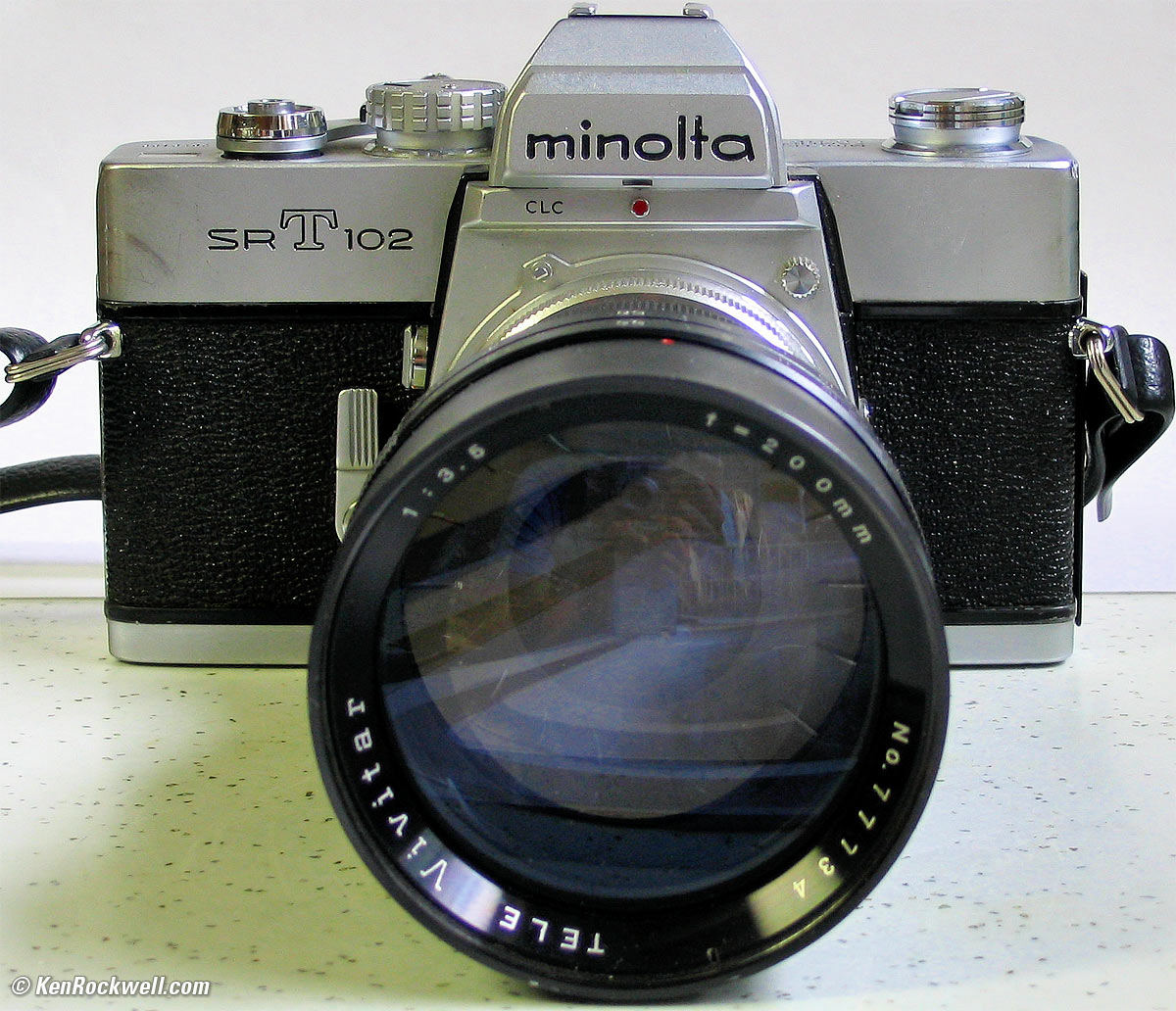
My Minolta SRT-102 with Vivitar 200 mm f/3.5 Preset T-Mount Lens. bigger.
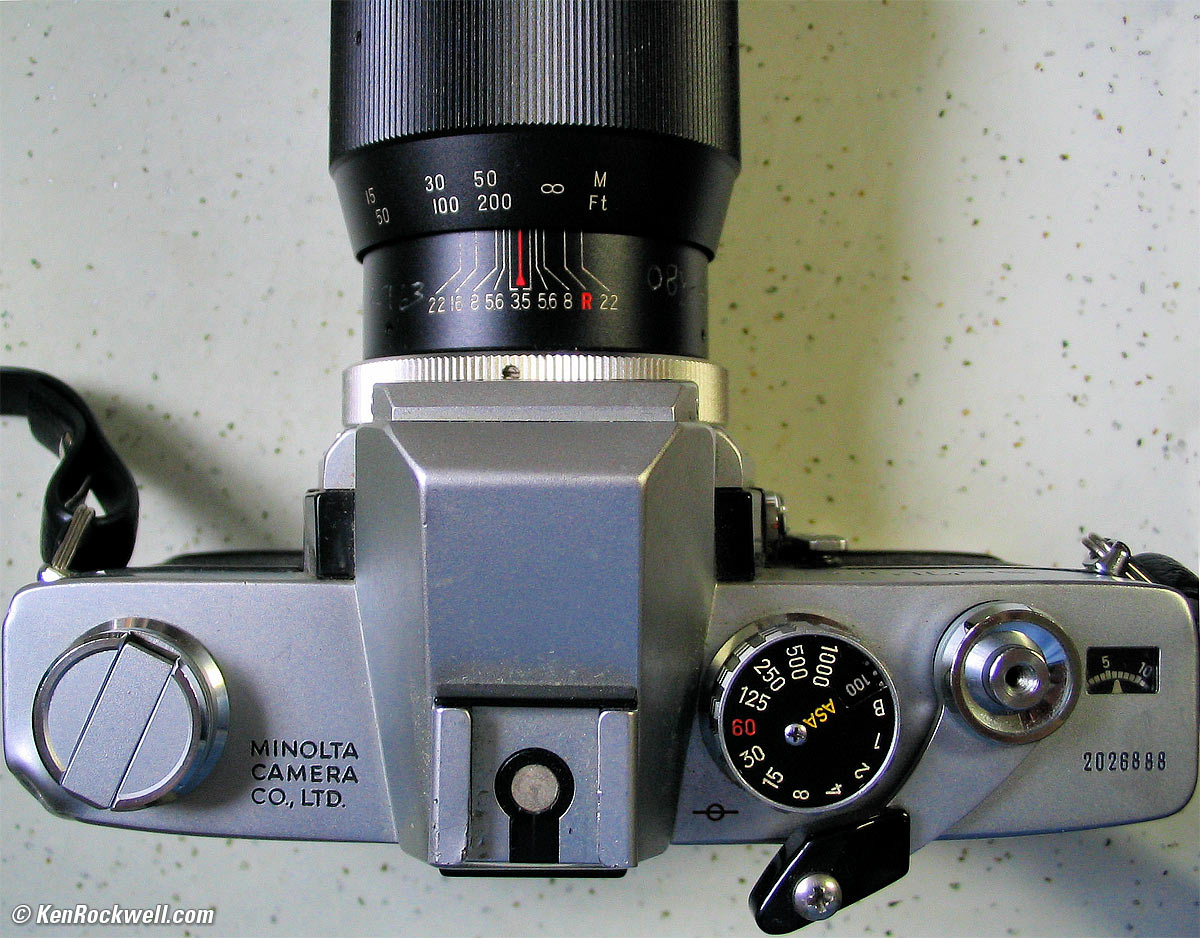
My Minolta SRT-102 with Vivitar 200 mm f/3.5 Preset T-Mount Lens. bigger.
Today I'd get it at this link directly to them at eBay (see How to Win at eBay), where they sell for about $30 each, body-only.
This free website's biggest source of support is when you use those or any of these links when you get anything, regardless of the country in which you live. It helps me keep adding to this free website when you get your things through these links — but I receive nothing for my efforts if you buy elsewhere. Please always use those or these links for the best prices and service. Thanks for helping me help you! Ken.
June 2013 Minolta Sony Zeiss Nikon Canon Fuji LEICA All Reviews

Introduction top
Intro Specs Performance Recommendations

|

I bought this used in 1974 when I was 12 years old. I still have it. It was Minolta's top-of-the-line camera in the 1970s. This was my dream camera for years before I got one.
History
I started with a Minolta SR-1. It had a clip on external meter. I then got an SR-7 which incorporated the meter into the body. It read through a separate aperture on the front of the camera. The SR-7 meter had two ranges. A button added or removed a pinhole in front of the light sensor for extreme low-light sensitivity.
Innovation
Minolta's innovation on the SR-T series was to add through-the-lens (TTL) metering. Minolta then added Contrast Light Compensation, CLC, to give correct exposure in contrasty light. CLC uses two CdS photocells in series to expose for the darker of two segments.
Model Line
The SRT-102 was the fancy model of the SRT-100 and SRT-101. The SRT-102 was my dream camera for most of my childhood. My dreams were full of wonder for its ability to display the chosen aperture through the finder and its split-image rangefinder. Unlike the common SRT-101, the SRT-102 adds an extra set of optics in front of the prism above the lens to look down on the aperture ring.
The SRT-100 only went to 1/500. The SRT-101 and SRT-102 go to 1/1000.
The SRT-102 has ground glass, microprism and split rangefinder focusing. The SRT-101 only had microprism.
The SRT-101 was the best selling camera of the Vietnam War era. Many of them survived the jungles while their owners made the ultimate sacrifice bringing freedom to the region.
Specifications top
Intro Specs Performance Recommendations
Meter and Power
TTL CdS with CLC. Match-needle in the finder. One 625 mercury cell. Battery check feature.
Today, use it with the Wein 625.
Focus
Split image rangefinder, microprism collar and matte ground glass with Fresnel.
Shutter
1 - 1/1,000 and Bulb.
Horizontal cloth focal plane. Mechanically timed. No batteries needed.
Flash Sync
1/60 X-sync.
FP sync, too.
Mirror Lock Up
Yes.
Most of today's Nikons can't do this, ha!
Lens Mount
Minolta MD and MC.
Performance top
Intro Specs Performance Recommendations
Battery Life
When it's off it's off.
I got over twenty years of use from the cell I put in in October 1983. It got fuzzy in March 2004 so I took it out — and it was still working.
Today, use it with the Wein 625 cells.
Flash
Sync was good for its day at 1/60. The traverse speed of the horizontal focal plane shutter limited this.
X sync is what we use today. FP Sync is for focal plane flashbulbs.
Metering
Metering is through-the-lens (TTL) at full aperture. Automatic diaphragm and automatic coupling of set aperture. Contrast Light Compensation (CLC) uses two CdS (Cadmium Sulfide) photo cells.
There is no automatic exposure. Automatic diaphragm means the aperture stops down the instant you press the shutter and opens up instantly afterwards.
The meter only measures to a fraction of a second at full aperture. It doesn't work for night photography the way we take for granted today.
CdS cells have lag and memory. If metering a very dark area after pointing at a bright area one needs to wait a bit for it to adapt to the darkness.
Finder
Full information.
Aperture displayed directly from the lens at the top of the finder.
Shutter speed displayed along the bottom with brackets.
Match-needle meter and battery check indication on right side of image.
Design Flaws
The plastic tip at the end of the film advance lever often falls off. This looks silly, but still works fine without the plastic tip.
Slackers wrap tape around the lever and call it a day if the tip falls off.
I fixed it the heavy metal way and slammed a stainless steel bolt through the plastic tip to keep it where I want it.
Be careful not to spin the shutter or aperture rings too quickly. The SRT-102 uses silk strands to couple these to the exposure meter needle in the finder. I spun one too fast and the silk strand came off the track. My dad, an expert precision model maker, was able to disassemble my SR-T and put it back on.
Recommendations top
Intro Specs Performance Recommendations
The best of the best mechanical Minoltas.
The SRT-200 and SRT-300 series were the same. Minolta also made some of these for other brands, like JC Penney as I recall. Certain model numbers only were sold through some outlets.
The Minolta X-700 is an electronic successor which uses the same lenses.
Help me help you top
I support my growing family through this website, as crazy as it might seem.
The biggest help is when you use any of these links when you get anything, regardless of the country in which you live. It costs you nothing, and is this site's, and thus my family's, biggest source of support. These places have the best prices and service, which is why I've used them since before this website existed. I recommend them all personally.
If you find this page as helpful as a book you might have had to buy or a workshop you may have had to take, feel free to help me continue helping everyone.
If you've gotten your gear through one of my links or helped otherwise, you're family. It's great people like you who allow me to keep adding to this site full-time. Thanks!
If you haven't helped yet, please do, and consider helping me with a gift of $5.00.
As this page is copyrighted and formally registered, it is unlawful to make copies, especially in the form of printouts for personal use. If you wish to make a printout for personal use, you are granted one-time permission only if you PayPal me $5.00 per printout or part thereof. Thank you!
Thanks for reading!
Mr. & Mrs. Ken Rockwell, Ryan and Katie.
Home Donate New Search Gallery Reviews How-To Books Links Workshops About Contact