Nikon
D3
© 2008 KenRockwell.com


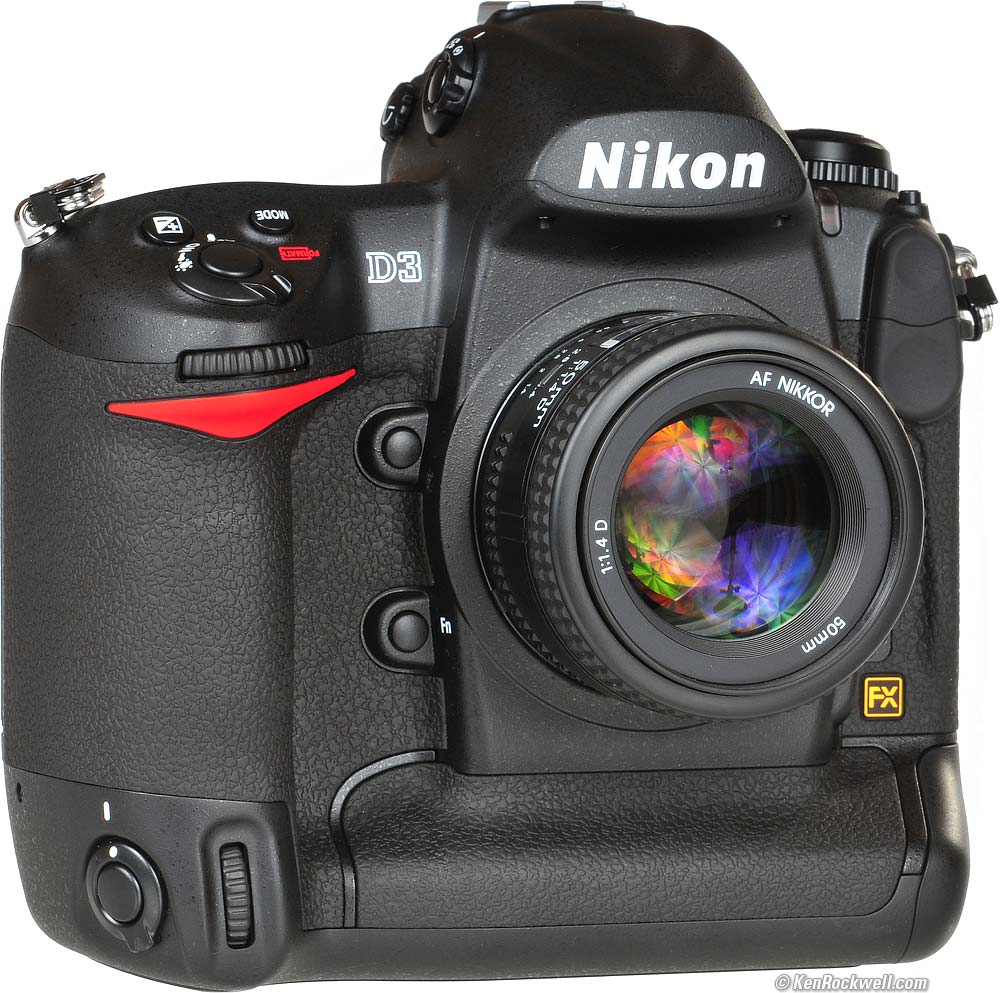
The Nikon D3 with 50mm f/1.4 AF-D. enlarge
Ritz and Adorama are taking orders now. Also keep checking here, since sometimes one might pop into stock. It helps me keep adding to this site when you get yours from these links, too, thanks! Since these will be very hard to get throughout 2007 and most of 2008, no dealer has any reason to discount them, so be very afraid of any online offers at less than $4,999.
Are you tired of the digital madness which has otherwise reasonable people blowing five grand every year and a half on the newest digital SLR? See my Free Full-Frame Digital SLR article.
NEW: I'm posting most of my up-to-the minute observations on my general What's New page, which I will eventually move onto this page.
Nikon Capture v 1.3 comments 12 January 2008
NEW: D3 Picture Control Settings 11 January 2008
NEW: How to Afford The D3 04 January 2008
NEW: Nikon D3 vs Hasselblad H3D-22 02 January 2008
NEW: Nikon D3 NEF vs. JPG Comparison 22 December 2007
NEW: Nikon D3 Lens Suggestions 11 December 2007
NEW: Nikon D3 vs Canon 5D at High ISOs 07 December 2007
NEW: Nikon D3 File Format Comparison 06 December 2007.
NEW: Preliminary Nikon D3 Sharpness Comparison 05 December 2007.
NEW: Nikon D3 High ISO Comparison 04 December 2007
NEW: Nikon's D3 Users Manual. I'm hearing that the very, very first people who ordered their D3s may start to get some of them starting December 1st.
NEW: D3 Sample Images 02 October 2007
Nikon's one-sheet printed D3 brochure.
Nikon (Japan) shares D3 example images15 September 2007
Top Intro What's New Specifications Recommendations
The Nikon D3 is a landmark introduced on August 23, 2007.
The D3 is Nikon's first full-frame DSLR to mimic the old 35mm film format, and surprise number one is that it can crank at 9 FPS. Surprise number two is that it's the same price as the D2Xs ($4,999.95), not the ridiculous $8,000 of Canon's three-day-older 1Ds Mk III.
Formats
Nikon calls the old 35mm film frame format "FX," a brilliantly terse and more accurate way to say "full frame," since "full-frame" always varied with what format of film camera you shot. The FX sensor is 23.9 x 36.0mm. The crop factor is 1.00.
The D3 can shoot in three formats. The Nikon D3 also does traditional DX (1.5 crop factor), as well as 4:5 cropped from full frame (24 x 30mm) formats. DX is the traditional format used by every other Nikon DSLR.
The Nikon D3 automatically recognizes DX lenses, masks the finder, and uses the central DX portion of the D3's sensor. Likewise, the D3 masks the finder in 4:5 mode.
The DX mode of the D3 uses only the middle part of the full-frame sensor, equivalent to the same sensor size use by every other Nikon digital camera. Gone are the puny cropped modes of the D2Xs: the cropped DX mode of the D3 simply is the standard Nikon digital size instead of full-frame.
The D3 is 12 MP in FX (full-frame) mode. It's only 5MP in DX mode, but in DX (cropped) mode it can smoke at 11 FPS if you don't need metering or autofocus from frame-to-frame. Everything works at 9FPS. This is another reason I buy only Nikon lenses: Heaven only knows if the lens that saved you $500 last year has a diaphragm that will buzz along at 11 FPS next year. As far as I know, all my crappy old used Nikkors ought to work fine at 11 FPS. I'll let you know when my D3 arrives.
AF
The Nikon D3 has 51 AF sensors, and thank God, they disappear when not active so they don't litter the viewfinder as they do on my other Nikons. Focus offset is adjustable for individual lens samples.
ISO
ISO runs from ISO 200 - 6,400, and from ISO 100 - 25,600 in trick modes.
ISO 25,600? Five-digit ISOs? My Pentax spot meters don't even go there. They stop at ISO 6,400.
Since full moonlight requires 20s @ f/2 at ISO 100, that means I can shoot the D3 at 1/12 at f/2 at ISO 25,600, which I easily can do hand-held with my 28mm f/1.4 AF.
LCD Screen
The LCD should be magnificent. It has 920,000 RGB dots or 307,200 pixels (640 x 480), more than any other digital camera except the similar Nikon D300. Every other current hot 3" and 2.5" LCD is only 320 x 240 x 3 = 230,000 dots or only 77k pixels.
The D3 appears to have no LCD cover, which is weird. Nikon mentions a tough tempered-glass LCD, but I don't know if that means the exterior of the D3 is glass. It would be cool if it was, since you could wipe it with any dirty T-shirt and it wouldn't care. We shall see.
Lenses and Flashes
See Nikon Lens Compatibility for an exact list.
The D3 is compatible with everything you own. It uses DX lenses like my favorite Nikon 18-200mm VR and 12-24mm and the SB-400, SB-600 and SB-800 flashes.
The reason to buy a D3 is to use full-frame lenses and use all of their full-frame image, not piddle around with DX.
Guess what: full frame lenses are every Nikon AF lens made since 1985! Go pull out that perfectly good 50mm f/1.8 AF you almost chucked (I just got one from a local classified ad for $40), and it works flawlessly on the D3! From my experience with my full-frame Canon 5D, a twenty year old bargain lens like my $100 used Canon 70-210mm consumer zoom gives wonderful images on full frame, better than anything I've seen technically from any lens on a DX Nikon camera.
Even better, the D3 works great, if you're willing to focus manually, with every manual focus lens made since 1977, and since 1959 if you're willing to have some machine shop work done. If you're a cheapskate, you could use all the old giveaway manual focus lenses I've been collecting and try to save enough to buy a D3. For instance, I just bought a beater 300mm f/2.8 ED-IF for $400 locally. I'm not good enough to track action with manual focus, but for landscapes like moonlight on the ocean, my 30-year-old 300mm just saved me $4,500 over a new 300mm f/2.8 VR. (Yes, the D200 and D300 do the same thing, but since I'm a wide-angle junkie, a 20mm f/3.5 AI-s on a D200 doesn't do anything for me, while on a D3, it's ultra-wide.)
I'm not kidding: even though I will get the new 14-24mm ultra ultrawide zoom because I want one, you could earn a living for years with nothing other than an inexpensive Nikon AF 18-35mm and old 1985 Nikon 70-210mm f/4 AF. Tell your wife you'll use nothing other than a few old manual focus throw-aways, and she'll insist you buy a D3 today with all the money you'll save on lenses.
With full-frame, we longer need to let Nikon rip us off with puny and overpriced DX lenses. I still feel ripped off paying almost as much for my beloved, but puny, 12-24mm DX as I paid for my masterpiece 17-35mm f/2.8 AFS because in 2003 the 12-24mm was the only game in town for DX cameras.
The good news is that old-timers still in their caves need to buy no new lenses, but the bad news is that there is no lens on earth that can do what the Nikon 18-200mm VR does in full-frame. (Nikon's life-changing 18-200mm VR only works in DX format.) Canon makes a 28 - 300mm IS, which would replace it on Canon, except that the Canon 28-300mm costs $2,200 and weighs four pounds.
Better still is that since only a few rich guys can afford the D3, and that they'll be buying expensive new lenses for it, the used market for old film lenses won't be affected by the D3. Cheap rich guys (and pros) will have a field day. I'm stoked.
One thing you may want to hoard is a 17-35mm f/2.8 AF-s. This is the wide lens to get for the D3, more useful of course than the insane new 14-24mm. When the D3 hits the hands of pros, there will be a run on the 17-35mm and I'll bet you the price goes up and availability drops. If you want to listen to me as I told everyone about the 18-200mm in 2005, now is the time to get your 17-35mm. The tele of choice is today's 70-200mm VR, but that is already a very popular lens with DX cameras, and pros already have these, so I see no problems. It's just that the 17-35 AFS was a clumsy choice for DX digital and they fell into disuse these past few years. Get the 17-35mm while you can, like now, before the D3 hits.
Your 35mm and 28mm PC (shift) lenses ought to work fine, so long as they are new enough to work properly on other modern cameras. Some 1960s era PC lenses had issues with clearances with the cameras newer than 1976.
Do it.
If you ordered your D3 back in August as I did, you'd have gotten it back in 2007 as I did.
If you're still waiting to order, the backlog is far deeper today. As I predicted in August 2007, the D3 is be one of those Nikon products, like the 18-200mm VR, that is more popular than Nikon's ability to manufacture it.
Top Intro What's New Specifications Recommendations
Full-frame, 9 FPS and matrix metering with manual focus lenses is enough for me to order one, but let's see what else is cooking.
The D3 and D300 have many features in common, so you'll see many similarities below.
Live View Mode
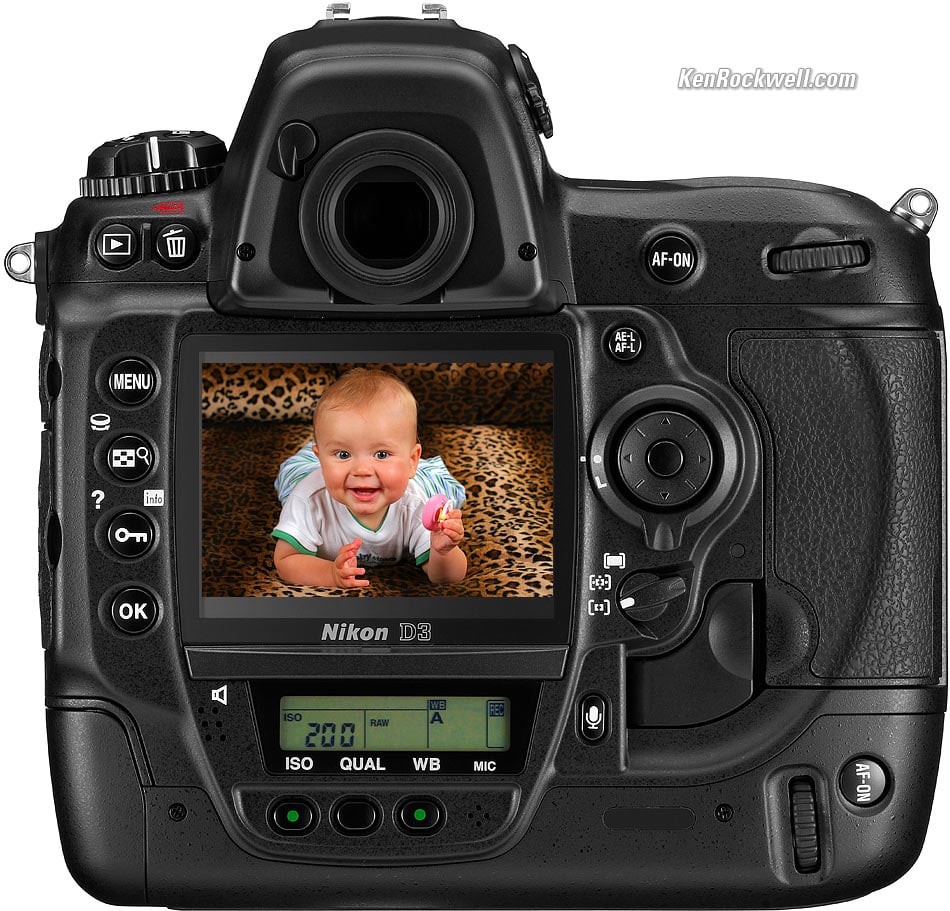
Nikon D3. (fake photo from my Canon 5D) enlarge
The D3's Live View system appears identical to the D300's.
Nikon has outdone Canon at Live View because Nikon's AF system works two different ways while in Live View, while Canon's does not work at all. Canon requires you use a custom function and press a button to flip up the mirror and interrupt Live View to do a spot AF setting, while the Nikon D3's AF system works while in Live View. The Canon system has to take the camera out of Live View for a moment to autofocus.
I'll opine that the D3's AF mirror remains in place while the viewing mirror gets out of the way. If this is the case, that means that the AF mirror still needs to flip out of the way when you shoot in Live View with the D3.
But wait - it gets better! The D3 also can do live view with both mirrors out of the way, as does the autofocusless Canon 40D, but the Nikon, unlike the 40D, is smart enough to do AF using the image directly from the image sensor, like a point and shoot, which Canon can't do.
You may select the on-screen area on which to focus, too.
High-Defintion 267 PPI 3" LCD
The D3 has an insanely good new LCD. Even if the D3 sucked, I'd get it (or the D300) just for the LCD.
The LCD has 920,000 dots (640 x 480 x 3 [RGB]), more than the D40, D40x, D80, D200, or the Canon Rebel XTi, Canon 40D, $4,500 Canon 1D Mk III or $8,000 Canon 1Ds Mk III.
This means there is twice the linear resolution compared to the 3" LCDs of Canon. The D300's LCD has 640 x 480 pixels. All the other 2.5" and 3" LCDs out there are only 230,000 dots, or about 320 x 240 pixels. I'll wait and see.
I'll gamble that the Nikon D3 LCD screen looks worlds better than anything else from Canon or Nikon (other than the Nikon D300 with the same screen), just as the screen on my $500 Nikon D40 looks worlds better than the comparatively awful screen of my beloved $2,500 Canon 5D.
Your computer screen is 100 pixels per inch, usually called DPI. The complete photo of the camera above is only 600 pixels wide, so it probably measures about 6 inches (15cm) on your screen. The baby image I Photoshopped onto the screen is only is 247 pixels wide. The enlarged version is 950 pixels wide, and the baby's frame is still only 347 pixels wide, half the horizontal resolution of the D3's LCD.
The 3" diagonal 640h x 480v pixel screen of the Nikon D3 calculates out to 267 pixels per inch, which is almost the same as a photo print (300 DPI). The LCD on the D3 will have seven times as many pixels in any unit area as your computer, so the example photo above can't possibly do the D3 justice.
For example, the D3's LCD has enough resolution to show every individual pixel of the complete image of the camera above, reduced to fit on the D3's screen, and still have pixels left over! That's sharp!
The D3's LCD is so good that for the first time it might make sense to hold a loupe to it.
Dual CF Card Slots Top
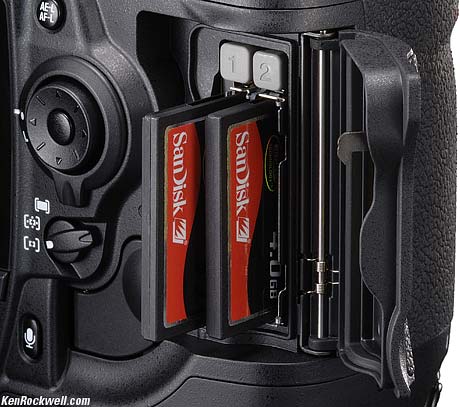
Nikon D3 Dual CF Card Slots.
Two CF card slots for consecutive (overflow) or simultaneous (backup) recording. You can send different formats to each card, or copy between them.
Digital Level Top
There's a digital level sensor to help us align our cameras for straight horizons!
It indicates a virtual horizon in the viewfinder, and either on the the top LCD (per Nikon Japan) or rear LCD (per Nikon USA).
Styled by Giugiaro Top
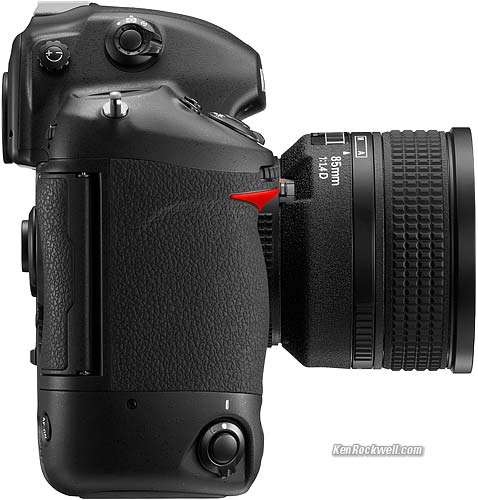
Nikon D3 - ciao bella!
Look at this work of art. Does Nikon even need to say "Giugiaro?" The genius is obvious. I want to pick it up and start feeling it all over.
In case you've been dead for the past several decades, Giorgetto Giugiaro also has designed Ferraris and loads of other beautiful things.
You could pay a whole lot more for a piece of sculpture much less functional than a D3. Brava Italia!
Autofocus Fine-Tuning Top
Different samples of lenses and cameras will have very slight variations which lead to slight errors in AF.
Personally I've hand-picked every lens to ensure it works well with the cameras I own, film and digital, SLR and rangefinder, for the past couple of decades.
Canon did something clever last year in the Canon 1D Mk III, and now on the D3 you also can tweak slight offset errors in the AF system for each individual lens.
There is memory for 20 lenses. I don't know if it's smart enough to track as you zoom, of if you must use one of the 20 memory spaces for each focal length of a zoom which you would like to calibrate. Focus offsets vary wildly with zoom setting, so you have to characterize zooms at several settings.
As of 24 September 2007, my sources tell me that each of the 20 memory spots are per lens, but is only one setting per lens meaning that the D3 isn't smart enough to have different offsets at different ends of the zoom range. I'll wait and see, and even if this feature sucks, it's still better than any other Nikon available as of September 2007, none of which have any of this feature.
Top LCD Top
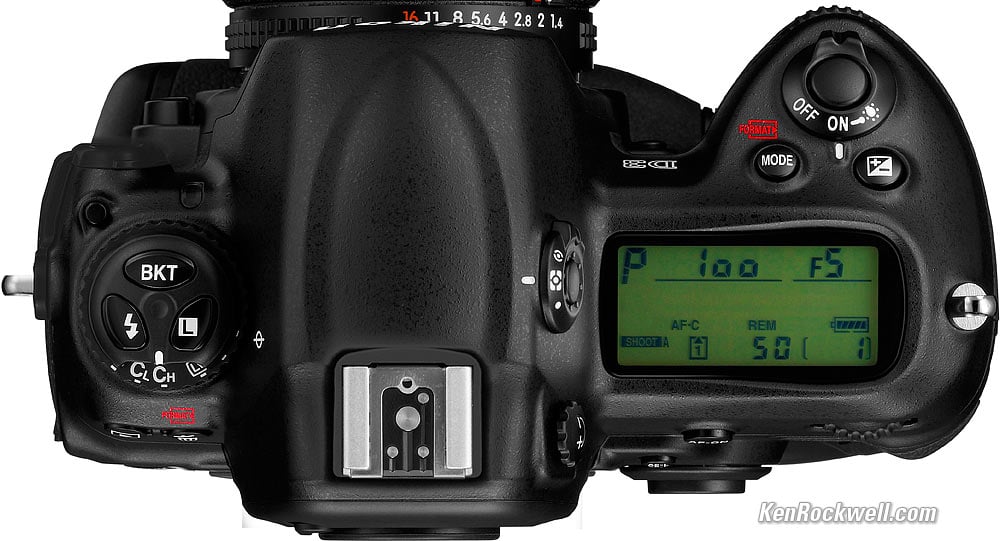
Nikon D3. enlarge
Not new is that I hate top LCDs. They are a throwback to mechanical film cameras when the controls had to go on top there because the film ran along the back.
Unless I'm shooting from waist level (which I don't), it's stupid to have to flip the camera to see the settings.
Thank goodness there is an INFO button on the rear of the D3, which is copied from my D40, which puts the information from the top LCD on the rear LCD where I can see it!
More Function Button Assignability Top
I LOVE the Nikon Function buttons. I wish I had several of them on each of my cameras.
The Nikon D3 now allows us to assign these features to the depth-of-field preview button and the AE-AF Lock button if we wish. Whoo hoo!
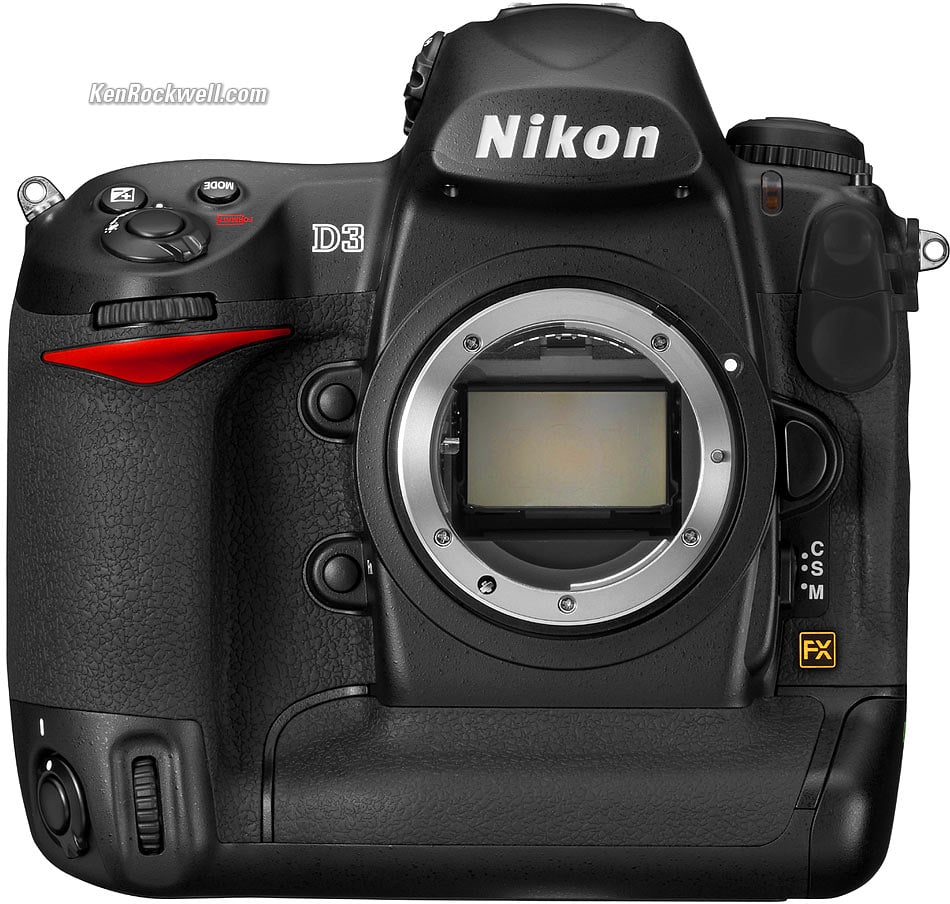
Nikon D3. enlarge.
Recordable Color and Contrast Settings Top
This appears identical to the Nikon D300.
Nikon uses the cryptic phrase "Picture Control System" to refer to the saturation and contrast adjustments. This keeps it as confusing as Canon's similar "Picture Styles" and "Parameters," which do the same thing.
Nikon claims that different model cameras set to the same settings will look the same, a great advantage for those of use with different cameras.
Canon has had a significant advantage because Canons have had a broader range of adjustments, so I can crank up my colors more vividly on my Canons than I can on my Nikons. Of course Nikon's narrower range of adjustments make it almost impossible to destroy your images by using the wrong settings, as I can do on my Canons.
My Nikons set to their maximum saturation (Color Mode IIIa and + Saturation in Optimize Image > Custom) are about equal to my Canons set at +2 saturation. My latest Canons go to +4 for saturation.
I'm unsure of the D3's performance here; it may be the same, but hopefully it's been expanded.
What has been expanded is a feature that's been in Casio point-and-shoots: the ability to store these settings and save, export and import them to and from cameras and users.
The Nikon D3 can customize and store up to nine sets of these, and export up to 99 to a CF card. Cooler still is that these settings can be shared with other new Nikon cameras, like the Nikon D300, after you've saved them.
Scene Recognition System Top
The Scene Recognition System appears identical to the Nikon D300.
Nikon has used a unique 1,005-pixel RGB sensor for light meters in its top cameras since the Nikon F5 of 1998. Today this sensor's rough image is interpreted by the D3's computer to try to figure out what you are photographing, and based on this knowledge, adjust not only the exposure, but now also adjust the AF and white balance.
Proper exposure has always been predicated on knowing what you're photographing, and how then you want it to look. For instance, dark things need to be left dark, and light things need to be left bright. A brilliant orange dot in the frame might be the disc of the sun, or might be an orange. You need to know which to expose correctly. The 1,005 pixel sensor feeds its data to the computer, the computer makes a good guess about the subject, and then calculates the exposure. This is similar to the way our eyes see. Our eyes see little; they merely fed data to our brains in which all seeing occurs.
For example, 3D AF tracking locates a moving subject and automatically shifts AF points to track it. This system also tells the exposure computer the subject's location in the frame so it can be weighted accordingly. By knowing the distance, it's another way the computer can guess if it's the sun or an orange.
Like our eyes and brain, this system is far more than its hardware. What will make the Nikon D3 wonderful (or not) is how much genius and wisdom has been programmed into it by its creators.
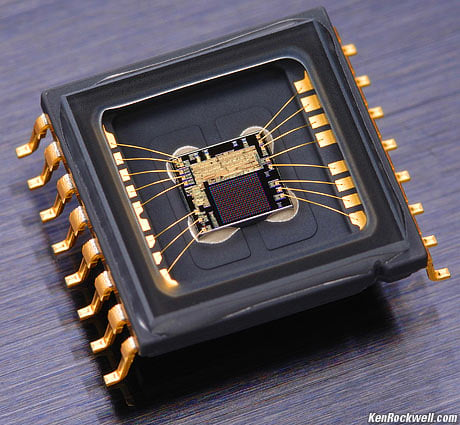
Nikon 1,005 Pixel RGB Sensor.
As-You-Shoot Dynamic Range Manipulation Top
Nikon calls this "Active D-Lighting." It appears identical to the system in the Nikon D300.
Nikon has had D-Lighting (not active) in other cameras. It's the same as Photoshop's Shadow/Highlight filter. It lightens shadows, and usually looks pretty bad doing it.
In other cameras, like my D40 and D80, you piddle with this in-camera after you've shot. The examples I see in my other Nikons look bad because the camera is doing a very unsharp mask of the dark areas and lighting them, but the very unsharp mask leaves dark rings around the dark areas, and the lightening makes the areas lighter, but doesn't bump up their local contrast as it should. I get much, much better results using DxO afterwards instead.
Active D-Lighting is new for the Nikon D3.
Active D-Lighting lets you select this trick before you shoot. No big deal, in fact, these filters usually look so bad and obvious in previous cameras (they use very large filtering radii so they often leave dark rings around the lightened areas) that this feature may permanently ruin many of your images, if Nikon hasn't updated the algorithms from the D40 and D80. Use with care!!!
Hopefully Nikon has fine-tuned this so it works subtly and well. I fear that my readers, too many of whom worry too much about the gear and software and not enough about lighting the subject properly in the first place, could start making crappy images that scream that they were made this way. Look at most real estate listings and you'll see lots of overuse of Photoshop's Shadow/Highlight filter at it's ugly 50% default. I hope that Nikon has gone easy on this and that it won't screw up images when left on.
If it works well, then it's brilliant and will make real images in the real world that will be far better than Canon, whose cameras still haven't figured out auto contrast, as Nikons have done for 8 years. Auto contrast, the default in Nikon's cryptic "Tone Curves," lets Nikon cameras adapt automatically to changing contrast as our eyes do.
I hope this works great, and you can tell I'm still skeptical based on the crappy D-Lighting in my D40 and D80.
HDMI Video Output Top
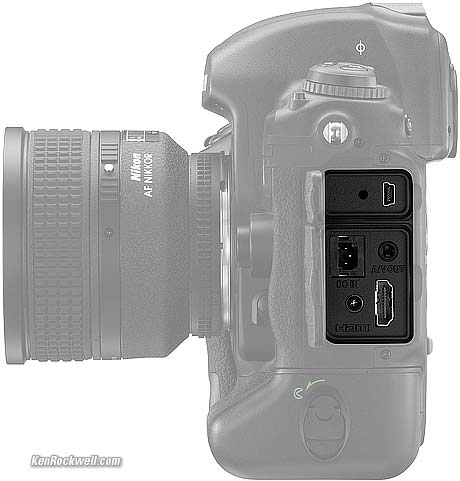
Nikon D3 Video, Data and Power Inputs and Outputs.
The Nikon D3 has a traditional analog NTSC and PAL video output. The D3's monitor works at the same time you use the analog output, but of course the analog video output looks crappy.
It also has a digital HDTV HDMI output, which plugs into most modern flat panel TVs and HDTVs. The only catch is that the D3's monitor goes blank when you use the HDMI output.
"EXPEED – Nikon’s image processing concept embodied." What? Top
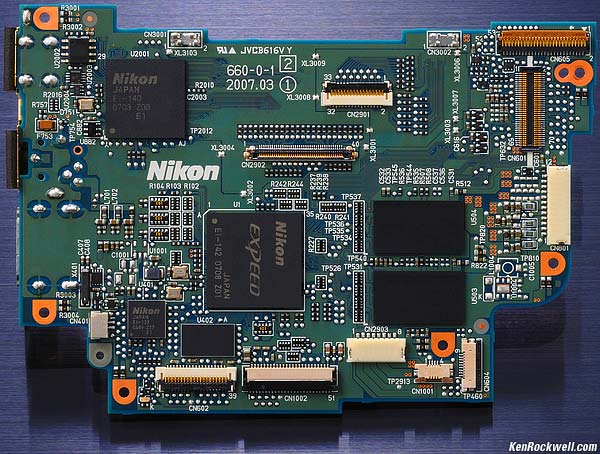
Nikon D3 Printed Circuit Board.
"EXPEED – Nikon’s image processing concept embodied" is marketing fluff. It's Nikon's fluff for the fact that the insides of their digital cameras contain signal processing, as every digital camera and CD player has for decades. It's like Canon's DIGIC: meaningless to users.
Call me immature, but who peed? EXPEED. Hee hee. DSP is important, but even Nikon hasn't figured out a brilliant phrase to communicate it as they have in "FX" and "Matrix."
(The Nikon D3 specifications have now grown into their own page)
Top Intro What's New Specifications Recommendations
Top Intro Specifications Recommendations
I ordered one for myself. Need I say more? I also want one of the 14-24mm zooms as soon as someone will take my money. I couldn't care less about the D300 personally since I already own a D200, but ordered one because most of you folks are going to want to know all about it (It's got a killer LCD screen!). Personally, I prefer full frame.
I've been a full-frame convert since I got my Canon 5D. Jamming more pixels into a small DX sensor hasn't made much sense since we hit 6MP in DX, so I've been petitioning for full-frame for any camera over 6 MP.
I'm also an ultra-wide junkie. Finally I can get ultra-ultra-wide views with Nikon digital, which we have never been able to do. The widest lens until now had been the 12-24mm DX, which is only ultra-wide, similar to an 18-35mm on 35mm film. I used to have no way to get the equivalent of a 14mm lens on 35mm film.
OK, I still can't do this until November, but you get the idea.
The D3 saves money. I almost thought I might want to get a Canon 1Ds Mk III.
12MP vs 21 MP is usually meaningless. Above 12 MP on full frame, like above 6MP on DX, most of the pixels will be showing lens and technique flaws rather than more sharpness.
The D3 has 4,256 horizontal pixels while the 1Ds Mk III has 5,616. That's 32% more, which, presuming one has perfect optics, is starting to become visible in large prints of 20 x 30" (60 x 80 cm) and larger. It's not a night and day difference, or even visible at small sizes like 13 x 19" (30 x 50 cm).
If I want 22 MP and had $8,000 to spend, I'd be looking at the Mamiya ZD medium format back at the same time as the 1Ds Mk III. Its the same price, but a much larger format.
Call me a sucker for beauty, as all photographers should be, but I think half of why I want a D3 isn't logic or the photos I could make with it, but simply because it is so beautiful. It makes me want to have and to hold it.
PLUG
If you find this as helpful as a book you might have had to buy or a workshop you may have had to take, feel free to help me continue helping everyone.
Thanks for reading!
Ken
Home Search Gallery How-To Books Links Workshops About Contact