Nikon 120-300mm f/2.8 TC VR
Built-in 1.4× teleconverter and Fluorite (2026 ~ today)
Introduction New Good Bad Missing
Specifications Performance Recommendations
Z9 Z8 Z7 II Z6 III Z6 II Z5 II Z5 IIC Zƒ Z7 Z6 Z5
DX (APS-C): Zƒc Z50 II Z50 Z30
Z System Z Lenses All Nikon Lenses Flash
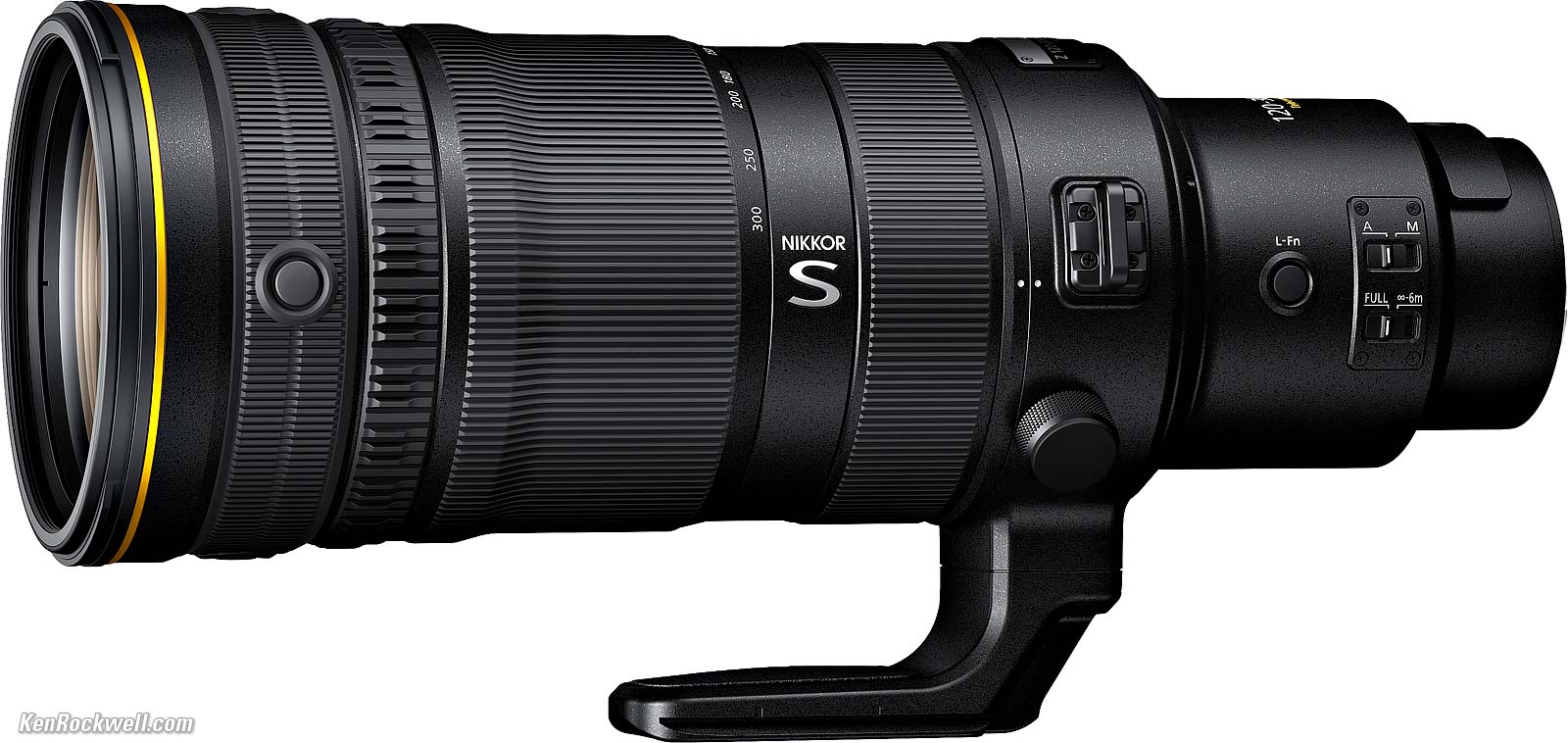
Nikon Z 120-300mm f/2.8 TC VR (122 × 1.0mm front filters and 46 × 0.75mm rear drop-in filters, 96.5 oz./2,735g, 3.2-6.6'/1-2m close focus, 0.25× macro ratio, $13,997). bigger.
I'd get mine at B&H or at Adorama, or get it used at eBay (How to Win at eBay), or get it used at KEH.
My junk-free, all-content website's biggest source of support is when you use those or any of these links to the places I use myself when you get anything, and it costs nothing more. I've bought from these places for over 100 combined years because they have the best service, the best selection, the best prices, and usually 100% cash-back returns for at least 30 days if you don't love your new goodies. As an Amazon Associate and eBay Partner Network Affiliate, I earn from qualifying purchases. Thanks! Ken.
October 2026 Better Pictures Nikon Z Z Lenses All Nikon Lenses All Nikon All Reviews

Introduction top
Introduction New Good Bad Missing
Specifications Performance Recommendations
|

I buy only from these approved sources. I can't vouch for ads below. |



This is a fast, huge, expensive six-pound (2¾ kg) telephoto ideal for sports, action and wildlife.
New is an internal, switchable 1.4× teleconverter. Flip the lever on the right side of the lens without taking your eye off your subject and this becomes a 168-420mm f/4 VR. Bravo!
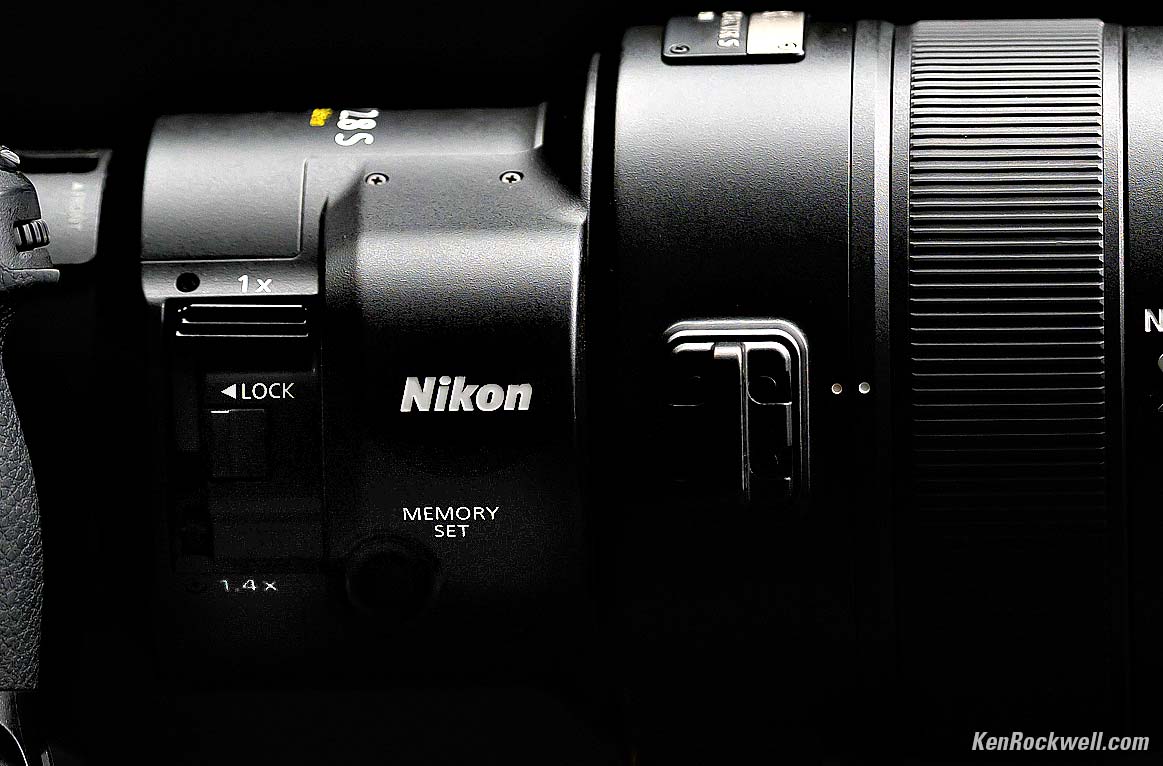
Nikon Z 120-300mm f/2.8 TC VR. bigger.
We get a serious lens for our $13,997: one of the three huge front elements is exotic Fluorite to give sharpness as good as Canon's Fluorite telephotos, and a second huge front element is made of Super ED glass. Less expensive lenses get lazy and only use these expensive materials for the smaller internal elements, while this beast puts these exotic materials big and up front where they can do the most good.
I'd get my Z 120-300mm f/2.8 VR TC at B&H or at Adorama, or get it used at eBay (How to Win at eBay), or get it used at KEH.
New intro top
 World's first f/2.8 lens with a built-in teleconverter. So? There are longer lenses with these: Nikon has had an AF-S 180-400mm f/4E VR FL TC since 2018 which now sells for half the price which works great on the FTZ/2 , and Canon has had an EF 200-400mm f/4 L IS with an internal 1.4× teleconverter since 2013.
1.1 pounds (515g) lighter than 2020's AF-S 120-300mm f/2.8 VR.
Good intro top
 Superb optics.
Native Arca-Swiss compatible foot. Nikon suggests manning-up to real screw-type Arca clamps, not whimpy lever clamps.
Uses 122 × 1.0mm front filters and 46 × 0.75mm rear drop-in filters.
Focus lock buttons.
AF/MF switch.
Padded Case & hood included.
Image Stabilization claims 6.5 stops improvement.
Lots of weather sealing: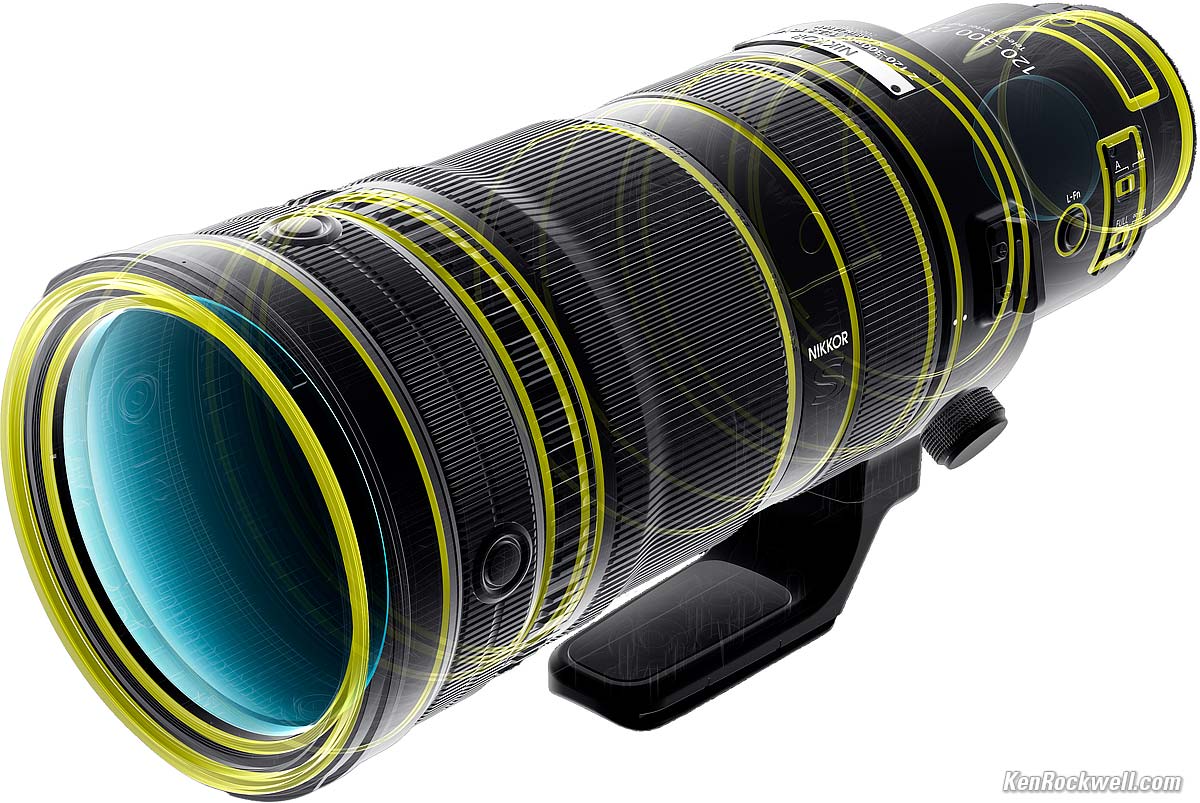
Nikon Z 120-300mm f/2.8 TC VR. bigger.
Bad intro top
 Big and heavy.
I see no VR switch, but I may have missed it.
Missing intro top
 I see no VR switch, but I may have missed it.
I see no preset focus memory button as on the AF-S 120-300mm f/2.8 VR, but this may be settable in camera menus.
Mounting index dot not raised so it can't be found by feel in the dark.
Mounting index dot is the same white as everything else, so it doesn't stand out when you need to find it to mount your lens.
No aperture ring.
No focus or depth-of-field scales.
No infra-red focus indices.
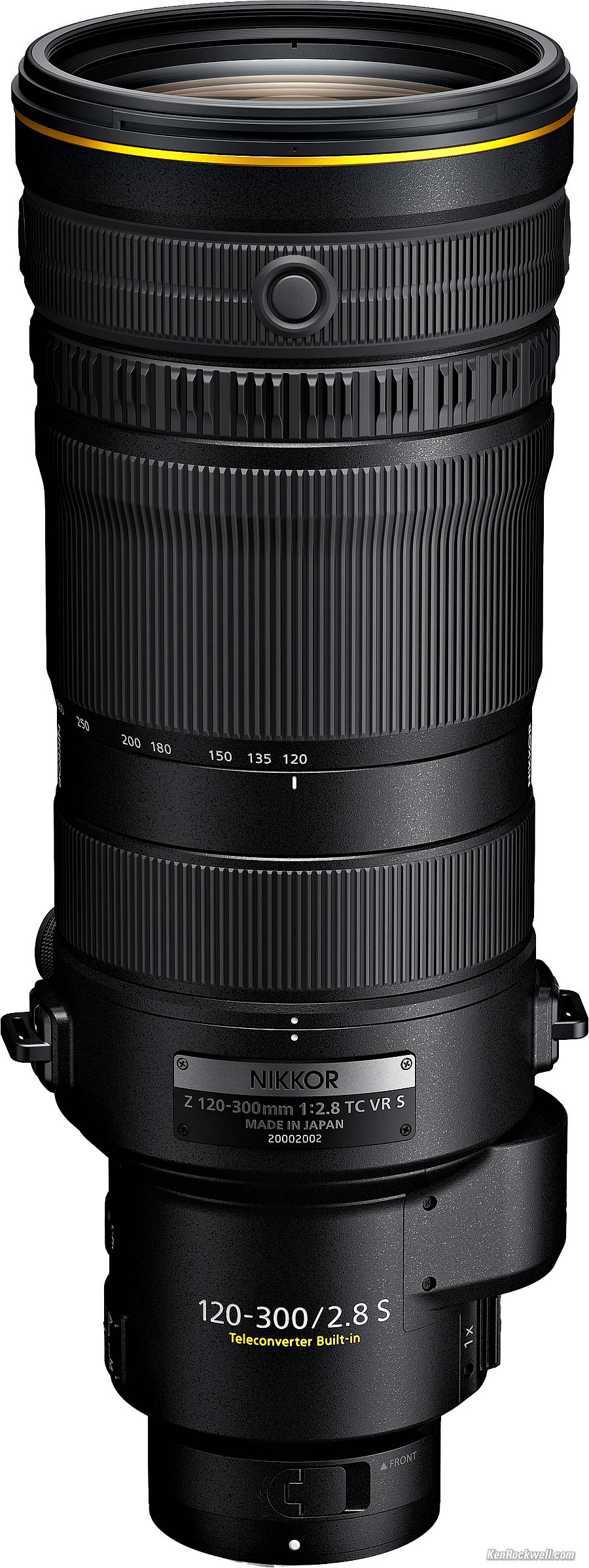
Nikon Z 120-300mm f/2.8 TC VR. bigger.
Specifications top
Introduction New Good Bad Missing
Specifications Performance Recommendations
I'd get my Z 120-300mm f/2.8 VR TC at B&H or at Adorama, or get it used at eBay (How to Win at eBay), or get it used at KEH.
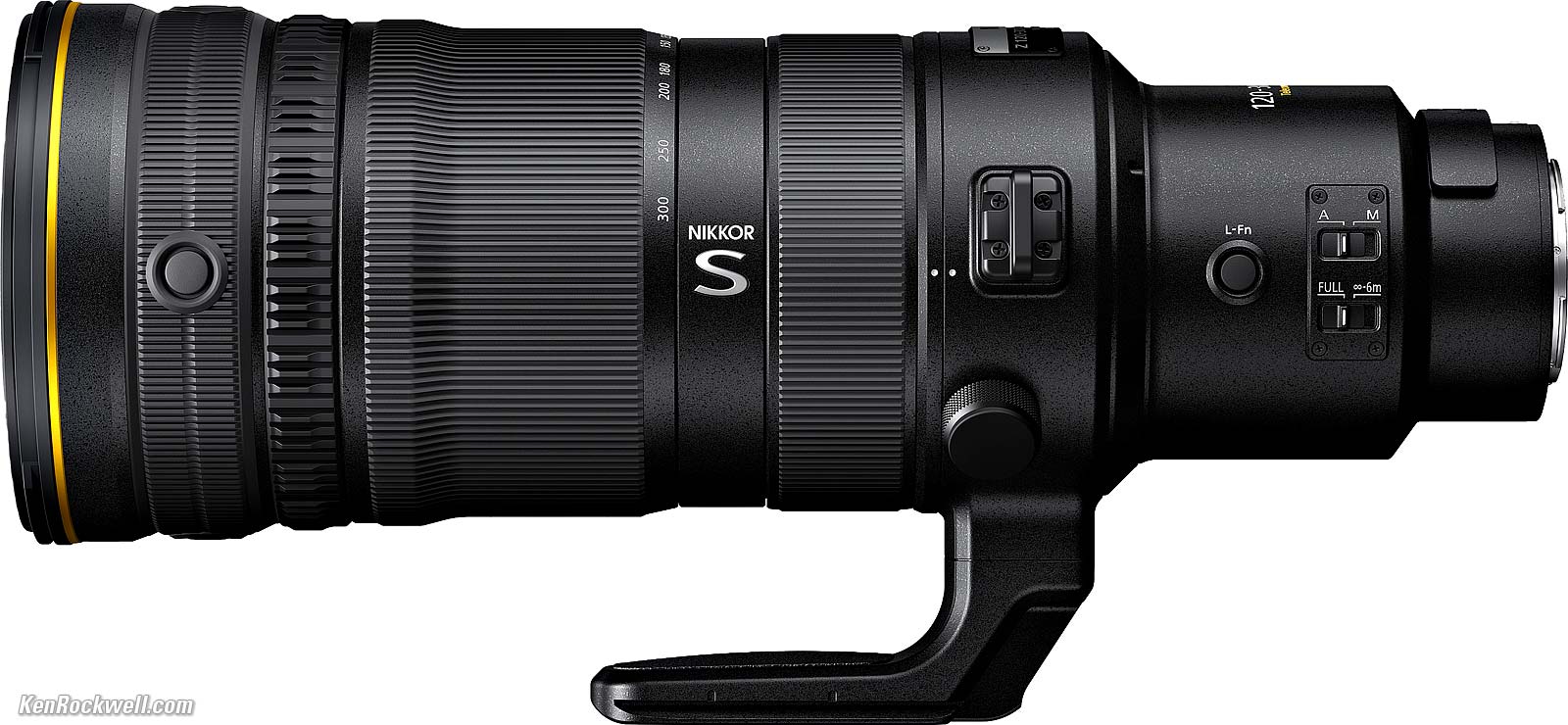
Nikon Z 120-300mm f/2.8 TC VR. bigger.
Name specifications top
Nikon calls this the NIKKOR Z 120-300mm f/2.8 TC VR S:
NIKKOR: Nikon's brand name for almost all their lenses since 1932.
Z: For Nikon's mirrorless cameras, only.
TC: Built-in switchable 1.4× teleconverter, which makes this a 168-420mm f/4 VR.
VR: Vibration Reduction (Image Stabilization).
S: Subliminally suggests sexual satisfaction. The "S" designation has no other purpose than subliminal seduction; Nikon and electronics and automobile and every kind of marketer have been using letters like "S" and "X" in model numbers since the 1940s for this same reason. Nikon called their first 1946 rangefinder lens mount the "S" mount, then went whole-hog to the "F" SLR mount in 1959, used "S" again when they updated their AI lenses to AI‑S in 1983, then they created AF‑S lenses in 1998, and here it is again.
Nikon's Model Number: 20135.
It also has:
ARNEO Coat: Magic anti-reflection coating that's especially good for use in high-speed lenses.
Aspherical: Specially curved glass elements for sharper pictures.
ED: Magic Extra-low Dispersion glass for reduced secondary chromatic aberration.
G: Gelded; has no aperture ring.
IF: Internal focusing; nothing moves externally as focused.
FL: Fluorite element(s) for sharper images in telephoto lenses.
M: Meso Amorphous Coat, Nikon's newest and most advanced antireflection coating, better than any of Super Integrated Multicoating, Nano or ARNEO coatings.
SIC: Nikon Super Integrated multiCoating.
SSVCM: Silky Swift Voice Coil (focus) Motor.
SR: Short-wavelength Refractive, a new optical material that helps reduce spherochromatism.
Super ED: Super Magic Extra-low Dispersion glass for super-reduced secondary chromatic aberration.
Ø122: 122 × 1.0mm front filter thread and 46 × 0.75mm rear drop-in filter holder.
Optics specifications top
Without Teleconverter
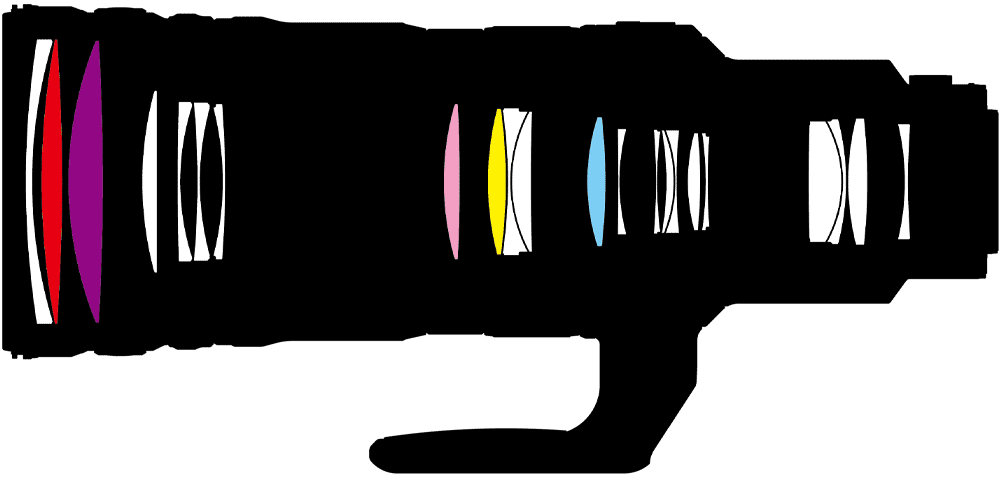
Z 120-300mm f/2.8 TC VR Internal Optical Construction: Super ED, Fluorite, Short-Wavelength Refractive (SR), ED and Aspherical elements. más grande.
With Teleconverter
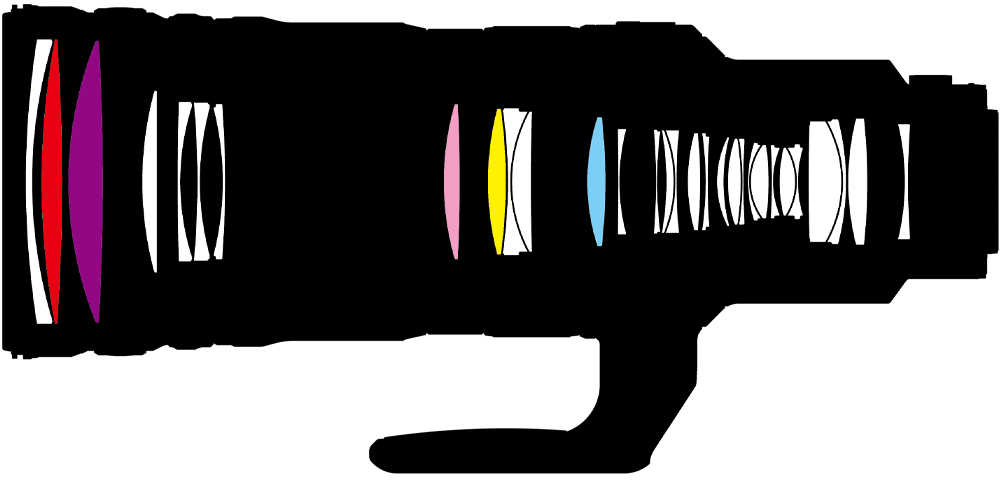
Z 120-300mm f/2.8 TC VR Internal Optical Construction: Super ED, Fluorite, Short-Wavelength Refractive (SR), ED and Aspherical elements. más grande.
22 elements in 19 groups.
Teleconverter: 8 elements in 5 groups, for a total of 30 (!) elements in 24 (!) groups.
1 Fluorite element for extreme sharpness.
1 ED element: magic Extra-low Dispersion glass for reduced axial secondary chromatic aberration.
1 Super ED element, which is even better than an ED element.
1 SR "Short-wavelength Refractive" element refracts blue light much more strongly than other colors to reduce spherochromatism.
1Aspherical element.
Nikon Super Integrated multiCoating (SIC).
Meso Amorphous Coat, Nikon's newest and most advanced antireflection coating, better than any of Super Integrated Multicoating, Nano or ARNEO coatings.
Fluorine front coating to resist dirt and smudges.
It zooms and focuses internally. Nothing moves externally, except for the control rings.
Diaphragm specifications top
9 rounded blades.
Electronically actuated.
Stops down to f/22 (f/32 with 1.4× teleconverter).
Filters specifications top
Takes 122 × 1.0mm front filters and 46 × 0.75mm rear drop-in filters.
Focal Lengths specifications top
120-300mm, or 168-420 mm with the internal 1.4× teleconverter engaged.
When used on a DX camera, it sees the same angles of view as a 180-450 mm lens sees when used on an FX or 35mm camera, or with the internal 1.4× teleconverter engaged sees the same angles of view as a 250-630mm lens sees on full frame.
See also Crop Factor.
Diagonal Angles of View specifications top
On Full-Frame FX
20⅓º ~ 8⅙º
14⅔º ~ 5⅚º with 1.4× teleconverter.
On DX
13⅓º ~ 5⅓º
9⅔º ~ 3⅚º with 1.4× teleconverter.
Autofocus specifications top
No external movement as focussed, so no air or dust is sucked in.
Focus Scale specifications top
No.
Not on lens, but may be displayed in-camera.
Infinity Focus Stop specifications top
No.
You have to focus somehow to get precise focus at infinity, just like at every other distance.
Depth of Field Scale specifications top
No.
Not on lens, but may be displayed in-camera.
Infrared Focus Index specifications top
No.
Close Focus (distance from subject to image plane) specifications top
It's the same with or without the 1.4× teleconverter:
Feet |
Meters |
|
120mm |
3.22' |
0.98m |
135mm |
3.25' |
0.99m |
150mm |
3.38' |
1.03m |
180mm |
3.97' |
1.21m |
200mm |
4.53' |
1.38m |
250mm |
5.91' |
1.8m |
300mm |
6.57' |
2m |
Maximum Reproduction Ratio specifications top
1:5.6 (0.18×) at 150mm.
1:4.0 (0.25×) with the 1.4× teleconverter when set to 150mm (210mm effective focal length).
Reproduction Ratio Scale specifications top
No.
Not on lens, but may be displayed in-camera.
Image Stabilizer specifications top
Rated 6.5 stops improvement.
Caps specifications top
Hood specifications top
HB-120 Lens Hood, included.
Case specifications top
Nice CL-L3 Padded Nylon Case, same as included with Z 400mm f/2.8 TC VR and Z 800mm f/6.3 VR, included.
Size specifications top
5.04" ø maximum diameter × 13.92" extension from flange.
128 mm ø maximum diameter × 353.5 mm extension from flange.
Weight specifications top
96.5 oz. (2,735 g).
Announced specifications top
12:01 AM, Thursday, 29 October 2026.
(Vaporware announcement was many months earlier.)
Promised for specifications top
12 November 2026.
Included specifications top
CL-L3 Padded Nylon Case, same as included with Z 400mm f/2.8 TC VR and Z 800mm f/6.3 VR.
Price, U. S. A. specifications top
October 2026 (Introduction)
$13,997 at B&H and at Adorama.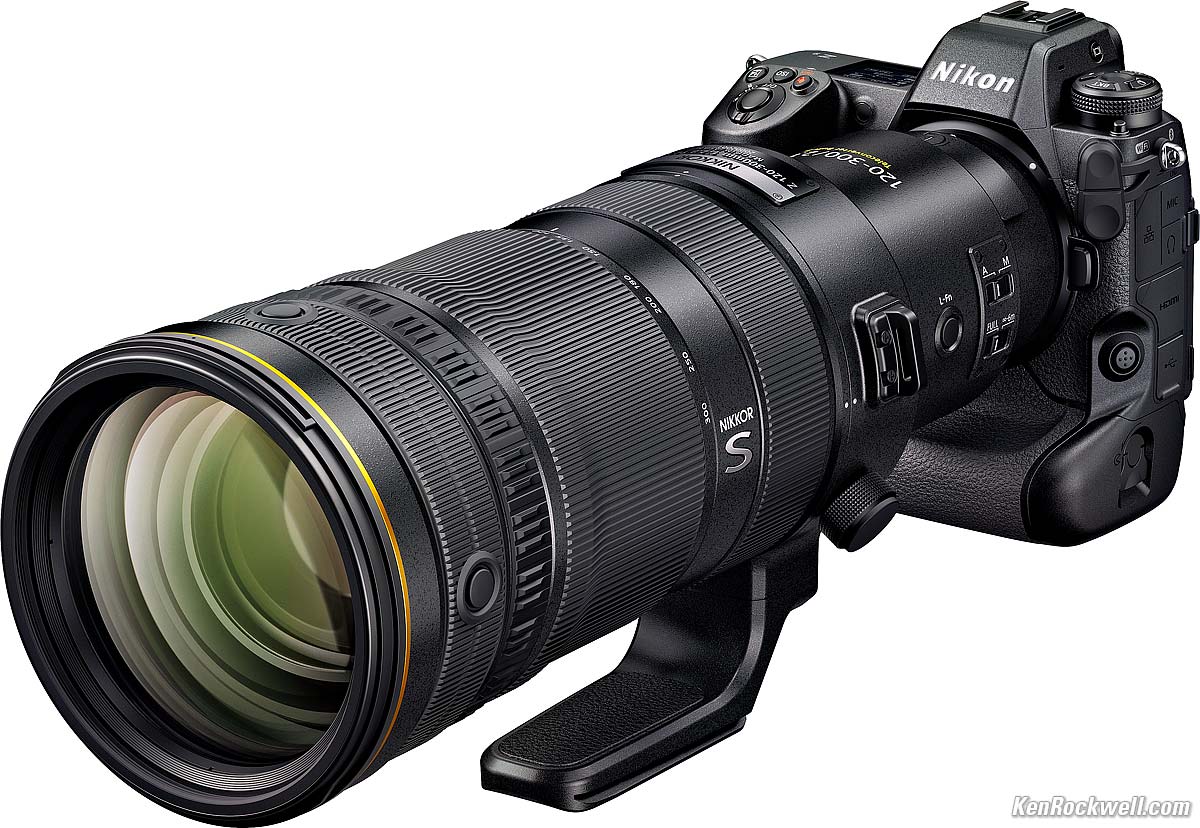
Nikon Z 120-300mm f/2.8 TC VR on the Nikon Z9. bigger.
Performance top
Introduction New Good Bad Missing
Specifications Performance Recommendations
I'd get my Z 120-300mm f/2.8 VR TC at B&H or at Adorama, or get it used at eBay (How to Win at eBay), or get it used at KEH.
Sharpness performance top
Lens sharpness has nothing to do with picture sharpness.
Every lens made in the past 100 years is more than sharp enough to make super-sharp pictures if you know what you're doing. The only limitation to picture sharpness is your skill as a photographer. It's the least talented who spend the most time worrying about lens sharpness and blame crummy pictures on their equipment rather than themselves. Skilled photographers make great images with whatever camera is in their hands; I've made some of my best images of all time with an irreparably broken camera! Most pixels are thrown away before you see them, but camera makers don't want you to know that.
If you're not getting ultra-sharp pictures with this, be sure not to shoot at f/11 or smaller where all lenses are softer due to diffraction, always shoot at ISO 100 or below because cameras become softer at ISO 200 and above, avoid shooting across long distances over land which can lead to atmospheric heat shimmer, be sure everything is in perfect focus, set your camera's sharpening as you want it (I set mine to the maximum) and be sure nothing is moving, either camera or subject. If you want to ensure a soft image with any lens, shoot at f/16 or smaller at ISO 1,600 or above at default sharpening in daylight of subjects at differing distances in the same image.
People worry waaaaay too much about lens sharpness. It's not 1968 anymore when lenses often weren't that sharp and there could be significant differences among them; ever since about 2010 all new lenses are all pretty much equally fantastic.
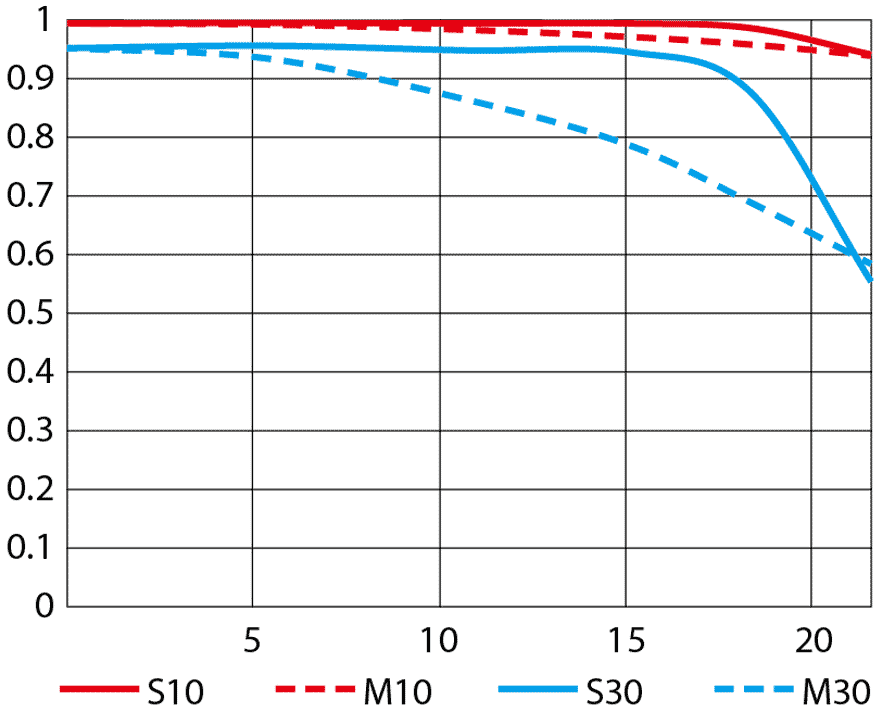
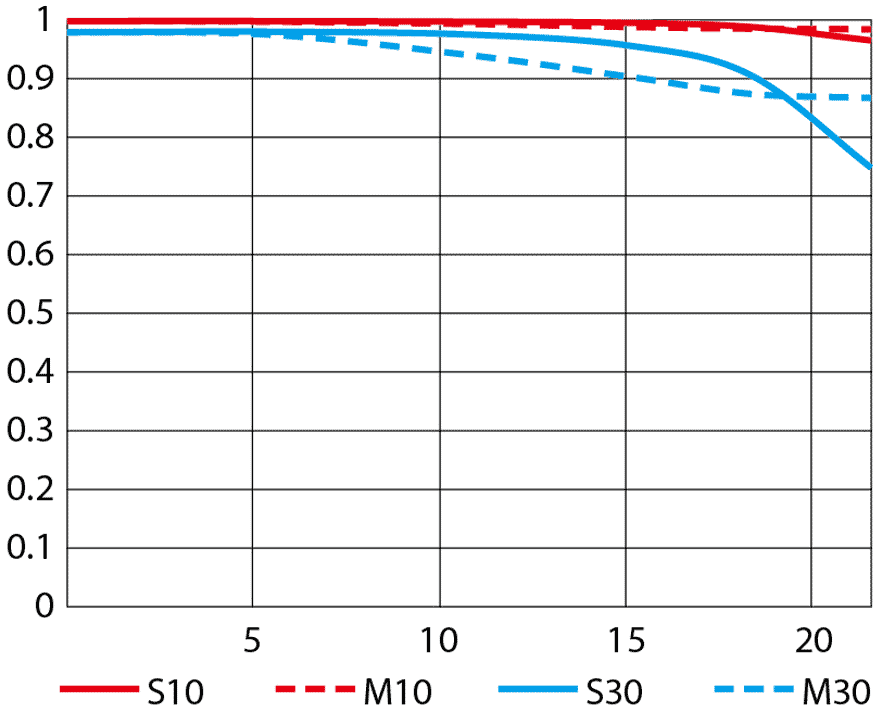
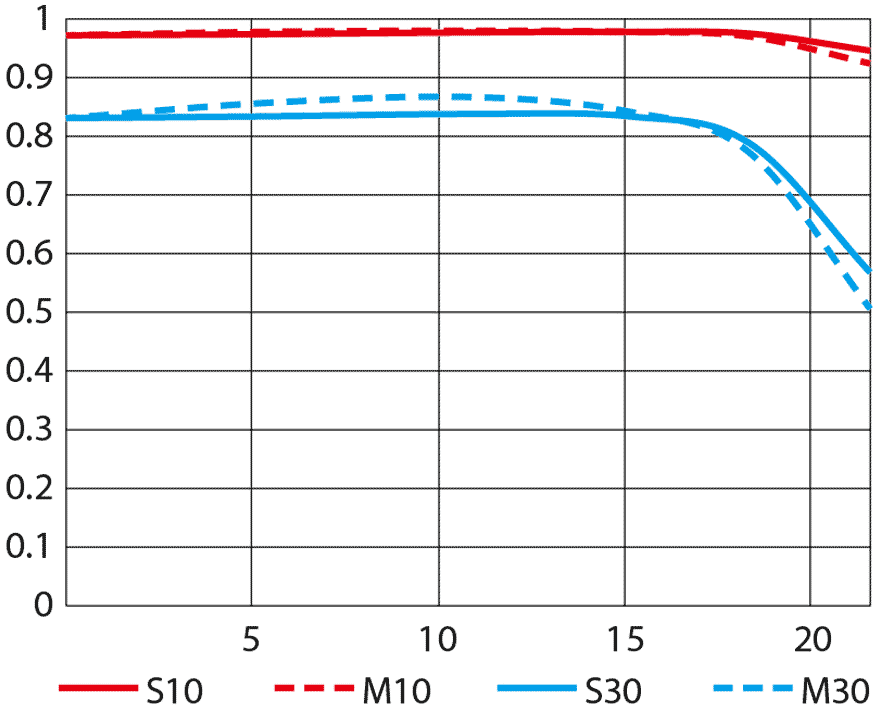
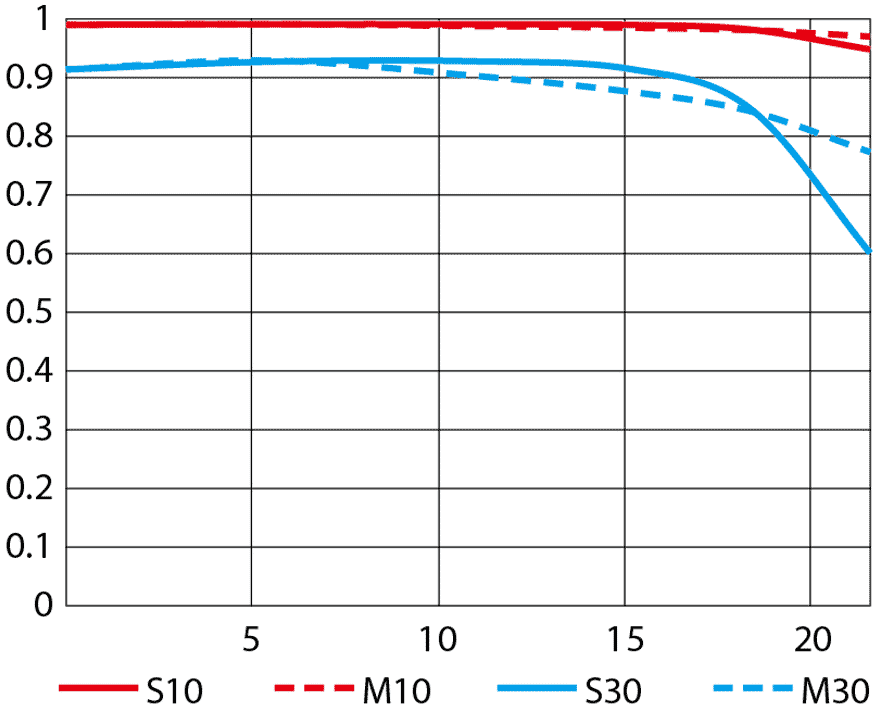
This lens is super sharp corner-to corner at every aperture, limited by your vision as an artist and of course by heat shimmer and by diffraction at the smallest apertures. Avoid f/16 and smaller unless you really need them for extreme depth of field because diffraction takes its toll. See also How to Calculate the Sharpest Aperture.
 |
 |
MTF at 120mm at f/2.8. |
MTF at 300mm at f/2.8. |
 |
 |
MTF with 1.4× Teleconverter at 168mm at f/4. |
MTF with 1.4× Teleconverter at 420mm at f/4. |
Nikon's MTF charts at 10 cyc/mm and 30 cyc/mm. Sagittal (radial) shown as solid lines. Meridional (tangential) shown as dashed lines.
While it's usually valid to compare rated MTFs between different lenses of similar vintage from the same maker, every maker measures or simply calculates MTF very differently, and therefore one cannot compare these curves between brands. For instance, Sony seems to ignore diffraction and simply calculate overly optimistic MTFs that hug 100%, which no real lens can do at f/8, while other brands are more realistic and include diffraction. Only Canon offers any insight on how they arrive at their curves.
See also my article on MTF and Canon's article on MTFs.
Recommendations top
Introduction New Good Bad Missing
Specifications Performance Recommendations
Shooting big game or shooting the big game? This is the lens for Nikon shooters.
For nature and landscape and things that hold still, I prefer smaller, lighter lenses with much broader zoom ranges like my favorite Z 100-400mm f/4.5-5.6 VR. Actually, in decent light I have no problems shooting action and sports with the Z 100-400mm f/4.5-5.6 VR; the need for this bigger, faster lens is if you're in dim light and need to stop action.
I'd get my Z 120-300mm f/2.8 VR TC at B&H or at Adorama, or get it used at eBay (How to Win at eBay), or get it used at KEH.
© Ken Rockwell. All rights reserved. Tous droits réservés. Alle Rechte vorbehalten. Alla rättigheter förbehållna. Toate drepturile rezervate. Niciun vampir nu a fost implicat în crearea acestei lucrări. Omnia jura reservata. Ken Rockwell® is a registered trademark.
Help Me Help You top
I support my growing family through this website, as crazy as it might seem.
The biggest help is when you use any of these links when you get anything. It costs you nothing, and is this site's, and thus my family's, biggest source of support. These places always have the best prices and service, which is why I've used them since before this website existed. I recommend them all personally.
If you find this page as helpful as a book you might have had to buy or a workshop you may have had to take, feel free to help me continue helping everyone.
If you've gotten your gear through one of my links or helped otherwise, you're family. It's great people like you who allow me to keep adding to this site full-time. Thanks!
If you haven't helped yet, please do, and consider helping me with a gift of $5.00.
As this page is copyrighted and formally registered, it is unlawful to make copies, especially in the form of printouts for personal use. If you wish to make a printout for personal use, you are granted one-time permission only if you PayPal me $5.00 per printout or part thereof. Thank you!
Thanks for reading!
Ken.