Home Donate New Search Gallery Reviews How-To Books Links Workshops About Contact
Nikon
50mm f/1.4 AI
NIKKOR (1977-1981)
© 2006~2012 KenRockwell.com

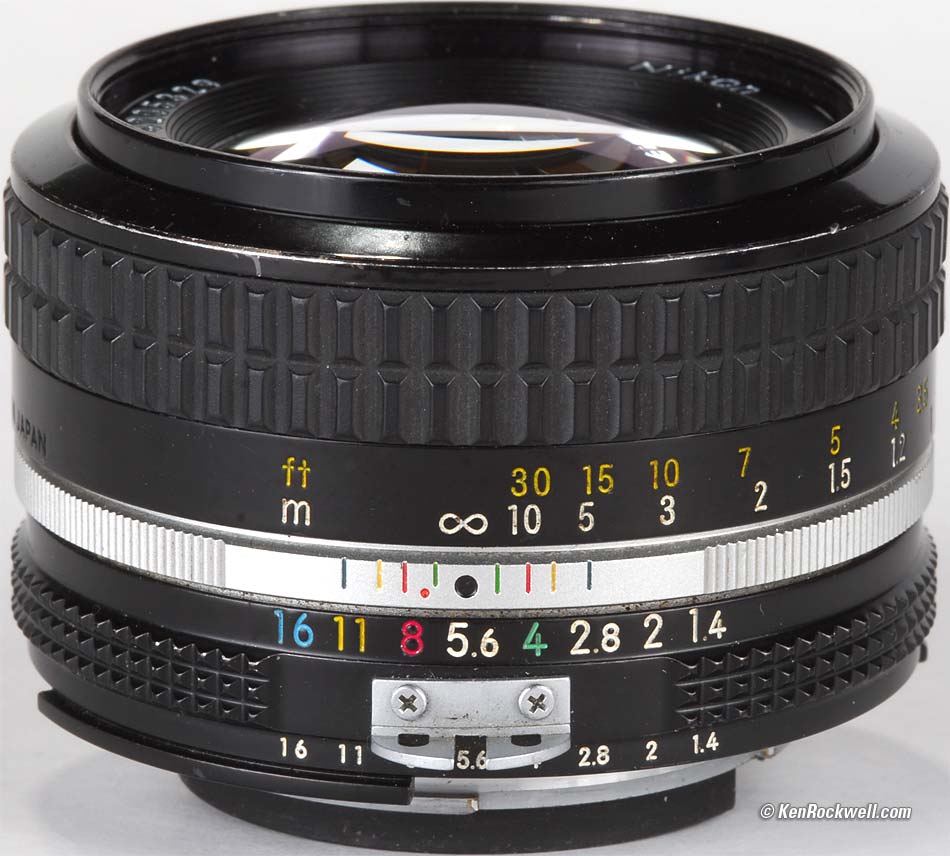
Nikon 50mm f/1.4 AI (FX, DX and 35mm coverage, 52mm filters, 9.0 oz./255 g, 1.5'/0.45 m close focus, about $125 used). enlarge. My biggest source of support is when you use any of these links, especially this link directly to them at eBay (see How to Win at eBay) or this link to the newest AI-s version brand-new at B&H Photo-Video or at Adorama, when you get anything, regardless of the country in which you live. Please always use these links when getting any of your gear so I can continue to share what I know. It helps me keep adding to this free website when you get yours through these links — but I receive nothing for my efforts if you buy elsewhere. Thanks for your support! Ken.
December 2012 Nikon Reviews Nikon Lenses All Reviews
Nikon 50mm f/1.4 AIS (1983-today)
50mm f/1.4 G (2008-today)
50mm f/1.4 NIKKOR-S AUTO (1966-1974)
58mm f/1.4 F (1959-1962)
Comparison to many other 50mm lenses
Introduction

Adorama pays top dollar for your used gear.
I use these stores. I can't vouch for ads below.
|

This was a popular lens in the 1970s. It was the "standard" lens sold with better Nikon cameras. The 50mm f/1.8 AI can be better optically, however.
In the 1950s through 1970s men measured their worth among men by the speed of their lens, regardless of whether or not they used the speed for it's only real purpose, available light photography. In those days an f/2 or f/1.8 lens marked a man as worthless, effeminate and weak. An f/1.4 lens was pretty common, and the f/1.2 lens made men think that they were super studs.
The problems were that the f/1.4 and f/1.2 lenses gave poor performance wide open, so one really should have used them at f/2 anyway to get decent results. In that case, the f/1.8 lenses gave the almost the same performance, and by f/4 where most people used them, the slower lenses were actually better since they have no distortion.
I was never happy with the fast Nikon normal lenses. My Minolta Rokkors were better, giving much better performance wide open.
This AI lens was replaced by the AI-s manual focus version in about 1983. The AI-s is identified by an orange (not blue) f/16 and an additional engraved notch in the mount. AI-s lenses added linear logarithmic aperture actuation by the aperture stop-down pin, making camera controlled aperture easier for the new automated cameras like the FA. The difference between AI and AI-s was only a few milliseconds of shutter lag in the FA, and there is no difference today on AF cameras.
Specifications
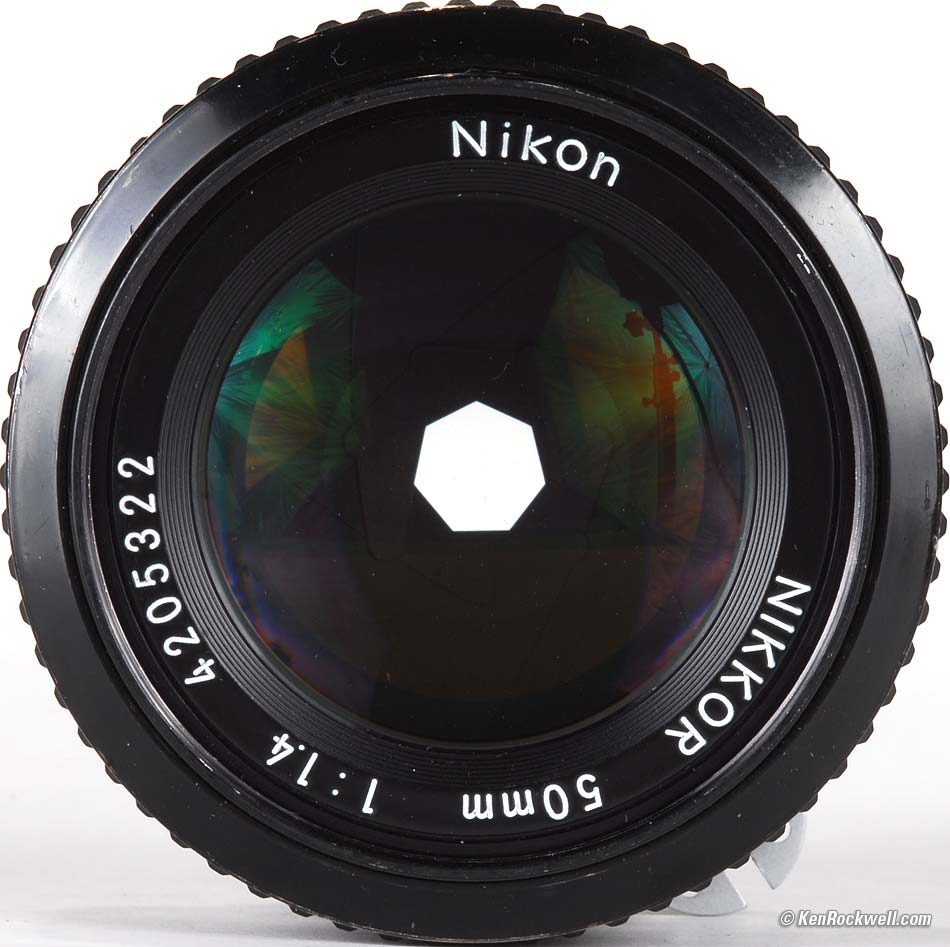
Nikon 50mm f/1.4 AI. (bigger)
It takes 52mm filters.
It has a seven-bladed diaphragm stopping down to f/16.
It has seven elements in six groups.
It focuses to 1.5 feet or 0.45m.
9.0 oz. (255g).
Performance
Overall
It has the standard performance I see in most fast normal and wide-angle manual focus Nikkors. It has the usual barrel distortion.
Sharpness
f/1.4: Spherical aberration lowers contrast. A lot of coma in the corners making them quite soft. Falloff.
f/2: Much better. Falloff much less.
f/2.8: Quite good, falloff and coma gone. Sharp all over.
Distortion
It has the typical mild to moderate barrel distorion of al Nikon's 50mm f/1.4 lenses.
Plug these figures into Photoshop CS2's lens distortion filter to correct the distortion. These aren't facts or specifications, they are the results of my research that requires a lot of data collection and computation.
FX and Film |
||
at infinity |
+1.4 |
+0.5 |
© 2007 KenRockwell.com
Recommendations
The 50mm f/1.8 AI costs less and has less distortion. They are just as sharp as each other.
Of course if you pick up one of these for $20, don't worry about it. These are an incredible bargain today since everyone with cashola has gone to AF and zooms.
You will find that you get just about nothing in focus at f/1.4 because of the tiny depth-of-field. If your camera's focus is a little out of adjustment you may get nothing in focus at f/1.4, since if you are off by a few inches at regular distances you will throw your intended subject out of focus. If you shoot at f/1.4 be sure to check and calibrate your camera's focus for best results.
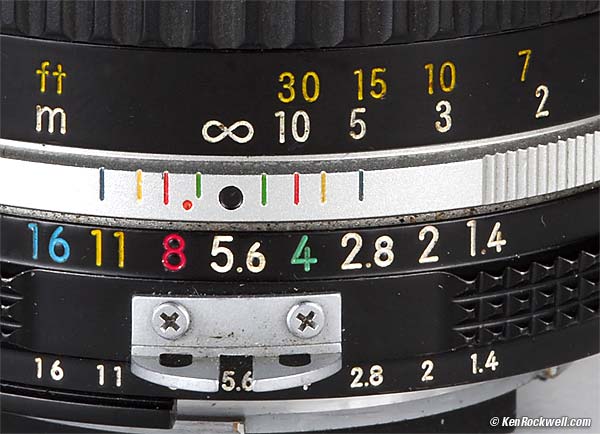
Nikon 50mm f/1.4 AI depth-of-feild scale.
Help me help you top
I support my growing family through this website, as crazy as it might seem.
The biggest help is when you use any of these links when you get anything, regardless of the country in which you live. It costs you nothing, and is this site's, and thus my family's, biggest source of support. These places have the best prices and service, which is why I've used them since before this website existed. I recommend them all personally.
If you find this page as helpful as a book you might have had to buy or a workshop you may have had to take, feel free to help me continue helping everyone.
If you've gotten your gear through one of my links or helped otherwise, you're family. It's great people like you who allow me to keep adding to this site full-time. Thanks!
If you haven't helped yet, please do, and consider helping me with a gift of $5.00.
As this page is copyrighted and formally registered, it is unlawful to make copies, especially in the form of printouts for personal use. If you wish to make a printout for personal use, you are granted one-time permission only if you PayPal me $5.00 per printout or part thereof. Thank you!
Thanks for reading!
Mr. & Mrs. Ken Rockwell, Ryan and Katie.
Home Donate New Search Gallery Reviews How-To Books Links Workshops About Contact