Home Donate New Search Gallery Reviews How-To Books Links Workshops About Contact
Nikon 600mm f/4 VR
© 2007-2012 KenRockwell.com
Intro Specs Performance Recommendations

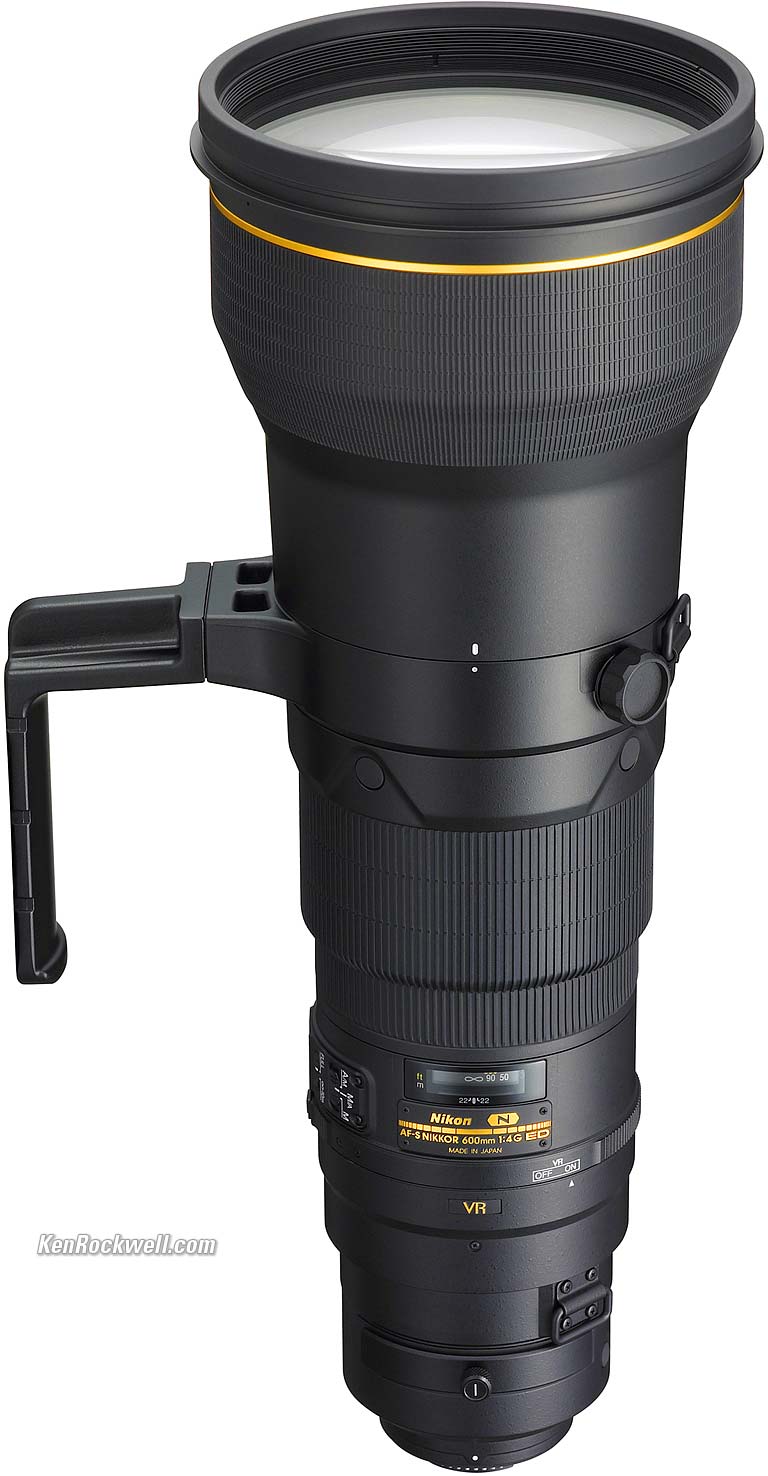
Nikon AF-S Nikkor 600mm f/4G ED VR (FX, DX and 35mm coverage, 52mm filters, 11.2 pounds/5.1 kg, 16.4'/5m close focus, about $9,800). enlarge. I'd order it at Adorama, B&H Photo-Video, or J&R or a mere $9,500 and wait. It helps me keep adding to this site when you get yours from those links, too, THANKS! Ken.
July 2012 More Nikon Reviews Nikon Lenses All Reviews
Introduction top
Intro Specs Performance Recommendations
Features Compatibility History

Adorama pays top dollar for your used gear.
I use these stores. I can't vouch for ads below.
|

This is Nikon's new standard lens for shooting surfing from shore. It adds Vibration Reduction (VR) to the previous 600mm f/4 AF-S II lens.
VR doesn't mean much for sports except if slow pans are your thing, but VR is crucial for wildlife photographers who are always working without enough light, or working with teleconverters. (No, I've not tried it with VR and a teleconverter.)
In addition to VR, another reason to drop almost ten Gs on this puppy is that it focuses more closely than the earlier models. This 600mm f/4 VR focuses to 16.4 feet or 5m, and even a little closer in manual focus.
Personally I use 600mm lenses for nature and landscape photography. I've always loved how I can crop a tight image from reality. For instance, point a 600mm lens at the reflection of the setting sun in any mirrored office building or at the wet sand at the beach, and your image explodes with light and color.
Features top
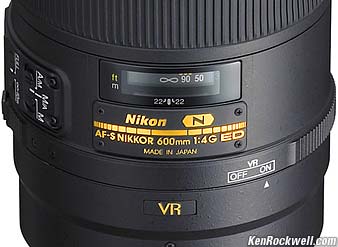
Nikon 600mm f/4 VR controls.
Nikon claims 4 stops of improvement for its VR-II system. Regardless of how well it works, nature photographers love this. Canon's been doing this for years on their 600mm lenses. The VR system also has a "tripod detection mode."
Preset focus point: you can set and recall a preset focus point, like home base or an animal's favorite haunt.
AF-LOCK and AF-ON buttons on the front of the lens, extremely handy. I wish all AF lenses had them.
Magnesium die-cast barrel.
Dust and moisture resistant.
Tripod VR mode to stop tripod vibration, nice if it works. I suspect it does.
Special anti-reflection coating ("Nano Crystal Coat," the N on the nameplate) on one surface, no big deal.
Focus Limit switch - no big deal.
Compatibility top
This 600mm f/4 VR works splendidly on every Nikon DX SLR, every Nikon FX SLR, most film SLRs since the 1980s, and works especially well on the newest D3 and D300.
See Nikon Lens Compatibility for details about your camera. This is an AF-S, VR and G lens.
Nikon 600mm History top
600mm f/5.6
Nikon has been making 600mm f/5.6 lenses like the 600mm f/5.6 P since 1964. The first ones were a pain and had kludgey and slow focusing.
Internal Focusing (IF) made them easy and fast to focus in 1976.
In 1977 Nikon introduced the 600mm f/5.6 AI ED-IF, followed in 1982 by the similar 600mm f/5.6 AI-s that I owned. Nikon made several more minor variations of this manual focus lens through 2005.
All the 600mm f/5.6 lenses are as big around as a 300mm f/2.8, or over 105mm (4") of solid glass surrounded by barrel and hood.
There have never been any autofocus 600mm f/5.6 lenses from Nikon.
600mm f/4
These 600mm f/4 lenses have a front element diameter of over 150mm (6") of ED glass.
Nikon's first 600mm f/4 lens came out in 1977 as the manual focus Nikon 600mm f/4 ED-IF AI. Nikon updated this to AI-s in 1982 and restyled the outside again in 1986, all with the same optics.
The first autofocus 600mm was the 600mm f/4 AF-I of 1992. AF was so slow and pokey that it was one of the reasons pro sports photographers fled to Canon and have never come back!
The first 600mm f/4 AF-S with fast focusing came out in 1996, but it was too late for the pros who left 4 years ago. The 600mm f/4 AF-S II version appeared in 2001.
This lens, Nikon's first ever 600mm with VR, was announced 23 August 2007.
Specifications top
Intro Specs Performance Recommendations
Name
Nikon calls this the Nikon AF-S Nikkor 600mm f/4G ED VR.
AF-S: Quiet focusing and instant manual focus override.
D: Sends focus distance information to the metering system.
ED: Magic glass for sharper images and less lateral secondary chromatic aberration (color fringing).
G: No aperture ring. Only works on pro cameras newer than about 1988. See more.
IF: Internal Focusing. Nothing moves on the outside of the lens when it focuses.
SWM: Silent Wave Motor for fast, quiet focusing.
Optics
15 elements in 12 groups. Three of these elements are of ED glass. Additional concave front protective element.
Diaphragm
9 blades, rounded. Stops down to f/22.
Close Focus
16.4 feet (5m) in auto focus, 15.7 feet (4.8m) in manual focus.
Maximum Reproduction Ratio
1:7.4.
Drop-in Filter
52mm.
Size
6.5" diameter by 17.5" long (166 x 445 mm), specified.
Weight
11.2 pounds (5.06 kg), specified. This is a lightweight: my 1996 400mm f/2.8 AF-I weights a few pounds more!
Included
CT-607 trunk (coffin) case
HK-35 hood
LN-1 strap, 52mm NC (clear) filter
52mm slip-in filter holder
front lens cover (I don't know if real leather or not)
LF-1 rear lens cap
Detachable tripod/monopod collar
Nikon Product Number
2173.
Announced
23 August 2007.
Price, USA
$9,800, July 2012.
$9,500 Fall, 2007, at introduction.
Performance top
Intro Specs Performance Recommendations
Every Nikon ED super-tele I've ever used has been optically spectacular. All the AF-S lenses have focused so fast they'll make your head spin.
Optically and focus speed-wise these lenses have nothing in common with ordinary lenses. When you drop ten big ones on a Nikon supertele, you've always gotten something spectacular.
I only own an old 400mm f/2.8 AF-I, and its optical performance is insane, as is its focus speed even with old technology.
Nol, I've not tried this 600mm yet, and I'm fully confident that it's a winner.
Nikon's MTF curve for this 600mm f/4 is just about perfect, better than any of their normal or other lenses.
Recommendations top
Intro Specs Performance Recommendations
You people know who you are.
Personally I own a 400mm f/2.8 because I can use a TC-14e to make it into a 600mm f/4 but there's no way to turn a 600mm f/4 back into a 400mm f/2.8.
Either the 400mm 2.8 or 600mm f/4 can be converted to an 800mm f/5.6. Use the TC-20e on the 400mm and the TC-14e on the 600mm.
Nikon doesn't suggest using the TC-20e or TC-17e on the 600mm because they make the combination slower than f/5.6, which isn't optimum for autofocus. It usually works, just not that great.
The Canon 600mm f/4 IS costs $2,500 less, weighs a half-pound more and close-focuses two feet less closely. Otherwise, it does the same thing on Canon cameras.
I would get this new VR lens instead of last year's 600mm f/4 AF-S II for not much difference in price.
Help me help you top
I support my growing family through this website, as crazy as it might seem.
The biggest help is when you use any of these links when you get anything, regardless of the country in which you live. It costs you nothing, and is this site's, and thus my family's, biggest source of support. These places have the best prices and service, which is why I've used them since before this website existed. I recommend them all personally.
If you find this page as helpful as a book you might have had to buy or a workshop you may have had to take, feel free to help me continue helping everyone.
If you've gotten your gear through one of my links or helped otherwise, you're family. It's great people like you who allow me to keep adding to this site full-time. Thanks!
If you haven't helped yet, please do, and consider helping me with a gift of $5.00.
As this page is copyrighted and formally registered, it is unlawful to make copies, especially in the form of printouts for personal use. If you wish to make a printout for personal use, you are granted one-time permission only if you PayPal me $5.00 per printout or part thereof. Thank you!
Thanks for reading!
Mr. & Mrs. Ken Rockwell, Ryan and Katie.
Home Donate New Search Gallery Reviews How-To Books Links Workshops About Contac