Nikon 400mm f/2.8 AF-I
The King of Lenses (1994-1998)

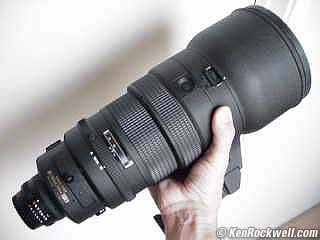
Nikon 400mm f/2.8 AF-I. (FX, DX and 35mm coverage, 52mm drop-in filters, 222.2 oz. (14 pounds or 6.3 kg), 10'/3m close focus, about $3,200 used). I'd get it at this link directly to them at eBay (see How to Win at eBay).
This all-content, junk-free website's biggest source of support is when you use those or any of these links to approved sources when you get anything, regardless of the country in which you live. Buy only from the approved sources I use myself for the best prices, service, return policies and selection. Thanks for helping me help you! Ken.
October 2017 Nikon Reviews Nikon Lenses Nikon Flash All Reviews
NEW: Nikon 400mm f/2.8 Lenses Compared
Sample Image

Canary Palm, 12 October 2017. Nikon D850, Nikon 400mm f/2.8 AF-I wide-open at f/2.8 at 1/800 hand-held at Auto ISO 64. bigger or full-resolution file or camera-original © file to explore on your computer (mobile devices rarely display full resolutions images properly).
Introduction

I buy only from these approved sources. I can't vouch for ads below. |



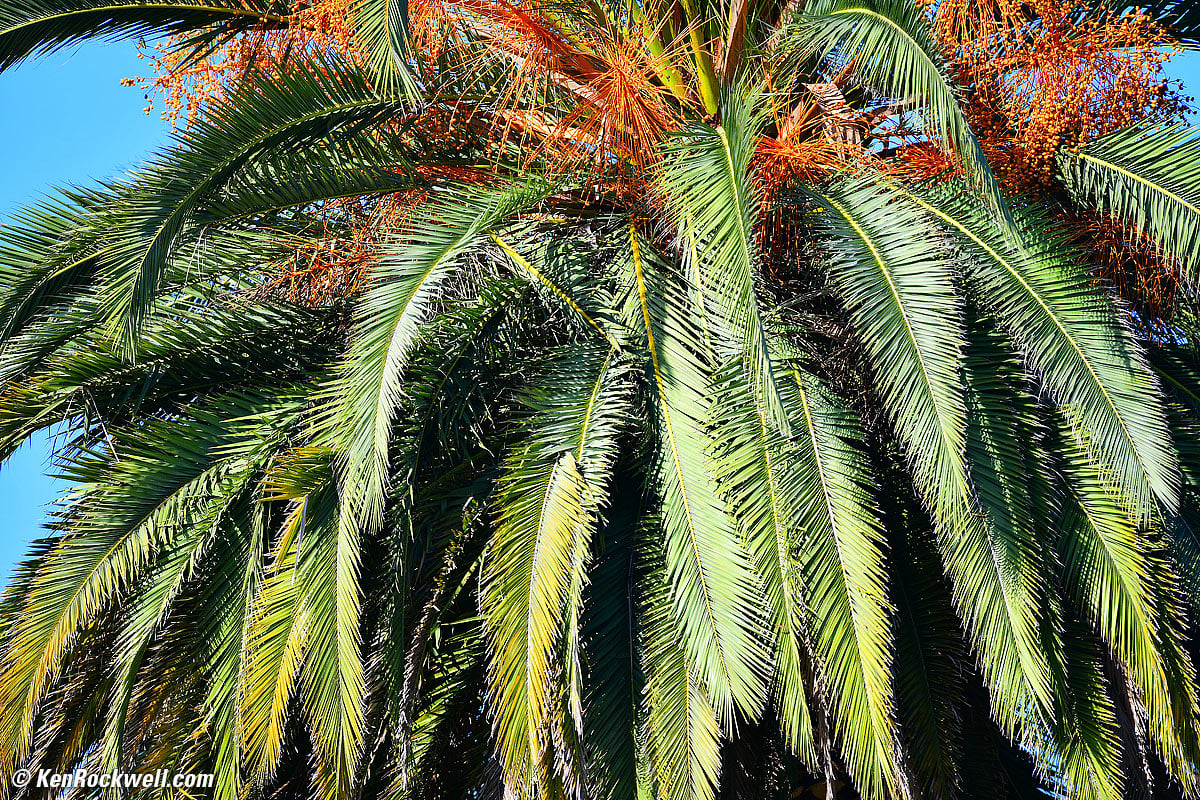

This Nikon 400/2.8 AFI is as extraordinarily good as it is expensive. This is the huge lens with which you see me at the home and contact pages. Optically it is as perfect as I can see, even wide open, and even on the state-of-the-art Nikon D850. Autofocus is fast and furious.
It is built like a tank and gives near perfect performance, as it had better for it's over $16,000 list price (corrected for inflation) when it was introduced in 1994.
It is optically superb. Nikon's newest 400/2.8 lenses aren't any better optically; the reason full time pros pay more for the newer models is for much lighter weight, closer close-focus distance, and maybe better instant manual-focus override.
This 400/2.8 AFI does have immediate manual-focus override when set to its M/A mode.
The newer AF-S and Vibration Reduction (VR) versions weigh a lot less, but optically, they are all superb.
Newer versions add VR which is great for hand0-holding scenic shots, but doesn't do anything for action shots.
History
See also Nikon 400mm f/2.8 Lenses Compared.
1985 - 2002
Nikon made 400mm f/2.8 AI-s manual focus lenses from 1985 through about 2002.
Nikon made about 2,500 of these.
1994-1998
This AF-I was Nikon's first autofocus 400mm f/2.8.
made about 1,500 of these.
1998-2001
400mm f/2.8 AF-S. Nikon made about 2,000 of these.
2001-2008
400mm AF-S II. Nikon made about 2,000 of these.
2007 - 2014
2014 - today
Specifications
Name
Nikon calls this the Nikon Nikkor 400mm f/2.8D AF-I ED-IF.
Compatibility
Works perfectly on almost every Nikon except the D3400. It works great on all FX Nikons, and even on the cheapest DX D40, D3000 and D3300.
Works perfectly on every recent AF film Nikon (F100, N80, F4, F5, F6, etc.).
Works perfectly on every manual focus Nikon made since 1977.
Pre-1977, pre-AI cameras will need a coupling prong added to the lens' aperture ring.
Older, lower-end film AF cameras like the N50 or 6006 may not autofocus, check your camera's manual.
See Nikon Lens Compatibility for details. Look in the AF-S, AF-I column for your camera.
Optics
Ten elements in seven groups.
ED glass.
Internal focus.
Diaphragm
9 straight blades.
Stops down to f/22.
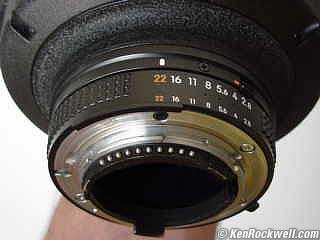
Focus
It has an internal coreless DC motor to drive the focusing mechanism to as close as 10 feet or 3.3 meters. This is closer than the newer AF-S version.
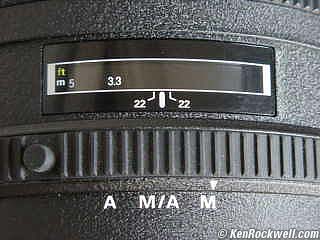
Focus Mode Switch
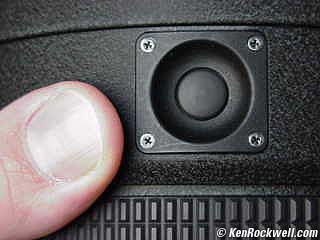
Focus Lock Switch (one of three)
Close Focus
Specified as 3.3m or 12 feet, but it actually focuses as close as ten short feet. That's closer than the newer AF-S and newest AF-S II versions.
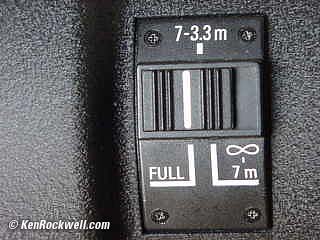
Focus Limit Switch
Filters
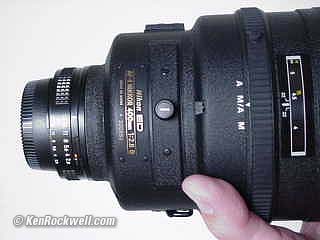
52mm Filter Holder
It takes Nikon-brand 52mm filters in a special internal drawer.
Nikon made sure that the slot on the lens through which this holder inserts is only wide enough to accept the good and thin Nikon brand filters.
This means if you want to insert a Tiffen or B&W filter for some color Nikon does not make that you are on your own. You could have a machine shop turn down (shave off) the front threads of your off-brand filter and it ought to fit fine. By messing with the filter instead of the lens at worst you'll screw up a filter instead of your lens.
Mechanics
It is built like a tank, and the AF selector ring even has a rubberized, waterproof cover over that ring's lock release, just like a piece of military hardware. Of course the ring itself (or the rest of the lens) isn't waterproof. The lens has rubber bumpers on the end of the lens and the hood.
Tripod Mount
It has a permanently attached tripod mount which also serves as a carrying handle.
Hood
It has a short removable HK-20 hood that has to be reversed and put over the front of the lens. Don't lose it; the replacement hood alone probably sells for $500.
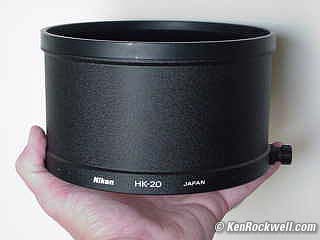
HK-20 Hood
Front Lens Cap
The lens cap is classy: it is genuine leather, not the fake leather of the cheap $1,000 telephotos like the 300 f/4 AF.
Size
I measure 16" long by 7"diameter.
Weight
This is Nikon's heaviest AF lens ever, at "222.2 ounces" in their specifications. That means about 14 pounds or 6.3 kg!
Price
These are prices with the included trunk case, leather hood and 52mm drop-in filter holder. Deduct $1,000 if missing these.
$3,200 used, October 2017.
B&H found some old stock and had them still brand-new at a close-out price of $5,500 in 2007, and they sold out fast.
About $5,500 used, 1997 ~ 2005.
$10,000 catalog price, 1994, equivalent to $17,000 with inflation in 2017.
Performance
Sharpness
The performance of the 400/2.8 AF-I is just about perfect. It is completely sharp across the entire field at every aperture.
Put the no-longer-available Nikon Lens Scope Converter on it for the sharpest 40 power telescope you've ever seen. If you're an astronomer you'll want to make a special adapter to allow you to mount a 20mm wide-field eyepiece to give you a 7mm exit pupil on a 20 power scope, heh heh.
Focus
Accuracy
Autofocus accuracy on my F100 is dead on, so I get all the sharpness I paid for, with and without the TC-20E converter.
AF Speed
Autofocus speed is just about instantaneous. This is the newest of the AF-I lenses and seems to have more in common with the AF-S lenses than the earlier AF-I lenses like the slow-to-focus 300/2.8 AF-I and 600/4 AF-I. This 400/2.8 AF-I is really fast!
There is some minor light falloff at f/2.8, and none at f/4 and smaller. That's the only flaw I can find, and that's not a flaw. Heck, to eliminate that small falloff Nikon would have to add another ten pounds to the lens. The levels of falloff are very low.
Focus lock buttons
There are four rubber-covered AF lock buttons towards the front of the lens. Hold one of them and it freezes the focus and keeps the camera meter on. This is how you should focus and recompose for still subjects, and a much handier feature than you think.
Auto/Manual focus mode switch
The Auto/Manual focus mode is bogus; much worse than Canon or the AF-S version.
In this mode you have to keep your finger pressing the AF button (usually the shutter button) while you turn the focus ring. While you do this the lens will eventually klunk over to the manual mode, and stay that way until you take your finger off the AF button.
If this feature is important to you than go Canon or the plastic Nikon AF-S.
It doesn't bother me, I use the "S" single focus mode and "[ ]" setting with the center sensor and focus lock button on an F100 for still subjects, and the "C" continuous AF mode with the "[+]" setting for moving animals. It works great with no need for manual fooling around.
Bokeh

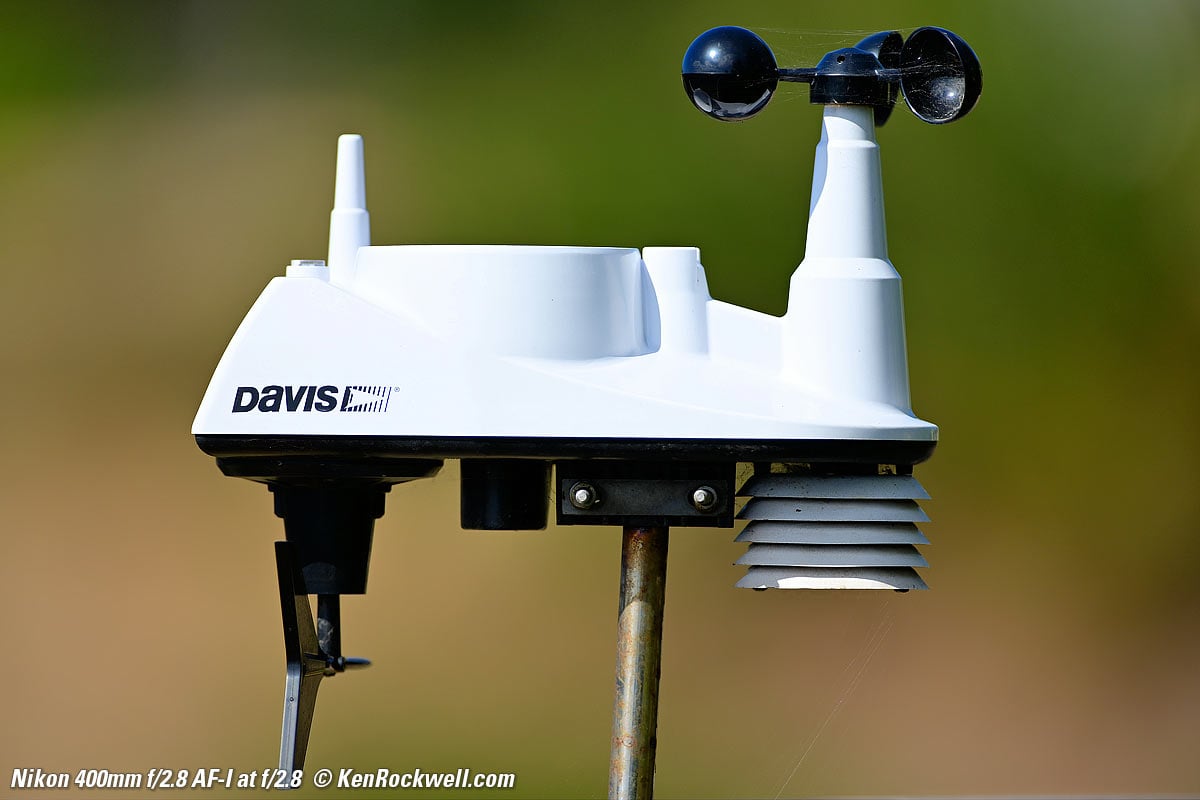
Bokeh, the feel or quality of out-of-focus areas as opposed to how far out of focus they are, is great.
As an ultra-speed ultra-telephoto, it will have the softest backgrounds of any lens.
Here's a sample at headshot distance:

Davis 6250 weather station, 12 October 2017, shot on Nikon D850. bigger or camera-original © file to explore on your computer (mobile devices rarely display full resolutions images properly).
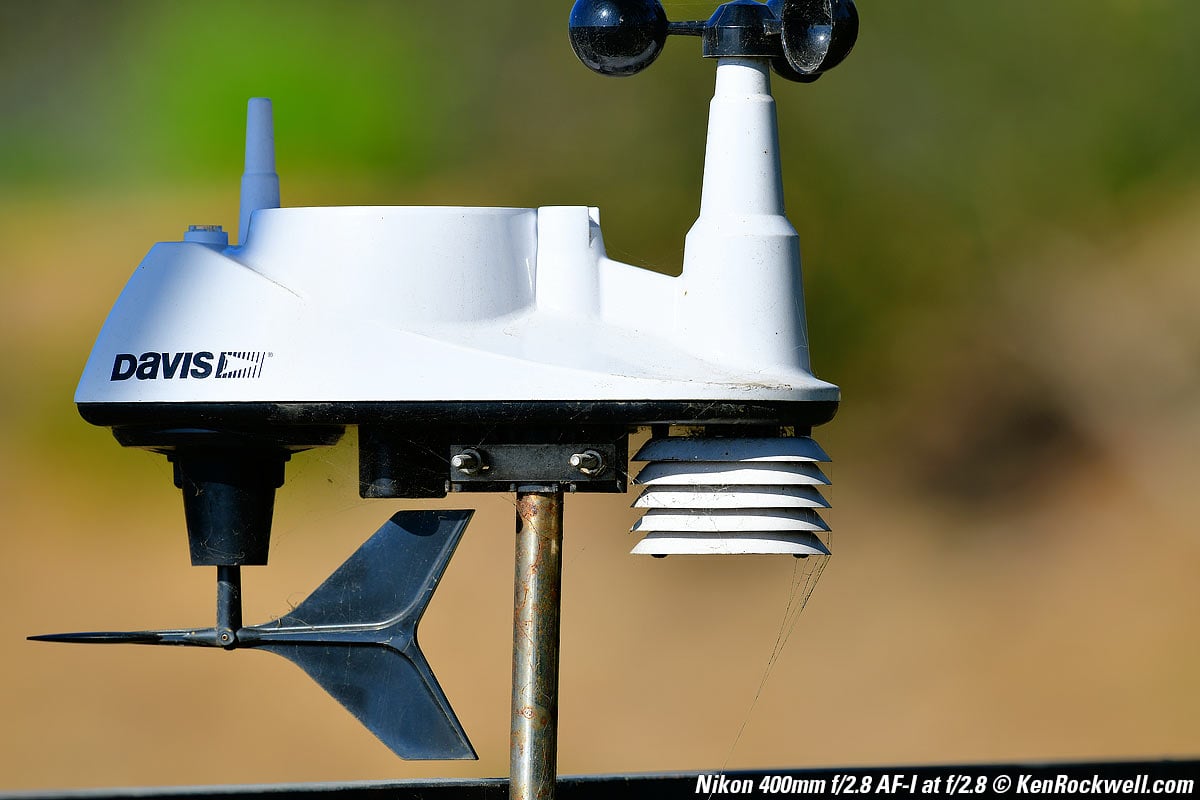
Davis 6250 weather station, 10 October 2018 (shot on Nikon Z7 & FTZ). bigger or camera-original © file to explore on your computer (mobile devices rarely display full resolutions images properly).
There is no visible distortion.
If you want to spilt pixels on a D3 at 200% magnification at infinity, you can correct it with these settings in Photoshop CS2's lens distortion filter. There is only about a couple of pixels of distortion at the most.
FX at ∞ |
|
Lens Only |
-0.15 |
+0.50 |
|
0.0 |
|
+ TC-20E |
0.0 |
© 2008 KenRockwell.com. All rights reserved.
Ghosts
None. Point it right at the sun at sunset; just watch your eyes.
Close-Focus
It is the closest-focusing 400mm available. Nikon cheats themselves here: the closest marked footage is 13 feet, however the closest marked meterage is 3.3m, and my sample focuses down to a mere measured 10 feet. This is closer than the newer, plastic barrel AF-S versions.
If a well-know Canon-sponsored bird photographer used this lens and the TC-20E and TC-14E teleconverters he would save himself all the painful screwing around he does with extension tubes on his 600mm f/4 Canon lens that only focuses about to 20 feet.
Performance with the TC-14E Teleconverter
EXIF and exposure data read correctly with the TC-14E, meaning the camera and EXIF read in the effective f/stop, which now starts at f/4, and the effective focal length, which reads 550mm.
Nikon D3
It works great with the TC-14. There is only an additional 40% magnification, and sharpness doesn't seem to change at all.
Film
Overall it works great with the TC-14E. It seems as if it may have a tad of barrel distortion, but that could be my imagination. I tested deliberately for this and it's pretty close to neutral at worst.
I wasn't able to get consistently sharp results for some reason. I'm unsure why, since results with the TC-20E or the lens alone are. It was probably due to bad luck for the only few rolls of film I shot, but in any case I returned the TC-14E since I need consistency.
The AF speed seems undiminished with this converter.
Performance with the TC-17E Teleconverter
EXIF and exposure data read correctly with the TC-17E, meaning the camera and EXIF read in the effective f/stop (t-stop), which now starts at f/4.8 (t4.8), and the effective focal length, which reads 650mm.
Nikon D3
If you're counting every pixel, it's a little softer wide open (t4.8). Stop down to t8 for better results.
Background bokeh is bad.
Film
Not tested.
Performance with the TC-20E Teleconverter
EXIF and exposure data read correctly with the TC-20E, meaning the camera and EXIF read in the effective f/stop, which now starts at f/5.6, and the effective focal length, which reads 800mm.
Nikon D3
Skip the TC-20E if you want the best sharpness. Stopping down helps.
Film
This combo doesn't work that well with on my D200 or D80. These cameras' high resolution AF systems are very picky, so they have a hard time focusing this combination.
It works great with the 400/2.8 AF-I. AF is slower than the 400mm naked, but still fast and right on, and the whole system is still very sharp. I use this on a rickety monopod (as seen on my home page) with Velvia and get great results.
This works great on my film cameras. The 400/2.8 works great with the TC-20E converter to give you a sharp, fast focusing 800mm f/5.6D AF-I that focuses to 10 feet. (If a certain famous Canon-sponsored bird photographer had this setup he wouldn't have to waste so much time screwing with those frightful extension tubes and converters on his 600mm f/4 AF Canon.)
Add the lens scope converter to that and you have an 80 power x 140mm objective spotting scope!
The AF speed is slower than without the converter This is normal.
Recommendations
Buy one. I paid the same price for a used one in 1999 as you can pay for new today! Somehow as of November 2006 B&H found some new ones here.
I was surprised that this lens is nowhere near as hard to carry as I expected. I lug this thing around just about everywhere. A lens like this is the main reason to shoot with 35mm cameras, since you simply can't get lenses this long and this fast for larger formats.
Put the shiny Nikon coffin trunk case away until you sell this and get a good bag. I use the Lowe Pro 600AW lens bag. I would have preferred the less expensive, made-in-USA Tenba lens bag, except it was out of stock when I went to order it.
Forget about using it on a tripod with an amateur camera like the F100 without a mirror lock up. On my Gitzo carbon fiber pod with a Bogen gear-drive head I get OK results at down to 1/60 or at 3 seconds or longer, but awful, blurry results between 1/50 and 2 seconds. This is because the F100 has both a lot of mirror flap and no lockup, so the whole assembly jiggles like crazy when seen through the viewfinder.
Plant your face to the back of the camera to help damp these vibrations, but at the lower speeds at which you really need the damping your facial movement will blur the image too.
Let me repeat myself: You cannot use this lens for landscapes on a tripod between 1/50 and 2 seconds with an F100. You will need a professional camera with a mirror lock up, like the F5 or an FE, FM or FA with a mirror self-timer prerelease.
Handheld I need to shoot at 1/125 or faster. I have no problem hand holding this beast, but most people think I'm crazy and they're correct.
The smartest thing to use is a cheap monopod. I have a dinky Gitzo. That holds the lens up for me and provides plenty of support. You can see me with this arrangement back on this site's home page.
You can spend about a thousand dollars for a tripod and head heavy enough to do this system justice, and that system still won't work with amateur cameras like the F100 at slow speeds.
Buy a $30 monopod and you'll get the same results at the same speeds at which the other system works well, 1/60 and up. The only disadvantage with the monopod is that it doesn't support itself when you want to walk away from it.
I was tempted by the $500 Wimberly head. It sure looks nice and I've heard good things about it. Cheapskate that I am, I find that my Bogen 3047 head does the same thing, so long as you don't forget to lock it down when you want to walk away from it.
The AF-I lens was replaced by the AF-S version in 1998. The AF-S has a plastic barrel and many plastic parts, and also weighs much less. The AF-S has much better ability to make fast manual focus adjustments, but does not focus as close, a critical need in nature photography. Mostly because of the close focus issue I prefer this older AF-I, as well as because I can't stand to pay good money for plastic lenses.
© Ken Rockwell. All rights reserved. Tous droits réservés. Alle Rechte vorbehalten.
Help Me Help You
I support my growing family through this website, as crazy as it might seem.
The biggest help is when you use any of these links when you get anything. It costs you nothing, and is this site's, and thus my family's, biggest source of support. These places always have the best prices and service, which is why I've used them since before this website existed. I recommend them all personally.
If you find this page as helpful as a book you might have had to buy or a workshop you may have had to take, feel free to help me continue helping everyone.
If you've gotten your gear through one of my links or helped otherwise, you're family. It's great people like you who allow me to keep adding to this site full-time. Thanks!
If you haven't helped yet, please do, and consider helping me with a gift of $5.00.
As this page is copyrighted and formally registered, it is unlawful to make copies, especially in the form of printouts for personal use. If you wish to make a printout for personal use, you are granted one-time permission only if you PayPal me $5.00 per printout or part thereof. Thank you!
Thanks for reading!
Mr. & Mrs. Ken Rockwell, Ryan and Katie.