Home Donate New Search Gallery How-To Books Links Workshops About Contact
LEICA 21mm Lenses:
1958 - today
© 2011~2026 KenRockwell.com. All rights reserved.

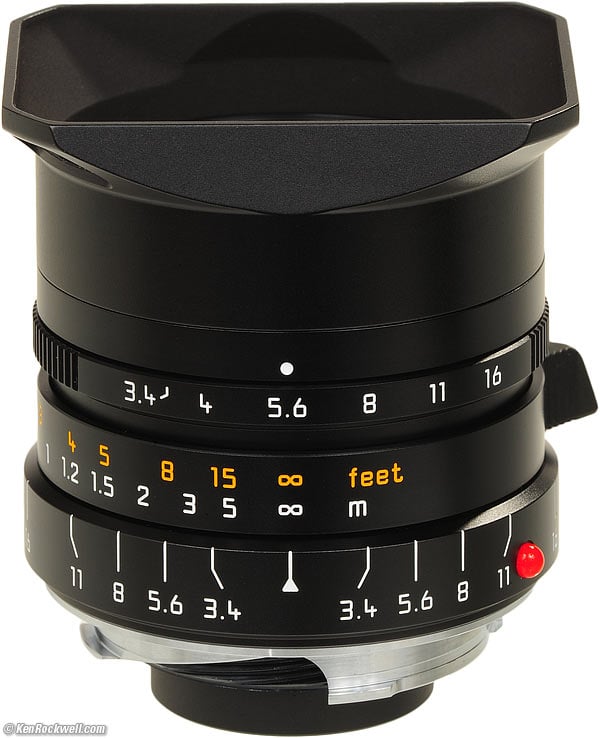
LEICA 21mm f/3.4 ASPH: 2011-today. This free website's biggest source of support is when you use these links to get your stuff from the same places I do, like here at eBay, when you get anything, regardless of the country in which you live. Thanks! Ken.
November 2011, September 2009 LEICA Reviews LEICA Lenses more reviews
Comparison tables of all brands of 21mm lenses
How to Afford Anything LEICA Lens Names
Introduction
LEICA has sold 21mm lenses for its cameras for over 50 years.
All of these couple to LEICA's rangefinders for perfect focus.
21mm lenses made before 1985 focus more closely than any camera's rangefinder can couple, so at distances closer than 1m or 0.7m (depending on your camera), you have to guess. No big deal; I'd rather have this option than the newest lenses which can't focus as close.
1958 - 1963: 21mm f/4 SUPER ANGULON top
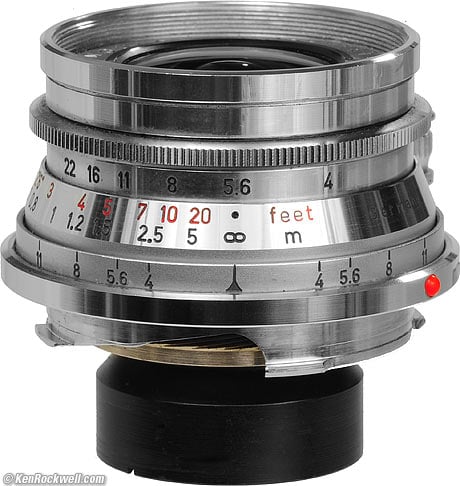
LEICA 21mm f/4 SUPER ANGULON (39mm filters, 251g, 1959), twice life-size. enlarge more.
Proof of Performance: Sample image one and sample image two (2MB JPGs.)

I buy only from these approved sources. I can't vouch for ads below. |



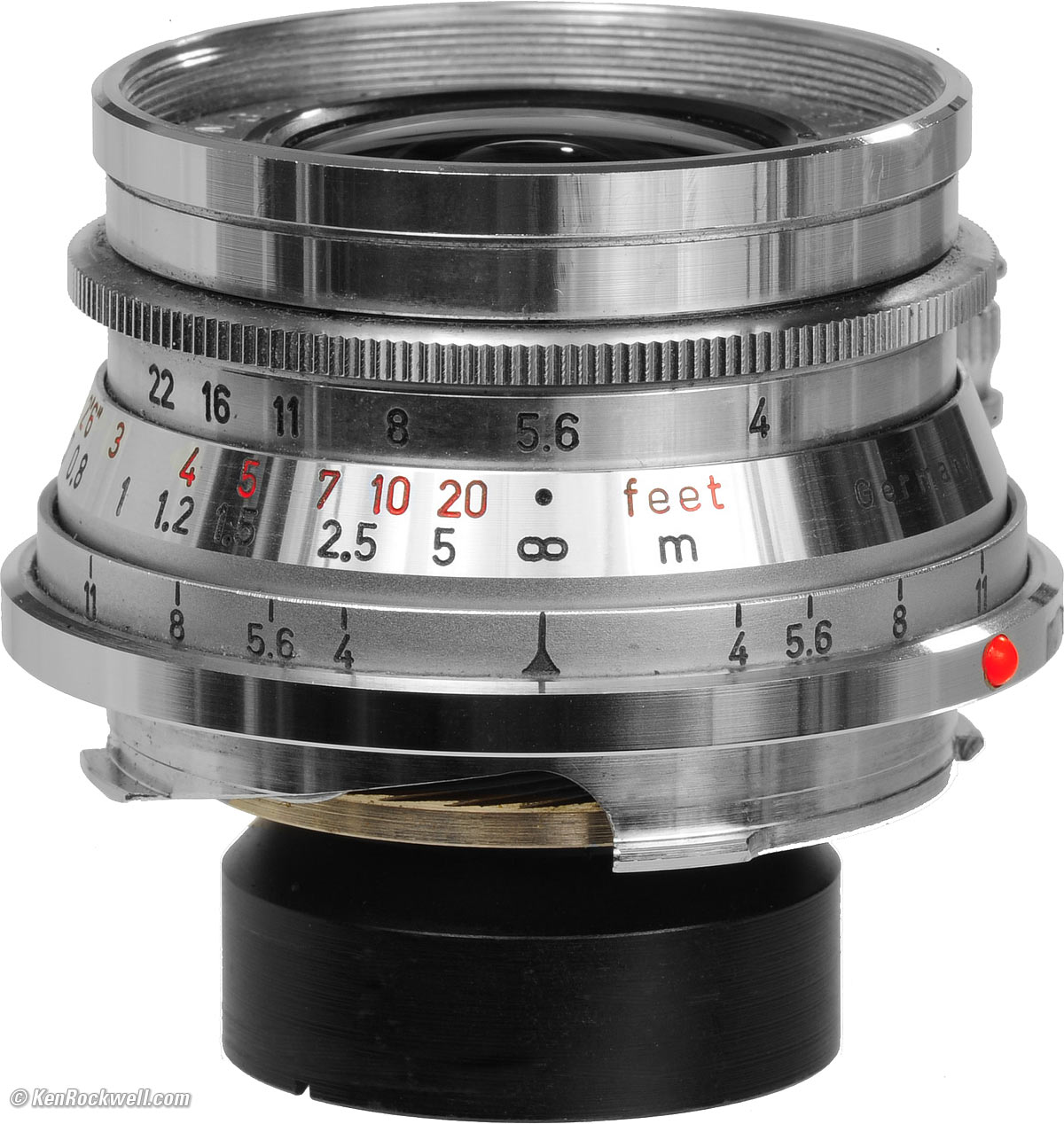
The first 21mm lens sold for use on LEICA cameras was the LEITZ 21mm f/4 SUPER ANGULON. It was designed and built by Schneider and resold by LEICA.
It came only in chrome, but it did come in both screw and bayonet mounts.
It is a largely symmetrical design, which means no distortion but plenty of light falloff (darkening) as you reach the edges.
It has a superior 9-bladed diaphragm.
It takes an OIXMO rear cap to enclose its rear cell, which extends further from the back of the mount than any current lens. The rear cell extends due to its short focal length and non-retrofocus design, which is what helps it have no distortion.
Because the rear cells extends so far, TTL metering won't work, and it will damage the swinging meter cell of the M5 and CL.
It isn't much use on an M9 because the sides take on funny color shifts due to the acute angles of sensor incidence at the sides, and the lack of a corrective file inside the M9. If you have a way to compensate for corner color shifts and don't need TTL metering, go for it. The corner color shifts on the M9 are sensor defects of the M9, none of this happens on film.
The LEITZ 21mm f/4 SUPER ANGULON is my favorite 21mm for use on the M3, M2, and M4, where we use external meters. It is exquisitely sharp on film, and has zero distortion so straight lines stay ruler-straight.
SUMON (11 102L) in bayonet mount.
SUOON (11 002K) in screw mount.
The finder in those days was the SBKOO, later called the 12 002L. The hood was the IWKOO, later called the 12 502N.
This 21mm shipped in a plastic bubble. The optional leather case was the ETBIX, later called the 14 565N.
In 2009 it sells used for about $900.
1963 - 1980: 21mm f/3.4 Super Angulon top
Schneider replaced the original 21mm f/4 with an improved 21mm f/3.4 in 1963. It is mentioned in the second issue of LEICA Photography magazine in 1963.
Like the 21mm f/4 Super Angulon, the 21mm f/3.4 Super Angulon was designed and built by Schneider to be resold by LEICA.
The 21mm f/3.4 was introduced at Photokina in Cologne, Germany, which ran from Saturday, 16 March through Sunday, 24 March, 1963. I was one year old so I didn't go, but the hours each day were from 9 to 6. Photokina occupied 850,000 square feet (80,000 m2) of exhibit space, and the president of West Germany opened the festivities. So many people showed up that they even needed to rent out rooms in people's homes and bring in cruise ships to house everyone. Times were good!
The 21mm f/3.4 originally came in chrome, and changed to black in the late 1960s.
Later models, from serial number 2,473,252, had their rear cells cut-out to allow metering on the M5. Otherwise the M5's meter arm gets caught.
Except for newer versions of this 21mm f/3.4 which do provide TTL metering on the M5, no versions of this 21mm f/3.4 or the earlier 21mm f/4 will provide TTL metering on any other LEICA.
Filters are 48mm screw-in, and series VII filters fit behind the hood.
The external front lens mount diameter is 52.5mm, which defines the front cap as p/n 14 102, size A52.5mm in plastic. The rear cap is the extra-deep 14 042.
The hood is part number 12 501, which is included with the lens, part number 11 103.
The finder is the same as before, the 12 002.
I haven't tried it, but the literature suggests the 21mm f/3.4 has higher optical quality than the earlier f/4 along with its extra half-stop of speed. It also added half-stop clicks to its aperture ring. The 21mm f/4 is so good that I'd worry more about the 21mm f/3.4's inferior 4-bladed diaphragm and non-standard 48mm filter size than any potential variation in sharpness.
What's weird is the hideous 4-blade diaphragm. You never need to worry about the shape of out-of-focus highlights, since nothing is ever very far out-of-focus with a 21mm lens, but the dorky diaphragm will give only silly 4-pointed sunstars.
In 1980 at close-out, full catalog price was $1,272 and dealer cost was $848, or $3,300 and $2,200 considering inflation in 2008.
In 2009 it sells used for about $1,000.
1980 - 1997: LEICA 21mm f/2.8 top
The 21mm f/2.8 is the 21mm first lens actually made by LEICA, instead of the earlier Schneider lenses merely resold by LEICA. It was made in Canada.
It is a retrofocus design, meaning that the back of the lens doesn't poke out as far as previous lenses, so TTL metering works on all cameras that have TTL metering.
You get TTL metering since the retrofocus design keeps the rear elements further from the film, but the literature suggests that you get more distortion in return.
Early versions (Elmarit, 1980 - 1985) took 49mm filters, while later ones (Elmarit-M, 1985-1997) took 60mm filters.
Early versions (1980 - 1985) focused (manually) as close as 0.38 meters (15 inches), while later ones (1985-1997) focus to 0.7m.
You'll see far more of the later ones with the 60mm filter size and 0.7m close focus than you will of the earlier versions of this first f/2.8 lens.
The hood for the 60mm filter version is a weird square thing.
The front cap for the 49mm filter version is 14 267.
At introduction in 1980, full catalog price was $870 and dealer cost was $580, or $2,250 and $1,500 considering inflation in 2008.
They sell for about $800 - $1,600 used in 2009.
1997-2011: LEICA 21mm f/2.8 ASPH review top
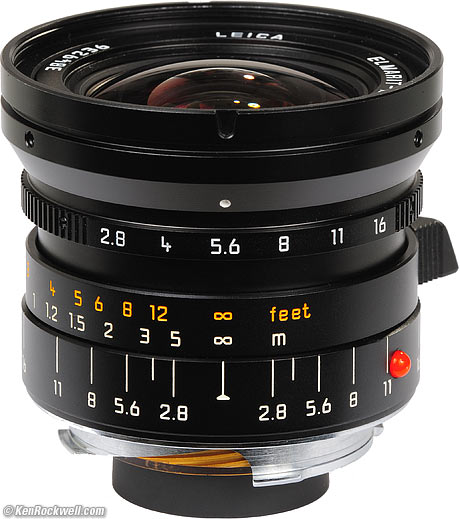
LEICA 21mm f/2.8 ASPH, twice life-size. enlarge more.
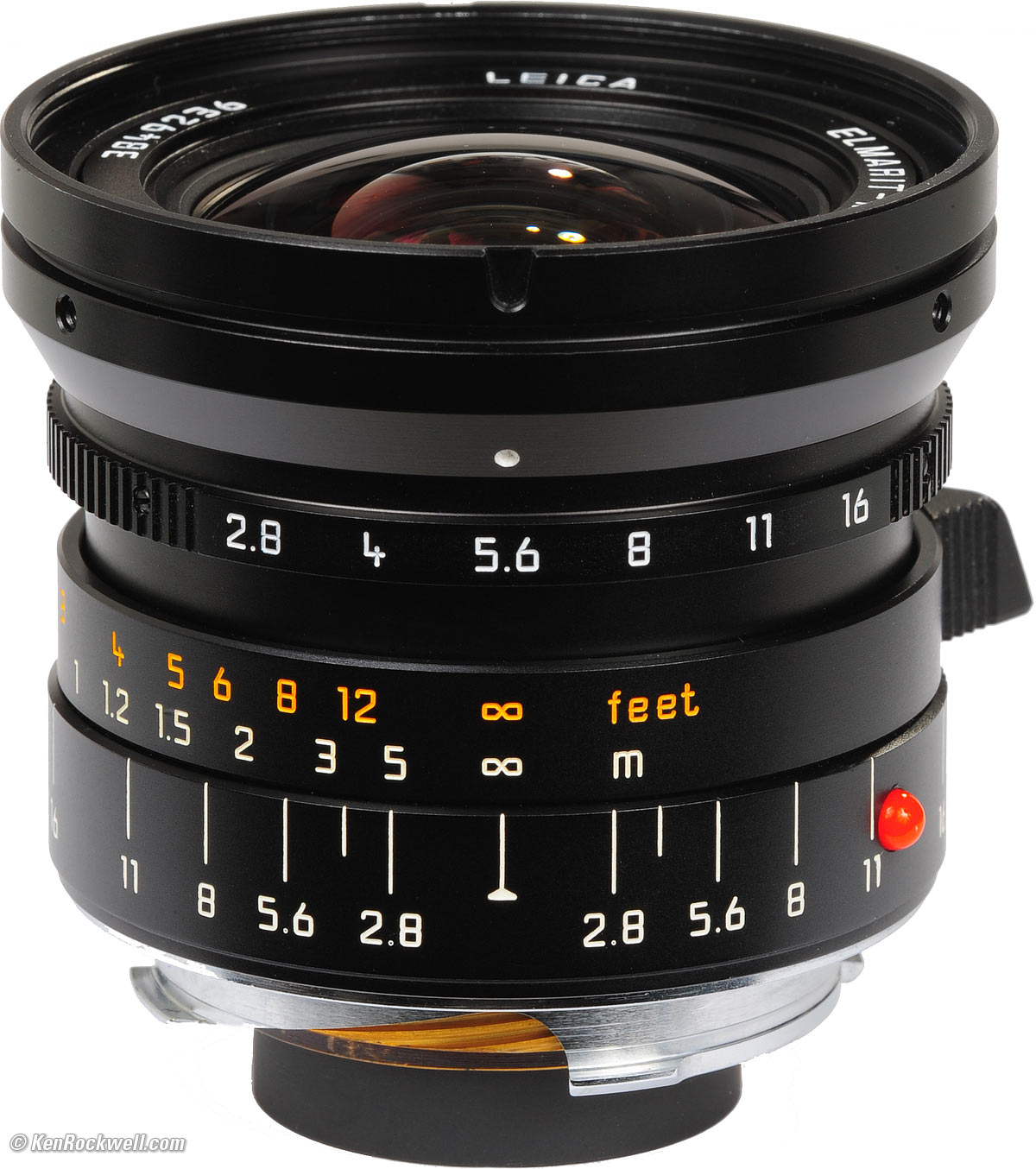
The 21mm f/2.8 ASPH (review) is the current model, made since 1997.
Sample image (12MB JPG).

Even though LEICA has been selling 21mm lenses for its cameras since the 1950s, this current 1997 design is the first LEICA 21mm lens actually made by LEICA in Germany.
There is also a much heavier chrome version, which supposedly weighs 415g instead of the 300g (specified) of this normal black version.
The 21mm f/2.8 ASPH sells new for $4,300 in the USA in February 2008 and sold new for $3,500 in January of 2007. In 2009 it sells used for about $2,600 - $3,000.
2008 - today: LEICA 21mm f/1.4 ASPH top
The LEICA Summilux-M 21mm f/1.4 is a big, fat $6,500 lens ($6,000 in 2008). It is too big and heavy to make much sense to use on a LEICA; any other version is far more sensible and has less distortion.
Filters are a pain on the 21mm f/1.4. Series VIII fit inside the hood (who has series VIII filters?), and supposedly there's an extra-cost adapter to use 82mm filters.
NEUE: 2011 - today: LEICA 21mm f/3.4 ASPH top
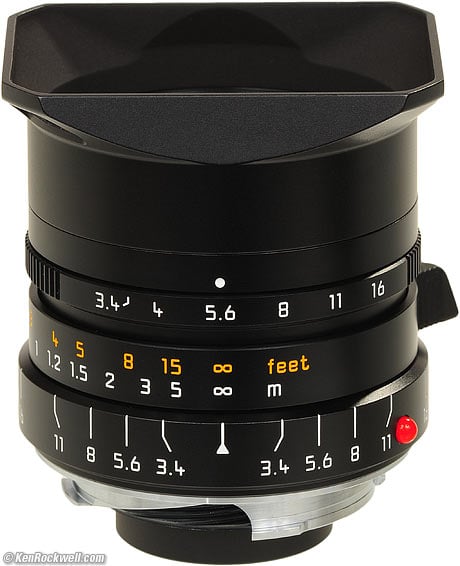
LEICA 21mm f/3.4 ASPH, twice life-size. enlarge more.
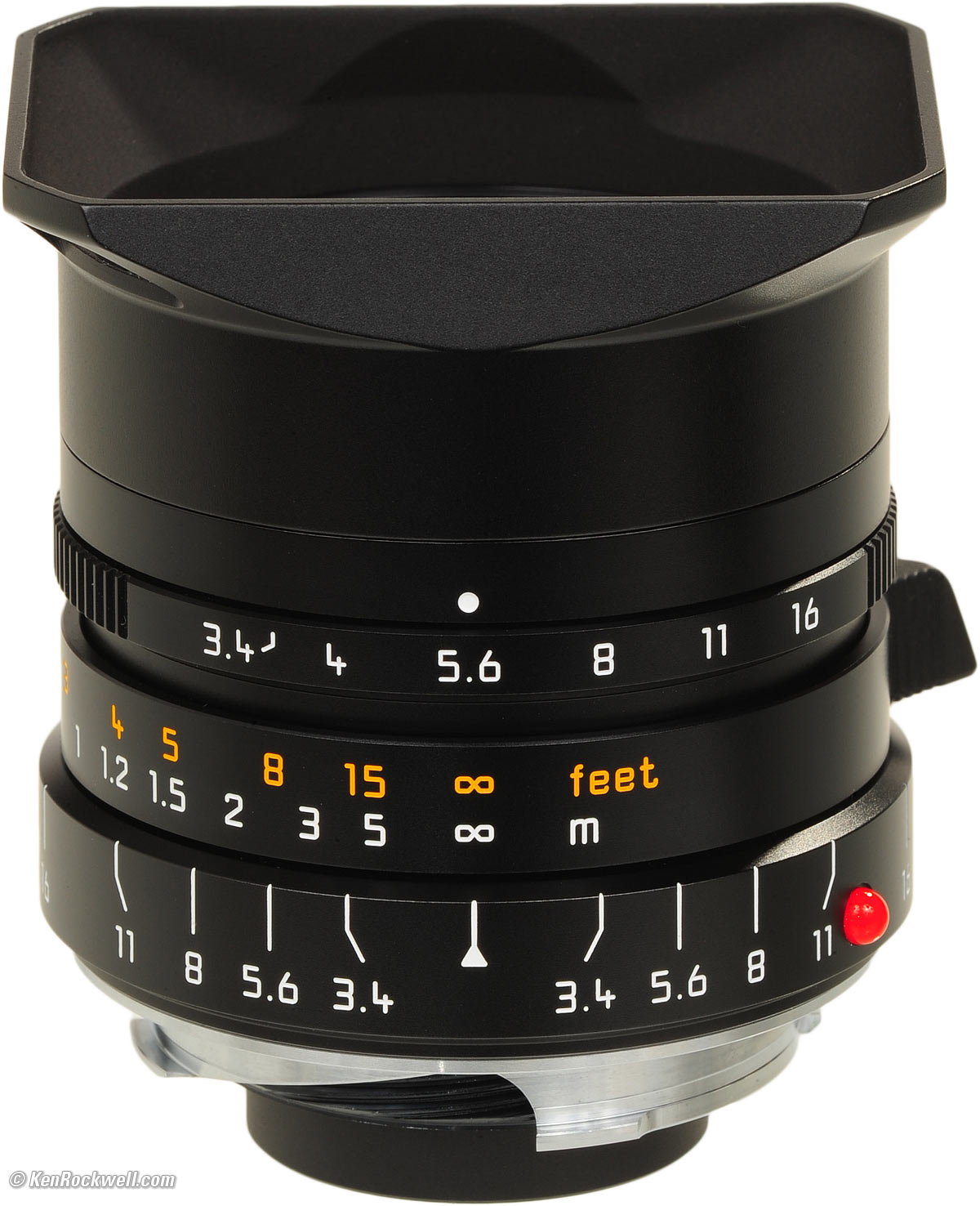
LEICA's best 21mm lens ever. It's small and compact (46mm filters, 263g with hood) and has a 9-bladed diaphragm like 1958's LEITZ 21mm f/4, and works on digital and TTL bodies with spectacular optics.
Summary Tables top
See also Comparison tables of all brands of 21mm lenses
See also Comparison Table on my SUPER-ELMAR-M 21mm f/3.4 page.
Years |
Close |
Optics |
Aperture Blades |
f/min |
TTL Metering |
Filter |
Weight |
|
21/4 |
1958-1963 |
0.4m* |
9/4 Symmetrical |
9 |
f/22 |
no |
39mm |
250.9g |
21/3.4 |
1963-1980 |
0.4m* |
8/4 Symmetrical |
4 |
f/22 |
no* |
48mm, or Series VII in hood |
301g |
21/2.8 |
1980-1997 |
0.38m or 0.7m* |
8/6 Retrofocus |
8 |
f/16 |
Yes |
49mm or 60mm* |
290g |
1997- |
0.7m |
9/7 Retrofocus Aspherical |
8 |
f/16 |
Yes |
55mm |
317g* |
|
2008- |
0.7m |
10/8 Retrofocus Aspherical |
f/16 |
Yes |
Series VIII in hood* |
580g |
||
2011- |
0.7m |
8/7 Retrofocus Aspherical |
9 | f/16 |
Yes |
46mm |
263g w/hood |
* See text.
Years |
Length |
Hood |
Catalog Number |
Price |
|
21mm f/4 |
1958-1963 |
27.00mm | IWKOO (12502N) |
M-mount: Screw Mount: |
$249 new in 1962 ($1,750 w/inflation), $800-1,500 used in 2009 |
21mm f/3.4 |
1963-1980 |
51mm |
12 501 |
11 103 |
$1,000 used |
21mm f/2.8 |
1980-1997 |
46.5mm |
12 537 (49mm) | 11 134 |
$1,000 used |
1997- |
46mm |
11 135 |
$4,300 new |
||
2008- |
66mm |
11 647 |
$6,500 new |
||
2011- |
55mm w/hood |
11 145 |
new |
Recommendations top
LEICA's best 21mm lens ever is the 21mm f/3.4 ASPH of 2011. It's small, light, compact, takes normal filters and has a 9-bladed diaphragm.
For use with non-TTL cameras, I love the original 21mm f/4 SUPER-ANGULON of 1958.
If you're on a budget, the Voigtländer 21mm f/4 (not compared here) works great on 35mm LEICAs.
The 21mm f/1.4 ASPH is for people with special needs. It has 50% more distortion than the 21mm f/2.8 ASPH and 21mm f/3.4 ASPH and has somewhat less sharpness, too, per LEICA's data: 21mm f/2.8 and 21mm f/1.4.
Most significantly, the f/1.4 is too big, too heavy and doesn't take proper filters. Worse, I'll bet you it gets in the way of much of the bottom of any 21mm viewfinder, making composition and shooting a pain compared to a proper sized lens.
Help me help you top
I support my growing family through this website, as crazy as it might seem.
The biggest help is when you use any of these links to Adorama, Amazon, eBay, Ritz, Calumet, J&R and ScanCafe when you get anything, regardless of the country in which you live. It costs you nothing, and is this site's, and thus my family's, biggest source of support. These places have the best prices and service, which is why I've used them since before this website existed. I recommend them all personally.
If you find this page as helpful as a book you might have had to buy or a workshop you may have had to take, feel free to help me continue helping everyone.
If you've gotten your gear through one of my links or helped otherwise, you're family. It's great people like you who allow me to keep adding to this site full-time. Thanks!
If you haven't helped yet, please do, and consider helping me with a gift of $5.00.
As this page is copyrighted and formally registered, it is unlawful to make copies, especially in the form of printouts for personal use. If you wish to make a printout for personal use, you are granted one-time permission only if you PayPal me $5.00 per printout or part thereof. Thank you!
Thanks for reading!
Mr. & Mrs. Ken Rockwell, Ryan and Katie.
Home Donate New Search Gallery Reviews How-To Books Links Workshops About Contact