LEICA 21mm f/3.4 ASPH
SUPER-ELMAR-M (2011-)
World's Sharpest Ultrawide
Intro Specs Performance Usage Compared Recommendations
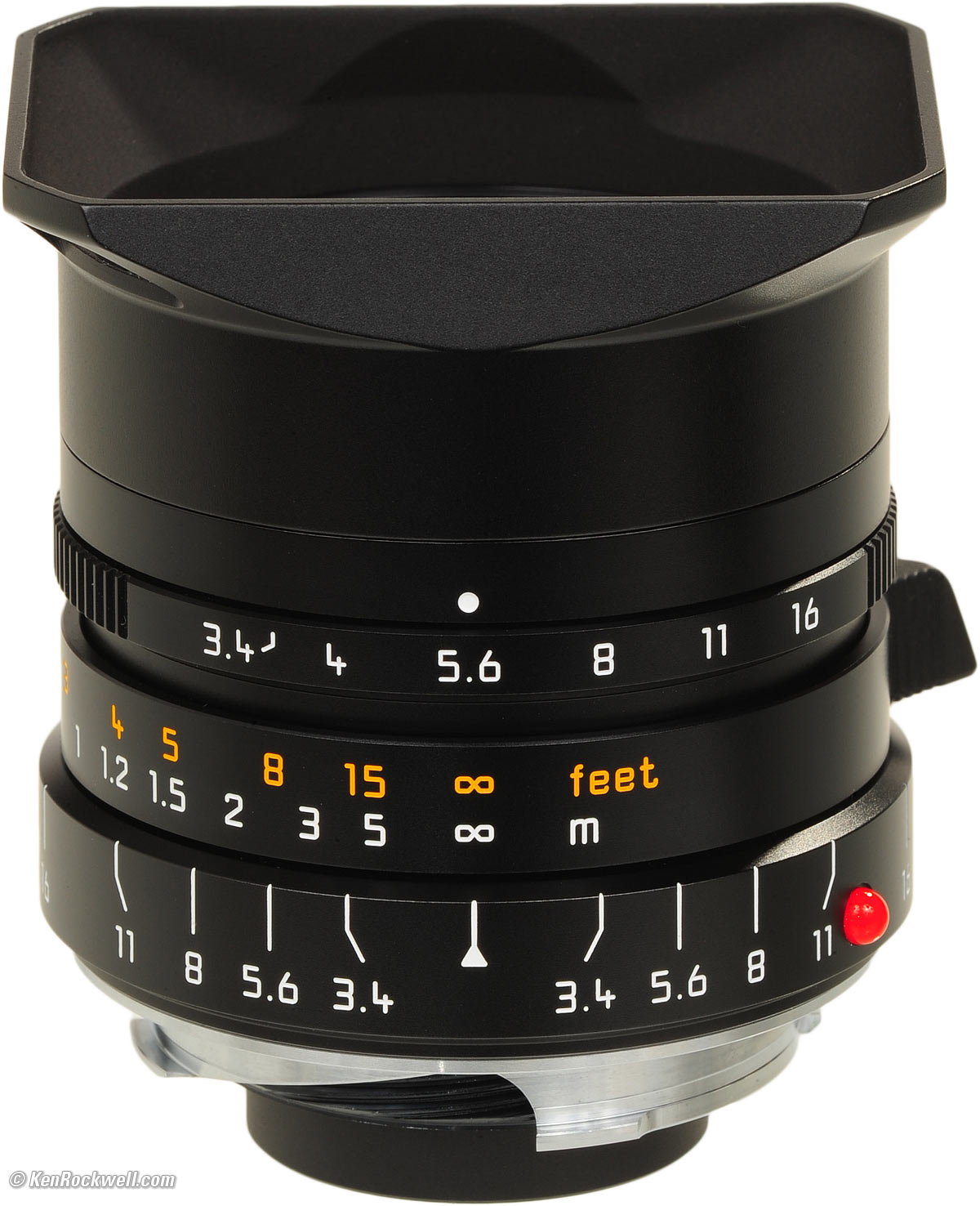
LEICA SUPER-ELMAR-M 21mm f/3.4 ASPH (46mm filters, 9.280 oz./263.1g with hood as shown, $4,000 new). Vergrößern.
$4,000 new at B&H, at Adorama and at Amazon.
About $2,700 used if you know How to Win at eBay.
This all-content, junk-free website's biggest source of support is when you use those or any of these links to approved sources when you get anything, regardless of the country in which you live. Thanks for helping me help you! Ken.
May 2026 Better Pictures LEICA Reviews LEICA Lenses All Reviews
LEICA ELMARIT-M 21mm f/2.8 ASPH (1997-2011)
LEICA SUMMILUX-M 21mm f/1.4 ASPH (2008-today)
LEICA 21mm lenses, 1958 - today
LEICA 21mm Viewfinders, 1958 - today
LEICA 21mm + Sony A7R II versus Canon 20mm USM + 5DS R Comparison01 October 2015
Why Fixed Lenses Take Better Pictures
Sample Image File

Golden Trees and Sunstar, June Lake Loop, 18 Oktober 2013. LEICA M typ 240, shot as DNG at ISO 200 with LEICA SUPER-ELMAR-M 21mm f/3.4 ASPH at about f/11 at 1/60, processed in Apple Aperture 3 into this full-resolution JPG. bigger or full-resolution JPG.

Introduction top
Intro Specs Performance Usage Compared Recommendations

I buy only from these approved sources. I can't vouch for ads below. |



The LEICA SUPER-ELMAR-M 21mm f/3.4 ASPH is LEICA's best ultrawide lens ever made at any price. It is ultrasharp at every aperture, has negligible distortion, is small, light and takes common 46mm filters, and for the first time since 1958's SUPER-ANGULON 21mm f/4, has a proper 9-bladed diaphragm for superior 18-pointed sunstars!
This LEICA SUPER-ELMAR-M 21mm f/3.4 ASPH is better than today's $10,000 LEICA SUMMILUX-M 21mm f/1.4 ASPH because this f/3.4 lens is sharper, less distorted, much smaller, lighter and takes normal filters. Better optics, better handling and less than half the price makes this new f/3.4 lens the choice of the discerning and practical photographer.
This LEICA SUPER-ELMAR-M 21mm f/3.4 ASPH is better than the previous $4,500 LEICA ELMARIT-M 21mm f/2.8 ASPH (1997-2011) because, while they have the same optical performance, this new lens has superior ergonomics, takes more common filters, is smaller, lighter and most importantly because this new lens has a 9-bladed diaphragm for superior 18-pointed sunstars.
Other than speed, the only lens that can outperform this lens in any way is 1958's SUPER-ANGULON 21mm f/4 because it takes standard 39mm filters and has less distortion due to its symmetrical design. The gotchas with the SUPER-ANGULON are that its symmetrical design prevents use with through-the-lens meters, ergonomics are weird with a rotating barrel and that it won't work on digital cameras because its protruding rear elements don't line up optically with the microlenses of sensors leading to wild vignetting and color shifts on the sides.
If you want the best LEICA ultrawide ever made, this LEICA SUPER-ELMAR-M 21mm f/3.4 ASPH is it.
$4,000 new at B&H, at Adorama and at Amazon.
About $2,700 used if you know How to Win at eBay.
Compatibility top
This LEICA SUPER-ELMAR-M 21mm f/3.4 ASPH works perfectly on every LEICA M camera, from 1954's LEICA M3 through today's newest digitals.
History top
See Guide to all LEICA 21mm lenses, 1958 - today for details.
1958-1963
The LEITZ SUPER-ANGULON 21mm f/4 was made for LEICA by Schneider. It's a great lens and one of my favorites because of its 9-bladed diaphragm, tiny size and standard 39mm filter, but sadly newer cameras cannot meter with this great lens. The sensors of digital cameras are not compatible with it either, unless you use some odd software to compensate for edge effects.
On film this is a great lens, but forget it with through the lens meters or any digital camera.
1963-1980
The LEITZ SUPER-ANGULON 21mm f/3.4 was also made for LEICA by Schneider.
It uses a bizarre 48mm filter size and has a hideous 4-bladed diaphragm.
It also is a symmetrical design not usually compatible with TTL metering or digital cameras, so I've never bothered with it.
This old f/3.4 is therefore the least desirable of all LEICA 21mm lenses, so it's amusing that LEICA chose to pimp it up when talking about this new 21mm f/3.4 ASPH. Even if this old f/3.4 was interesting, it wasn't even made by LEICA.
1980-1997
The LEICA ELMARIT 21mm f/2.8 was the first 21mm actually made by LEICA.
It took 49mm filters and later 60mm filters.
1997-2011
The LEICA ELMARIT-M 21mm f/2.8 ASPH is LEICA's first aspherical 21mm lens and has magnificent performance, except for its moronic 8-bladed diaphragm that gives nasty 8-pointed sunstars that scream "shot on Canon!"
It takes 55mm filters, again a weird size for LEICA.
2011-
This LEICA SUPER-ELMAR-M 21mm f/3.4 ASPH is LEICA's best 21mm lens ever. It offers the superior 9-bladed diaphragm for the first time since 1963, as well as superior ergonomics and takes a reasonable 46mm filter.
Yahoo!
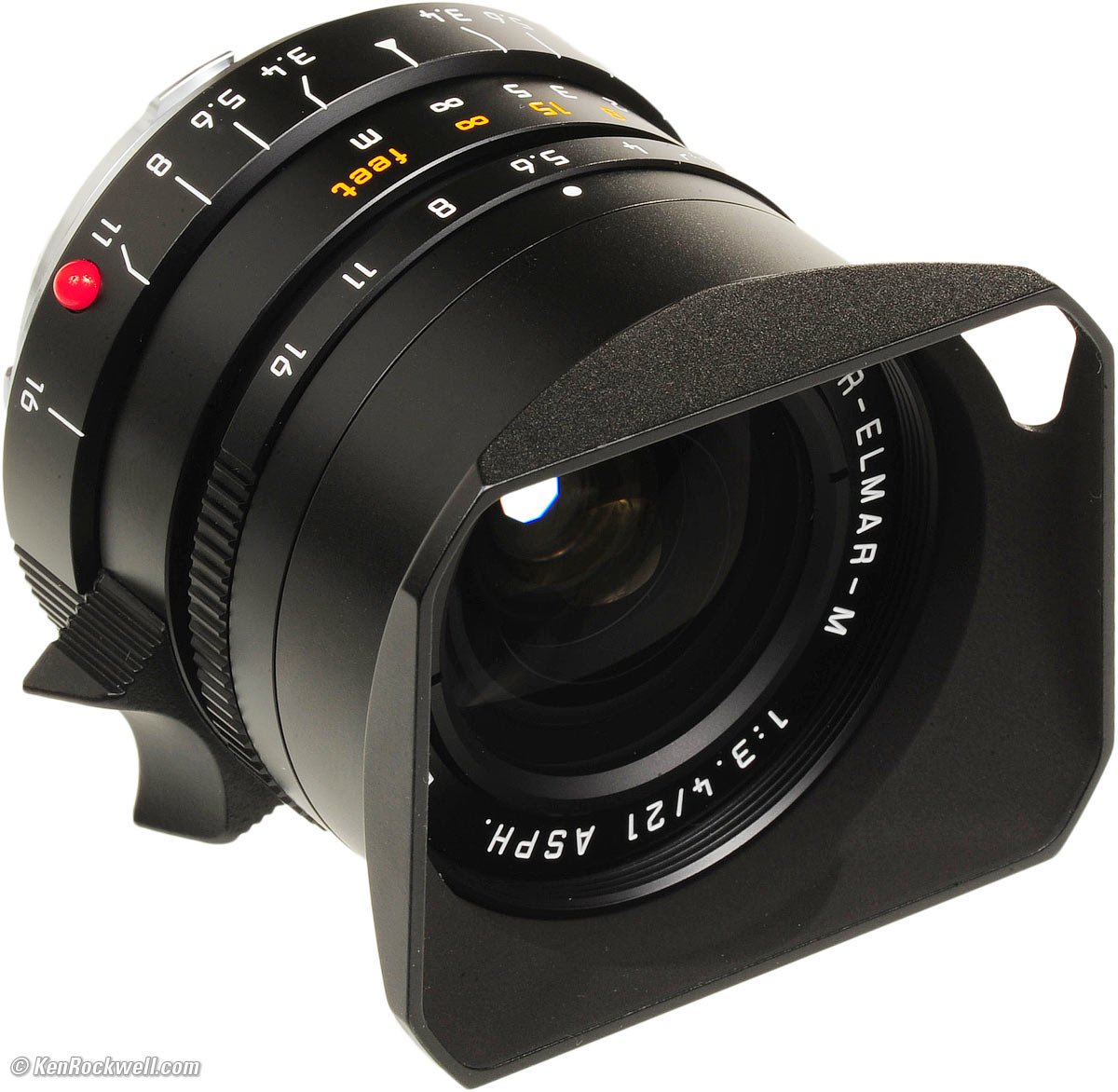
LEICA SUPER-ELMAR-M 21mm f/3.4 ASPH. Vergrößern.
Specifications top
Intro Specs Performance Usage Compared Recommendations
$4,000 new at B&H, at Adorama and at Amazon.
About $2,700 used if you know How to Win at eBay.
Name
LEICA calls this the LEICA SUPER-ELMAR-M 21mm f/3.4 ASPH, Verk. Nr. 11 145.
SUPER-ELMAR means it's an f/3.4 lens.
The -M means it's for LEICA's M-Kameras.
ASPH means it has two aspherical surfaces for higher optical performance.
Optics top
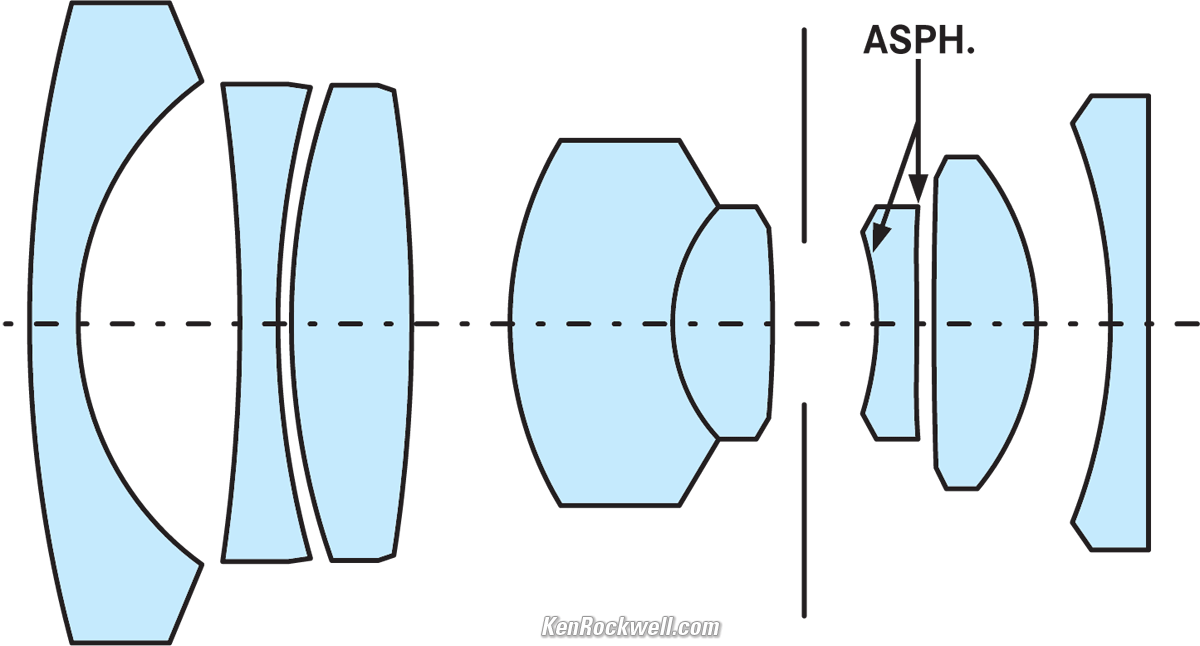
LEICA SUPER-ELMAR-M 21mm f/3.4 ASPH diagram. Vergrößern.
8 elements in 7 groups.
Two aspheric surfaces.
Four elements made with anomalous partial dispersion glass.
Rear surface is planar (flat).
Multi-coated.
Focal Length top
21mm.
The actual focal length of this f/3.4 lens is actually slightly longer than the actual focal length of the LEICA ELMARIT-M 21mm f/2.8 ASPH (1997-2011) to which I compared it directly.
If used on the failed half-frame LEICA M8, it sees only an angle of view similar to what a 28mm lens sees on a real camera.
Angle of View top
90º diagonal (75º on the half-frame M8).
81º horizontal (65º on the half-frame M8).
59º vertical (46º on the half-frame M8).
Diaphragm top
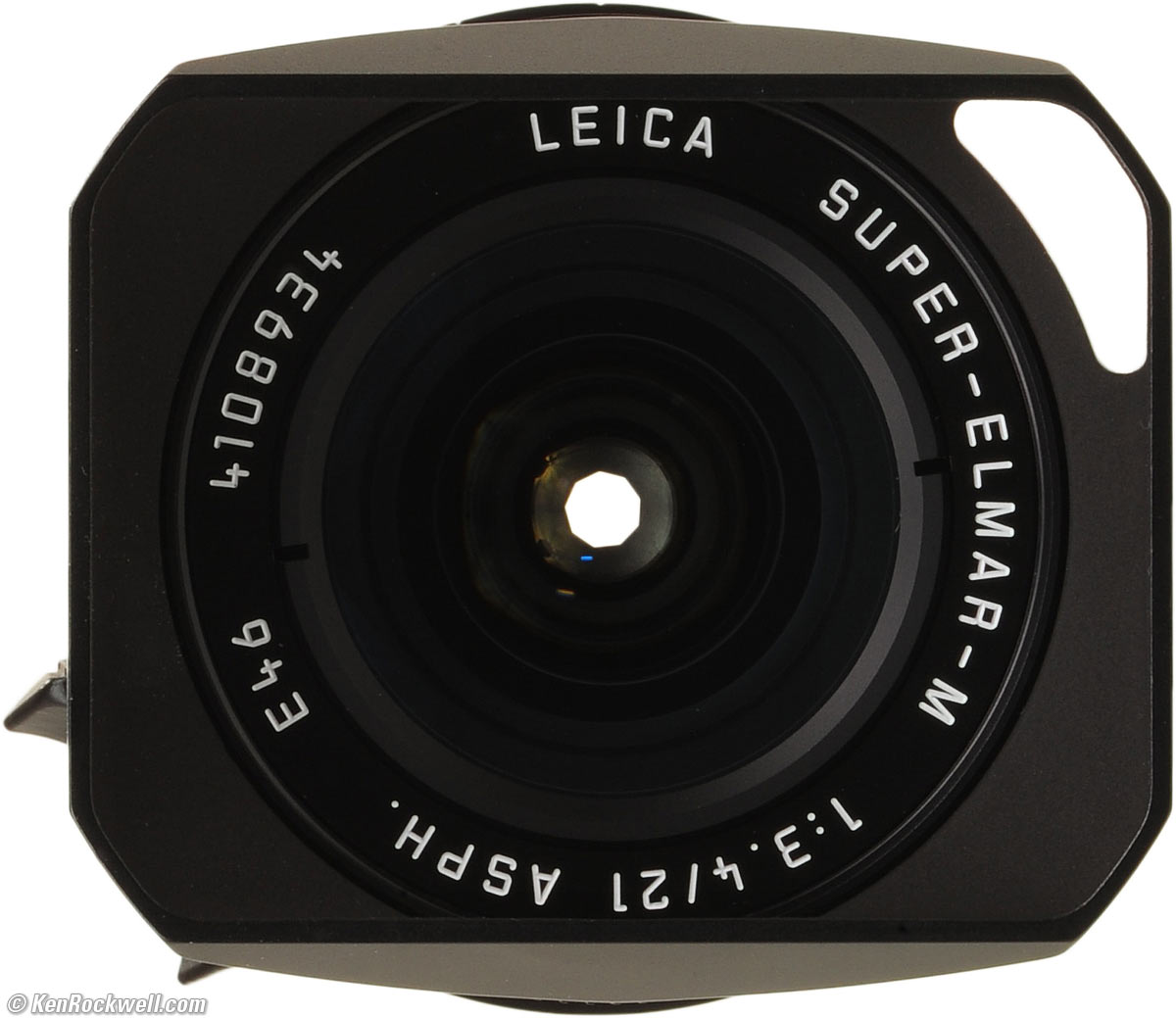
LEICA SUPER-ELMAR-M 21mm f/3.4 ASPH at f/5.6. Vergrößern.
9 straight blades, hallelujah!
This leads to superior sunstars, which is important for an ultrawide lens.
Close Focus
0.7 meters (2.5 feet), marked.
Maximum Reproduction Ratio
1:29.8.
Minimum Subject Dimensions
716 x 1,074mm.
Filters
Common 46 x 0.75 mm (E46).
Avoid filters with extra-long mounting rings like those by Contax and some by B+W; they won't fit inside the hood.
LEICA filters and Hoya filters work great.
Size top
65.92mm (2.596") maximum diameter of hood, measured.
54.83mm (2.159") extension from flange, including hood, measured. (rated 43mm without hood.)
Weight top
9.280 oz. (263.1g), measured, with hood.
9.825 oz. (278.6g), measured with hood and caps.
8.735 oz. (247.65g), measured without hood or caps.
Hood alone: 0.545 oz. (15.4g).
Front 14 212 and rear 14 269 caps: 0.545 oz. (15.45g) together.
Rated 9.2 oz. (260g) by LEICA.
Caps top
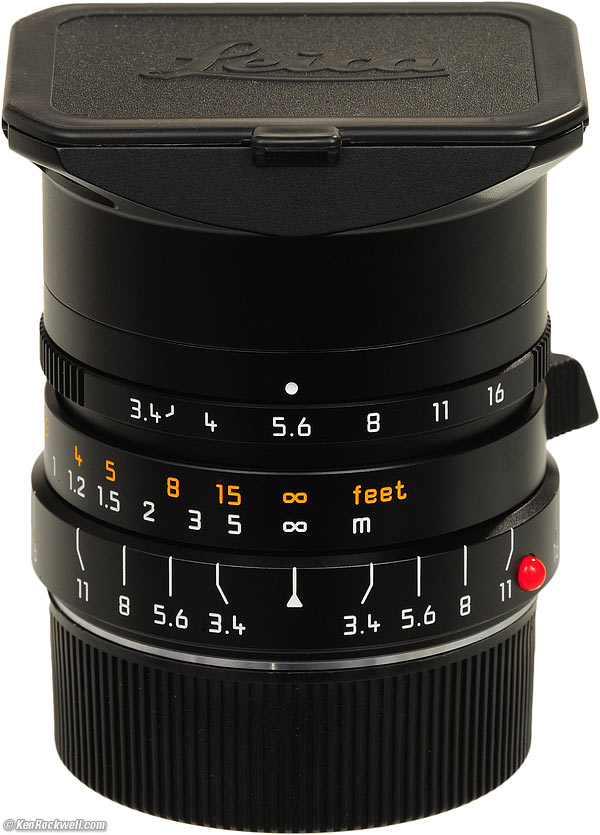
LEICA SUPER-ELMAR-M 21mm f/3.4 ASPH, capped.
The supplied flexible TPE-V plastic Nr. 14 212 hood cap slips over the front of the hood. It is the same cap as used by the new LEICA SUMMILUX-M 35mm f/1.4 ASPH (floating element) and LEICA TRI-ELMAR-M 16-18-21mm f/4 ASPH. The cap cost $27 back in 2011 and $20 in 2026.
The loaned lens seen here came with a standard 14 269 M rear cap. Lenses today come with the new 14 379 hard PC/ABS plastic rear M cap.
Hood top
The supplied 12 465 hood is the same as used by the new LEICA SUMMILUX-M 35mm f/1.4 ASPH (floating element) and LEICA TRI-ELMAR-M 16-18-21mm f/4 ASPH. It used to sell new for $265 in 2011.
The hood is short, tough and simple. It works well and doesn't get in the way.
The hood is LEICA's newest "spin-tight" design that screws on and off, and is hard-keyed for perfect alignment.
Announced top
21 June 2011.
Available top
Possibly by the end of 2011.
Part Numbers top
Complete lens kit: 11 145 (what's included).
Nappa leather case: 439-606.096-000 (included).
14 212 hood cap (TPE-V, included).
12 465 Hood (included).
14 379 rear cap (PC/ABS, included). Replaces older 14 269 rear cap.
14 231 E46 Front Cap (not included, used if you lose the hood).
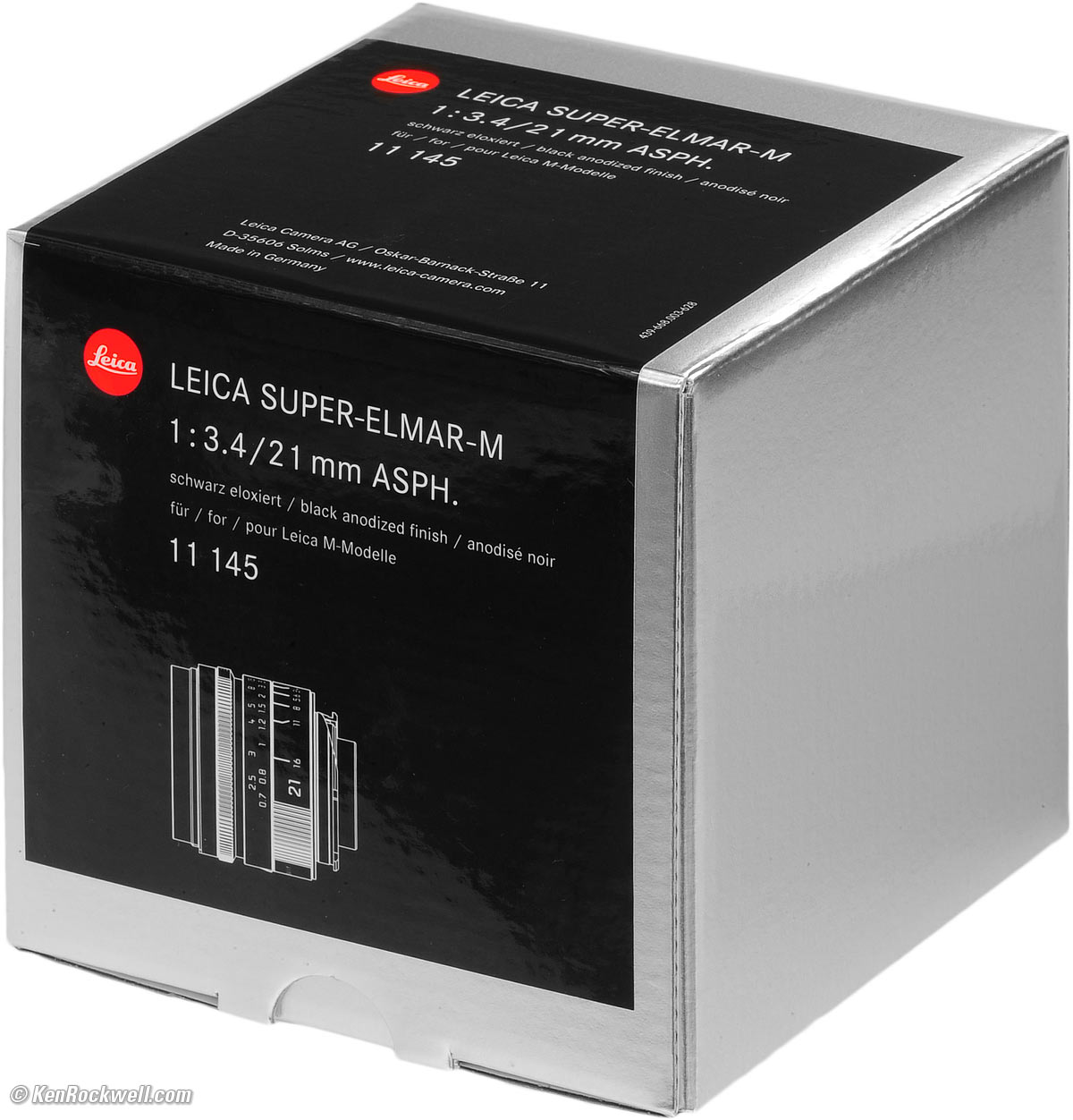
Box, LEICA SUPER-ELMAR-M 21mm f/3.4 ASPH. Vergrößern.
Included top
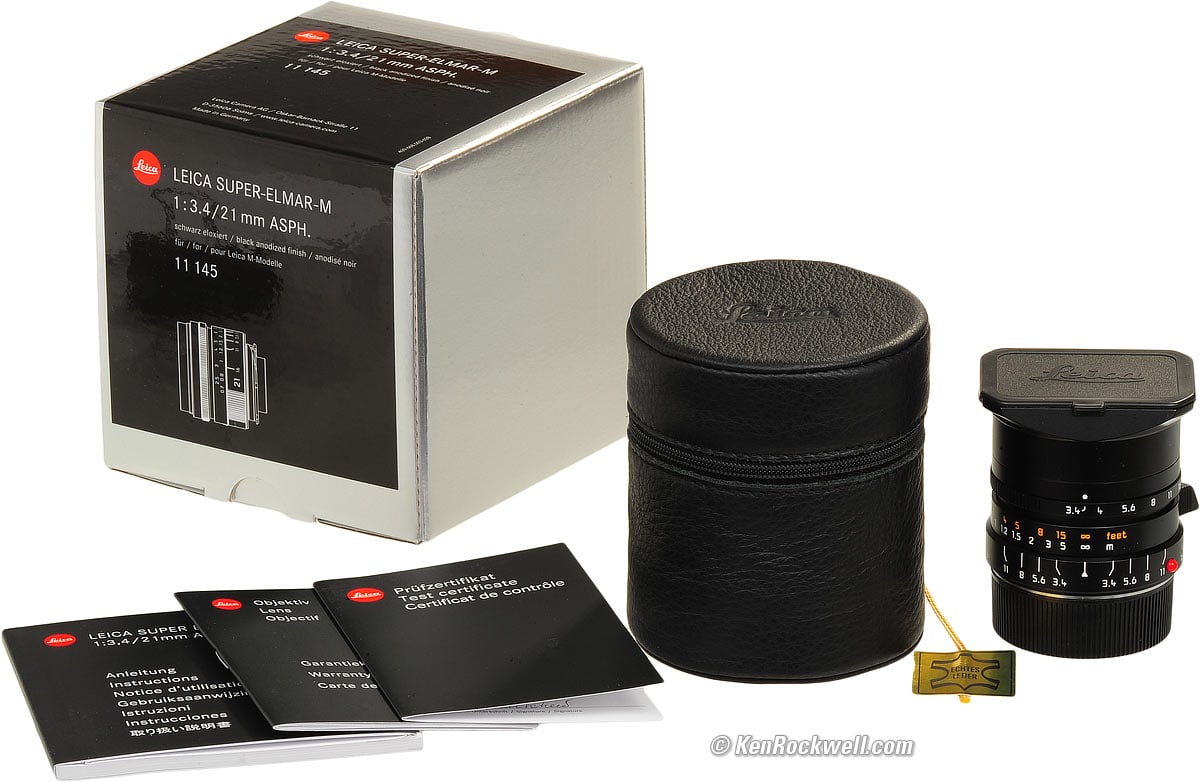
Ensemble: LEICA SUPER-ELMAR-M 21mm f/3.4 ASPH. Vergrößern.
The lens comes with everything seen here, and more!
The lens arrives in a plastic bag with a matching serial number.
This is shipped inside a custom-padded genuine leather case. It has no straps and serves no purpose other than for protecting the SUPER-ELMAR-M 21/3.4 ASPH when it's thrown in the LEICAMAN's luggage.
This case is packed between cut foam spacers on top and bottom of the box.
The box includes an instruction manual, warrantee certificate and serial-numbered Prüfzertifikat (hand-signed test certificate).
The box has a serial number that matches the lens.
The silver box seen here is shipped inside another plain cardboard outer box, also with a matching serial number. The outer box is for protection against germs and fingerprints to insure that your shiny silver box is not touched by anyone other than yourself when you get your lens. This makes five items with serial numbers: lens, bag, Prüfzertifikat, box and germ shroud.
Quality top
MADE IN GERMANY.
Price, USA top
May 2026
$4,000 new at B&H, at Adorama and at Amazon.
About $2,700 used if you know How to Win at eBay.
January 2014
November 2011
Performance top
Intro Specs Performance Usage Compared Recommendations
Overall Bokeh Color Balance Distortion Ergonomics Falloff
Finder Blockage Flare and Ghosts Focus Lateral Color Mechanics
Sharpness Spherochromatism Sunstars
$4,000 new at B&H, at Adorama and at Amazon.
About $2,700 used if you know How to Win at eBay.
Overall performance top
The LEICA SUPER-ELMAR-M ASPH 21/3.4 is LEICA's best 21mm f/3.4 ever, at any price. Its performance is virtually flawless.
Get one; there is no other 21mm lens to consider unless you really need f/1.4, or prefer the original LEITZ SUPER-ANGULON 21mm f/4 for its 39mm filter and lower distortion on film.
Bokeh performance top
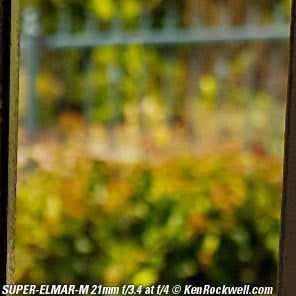
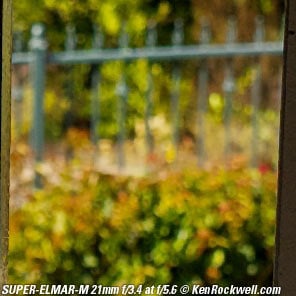
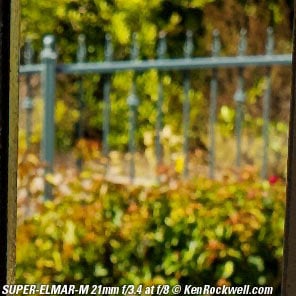
Bokeh, the character of out of focus backgrounds, not simply how far out of focus they are, is unimportant with 21mm lenses because almost nothing is ever out of focus.
The only way to see anything out of focus is to have something very close to the lens, and then focus on it.
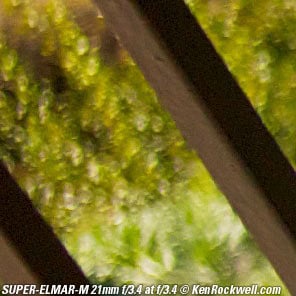
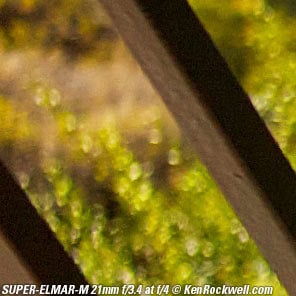
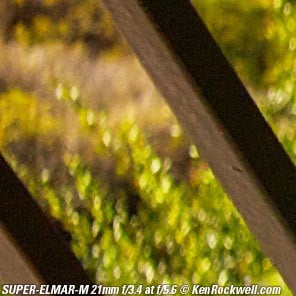
If you do this, bokeh is only fair in the center, and poor on the sides.
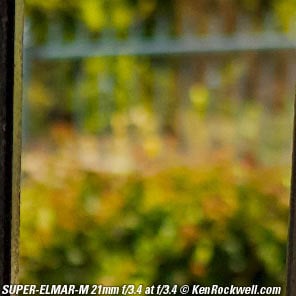
Here are crops from extremely enlarged prints of about 35 x 52" (90 x 135cm), or the equivalent of looking at LEICA M9 images, shot as DNG and converted in Apple Aperture 3, at 100% on-screen.
In these examples, a vertically polarized phase lattice was set up at 1 meter (3 feet) on which the SUPER-ELMAR-M ASPH was focused, while synthetic reference vegetation seen out of focus in the background was at 15 meters (50 feet).
Center Bokeh
 |
 |
 |
 |
Left Edge Bokeh
 |
 |
 |
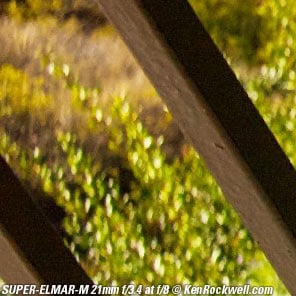 |
Edge bokeh doesn't vary much at the larger apertures because mechanical vignetting hides much of the aperture regardless of the diaphragm setting.
Color Balance performance top
Color balance appears the same as my other LEICA lenses, especially the LEICA ELMARIT-M 21mm f/2.8 ASPH (1997-2011) to which I compared it directly.
On a LEICA M9 and LEICA M9-P, you will see what appears to be a cooler color balance if you don't use a 21mm lens profile. This is because the light from the back of this lens hits these cameras' sensors at a steep angle which causes the light to hit different CCD wells leading to a bluer rendition over most of the frame. When you use a 21mm lens profile, all this technical hocus-pocus goes away and the picture looks normal, but on a digital LEICA without a profile set, the overall image, especially sides, will look bluer.
More at Usage.
Distortion performance top
The LEICA SUPER-ELMAR-M 21mm f/3.4 ASPH has minimal distortion. If you see it, it bulges a little in the center and sucks-out again at the sides.
Its complex distortion doesn't correct completely with Photoshop's lens distortion filter; some waviness remains after correction. These aren't facts or specifications, they are the results of my research that requires hours of photography and calculations on the resulting data.
Correct with |
|
10' (3m) |
-1.5 |
© 2011 KenRockwell.com. All rights reserved.
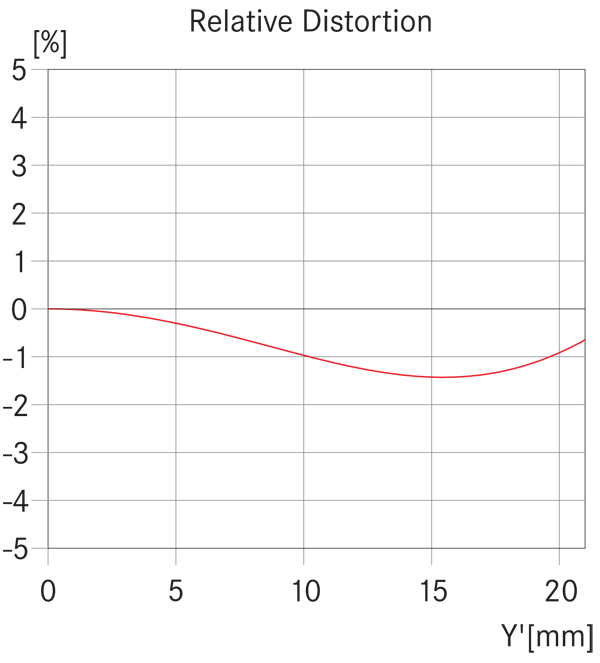
LEICA's claimed distortion.
Ergonomics performance top
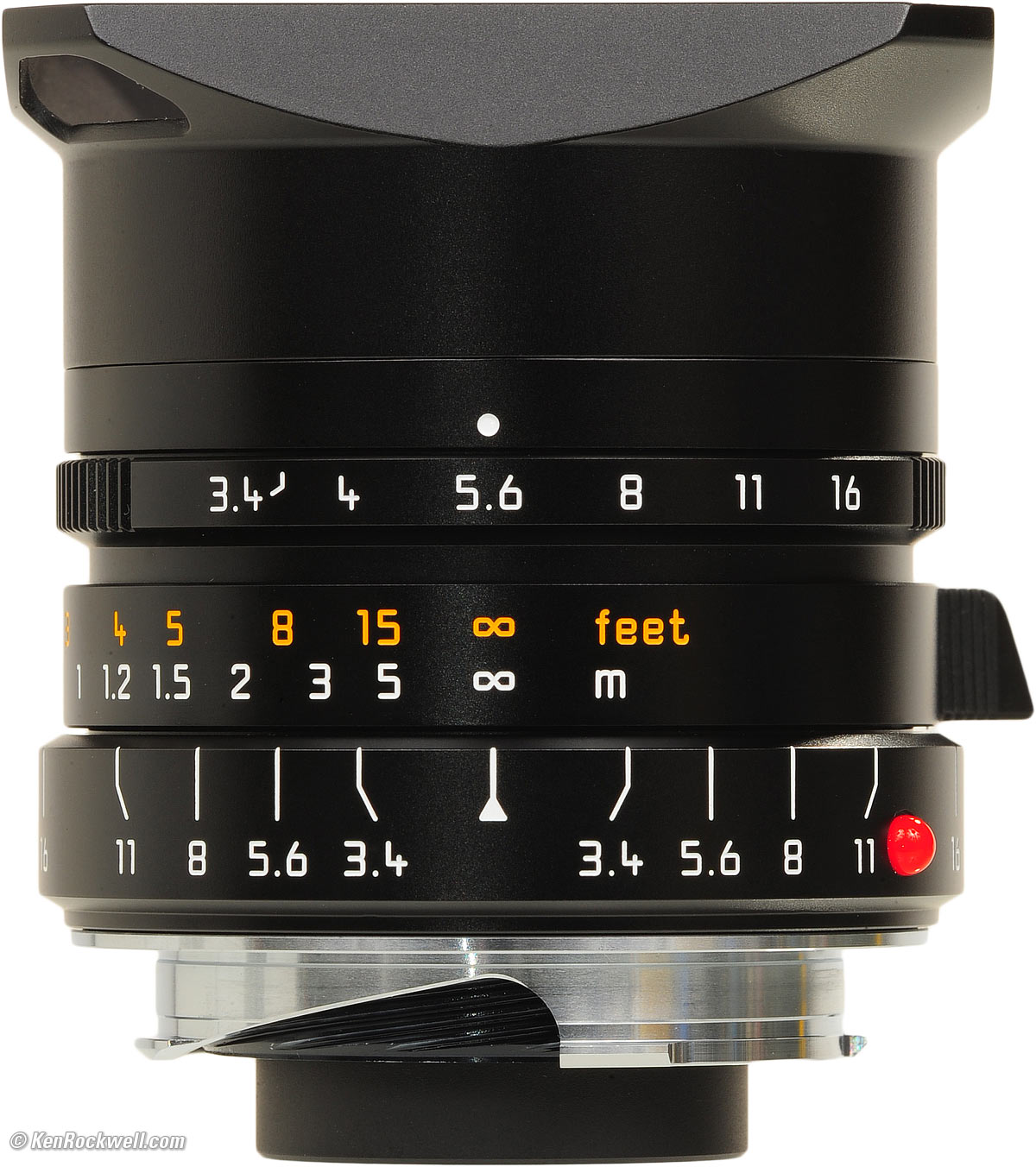
LEICA SUPER-ELMAR-M 21mm f/3.4 ASPH. Vergrößern.
Ergonomics are perfect. They are the best of any 21mm LEICA lens ever.
The hood is solid metal. It's not moving no matter what you bang against it.
The aperture ring is exactly what we expect from LEICA; it's the same as other current lenses.
Likewise, focus is the same as other LEICA lenses made these past 30 years or so: perfect. This sample's focus was slightly stiffer than the focus of my LEICA ELMARIT-M 21mm f/2.8 ASPH.
Falloff (darker corners) performance top
The LEICA 21mm f/3.4 SUPER-ELMAR-M ASPH has no significant falloff when used with a lens profile on the LEICA M9.
If used without a profile, it appears to have significant falloff as a result of limitations of the M9's and M9-P's sensor.
I've greatly emphasized it below by shooting a gray field and presenting it against another gray field.
Unlike most of my lens reviews, I've shown these results in color so that shading variations and peripheral color shift are visible. For other lenses, I show these in monochrome for simplicity.
As of this writing (08 November 2011), the M9's most recent 1.162 firmware is defective (it doesn't always bother to write files), so my M9 is running the last good firmware version (1.138). Version 1.138 predates this lens' release, so my M9 lacks the exact profile for this lens — and love you readers as I do, I cannot load the 1.162 firmware just to try this profile at the expense of losing my images. Therefore I used the manual profile for the LEICA ELMARIT-M 21mm f/2.8 ASPH, which works great. More at Usage.
LEICA 21mm f/3.4 SUPER-ELMAR-M ASPH light falloff on M9 at infinity: No lens profile:
© 2011 KenRockwell.com. All rights reserved.
With 21mm f/2.8 ASPH 11 135/11 897 profile:
© 2011 KenRockwell.com. All rights reserved.
|









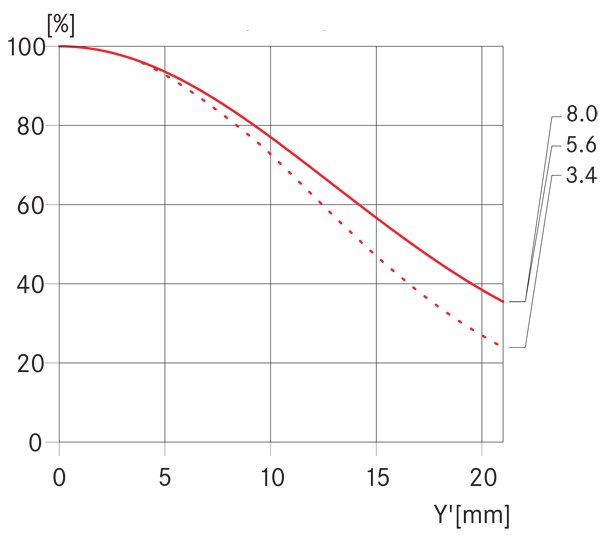
LEICA's claimed illuminance at f/3.4, f/5.6 and f/8.
LEICA rates it as 2.1 stops corner falloff at f/3.4 and 1.6 stops at f/5.6. (1.2 stops at f/3.4 and 1.0 stops at f/5.6 on the old half-frame M8).
Finder Blockage performance top
There is only the slightest blockage at the bottom of a shoe-mounted 21mm finder.
Flare and Ghosts performance top
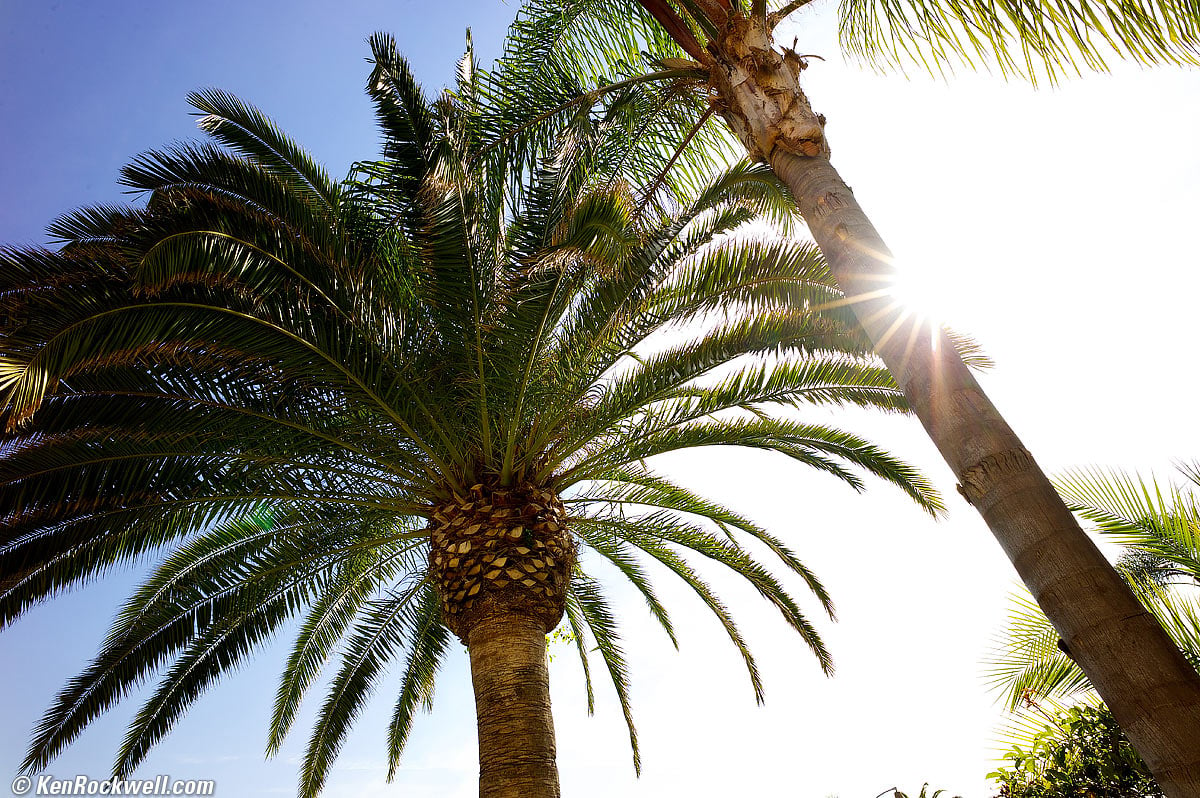
Blinding direct view of midday sun at f/8, Aviara Drive, LEICA M9. Vergrößern.
Flare and ghosts aren't a problem. The only way to see ghosts or flare is to have the disk of the sun in the image, and expose for a much darker foreground against which one slight blob opposite the sun just might be able to be seen.
Focus performance top
Focus Accuracy
Focus accuracy is a personal issue between your sample of body and your sample of lens. No two samples match if you start looking too hard; this is a limitation of the mechanical technology.
This said, this particular sample focuses perfectly, as I'd expect for any 21mm lens.
21mm lenses have such huge depths-of-field that I've never seen one that didn't focus perfectly.
Focus Feel
Focus feels the same as other current LEICA lenses, if not a tiny bit stiffer.
There is never any play.
Lateral Color Fringes performance top
There are no lateral color fringes as shot on a LEICA M9.
Materials and Construction performance top
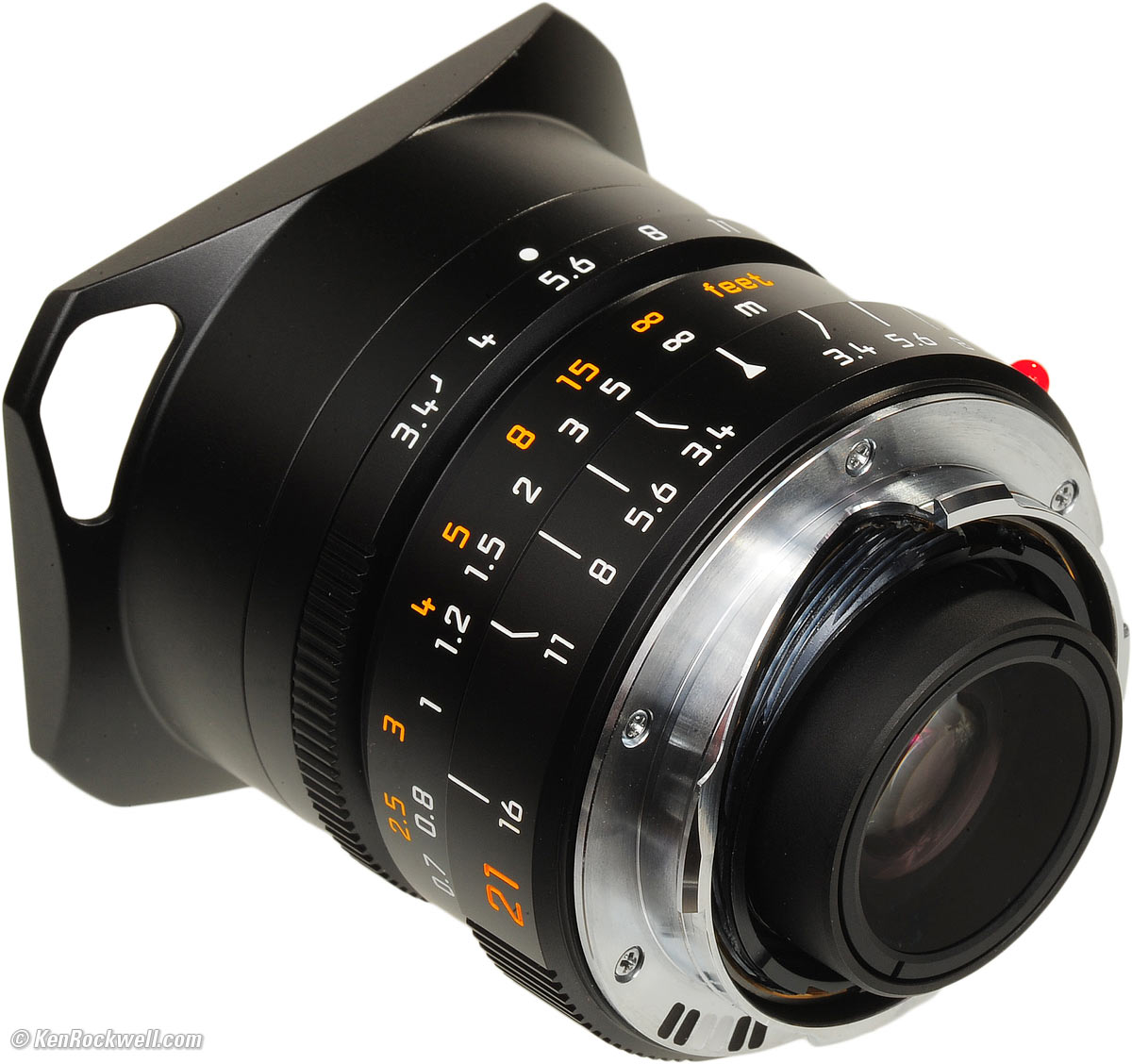
Rear, LEICA SUPER-ELMAR-M 21mm f/3.4 ASPH. Vergrößern.
This SUPER-ELMAR-M ASPH is extremely well made. It's made the same as all other current LEICA lenses.
As expected, it's all black-anodized aluminum, with brass focus helicoids and mount, a solid aluminum threaded hood, and a red plastic index ball.
All markings are engraved and filled with paint.
Bravo!
Sharpness performance top
Warning 1: Image sharpness depends more on you than your lens.
Warning 2: Lens sharpness doesn't mean much to good photographers.
With these caveats, this SUPER-ELMAR-M 21mm f/3.4 ASPH is super-sharp at every setting. LEICA has never made a sharper 21mm lens.
Per my optical range tests, it's as sharp as the previous LEICA ELMARIT-M 21mm f/2.8 ASPH (1997-2011), both of which are spectacular.
This f/3.4 lens is rated slightly sharper than today's LEICA SUMMILUX-M 21mm f/1.4 ASPH. I don't have one of the f/1.4s here for direct comparison.
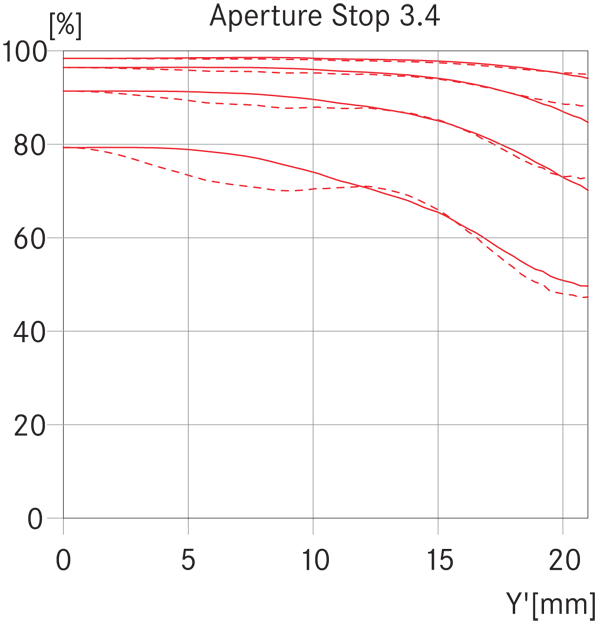
LEICA's claimed MTF at 5, 10, 20 und 40 cyc/mm.
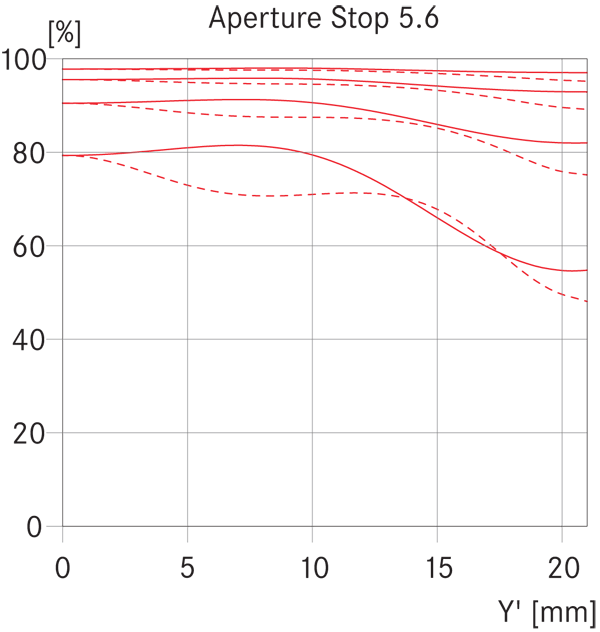
LEICA's claimed MTF at 5, 10, 20 und 40 cyc/mm.
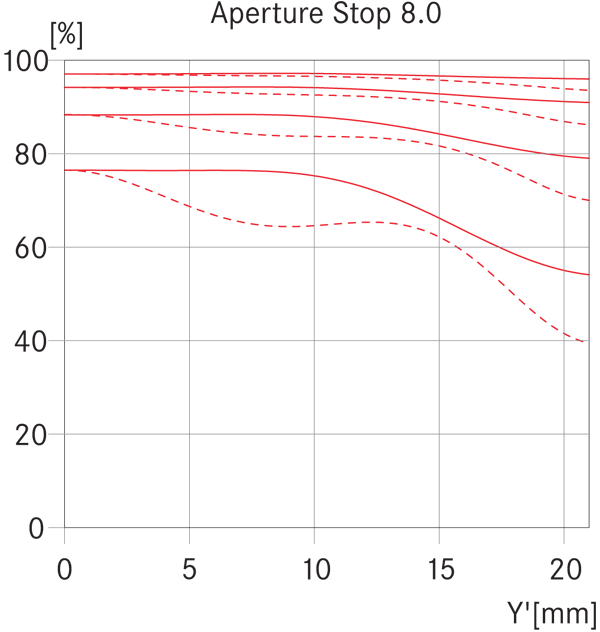
LEICA's claimed MTF at 5, 10, 20 und 40 cyc/mm.
LEICA's MTF curves agree with what I saw: no variation in sharpness with aperture, and sharp corner-to-corner.
Spherochromatism performance top
The LEICA SUPER-ELMAR-M 21mm f/3.4 ASPH has no visible spherochromatism, as expected.
Spherochromatism, mistakenly called "color bokeh" by laymen, is when out-of-focus highlights take on colored fringes, usually green and magenta.
Sunstars performance top
18-point sunstars at f/8. LEICA M9. Vergrößern.
The SUPER-ELMAR-M ASPH's straight 9-bladed diaphragm begets magnificent uniform 18-pointed sunstars on brilliant points of light.
Usage top
Intro Specs Performance Usage Compared Recommendations
$4,000 new at B&H, at Adorama and at Amazon.
About $2,700 used if you know How to Win at eBay.
Finders
You will need to use your choice of shoe-mounted 21mm viewfinder.
Metering
TTL and shoe-mounted LEICAMETERS of all LEICA and lesser cameras of all ages work great with this 21/3.4.
Lens Profiles (für digital LEICAs only)
Use a 21mm lens profile on the LEICA M9 or LEICA M9-P.
Without a lens profile, images sides and corners will be much darker and bluer.
As of this writing (08 November 2011), the LEICA M9's most recent 1.162 firmware is defective (it doesn't always bother to write files), so of course my M9 is running the last good firmware version 1.138. Version 1.138 predates this lens' release, so therefore my M9 lacks the exact profile for this lens.
I wouldn't suggest loading the 1.162 firmware just to get the proper profile for this lens at the risk of losing images.
I use the manual profile for the LEICA ELMARIT-M 21mm f/2.8 ASPH, and it works great.
Hood
The hood screws on and off.
Unscrew it to mount filters.
Filters
Since the hood screws over your filter, the hood won't screw over extra-fat filters like the Contax and some by B+W.
LEICA filters and Hoya filters work great, as do most Heliopan and B+W filters.
Compared top
Intro Specs Performance Usage Compared Recommendations
$4,000 new at B&H, at Adorama and at Amazon.
About $2,700 used if you know How to Win at eBay.
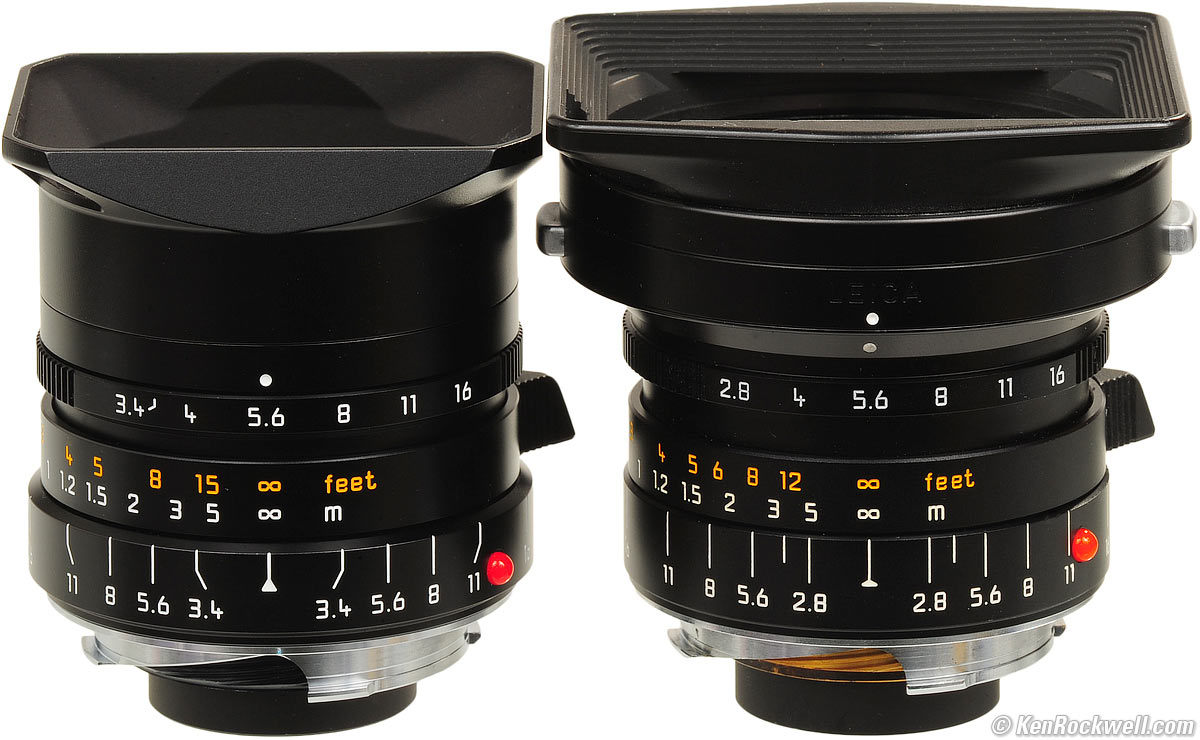
LEICA SUPER-ELMAR-M 21mm f/3.4 ASPH ünd LEICA ELMARIT-M 21mm f/2.8 ASPH. Vergrößern.
Per my optical range tests, this f/3.4 lens as sharp at f/4 and smaller as the previous LEICA ELMARIT-M 21mm f/2.8 ASPH (1997-2011). This f/3.4 lens is sharper at f/3.4 than the f/2.8 lens is at f/2.8.
This f/3.4 lens is rated slightly sharper than today's LEICA SUMMILUX-M 21mm f/1.4 ASPH. I don't have one of the f/1.4s here for direct comparison.
| Dates | 2011- |
2008- |
1997-2011 |
1980-1997 |
1963-1980 |
1958-1963 |
| Color | black |
black |
black, also silver |
black |
Black or silver |
silver |
| Filter | 46mm |
Series VIII or 82mm |
55mm |
55mm, earlier 49mm |
48mm or Series VII |
39mm |
| Length | 55mm w/hood |
66mm |
46mm |
46.5mm |
51mm |
27mm |
| Finder Blockage | minor |
major |
minor |
none |
||
| Optics | 8/7 retrofocus aspherical |
10/8 retrofocus aspherical |
9/7 retrofocus aspherical |
8/6 retrofocus |
8/4 symmetrical |
9/4 symmetrical |
| Diaphragm | 9 blades |
8 blades |
8 blades |
4 blades! |
9 blades |
|
| Sunstars | 18 points |
8 points |
8 points |
4 points! |
18 points |
|
| Aperture ring clicks | half stops |
half stops |
half stops |
full stops |
||
| f/min | f/16 |
f/16 |
f/16 |
f/16 |
f/22 |
f/22 |
| Close focus | 0.7m |
0.7m |
0.7m |
0.7m, earlier 0.38m |
0.4m |
0.4m |
| Distortion, 3m | -1.5, complex |
+1.0 simple |
||||
| Weight | 263g w/hood |
580g |
347g w/hood |
290g |
301g |
251g |
| Price, 11/2011 | $2,995 |
$6,495 New |
$3,500 |
$1,300 used |
$1,500 used |
$1,000 used |
| Price, 05/2026 | $4,000 |
$9,840 New |
Recommendations top
Intro Specs Performance Usage Compared Recommendations
As I've been saying, this is LEICA's best 21mm lens ever. I had my own on order only an hour after I got this loaner in my hands.
This 21/3.4 is a lens for photographers. The LEICAMAN doesn't make photographs, so he prefers the big, ugly and expensive LEICA SUMMILUX-M 21mm f/1.4 ASPH instead as a toy, but don't you be fooled. The f/1.4 lens is only for LEICAMEN and for use only if you really need faster apertures for use in very low light. Because of the short focal length, even at f/1.4 there isn't much out-of-focus. If you need to isolate a subject, use a longer lens.
I use a clear (UV) protective filter instead of a cap (exactly like an iPhone) so I'm always ready to shoot instantly. I only use a cap when I throw this in a bag with other gear without padding — which is never. The UV filter never gets in the way, and never gets lost, either.
If you want a filter worthy of LEICA, go for the LEICA 13033 E46 UVa II in black, the LEICA 13034 E46 UVa II in silver.
For the discount crowd, look at the Fujifilm PRF-46 Protector Filter or the water-resistant multicoated Hoya NXT+ 46mm UV, multicoated B+W 010 MRC MASTER, or any multicoated Hoya filter.
All these filters are just as sharp and take the same pictures, the difference is how much abuse they'll take and stay clean and stay in one piece. Since filters last a lifetime or more, there's no reason not to buy the best as it will last you for the next 50 years; I'd get the genuine LEICA filter. Filters aren't throwaways like digital cameras which we replace every few years, like it or not. I'm still using filters I bought back in the 1970s!
It's an exotic lens and isn't always in stock. Order it and be patient:
$4,000 new at B&H, at Adorama and at Amazon.
About $2,700 used if you know How to Win at eBay.
© Ken Rockwell. All rights reserved. Tous droits réservés. Alle Rechte vorbehalten. Alla rättigheter förbehållna. Toate drepturile rezervate. Niciun vampir nu a fost implicat în crearea acestei lucrări. Omnia jura reservata. Ken Rockwell® is a registered trademark.
Help Me Help You top
I support my growing family through this website, as crazy as it might seem.
The biggest help is when you use any of these links when you get anything. It costs you nothing, and is this site's, and thus my family's, biggest source of support. These places always have the best prices and service, which is why I've used them since before this website existed. I recommend them all personally.
If you find this page as helpful as a book you might have had to buy or a workshop you may have had to take, feel free to help me continue helping everyone.
If you've gotten your gear through one of my links or helped otherwise, you're family. It's great people like you who allow me to keep adding to this site full-time. Thanks!
If you haven't helped yet, please do, and consider helping me with a gift of $5.00.
As this page is copyrighted and formally registered, it is unlawful to make copies, especially in the form of printouts for personal use. If you wish to make a printout for personal use, you are granted one-time permission only if you PayPal me $5.00 per printout or part thereof. Thank you!
Thanks for reading!