Home Donate New Search Gallery Reviews How-To Books Links Workshops About Contact
Nikon
200mm f/4
NIKKOR-Q (1961-1976)
© 2005-2012 KenRockwell.com

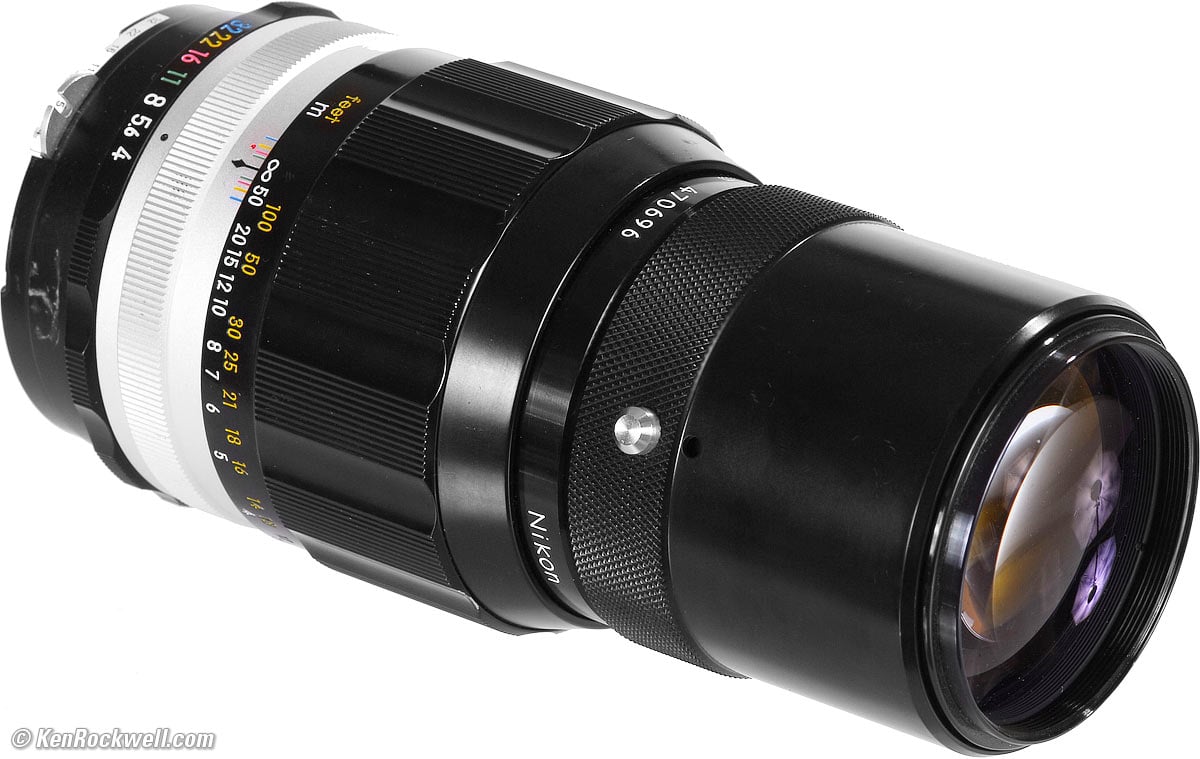
Nikon NIKKOR-Q 200mm f/4. (FX, DX and 35mm coverage, 52mm filters, 22.020 oz./624.3 g, 6.6'/2 m close focus, about $75 used). enlarge. This free website's biggest source of support is when you use these links, especially this link directly to them at eBay (see How to Win at eBay), when you get anything, regardless of the country in which you live. Thanks! Ken.
July 2012, 2005 More Nikon Reviews Nikon Lenses All Reviews
Nikon 200mm Lens Center Sharpness Compared
Nikon 200mm Corner Sharpness Compared
Other Nikon 200mm f/4 lenses:
200mm Micro-NIKKOR AF-D (1993-today, AF)
200mm f/4 AI-s Micro-NIKKOR (1978-2005) (1978-2005, manual focus)
200mm f/4 AI-s (1981-1996)
200mm f/4 AI (1977-1981)
200mm f/4 Q (1961-1976) (this lens)
Introduction

Adorama pays top dollar for your used gear.
I use these stores and ScanCafe. I can't vouch for ads below.
|

This lens, introduced in 1961, is a bargain and a great performer.
I got my first one, in really beat up and ugly shape, for $10. No, it wasn't the one you see above. I sold mine before I made this website. This one above was donated to me by Guy Prince in California.
Of course you need to have it converted to AI for about $25 before you can mount it on a modern camera like a D70. These photos are a converted sample; not converted properly with the correct updated Nikon parts, but cut on a lathe:
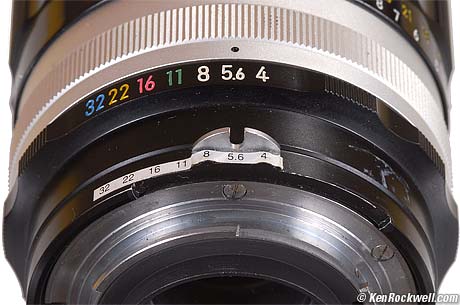
A hatchet-job conversion with a lathe and a sticker.
The FE, FM and F4 were the last cameras that can use these lenses without modification. The F6 can be modified for these ancient lenses.
The optics are the same from 1961 - 1976. Multicoating was added in 1973, thus the added "C" designation.
Specifications
It has four elements in four groups.
This ancient version is a little bigger and heavier than the AI versions. The Q weighs 630g and is 163.0mm long by 72mm in diameter. I measured 6-1/2" long and 18-1/2 oz.
It has a swell built-in telescoping hood (you can't get that on the 80-200 AFS) and takes normal 52mm filters. Of course it's built like they used to: all studly metal.
It focuses down to about 6 or 7 feet; not very close. That's the main optical disadvantage of these old lenses.
This ancient lens only has a six-bladed diaphragm and stops down to f/32, a stop smaller than the 80-200 AF-S that cost me over one-hundred times as much.
Performance
Optically I found mine to be as good as the newer AI and AI-s versions, even though the Q version has only four elements in four groups while the AI versions have five.
It has no distortion, again superior to zooms.
It is single-coated in blue. This probably explains its very slightly warm color balance. I actually prefer this color balance to the neutral balance of most modern Nikkors.
It has slight magenta/green secondary lateral chromatic aberration visible in the lab but not in my photos.
It was reviewed in the May, 1962 Modern Photography magazine, page 79. They found optimum performance at f/11.
By aperture:
f/4: It's sharp all
over. There is some of the usual light falloff.
f/5.6: the falloff is gone and it's sharp all over. I didn't see any improvement
by stopping down.
Recommendations
Optically this is a swell lens. It's not difficult to make a sharp 200mm f/4 lens. The only things that have been improved in the past 40 years have been to make them smaller, focus closer and zoom.
This is a perfectly good lens if you want a very sharp telephoto. Heck, it's a much better performer than the 70-300 ED many amateurs are buying today; it just lacks the convenience.
Go here if you need to have it AI converted for use on modern cameras. John converted my lens and did a very careful job.
Help me help you top
I support my growing family through this website, as crazy as it might seem.
The biggest help is when you use any of these links when you get anything, regardless of the country in which you live. It costs you nothing, and is this site's, and thus my family's, biggest source of support. These places have the best prices and service, which is why I've used them since before this website existed. I recommend them all personally.
If you find this page as helpful as a book you might have had to buy or a workshop you may have had to take, feel free to help me continue helping everyone.
If you've gotten your gear through one of my links or helped otherwise, you're family. It's great people like you who allow me to keep adding to this site full-time. Thanks!
If you haven't helped yet, please do, and consider helping me with a gift of $5.00.
As this page is copyrighted and formally registered, it is unlawful to make copies, especially in the form of printouts for personal use. If you wish to make a printout for personal use, you are granted one-time permission only if you PayPal me $5.00 per printout or part thereof. Thank you!
Thanks for reading!
Mr. & Mrs. Ken Rockwell, Ryan and Katie.
Home Donate New Search Gallery Reviews How-To Books Links Workshops About Contact