Home Donate New Search Gallery Reviews How-To Books Links Workshops About Contact
Nikon
50mm f/2
NIKKOR-H and AI (1964-1979)
© 2014 KenRockwell.com. All rights reserved.
Intro Specs Performance Compared Usage Recommendations More


Nikon NIKKOR-H Auto 50mm f/2 (1964-1972, FX, DX and 35mm coverage, 52mm filters, 7.3 oz./206g, 2'/0.6 m close focus, about $50 used). enlarge. I'd get it at this link directly to them at eBay (see How to Win at eBay).
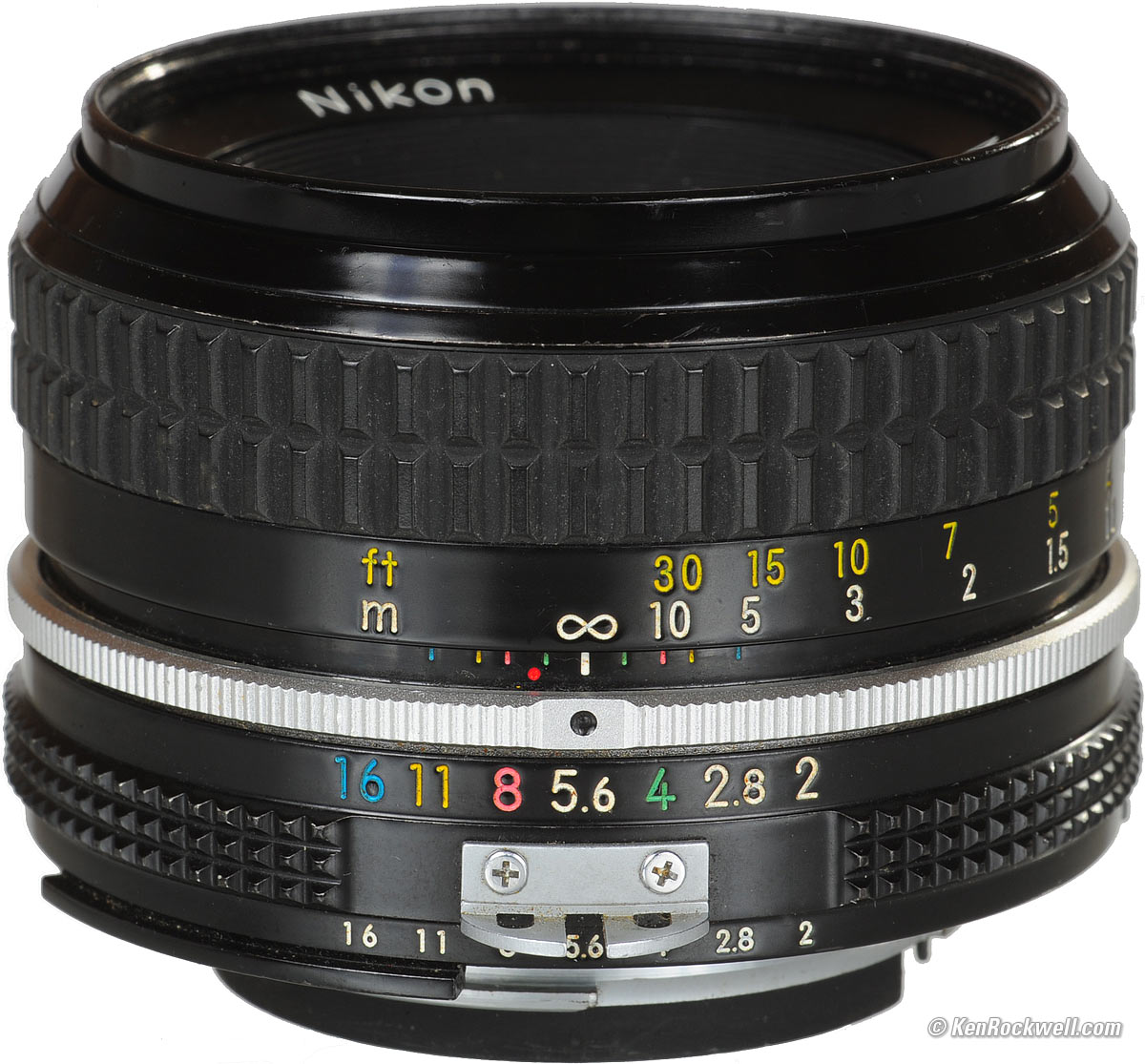
Nikkor 50mm f/2 AI (1974-1979, FX, DX and 35mm coverage, 52mm filters, 7.8 oz./220g, 1.5'/0.45 m close focus, about $50 used). enlarge. I'd get it at this link directly to them at eBay (see How to Win at eBay).
This free website's biggest source of support is when you use those or any of these links to approved sources when you get anything, regardless of the country in which you live — but I receive nothing for my efforts if you take the chance of buying elsewhere. I get no government hand-outs and run no pledge drives to support my research, so please always use any of these links to approved sources for the best prices, service and selection whenever you get anything. Thanks for helping me help you! Ken.
August 2014 Nikon Reviews Nikon Lenses All Reviews
Introduction top
Intro Specs Performance Compared Usage Recommendations More

Adorama pays top dollar for your used gear.
|

Nikon's first SLR lens was the original NIKKOR-S 5cm f/2 sold from June 1959 through 1963. It had seven elements and was a double-Gauss design modified with an extra front element to make it a slight retrofocus design to clear the rear flipping mirror. I'm not reviewing that lens here.
The lens I am reviewing is this 6-element Nikon 50mm f/2, which was introduced in January 1964. It was first called the NIKKOR-H Auto. Its optics were unchanged through the AI NIKKOR version which was made until 1979. Multicoating was added in 1972. Except for the multicoating, nothing changed optically from 1964-1979; it's all the same lens but in many different cosmetic variations.
I got this along with my Nikon F body for $75 in July 2007.
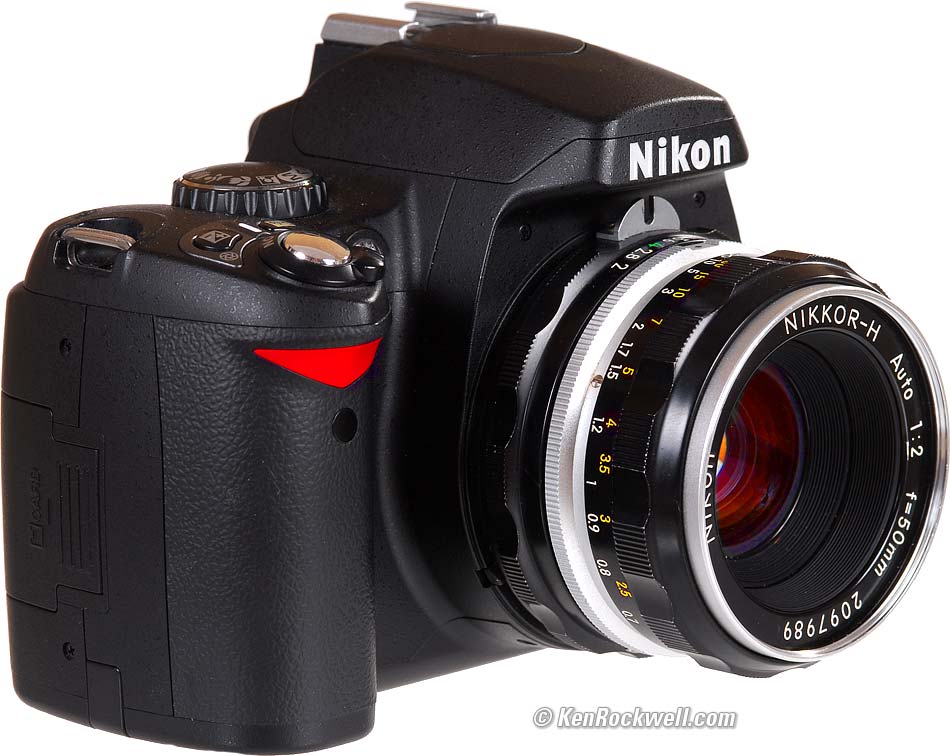
Nikon D40 and 50mm Nikkor-H. enlarge.
Specifications top
Intro Specs Performance Compared Usage Recommendations More
Name
Nikon calls this the Nikon NIKKOR-H Auto 50mm f/2.
Auto means automatic diaphragm, which means the diaphragm opens and closes automatically as you snap the shutter. This was hot stuff back in the 1960s.
The H in Nikkor-H means Hex, or six elements; the fact that all Nikon 50mm f/2 lenses have 6-blade diaphragms is coincidental.
Optics
6 elements in 4 groups.
Coating
Single-coated mostly in blue, multicoated from 1972-on.
Diaphragm
6 straight blades.
Close Focus
2' or 0.6m for earlier models, 1.5' (0.45m) for later ones.
Filter
52mm.
Construction
All metal: metal mount, metal focus ring, metal filter threads, metal aperture ring.
Engraved and filled lens name and serial number, engraved and filled aperture ring, engraved and filled colored depth-of-field markings.
Size
NIKKOR-H: 2.538" diameter, 1.520" extension from flange (64.46 x 38.59mm), measured.
Note: Unlike AI lenses, the aperture rings of these pre-AI lenses extend a bit past the mounting flange. I made a differential measurement from the flange mounting surface, not the overhanging aperture ring.
Weight
NIKKOR-H: 7.265 oz. (205.9g), measured.
Performance top
Intro Specs Performance Compared Usage Recommendations More
Sharpness
Excellent!
On a D3, the 50mm f/2 AI is always sharp edge-to-edge.
The images are sharp at f/2. however there's veiling from spherical aberration which lowers contrast. This is greatly improved by f/2.8, and contrast is perfect at f/4 and smaller.
Distortion
Minor barrel (bulging).
If it bothers you, it cleans right up from film scans or FX digital with a value of +1.4 in PhotoShop CS2's Lens Distortion Correction Filter.
Ease of Focus
Extraordinary.
The focus ring flicks with one finger, without play, slop, grittiness or any need for damping. Lenses like these make modern lenses, even off-brands like the Zeiss-branded Cosina-made lenses, feel like poop by comparison.
Compared top
Intro Specs Performance Compared Usage Recommendations More
The newer f/1.8 50mm lenses are as sharp, and have none of the barrel distortion of these earlier f/2 lenses.
Usage top
Intro Specs Performance Compared Usage Recommendations More
AI Conversion Successful!
As shown, I bought the 50mm Nikkor-H in its original non-AI form.
I bought an AI conversion kit, which is simply a modern AI aperture ring. It was trivial to unscrew the mount (using specialized screwdrivers), swap the old ring for new, and now my 50mm f/2 Nikkor-H from 1972 is fully compatible with matrix metering, auto exposure and full EXIF data on my D3. How's that for Nikon preserving long-term investment value in its lenses?
I found an old, unused conversion kit; I don't think Nikon sells them any more. Nikon did these conversions for only about $25 each until the 1980s, when everyone who was paying attention should have had their old lenses converted.
The AI version came as AI.
Recommendations top
Intro Specs Performance Compared Usage Recommendations More
The pre-AI lenses don't mount to modern Nikons. Get the AI version so it will mount to everything. You need either the AI version, of have an older one AI converted to work on a D300 or D3. See Nikon Lens Compatibility for more.
This is an extremely high performance, fast lens at a bargain price used.
If you've found the time, effort and expense I put into researching and sharing all this, this free website's biggest source of support is when you use these links, especially this link directly to them at eBay (see How to Win at eBay), when you get anything, regardless of the country in which you live. Thanks! Ken.
More Information top
Intro Specs Performance Compared Usage Recommendations More
Help me help you top
I support my growing family through this website, as crazy as it might seem.
The biggest help is when you use any of these links when you get anything, regardless of the country in which you live. It costs you nothing, and is this site's, and thus my family's, biggest source of support. These places have the best prices and service, which is why I've used them since before this website existed. I recommend them all personally.
If you find this page as helpful as a book you might have had to buy or a workshop you may have had to take, feel free to help me continue helping everyone.
If you've gotten your gear through one of my links or helped otherwise, you're family. It's great people like you who allow me to keep adding to this site full-time. Thanks!
If you haven't helped yet, please do, and consider helping me with a gift of $5.00.
As this page is copyrighted and formally registered, it is unlawful to make copies, especially in the form of printouts for personal use. If you wish to make a printout for personal use, you are granted one-time permission only if you PayPal me $5.00 per printout or part thereof. Thank you!
Thanks for reading!
Mr. & Mrs. Ken Rockwell, Ryan and Katie.
Home Donate New Search Gallery Reviews How-To Books Links Workshops About Contact