Home Donate New Search Gallery How-To Books Links Workshops About Contact
W-NIKKOR·C 3.5cm f/2.5
Nikon 35mm f/2.5 (1952-1964)
© 2010 KenRockwell.com. All rights reserved.
Intro Specs Performance Usage Recommendations

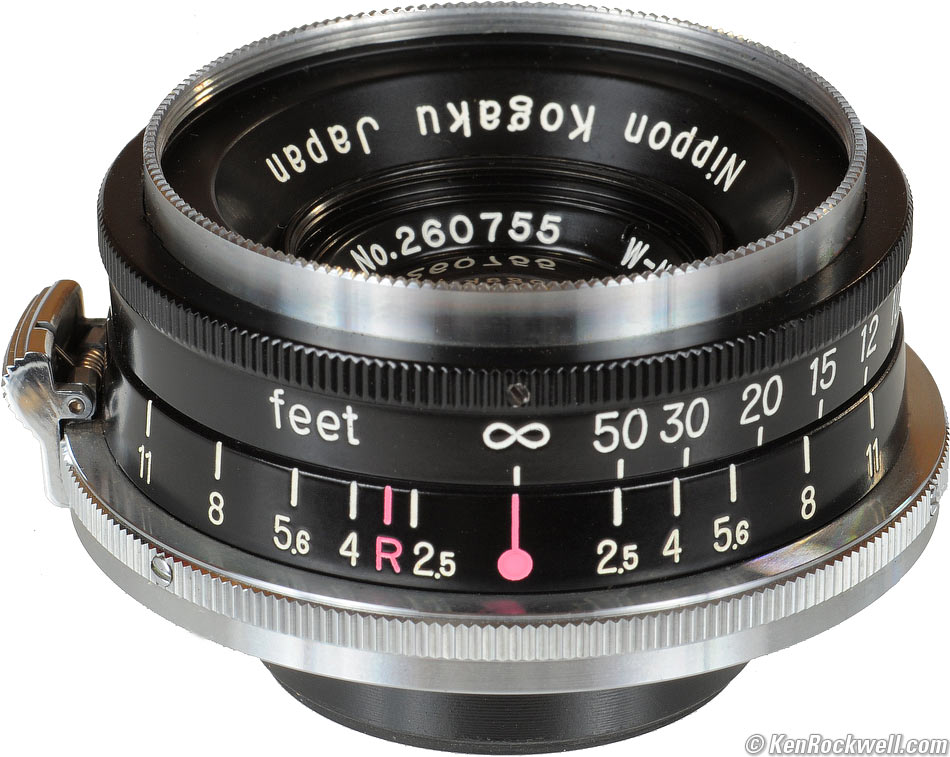
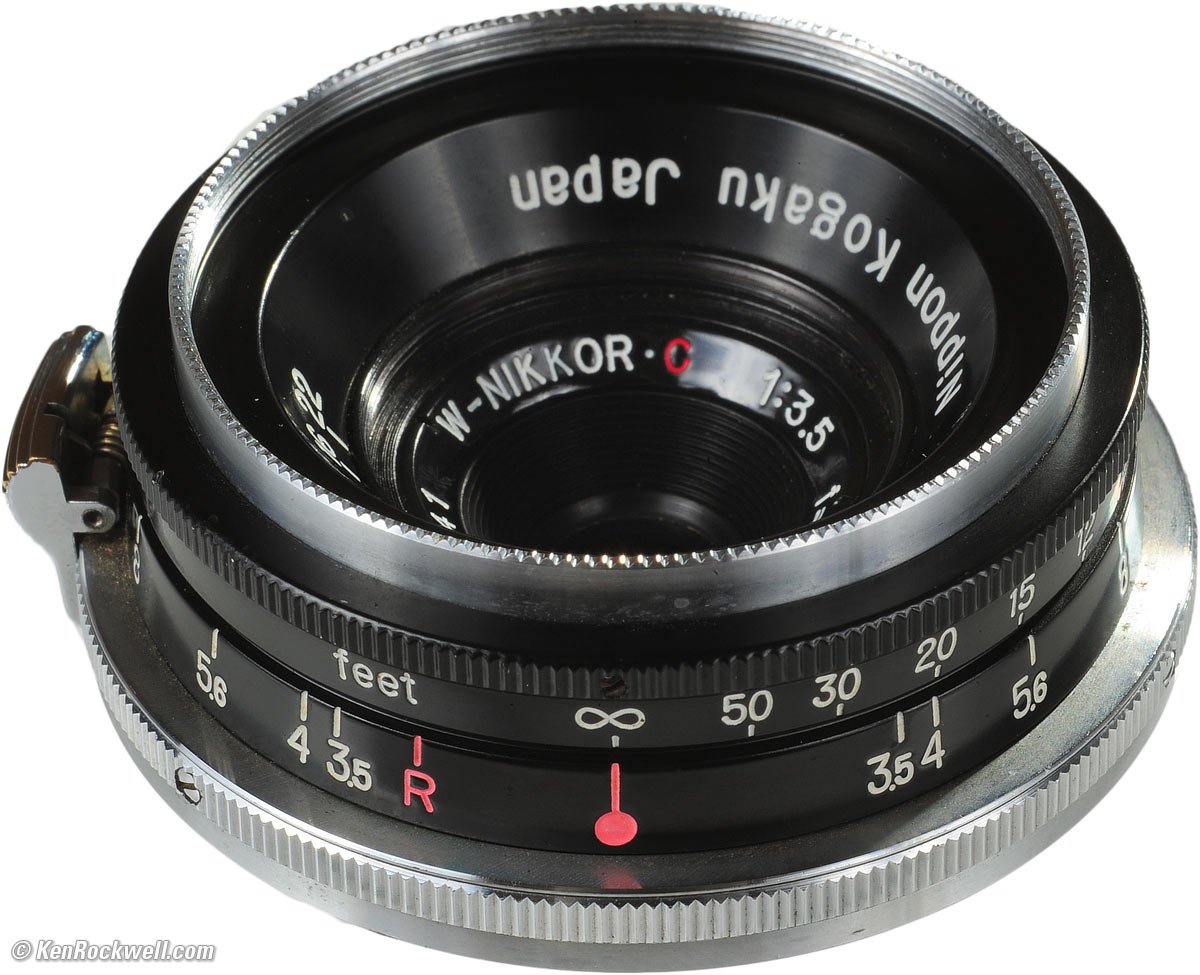
Nikon W-NIKKOR·C 3.5cm f/2.5 (35mm f/2.5). enlarge.
I get my goodies at Ritz, Amazon and Adorama. It helps me keep adding to this site when you get yours from those links, too.
May 2008 Nikon Rangefinder System Nikon SLR System All Reviews

|

Intro Specs Performance Usage Recommendations
The Nikon W-NIKKOR·C 3.5cm f/2.5 (35mm f/2.5) was a popular wide-angle lens for Nikon's 1950s rangefinder cameras.
This old lens' performance can exceed modern SLR lenses. This is because rangefinder lenses are designed without the compromise of having to avoid the flipping SLR mirror. Rangefinder lenses can get much closer to the film if the designer wants them to.
This 3.5cm lens is one of the good ones that was over-designed for its era, so it still performs wonderfully today.
It's a tiny lens: the size of a slightly flattened golf ball weighing under 4 oz. (111g)!
Compatibility
These lenses mount only on Nikon's old rangefinder cameras. Some smaller percentage were made in mounts for other brands of olde-tyme rangefinder cameras.
Nikon's best rangefinder camera is the Nikon SP (1957-1964), and this lens works on all of the rangefinder cameras made from 1948-1964, like the M, S, S2, S3 and etc.
These can't mount to any digital camera today, but are easy to shoot digitally. Simply shoot film, and have the lab scan the film as it's developed.
History
1947-1964
Nikon's first 35mm lens for the rangefinder system was a much simpler and slower 3.5cm (35mm) f/3.5. It's only a 4-element Tessar, and probably not a particularly great performer in the corners for a lens this wide. Nikon made about 20,000 of these in various cosmetic variations.
1952-1964
Nikon made about 25,000 copies the excellent 6-element lens reviewed here. It came in various cosmetic variations to induce people to buy new versions, even though they were all the same optically.
1956-1964
Nikon made about 7,000 of the faster Nikon 3.5cm (35mm) f/1.8 lens. It has 7 elements.
The numbers don't feel like it, but f/3.5, f/2.5 and f/1.8 are exactly full stops away from each other.
The f/2.5 probably has the best optical quality of the bunch. The f/1.8 ought to be as good if you don't worry about distortion and adds an extra stop of utility. I'll let you know if I get to borrow an f/1.8.
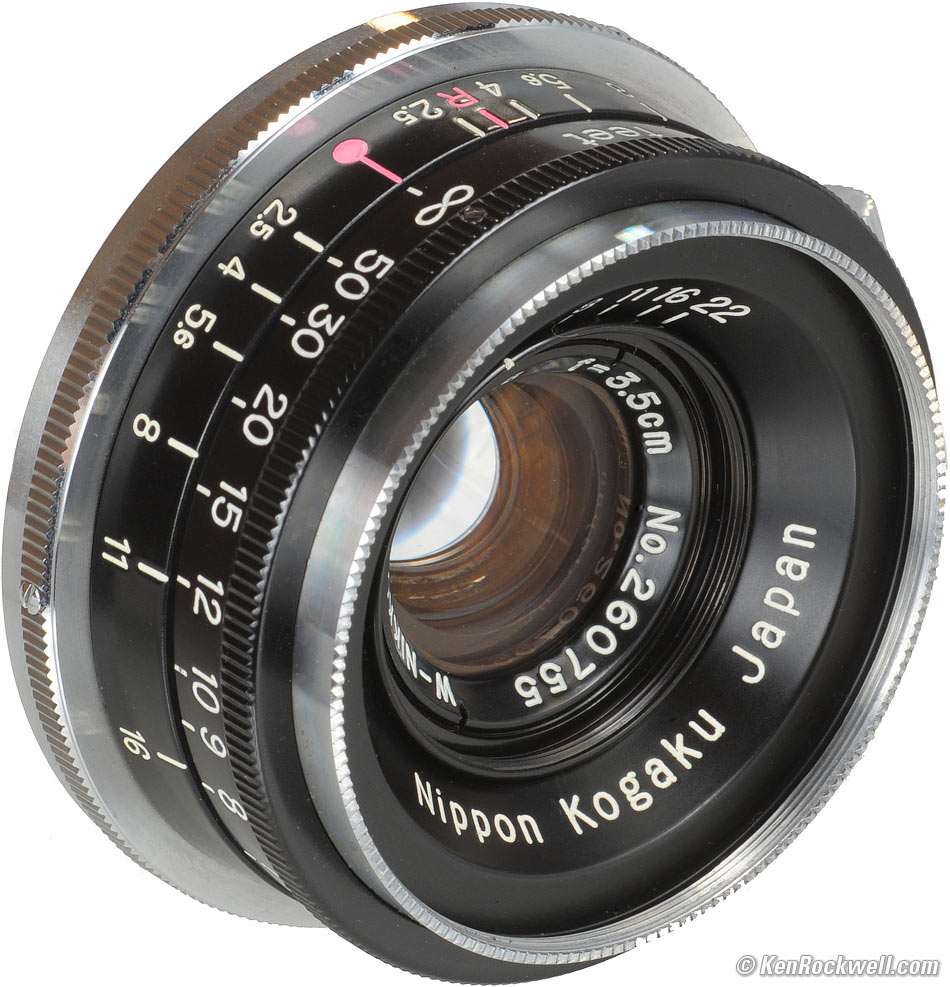
Nippon Kogaku W-NIKKOR·C 3.5cm f/2.5 (35mm f/2.5). enlarge.
Specifications & Commentary top
Intro Specs Performance Usage Recommendations
Name
Nikon (Nippon Kogaku) calls this the W-NIKKOR·C 3.5cm f/2.5. "W" means wide. Like all Nikon rangefinder lenses, these first versions were marked "C" to denote "coated," which was advanced technology for 1952. The "C" was dropped in about 1957, at which time all competitive lenses were coated, too.
Focal Length
35mm (3.5cm).
Optics
6 elements in 4 groups.
Conventional spherical, symmetrical design with two cemented doublets on each side of the diaphragm, and two additional single elements in front and back. This is a design still used today for normal lenses.
Single-coated in blue and amber.
Diaphragm
8 reversed-curved blades. The lack of straight sections will probably eliminate sunstars at moderate apertures.
Close Focus Distance
3 feet (0.9m).
Filter Thread
43mm, 0.50mm pitch (43E). Newer filters are 0.75mm pitch, (43ES), so watch it: do not force a filter onto the lens. A new 43mm filter will seem to fit, then bind after you've screwed it in a turn or two. Don't push it any farther.
Mount
Nikon S rangefinder, external bayonet. Other mounts were available for different rangefinder cameras.
Size
1.382" long by 2.196" diameter (35.10 x 55.79m) overall, measured, excluding the bayonet release. Even though there is a focus helicoid, the overall length doesn't change because the lens pokes out both the front and rear of the mount.
Weights: (measured)
Lens: 3.917 oz. (111.0g).
Front Plastic Snap-Cap: 0.167 oz. (4.75g).
Rear Metal Cap : 0.277 oz. (7.85g).
Lens and caps: 4.360 oz. (123.7g).
Corinthian Leather Case: 3.035 oz. (86.0g).
Cased Ensemble: 7.395 oz. (209.7g).
Price
Catalog price (corrected for inflation in 2008) was $1,100 from 1952 ~ 1960.
In 2008, used ones in about the condition you see here sell for about $400, if they include the case and both caps. Older, worn all-chrome versions missing caps or the case might go for $200, and a very nice one with a hood (not needed) easily can sell for $500.
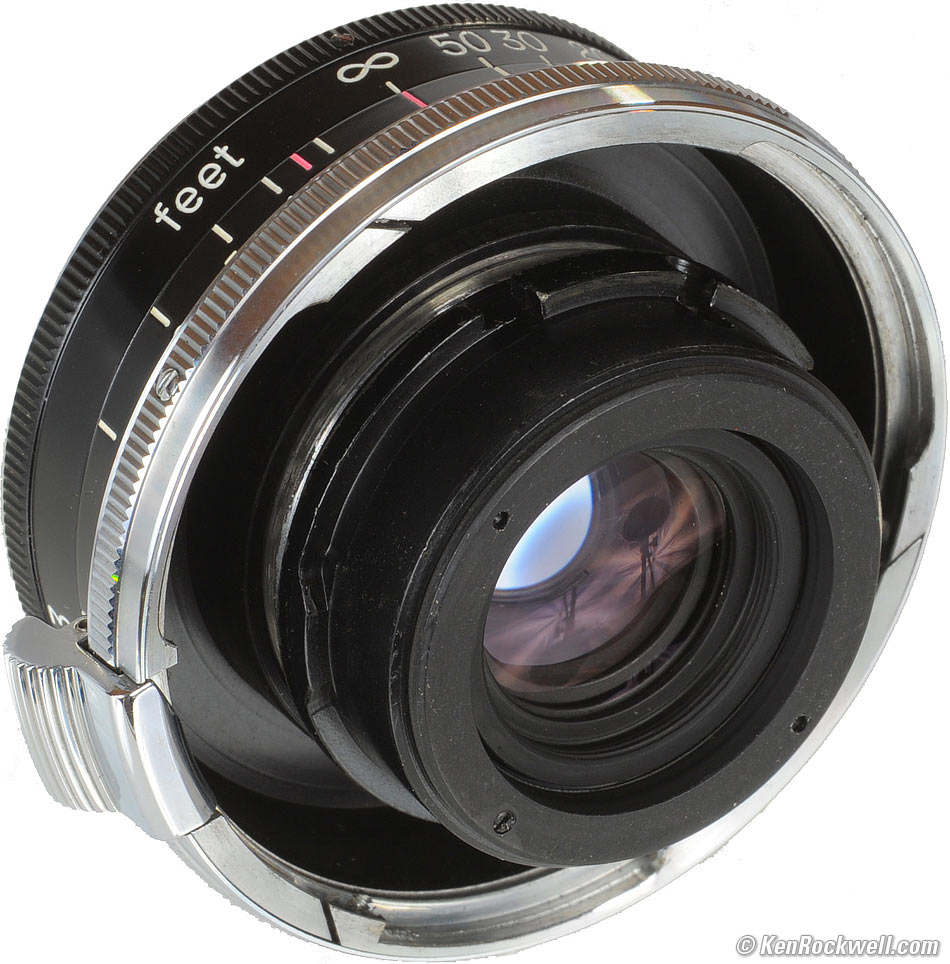
Rear, Nikon W-NIKKOR·C 3.5cm f/2.5. enlarge.
Performance back to top
Intro Specs Performance Usage Recommendations
Overall Distortion Ergonomics Falloff
Focusing Hood Mechanics Sharpness
Overall performance top
The Nikon 3.5cm f/2.5 is an excellent lens, even outperforming today's SLR lenses like the 35mm f/2 AF-D. It has superb sharpness and no visible distortion. It is faster and has less distortion than the newest 24-70mm f/2.8 AF-S.
That's all fine and dandy, but this is a lens for a camera system which photographers have ignored since the late 1950s.
Today, you'd have a far easier time shooting with the equally excellent 35mm f/2.8 lens of the Nikon 35Ti.
Distortion performance top
There is no visible distortion. This is one of the advantages of rangefinder camera systems and the symmetrical design of this lens. Wide lenses easily can be designed with no distortion for rangefinder cameras.
Unlike SLR lenses, which have to go through optical gyrations (retrofocus design) to keep the rear elements away from the flipping mirrors, rangefinder lens designs have no such limitations. The rear elements of short lenses can get as close to the film as needed.
I can't see this distortion. The only way I was able to quantify it was to enlarge it 40 times and then drop a ruler on it.
It's not needed, but if you want to do silly things like hold rulers up to huge prints, it's easy to correct the distortion from scanned film by plugging these figures into Photoshop CS2's lens distortion filter.
infinity |
+0.4 |
10' (3m) |
0.0 |
© 2008 KenRockwell.com
Ergonomics performance top
It's easy to grab the larger silver ring for mounting and unmounting.
Focus and apertures set easily.
That's all this lens does.
Falloff (darkened corners) performance top
There is mechanical vignetting (falloff) at f/2.5. It's less at f/4 and completely gone by f/5.6.
Focus performance top
This is one of the few areas in which rangefinder cameras excel.
The rangefinder of any camera system has to be accurate and precise enough for use with the fastest and longest lenses of that system.
This 35mm f/2.5 lens is short enough and slow enough that even a legally blind person probably can get great focus. You can be way off in the viewfinder, and still be dead-on on film because the Nikon camera's rangefinder system is so precise.
Hood performance top
I suppose there is a hood for this 35mm lens someplace, but it's not needed. The front elements of this 35mm lens are already deeply recessed.
The main reason to use a hood is to keep your fingers out of the picture.
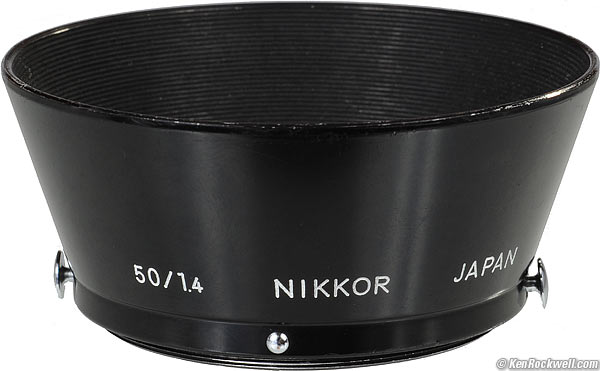
Oddly, the hood to the 50mm f/1.4 (43mm snap-in) works, probably better than it does on the 5cm f/1.4. There can be a fraction of a millimeter of the corner of the on-film image slightly darkened at some settings, but I doubt that it would ever be noticed in actual use.
Mechanics performance top
It's all metal and all markings are engraved.
The focus glides without any play.
Magnificent!
Sharpness performance top
On Fuji Velvia 50, it's super-sharp even at f/2.5 and even in the corners viewed at 20x (20x30" (50x75cm) prints).
The biggest issue at f/2.5 in the corners is the falloff (darkening), but it's still super-sharp.
There isn't much to say when I review a great lens. It just doesn't get fuzzy.
Usage back to top
Intro Specs Performance Usage Recommendations
Aperture Setting Focusing Framing Mounting Unmounting Stowage
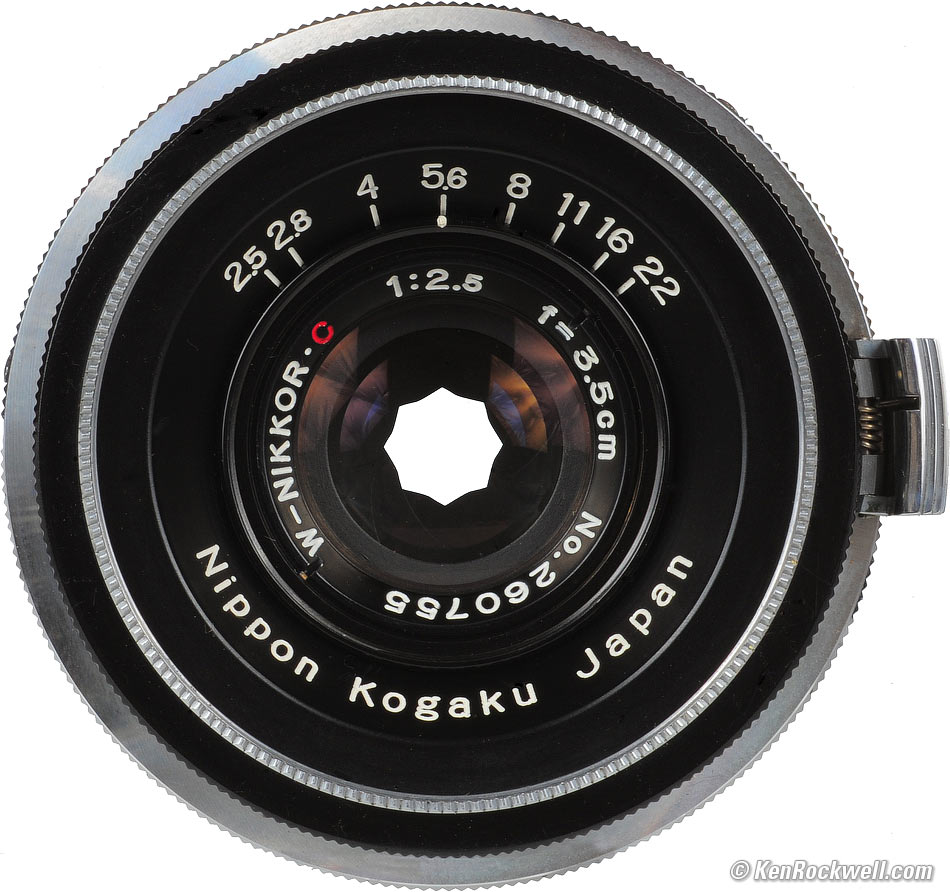
Nippon Kogaku W-NIKKOR·C 3.5cm f/2.5 (35mm f/2.5). enlarge.
The aperture is set by rotating the filter ring!
This isn't a problem because the filter ring isn't easily knocked when focusing.
The apertures are clearly-marked, so I have no problem seeing them through a polarizer or red 25 (R60) filters. I have to look a little harder, and I can see them even through a 3-stop neutral density filter (ND 0.9).
The only issue could be if you're using a really dark filter, in which case you'd have to set the aperture with Braille (counting the clicks from f/2.5)
The big spring-loaded knob to the right in the photo above is the bayonet release for unmounting.
Turn the lens' focus ring, or the camera's own focus wheel (the sharply toothed wheel in front of the shutter release).
On the Nikon SP, focus by looking through the main finder window.
Framing and Composition usage top
On the SP, peep through the little finder just to the left of the main finder. Use the framelines there. If you're very close, use the inside set of framelines, otherwise use the bigger one.
Be sure to focus through the main finder, but move your eye a fraction of an inch (1cm) to the left to compose.
Is there any wonder why rangefinder cameras died so fast when the Nikon F SLR came out?
Set both the lens and the camera to infinity (∞).
Line up the red focus index dot on the lens with the big red dot on the camera body.
Gently push the lens straight in.
Rotate counter-clockwise until it clicks into position.
Twist the lens' focus ring back and forth a little to be sure it's locked to the camera's focus system.
Press the lens' release button (the big knob on the side) towards the center of the lens.
Rotate the lens clockwise until the lens' focus index is by the big red dot on the camera body.
Lift straight out.
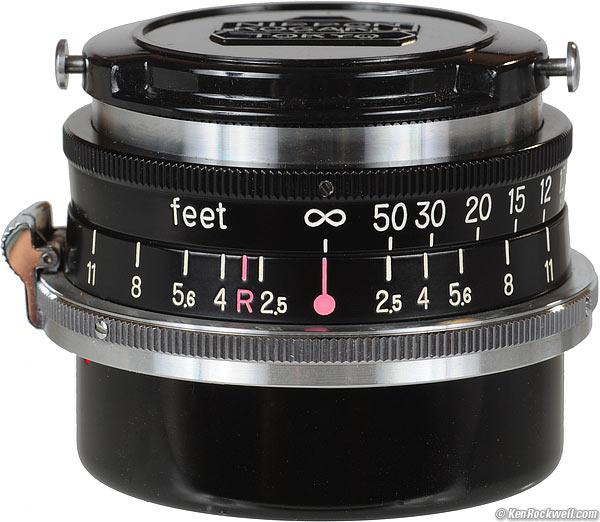
Capped Nikon 3.5cm f/2.5.
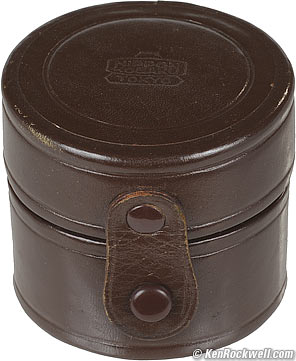
The front cap pops on (press the chrome tabs) and the rear metal cap is a bayonet. Pop it in the small Corinthian leather case (2-1/2" tall by 2-7/8" diameter (63x73mm) and off you go. The case is smaller than most SLR lenses: it's too small to warrant any attachments for straps.
 |
 |
Corinthian Leather Case. |
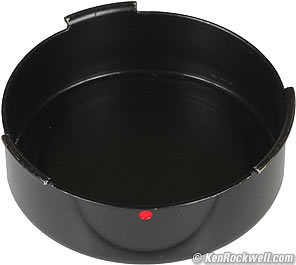
Metal Rear Cap. |
The rear cap is a work of art. It's enameled stamped metal with an inset and painted red dot. Nikon got cheaper later in the 1950s and downgraded to plastic rear caps.
Compared top
Intro Specs Performance Compared Recommendations
The numbers don't feel like it, but f/3.5, f/2.5 and f/1.8 are exactly full stops away from each other.
The Nikon 35mm f/1.8 lens has about the same sharpness at the same apertures, therefore, if you don't need anything faster than f/2.5, you can save a lot of money with this lens compared to the f/1.8 lens.
I have not tried the oldest 35mm f/3.5 lens, I expect that its performance is the weakest of Nikon's three 35mm (3.5cm) rangefinder lenses.
The Nikon 28mm f/3.5 has much poorer performcne than this 35mm lens.
Recommendations top
Intro Specs Performance Usage Recommendations
Most intelligent photographers who want excellent quality while shooting film would never waste all the effort needed to shoot the utterly manual Nikon rangefinder system, which went obsolete 50 years ago with the introduction of the Nikon F. For the same effort, far better results can be had with any medium format camera like an old Hasselblad. This is the reason the 35mm system was never popular in the 1950s compared to larger formats. 35mm was the format for kids who got picked last in gym class.
35mm has always been a film format to use only when portability and speed are more important than image quality. It was called "miniature format" back in the 1950s. Even most newspapermen, who needed speed, shot 4x5" Graflexes and 120 TLRs. 35mm was a dinky amateur's format in the 1950s; most serious amateurs shot 120 through the 1960s.
If you want to shoot 35mm film, for a fraction of the cost of the Nikon rangefinder system you can shoot the superior Nikon FE and manual focus Nikon SLR lenses. Not only is an FE worlds better than a rangefinder camera, you can find used FEs with lenses starting at around $100. This 3.5cm f/2.5 lens is among the least expensive rangefinder lenses today, but a much uglier sample than the nice one shown here will still set you back at least a couple of hundred dollars.
If for some odd reason you're worried about image quality and still want to shoot miniature format (35mm), get a 1990s Nikon 35Ti. It has the same superb optical quality of this lens, and adds automatic exposure, Matrix metering, flash, a queit leaf-shutter, multicoating, autofocus, built-in motor-drive and I forget what else, all for about the same used price as this lens. The 35Ti is smaller than a 1950s rangefinder and needs no external meter as do the old rangefinders.
If you're still reading, I still need to try the f/3.5 and f/1.8 versions, but based on my experience so far, this f/2.5 lens not only is a superb performer, it is quite likely the best performer among all the 35mm (3.5cm) Nikon rangefinder lenses. It has superior sharpness and no visible distortion, the raison d'etre of rangefinder cameras.
Acknowledgment
Many thanks to Beverly Hills pediatrician and photographer Morris Naiditch, M.D., whose forethought in buying this Nikon SP new in 1958, and keeping it out of the hands of collectors, allowed me to review it today.
Help me help you top
I support my growing family through this website, as crazy as it might seem.
The biggest help is when you use any of these links to Adorama, Amazon, eBay, Ritz, Calumet, J&R and ScanCafe when you get anything, regardless of the country in which you live. It costs you nothing, and is this site's, and thus my family's, biggest source of support. These places have the best prices and service, which is why I've used them since before this website existed. I recommend them all personally.
If you find this page as helpful as a book you might have had to buy or a workshop you may have had to take, feel free to help me continue helping everyone.
If you've gotten your gear through one of my links or helped otherwise, you're family. It's great people like you who allow me to keep adding to this site full-time. Thanks!
If you haven't helped yet, please do, and consider helping me with a gift of $5.00.
As this page is copyrighted and formally registered, it is unlawful to make copies, especially in the form of printouts for personal use. If you wish to make a printout for personal use, you are granted one-time permission only if you PayPal me $5.00 per printout or part thereof. Thank you!
Thanks for reading!
Mr. & Mrs. Ken Rockwell, Ryan and Katie.
Home Donate New Search Gallery Reviews How-To Books Links Workshops About Contact
first written 09 May 2008