Home Donate New Search Gallery Reviews How-To Books Links Workshops About Contact
How to Make Great Photos
in
Crappy Locations
© 2006-2012 KenRockwell.com
This page also is in German, Italian and Hungarian.

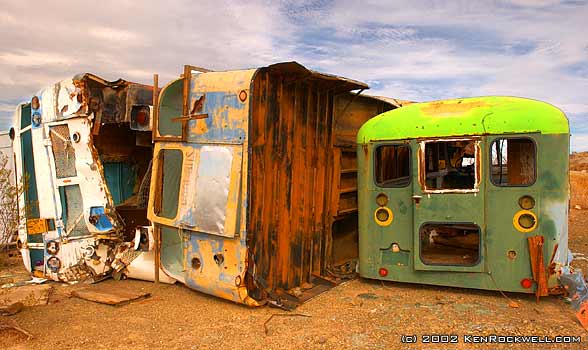
Somewhere in Arizona, October, 2002.
My biggest source of support is when you use any of these links when you get anything, regardless of the country in which you live. Thank you! Ken.
July 2012 Better Pictures Nikon Canon Fuji LEICA All Reviews
INTRODUCTION

I buy only from these approved sources. I can't vouch for ads below. |



Don't let your creative juices be stymied by lame excuses like "If I only lived in Yosemite," "If I only could take vacation in the sandstone slot canyons of the American Southwest," and "If I was only close to an ocean."
Big deal. If you did all you'd probably do is make more of the same clichéed photos we've already seen.
Great photos happen anyplace a skilled photographer happens to be.
Please don't anyone get ticked off; when I say "crappy" I'm talking about locations from which people write me whining about the perceived lack of photographic opportunities. Everyone in my family lives in a photographically crappy location.
Even if you live in Flint, Michigan or smoggy Japan or Igloolik, Canada in the dark of winter you can make great photos if you just open your eyes. Opening your eyes is required for photography regardless of where you are. Closed eyes in even the loveliest of places still lead to dull photos. Open eyes even in the crappiest of locations leads to brilliant work.
The idea for this article came to me when I got this question from someone in the American southeast. Darn, I wished I was there to photograph what I think I'd find there: old barns, weathered abandoned cars, BBQ joints and everything. It's all perspective.
RECOMMENDATIONS
Open your eyes
We all overlook what we see every day. We take it for granted. These things are dull to us, but often interesting to others. Photograph what's unique about your area. If you live in the Arctic, try seeing patterns in ice lit by moonlight or igloos lit from whale-blubber oil lamps within. If everything's dark and crappy, don't complain: make photos exaggerating just how bad things are.
Look for color - anywhere
Even the grayest of places has its color. Look for neon and other signs at night. They're even better in the rain when you can catch the colors glinting off the streets.
Make time exposures outdoors at night. Even though you may not see colors with your eyes, cameras (digital and film) will pick up and highlight colors in low light. The more varied the lighting, the better. Make photos inside an area with varied lighting, for instance, a shopping mall. The camera will accentuate these differences between tungsten, fluorescent, sodium and metal halide light which are invisible to our eyes.
My work is about color. I keep my eyes peeled and find it all over. Maybe it's a fire extinguisher on the wall of an auto repair station. Maybe it's one bright boxcar in the middle of a gray railroad yard. Maybe it's little bit of red panty sneaking out from a girl's jeans. It's out there. You just need to look for it.
What sticks out?
Look for anything out of place. Look for what stands out and ask yourself why it stands out. Make photos to highlight whatever it is that makes something catch your eye.
Art classes
Photography is all about being able to see. It's not about cameras. Enroll in any art class (painting, drawing, watercolor, sculpture etc.) where you'll find a lot of emphasis on seeing and composition.
Look for details
The strongest photo is the one that expresses itself most clearly. The strongest photos have the least in them.
Many photo classes have an assignment to lock yourself in your bathroom and shoot a whole roll of film. Your first reaction is "this is stupid." Then things start dawning on you as you start seeing details. Eventually you make so many photos you wish you got to use more film.
What you learn is that looking and seeing is everything. There are photos to be made everywhere.
Get in your car
Yes, I do live in San Diego, California, but I'm still at least six hours away from the places that come to mind when people think "landscapes." If I want to get to the clichés even I have to drive. No matter where you are, drive a little or drive six hours and you, too, can get to anyplace you want.
If I stay local I can find plenty to photograph. So can you, too.
Night Time
I said this above, and I'll say it again because it's a good one. Grab your tripod and go make some time exposures wherever you are. Night time always explodes with color in your camera, even on the dullest, dingy street.
This is from an industrial city in Italy. It looked pretty dark and creepy walking around in the middle of the night. I used a short tripod and a wide-angle lens for a dynamic angle and a time exposure to catch the streaks of light from passing cars. I got a decent shot because also I knew all the different lighting would pop as color on my film.
The streets were lit with yellow streetlights, the doorway on the right with fluorescent that I know would turn green on film and the metal halide lights on the Molle Antonelliana which I knew would turn blue.
You can do this in any barren, bleak waste city. Of course this was Torino, Italy, which is also a nice place — but still called the "Detroit of Italy." My point is it looked yucky at the time. You need to learn to see the various kinds of artificial light and learn how they change on film or digital capture.

Mezzanotte, Torino, Italia. Ottobre 2003. huge image.
The Studio
Many people work exclusively in a studio to create their own realities. You can do this anyplace.
Enjoy Crappy Places!
Last but not least, I have friends like Karl Grobl and Jim Cline who live right here in Sunny California. They prefer to go photograph in the dusty, diseased, dangerous third world. They even pay good money to do this! So don't expect any sympathy from me just because you think you live in a place lacking photographic opportunity.
Great photos come from within. Go out and enjoy!
Help me help you top
I support my growing family through this website, as crazy as it might seem.
The biggest help is when you use any of these links when you get anything, regardless of the country in which you live. It costs you nothing, and is this site's, and thus my family's, biggest source of support. These places have the best prices and service, which is why I've used them since before this website existed. I recommend them all personally.
If you find this page as helpful as a book you might have had to buy or a workshop you may have had to take, feel free to help me continue helping everyone.
If you've gotten your gear through one of my links or helped otherwise, you're family. It's great people like you who allow me to keep adding to this site full-time. Thanks!
If you haven't helped yet, please do, and consider helping me with a gift of $5.00.
As this page is copyrighted and formally registered, it is unlawful to make copies, especially in the form of printouts for personal use. If you wish to make a printout for personal use, you are granted one-time permission only if you PayPal me $5.00 per printout or part thereof. Thank you!
Thanks for reading!
Mr. & Mrs. Ken Rockwell, Ryan and Katie.
Home Donate New Search Gallery Reviews How-To Books Links Workshops About Contact