Home Donate New Search Gallery Reviews How-To Books Links Workshops About Contact
ZTS MBT-1 Battery Tester
© 2013 KenRockwell.com. All rights reserved.

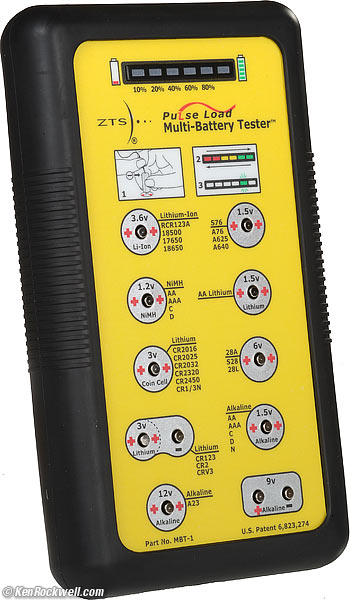
ZTS MBT-1 Battery Tester. enlarge. I bought mine at Adorama. Amazon sells them, too. My biggest source of support for this free website is when you use those or any of these links when you get anything, regardless of the country in which you live — but I receive nothing for my efforts if you buy elsewhere. I'm not NPR; I get no government hand-outs and run no pledge drives to support my research, so please always use any of these links for the best prices and service whenever you get anything. Thanks for helping me help you! Ken.
June 2013 Better Pictures Nikon Canon Fuji LEICA All Reviews

Adorama pays top dollar for your used gear.
|

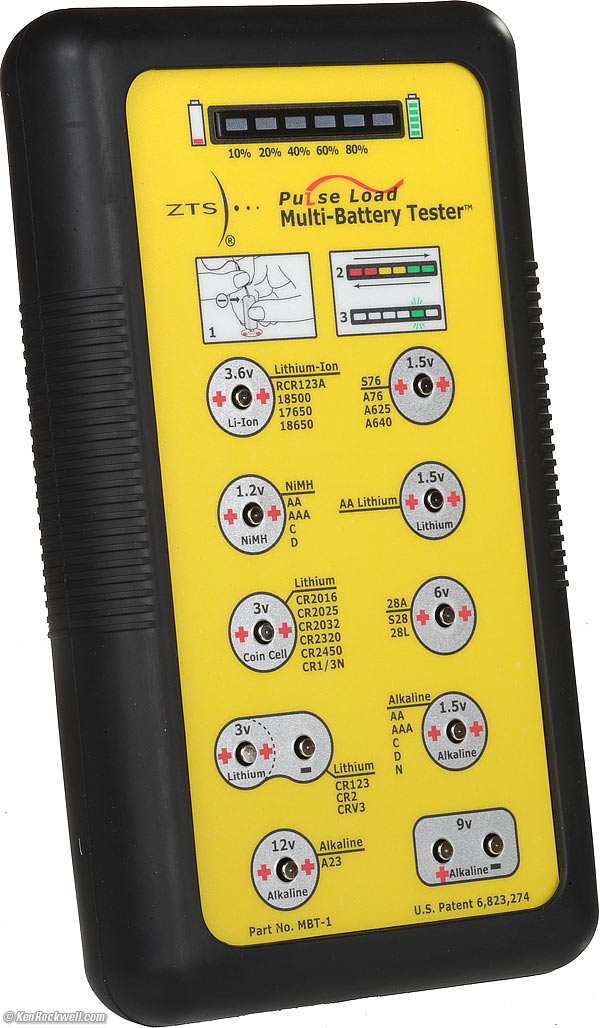
This ZTS MBT-1 is an excellent professional-grade battery tester, and at about $70, a no-brainer for anyone who needs to test lots of batteries. For under $30, the smaller but just as advanced Mini model tests fewer kinds of batteries, but tests the ones most used by digital photographers and fits in any bag along with your flash gear. I'll get to these testers after I finish this introduction and cover some wrong ways to test batteries.
Digital cameras usually have built-in battery testers, but flashes don't. Especially with all the shots we make on digital, we're always killing the AA cells in our flashes.
I'm always testing batteries before I put them in the cameras people loan me to test.
I shoot lots of film cameras and use hand-held light meters, and they use all sorts of odd batteries.
I have a thing about batteries. Ever since I've been a kid I've been playing with them, and now as a dad, my kid Ryan runs through more batteries than I ever have. As dad, I'm in charge of testing and replacing all his batteries.
Wrong Way #1: Voltmeters
I used to use an engineer's voltmeter to test open-circuit voltages, but while precise to four digits, it's not accurate because the batteries aren't doing anything when tested. When I get fancy I might hook a resistor across the terminals to simulate a load, but I need different resistors for each battery, and unless you're a battery engineer, a reading like 5.8568 V probably isn't meaningful.
Wrong Way #2: Cheap Chinese Testers
I bought a cheap do-everything model T-333 tester last year, and it was nice because it tested every kind of normal and photo battery. It was easy to use and gave precise readings on a long scale. It uses one AAA cell to power itself.
Precise doesn't mean accurate.
The only problem was that batteries I removed from dead equipment still tested as "good." Over time I realized that I had to read batteries only within the "good" range. When they got to the bottom third of the small "good" range, they were dead.
Over more time I realized that its readings for different kinds of batteries needed to be read differently. As an engineer, I was starting to have to use a look-up-table to be able to turn its readings into something meaningful.
Just as bad, I don't know that the T-333 tester tests with any sort of load, and it was a pain to use because the battery I tested the most, AA, had to be stuck in the much larger cut-out for C size cells.
The Right Way: The ZTS MBT-1
One fine day I was browsing online, and saw this ZTS tester. The ZTS name sounded familiar, and the price was right for someone who tests as many batteries as I do (have kids and you'll see what I mean).
Now that I've had it several weeks, I can't live without it. It just works!
Like an Apple laptop or iPod, it looks simple outside, but it's got some very advanced microprocessor control doing a lot of work inside.
Unlike any tester I've used before, it quickly tests the battery actually doing something and gives me a direct readout of the percentage of life left.
The ZTS tester reads the same every time on each battery. Its readings are repeatable and meaningful, not just "GOOD" or "WHO KNOWS?"
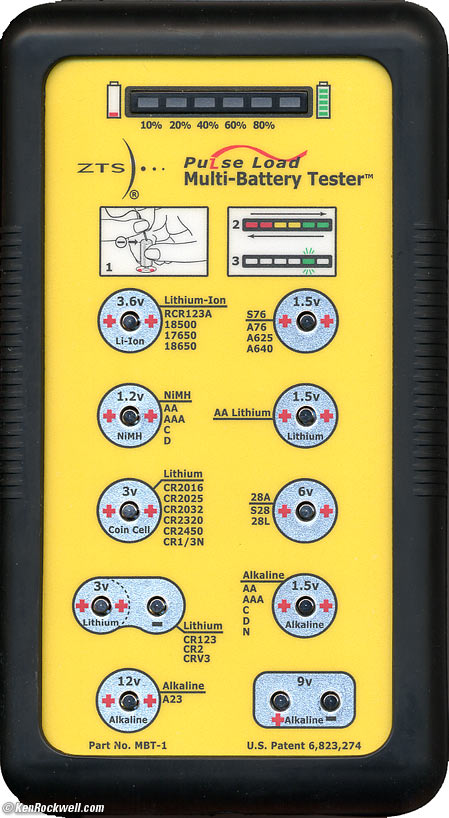
Online catalogs never showed what batteries it really tested, so here is the front panel:
Usage
It's super easy to use. Put in 4-AA cells to power it, then all you do each time is hold the cell to the appropriate nickel-plated brass contact, and take the little probe wire off the right side and hold it to the top of the battery.
ZTS tells me that even if you use this every day that the 4-AA cells ought to last you two years, and there's no power switch to worry about — it's all automatic.
The tester first checks its own batteries for a fraction of a second, then the LEDs dance around for a couple of seconds while the battery being tested actually does some work.
Then one LED lights brightly to tell you exactly how much power is left.
This seems simple, and it is. All battery testers should be this way, but they're not.
The more I use this tester, the more I like it. It gives me a real measurement in just seconds.
What it tests
My photo should tell all. The only things it doesn't test are the big 6 V lithiums that power older 35mm consumer film cameras, like the Canon A2E and Konica Hexar. The crappy T-333 tests those, but not very well. I checked some older AF film Nikons, and they all take two 3V lithiums, which are tested, not the 6V packs of other cameras of the 1990s which aren't tested by the MBT-1
The ZTS MBT-1 test not just AA, but has separate, accurate tests for alkaline, lithium and Ni-MH cells. Ni-Cds are tested on the Ni-MH terminals. Each of these chemistries tests differently, and the ZTS testers are the only ones of which I know that test these properly. Other testers will always read low with Ni-MH and read too high with lithium AAs.
There is only so much room on the front panel, so every possible battery model isn't listed for each position.
The top left 3.6V lithium-ion position is for rechargeable versions of 3V photo batteries.
The top right S76 position is for button cells, like those that power the Nikon F2, F3, FE, FM and FM3a style cameras. S76, aka LR44, cells power everything, including keychain laser pointers and flashlights. This position is where watch batteries are tested.
The next row tests Ni-MH (all sizes) and AA lithiums.
The middle row tests lithium coin cells, used in your car's remote as well as as the clock back-up cells inside most Canon digital SLRs. Film data backs also use these cells. Next to this is where you test the 6 volt A544/28A/28L batteries. which power a lot of medium format cameras (like the Mamiya 6 and today's Mamiya 7) as well as the analog Pentax Spotmeter used by Ansel Adams. The A544 also powers the Canon AE-1 and F-1n.
Second from the bottom, you can test 3V photo lithiums, like the CR123A and CR2 which power just about every recent film SLR and point-and-shoot from today's Nikon F6 to N75 and N80 to yesterdays Nikon 35Ti. The alkaline terminal checks all sizes of normal cells, from AA and tiny N, AAA and AAAA through D and F cells.
The bottom row tests the 12V batteries used in ceiling fan remote controls, and 9V alkaline are tested on the bottom right. Test your smoke detector batteries with this on a regular basis, and you'll know when they need replacing without having to replace them blindly each year.
Quality
The ZTS tester is made in the USA. I didn't think any electronic consumer products were anymore, but this reasonably priced ZTS is made right in Cincinnati, Ohio. ZTS has no plans of cheaping-out and make them in China next week either. They like the quality control they get this way.
Battery Life
It runs on 4 AA cells and has no power switch because it doesn't need one.
It's always ready to test.
After five years of use in 2013, the first set of alkaline Duracells I put in back in 2008 were dead.
The tester still worked, but started to blink its 10% and 20% LEDs alternately, which meant nothing until I figured out that this meant low (tester) batteries.
I popped in a new set, and tested the cells I just removed from the tester. They tested 10% or less, confirming that the tester very efficiently uses all the power in its cells before you have to replace them.
When I popped in the new set, the tester lit its 100% LED to let me know the new set was AOK. Brilliant!
Who is ZTS?
I thought the name sounded familiar. ZTS used to make film camera testers that I'd see in camera repair labs.
Today their battery testers are used by NASA, the US military, the FBI and medical equipment makers checking batteries before they are assembled into products.
Even the inexpensive Mini is made to very high American standards.
Recommendations back to top
I use mine daily for all the cameras I have to test, as well as my kid's toys.
This full-size (8-1/4 by 4-3/4 x 1-1/2") MBT-1 tester is most useful for serious photographers.
The ZTS Mini, also sold at Adorama and Amazon, tests what digital, news and wedding photographers need, which is Ni-MH and alkaline cells of every cylindrical size, 3V photo lithium (the CR123A, CR2 and CRV3 type), as well as 9V alkalines for your remote strobe triggers and home smoke alarms. For under $30, everyone needs one in his bag to check flash batteries. I'm going to try to get one of these Minis to test as well.
If you use 9V lithiums, ZTS makes a variation of the Mini, the Mini 9R, which test these instead of the 3V lithiums.
Heck, for under $30, every mom or dad who changes toy batteries needs a Mini. It costs little more than the junky Chinese testers.
Help me help you top
I support my growing family through this website, as crazy as it might seem.
The biggest help is when you use any of these links when you get anything, regardless of the country in which you live. It costs you nothing, and is this site's, and thus my family's, biggest source of support. These places have the best prices and service, which is why I've used them since before this website existed. I recommend them all personally.
If you find this page as helpful as a book you might have had to buy or a workshop you may have had to take, feel free to help me continue helping everyone.
If you've gotten your gear through one of my links or helped otherwise, you're family. It's great people like you who allow me to keep adding to this site full-time. Thanks!
If you haven't helped yet, please do, and consider helping me with a gift of $5.00.
As this page is copyrighted and formally registered, it is unlawful to make copies, especially in the form of printouts for personal use. If you wish to make a printout for personal use, you are granted one-time permission only if you PayPal me $5.00 per printout or part thereof. Thank you!
Thanks for reading!
Mr. & Mrs. Ken Rockwell, Ryan and Katie.
Home Donate New Search Gallery Reviews How-To Books Links Workshops About Contact