
I buy only from these approved sources. I can't vouch for ads below. |



Tokina 10-17mm
© 2007
KenRockwell.com
Intro Specs Performance Recommendations

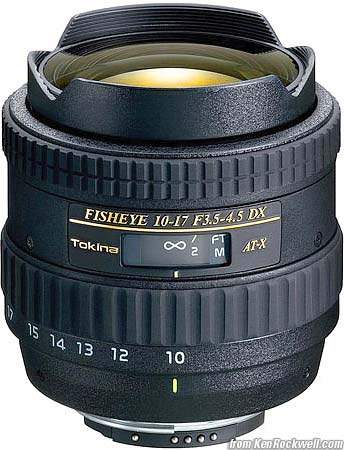
Tokina 10-17mm.
I'd get mine here or here (Nikon) or here or here (Canon). It helps me publish this site when you get yours from these links, too.
February 2007 More Tokina Reviews Other brand reviews
Nikon Reviews Nikon Lenses Canon Reviews Canon Lenses
INTRODUCTION top
Intro Specs Performance Recommendations
Everyone keeps asking me about this lens. I'm trying to borrow one so I can address it properly. Since I get so many questions about it I'm going to share my strong opinions based on this unique lens' uniqueness, which makes recommendations easy.
It has the same optics as the Pentax 10-17mm, but in a different body to fit Nikon and Canon.
It does not work with film cameras or full-frame or 1.3x Canon cameras.
It a one-of-a-kind zoom fisheye lens, not a wide angle lens. Fisheye lenses bend straight lines deliberately. I've owned fisheye lenses for decades. They are very difficult to use well, and fairly useless except as a special effect. Recently I've been using DxO software to stretch out the curvy images into something useful, but DxO doesn't work with the Tokina 10-17mm lens currently.
This Tokina costs the same as the real Canon or Nikon fisheye ($500 - 600), either of which which I strongly suggest instead of this lens.
For Nikon get the Nikkor 10.5mm DX.
Canon makes no fisheyes for their 1.3x and 1.6x digital cameras like the 1D and Rebel and D20 D30, but Canon does make a spectacular 15mm Fisheye for the film and full-frame cameras for the same price as any of these.
If you are serious about fisheyes, get the Canon 15mm Fisheye and a Canon 5D, which offers far superior fisheye performance over any of the other solutions. I own both the Canon 15mm and the Nikon 10.5mm.
If you want a wide angle that keeps straight lines straight, then forget this Tokina 10-17mm zoom, because it's a fisheye! Most people don't want a fisheye - they want a wide angle which isn't this 10-17mm.
If you want a wide angle, I strongly suggest instead the Tokina 12-24mm for the same price. For my Nikon I own the Nikkor 12-24mm which is more expensive. For Canon I'd get the superior Canon 10-22mm which isn't much more expensive than the Tokina. See also my explicit Digital Wide Zoom comparison.
SPECIFICATIONS top
Intro Specs Performance Recommendations
Name: Tokina calls this the FISHEYE 10-17 F3.5-4.5 DX (for Nikon) and something similar for Canon.
DX: Only works on small (Nikon and 1.6x Canon) digital cameras, not film.
G: No aperture ring. Only works on cameras newer than about 1992.
Focal Length: 10-17mm.
Maximum Aperture: f/3.5 - 4.5.
Optics: 10 elements, 8 groups, including one SD glass element. Tokina's SD glass is the same as Canon's UD glass which is the same as Nikon's ED glass, which helps reduce color fringing.
Tokina claims a magic front coating making cleaning easier. I believe this but have not tried it. Tokina is part of Hoya, the worlds' largest maker of optical glass which is used, in part, in lenses of every other brand including, as far as I know, Nikon, Canon and Leica. They know their stuff when it comes to glass and coatings.
Diaphragm: Primitive 6 blade (hexagonal). Stops down to f/22.
Filter Size: None usable.
Close Focus: 5.5" (14cm) from the image plane (the back of the camera).
Maximum Reproduction Ratio: 1:2.5.
Size: 2.75" diameter x 2.79" extension from flange (70 x 71.1mm), specified.
Weight: 12.3 oz. (350 g), specified.
Hood: None; but has little ridges around the front to protect the glass from being hit. Tokina calls this a hood, but I don't.
Introduced: October, 2006.
PERFORMANCE top
Intro Specs Performance Recommendations
WARNING: THIS IS A FISHEYE LENS.
Here's the part many readers aren't getting: it's a fisheye lens, which is only suited for special effects. It gives curvy images like this:
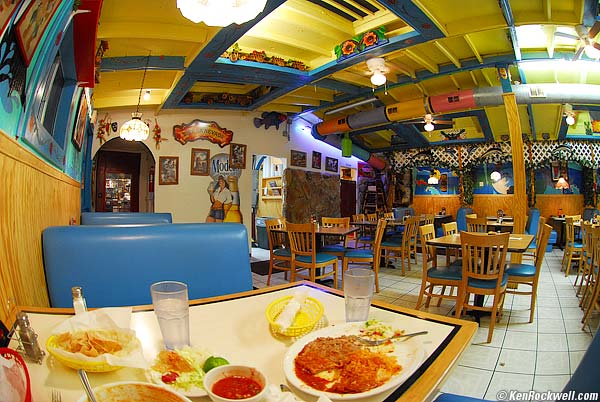
La Especial Norte, Leucadia, California.
The difference between this zoom Tokina fisheye and a regular fisheye is that you can zoom into the center, giving a less-curvy image like this:
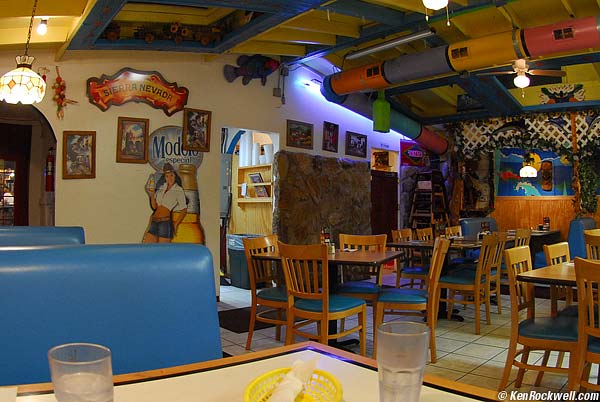
Crop from center of above, similar to what you'd get at 17mm with the Tokina.
Zoomed in you get an image which is only partly fisheye. I wouldn't know what to do with these images. They aren't fisheye or that curvy, but still too curvy for most uses. Look at the table at the bottom and the ceiling at the top of the shot above: they are still curved, just not as much.
RECOMMENDATIONS top
Intro Specs Performance Recommendations
This is a special purpose, fun and special purpose lens. Did I remember to say special purpose? I'm not sure what to make of it until I get to play with one.
You either will love it to death, or use it once and eBay it.
It's probably fantastic for underwater use, so long as you can zoom it, since fisheyes are so helpful underwater. It's the only zoom fisheye in existence.
If DxO comes out with a module to correct the distortion this could become a uniquely useful lens. Until then, and probably even then, I suggest getting the real camera-brand fisheye lens (DxO makes modules for both of them already) instead if you really want fisheye.
If you want wide angle, get the Tokina 12-24mm, the Canon 10-22mm or the Nikkor 12-24mm.
Help me help you top
I support my growing family through this website, as crazy as it might seem.
The biggest help is when you use any of these links to Adorama, Amazon, eBay, Ritz, Calumet, J&R and ScanCafe when you get anything, regardless of the country in which you live. It costs you nothing, and is this site's, and thus my family's, biggest source of support. These places have the best prices and service, which is why I've used them since before this website existed. I recommend them all personally.
If you find this page as helpful as a book you might have had to buy or a workshop you may have had to take, feel free to help me continue helping everyone.
If you've gotten your gear through one of my links or helped otherwise, you're family. It's great people like you who allow me to keep adding to this site full-time. Thanks!
If you haven't helped yet, please do, and consider helping me with a gift of $5.00.
As this page is copyrighted and formally registered, it is unlawful to make copies, especially in the form of printouts for personal use. If you wish to make a printout for personal use, you are granted one-time permission only if you PayPal me $5.00 per printout or part thereof. Thank you!
Thanks for reading!
Mr. & Mrs. Ken Rockwell, Ryan and Katie.
Home Donate New Search Gallery Reviews How-To Books Links Workshops About Contact