Home Donate New Search Gallery Reviews How-To Books Links Workshops About Contact
Roxsen Nikon
-> Canon Lens Converter
© 2007 KenRockwell.com

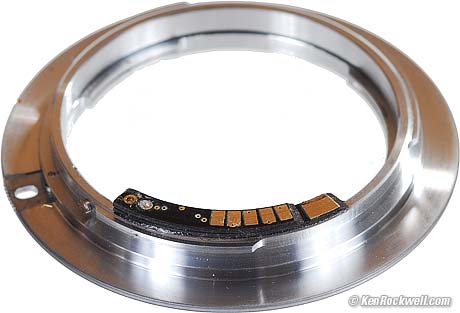
Rosen Nikon - Canon Converter. This is the rear, or Canon, side.
September 2007
I personally buy from Adorama, Amazon, Ritz, B&H, Calumet and J&R. I can't vouch for ads below.
|



Top Specs Performance Recommendations
I've known about these adapters for some time, but never dared buy one for myself.
Curiosity got the better of me since I wanted to start testing Nikon lenses on full-frame without having to buy film or wait for my Nikon D3, so I got one of these.
It cost me $50, with shipping, direct from Hong Kong via eBay.
Top Introduction Performance Recommendations
It jams on the back of a Nikon lens.
You then jam the adapter onto your Canon camera.
The chip epoxied to the adapter tells the Canon camera that you have a 50mm f/2.0 attached, which wakes up some of the Canon camera's functions, and confuses others.
Top Introduction Specs Recommendations
It works, but with reservations.
First, remember you are playing in God's domain. This isn't supposed to work at all. You can and may destroy your camera, lens, or both.
Mechanically it works with my Canon 5D and Rebel XTi, and with Nikon AF, AF-S, AI and even non-AI lenses. That's good.
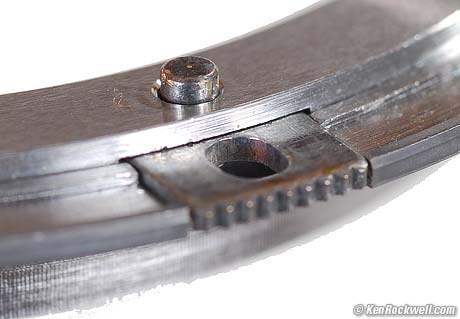
Front, or Nikon side, of the adapter.
This is the little pin and its release, which locks the adapter to the Nikon lens.
Focusing
The AF points blink in the viewfinder as you hit perfect manual focus. That's why this adapter has a chip epoxied to it and why it cost me $40 instead of $10.
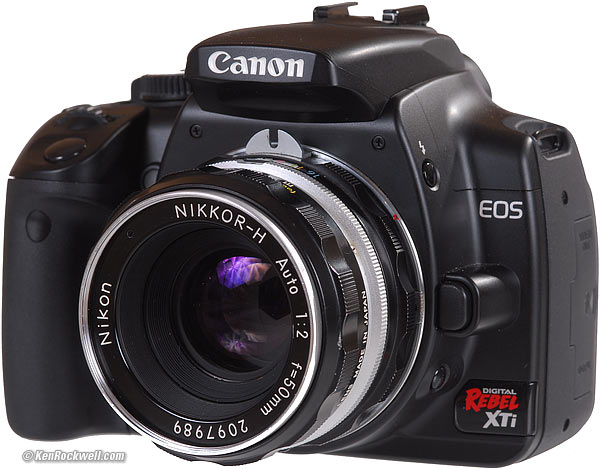
Nikon 50mm Nikkor-H on Canon Rebel XTi.
The bad part is that my sample is 0.35mm too thin. Mine mics at 1.11mm thicck, flange face to flange face. This one seems to be the correct thivkness, I'll have to try it.
Another adapter I tried from a different source also was the wrong thickness. This means that the focus scales aren't accurate, so to focus at infinity I need to set the Nikon lens to a closer distance.
These adapters easily achieve accurate infinity focus; the problem is that they can focus well beyond infinity. To get the claimed accurate infinity focus I have to focus my lens manually somewhat closer.
Optical Quality
The thickness error isn't a big deal to most people, but is a big deal if you use Nikon wide angle lenses with rear focusing (RF) or close-range correction (CRC). This is most of Nikon's wide angle lenses made in the past 30 years.
Comparing my Nikon 14mm to my Canon 14mm, and comparing my Nikon 16mm fisheye to my Canon 15mm fisheye, both Canons looked much better than the Nikons. I was confused, since my Nikon lenses worked so much better on film than they did on my 5D. Could my Nikon lenses really be this crappy?
I got suspicious that the focus error could be causing the lens' mechanical close-range correction systems to screw up the optics. If you set the lens to the wrong distance, the corrections will be all wrong. CRC and modern zoom lenses are very picky about having the correct flange focal distance to get optimum performance, especially in the corners with wide lenses.
I tried the converter again with my Nikon 16mm fisheye, but removed its rear filter to attempt to correct the optical path length. AHA!!! Much improved! Now my fisheye almost is set at infinity when it is focused at infinity. Before I removed the filter, I had to focus my fisheye at 1.5' (0.5m) to focus at infinity with this converter.
Nikon's most advanced lenses use very tricky optics that readjust themselves as you focus. This lets these lenses give optimum performance at every distance.
Heaven help you if you try a cockamamie adapter like this which has 350 microns of error. This was enough to make me have to put my Nikon lens' focus ring in the wrong position, which de-optimized the lens' optical formulae, which curved their fields and defocused the corners. Even though the centers were perfect, the sides looked crappy wide open. The sides look fine stopped way down.
It works great with conventional lenses like the old 50mm shown above, but poorly if you shoot modern wide lenses wide open.
Oh well, I guess my $40 adapter probably can't replace a $5,000 D3.
Exposure
Results vary, but you can try to use manual and aperture-priority metering. I get the best results in manual via trial and error, looking at the LCD each time.
Since the adapter tells the camera that you're using an f/2 lens, unless you really are using an f/2 lens, I use any metering pattern other than Evaluative. Evaluative makes many tricky measurements, all predicated on knowing the actual f/stop of your lens. Since this adapter usually feeds the camera the wrong value, Evaluative metering is almost guaranteed to give you the wrong value.
Give it up. I set exposure manually and look at the LCD and color histograms.
White Balance
WB seems to be OK in Auto, but since we are sending the camera very mixed signals, I prefer to run my camera in any of the fixed WB settings.
EXIF Data
The EXIF records the correct shutter speed, but always thinks the lens was at f/2 and that it was 50mm.
Finder Readouts
Since the camera is being fed very confusing information, most of the time my viewfinder indicators were way too dark.
You may not have noticed this until now, but almost every camera automatically varies its finder displays to match the ambient lighting. With this adapter the camera has no idea of the actual ambient lighting.
Manual Diaphragm
You're back in the 1950s!
You must turn the aperture ring to close the diaphragm to make your photo, and turn it the other way to open it to get a bright image for focusing.
Top Introduction Specs Performance
You hackers know who you are. It's well worth my fifty bucks, but I'm still looking for a precision model with the exact thickness for dead-on infinity focus and correct CRC function.
The cheaper models without the chip are less helpful, since I can focus much better with the blinking AF lights than by the ground glass.
Remember you're playing with fire here. One reader wrote that his same converter fell apart inside his 5D and trashed it. Be very careful, it's not made or warranted by Canon or Nikon or anyone. It can break and break your camera.
Next time I'll try This one which may be the correct thickness.
Help me help you top
I support my growing family through this website, as crazy as it might seem.
The biggest help is when you use any of these links to Adorama, Amazon, eBay, B&H, Ritz, Calumet, J&R and ScanCafe when you get anything, regardless of the country in which you live. It costs you nothing, and is this site's, and thus my family's, biggest source of support. These places have the best prices and service, which is why I've used them since before this website existed. I recommend them all personally.
If you find this page as helpful as a book you might have had to buy or a workshop you may have had to take, feel free to help me continue helping everyone.
If you've gotten your gear through one of my links or helped otherwise, you're family. It's great people like you who allow me to keep adding to this site full-time. Thanks!
If you haven't helped yet, please do, and consider helping me with a gift of $5.00.
As this page is copyrighted and formally registered, it is unlawful to make copies, especially in the form of printouts for personal use. If you wish to make a printout for personal use, you are granted one-time permission only if you PayPal me $5.00 per printout or part thereof. Thank you!
Thanks for reading!
Mr. & Mrs. Ken Rockwell, Ryan and Katie.
Home Donate New Search Gallery Reviews How-To Books Links Workshops About Contact