Tokina 150-500mm f/5.6
AT-X SD (1986-2000)
Intro Compatibility Specifications Performance Recommendations More

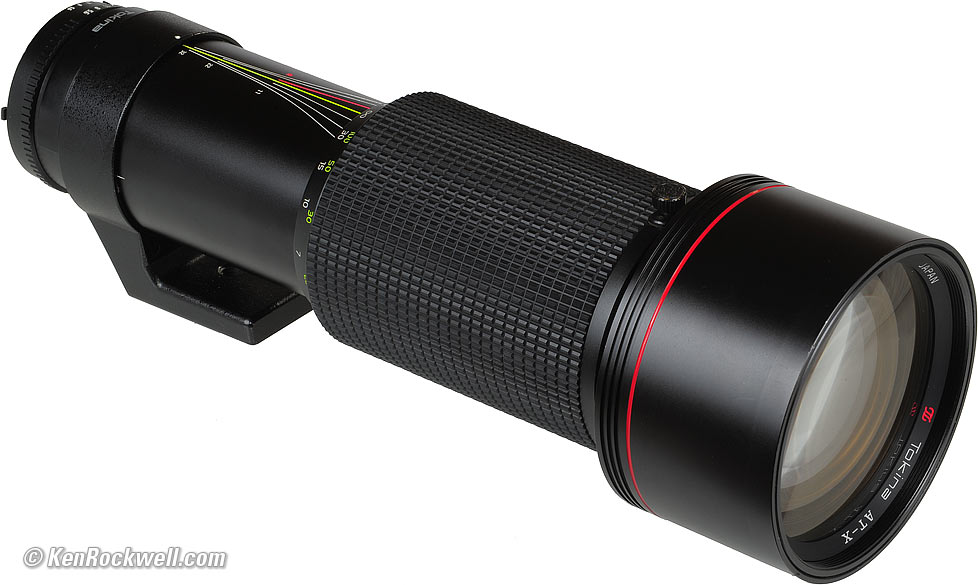
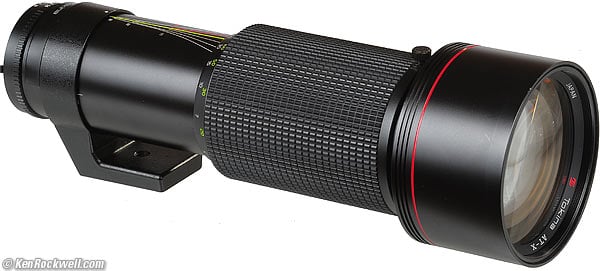
Tokina 150-500mm f/5.6 AT-X SD. (manual focus, 95mm metal filter thread, 79 oz./2,240g, 10.2'/3.1m close focus, about $250 used.) enlarge.
This all-content, junk-free website's biggest source of support is when you use those or any of these links to my personally-approved sources when you get anything, regardless of the country in which you live. Never buy at retail or any other source not on my personally approved list since you'll have no way of knowing if you're missing accessories, getting a defective, damaged, returned, store demo or used camera. Buy only from the approved sources I use myself for the best prices, service, return policies and selection. Thanks for helping me help you! Ken.
October 2015 Tokina Nikon Nikon Lenses Canon Canon Lenses Fuji Sony Zeiss All Reviews
Introduction
Top Intro Compatibility Specifications
Performance Recommendations More

Adorama pays top dollar for your used gear.
|

This is an exotic manual-focus third-party lens that was made to fit Nikon, Canon FD, and some other cameras.
The Nikon mount version works great with Nikon's full-frame and better DX digital cameras. Focus is of course always manual.
Tokina only sold about 1,000 of these in USA over 10 years. At its peak, they only sold about 10 per month in the USA.
When new, it sold for just over $1,000 at deep NYC discount at places like B&H Photo Video. In 2015, they go for about $250 used.
It's a big lens, over a foot (30cm) long and takes a 95mm filter.
It has exceptionally low distortion, making it a great choice if architectural vignettes are your thing.
Compatibility
Top Intro Compatibility Specifications
Performance Recommendations More
Nikon
The Nikon version works great with most Nikon cameras, 35mm and digital.
It works flawlessly with every manual focus Nikon ever made, from the original Nikon F of 1959 through the FM3a and today's FM-10.
On DSLRs and the F6, use the "Non-CPU Lens Data" menu option to set focal length and f/5.6 to get full color matrix metering, EXIF data and finder read-out of set aperture. It works great in aperture-preferred as well as manual modes on these cameras.
It works perfectly on every professional 35mm camera (F, F2, F3, F4, F5, F6), and adds Matrix metering on the FA, F4 and F6.
The meters of cheaper digital (D90, D5500 and below) and cheaper film cameras (N80 and below) will not couple (or work at all) with this lens, so you'll be on your own guessing exposure using the rear LCD or an external meter, or get a tiny Gossen Digisix meter and hotshoe adapter, or an iPhone app to meter manually.
See Nikon Lens Compatibility for details on your camera. Read down the "AI, AI-s" column for this lens.
Canon
The Canon version only works on Canon's 35mm FD cameras.
It will not work on any Canon digital camera.
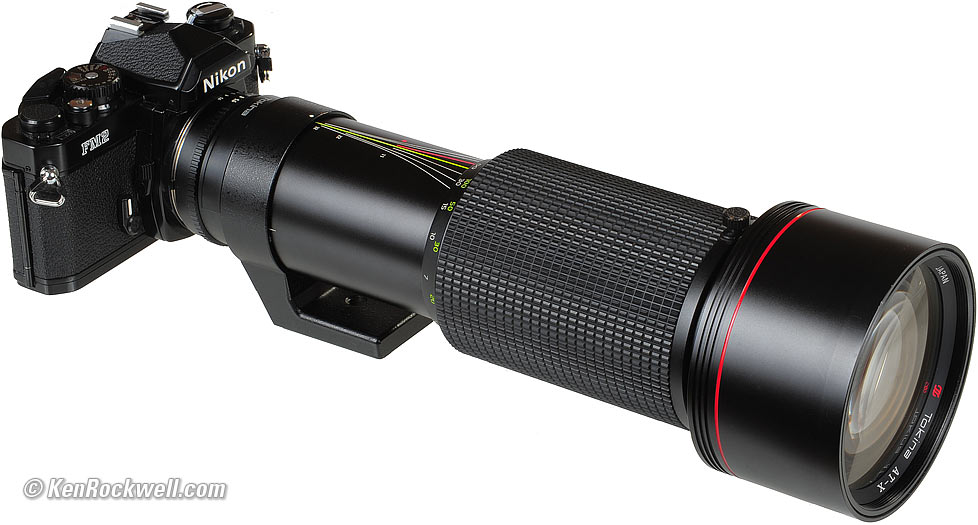
Tokina 150-500mm f/5.6 AT-X and Nikon FM2. enlarge.
Specifications
Top Intro Compatibility Specifications
Performance Recommendations More
Name
Tokina calls this the Tokina AT-X 150-500mm f/5.6 SD. SD stands for super-low dispersion glass, similar to Nikon's ED glass and Canon's UD glass.
Focal Length
150-500mm
Maximum Aperture
f/5.6 at all focal lengths.
Optics
15 elements in 13 groups.
Single-coated.
Some SD (same as ED or UD) glass.
Diaphragm
7 blades stopping down to f/32.
Annoying half-stop clicks between f/8 and f/22.
Close Focus Distance
10.2 feet (3.1m), marked.
Filters
95mm front thread and 35.5mm rear drop-in.
Size
12.362" extension from flange by 4.099" diameter (314 x 104.11mm), Nikon mount, focused at infinity. Extends about an additional 0.67" (17mm) when focused at 10' (3m).
Weight
79 oz. (4 pounds, 15 oz. or 2,240g), measured.
Tokina's Model Number
AT-X 150.
Price
1994: $870 at full NYC discount. (equivalent to $1,400 in 2015 including inflation)
2000: over $1,000 at full NYC discount. (equivalent to $1,400 in 2015 including inflation)
2008: about $400 used.
2015: about $250 used.
Tokina 150-500mm f/5.6 AT-X in Canon FD Mount.
Performance
Top Intro Compatibility Specifications
Performance Recommendations More
Overall Bokeh Coatings Color Distortion Ergonomics
Falloff Filters Hood, Caps and Case Mechanics Sharpness
Overall back to performance back to top
Optically excellent at 150mm, it gets a little softer at 500mm.
Distortion is among the least I've seen in a zoom lens, less than anything from Nikon.
A man can hand-hold it easily. As a one-touch zoom, it's easy to use freehand or on a tripod.
Bokeh back to performance back to top
Bokeh on backgrounds seems neutral.
Coatings back to performance back to top
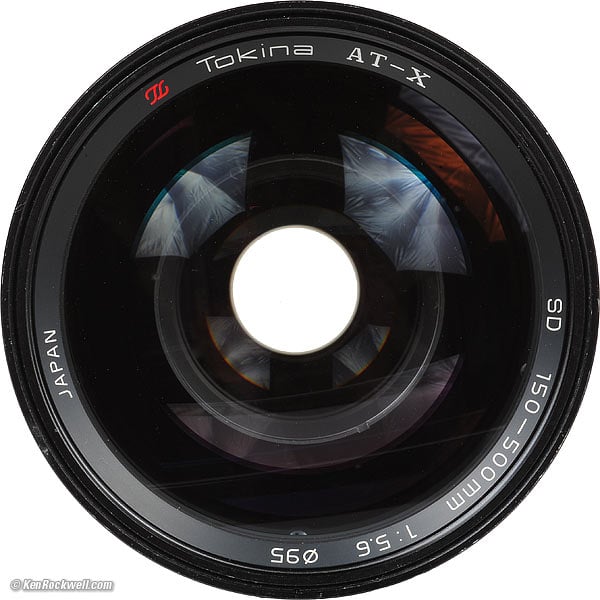
Tokina 150-500mm f/5.6 AT-X.
The coatings seem like only single-coating, and not particularly effective ones at that.
When you look at the front of the lens, you see a lot more reflections from the glass than from a Nikkor or Canon lens.
Color Rendition back to Performance back to top
Color is neutral and seems to match my modern Nikkors.
Distortion back to performance back to top
The Tokina 150-500mm has the least distortion I've ever measured in a telephoto zoom. It's almost invisible at every setting. It's always a tiny bit of pincushion distortion.
If you need to, it's trivial to correct the distortion completely by plugging these figures into Photoshop CS2's lens distortion filter. These aren't facts or specifications, they are the results of my research that requires hours of photography and calculations on the resulting data.
Full Frame at 30' (10m) |
|
150mm |
-1.0 |
200mm |
-0.5 |
250mm |
-0.5 |
300mm |
-0.5 |
400mm |
-0.5 |
500mm |
-1.2 |
© 2008 KenRockwell.com. All rights reserved.
Ergonomics back to performance back to top
Move mouse over to see it zoom.
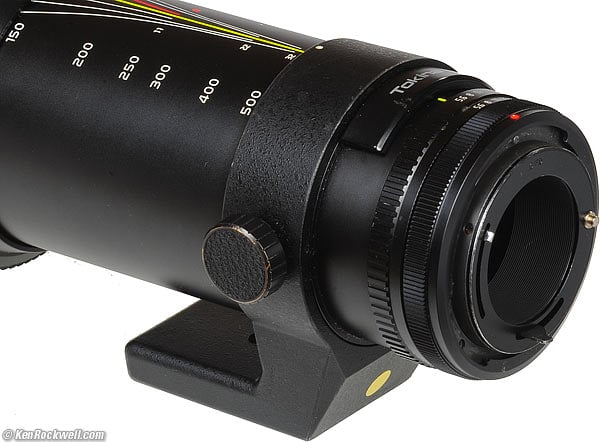
It's easy to use. Grab the big ring, push-pull to zoom and twist to focus.
There is a friction lock to lock both focus and zoom position.
The focus feels good, a tiny bit more damped than I might like.
Zooming also feels as good as I've felt in any third-party lens.
Zoom and focus are OK, but never perfectly sooth as it can be on a Nikon or Canon lens. It feels like entirely aluminum cams and helicoids, with no brass internally.
The half-stop clicks between f/8 and f/22 bug me. I'm used to setting exposure by counting clicks. With this lens, it takes a lot more concentration because clicks mean different things in different places.
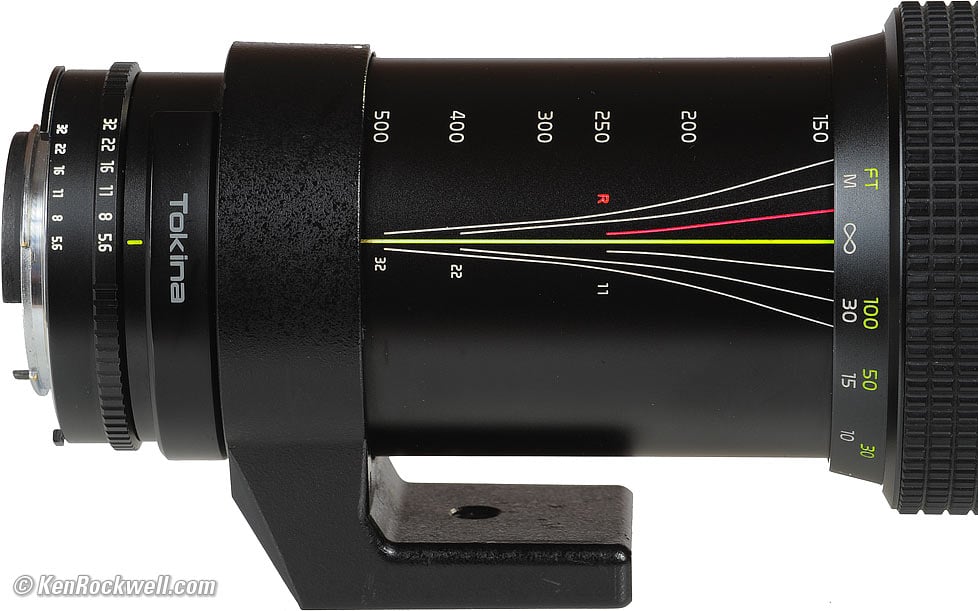
Tokina 150-500mm drop-in filter holder and zoom controls. enlarge.
Falloff (darkened corners) back to performance back to top
Falloff is minor, which is a good thing since most of us will always be shooting the Tokina 150-500mm wide-open at f/5.6.
I can only see it with real pictures if I shoot a sequence at different apertures and then switch among them on-screen, which lets me see the change in corner brightness from image to image. I'd never see any falloff at any focal length by looking at a normal image alone.
If you're shooting walls, stop down to f/8 or f/11 and it goes away entirely. For normal subjects, the falloff is minor even at f/5.6.
Filters back to performance back to top
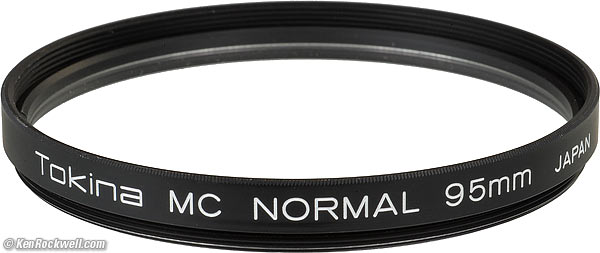
Tokina 95mm filter.
Most people will use a front 95mm filter for protection. The 95mm Tokina filter wasn't standard, but many people bought them along with the lens. Any 95mm filter fits, like the Nikon L37c.
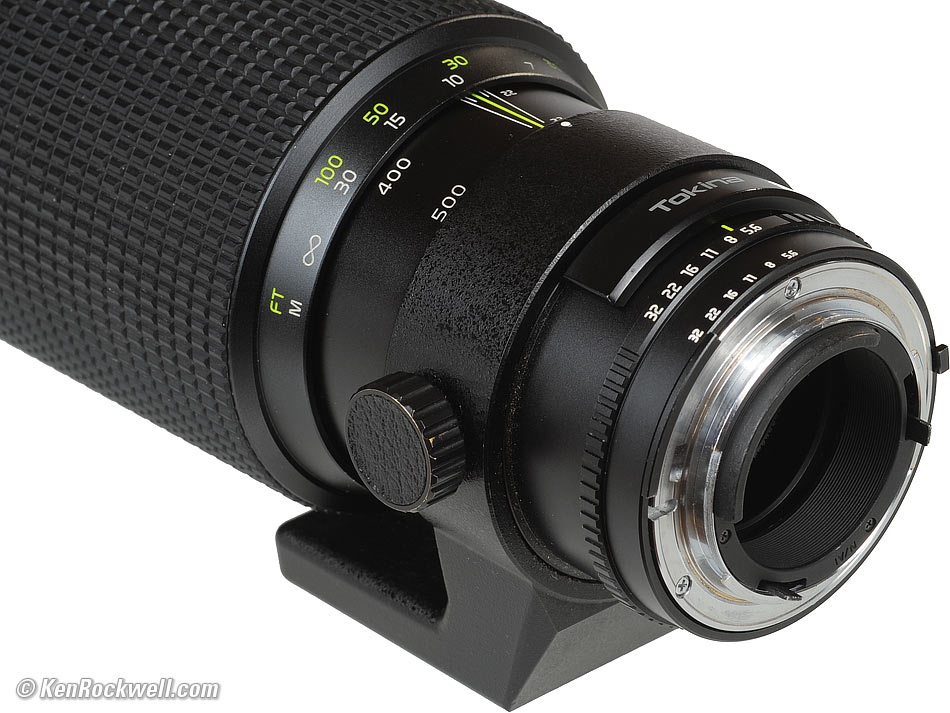
Tokina 150-500mm f/5.6 AT-X rear view, closer. enlarge.
There also is a drop-in holder for 35.5mm screw-in filters. Just pull out the thing marked "Tokina" in gray, between the tripod collar and the aperture ring . The 150-500mm comes with a clear filter in the slot, which is needed for proper focusing.
These lenses may or may not have included a set of colored 35.5mm filters. Most people use the less expensive 35.5mm filters for color manipulation instead of the more expensive 95mm front filters.
You can still buy these 35.5mm filters, as well as the original set #1 for color and set #2 for black-and-white film.
Hood, Caps and Case back to performance back to top
Hood
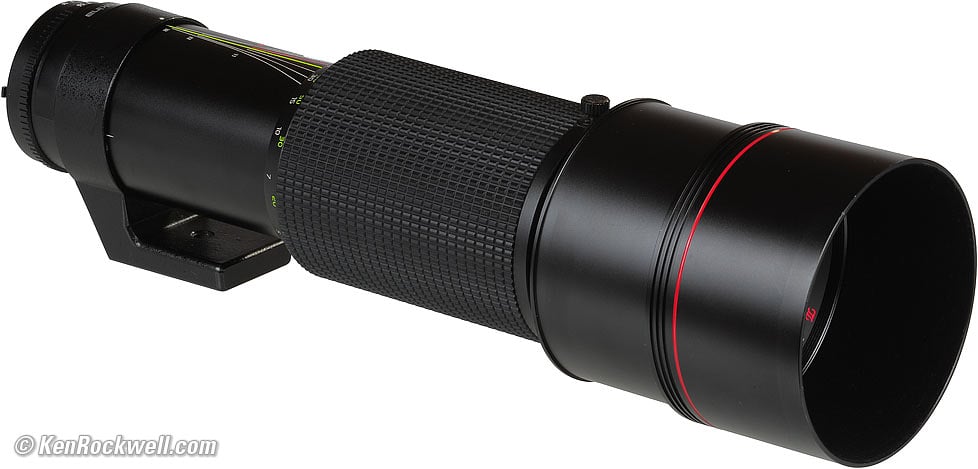
Tokina 150-500mm f/5.6 AT-X with hood extended. enlarge.
The hood is built-in. Just slide it forward.
It's relatively loose. Mine slides forward or back if I tilt the lens up or down. If I cared, a rubber band would hold it in position.
It's flocked on the inside.
Front Cap
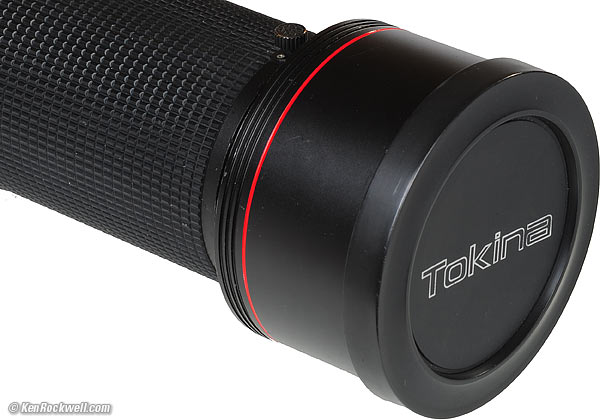
Tokina 150-500mm f/5.6 AT-X front cap.
The front cap is push-on plastic, with Tokina embossed in silver.
System Case
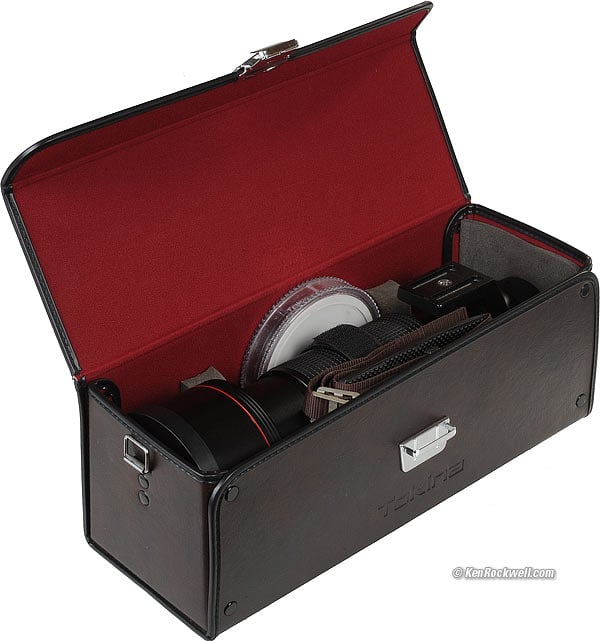
Tokina 150-500mm f/5.6 AT-X system case.
The case feels like vinyl over cardboard, with reddish fuzz on the inside.
There are two hard foam bulkheads which cradle the lens. You must rotate the tripod mount as shown for it all to fit.
There is a velcro strap which holds the lens to the bulkheads.
The strap is brown nylon mesh with a black rubber pad to match the brown vinyl and black piping.
There's enough space to pop in a 95mm filter in its case.
Mechanics back to performance back to top
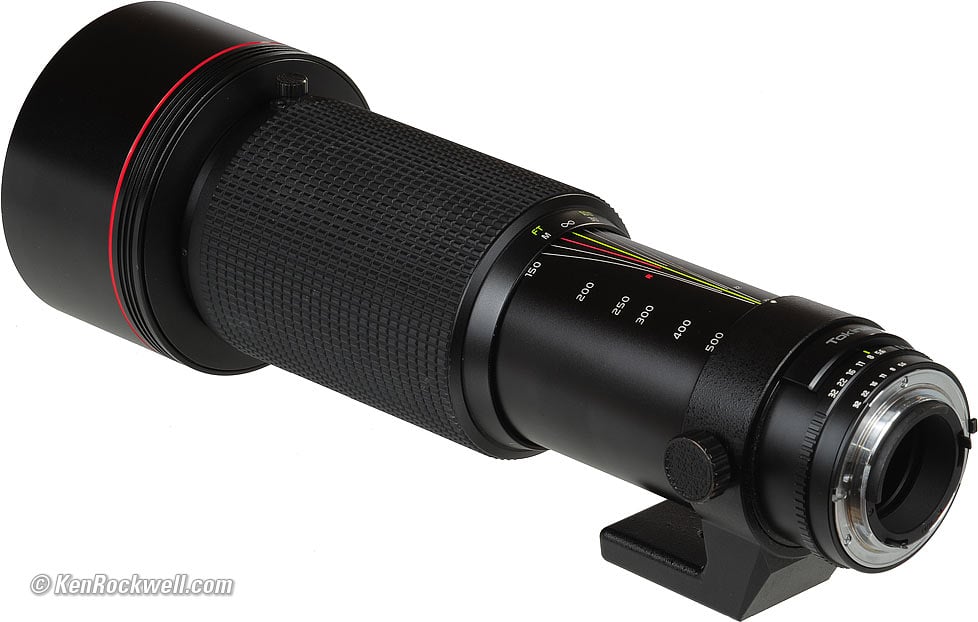
Tokina 150-500mm f/5.6 AT-X, rear view. enlarge.
Hood
Flocked anodized aluminum.
Filter Threads
Anodized aluminum.
Barrel
Anodized aluminum.
Focus and Zoom Ring
Anodized aluminum.
Aperture Ring
Anodized aluminum.
Markings
Engraved and filled.
Serial Number
Engraved and filled on rear bottom of barrel, often hidden under the tripod mount.
Internals
Feels like all aluminum, no brass.
Sharpness back to performance back to top
On the Nikon D3 full-frame camera, it's wonderful even wide-open at 150mm and then softer at 500mm.
150~250mm: Sharp edge-edge, even wide-open.
400~500mm: It looks like it has some spherical aberration wide open (f/5.6) Stop down a stop or two and it's better. My sample is a bit softer on the right side at the longer focal lengths.
Check your focus, mine tends to fool my D3's electronic rangefinder at 500mm to focus a little bit behind the subject.
Recommendations
Top Intro Compatibility Specifications
Performance Recommendations More
This is an unusual manual focus lens.
It works on almost all Nikons (see Nikon Lens Compatibility and read down the AI, AI-s column), but the Canon FD version only works on old Canon manual focus cameras. The Canon version will not work on any Canon EOS or digital camera, but works great on cameras like the T90, T70, F-1n and AE-1.
For autofocus cameras, I prefer my Nikon 200-500mm VR or my Canon 100-400mm L IS II, since they both autofocus and add image stabilization. 500mm versus 400mm isn't worth the loss of AF and VR, if you're shooting a modern camera, while the new lenses focus much closer.
For manual focus cameras, this is a unique lens not offered by Canon or Nikon. Its extremely low distortion may make it a winner for those who need it.
This all-content, junk-free website's biggest source of support is when you use those or any of these links to approved sources when you get anything, regardless of the country in which you live. Never buy at retail or any other source not on my personally approved list since you'll have no way of knowing if you're missing accessories, getting a defective, damaged, returned, store demo or used camera. I use the stores I do because they ship from secure remote warehouses where no one gets to touch your new camera before you do. Buy only from the approved sources I use myself for the best prices, service, return policies and selection.
Thanks for helping me help you!
Ken, Mrs. Rockwell, Ryan and Katie.
More Information
Top Intro Compatibility Specifications
Performance Recommendations More
See also Modern Photography, March 1988, pages 61 and 62.
© Ken Rockwell. All rights reserved. Tous droits réservés. Alle Rechte vorbehalten.
Help Me Help You
I support my growing family through this website, as crazy as it might seem.
The biggest help is when you use any of these links when you get anything. It costs you nothing, and is this site's, and thus my family's, biggest source of support. eBay is always a gamble, but all the other places always have the best prices and service, which is why I've used them since before this website existed. I recommend them all personally.
If you find this page as helpful as a book you might have had to buy or a workshop you may have had to take, feel free to help me continue helping everyone.
If you've gotten your gear through one of my links or helped otherwise, you're family. It's great people like you who allow me to keep adding to this site full-time. Thanks!
If you haven't helped yet, please do, and consider helping me with a gift of $5.00.
As this page is copyrighted and formally registered, it is unlawful to make copies, especially in the form of printouts for personal use. If you wish to make a printout for personal use, you are granted one-time permission only if you PayPal me $5.00 per printout or part thereof. Thank you!
Thanks for reading!
Mr. & Mrs. Ken Rockwell, Ryan and Katie.