Canon RF 14mm f/1.4L VCM
World's widest professional f/1.4 lens.
Superb Optics for Astronomy & Low-Light Action & Sports (2026 ~ today)
Sample Images Intro New Good Bad Missing
Specifications Performance Compared
R1 R3 R5II R5 R5C R6III R6II R6 R6V R R8II R8 RP
R7 R10 R50 R50V R100 Bodies Compared
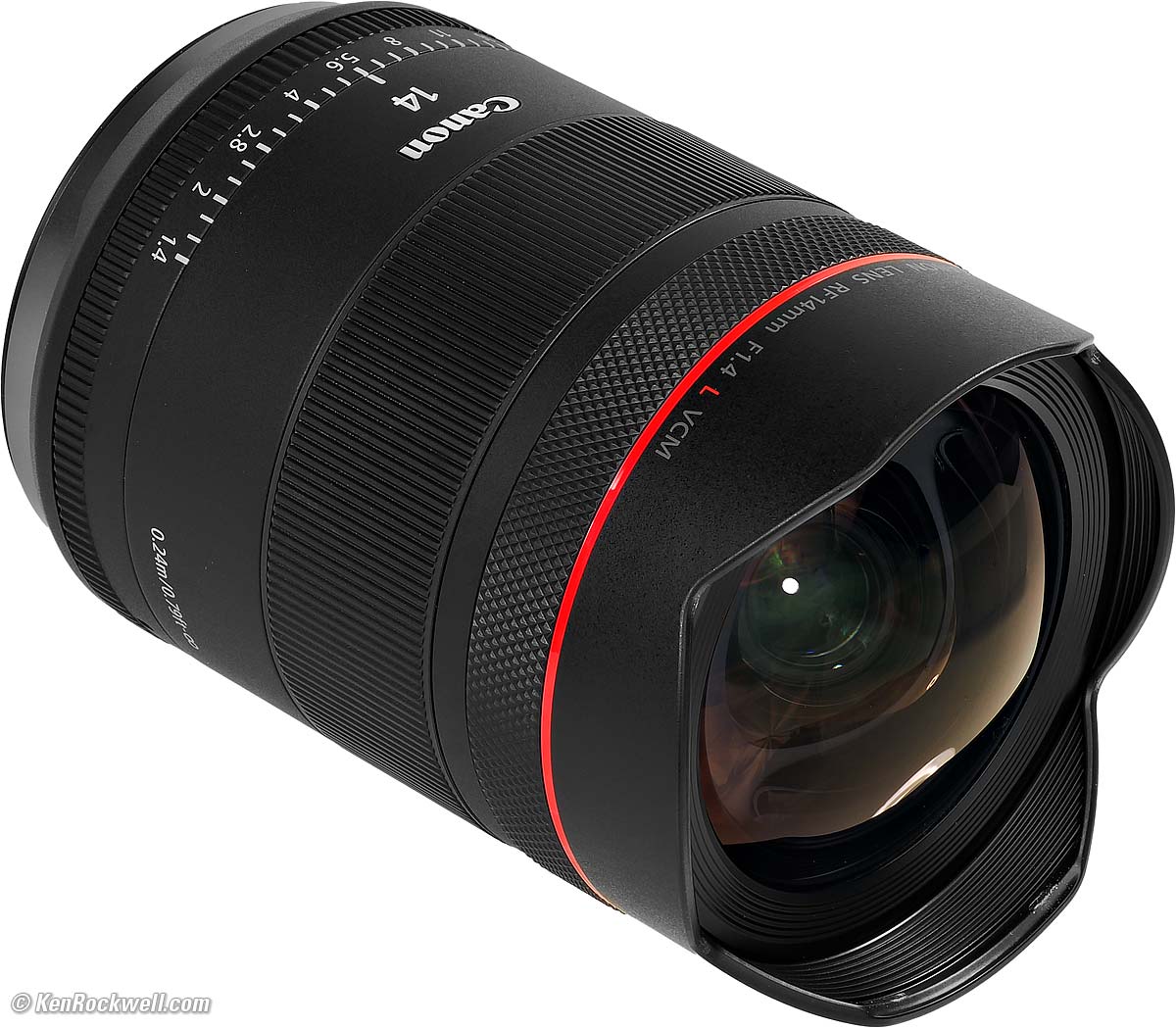
Canon RF 14mm f/1.4L VCM (rear gelatin filters only, 20.3 oz./576g, 0.8'/0.24m close focus, 0.19× macro ratio, $2,599). bigger.
I got mine at B&H. I'd also get it at Crutchfield, at Amazon or at Adorama, or get it used at eBay (How to Win at eBay), or get it used at KEH.
My junk-free, all-content website's biggest source of support is when you use those or any of these links to the places I use myself when you get anything, and it costs nothing more. I've bought from these places for over 100 combined years because they have the best service, the best selection, the best prices, and usually 100% cash-back returns for at least 30 days if you don't love your new goodies. As an Amazon Associate and eBay Partner Network Affiliate, I earn from qualifying purchases. Thanks for helping me help you! Ken.
October 2026 Better Pictures Canon Reviews RF Lenses EF Lenses Flash All Canon Reviews All Reviews
How to Use Ultrawide Lenses
Why Fixed Lenses Take Better Pictures
FD 14mm f/2.8L (1982 ~ 1987, 484g, use with adaptors on mirrorless)
EF 14mm v/2.8L (1991 ~ 2007, 538g, use with EF to RF adaptor on mirrorless)
EF 14mm f/2.8L II (2007 ~ today, 643g, use with EF to RF adaptor on mirrorless)
RF 14-35mm f/4L IS USM (2011 ~ today, 538g)
Sample Images top
Sample Images Intro New Good Bad Missing
More samples throughout this review at Bokeh, Distortion, Falloff, Macro, Spherochromatism and Sunstars.
These are just snapshots; my real work is in my Gallery.
These are all shot hand-held as Large Normal (


I set my Picture Style at my usual for Canon: Standard, Saturation +4, Sharpness: 7 Strength, 1 Fineness and 1 Threshold:
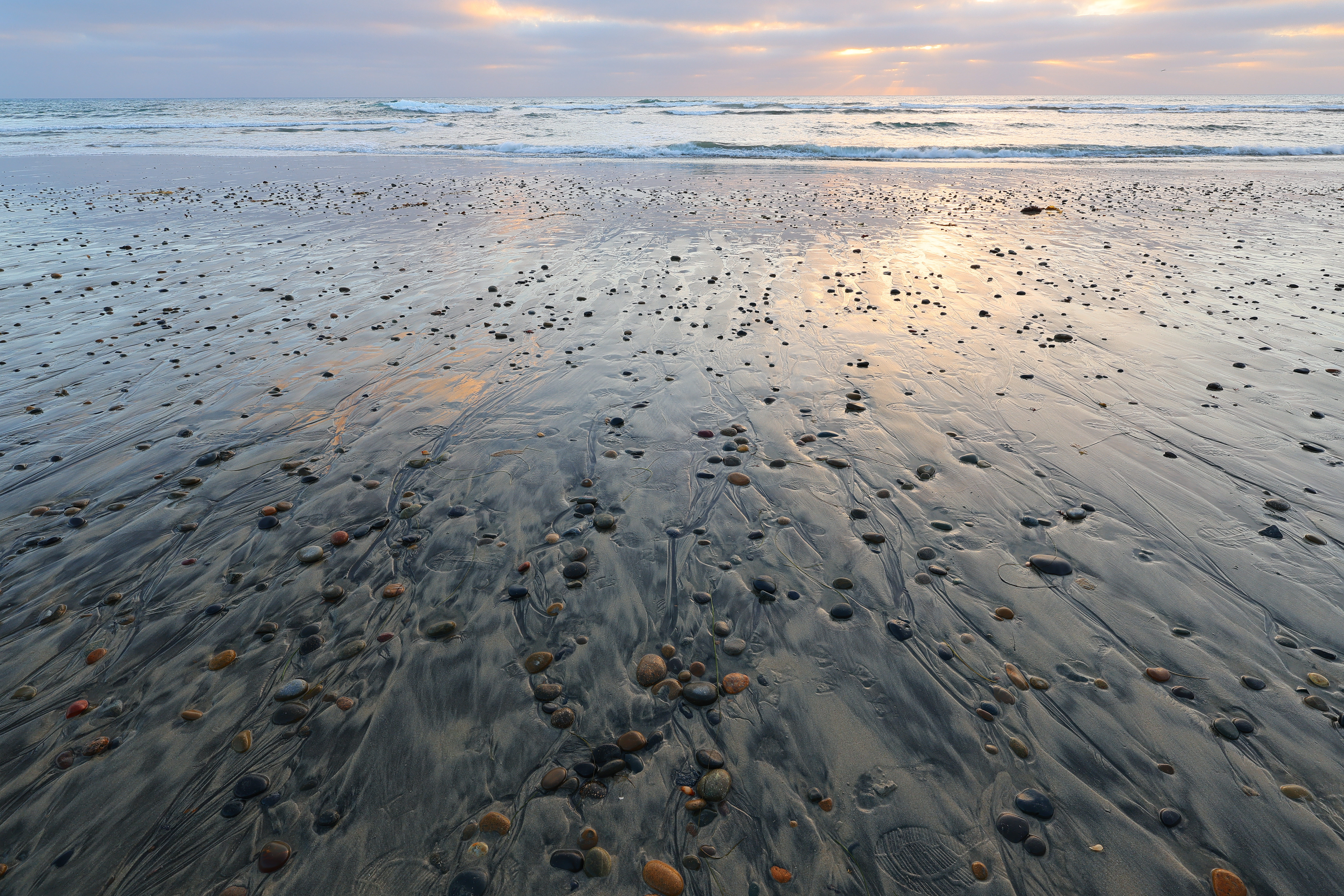
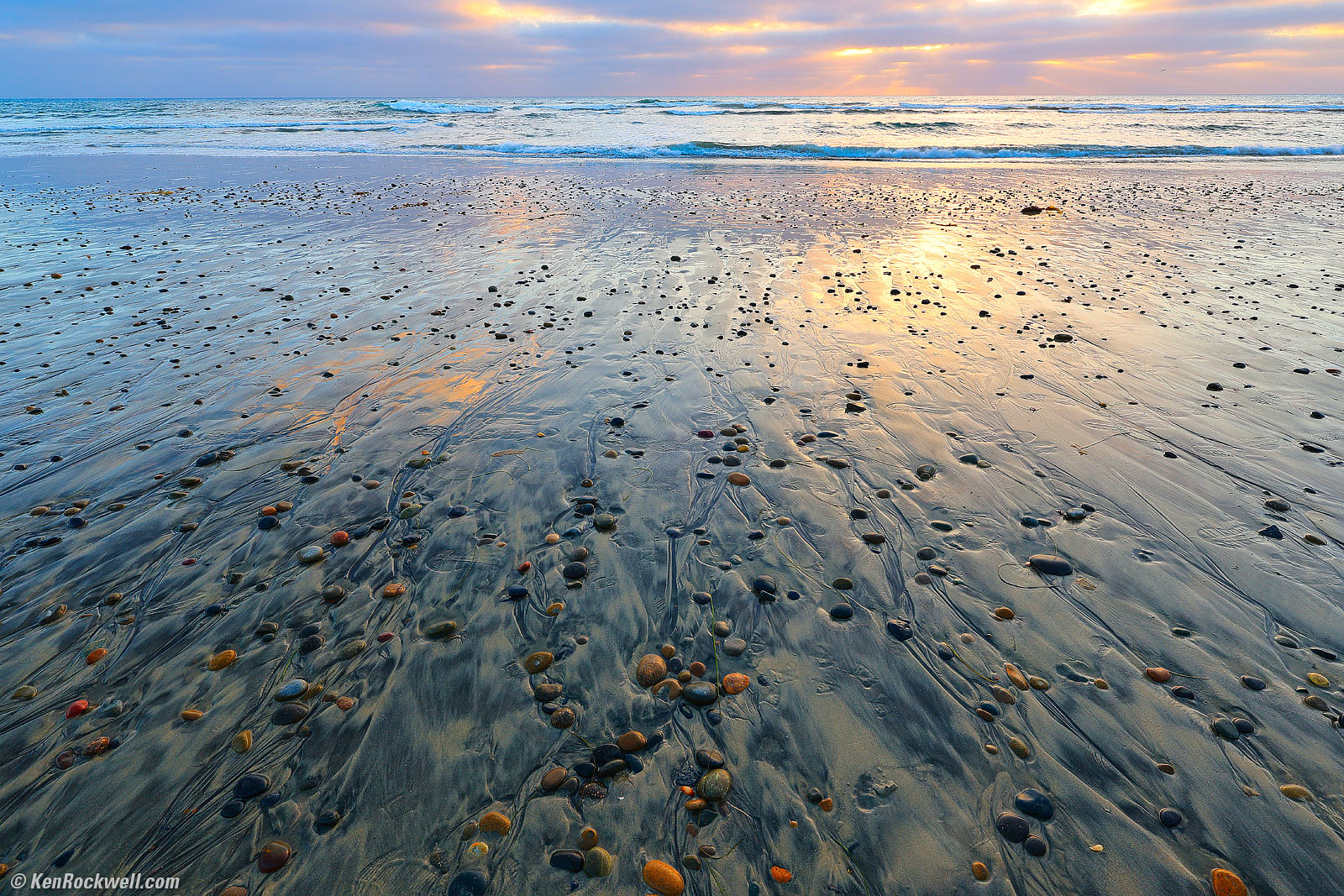
Quiet Sunset, Fletcher Cove, 6:37 PM, Monday, 14 September 2026. Canon R6 III, RF 14mm f/1.4L VCM at f/11 for depth-of-field from my feet to infinity, hand-held 1/20 at Auto ISO 100 (LV 11.4), Skylum Luminar software to amp it up from what was a very quiet and mostly gray evening. bigger or camera-original 32 MP © 10.8 MB JPG.
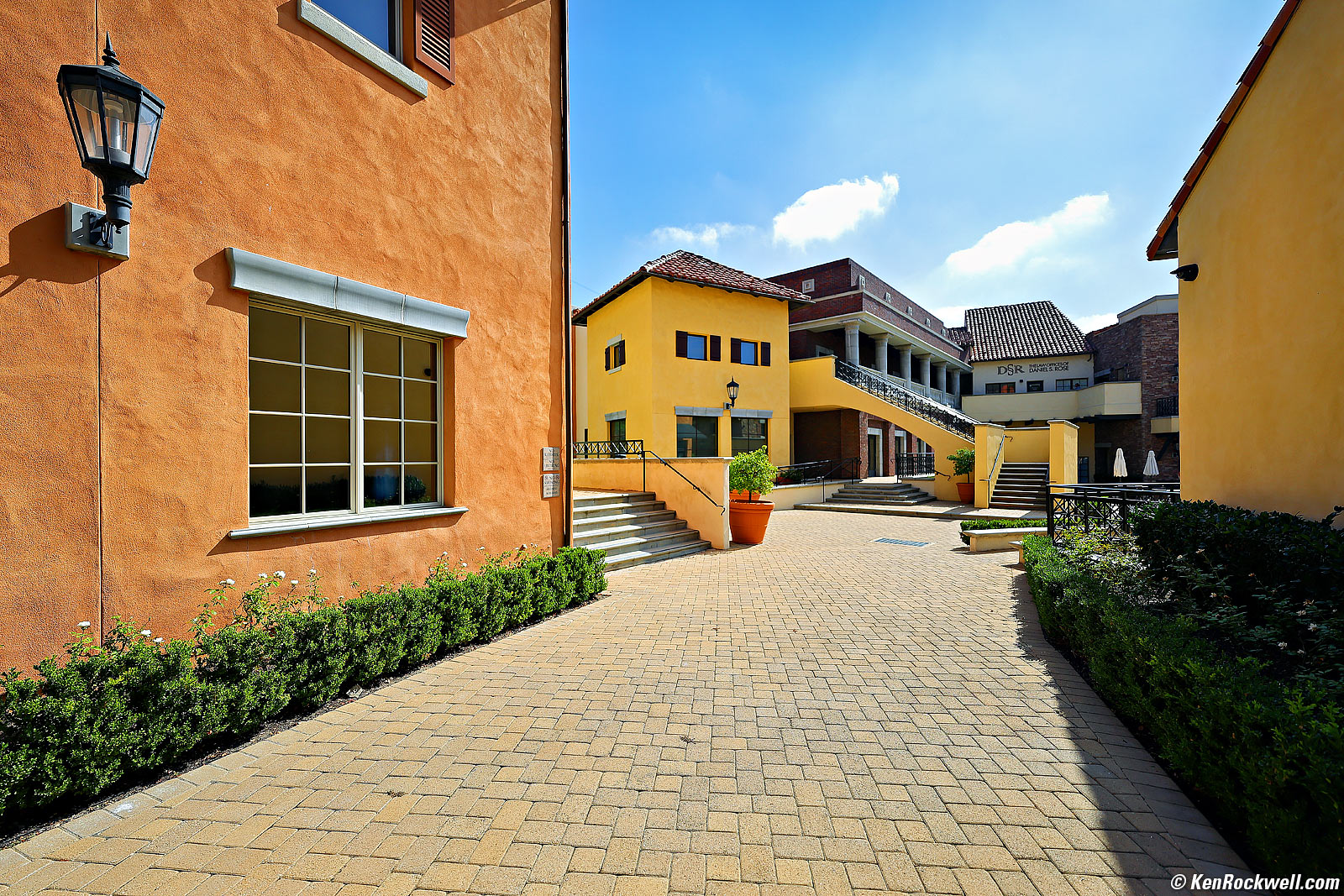
Positano, Italy, 10:15 AM, Saturday, 12 September 2026. Canon R6 III, RF 14mm f/1.4L VCM wide-open at f/1.4 at 1/5,000 at ISO 50L, +0.3 stops exposure compensation (LV 14.4), Radiant Photo software to add light to the shadows while retaining highlights. bigger.
How sharp is it wide-open at f/1.4? Here's the top left corner magnified 4.35 times:
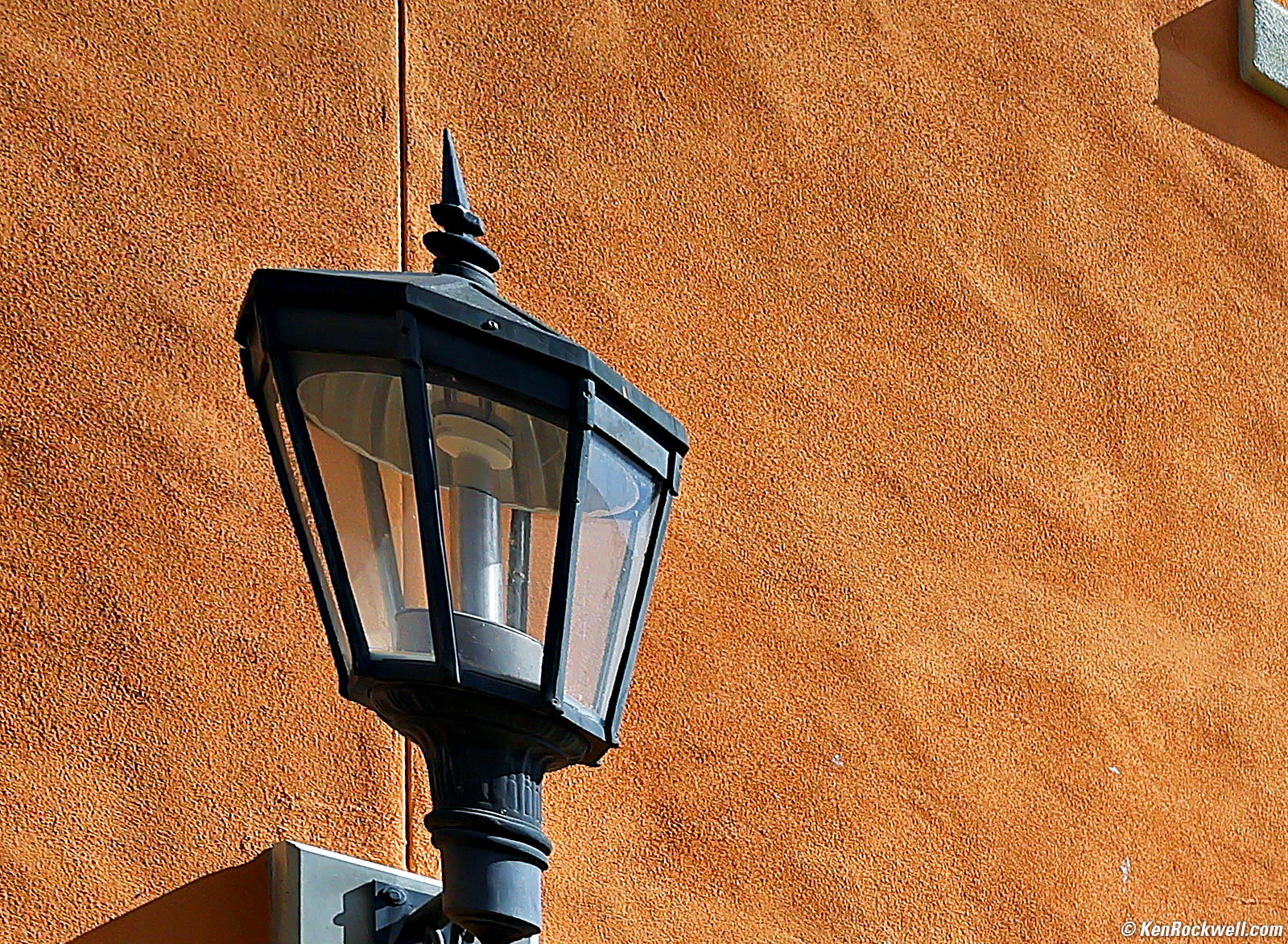
1,600 × 1,200 pixel (4.35×) crop from above. bigger.
No coma, no blur, no softening, just exquisite performance.
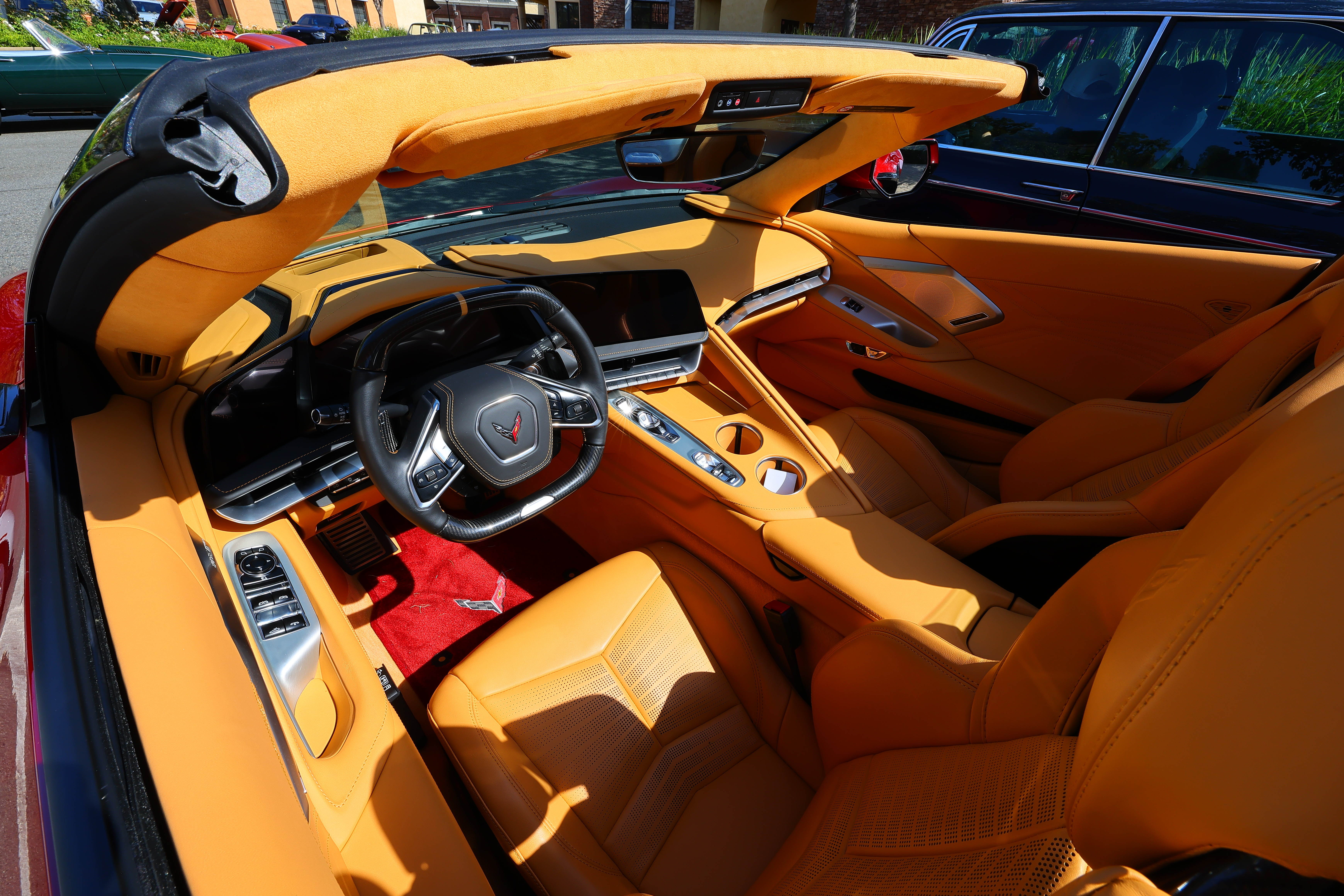
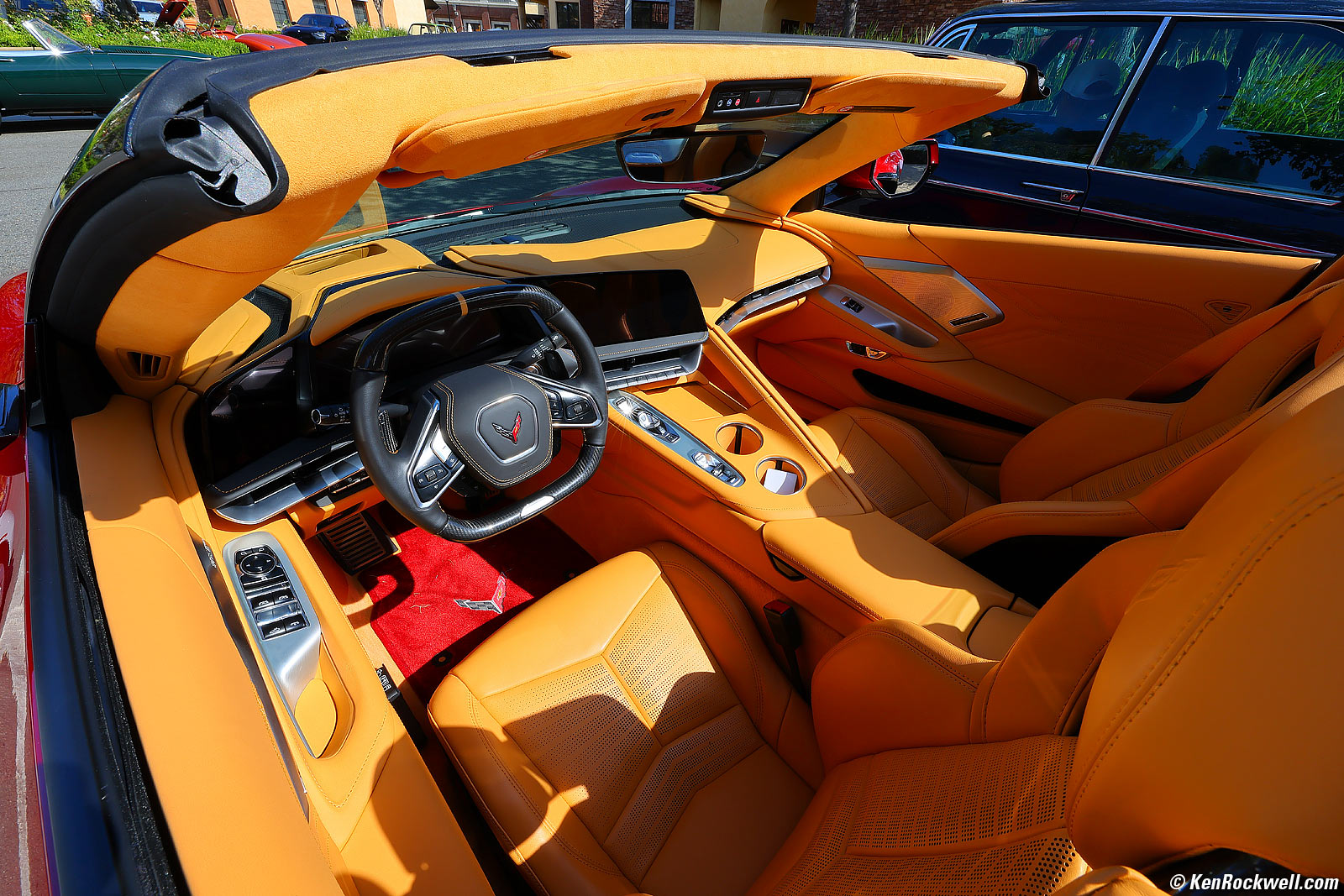
C8 Corvette Interior, Positano, Italy, 10:19 AM, Saturday, 12 September 2026 . Canon R6 III, RF 14mm f/1.4L VCM at f/16 for depth-of-field at 1/50 at Auto ISO 100, -0.7 stops exposure compensation to keep the bright tan from washing out (LV 13⅔), Radiant Photo software to add light to the shadows while retaining highlights. bigger or camera-original 32 MP © 6.5 MB JPG.
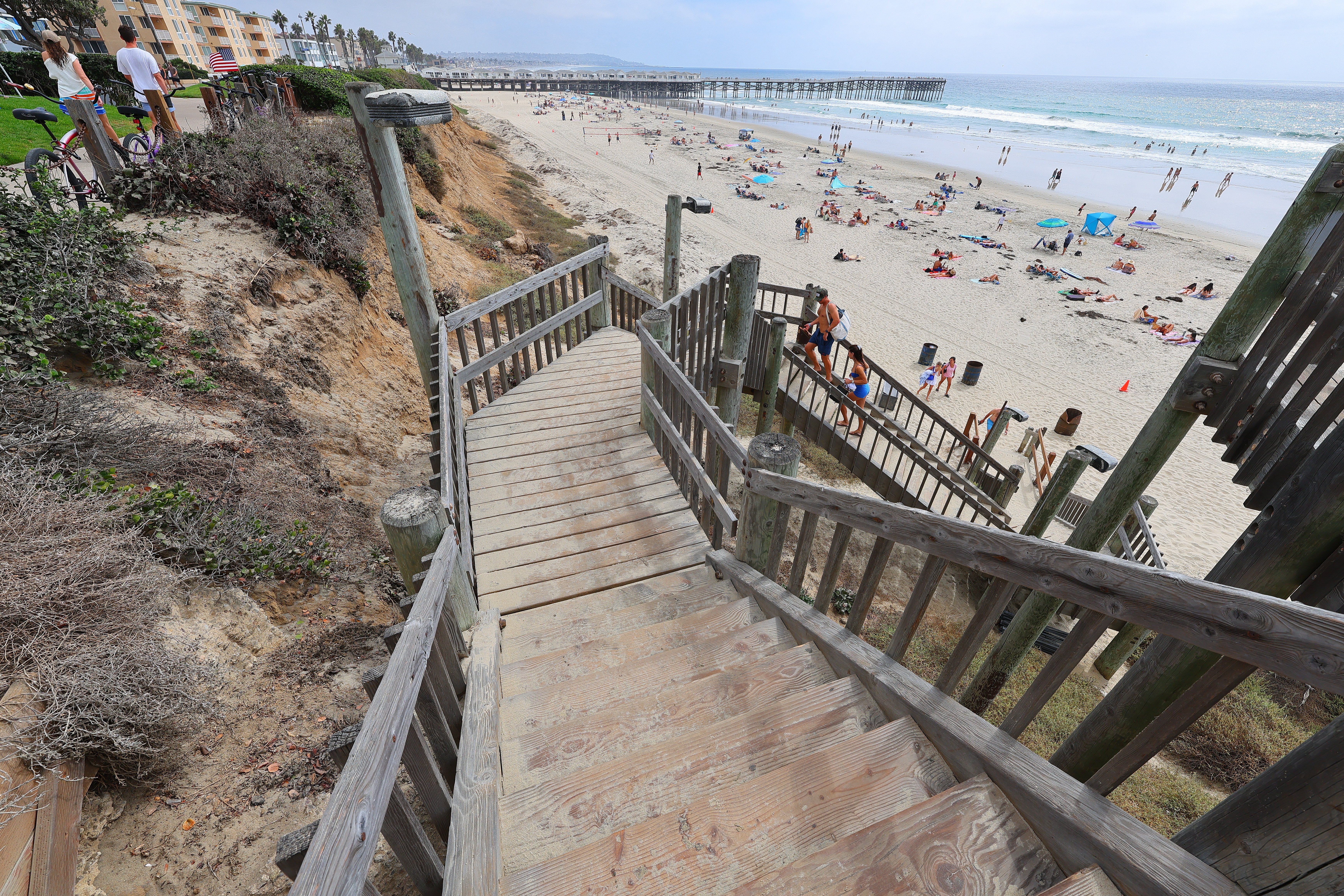
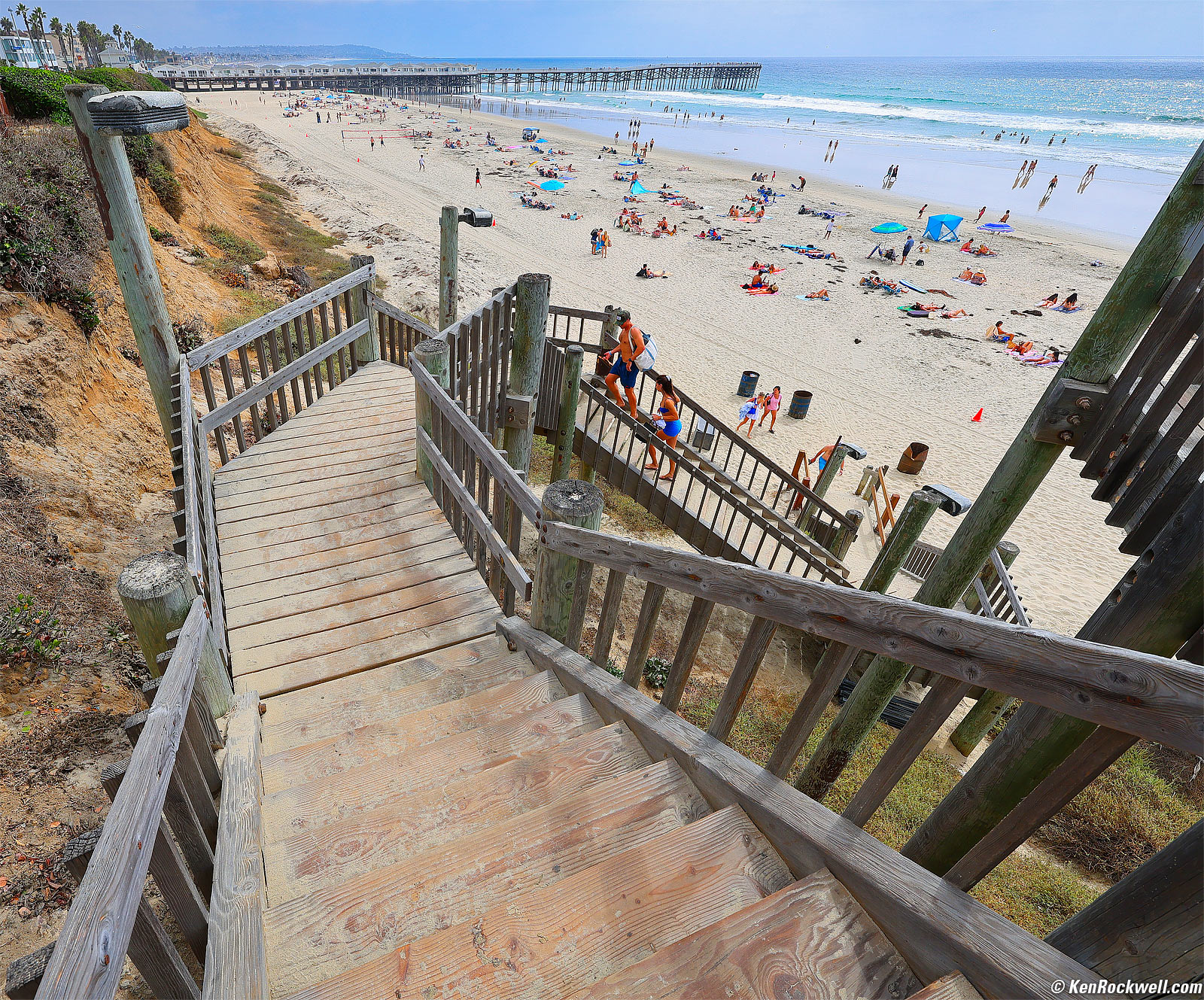
Twisty Path to the Sea, 2:54 PM, Saturday, 12 September 2026. Canon R6 III, RF 14mm f/1.4L VCM at f/7.1 at 1/400 at Auto ISO 100 (LV 14¼), Skylum Luminar software to amp it up. bigger or camera-original 32 MP © 12.7 MB JPG.
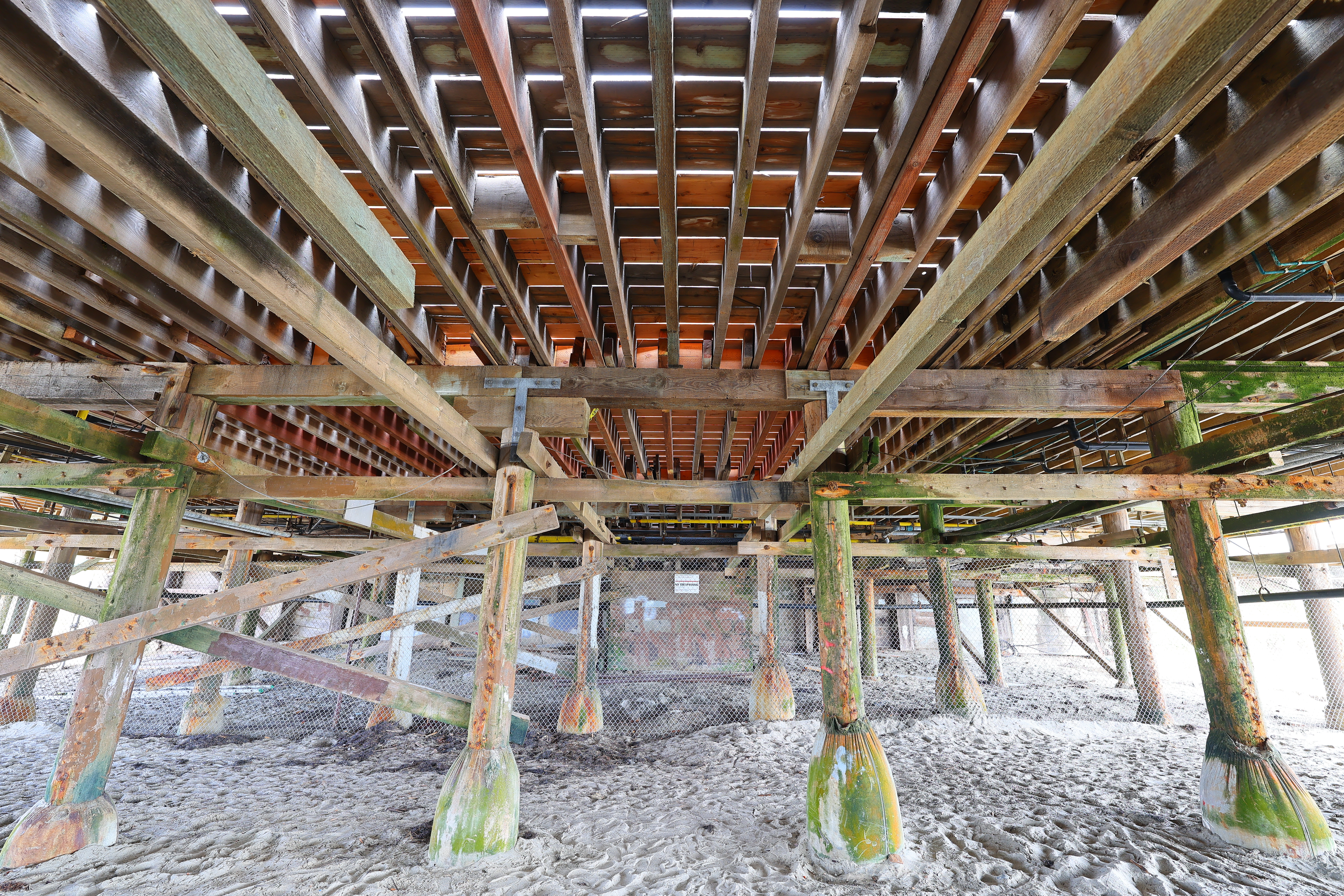
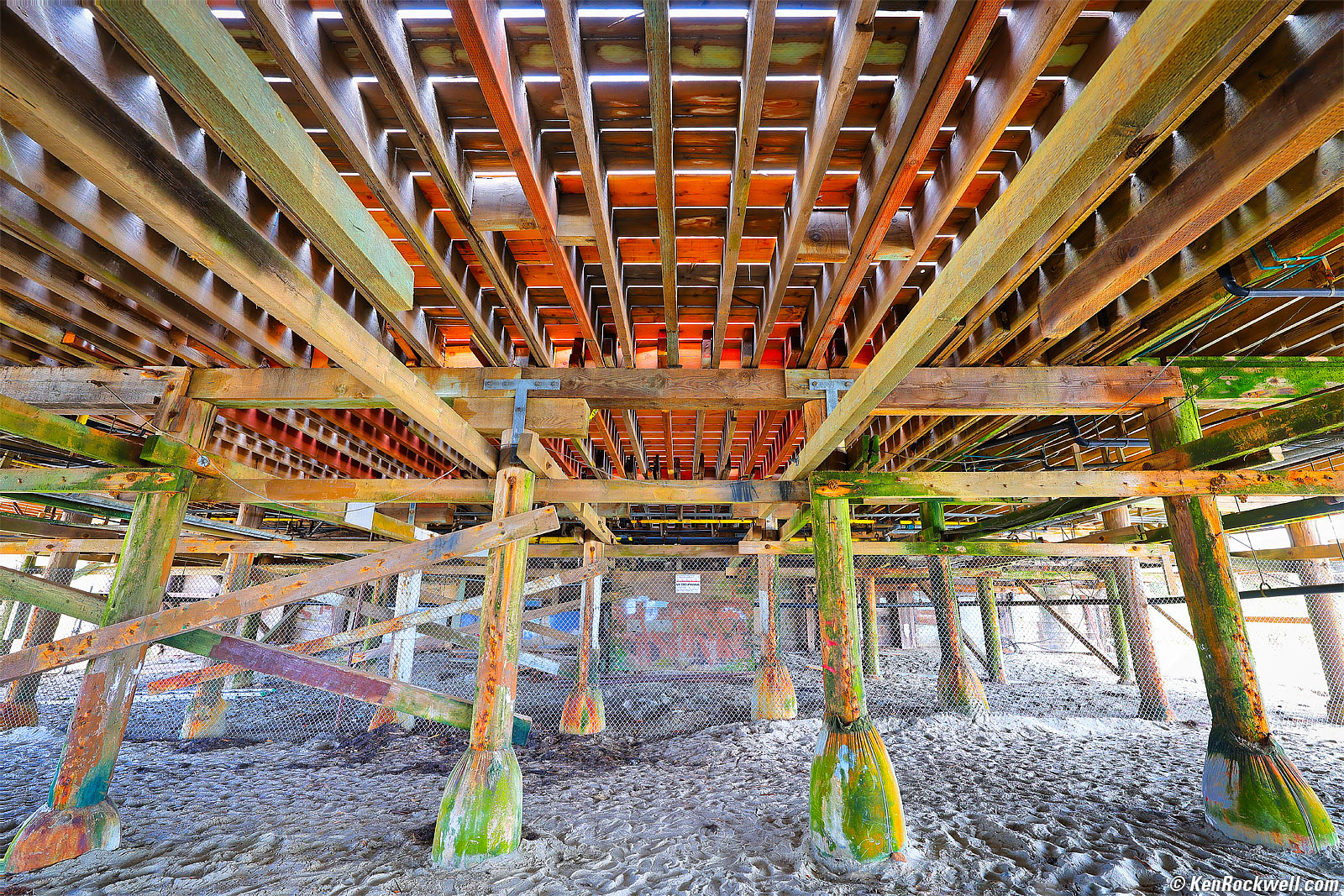
Under the Pier, 3:03 PM, Saturday, 12 September 2026. Canon R6 III, RF 14mm f/1.4L VCM at f/4 hand-held at 1/10 at Auto ISO 100 (LV 7.4), Skylum Luminar software to amp it up from an otherwise boring gray shot. bigger or camera-original 32 MP © 15.0 MB (!) JPG (remember that what may look soft is simply out-of-focus at f/4; the lens is ultrasharp).

Introduction top
Sample Images Intro New Good Bad Missing
Specifications Performance Compared
|

I buy only from these approved sources. I can't vouch for ads below. |



This is an extraordinarily sharp and ultrafast ultra-ultrawide lens. It is intensely sharp all the way out to the corners wide-open at f/1.4; essentially optically perfect.
I shot this lens and am awed at this, and only afterwards looking at the specifications do I realize that Canon has pulled every optical trick it's learned over all these decades, technology it rarely uses, like blue-refractive compound to reduce spherochromatism and an exotic fluorite element usually reserved for the most insane optical designs. It also uses Air-Sphere and Sub-Wavelength coatings to eliminate flare and ghosts that have always plagued lenses this wide.
I appreciate how incredible is this lens because I've owned exotic 13mm, 14mm and 15mm lenses back in the olden days when they were both insanely expensive (about the equivalent of $20,000 today for a 13mm ) — and those lenses were soft, distorted and even off-color back in their day!
Not only is it ultrasharp, it has none of the other optical flaws which ran rampant in other earlier ultra-ultrawides. For instance, there is no significant peripheral color shift. Older lenses used to get bluer on the sides and corners because of how anti-reflection coatings lost their effectiveness when light hit the glass at sharp angles, while this lens shows no visible shift. Its color balance doesn't shift in different parts of the frame as these lenses did in olden days.
Older 14mm lenses used to have awful and difficult to correct distortion and all sorts of weird flare and ghosts, again all fixed in this lens. Yes, this is an expensive lens, but it's also extraordinary. It is extremely difficult to make a good 14mm f/2.8, much less make an f/1.4 ultraspeed lens like this. Bravissimo!
This lens is also much lighter than past, slower 14mm lenses. Amazing!
This is the world's best pro lens for Milky Way shooting: ultra-fast and ultra-wide.
While there are lots of wider f/1.8 lenses, unless they're 8mm focal length or less on full-frame at f/1.8, this 14mm f/1.4 lens beats them for unguided astro photos.
f/1.4 lets us use only 63% of the exposure time needed for the same exposure at f/1.8.
With no ability to take any front protective filter, this lens is doomed to a sheltered life because even the slightest front element damage essentially destroys this lens. I carry this capped all the time on my camera even while out actively shooting, removing the cap only to compose and shoot.
Any damage, dirt or fingerprints are often visible in the image due to this lens' almost limitless depth of field. Unlike a tele where an obvious front-element chip can simply be filled-in with black paint and never be seen again (honest), even minor dust can become sufficiently in focus to be seen in some images, especially if the sun or other brilliant source of light is in the image or shining on the front surface. Thankfully it has a fluorine coating to resist crud, but dust still collects because the cap does not seal and lets in dust.
I got my RF 14mm at B&H. I'd also get it at Crutchfield, at Amazon or at Adorama, or get it used at eBay (How to Win at eBay), or get it used at KEH.
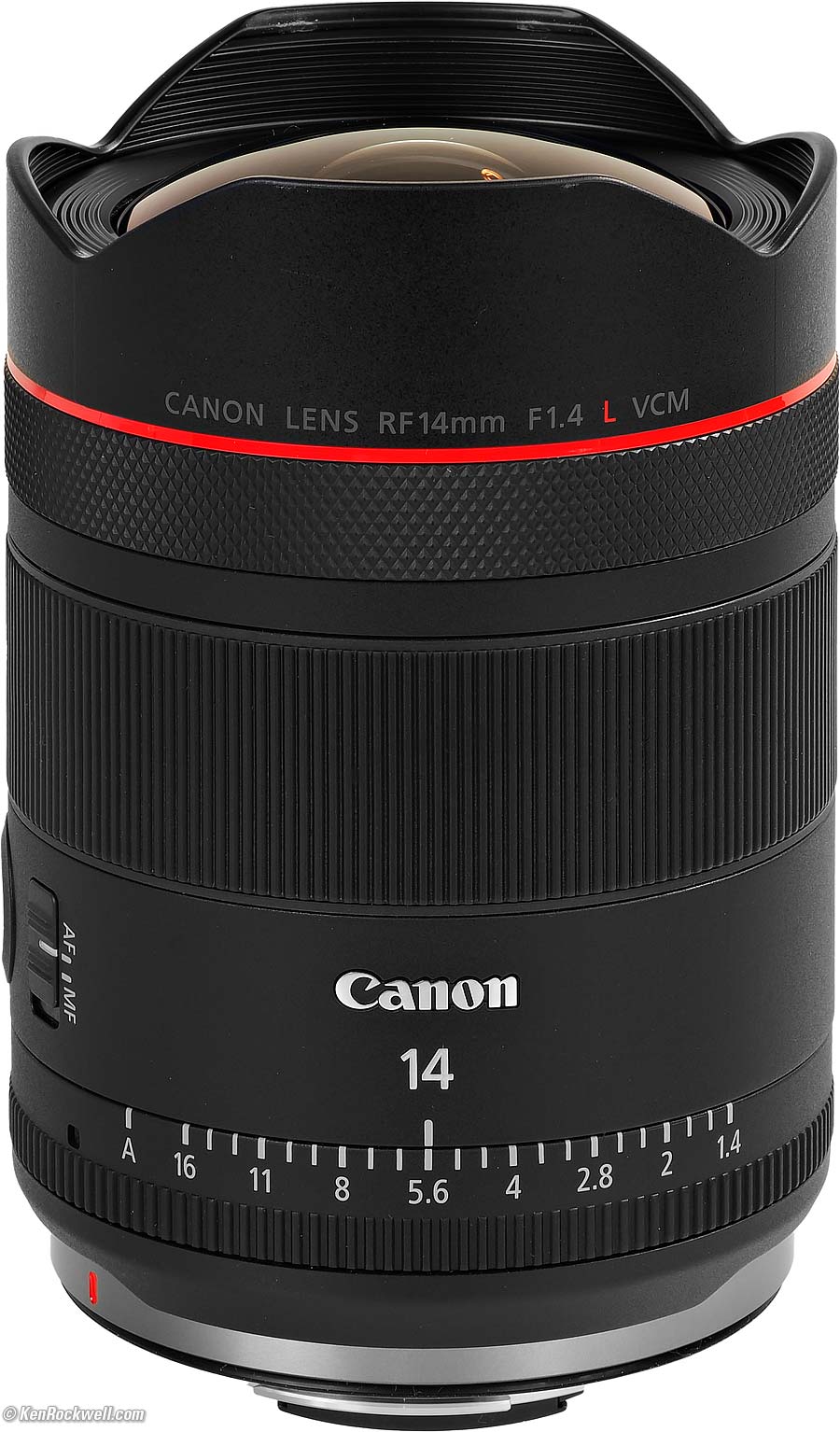
Canon RF 14mm f/1.4L VCM. bigger.
New intro top
 World's widest professional f/1.4 lens; far, far wider than Sony's widest f/1.4 at 24mm, and Nikon's widest f/1.4 is a 35mm lens!
Canon's first fixed 14mm lens for its mirrorless system.
World's first professional 14mm f/1.4 lens. Consumer brands have made these before, but never has LEICA, Nikon or even Sony made a 14mm f/1.4. Sony makes a 14mm f/1.8 and there are loads of off-brand 14mm f/1.4s, while this is the first pro-level 14mm f/1.4.
Good intro top
 Flawless and essentially diffraction-limited optics.
Small.
Light.
Programmable focus lock button.
AF/MF switch.
Case included.
Professionally Made in Japan.
100% U.S.A.-based high-quality technical support at (800) OK-CANON.
Bad intro top
 With no ability to take any front protective filter, this lens is severely susceptible to dirt and damage to the front element, and even the slightest front element damage essentially destroys this lens because its depth-of-feild is so deep that damage or even fingerprints usually will be in focus.
Expensive! All this technology and performance in a lens this insanely wide and fast doesn't come cheap.
Plastic exterior, typical of what consumers accept in 2026.
Like the other VCM lenses from Canon (RF 20mm f/1.4L VCM, RF 24mm f/1.4L VCM, RF 35mm f/1.4L VCM, RF 50mm f/1.4L VCM and 85mm f/1.4L VCM), the VCM lenses from Viltrox, and the linear XD motor lenses from Sony, it feels like there's something floating around loose inside when the camera isn't awake because there is. The focus groups ride on rails inside these lenses, and when the focus system isn't active these optics float around randomly.
Missing intro
 No image stabilization, but works great if you have a stabilized camera.
No Stabilizer switch for in-camera stabilization.
Specifications top
Sample Images Intro New Good Bad Missing
Specifications Performance Compared
I got my RF 14mm at B&H. I'd also get it at Crutchfield, at Amazon or at Adorama, or get it used at eBay (How to Win at eBay), or get it used at KEH.
Name specifications top
Canon calls this the Canon RF 14mm f/1.4L VCM:
RF: Works only on Canon's EOS-R Mirrorless cameras.
L: Expensive as L.
VCM: Voice Coil (focus) Motor.
Model Number: RF14F14LVCM.
Optics specifications top
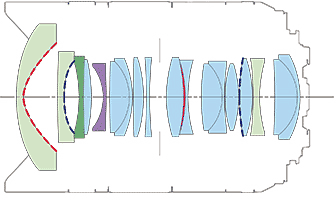
Canon RF 14mm f/1.4L VCM internal construction. Aspherical, UD glass, Regular Optical Glass and exotic Fluorite elements. BR (Blue-Refractive) compound, red dashes are Sub-Wavelength Coatings (SWC) and dark blue dashes show Air-Sphere coatings.
18 elements in 13 groups.
Three Aspherical elements.
One UD extra-low dispersion element, which help reduce secondary axial chromatic aberration.
One exotic Fluorite element for extraordinary sharpness.
BR (Blue-Refractive) compound squirted between two elements to minimize spherochromatism.
Air Sphere variable-refractive index coating (ASC).
Sub-Wavelength Coatings (SWC).
Fluorine coating to resist dirt and smudges.
Diaphragm specifications top
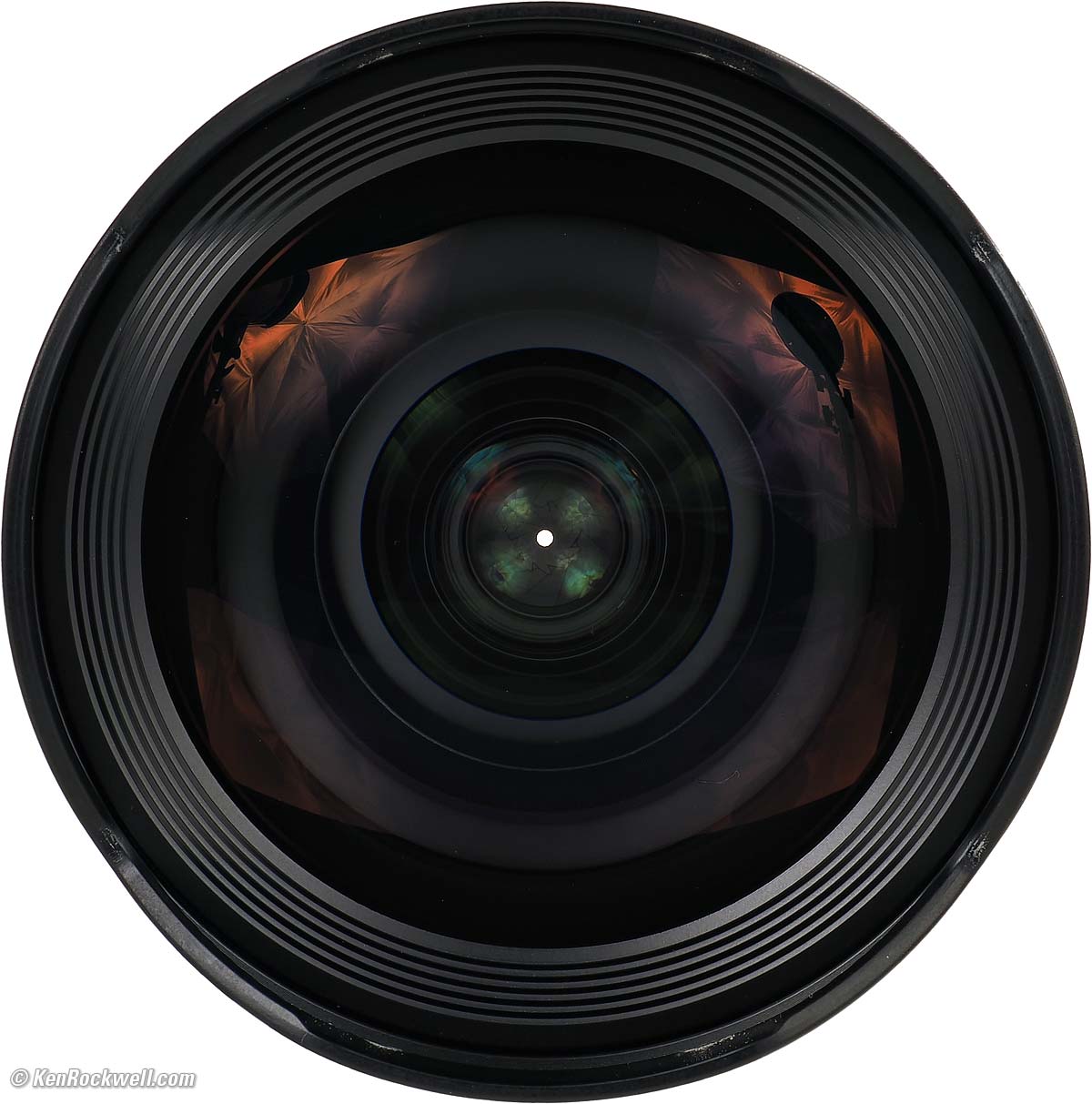
Canon RF 14mm f/1.4L VCM. bigger.
11 (!) rounded blades.
Electronically actuated.
Stops down to f/16.
Filters specifications top
Rear gelatin filter slot, only.
No front threads.
Coverage specifications top
Full-frame, which means it also covers APS-C.
Angles of View specifications top
114º diagonal on full frame.
104º horizontal on full frame.
81º vertical on full frame.
Focus Scale specifications top
No.
Not on lens, but may be displayed in-camera.
Infinity Focus Stop specifications top
No.
You have to focus somehow to get precise focus at infinity, just like at every other distance.
Depth of Field Scale specifications top
No.
Not on lens, but may be displayed in-camera.
Infrared Focus Index specifications top
No.
Close Focus (distance from subject to image plane) specifications top
0.787 feet or 9.45 inches or 0.24 meters.
Maximum Reproduction Ratio specifications top
1:9.1 (0.11×).
Reproduction Ratio Scale specifications top
No.
Not on lens, but may be displayed in-camera.
Image Stabilizer specifications top
NONE.
Caps specifications top
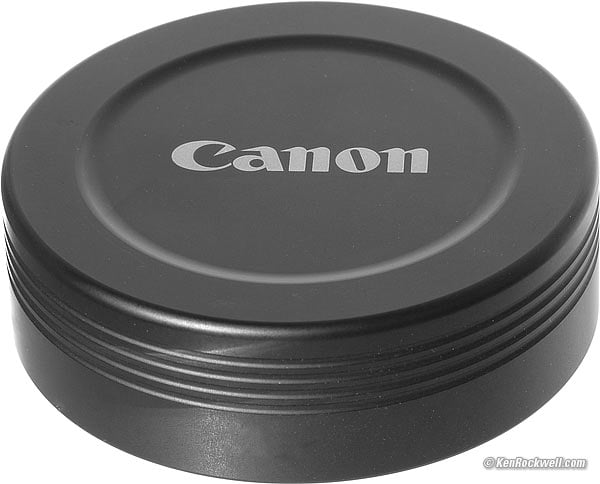
Crazy plastic 14B front cap, included:
|
|
| Dust and crud easily flow through the vents all around this 14B cap. bigger. |
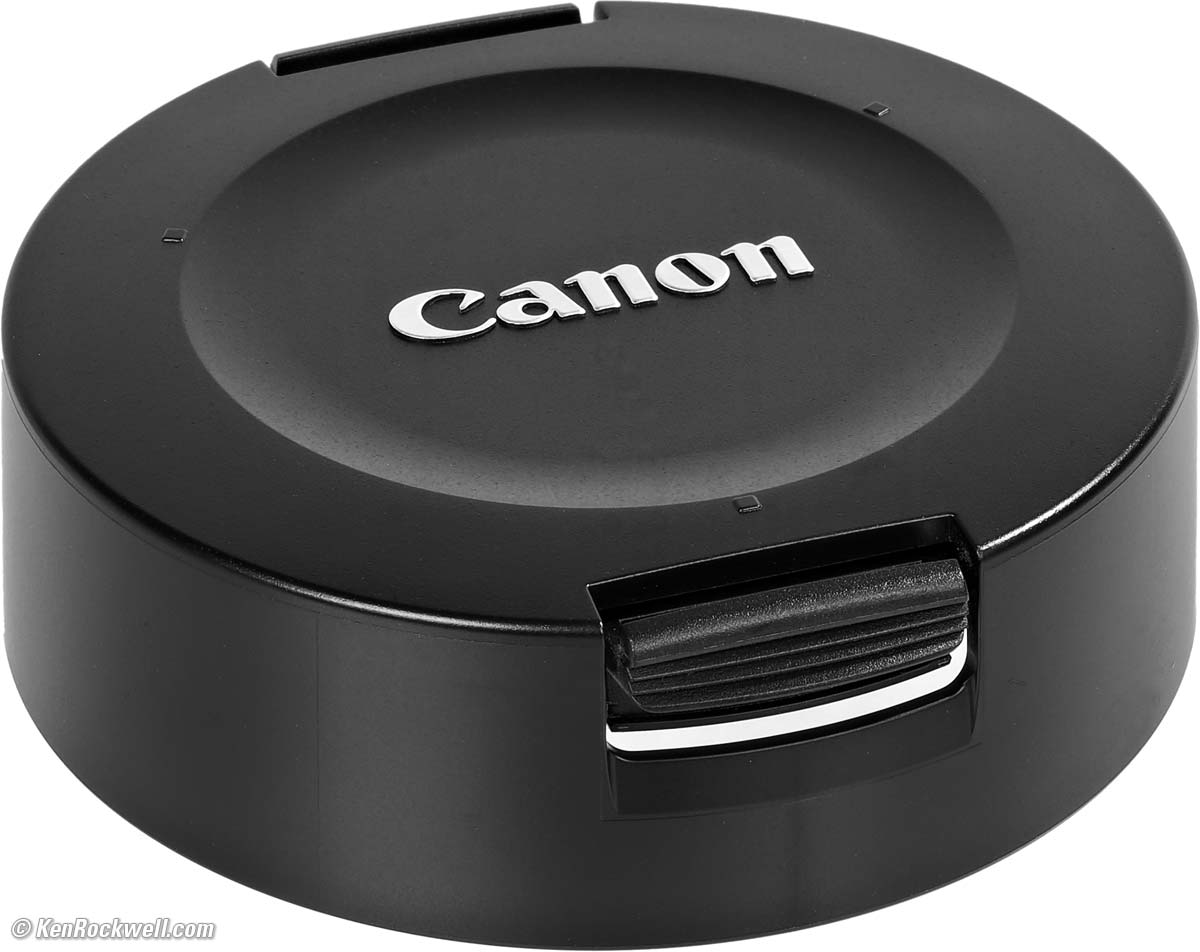
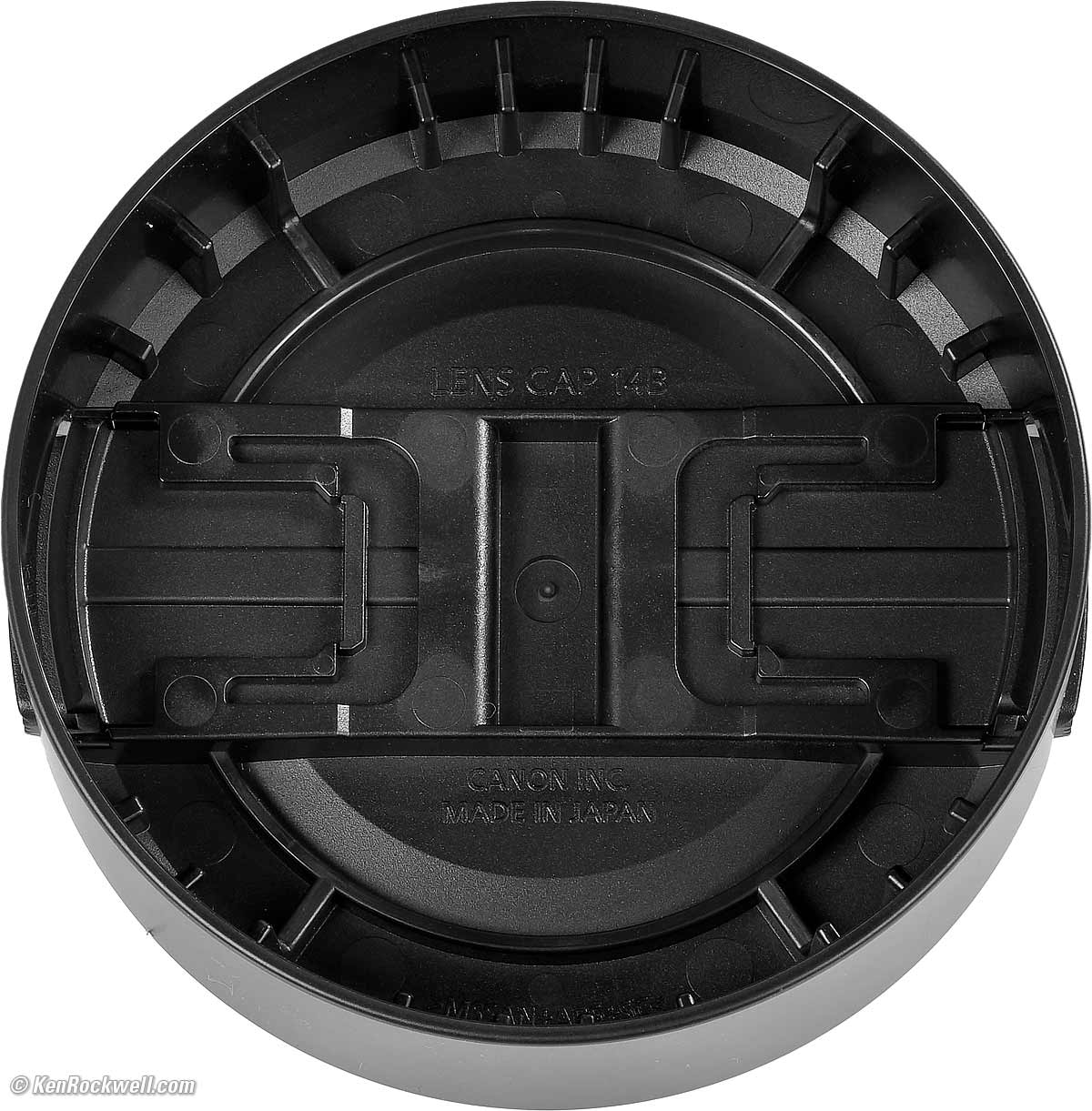
The front cap locks-on, which is good, but ultimately the front cap is crappy. It is dinky hard plastic with no felt lining and lots of airspace between the cap and the lens, so:
1.) With no seal typical of a proper solid-alloy felt-lined ultrawide cap as included with the EF 14mm f/2.8L, dust, sand and other crud easily makes it around the cap and onto the front of this lens. Boo!
2.) Because the hard plastic cap is always rattling against the lens' plastic fake hood, wear marks appear from contact with the mounting points of the cap:
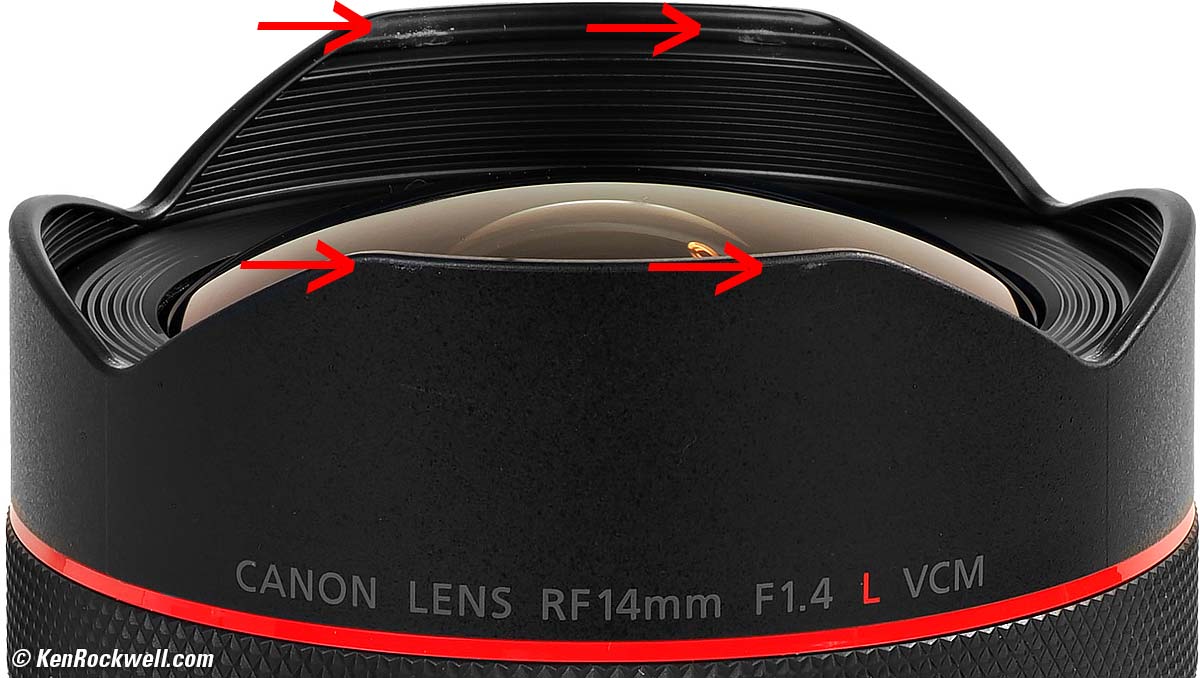
Wear Marks on My New Lens from the Crappy Plastic Cap. bigger.
The rear cap is a standard RF II Rear Lens Cap (p/n 7464C001), or the older RF Rear Lens Cap (p/n 2962C001), depending on when your 14mm was made.
Hood specifications top
There are no hoods.
The dinky plastic protrusions are to protect the bulbous front element:
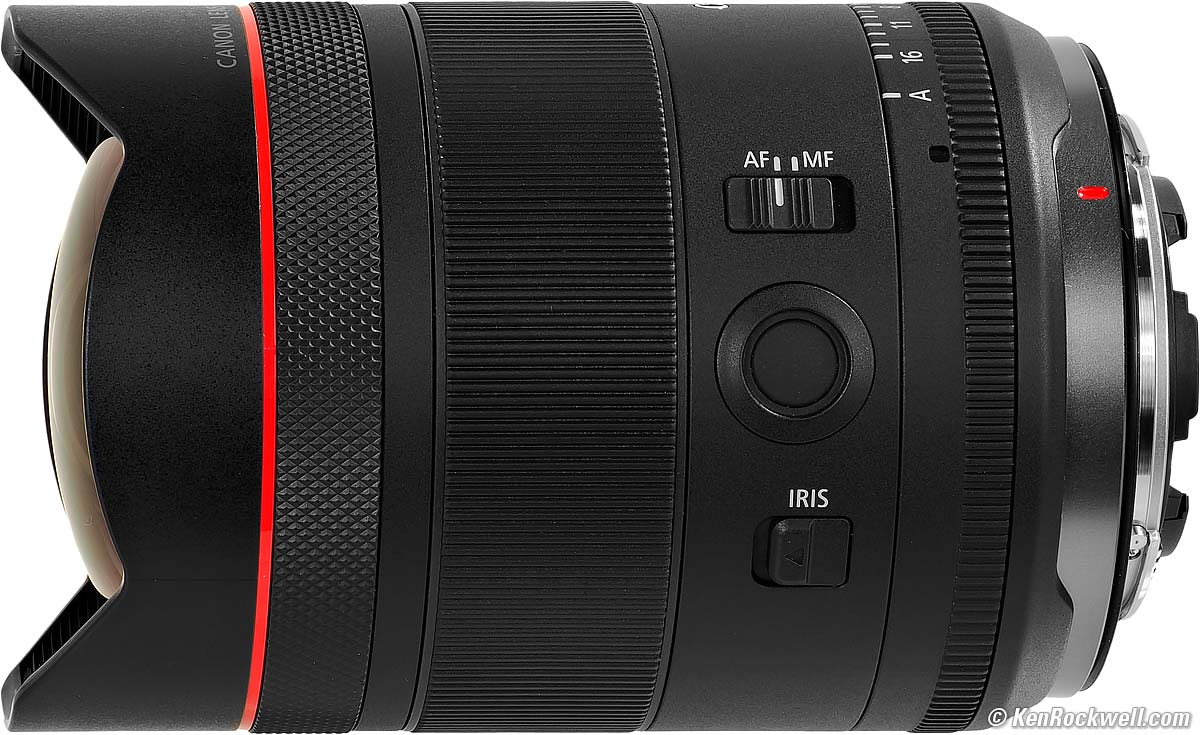
Canon RF 14mm f/1.4L VCM. bigger.
Case specifications top
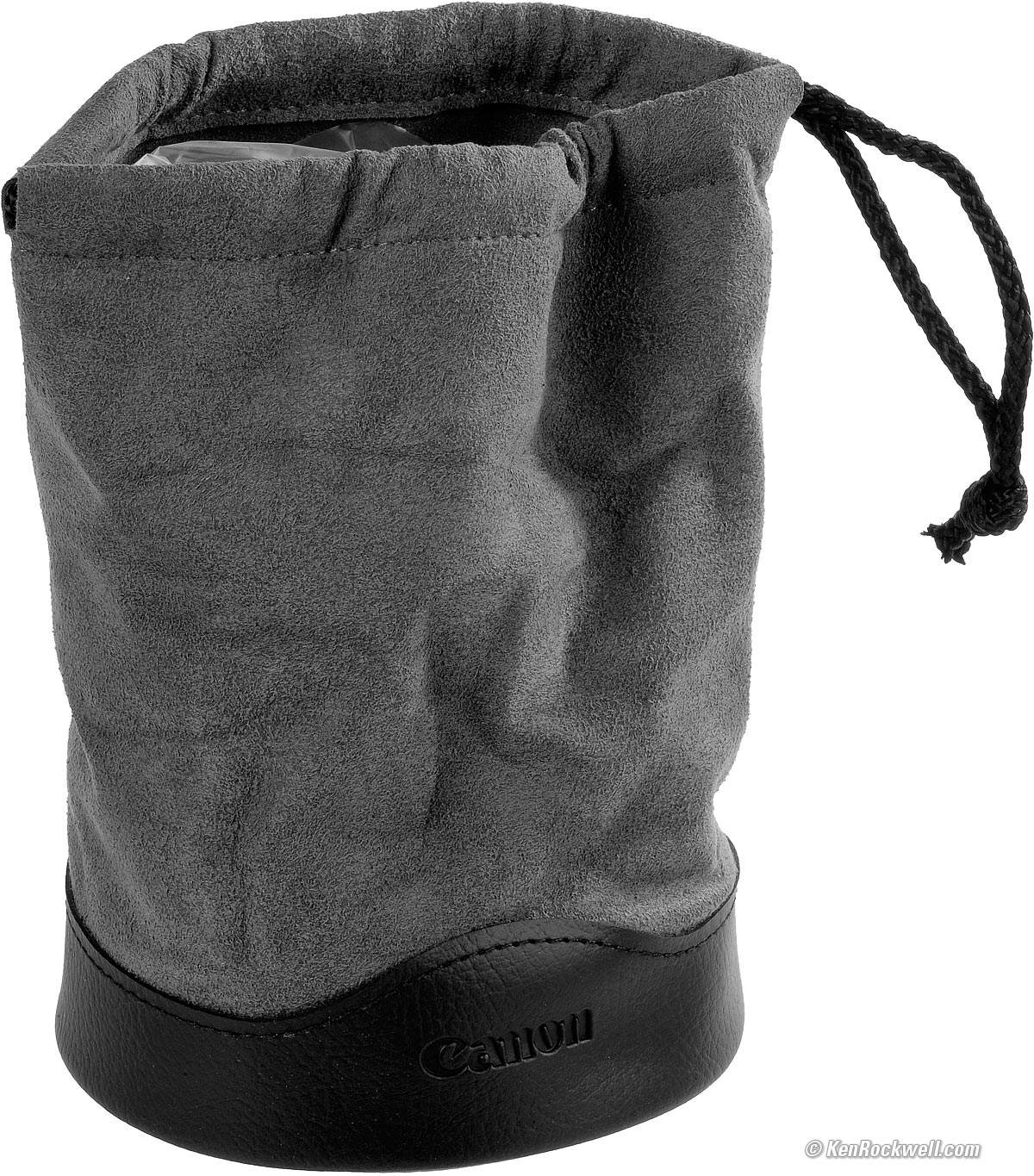
Canon LP1219 Lens Sack. bigger.
Nice LP1219 pseudosuede sack included.
Size specifications top
3.012" ø maximum diameter × 4.409" extension from flange.
76.5 mm ø maximum diameter × 112 mm extension from flange.
Weight specifications top
20.330 oz. (576.35 g), actual measured weight.
Rated 20.4 oz. (578 g).
Announced specifications top
11 PM, 04 February 2026, NYC time.
Included specifications top
Lens.
RF Rear Cap (p/n 2962C001).
LP1219 pseudosuede sack.
Model Numbers specifications top
Model number: RF14F14LVCM.
Product code: 7427C002 (7427C001 in Japan).
JAN code: 4549292-254068.
Price, U. S. A. specifications top
29 September 2026
$2,599 at B&H, at Crutchfield and at Adorama
368,500 yen in Japan.
Packaging specifications top
Microcorrugated cardboard box:
|
|
Box. bigger. |
Box End. bigger. |
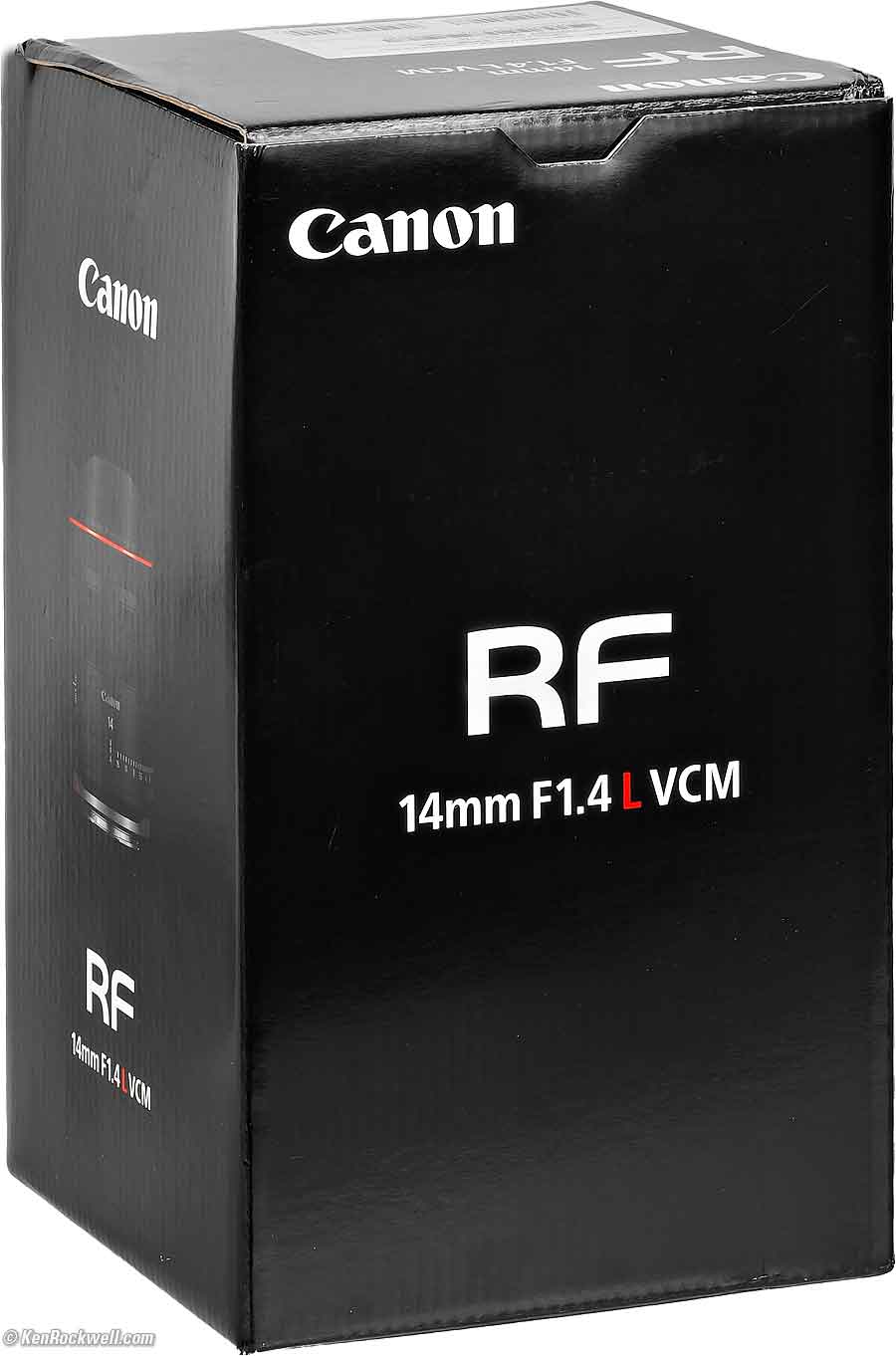
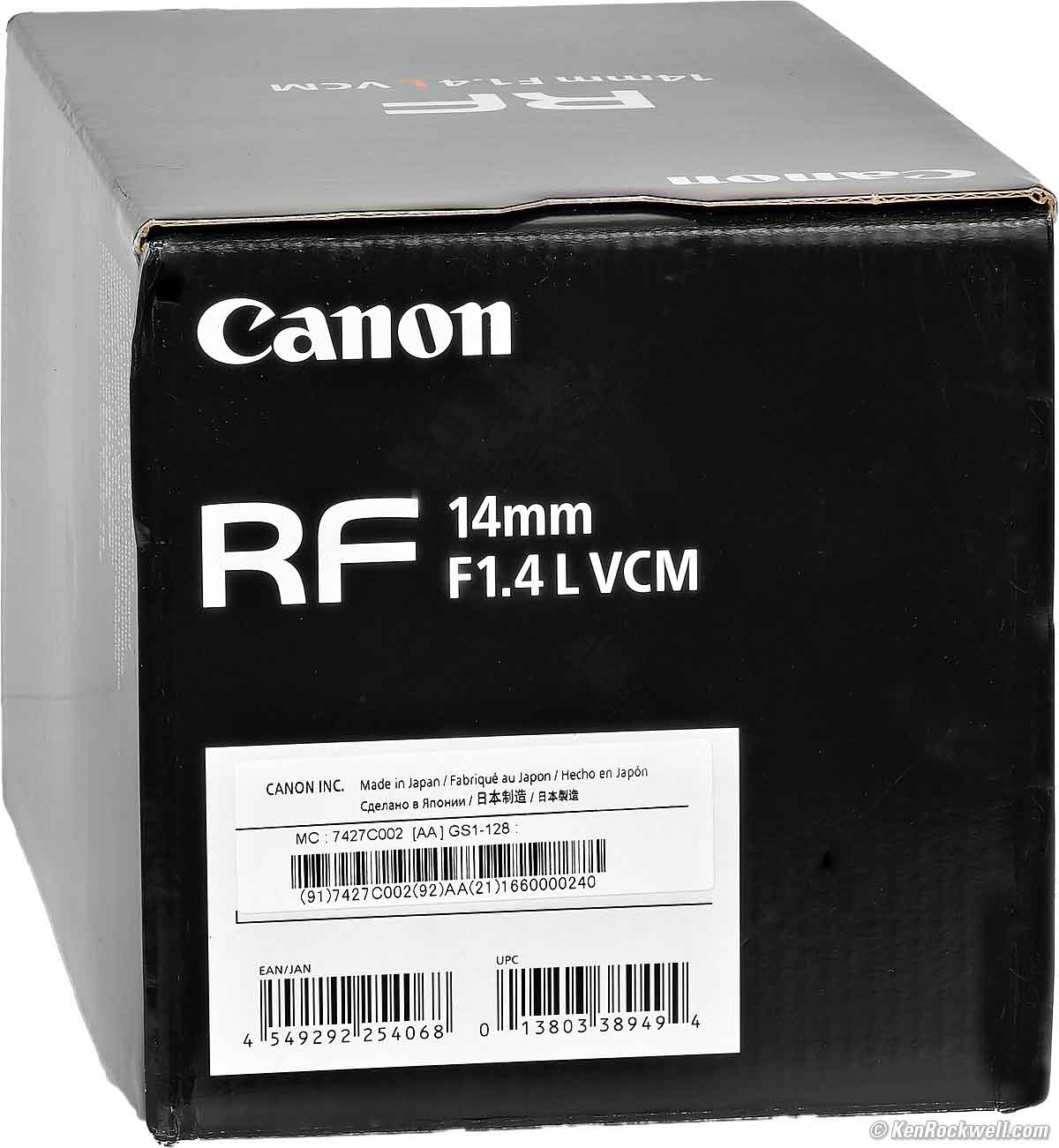
Corrugami inner supports.
Performance top
Sample Images Intro New Good Bad Missing
Specifications Performance Compared
Overall Autofocus Manual Focus Breathing
Distance Recording Bokeh Distortion Ergonomics
Falloff Filters Flare & Ghosts Lateral Color Fringes
Lens Corrections Macro Mechanics Sharpness
Spherochromatism Stabilization Sunstars
I got my RF 14mm at B&H. I'd also get it at Crutchfield, at Amazon or at Adorama, or get it used at eBay (How to Win at eBay), or get it used at KEH.
Overall performance top
The RF 14mm f/1.4L VCM has superb optics in a compact, lightweight package.
14mm lenses used to be big and fat.
Autofocus performance top
Autofocus is immediate.
Ultrawides have always had fast autofocus.
Manual Focus performance top
Manual focusing is entirely electronic; the manual focus ring isn't connected to anything other than a digital encoder.
You may or may not be able to get instant manual focus override depending on how you set your camera; no big deal, use the AF/MF switch.
Focus Breathing performance top
Focus breathing is the image changing size (growing and shrinking slightly) as focused in and out. It's important to cinematographers that the image not breathe (change size) as focus gets pulled back and forth between different actors as they speak. The image is said to breathe because it expands and contracts as the focus follows the dialog back and forth.
The image from the RF 14mm f/1.4LVCM gets somewhat smaller as focussed more closely.
Focus Distance Recording performance top
The focused distance is recorded in the EXIF data.
I read this in the lower left of my screen in Photoshop's lens correction filter.
Bokeh performance top
Bokeh, the feel, character or quality of out-of-focus areas as opposed to how far out of focus they are, is exceptional.
Bokeh is rarely important with ultrawide lenses because so little gets ever gets out of focus. If anything is out of focus, it's always smooth and undistracting.
Here are photos from headshot distance. I'm focused on the DAVIS logo. Click any for the © camera-original file:
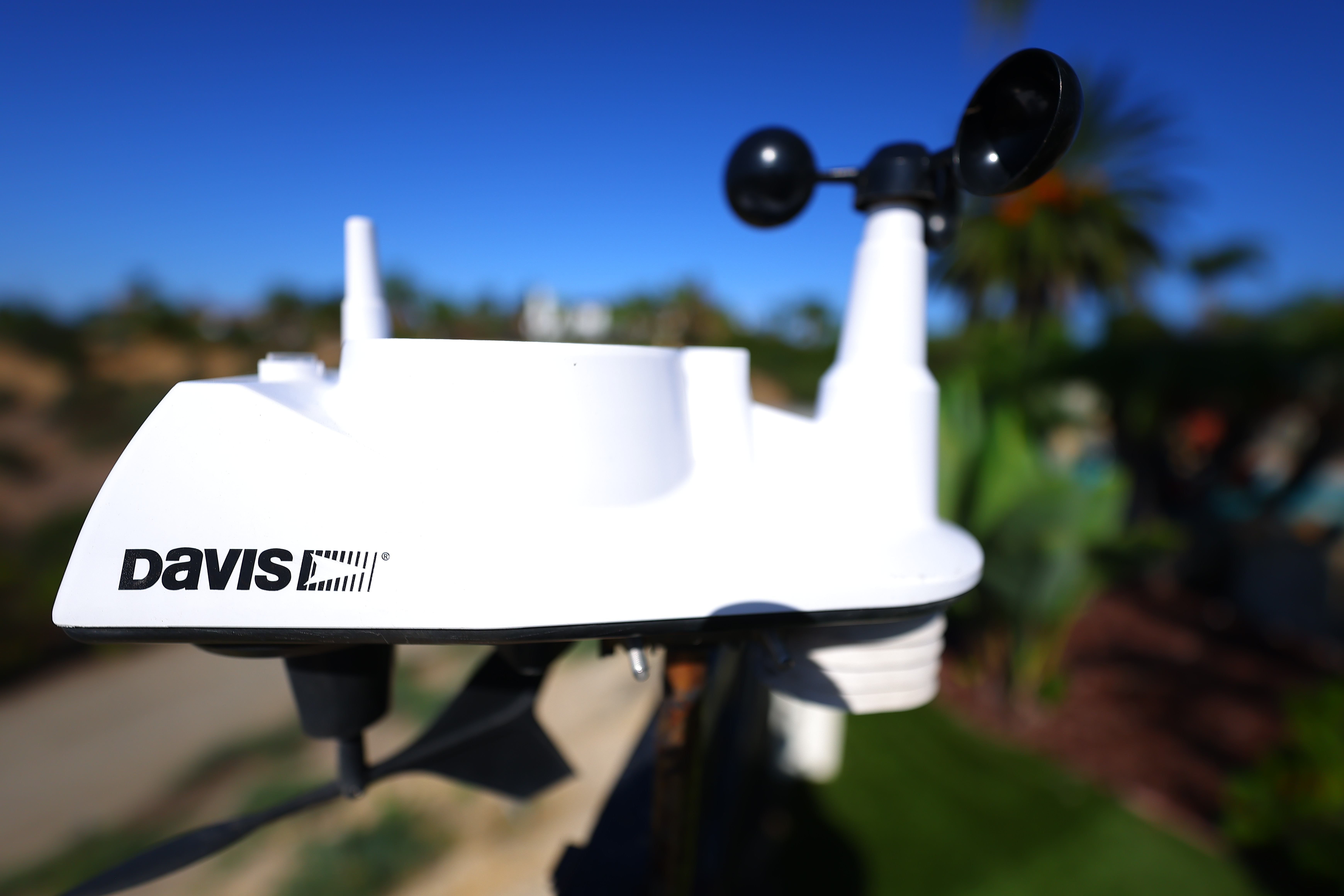
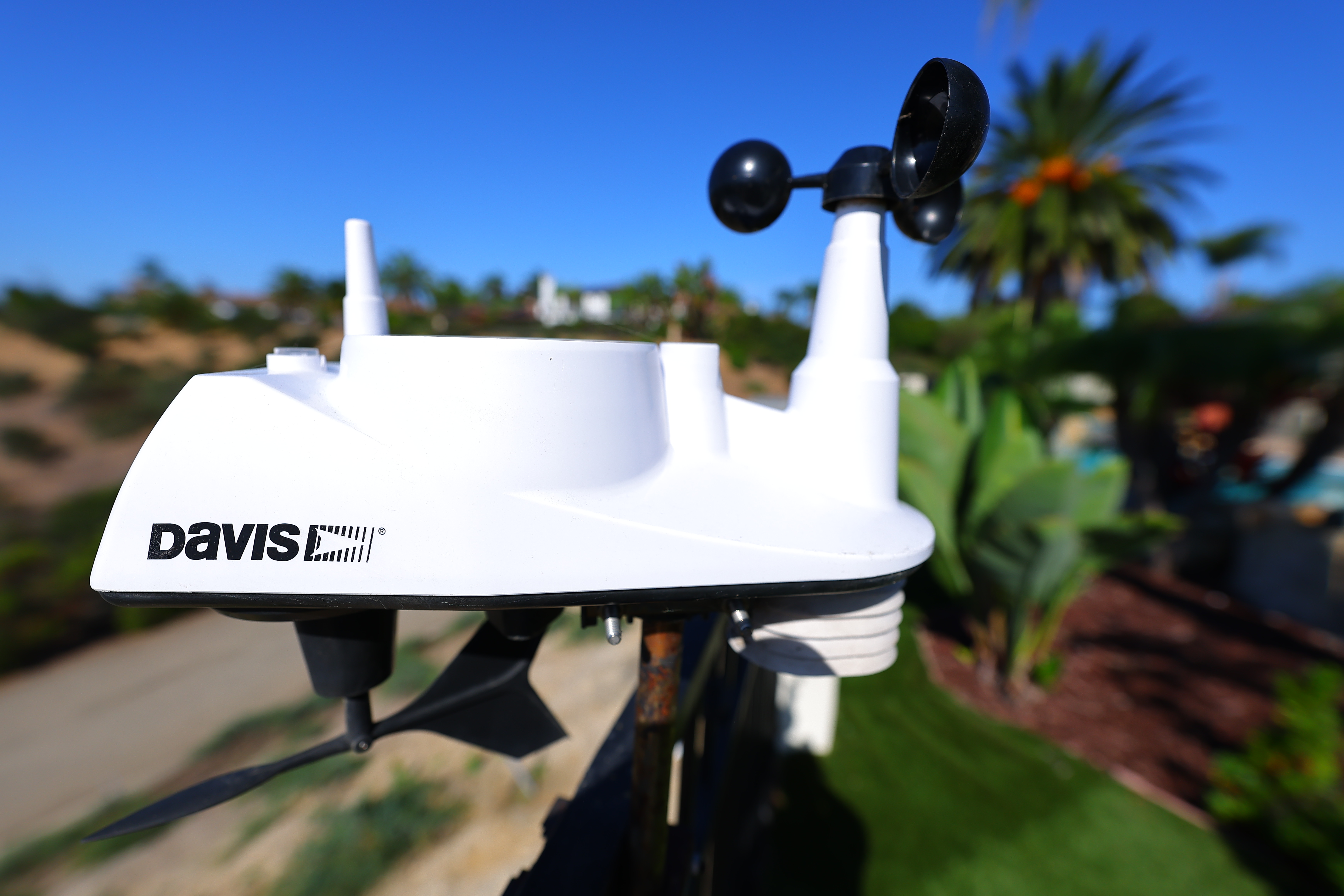
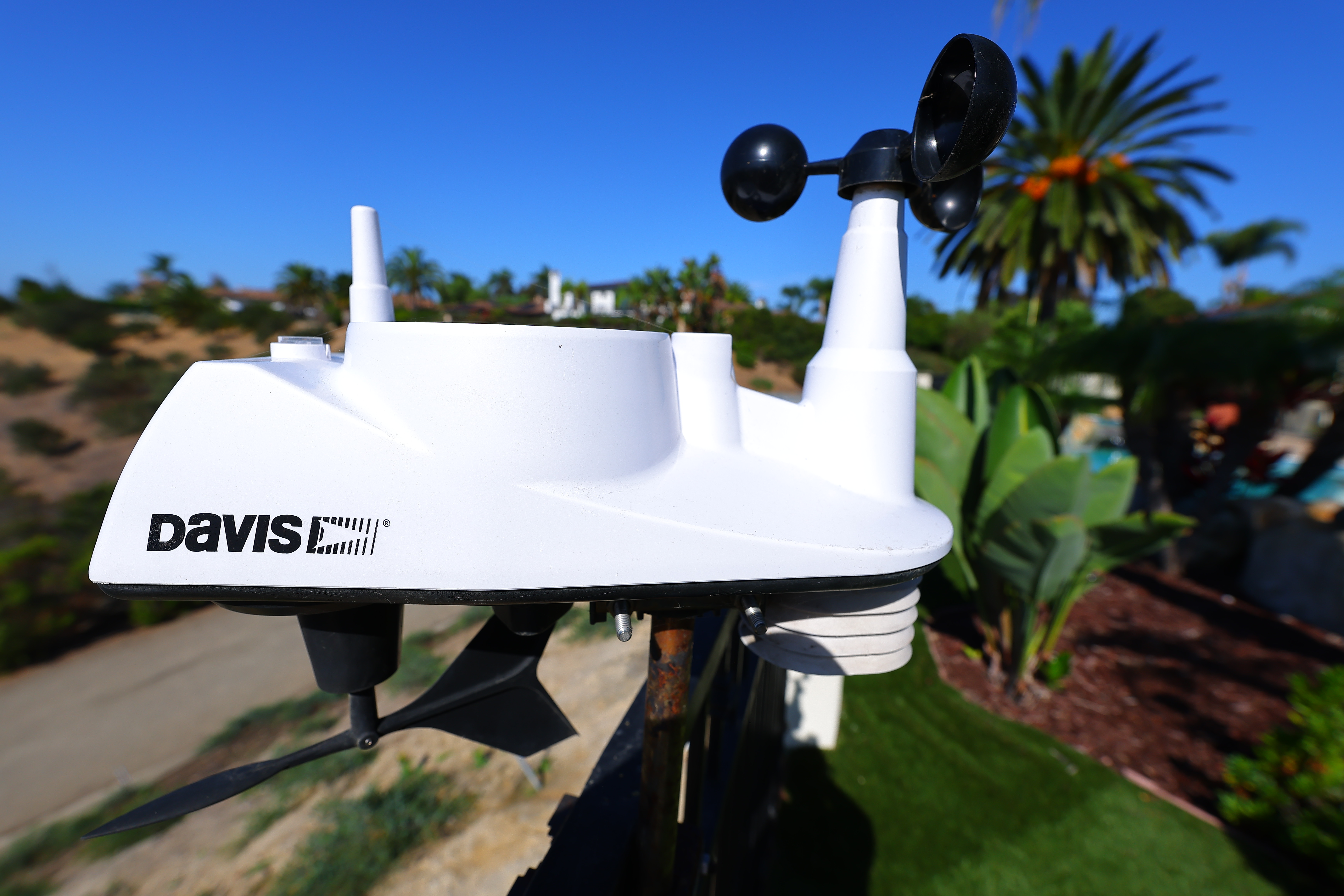
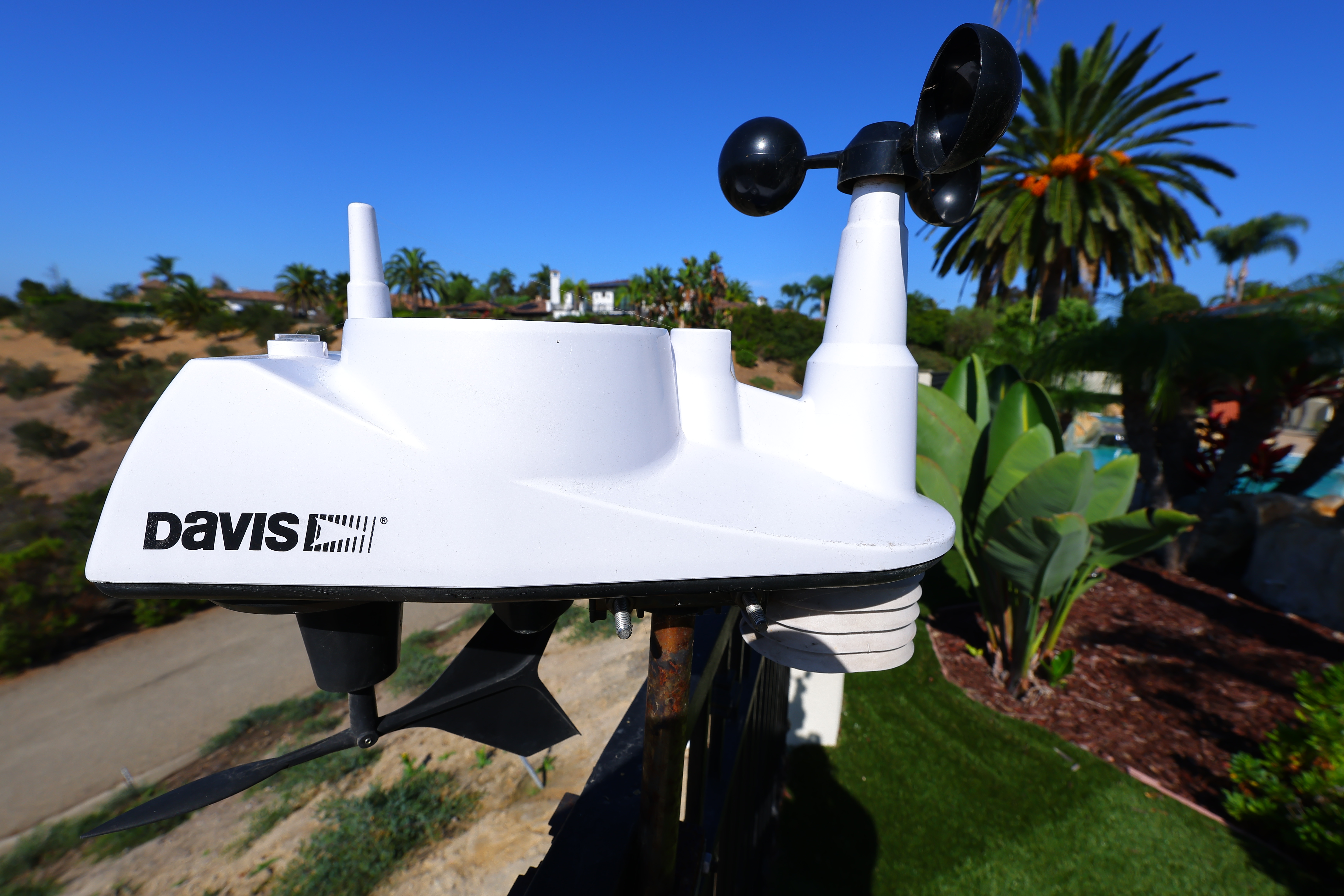
Made-in-U. S. A. Davis 6357 Vantage Vue Wireless Sensor Suite (use with WeatherLink console), 9:46 AM, Friday, 25 September 2026. Canon EOS R6 III, RF 14mm f/1.4L VCM at 1/8,000, 1/2,500, 1/500 and 1/160 at ISO 50L (LV 15.0, 15.4, 15.0 and 15.4).
Click any for the camera-original © file.
As always, if you want to throw the background as far out of focus as possible, shoot at f/1.4 and get as close as possible.
Distortion performance top.
This lens integrates electronic distortion correction as part of its optical design. Therefore the camera's Distortion Correction setting is grayed-out because it can not be turned off.
Set this way, there is no visible distortion. Most buildings are crookeder than this lens:
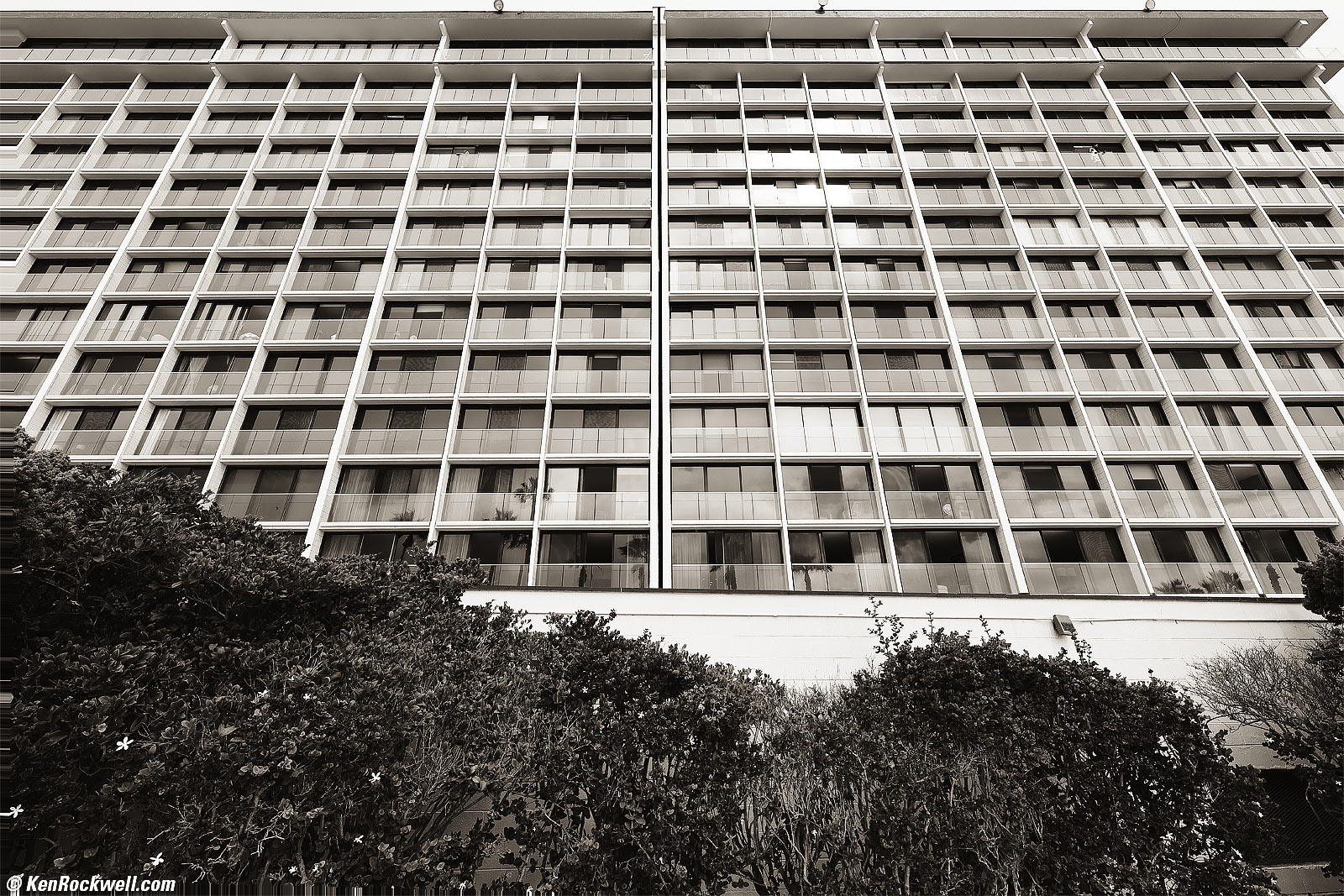
Capri by the Sea, Pacific Beach, California, 10:19 AM, Saturday, 12 September 2026. Canon R6 III, RF 14mm f/1.4L VCM at f/7.1 at 1/400 at Auto ISO 100 (LV 14¼), split-toned print. bigger.
For more critical scientific use, use correction factor of +0.40 in Photoshop's lens correction filter to camera-corrected JPG images.
If you shoot raw data rather than JPG images, whatever software you use to create visible images from raw data may or may not correct the distortion as is done in-camera as JPGs. You're on your own there; I don't bother with raw data.
While Canon's own software probably also corrects this from RAW CR3 files, be warned that other brands of raw processing software probably won't correct the distortion, and Heaven only knows what distortion you may see then.
Ergonomics performance top
|
|
Canon RF 14mm f/1.4L VCM. bigger. |
Canon RF 14mm f/1.4L VCM. bigger. |
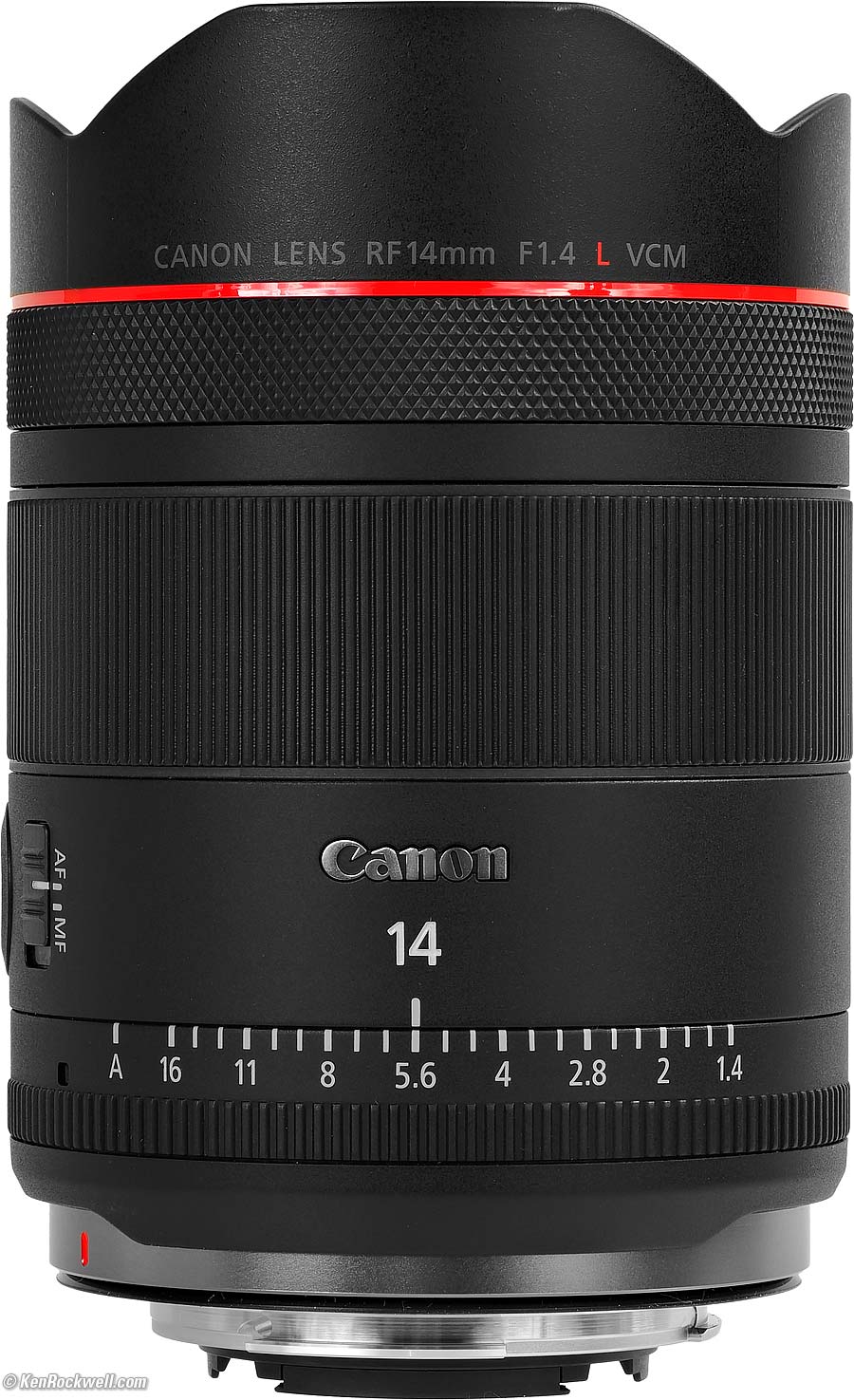
Ergonomics are straight-ahead: just a lens with three control rings!
The front ring is a programmable clicked control ring. Set it in your camera for aperture, exposure compensation or whatever your camera provides.
The fat rubber ring is also usually programmable (depending on your camera), and is usually manual focus.
You may or may not be able to get instant manual focus override depending on how you set your camera; no big deal, use the AF/MF switch.
The aperture ring is mostly for video. It only works for still shots on the newer cameras, and it has no clicks so it's downright weird to use for stills.
With no ability to take any front protective filter, this lens is very susceptible to front element damage. Therefore I have to I carry this lens capped all the time if it's on my camera, removing the cap only to compose and shoot.
Any damage, dirt or fingerprints are often visible in the image due to this lens' almost limitless depth of field. Unlike a tele where an obvious front-element chip can simply be filled-in with black paint and never be seen again (honest), even minor dust can become sufficiently in focus to be seen in some images, especially if the sun or other brilliant source of light is in the image or shining on the front surface. Thankfully it has a fluorine coating to resist crud, but dust still collects because the cap does not seal and lets in dust. Even a fingerprint is often visible as a dark blotch in the image due to the huge depth-of-field, and even minor damage often destroys this lens.
Falloff performance top
Falloff isn't a problem.
I've greatly exaggerated the falloff by shooting a gray field and placing these on a gray background; it will not look this bad in actual photos of real things:
Falloff on full-frame at infinity, Peripheral Illumination correction at its default of ON:
© 2026 KenRockwell.com. All rights reserved. |




If you save only raw data rather than create JPG images in-camera, whatever software you use to create visible images from that raw data later may or may not correct this as is done in-camera as JPGs. You're on your own there; I don't bother with raw data.
If you go out of your way to turn off the correction, or possibly in some raw software, this is what you get:
Falloff on full-frame at infinity, Peripheral Illumination correction deliberately turned OFF:
© 2026 KenRockwell.com. All rights reserved. |




Filters, use with performance top
There is no way to use front filters for protection or creative effects.
The only way to use filters is to cut a gelatin filter to the right size (see the template in Canon's RF 14mm f/1.4L VCM User's Guide) and slide it into the rear gel holder:
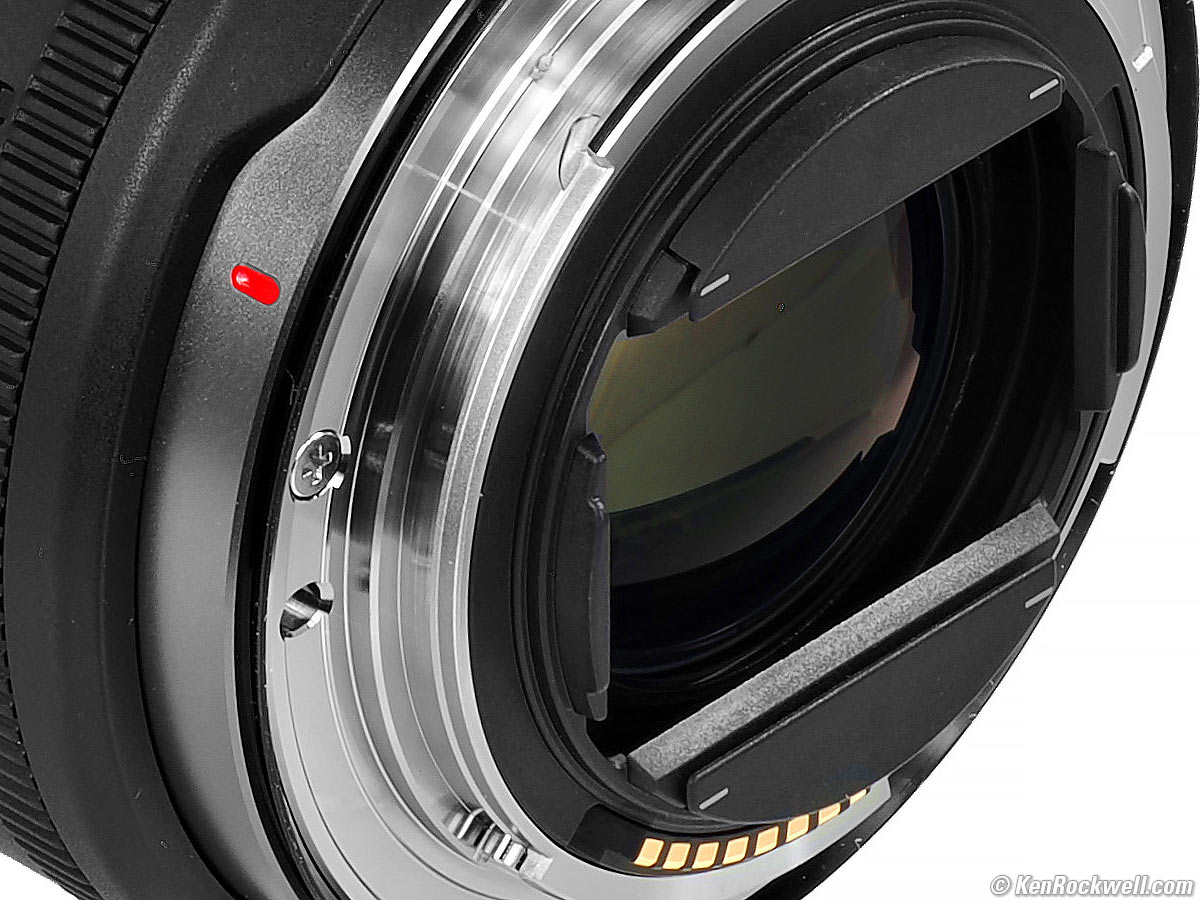
Gel Filter Holder Slots. bigger.
Genuine gelatin filters are very, very delicate and expensive.
Don't use Rosco or Lee filters, which are for putting over stage lighting — not in an imaging path. They aren't optically flat.
Flare & Ghosts performance top
Flare and ghosts are extremely well controlled.
Bravo to Canon for using exotic Air-Sphere and Sub-Wavelength coatings where they are needed. In older days lenses this wide suffered from bizarre flare and ghosts.
See examples at Sunstars.
Lateral Color Fringes performance top
There are no lateral color fringes when shot as JPG with the default Chromatic Aberration Correction left ON.
if you go out of your way to turn this OFF (or shoot raw and then use non-manufacturer software to process that data into images) then there is still essentially no lateral color. If I look very carefully in the corners at 300% on my four-foot-wide monitor from a foot and a half away I almost can imagine the slightest green/magenta fringes, but they are more imaginary than actually visible.
This is superb performance. Back when I had a Nikon 13mm f/5.6 its lateral color was so severe and required so much correction that half the time my Nikon DSLRs gave up and couldn't correct it!
Lens Corrections performance top
Other cameras may vary as the years roll on, but my EOS R1, R3, R5 II, R5, R5C, R6 II, R6, R, R8, RP, R7, R10, R50 and R100 all have options to correct for falloff (Peripheral Illumination Correction), Distortion and a Digital Lens Optimizer which corrects for a suite of other aberrations.
These are all ON by default.
This lens integrates electronic distortion correction as part of its design, so the Distortion setting is grayed-out because it can not be turned off.
You can turn off falloff correction and/or the Digital Lens Optimizer.
If you turn off the Digital Lens Optimizer, you are then offered à la carte ON/OFF options for Chromatic Aberration Correction and Diffraction Correction.
If you shoot raw data rather than JPG images, whatever software you use to create visible images from raw data may or may not correct these as is done in-camera as JPGs. You're on your own there; I don't bother with raw data.
Macro Performance performance top
It focuses up to three inches (75mm) from the front of the lens, but it's so wide that it doesn't seem that close. When you are this close, it's difficult no to block your own light.
Ultrawides are dumb lenses to use for close-ups unless you want a special effect.
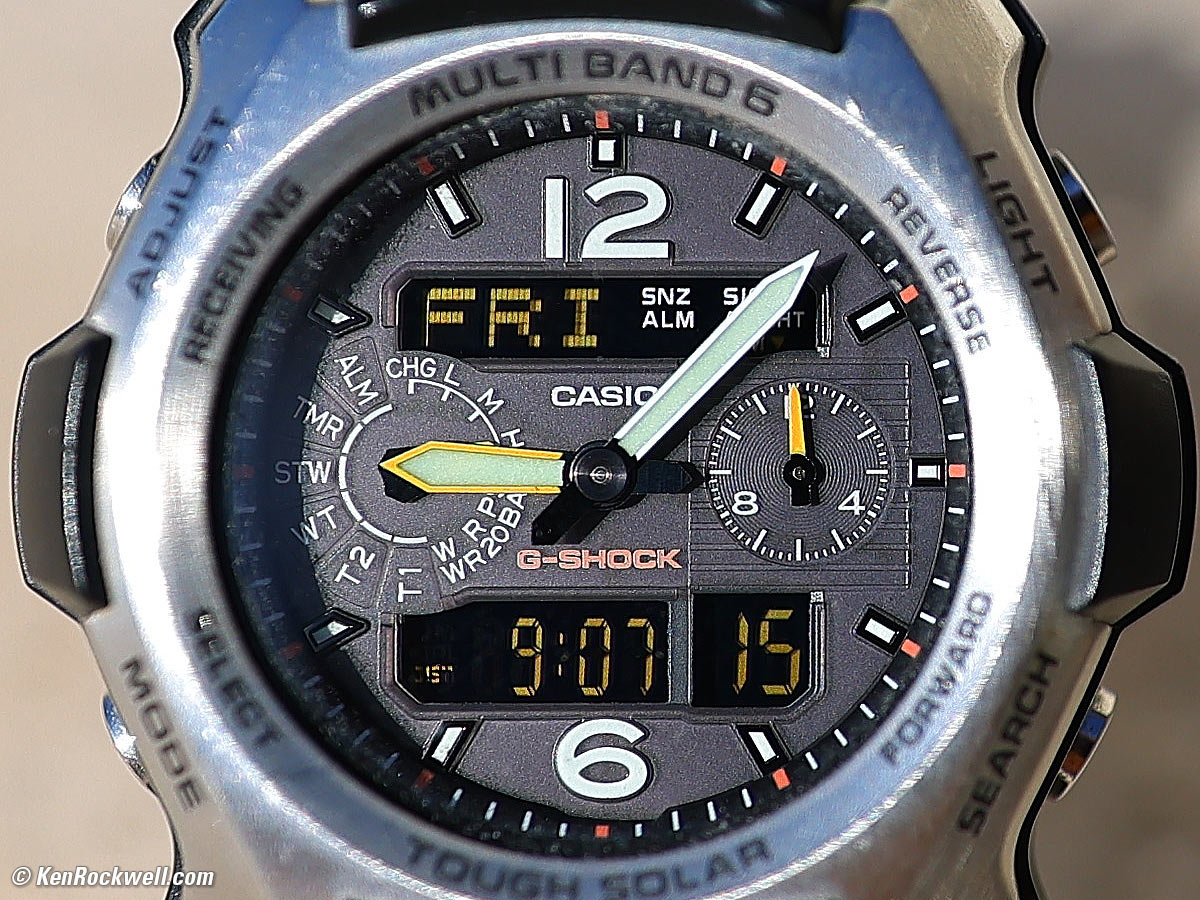
It's super sharp, especially wide open:
At f/1.4
It's super sharp at f/1.4:
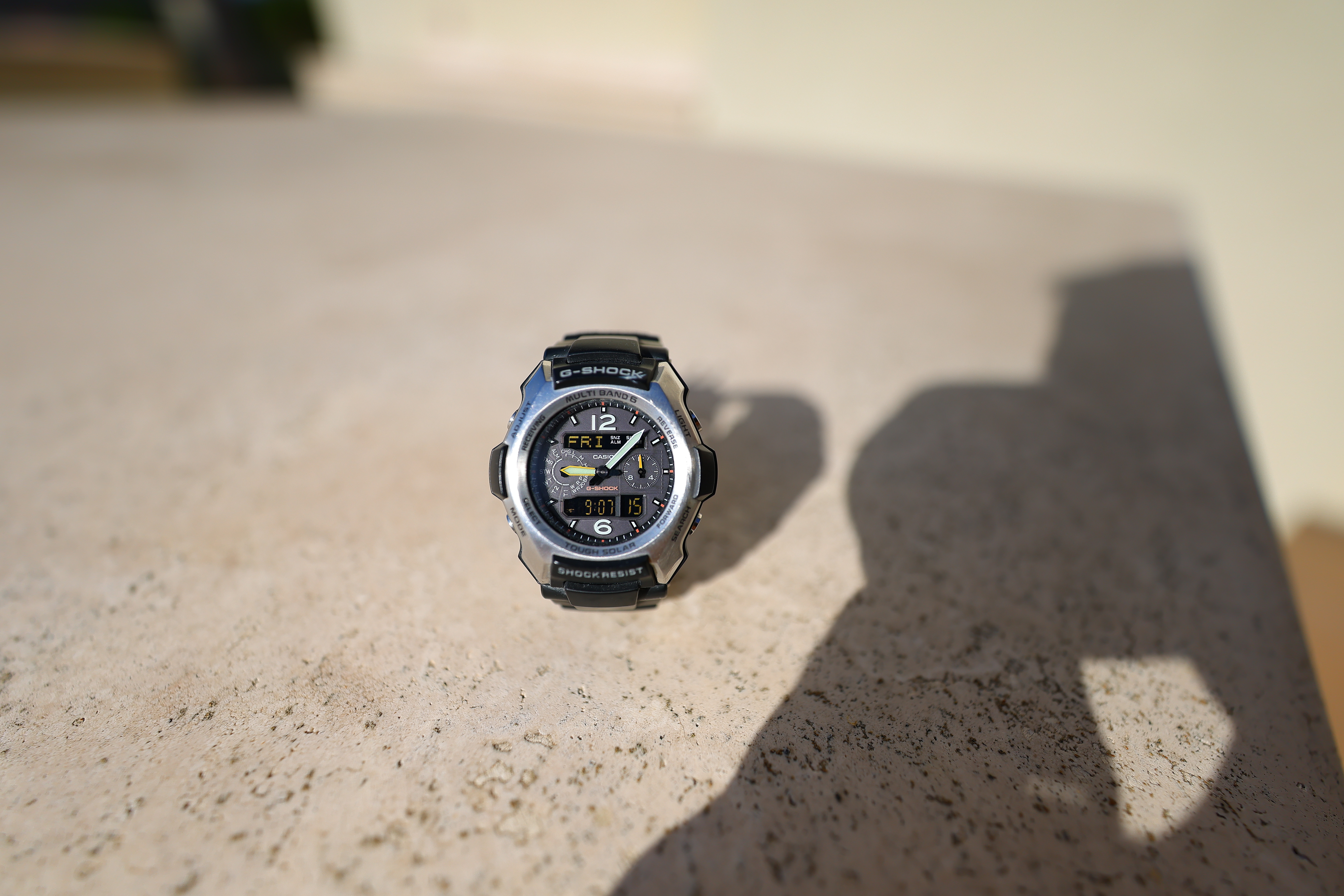
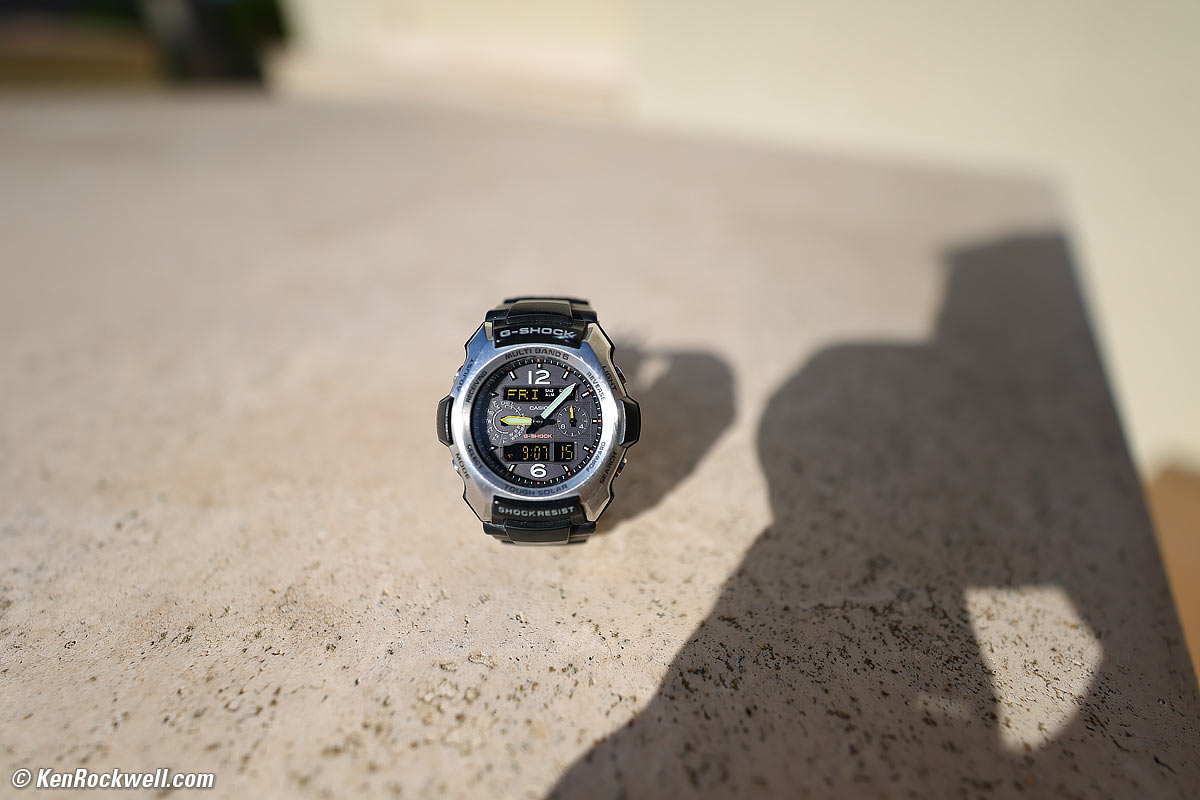
Casio G-Shock Solar Atomic Watch at close-focus distance, 9:07 AM, Friday, 25 September 2026. Canon R6 III, RF 14mm f/1.4L VCM at f/1.4 at 1/8,000 at ISO 50L (LV 15.0). bigger or camera-original 3.9 MB © 32 MP JPG file.
1,200 × 900 pixel (5.8× magnification) crop from above. bigger or camera-original © file.
The texture you're seeing is the watch face solar cell.
If these 1,200 × 900 pixel crops are about 3" (8cm) wide on your screen, then the complete image printed at this same 8 magnification would be about 12 × 18" (30 × 44 cm).
If these 1,200 × 900 pixel crops are about 6" (15cm) wide on your screen, then the complete image printed at this same extreme magnification would be about 23 × 35" (59 × 88 cm).
If these 1,200 × 900 pixel crops are about 12" (30cm) wide on your screen, then the complete image printed at this same extreme magnification would be about 46 × 70" (1.18 × 1.8 meters).
At f/8
It's ultra sharp at f/8.
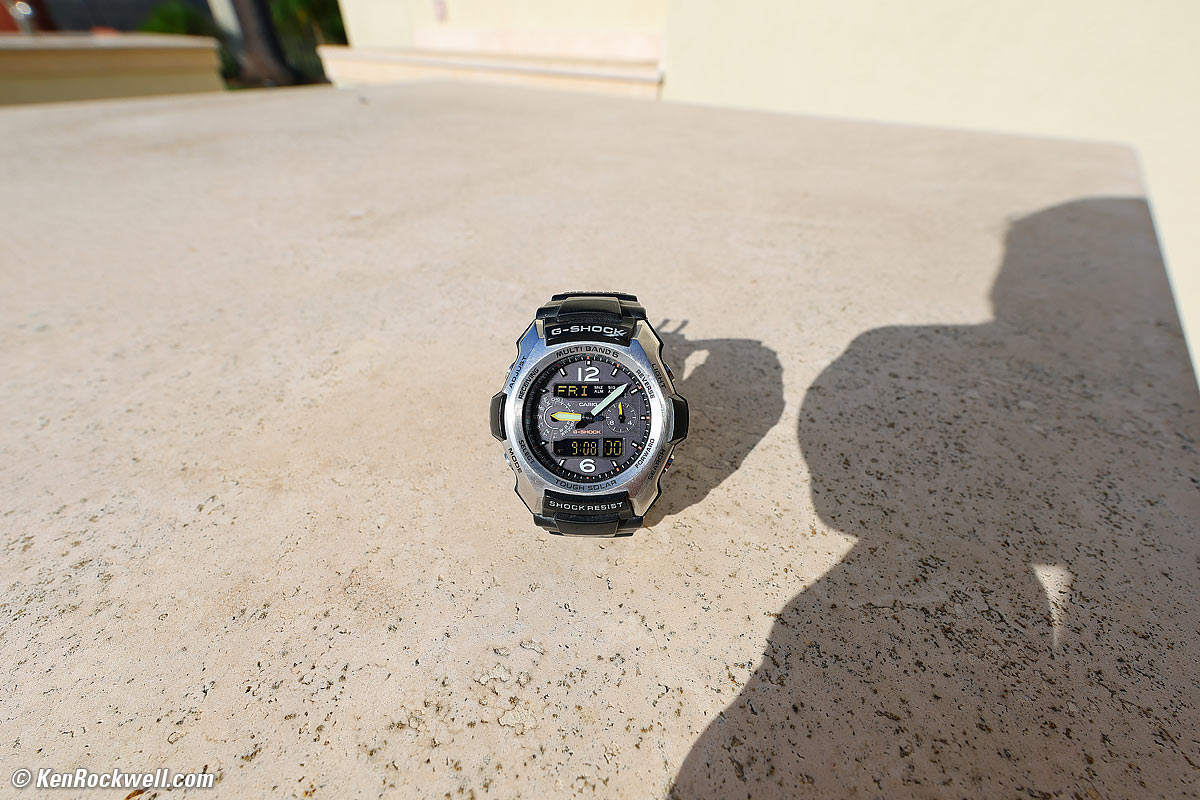
Of course we have much more depth of field at f/8 compared to f/1.4:
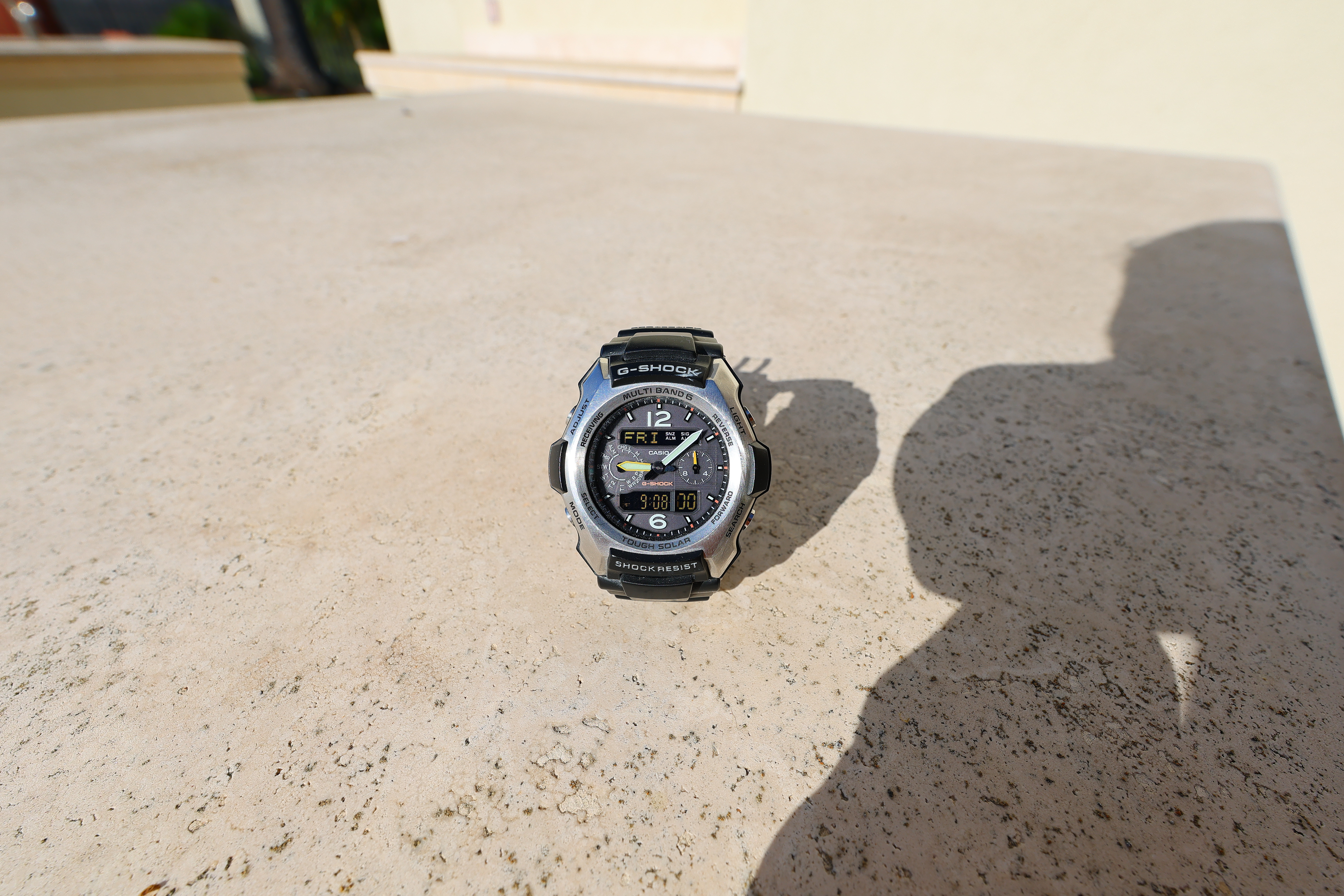
Casio G-Shock Solar Atomic Watch at close-focus distance, 9:08 AM, Friday, 25 September 2026. Canon R6 III, RF 14mm f/1.4L VCM at f/8 at 1/320 at ISO 100 (LV 14.5). bigger or camera-original 3.9 MB © 32 MP JPG file.
1,200 × 900 pixel (5.8× magnification) crop from above. bigger or camera-original © file.
The texture you're seeing is the watch face solar cell.
If these 1,200 × 900 pixel crops are about 3" (8cm) wide on your screen, then the complete image printed at this same 8 magnification would be about 12 × 18" (30 × 44 cm).
If these 1,200 × 900 pixel crops are about 6" (15cm) wide on your screen, then the complete image printed at this same extreme magnification would be about 23 × 35" (59 × 88 cm).
If these 1,200 × 900 pixel crops are about 12" (30cm) wide on your screen, then the complete image printed at this same extreme magnification would be about 46 × 70" (1.18 × 1.8 meters).
Mechanical Quality performance top
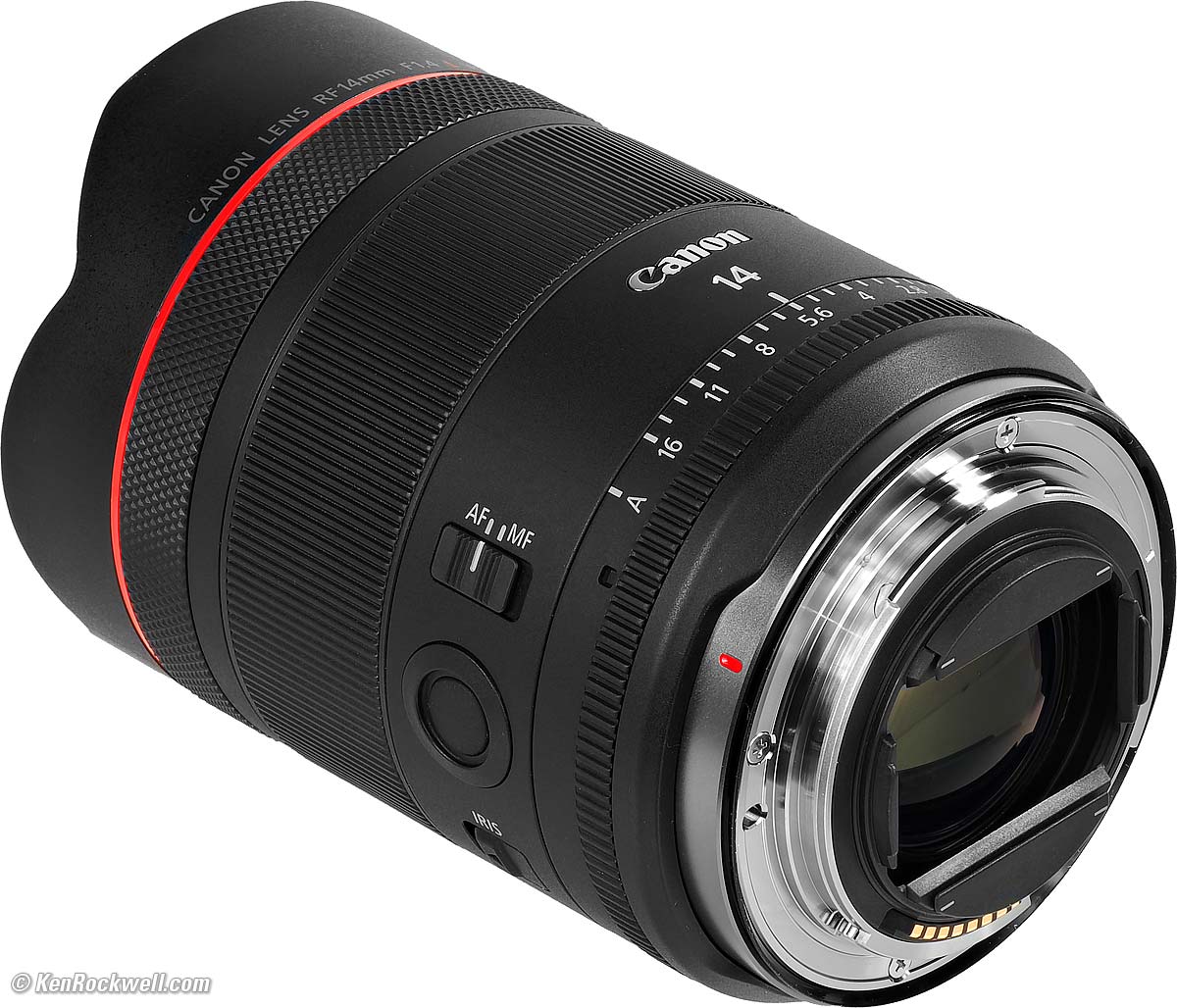


Canon RF 14mm f/1.4L VCM. bigger.
This is all plastic on the outside, with a metal mount.
Exterior Finish
Black plastic.
Simulated Front Hood mechanics performance top
Dinky plastic.
Front Bumper. mechanics performance top
None.
Filter Threads mechanics performance top
None.
Hood Bayonet Mount mechanics performance top
None.
Barrel Exterior mechanics performance top
Plastic.
Front Control Ring mechanics performance top
Hard plastic.
Focus Ring mechanics performance top
Rubber-covered plastic.
Slide Switches mechanics performance top
Plastic.
Function (AF Lock) Button mechanics performance top
Rubber-covered.
Identity mechanics performance top
Printed around front of lens just ahead of the red L-band in nearly invisible gray on gray, also "14" engraved and filled with paint on the top of the barrel.
Internals mechanics performance top
Hard to tell, probably a mix of plastic and metal.
Dust Gasket at Mount mechanics performance top
Yes.
Mount mechanics performance top
Chromed metal.
Markings mechanics performance top
Paint.
Serial Number mechanics performance top
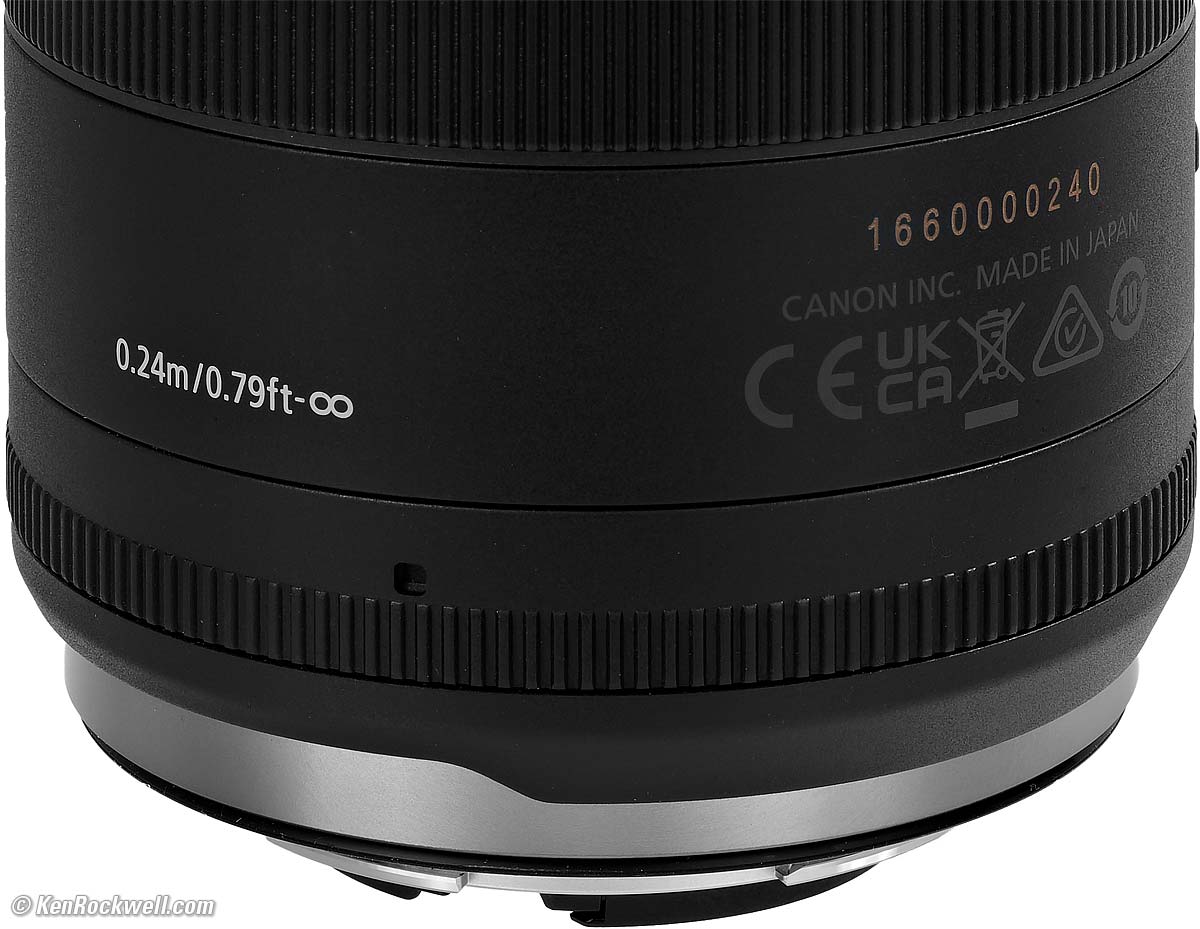
Canon RF 14mm f/1.4L VCM. bigger.
Laser engraved in warm black on black on the bottom of the barrel.
This is a highly detailed and well-lit studio photograph which makes it far more legible than it is in actual life. To read it in person you'll need a flashlight.
Date Code mechanics performance top
The serial number contains a date code.
My serial number starts with 166, which means it was made in June 2026.
Noises When Shaken mechanics performance top
It sounds like there's something loose inside, which is the focus group flopping around.
It's inelegant, but normal.
Truth, Ethics & Respect mechanics performance top
Made in Japan.
Sharpness performance top
Lens sharpness has nothing to do with picture sharpness; every lens made in the past 100 years is more than sharp enough to make super-sharp pictures if you know what you're doing. The only limitation to picture sharpness is your skill as a photographer. It's the least talented who spend the most time worrying about lens sharpness and blame crummy pictures on their equipment rather than themselves. Skilled photographers make great images with whatever camera is in their hands; I've made some of my best images of all time with an irreparably broken camera! Most pixels are thrown away before you see them, but camera makers don't want you to know that.
If you're not getting ultra-sharp pictures with this, be sure not to shoot at f/11 or smaller where all lenses are softer due to diffraction, always shoot at ISO 100 or below because cameras become softer at ISO 200 and above, be sure everything is in perfect focus, set your camera's sharpening as you want it (I set mine to the maximum) and be sure nothing is moving, either camera or subject. If you want to ensure a soft image with any lens, shoot at f/16 or smaller at ISO 1,600 or above at default sharpening in daylight of subjects at differing distances in the same image.
People worry waaaaay too much about lens sharpness. It's not 1968 anymore when lenses often weren't that sharp and there could be significant differences among them; ever since about 2010 all new lenses are all pretty much equally fantastic.
This lens is ultra sharp corner-to corner at every aperture, limited by your vision as an artist and of course by diffraction at the smallest apertures. This lens is so sharp that diffraction starts to dull the image even at f/8 if you're paying attention. See also How to Calculate the Sharpest Aperture When You Need Both Depth of Field and Freedom From Diffraction.
Used properly, all of Canon's RF lenses are equally sharp. The differences are in maximum apertures and focal lengths, but none of them are soft if you know how to use them. Lens sharpness has nothing to do with picture sharpness.
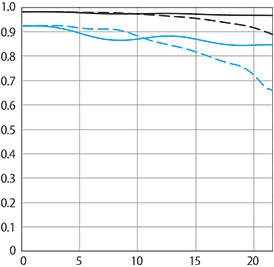
Canon RF 14mm f/1.4L VCM MTF wide-open at f/1.4 at 10 cyc/mm (black) and 30 cyc/mm (blue). Sagittal (radial) shown as solid lines. Meridional (tangential) shown as dashed lines.
See also my article on MTF and Canon's article on MTFs.
While it's usually valid to compare rated MTFs between different lenses of a similar age from the same maker, every maker measures or simply calculates MTF very differently, and therefore one cannot compare these curves between brands. For instance, Sony seems to calculate and choose to ignore diffraction, while others don't.
Spherochromatism performance top
Spherochromatism, also called secondary spherical chromatic aberration or "color bokeh," is an advanced form of spherical and chromatic aberration in a different dimension than lateral chromatic aberration and therefore cannot be corrected with software or automatic corrections. It happens mostly in fast normal and tele lenses when spherical aberration at the ends of the color spectrum are corrected differently than in the middle of the spectrum. Spherochromatism can cause colored fringes on out-of-focus highlights, usually seen as green fringes on backgrounds and magenta fringes on foregrounds. Spherochromatism is common in fast lenses of moderate focal length when shooting contrasty items at full aperture. It goes away as stopped down.
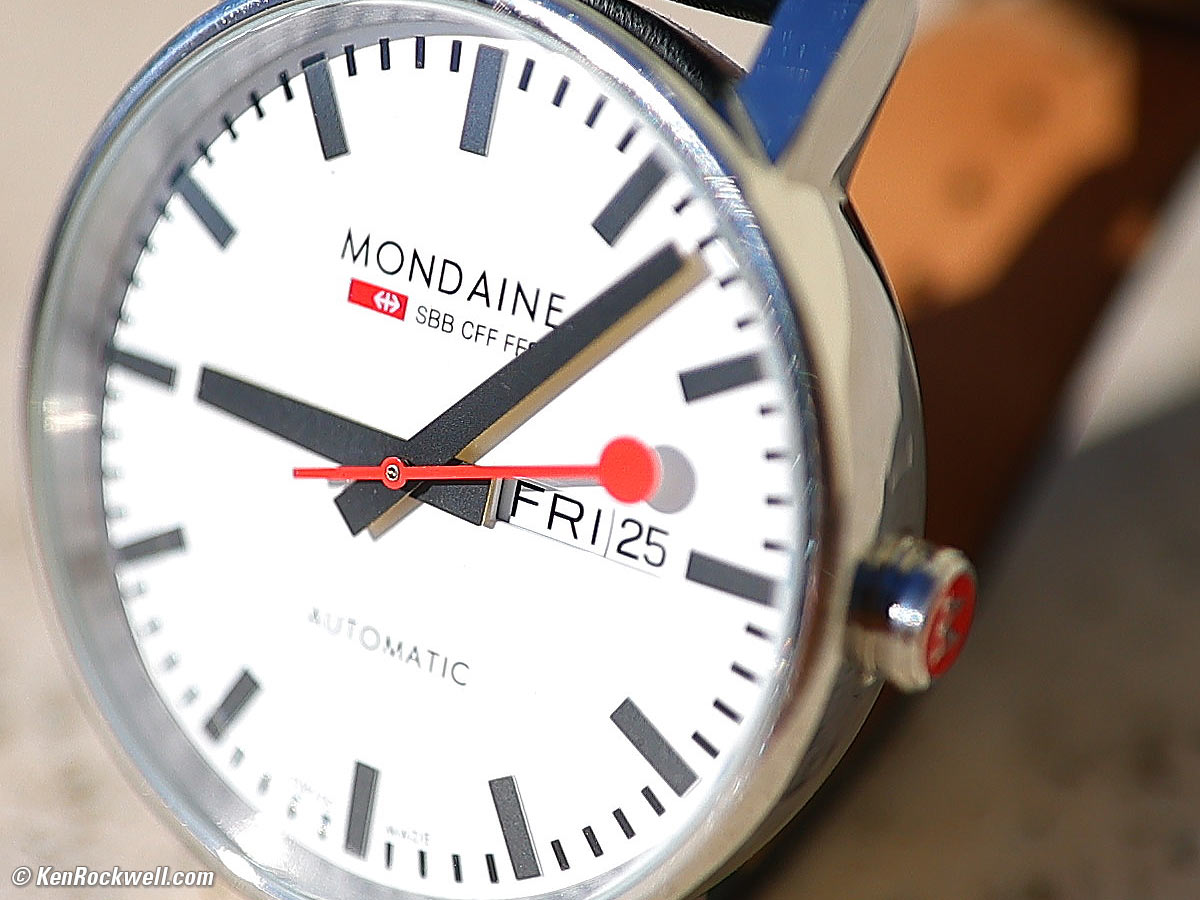
It has no significant spherochromatism. Canon's "BR (Blue-Refractive) compound," whatever it is, really works:
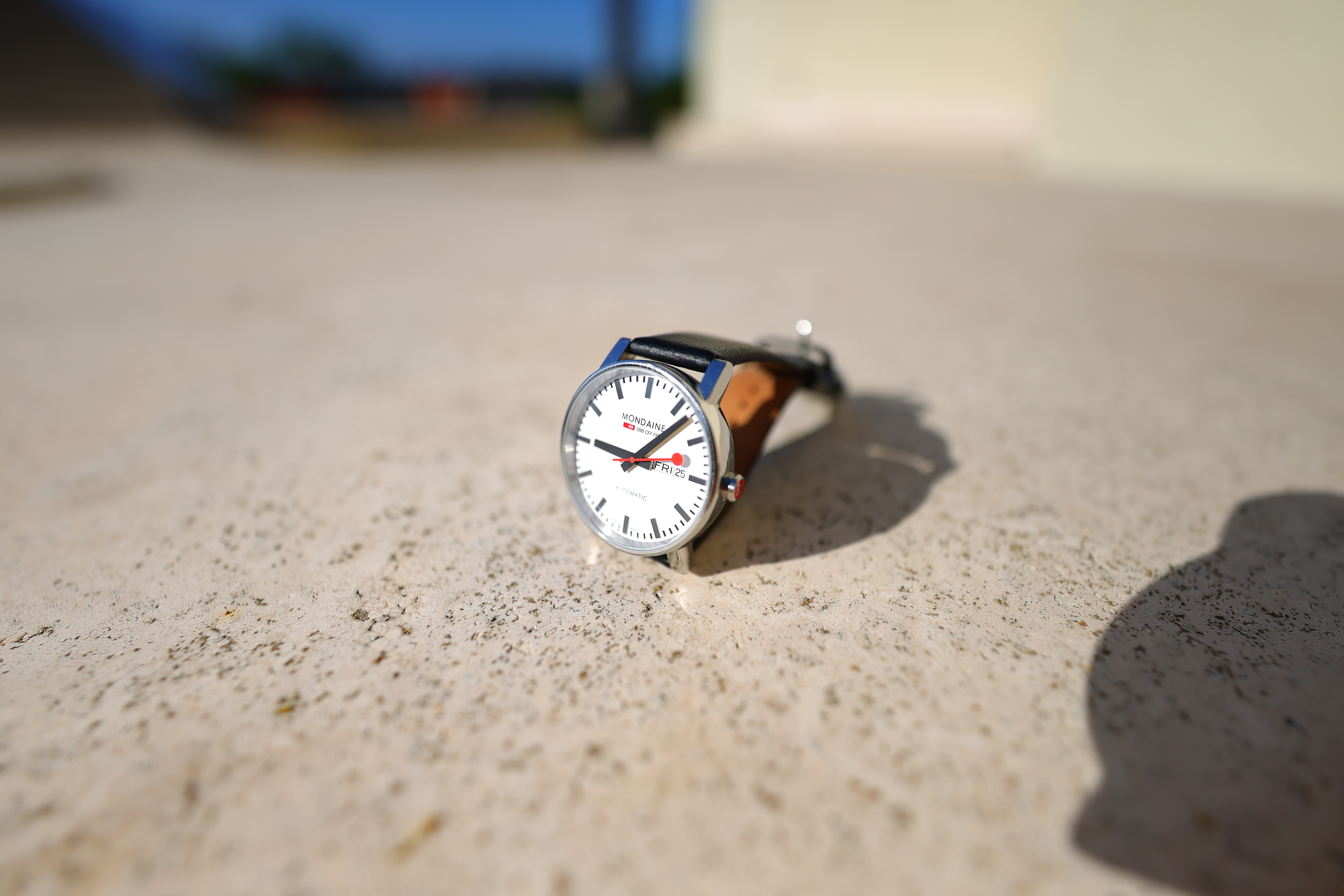
Mondaine A132.30348.11SBB at close-focus distance, Friday, 25 September 2026. Canon R6 III, RF 14mm f/1.4L VCM at f/1.4 at 1/8,000 at ISO 50L (LV 15.0). bigger or camera-original 3.7 MB © 32 MP JPG file.
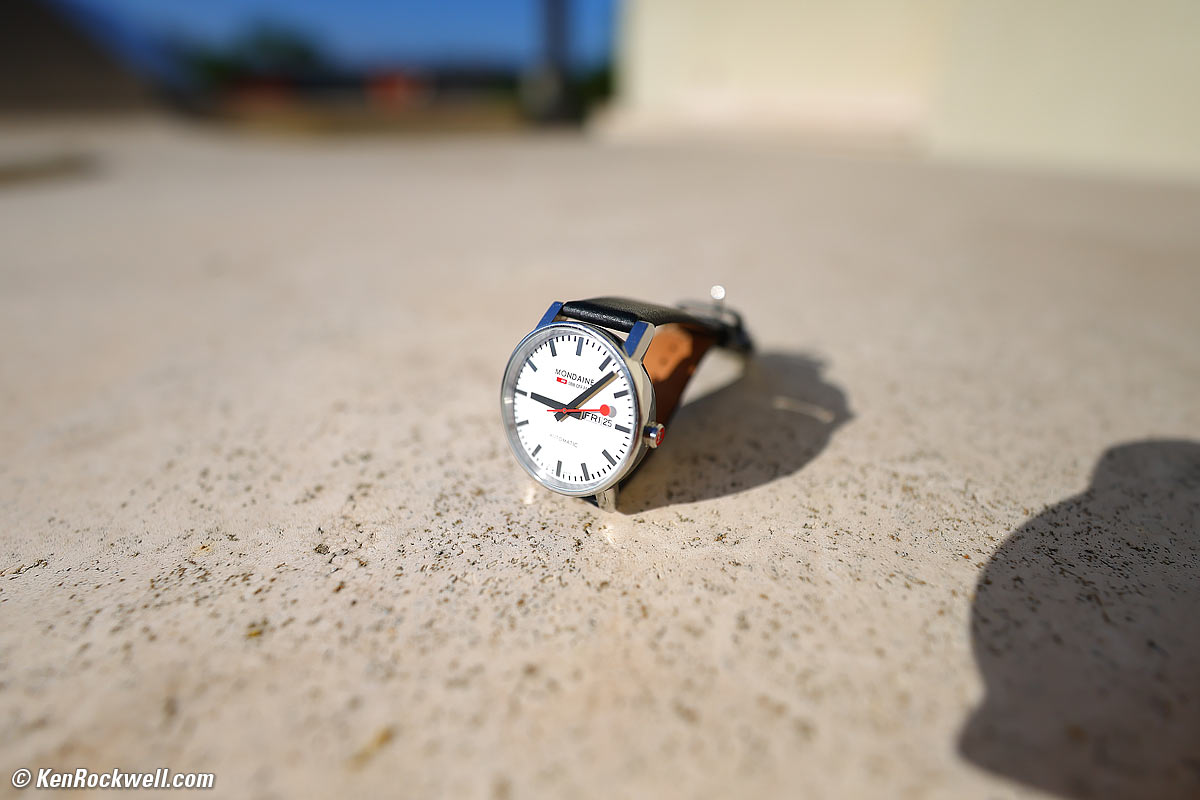
1,200 × 900 pixel (5.8× magnification) crop from above. bigger or camera-original © file.
If these 1,200 × 900 pixel crops are about 3" (8cm) wide on your screen, then the complete image printed at this same 8 magnification would be about 12 × 18" (30 × 44 cm).
If these 1,200 × 900 pixel crops are about 6" (15cm) wide on your screen, then the complete image printed at this same extreme magnification would be about 23 × 35" (59 × 88 cm).
If these 1,200 × 900 pixel crops are about 12" (30cm) wide on your screen, then the complete image printed at this same extreme magnification would be about 46 × 70" (1.18 × 1.8 meters).
Image Stabilization (IS) performance top
This lens has NO Optical Image Stabilization (OIS, IS or VR (Vibration Reduction)), however it works well with in-camera stabilization if you have it.
"Percent Perfectly Sharp Shots" are the percentage of hand-held, free-standing with no support or bracing, frames with 100% perfect tripod-equivalent sharpness as viewed at 300%. Hand tremor is a random occurrence, so at marginal speeds some frames will be perfectly sharp while others will be in various stages of blur — all at the same shutter speed.
Looking at images from my stabilized R6 III at 300% on my 100 DPI monitor from 2½ feet (76 cm/s) away are the same as scrolling around a 18 × 12 foot (5.5 × 3.6 meters!) print, from just 2½ feet (76 cm/s) away — and images are still perfectly sharp most of the time at a half second.7mm!!
This rates what percentage of shots are perfectly sharp, not how sharp are all the frames:
| % Perfectly Sharp Shots on my stabilized R6 III | 4s |
2s |
1s |
1/2 |
1/4 |
1/8 |
1/15 |
1/30 |
1/60 |
1/125 |
| Stabilization ON | 60 |
50 |
66⅔ |
71 |
100 |
100 |
100 |
100 |
100 |
100 |
| Stabilization OFF | 0 |
0 |
0 |
0 |
0 |
7 |
29 |
31 |
93 |
100 |
I see 6½ stops of real-world improvement. SIX AND A HALF STOPS!!!
This is all measured in the center of the frame. Unlike with optical stabilization, geometry makes in-camera sensor-shift stabilization much less effective as one gets to the corners of ultrawide lenses.
Sunstars performance top
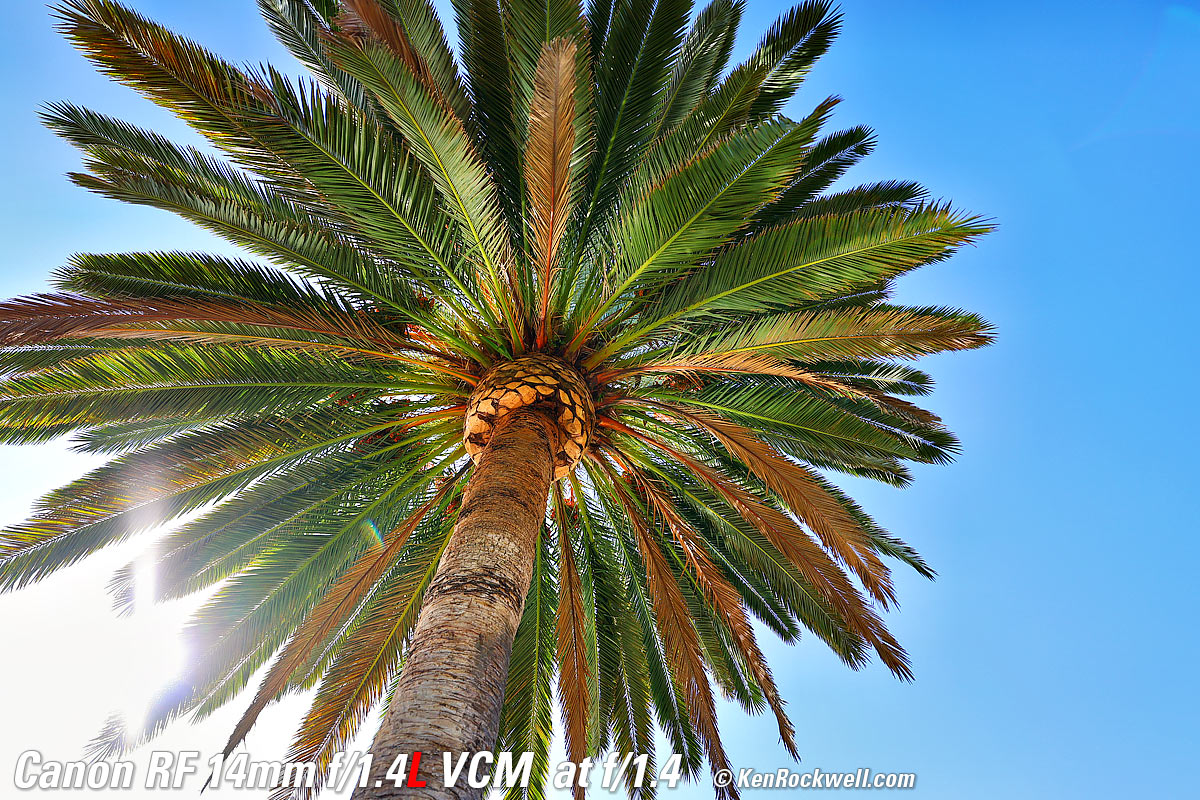
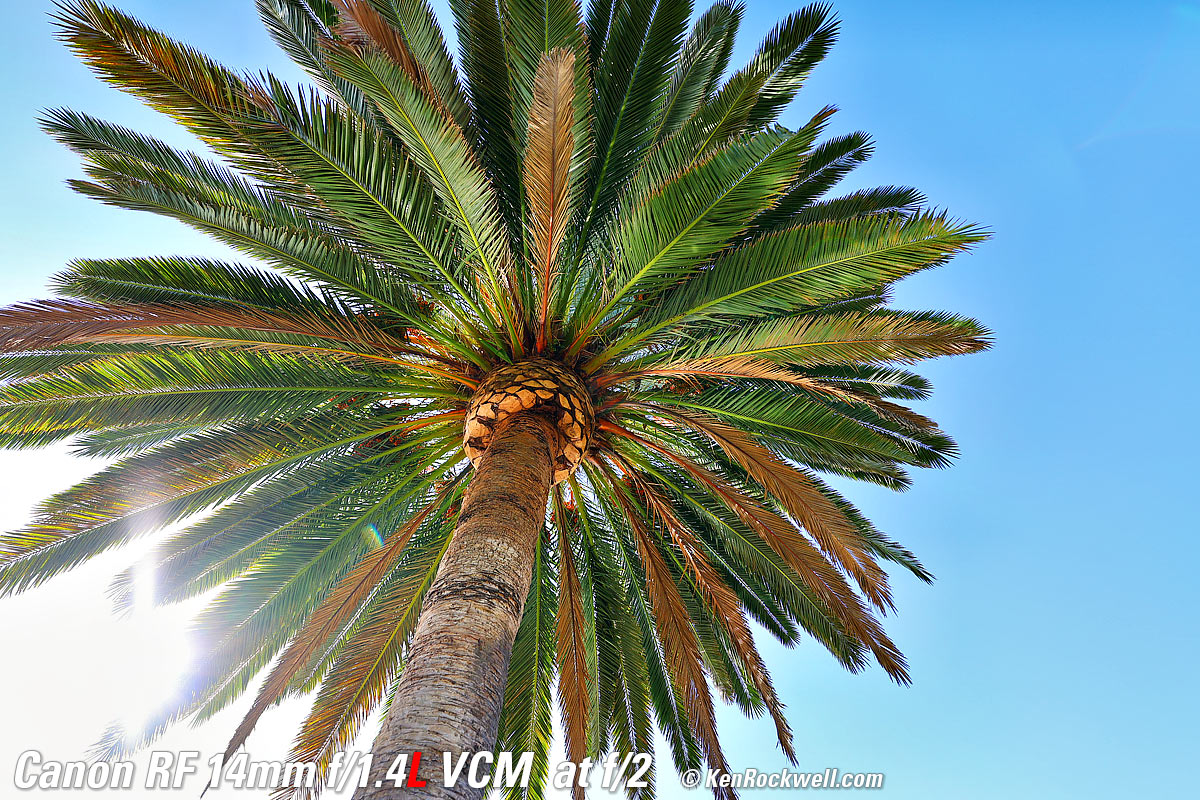
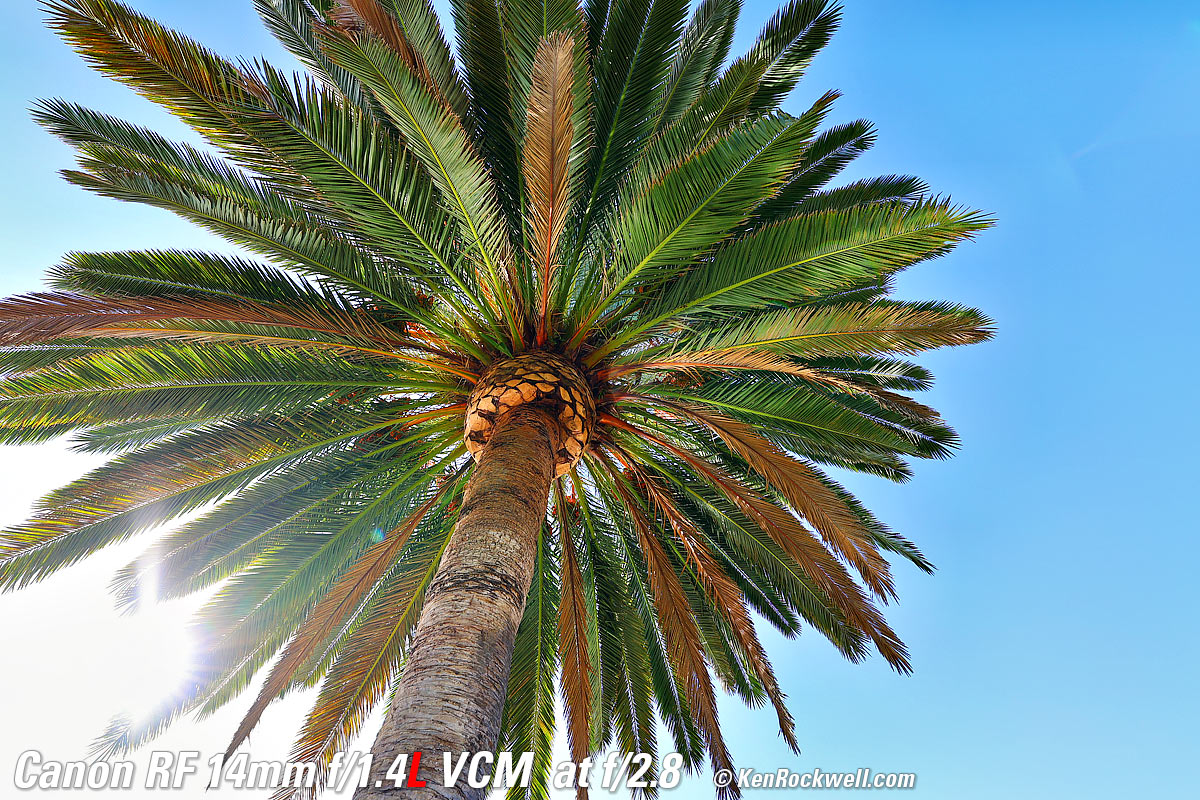
With an 11-bladed rounded diaphragm, I get mild but exquisite 22-point sunstars on brilliant points of light at the smaller apertures.
Ignore the vertical smear at large apertures. This is a sensor artifact called interline transfer smear and is a camera, not a lens, defect.
Click any to enlarge:
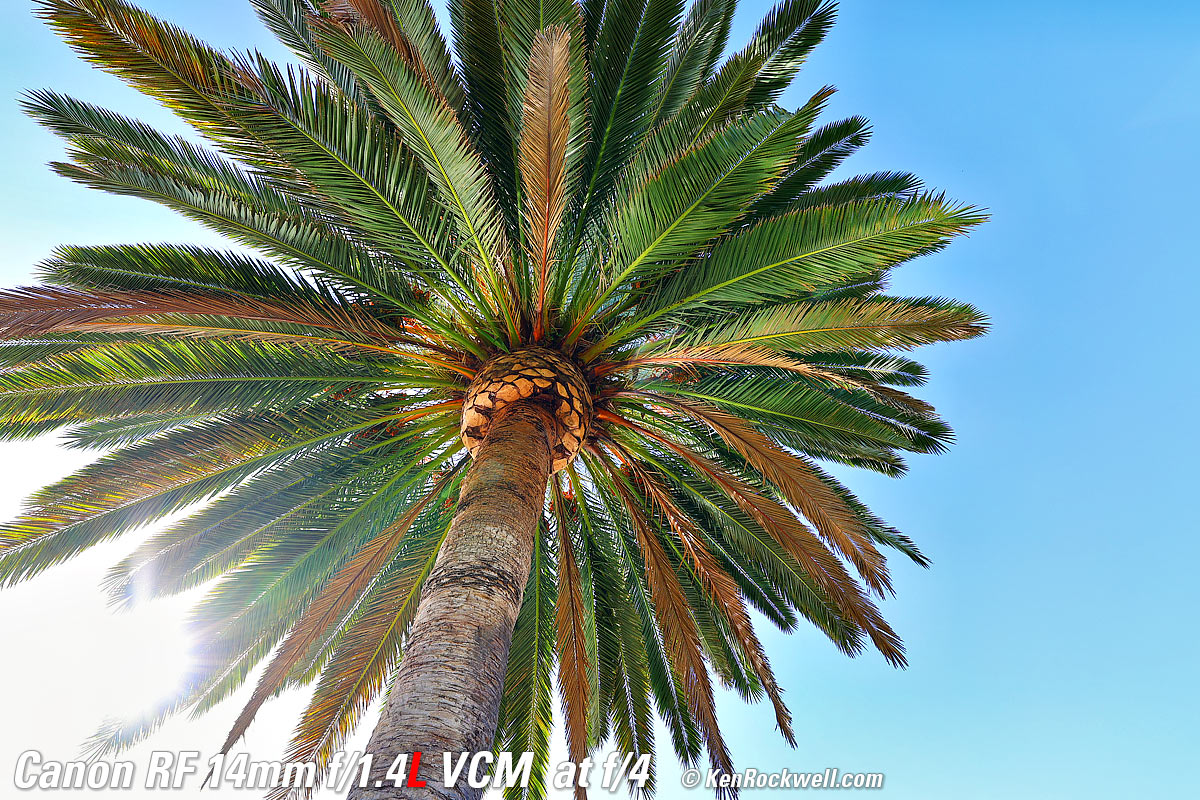
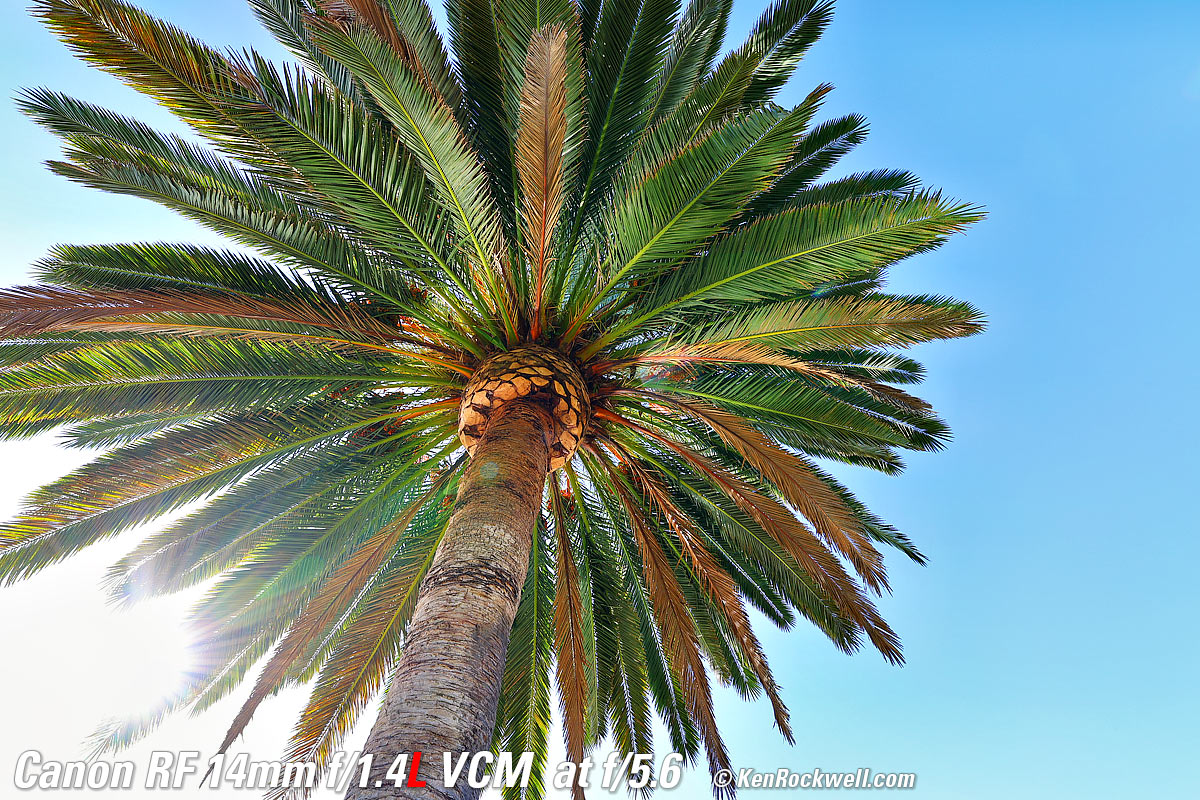
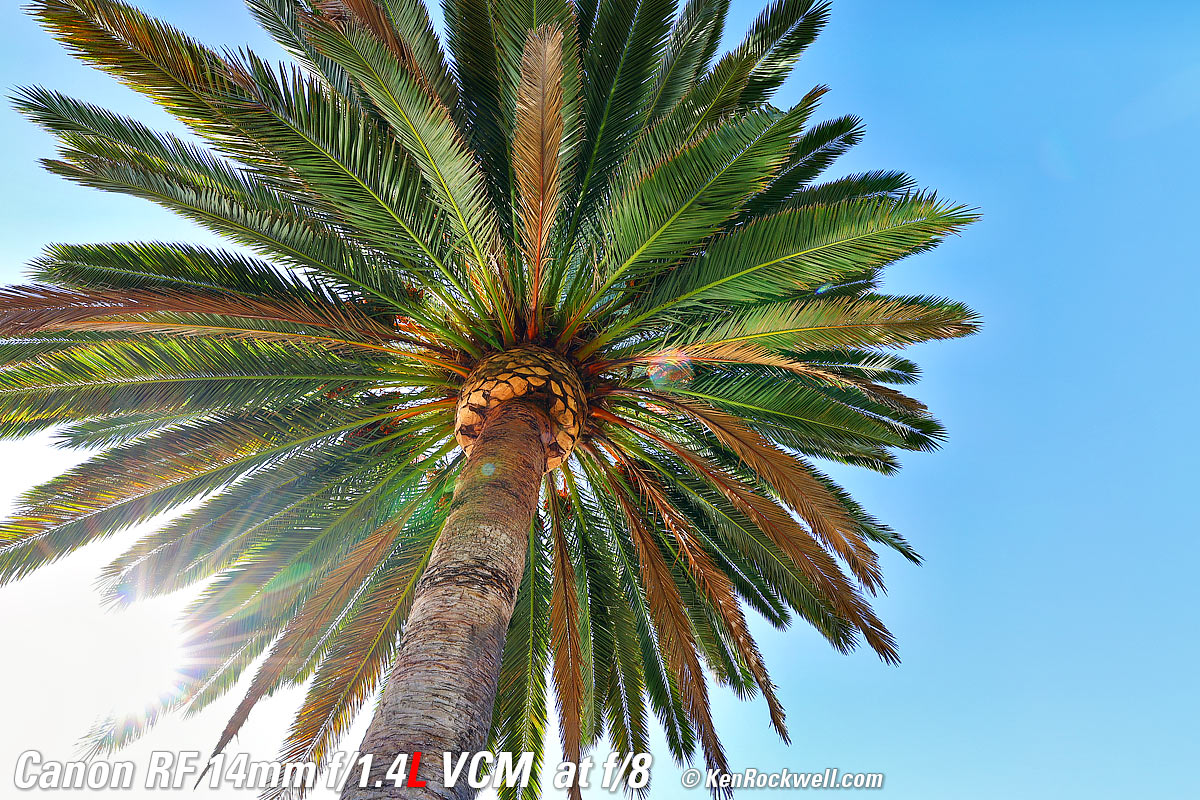
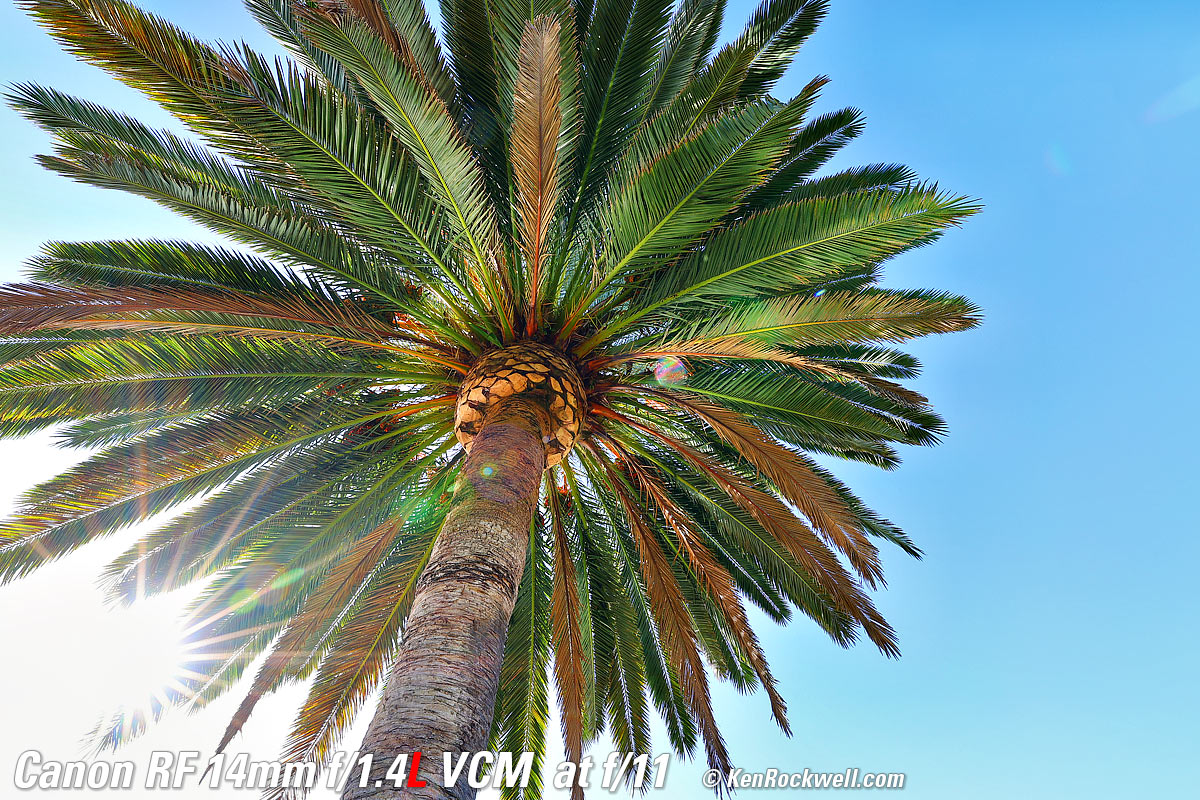
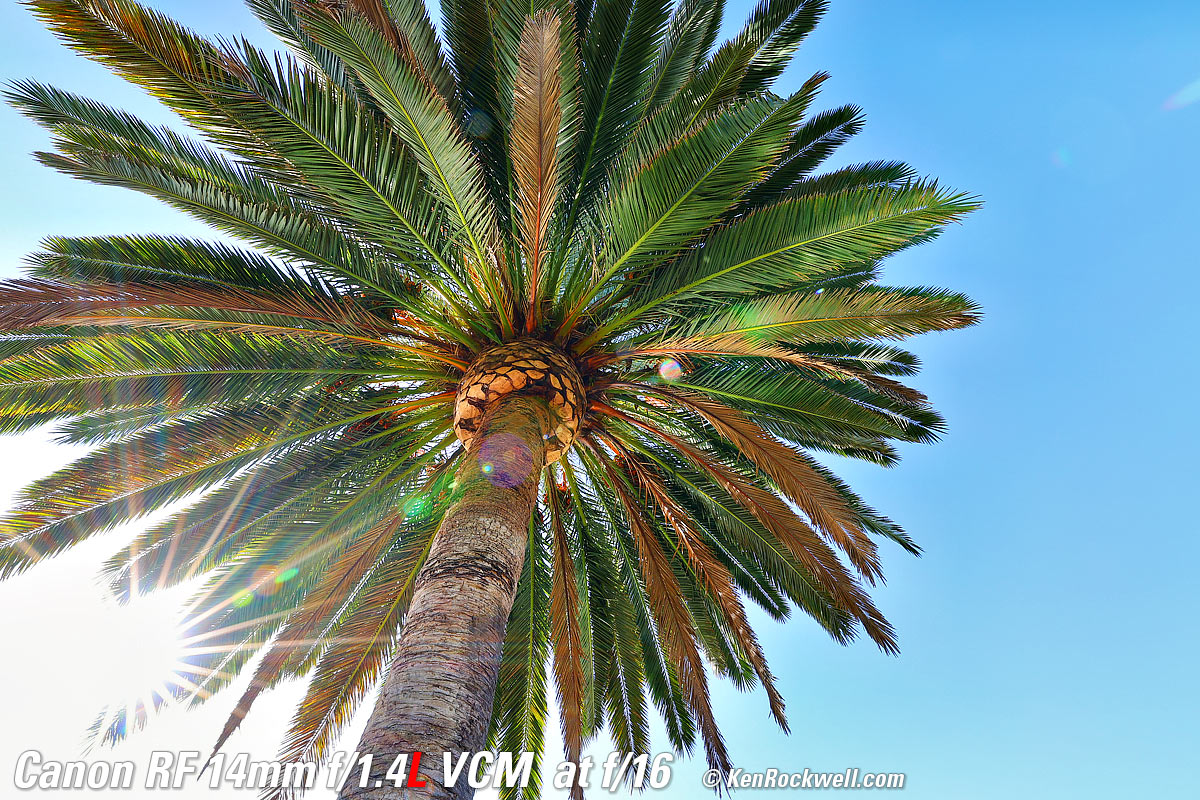
Click any to enlarge.
Compared top
Sample Images Intro New Good Bad Missing
Specifications Performance Compared
I got my RF 14mm at B&H. I'd also get it at Crutchfield, at Amazon or at Adorama, or get it used at eBay (How to Win at eBay), or get it used at KEH.
All Canon Mirrorless Ultrawide Lenses Compared.
User's Guide top
Sample Images Intro New Good Bad Missing
Specifications Performance Compared
I got my RF 14mm at B&H. I'd also get it at Crutchfield, at Amazon or at Adorama, or get it used at eBay (How to Win at eBay), or get it used at KEH.
How to Use Ultrawide Lenses
Canon RF 14mm f/1.4L VCM. bigger.
The aperture ring cannot move between the "A" and the marked aperture settings unless you move the IRIS slider forward to defeat the lock. Once you're holding it forward you can move the ring anywhere you want.
The aperture ring is blocked again from moving between the set apertures or the "A" position when you release the IRIS slider.
I leave my 14mm in A and set my apertures in my camera. As an old-timer it's just weird to have an aperture ring without clicks unless it's on my view camera.
Obviously you may do whatever feels best.
See also Canon's RF 14mm f/1.4L VCM User's Guide.
Recommendations top
Sample Images Intro New Good Bad Missing
Specifications Performance Compared
Be sure to get yours only from my recommended sources so that you can just send it back if you don't love it. You never have to guess about how well it will work for you; order it and see for yourself. That's why I've used B&H and Adorama since I was a kid in the 1970s: I can try it in my own environment with my own other gear and if I don't love it, back it goes:
I got my RF 14mm at B&H. I'd also get it at Crutchfield, at Amazon or at Adorama, or get it used at eBay (How to Win at eBay), or get it used at KEH.
Canon makes a slew of Ultrawide lenses. See my executive summaries at All Canon Mirrorless Ultrawide Lenses Compared to learn which is best for what. Personally f/4 is more than fast enough for anything I shoot, so I prefer the huge zoom range of the RF 14~35mm f/4L IS USM which is also smaller, lighter, takes normal filters and is only half the price, but we're all different. Thank your lucky stars you shoot Canon, who has the largest selection of useful lenses of any maker.
I can't use a clear (UV) protective filter to protect my lens, so I always carry it around my neck with its cap on, removing the cap only to compose and shoot, and then immediately replace it for protection.
If you do use filters, be sure to use only genuine gelatin filters which are very, very delicate and expensive. Resist using Rosco or Lee filters, which aren't optically flat and are designed for putting over lights — not in an imaging path.
Ultra-ultrawide lenses are by far the most difficult lenses to use well. Most hobby photographers get horrible results with lenses this wide, so be sure you are fluent in How to Use Ultrawide Lenses.
I got my RF 14mm at B&H. I'd also get it at Crutchfield, at Amazon or at Adorama, or get it used at eBay (How to Win at eBay), or get it used at KEH.
© Ken Rockwell. All rights reserved. Tous droits réservés. Alle Rechte vorbehalten. Alla rättigheter förbehållna. Toate drepturile rezervate. Niciun vampir nu a fost implicat în crearea acestei lucrări. Omnia jura reservata. Doe! Ken Rockwell® is a registered trademark.
Help Me Help You top
I support my growing family through this website, as crazy as it might seem.
The biggest help is when you use any of these links when you get anything. It costs you nothing, and is this site's, and thus my family's, biggest source of support. These places always have the best prices and service, which is why I've used them since before this website existed. I recommend them all personally.
If you find this page as helpful as a book you might have had to buy or a workshop you may have had to take, feel free to help me continue helping everyone.
If you've gotten your gear through one of my links or helped otherwise, you're family. It's great people like you who allow me to keep adding to this site full-time. Thanks!
If you haven't helped yet, please do, and consider helping me with a gift of $5.00.
As this page is copyrighted and formally registered, it is unlawful to make copies, especially in the form of printouts for personal use. If you wish to make a printout for personal use, you are granted one-time permission only if you PayPal me $5.00 per printout or part thereof. Thank you!
Thanks for reading!
Ken.