Home Donate New Search Gallery Reviews How-To Books Links Workshops About Contact
Canon 50mm f/2.5 Macro
Full-Frame EF (1987-2018)
© 2013
KenRockwell.com. All rights reserved.
Intro Specifications Performance Compared Recommendations
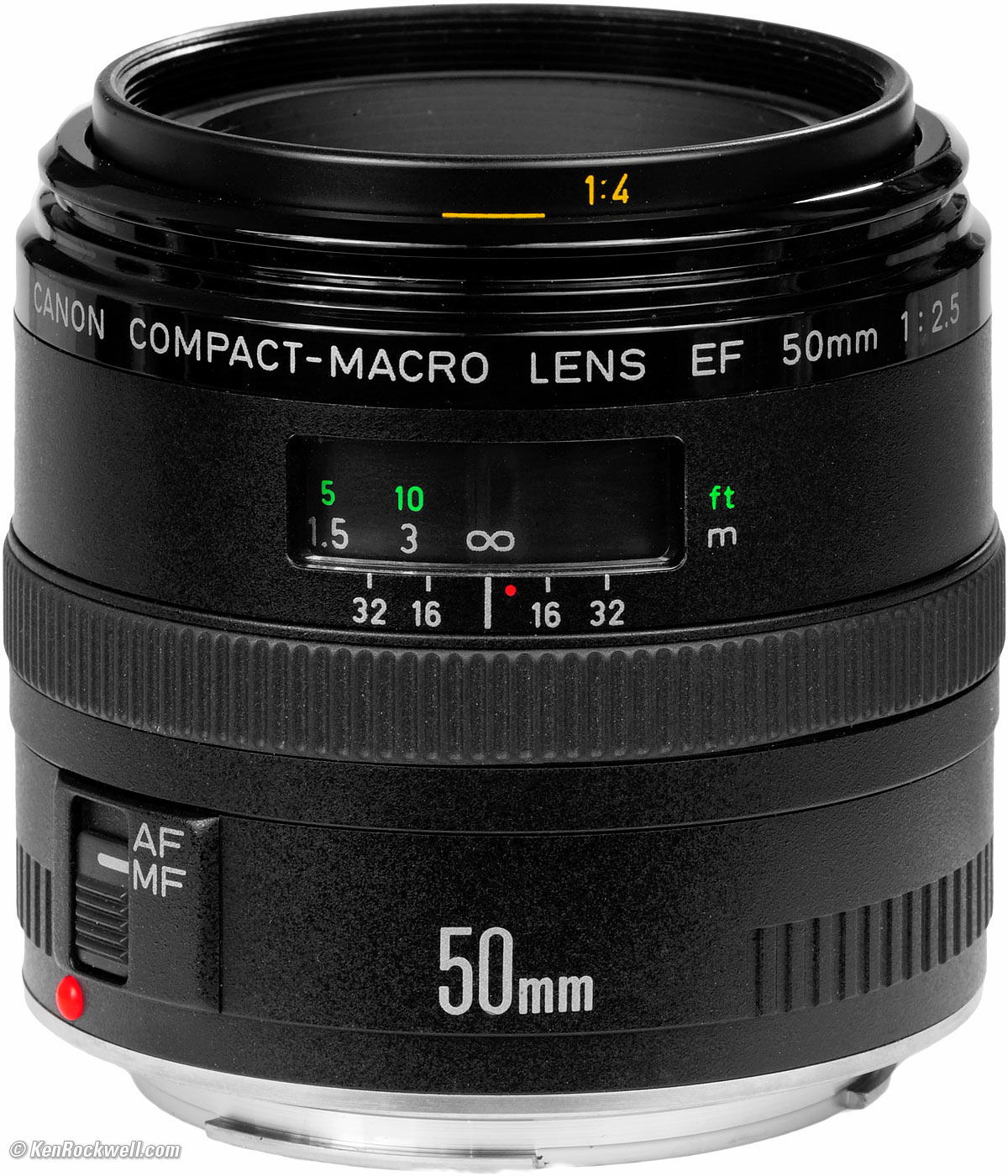
Canon EF 50mm f/2.5 Macro (52mm filter, 9.5 oz./269g, 1:2 macro, about $270 new or $165 used). enlarge. I'd get it at Adorama or at Amazon, or this link to it used at eBay (see How to Win at eBay). My biggest source of support for this free website is when you use those or any of these links when you get anything, regardless of the country in which you live — but I receive nothing for my efforts if you buy elsewhere. I'm not NPR; I get no government hand-outs and run no pledge drives to support my research, so please always use any of these links for the best prices and service whenever you get anything. Thanks for helping me help you! Ken.
Good: Fast autofocus, super-sharp, no distortion, small, light and inexpensive makes it my favorite Canon 50mm lens.
Bad: You have to move a switch for manual focusing.
November 2013 Canon Reviews Canon Lenses All Reviews
NEW: Canon 50mm Lenses Compared 05 Nov 2013
Why fixed lenses take better pictures.

Introduction top
Intro Specifications Performance Compared Recommendations

Adorama pays top dollar for your used gear.
I use these stores. I can't vouch for ads below.
|

Canon's sharpest 50mm lens, this 50mm Compact-Macro works great for everything for which you'd use a 50mm fixed normal lens, and it focuses super-close for macro shots with no fiddling required.
It uses a complex 9-element floating-element design for no distortion and intense sharpness at every distance, and it remains small, light and inexpensive. It is a superb choice as a normal lens for everyday use, with optics easily superior to the 50mm f/1.4.
For dedicated macro work, I prefer the 100mm or 180mm macro lenses so I can stand far enough back as not to interfere with my own lighting or annoy the subject, and present it in a more natural perspactive. For flat art, this lens is superb.
This is one of the oldest lenses still in Canon's catalog. It was introduced in December 1987, and continues to this day. I reviewed one sample in 2006 on the 5D, and another sample, made in 2007, on a 5D Mk II in 2010.
This 50mm f/2.5 has exceptionally good optics, in an inexpensive, small and handy package.
Compatibility
As an EF lens, it works perfectly with every autofocus EOS Canon SLR, from Canon's very first EOS 650 and EOS 620 that were introduced with this lens in 1987, to today's newest 5D Mark III and 1D X.
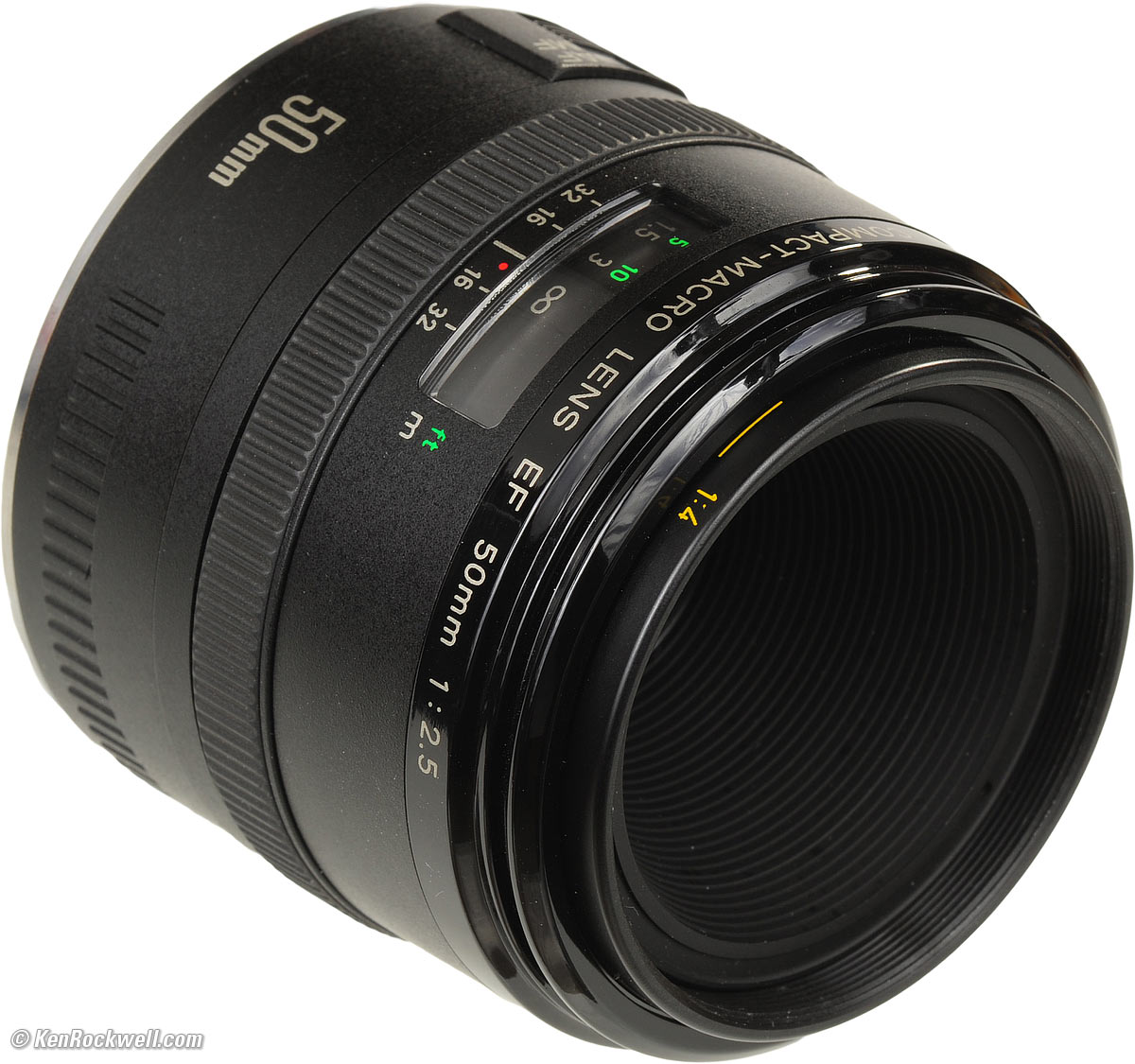
Canon 50mm f/2.5 Macro. enlarge.
Specifications top
Intro Specifications Performance Compared Recommendations
Name
Canon calls this the Canon Compact-Macro Lens EF 50mm f/2.5.
EF means there's a loud motor that does the focusing. It doesn't have the silent ultra-sonic motor (USM) of newer lenses like the 100mm f/2.8.
Focal Length
50mm.
Used on a 1.3x camera it gives an angle of view similar to what a 63mm lens would give on a 35mm film camera.
On a 1.6x camera it gives an angle of view similar to what a 81mm lens would give on a 35mm film camera. See also Crop Factor.
Maximum Aperture
f/2.5.
That's 1/3 of a stop faster than f/2.8, and exactly a stop faster than f/3.5, and exactly one stop slower than f/1.8.
Optics
9 elements, 8 groups.
Floating elements. As focused more closely, the front section moves forward, while the rear section stays fixed.
Diaphragm
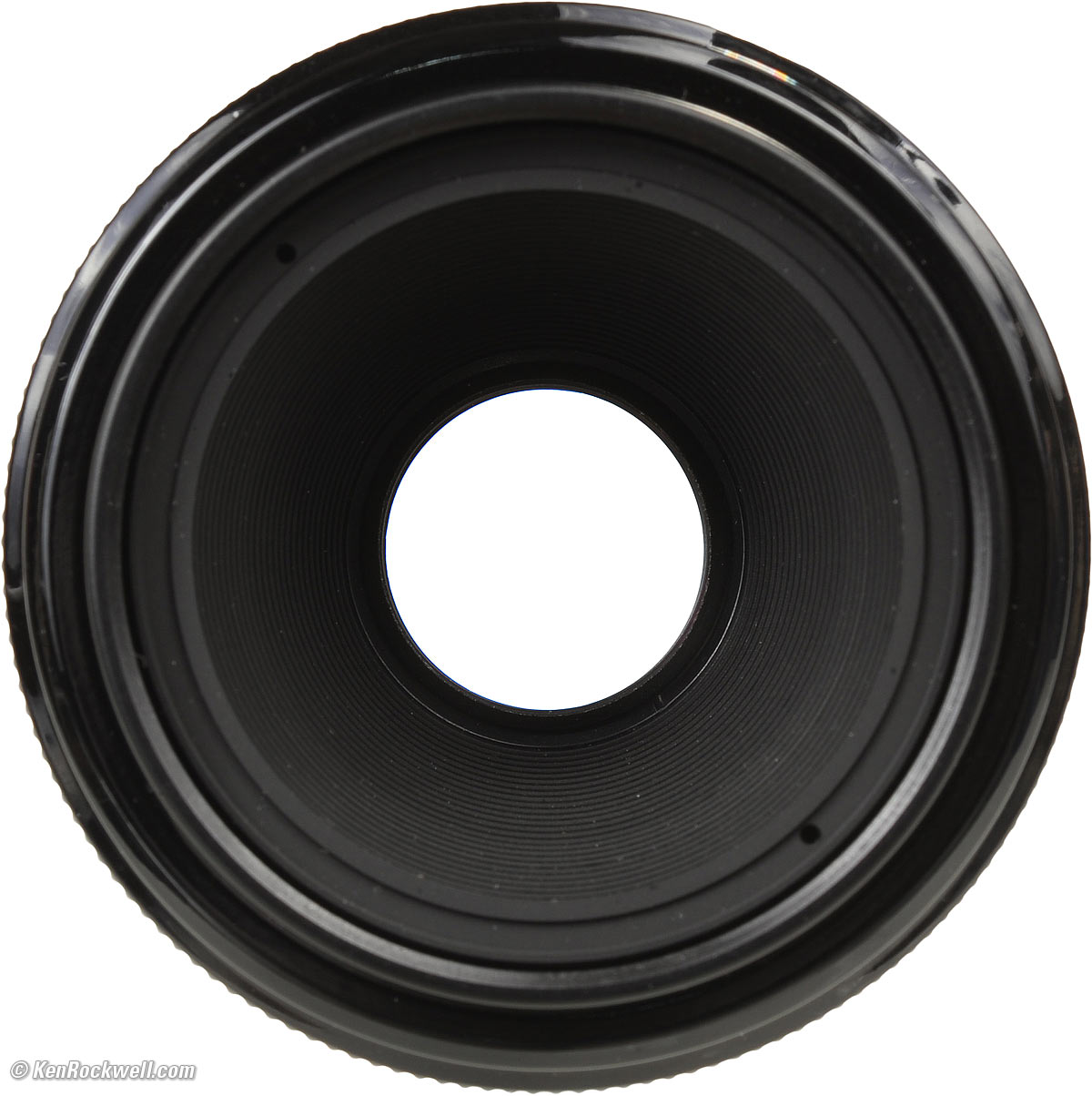
Front, Canon 50mm f/2.5 Macro at f/2.5. enlarge.
Stops down to f/32.
2007 production: 6 blades.
Earlier: 5 blades.
Filter Thread
52mm, metal.
Extends, but does not rotate, as focused.
Close Focus
9" (24.9cm) from the image plane (the back of the camera).
Maximum Reproduction Ratio
1:2, half life size.
The 4-element, 3-group Canon EF Life-Size Converter, which costs as much by itself as the 50mm macro lens, lets you get from 1:4 to 1:1.
Working Distance:
The lens sticks out quite a bit, so 9-1/2" from the image plane means it focuses only 4-1/8" (10.5cm) from the front of the lens.
This is why you really want the 100mm: how are you going to get light in there with only 4" of clearance?
Size (measured)
2.659" diameter x 2.477" extension from flange (67.54 x 62.93mm) focused at infinity.
It extends to 3.466" (88.04mm) from the flange at the closest focus distance.
Weight
2007 production: 9.500 oz. (269.3g). With both caps: 10.155 oz. (287.85g).
Earlier lens: 9.530 oz. (270.2g).
Canon specifies 9.9 oz. (280g).
Case
LP814 pouch, not included.
Introduced
December 1987.
Price
June 2013: $270 new or $165 used.
August 2012: $280 new or $150 used.
RATED MTF
Canon rates it as excellent, better than the 50mm f/1.8, 50mm f/1.4 USM and 50mm f/1.2L.
The 100mm Macro and 100mm Macro L are even better.
See also Canon EF Lens Work III.
Performance top
Intro Specifications Performance Compared Recommendations
Autofocus Bokeh Color Color Fringes Construction
Distortion Ergonomics Falloff Filters Flare Flash
Macro Serial Nr Sharpness Sunstars Survivability IS
It's a superb optical and mechanical performer.
Its only shortcoming is its 1987-era autofocus system, which is fast, but noisy and requires a switch to get in and out of manual focus mode.
Focusing performance top
The focus is fast but noisy.
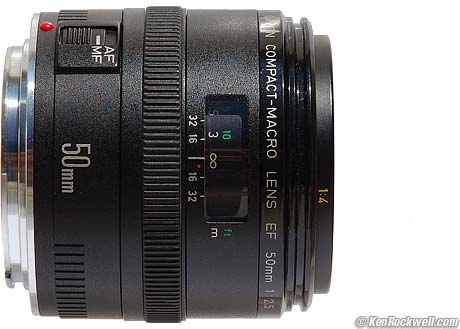
Canon EF 50mm f/2.5 Macro. enlarge. Move your mouse over it to see it extend!
It's fun to watch the barrel go flying in and out and listen to the little motor sound as if it's about to explode. Mouse over the photo at the top to see it work.
In practice, it's instant at normal distances, and fast even if it has to slam back and fourth across the entire macro range.
Autofocus Accuracy
AF accuracy of my 2007 sample on a 5D Mark II is perfect.
An earlier sample on a 5D wasn't as good. The older sample on a 5D, XTi and 30D tended to focus behind the subject at close distances, and a little in front of the subject at infinity. Stopped down to f/5.6, the results are much better.
Stick with a new sample and the newest cameras and all seems to be perfect.
Manual Focus
You have to move the switch on the lens from AF to MF.
Once you do that, it works great. You can flick it with a finger tip.
It doesn't creep on a copy stand.
The focus ring is geared to turn 370,º while the inner focus scale moves more slowly.
Manual focus is always fast, easy and precise.
Manual Exposure
Using the camera's meter, there's no need to do anything differently.
However, if you use an external light meter, the lens changes its effective aperture as you focus more closely, and this it not indicated on the camera. (This is different from Nikon's macro lenses, which do automatically compensate for external light meters when used with AF and digital cameras.)
If using an external light meter, here are Canon's suggested correction factors:
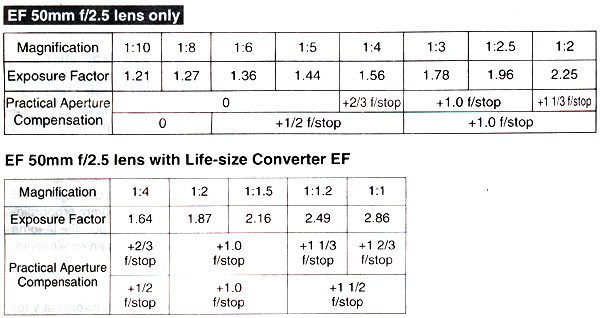
Canon external-meter manual exposure correction factors.
You'll have to make these corrections the hard way, and they aren't marked on the lens.
This is only a problem if using an external exposure or flash meter. It's not a problem when using the camera's own meter.
It will drive you whacko if you're in a studio with one set of strobes and try to copy the f/stop between Canon and Nikon cameras.
Bokeh performance top
Bokeh is wonderful. Backgrounds are always soft and undistracting.
Bokeh is the character of out of focus backgrounds, not simply how far out of focus they are.
Lateral Color Fringes performance top
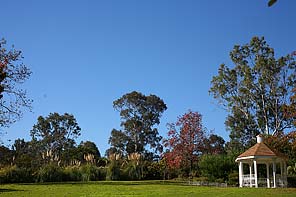
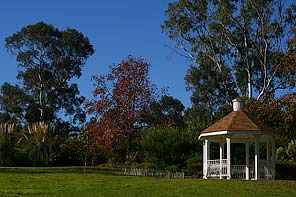
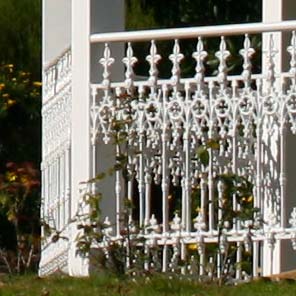
There aren't any color fringes for gazebo and lawn furnishings specialists.
 |
 |
Full image, 5D |
Full Image, Rebel XTi |
|
 |
100% crop from 5D |
100% crop from XTi |
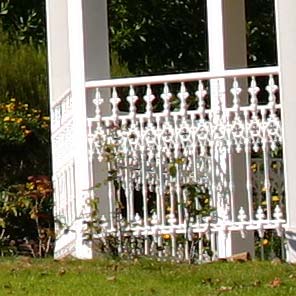
With the extra resolution of the 5D Mark II, there is just the slightest red/cyan fringe at the sides; nothing to worry about.
Color Rendition performance top
I see no differences from my other Canon lenses.
Construction performance top
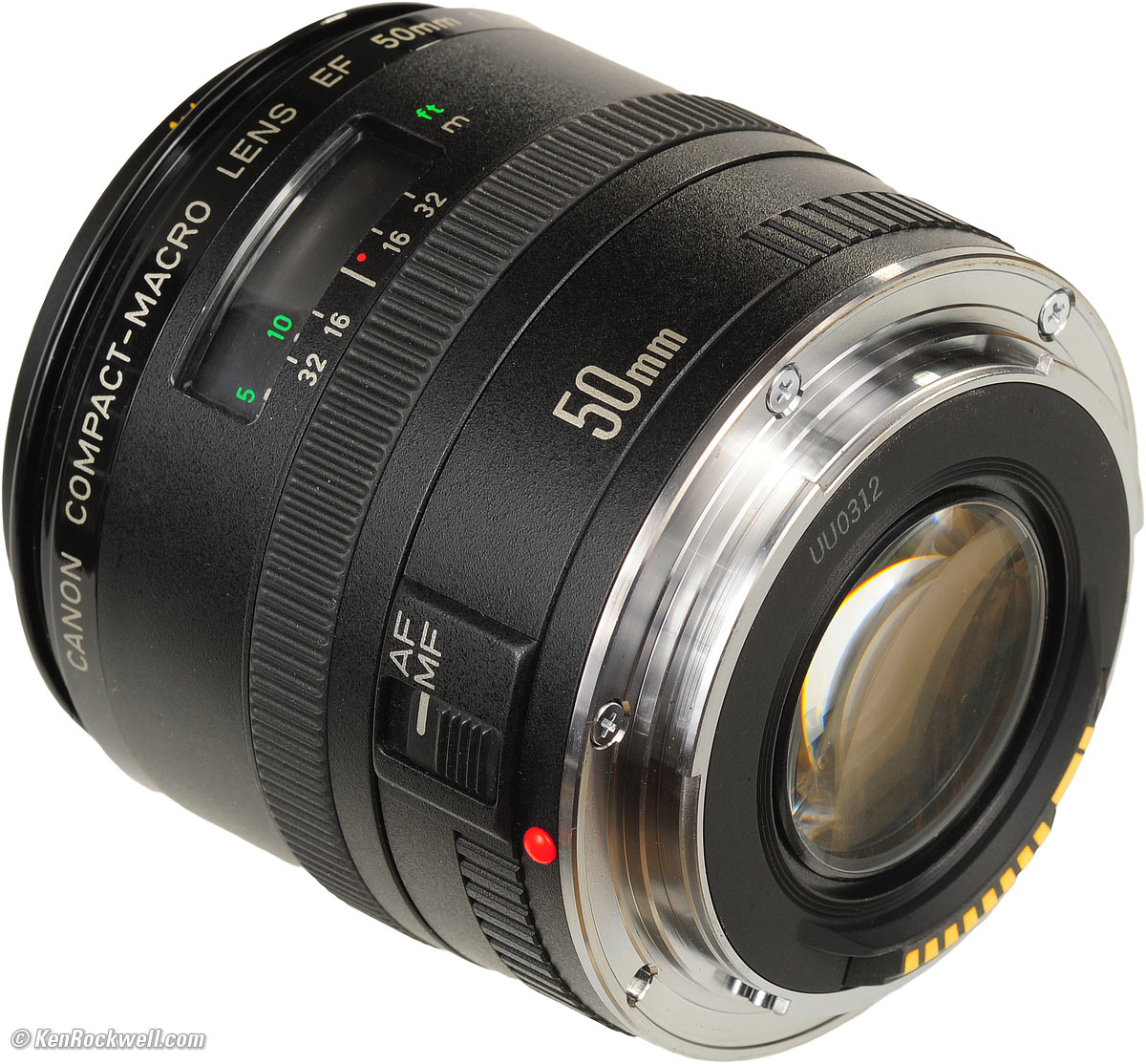
Canon 50mm f/2.5 Macro. enlarge.
Construction is solid, with metal innards covered in plastic.
Filter Thread
Metal
Forebarrel
Metal
Hood attachment ring
Metal.
Barrel
Plastic.
Slide Switches
Plastic.
Internals
Metal helicoid with what looks like a plastic follower.
Markings
Painted.
Serial Number
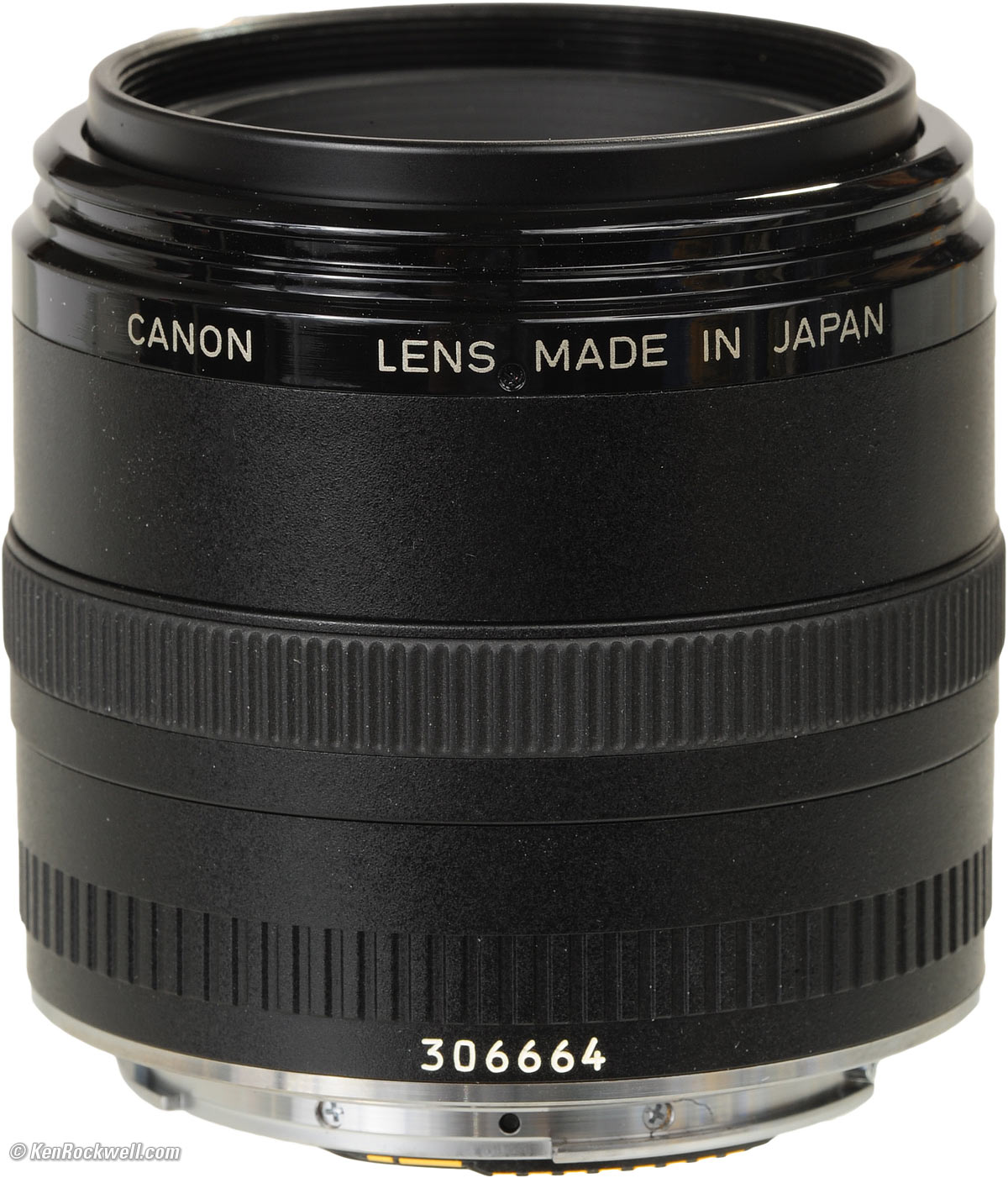
Bottom, Canon 50mm f/2.5 Macro. enlarge.
The serial number is engraved in the bottom rear of barrel, near the mount, and filled with paint.
Ass-Gasket (dust seal at mount)
No.
Mount
Metal.
Noises when shaken
A little clunking (this is normal).
Made in
Canon's 3,000 employee, 750,000 sf (75,000 m^2) lens plant in Utsunomiya, Japan, founded in 1977.
Distortion performance top
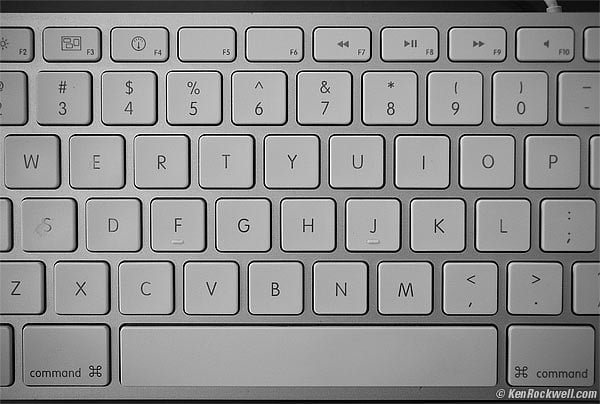
Keyboard. The variation in my desk lighting is more than any distortion.
The Canon 50mm Macro is one of the most distortion-free lenses I've ever used. It has no visible distortion at any distance.
For critical photogrammetric use, try these figures in Photoshop's Lens Distortion Filter. This lens has so little distortion that it's very hard to measure.
Full-frame |
|
∞ |
+0.2 |
10' (3m) |
0.0 |
3' (1m) |
+0.2 |
1' (0.3m, 1:3.5) |
0.0 |
© 2010 KenRockwell.com. All rights reserved.
Ergonomics (handling and ease-of-use) performance top
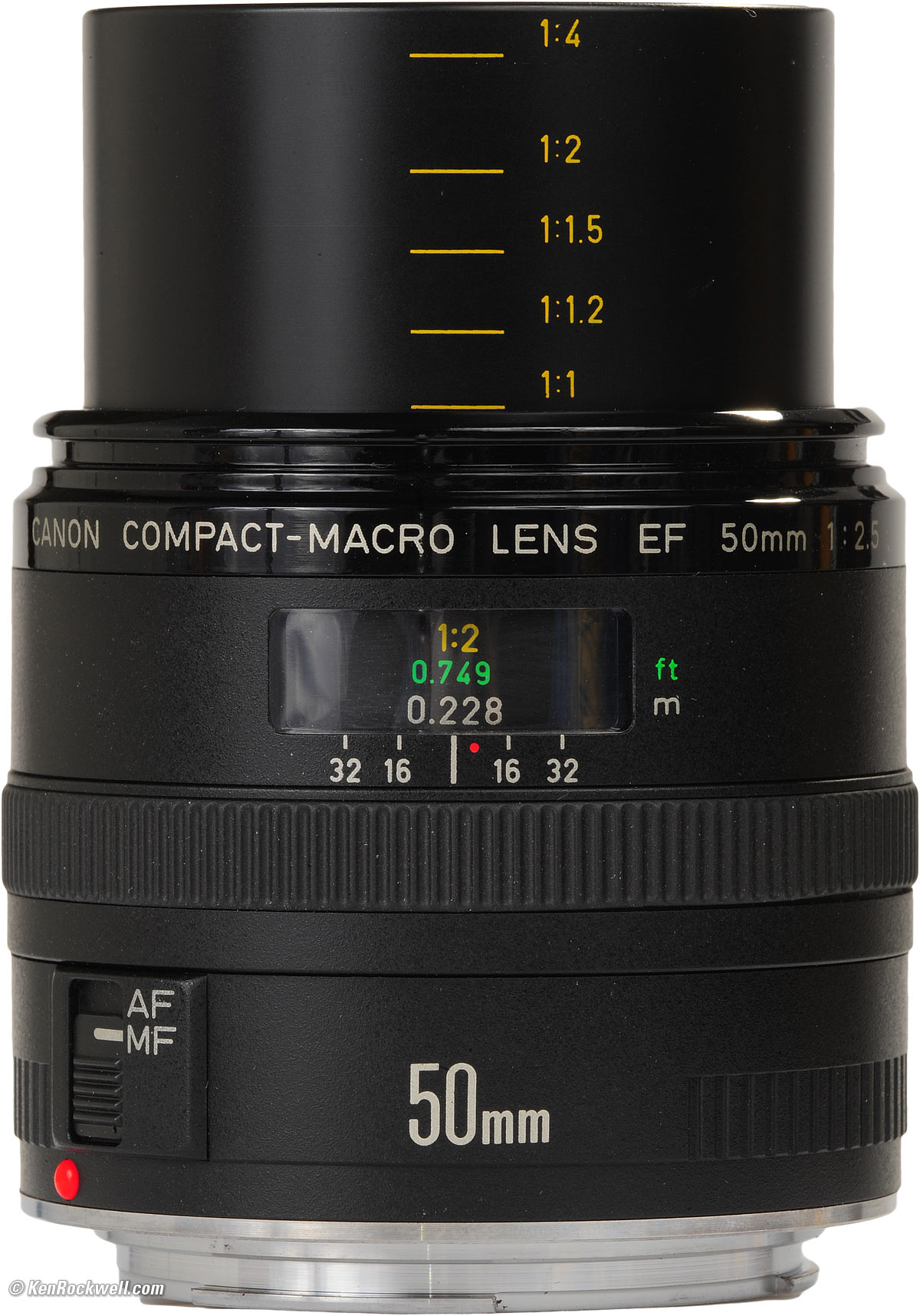
Canon 50mm f/2.5 Macro. enlarge.
Except for the manual slide switch to get between auto and manual focus, ergonomics are swell. Everything just works.
Falloff (Darker corners) performance top
Falloff is fine. Stop down a stop and it's gone, even on full-frame.
Here are shots of an Expodisc on my 5D full-frame camera.
This is a tough test which shows even the slightest falloff as displayed here. You'll almost never see this in normal photography. Ignore the minor exposure variations between frames.
Canon EF 50mm f/2.5 falloff on full-frame at infinity.
© 2010 KenRockwell.com. All rights reserved.
|






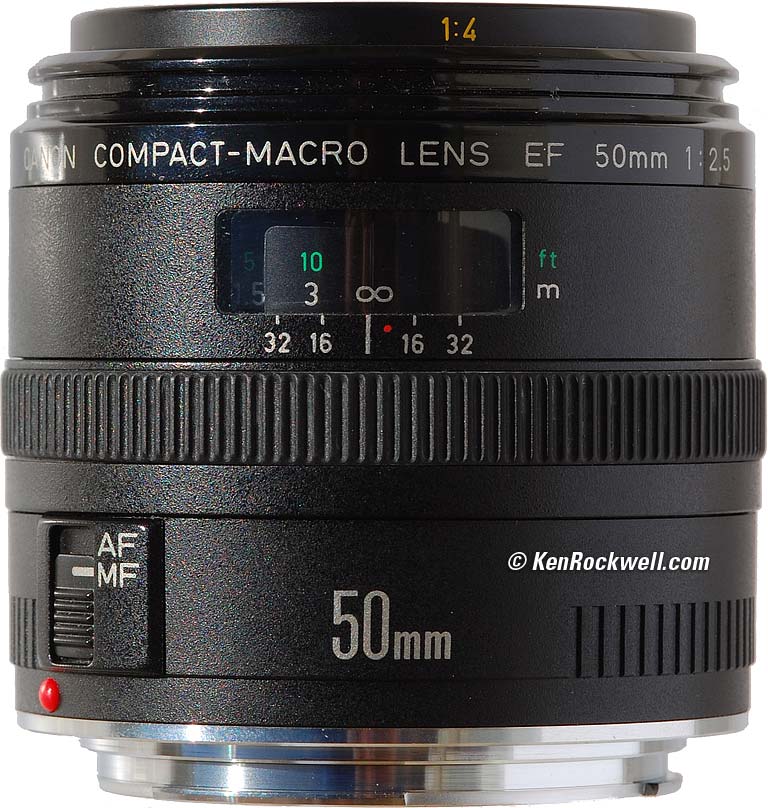
On smaller sensor cameras this almost entirely goes away, even in this test, because they only use the middle of the image. See Crop Factor.
Filters, use with performance top
On my full-frame 5D I can use four regular 52mm screw-in filters with no vignetting.
Five filters vignette at infinity and work fine at close distances.
There's no need to worry about filter vignetting even with a full-frame camera. Smaller sensor cameras are even less subject to it (see Crop Factor).
Flare and Ghosts performance top
No problem.
This is a dangerously blinding California midday sun exposed two stops more than I would for daylight, against a deliberately dark growth of bushes. Only an idiot would do this, and the flare is still minimal. I'm not going to worry about flare; I'm going to worry about my eyesight!
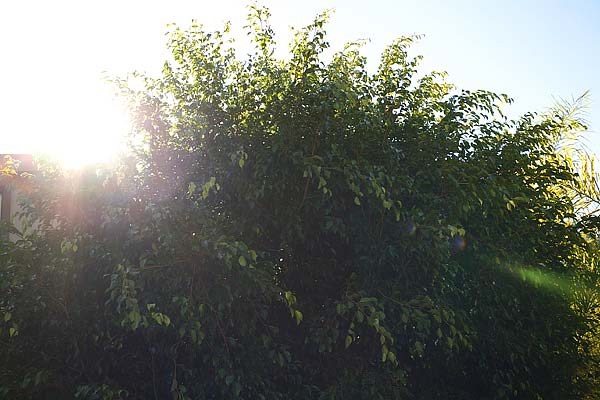
Crap Tree. 50mm Macro, Canon 5D, f/5.6 @ 1/125, ISO 50.
Flash, use with performance top
Even at the closest focus distance of a few inches I get no shadows from the built-in flash of my Rebel XTi.
The XTi's built-in flash exposes as well at close distances as it does at far.
Macro performance top
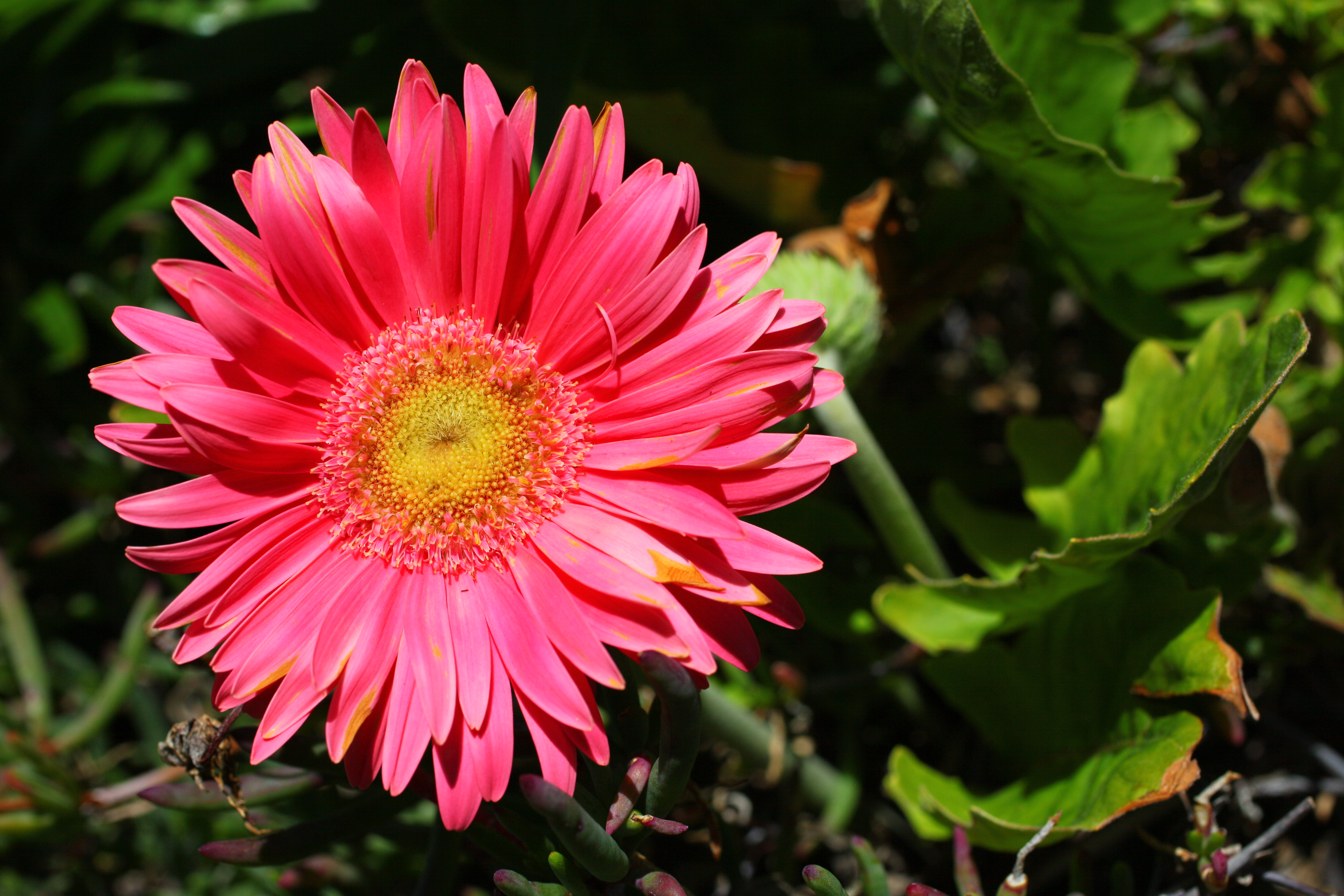
Flower. Camera-original © 5D Mark II JPG (4MB).
The biggest problem in macro is that for everything to be sharp, everything has to be flat, since there is no depth-of field. Most macro pros shoot everything at f/32 with strobes. The shot above was at f/10, hand-held, so only the yellow is reasonably in focus.
It goes to half life size. That means the photo will cover double the dimensions of your film or image sensor.
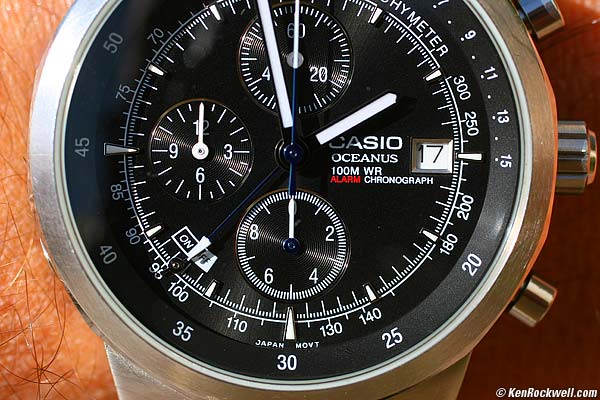
at closest focus, full image on a 30D.
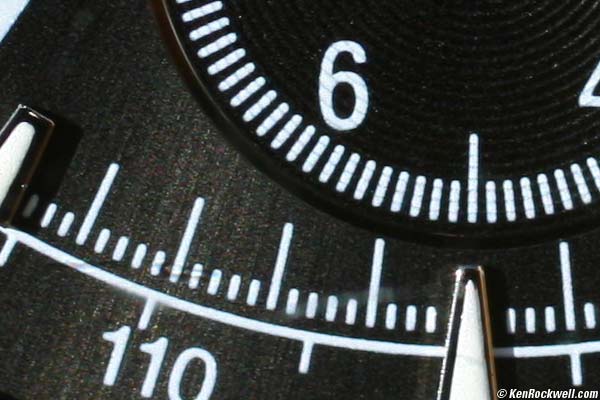
100% crop from above, no extra sharpening. f/6.3 @ 1/250, ISO 100, 30D.
These snaps are from a 1.6x 30D. You won't be able to get as close an image with a 1.3x or full-frame or film camera. (see Crop Factor.)
Serial Number performance top
The serial number is on the bottom rear of the barrel, engraved and filled with white paint.
Sharpness performance top

Window. Camera-original © 5D Mark II JPG (4MB).
Sharpness is always excellent, as you'd expect for a macro lens.
When I compared it directly to the f/1.4 at infinity on a 5D Mark II, this inexpensive macro is clearly superior.
When shot on the 5D Mark II, it's always sharp in the center.
At f/2.5, the sides can be a little lower in contrast due to a tiny bit of coma, but they improve at f/2.8, improve even more at f/4, and are perfect at f/5.6 and at f/8. The sides are sharp, even at f/2.5, which is a lot better than the 50mm f/1.4 if you're counting pixels.
By f/11 and smaller, this lens is so sharp that diffraction is the limiting factor.
Sunstars performance top
Most older models have 5-bladed diaphragms, and beget 10-pointed sunstars on bright points of light.
The current model has a 6-bladed diaphragm, and makes 6-pointed sunstars.
Survivability performance top
It feels pretty tough, but it's not sealed against the elements.
I suspect what will kill this lens is ingress of dirt and grit.
IS (Image Stabilization) performance top
The 50mm f/2.5 Macro has NO Image Stabilization.
TIP: In dim light, fire several shots and pick the sharpest. Blur is a random event, so if you fire enough shots, you'll eventually get a sharp one even at speeds of 1/4 second!
Compared performance top
Intro Specifications Performance Compared Recommendations
NEW: Canon 50mm Lenses Compared 05 Nov 2013
I shot this f/2.5 macro directly against the 50mm f/1.4 USM at the test range on a 5D Mark II. The f/1.4 lens is much softer at every aperture, especially from f/2.5 - f/8. At 100% on-screen, the f/1.4 lens looks broken by comparison at the larger apertures.
This less expensive macro was much sharper at large apertures. By f/11, the f/1.4 lens improved to be about as good as this macro, where most lenses have the same sharpness due to diffraction anyway.
This macro also had much less distortion, and of course could focus much more closely. The macro had a slightly larger angle-of-view than the 50mm f/1.4.
If you split pixels, this inexpensive lens is clearly superior to the f/1.4 version.
The 50mm f/1.2 L might be about as sharp, but has much more distortion.
Recommendations top
Intro Specifications Performance Compared Recommendations
The Canon 50mm f/2.5 Compact-Macro is a superb choice as an all-around 50mm lens. it is the sharpest and the least distorting of any Canon 50mm lens.
It may not be expensive, but this is Canon's best 50mm lens optically.
It's not the fastest, but with the high ISOs of DSLRs, still works great in low-light, and gives a much deeper depth-of field and often higher AF accuracy than Canon's faster lenses.
As a standard lens, this lens also focuses immediately to any close distance you might want; you never hit a stop at 1.5 feet (0.45m) as you do with Canon's other 50mm lenses.
For dedicated macro use, longer lenses are far more practical since you won't be so close that you'll bloch your light or annoy your subjects, as you are apt to do with any 50mm lens. For serious macro use, I'd get a Canon 100mm f/2.8 or Canon 100mm f/2.8 L IS instead, just to open up the distance between the front of my lens and the subject.
I first published this review on 06 December 2006, and rewrote it on 29 April 2010 with new data from a newer sample of this lens on the 5D Mark II.
Help me help you top
I support my growing family through this website, as crazy as it might seem.
The biggest help is when you use any of these links when you get anything, regardless of the country in which you live. It costs you nothing, and is this site's, and thus my family's, biggest source of support. These places have the best prices and service, which is why I've used them since before this website existed. I recommend them all personally.
If you find this page as helpful as a book you might have had to buy or a workshop you may have had to take, feel free to help me continue helping everyone.
If you've gotten your gear through one of my links or helped otherwise, you're family. It's great people like you who allow me to keep adding to this site full-time. Thanks!
If you haven't helped yet, please do, and consider helping me with a gift of $5.00.
As this page is copyrighted and formally registered, it is unlawful to make copies, especially in the form of printouts for personal use. If you wish to make a printout for personal use, you are granted one-time permission only if you PayPal me $5.00 per printout or part thereof. Thank you!
Thanks for reading!
Mr. & Mrs. Ken Rockwell, Ryan and Katie.
Home Donate New Search Gallery Reviews How-To Books Links Workshops About Contact