Nikon 70-210mm f/4
FX AF (1986-1988)
Intro Format Compatibility Specs
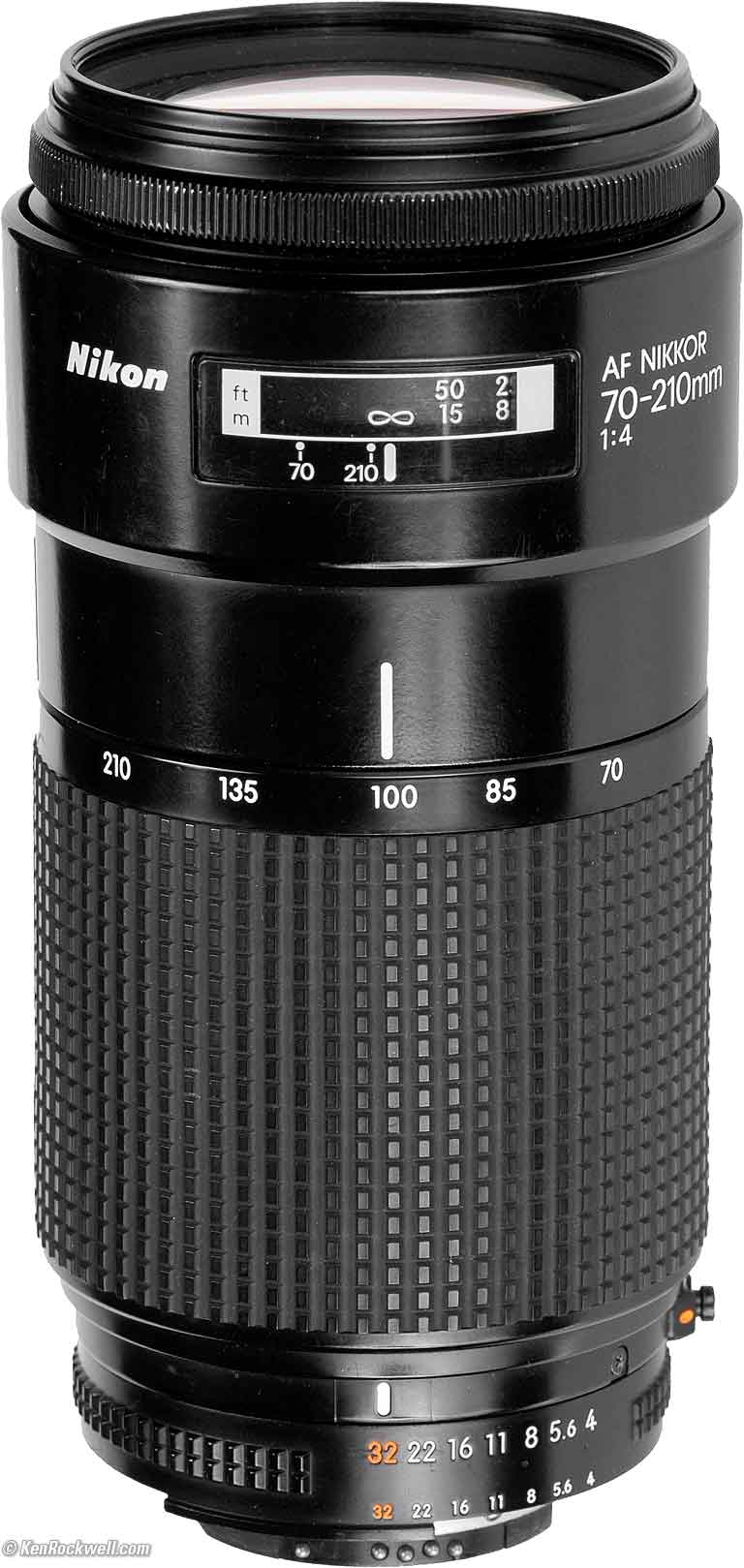
Nikon 70-210mm f/4 AF (62mm filters, 27 oz. /760g, 3.7'/1.1m close focus, about $150 used if you know How to Win at eBay). bigger. I got mine at this link directly to them at eBay.
This all-content, junk-free website's biggest source of support is when you use those or any of these links to approved sources when you get anything, regardless of the country in which you live. Buy only from the approved sources I use myself for the best prices, service, return policies and selection. Thanks for helping me help you! Ken.
April 2018 Nikon Reviews Nikon Lenses Nikon Flash All Reviews

Introduction
Top Intro Format Compatibility Specs

I buy only from these approved sources. I can't vouch for ads below. |



This lens was Nikon's first AF telephoto zoom of 1986. It was only made for 18 months, to be replaced by the smaller, slower and cheaper 70-210mm f/4-5.6 AF.
This 70-210mm f/4 AF has the same optics as the manual focus Series E 70-210mm f/4, which had very similar optics to the Nikkor 80-200mm f/4 AI-s over which some collectors dream.
This 70-210mm f/4 AF lens is unique because it provides a constant f/4 aperture all the way out to 210mm. This makes it a very attractive alternative to the f/2.8 zooms for a much lower size and price. It also focusses closer than any other Nikon non-micro telephoto zoom.
Today one's choices in new zooms are either the fat, heavy and expensive f/2.8s or the dinky plastic f/5.6 70-300mm zooms, which are so slow that they cannot be used with slow film like Velvia and handheld.
Unfortunately my first sample of this 70-210 had AF errors at 210mm which reduced the lens' performance. My second one seems AOK.
Format
Top Intro Format Compatibility Specs
This is a full frame FX lens, and I'm reviewing it as such.
It works great on DX cameras, too, on which you may make the usual inferences.
Compatibility
Top Intro Format Compatibility Specs
This lens works perfectly with every FX digital camera.
It also works on better DX cameras, but won't autofocus on many DX cameras. For DX cameras, any DX telephoto is worlds ahead of this old lens.
This lens works great with most 35mm Nikon cameras made since 1977. Of course it won't autofocus on manual-focus cameras, but otherwise everything works great.
See Nikon Lens Compatibility for details on your camera. Read down the "AF, AF-D (screw)" column.
Specifications
Top Intro Format Compatibility Specs
It takes 62mm filters in its solid metal filter ring. This ring rotates while focussing but not zooming.
It has thirteen elements in nine groups.
It's 3" (76mm) around and 6.14" (156mm) long and weighs 27 oz (760g). Length stays the same while zooming.
It is a two-ring zoom.
It takes the HN-24 screw in metal hood which you ought to use.
It has a seven-bladed diaphragm stopping down to f/32. (By comparison the f/2.8 lenses only go to f/22.)
It focusses down to 3.7 feet at all focal lengths with no need to screw with any special macro ranges. This is exceptional, and makes it the closest focussing telephoto zoom ever made by Nikon except for the special micro lenses.
Performance
Top Intro Format Compatibility Specs
This lens has a huge, effortlessly rotating grip for zooming and a tiny manual focus ring. The feel of the zoom ring is unique and feels completely undamped (no grease used). Therefore it spins instantly and effortlessly. The lens groups internally moved by the zoom ring are so well balanced that even without the grease the zoom setting stays put, even when pointed up or down. I prefer the feel of this zoom control to any other zoom, and that includes the 80-200 AF-S I use.
I love the super-close focussing.
I had one flaw in one of two samples: there was an autofocus error at the 210mm end that caused my 1999 vintage F100 to focus a little too close. Therefore I lost the sharpness I needed. The newer 70-210mm f/4-5.6D and the 80-200mm f/2.8 AF-S don't have this problem. A second sample of this lens on my new 2001 F100 seems fine, with any AF error happening at the 70mm and and not significant photographically.
The focus setting holds while zooming, although the errors in the AF system vary causing AF cameras to refocus with zoom setting. I prefer to autofocus my current sample of this lens on my 2001 F100 at 210mm and zoom out while holding the focus. I've tested this and I see no difference on film, so don't worry about it.
It has very little ghosting. It has lots of flare if no hood is used. Keep the sun out of this lens.
AF speed is slow on an F100. One full turn of the AF screw focusses the lens from infinity to 40.' This is exactly the same slow speed as today's new 70-300ED and 70-300G lenses. The much newer 70-210/4-5.6D goes to 15' in that same turn, explaining its much, much faster AF performance than any other similar lens.
It has neutral to maybe very slightly magenta color balance.
It has a little barrel distortion at 70mm and a little pincushion distortion at 210mm, just about perfect balance between the two ends. Between 100 and 120mm I can't see any distortion at all. This is the least distorting zoom I've used.
It is sharp all over at all apertures to 135mm, but not quite as sharp at 210. It's just about as sharp as my $1,500 80-200mm f2.8 AF-S lens, except at 210mm where the AF-S has a slight advantage.
There is the usual falloff at f/4, little at 5.6, and none at f/8. The falloff is less severe than with the AF-S lens.
On the optical bench I see better than usual performance: very little astigmatism and little chromatic aberration.
The internals are metal and screws are used to hold it together.
This was an expensive lens. Looking at the ads in photography magazines at the time it sold at deep discount for $295 in June 1987. By comparison, in December of 1991 the 70-210mm f/4-5.6 AF lens sold for only $212, while the other lenses had increased slightly as the Yen/Dollar rate became less favorable. I suspect that this is why Nikon discontinued it as unpopular because of the cost.
Bokeh: See my Bokeh Comparisons page for examples.
Recommendations
Top Intro Format Compatibility Specs
I got mine at this link directly to them at eBay.
I recommend this old lens very highly if you can get around the slight autofocus errors with your particular camera and your lens.This is easy to test if you have good eyes: see if the image on the ground glass of your viewfinder seems super sharp at the different focal lengths. If you can tweak the manual focus ring and make the image sharper then you have some focussing errors, presuming your camera's screen is properly adjusted.
It's inexpensive; I paid $130 for mine used.
Its fast f/4 aperture, low price, super close focussing and great optical performance make it very tempting. If you have focus errors then this or any lens performs only so-so, so if this is the case instead recommend the equally inexpensive 70-210mm f/4-5.6D you may still find new although it's discontinued. It's a stop slower where you need it at the 210mm end, but the f/4-5.6D version is even sharper and smaller.
This AF error is a bummer. Because of it I instead had to buy $2,000 worth of lenses to replace it: the 80-200 AF-S for when I need f/2.8, and the 70-210/4-5.6D for when I need small. I would have loved to own only this one lens with its great compromise speed of f/4 and super-close focussing. Now that I just got a second one in 2001 maybe I can dump my AF-S. We'll see! I've been using this 70-210 a lot and not really missing the AF-S, but certainly feeling how much lighter my bag is!
Of course if you are shooting action the AF speed of the 70-210/4 may be too slow, especially if you are still using one of the primitive single-sensor AF cameras. In this case go for the just discontinued AF 70-210/4-5.6D.
I use a clear (UV) protective filter instead of a cap. I only use a cap when I throw this in my bag, otherwise I leave a clear filter on my lens at all times.
The very best protective filter is the Hoya multicoated HD3 62mm UV which uses hardened glass and repels dirt and fingerprints.
For less money, the B+W 62mm 010 is an excellent filter, as are the multicoated version and the basic multicoated Hoya filters, but the Hoya HD3 is the toughest and the best.
Filters last a lifetime, so you may as well get the best. The Hoya HD3 stays cleaner than the others since it repels oil and dirt.
This all-content, junk-free website's biggest source of support is when you use those or any of these links to approved sources when you get anything, regardless of the country in which you live. Nikon does not seal its boxes in any way, so never buy at retail or any other source not on my personally approved list since you'll have no way of knowing if you're missing accessories, getting a defective, damaged, returned, non-USA, store demo or used lens. I use the stores I do because they ship from secure remote warehouses where no one gets to touch your new camera before you do. Buy only from the approved sources I use myself for the best prices, service, return policies and selection.
Thanks for helping me help you!
Ken, Mrs. Rockwell, Ryan and Katie.
© Ken Rockwell. All rights reserved. Tous droits réservés. Alle Rechte vorbehalten.
Help Me Help You
I support my growing family through this website, as crazy as it might seem.
The biggest help is when you use any of these links when you get anything. It costs you nothing, and is this site's, and thus my family's, biggest source of support. These places always have the best prices and service, which is why I've used them since before this website existed. I recommend them all personally.
If you find this page as helpful as a book you might have had to buy or a workshop you may have had to take, feel free to help me continue helping everyone.
If you've gotten your gear through one of my links or helped otherwise, you're family. It's great people like you who allow me to keep adding to this site full-time. Thanks!
If you haven't helped yet, please do, and consider helping me with a gift of $5.00.
As this page is copyrighted and formally registered, it is unlawful to make copies, especially in the form of printouts for personal use. If you wish to make a printout for personal use, you are granted one-time permission only if you PayPal me $5.00 per printout or part thereof. Thank you!
Thanks for reading!
Mr. & Mrs. Ken Rockwell, Ryan and Katie.