Home Donate New Search Gallery Reviews How-To Books Links Workshops About Contact
Nikon Lens Reviews
Mirrorless DSLR Macro Manual Focus
Teleconverters PC-E
Compatibility Comparisons Lens Scope Converter
Rangefinder (1940s - 1950s) Nikon 1 IX More Information
Better Pictures Nikon Reviews Nikon Flash All Reviews

This all-content, junk-free website's biggest source of support is when you use any of these links to approved sources when you get anything, regardless of the country in which you live. Thanks for helping me help you! Ken.
Mirrorless Lenses

I buy only from these approved sources. I can't vouch for ads below. |



Best lenses for DX SLRs (The DX Dream Team)
Best lenses for FX and 35mm SLRs
Nikon Lens Terminology Explained
Nikon Lens Compatibility: what works with what
Nikon Ultrawide Zooms Compared
Teleconverters and Accessories Third-party teleconverters
Understanding Basic Lens Specifications
Using Manual Focus Lenses on AF Cameras
Bizarre: Using Nikon lenses on Canon cameras
older recommendations for Digital SLRs
older recommendations for Film SLRs
older recommendations for Manual Focus SLRs
Mirrorless top
See Nikon Mirrorless Lenses
DSLR top
Skip to AF lenses starting at:
8-9mm 10-11mm 12mm 14mm 15mm 16mm
17mm 18mm 19mm 20mm 24-25mm 28mm
35-40mm 50 & 58mm 55mm 60mm 70-75mm
See also Manual Focus Lenses, as they also work on digital cameras.
Explanation of Nikon's endless alphabetic designations
Nikon Pro Normal Zoom Comparison
8-9mm AF lens index top
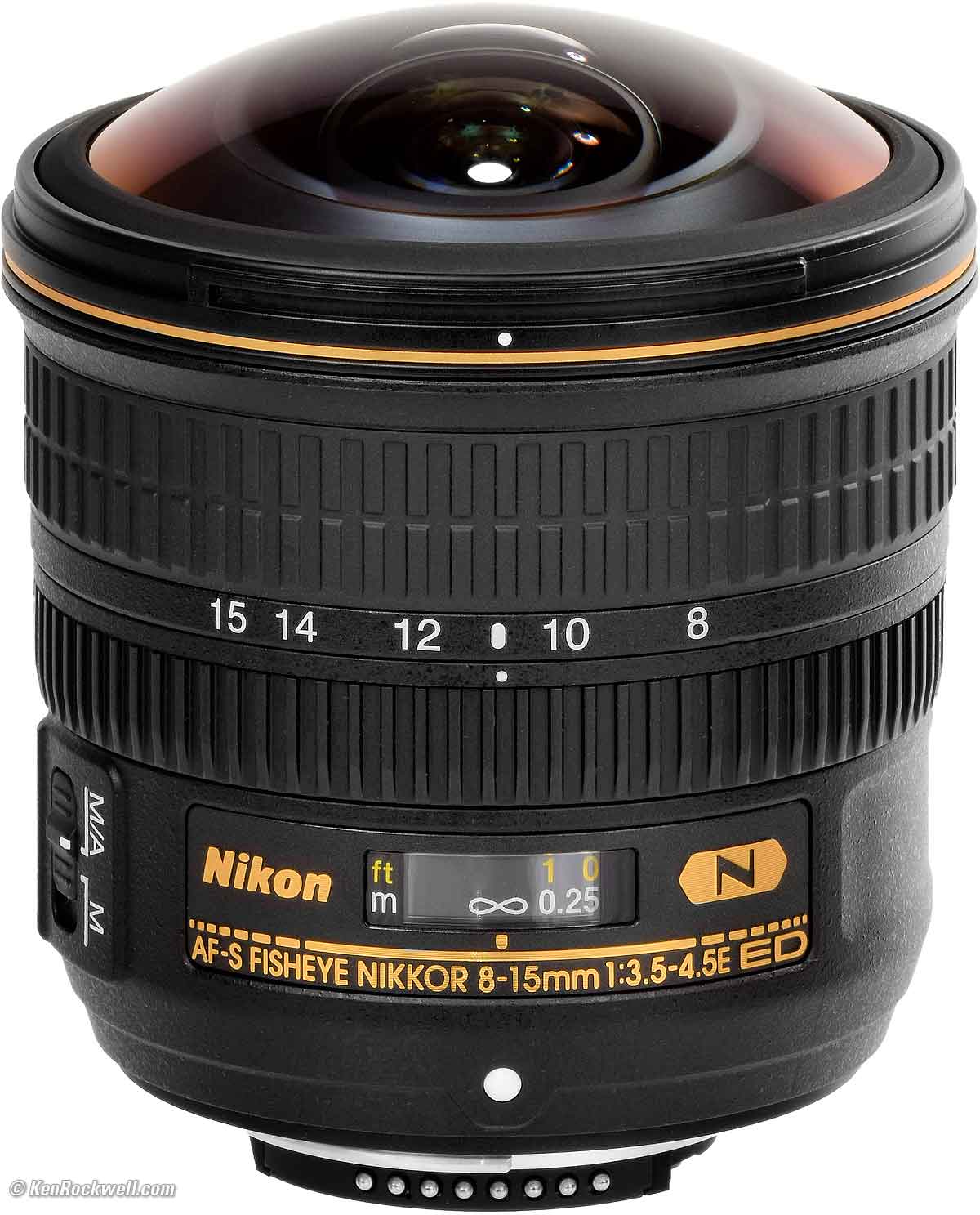 |
NEW: Nikon 8-15mm Fisheye FXFor FX cameras, and works on DX cameras. Rear gel filters, 17.0 oz. (481g), 0.5 feet (0.16 meters) close focus. 2017 ~ today. |
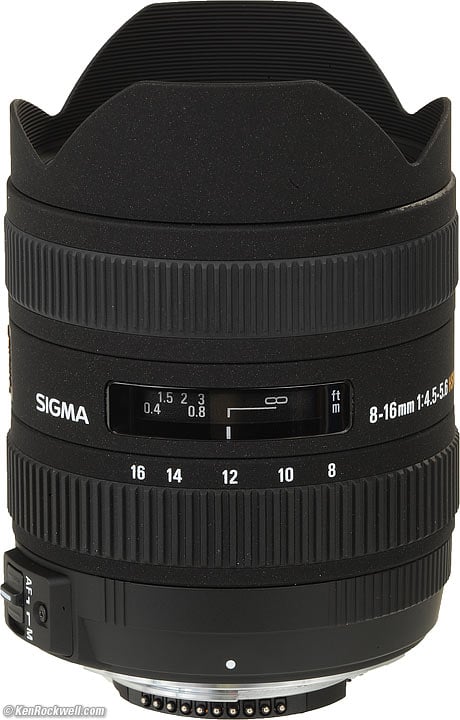 |
Sigma 8-16mm DXFor DX cameras only. No filters, 19.6 oz. (554g), 0.8 feet (0.24 meters) close focus. 2010 ~ today. |
9mm f/2.8 DX (speculation) |
10-11mm AF lens index top
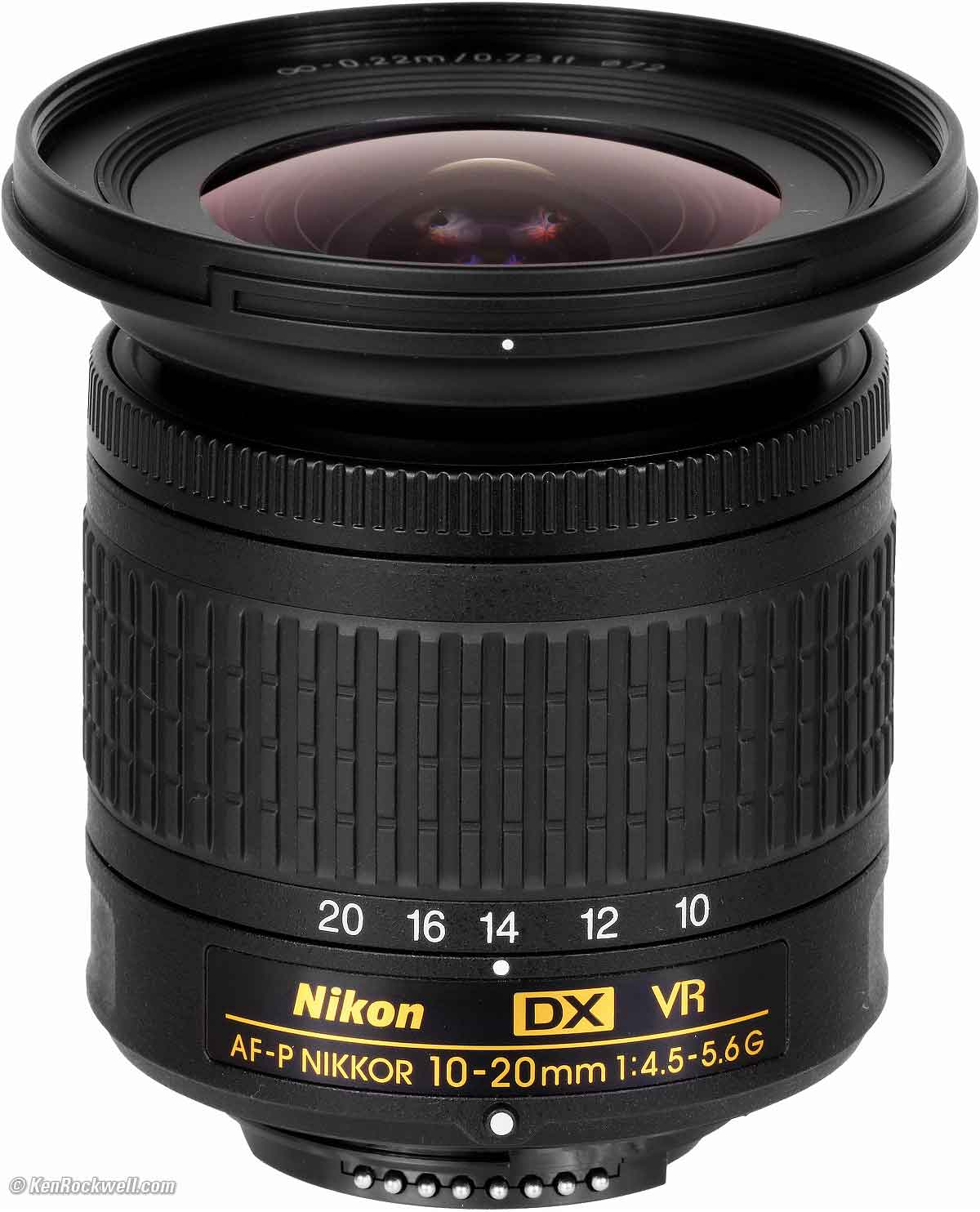 |
Nikon 10-20mm VR DXFor DX cameras, and sort of works on FX cameras as wide as 13mm! 72mm filters, 8.0 oz. (227g), 0.7 feet (0.22 meters) close focus. 2017 ~ today. |
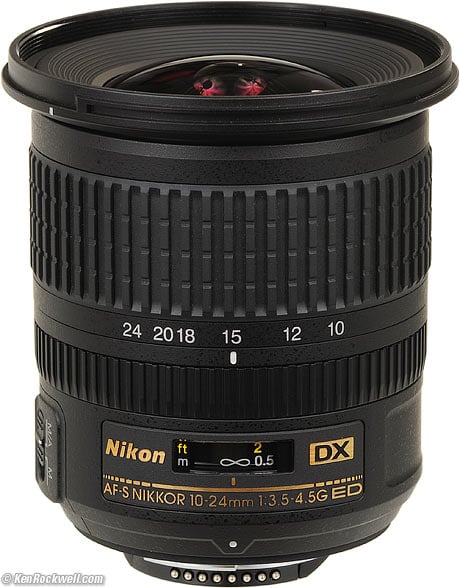 |
10-24mm DXFor DX cameras, and sort of works on FX cameras as wide as 18mm. 77mm filters, 16.3 oz (463g), 0.8 feet (0.24 meters) close-focus. 2009 ~ today. |
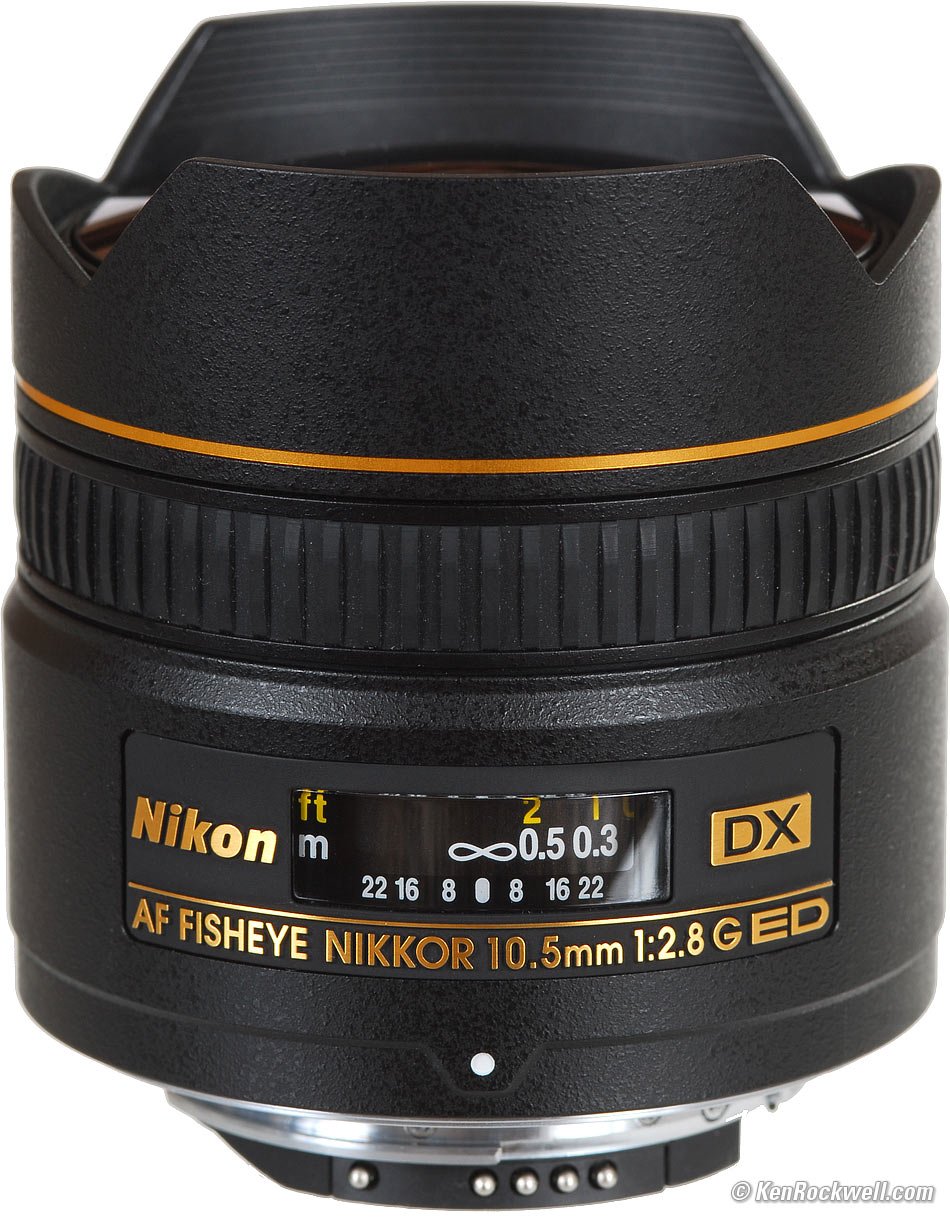 |
10.5mm Fisheye DXFor DX cameras only. Rear gel filters, 10.7 oz. (303g), 0.45 feet (0.14 meters) close-focus. 2003 ~ today |
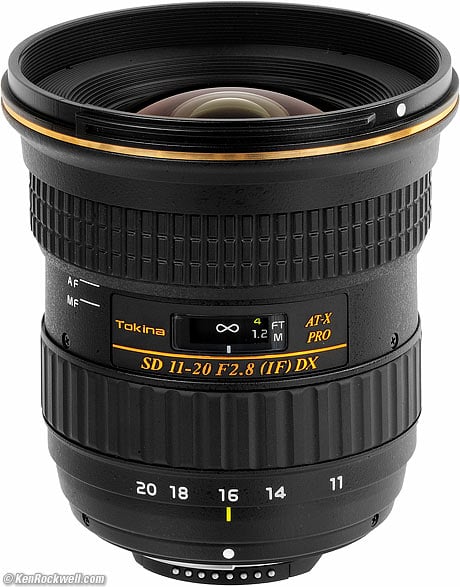 |
Tokina 11-20mm f/2.8 DXFor DX cameras, and works on FX cameras as wide as 16mm. 82mm filters, 19.4 oz. (550 g), 0.9 feet (0.28 meters) close-focus. 2015 ~ today |
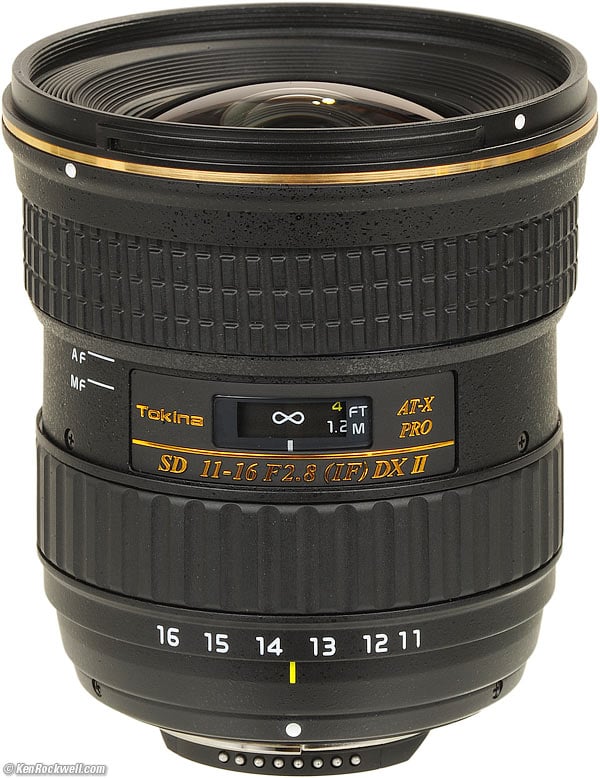 |
Tokina 11-16mm f/2.8 II DXFor DX cameras, and works on FX cameras as wide as 16mm. 77mm filters, 19.2 oz. (544 g), 1 foot (0.3 meters) close-focus. 2012 ~ today. |
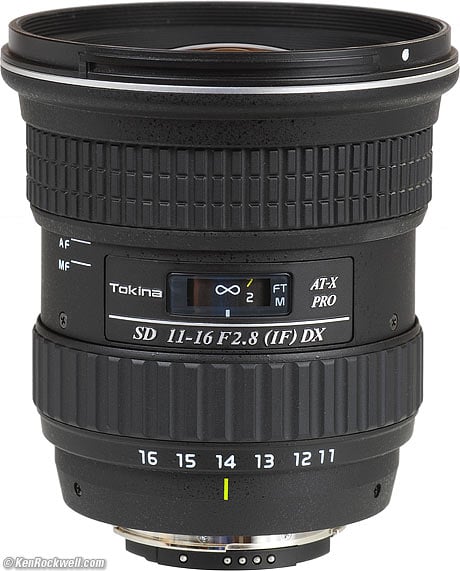 |
Tokina 11-16mm f/2.8 DXFor DX cameras, and works on FX cameras as wide as 15mm. 77mm filters, 19.3 oz. (548 g), 1 foot (0.3 meters) close-focus. 2008 ~ 2013. |
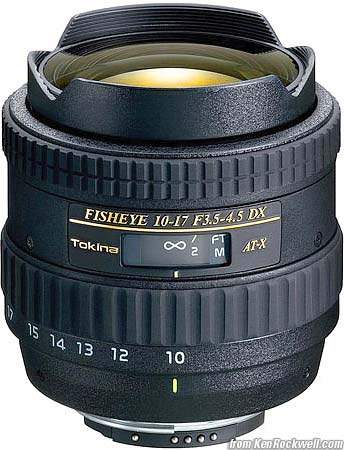 |
Tokina 10-17mm Fisheye DXFor DX cameras only. No filters, 12.3 oz. (350 g), 0.45 feet (0.14 meters) close-focus. 2006 ~ today. |
Nikon 10-18mm f/4 (speculation) |
12mm AF lens index top
Nikon Ultra-Ultrawide Lens Comparison
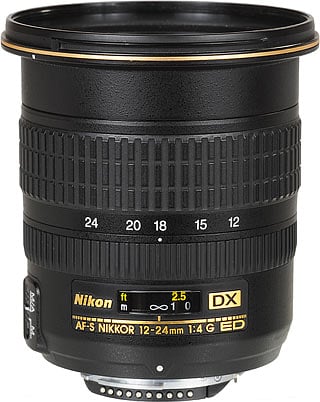 |
12-24mmFor DX cameras, and sort of works on FX cameras as wide as 16mm. 77mm filters, 16.2 oz. (461 g), 1 foot (0.3 meters) close-focus. 2003 ~ today. |
14mm AF lens index top
Nikon Ultra-Ultrawide Lens Comparison
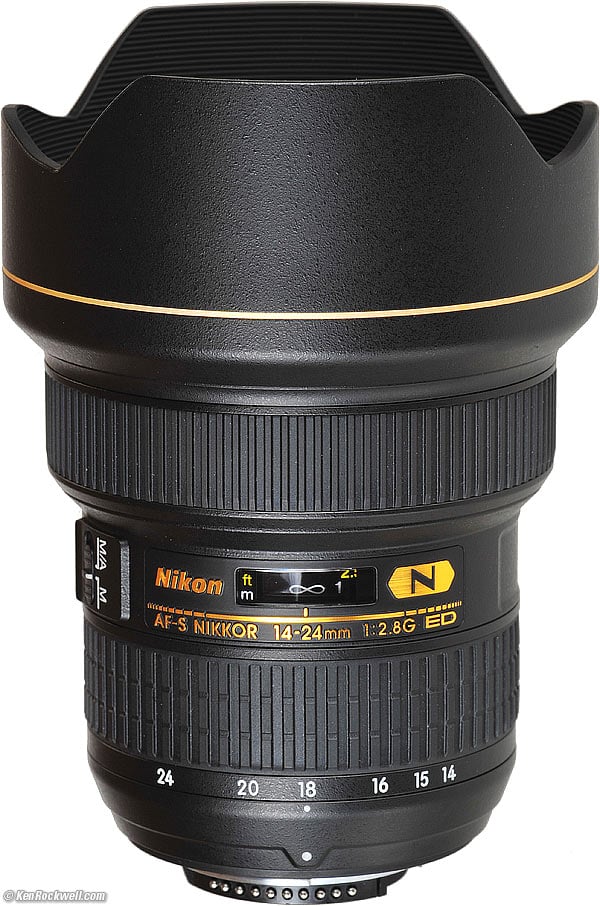 |
14-24mm f/2.8GFor FX cameras. Works on DX cameras, but any DX ultrawide like the 10-20mm works better for a lot less money on DX. No filters, 35.3 oz. (1,000 g), 0.9 feet (0.28 meters) close-focus. 2007 ~ today. |
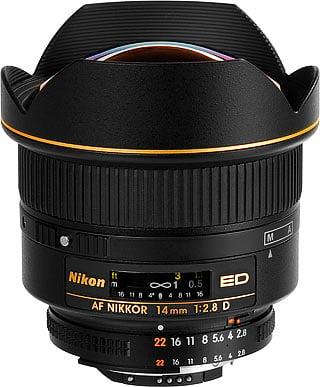 |
14mm f/2.8DFor FX cameras. Works on DX cameras but any DX ultrawide like the 10-20mm works better for a lot less money on DX. Rear gel filters, 23.5 oz. (667 g), 0.65 feet (0.2 meters) close-focus. 2000 ~ today. |
15mm AF lens index top
|
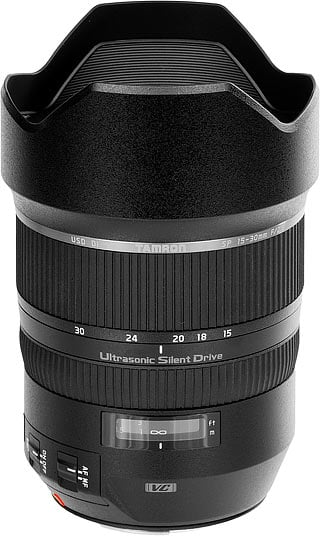
NEW: Tamron 15-30mm f/2.8 VR/IS Review.Works on Nikon or on Canon full frame, and works on APS-C, too. Takes no filters unless you buy a special adapter, 38.1 oz./1,079g, 0.9'/0.28m close focus. Check price. 13 May 2018 |
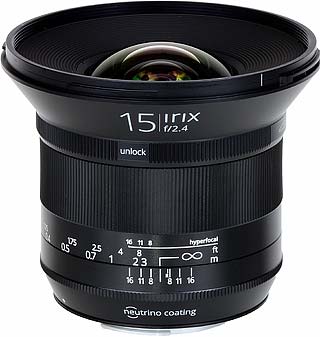 |
NEW: Irix 15mm f/2.495mm filters, 22.6 oz./642g, 0.8'/0.25m close-focus 18 May 2017 for all formats, especially 35mm and full-frame |
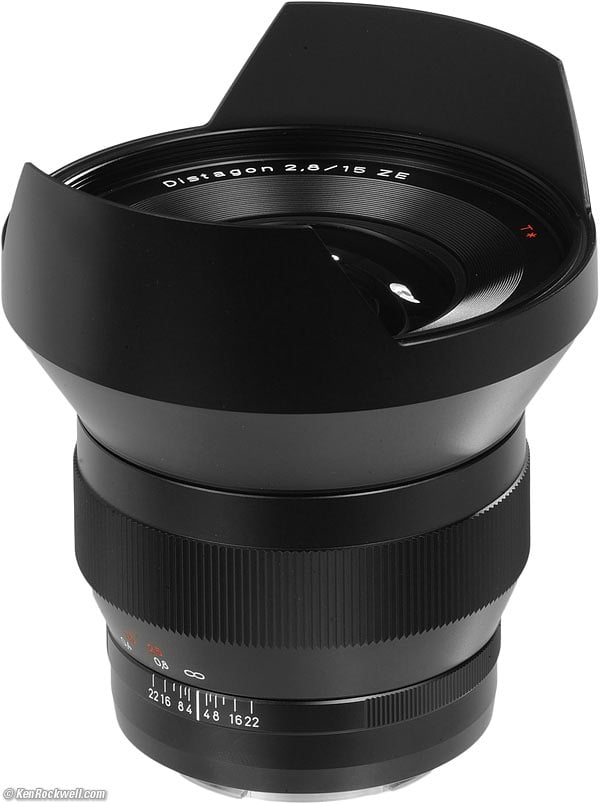 |
Zeiss 15mm f/2.816 March 2012 for all formats, especially 35mm and full-frame |
16mm AF lens index top
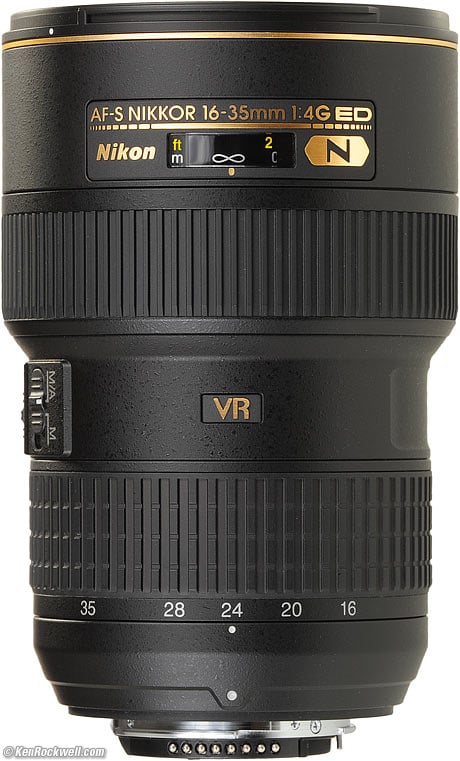 |
16-35mm f/4 VR FXFor FX cameras. Works on DX cameras, but any DX lens works better for a lot less money on DX. 77mm filters, 23.9 oz. (678 g), 1 foot (0.29 meters) close-focus. 2010 ~ today |
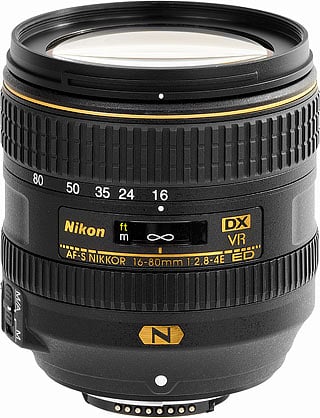 |
16-80mm f/2.8-4E VR DXFor DX cameras only. 72mm filters, 16.9 oz. (479 g), 1.15 foot (0.35 meters) close-focus. 2015 ~ today. |
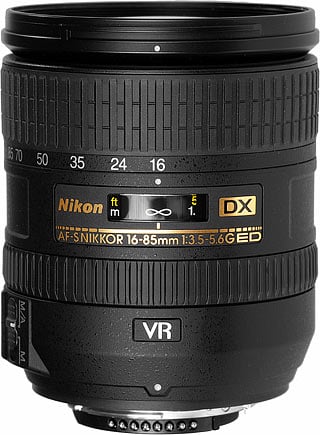 |
16-85mm VR DXFor DX cameras only. 67mm filters, 17.2 oz. (487 g), 1.3 foot (0.38 meters) close-focus. Nikon 16-85mm VR vs. 18-200mm VR Comparison 2008 ~ today. |
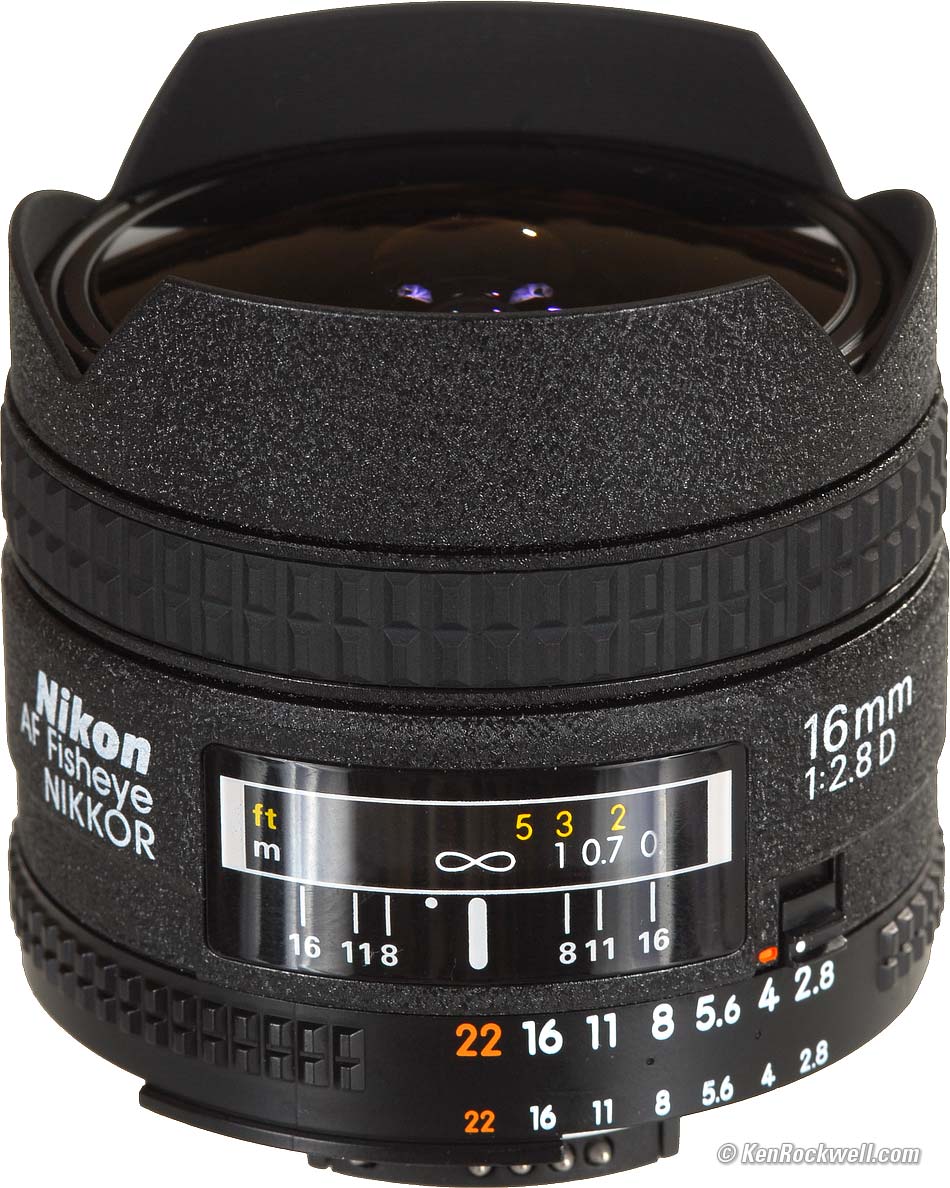 |
16mm f/2.8 Fisheye FXFor FX cameras. Works on DX cameras, but the 10.5mm DX Fisheye works much better for less money on DX. Rear bayonet filters, 10.3 oz. (293 g), 0.85 feet (0.25 meters) close-focus. 1993 ~ today. |
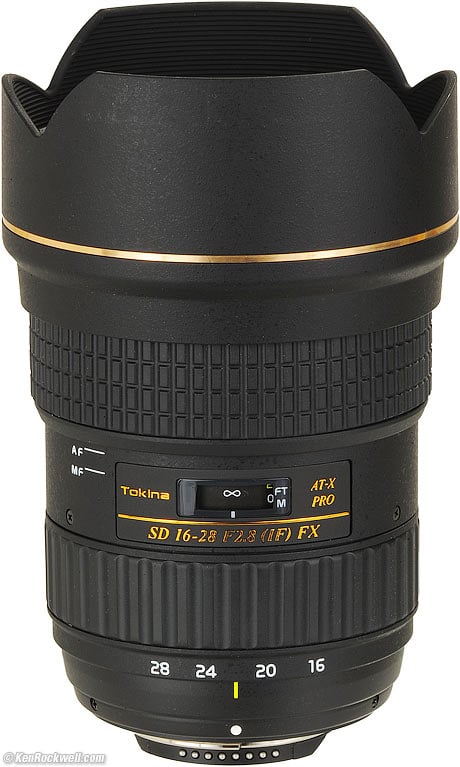 |
Tokina 16-28mm f/2.8 FXFor FX cameras. Works on DX cameras, but any DX lens works better for a lot less money on DX. No filters, 33.4 oz. (946 g), 0.9 feet (0.28 meters) close-focus. 2010 ~ tåoday. |
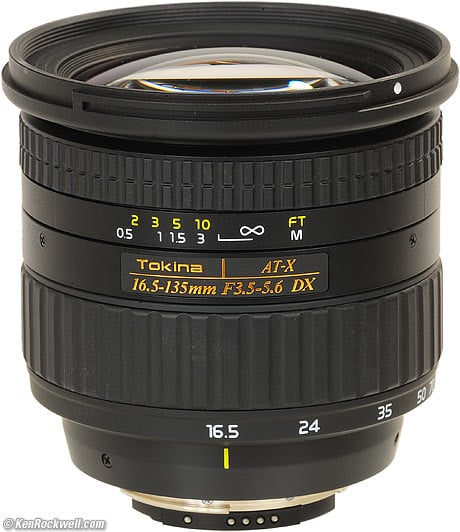 |
Tokina 16.5-135mm DXFor DX cameras only. 77mm filters, 21.9 oz./620g, 1.7 feet (0.5 meters) close-focus. Introduced 2009, now discontinued. |
17mm AF lens index top
17mm and 18mm Lenses and Zooms Compared
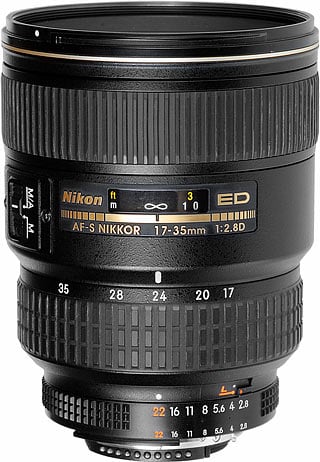 |
17-35mm f/2.8 FXFor FX cameras. Works on DX cameras, but any DX lens like the 17-55mm f/2.8 DX works much better for less money on DX. 77mm filters, 25.8 oz. (730 g), 1 foot (0.28 meters) close-focus. 1999 ~ today. |
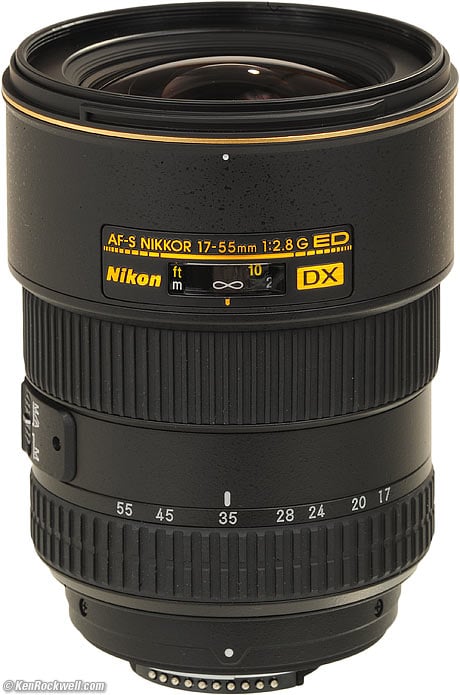 |
17-55mm f/2.8 DXFor DX cameras only. 77mm filters, 26.5 oz. (751g), 1.25 feet (0.36 meters) close-focus. 2003 ~ today. |
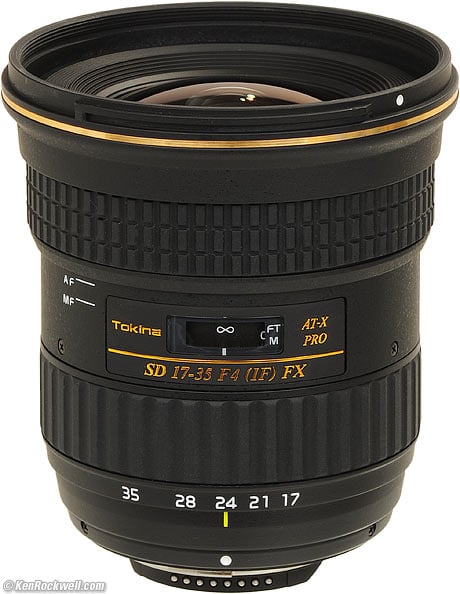 |
Tokina 17-35mm f/4 FXFor FX cameras. Works on DX cameras, but any DX lens works much better for less money on DX. 82mm filters, 20.9 oz. (592g), 0.9 feet (0.28 meters) close-focus. 2011 ~ today. |
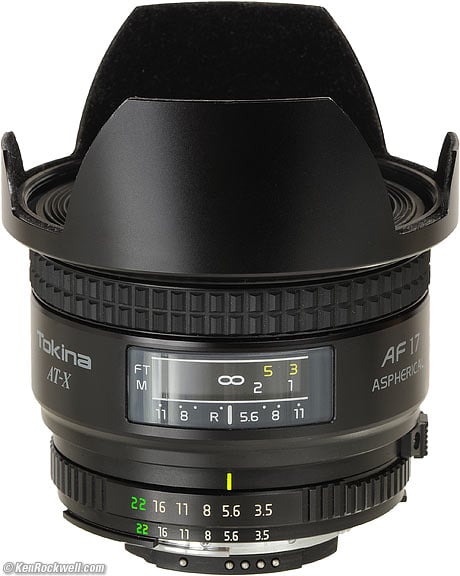 |
Tokina 17mm f/3.5 FXFor FX cameras. Works on DX cameras, but any DX lens works much better for less money on DX. 1993~1999 AT-X: 72mm filters, 14.3 oz. (406 g), 0.82 feet (0.25 meters) close focus. 1999~2005 AT-X PRO: 77mm filters, 15.5 oz. (440 g), 0.82 feet (0.25 meters) close focus. |
18mm AF lens index top
Nikon 18-200 vs. 28-300 vs. 18-300 Comparison 11 July 2012
17mm and 18mm Lenses and Zooms Compared
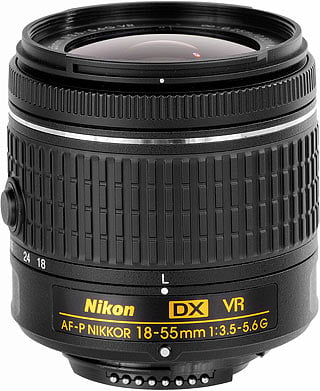 |
18-55mm AF-PFor DX cameras only. 55mm filters, 7.1 oz. (200 g), 0.82 feet (0.25 m) close-focus. 2016 ~ today. |
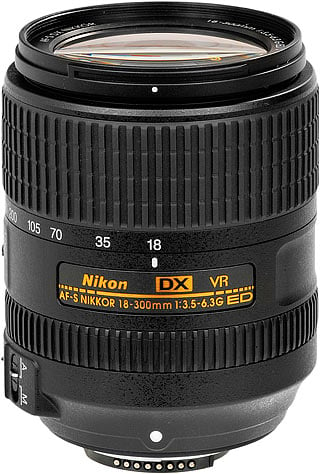 |
18-300mm VR DXFor DX cameras only. 67mm filters, 19.4 oz (550 g), 1.6 feet (0.48 m) close-focus. 2014 ~ today. |
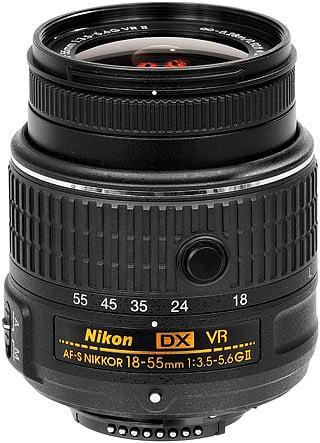 |
For DX cameras only. 52mm filters, 6.9 oz/195g, 0.9 feet (0.27 m) close-focus. 2014 ~ 2017 (replaced by 18-55mm AF-P). |
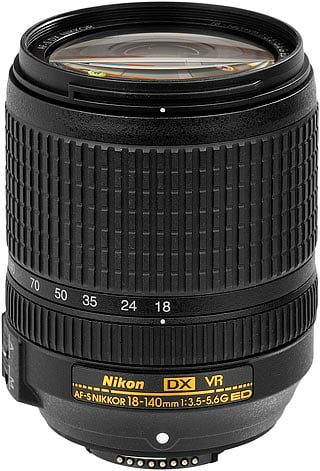 |
18-140mm VR DXFor DX cameras only. 67mm filters, 17.3 oz. (490 g), 1.5 feet (0.45 m) close focus. 2013 ~ today. |
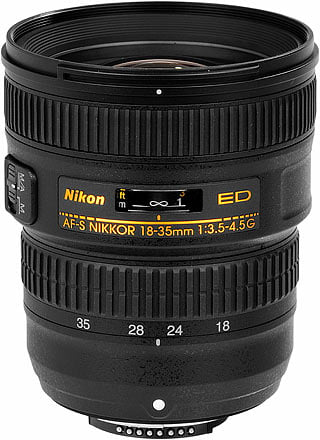 |
18-35mm G FXFor FX cameras. Works on DX cameras, but any DX lens works much better for less money on DX. 77mm filters, 13.6 oz. (385g), 0.9 feet (0.28 m) close-focus. 2013 ~ today. |
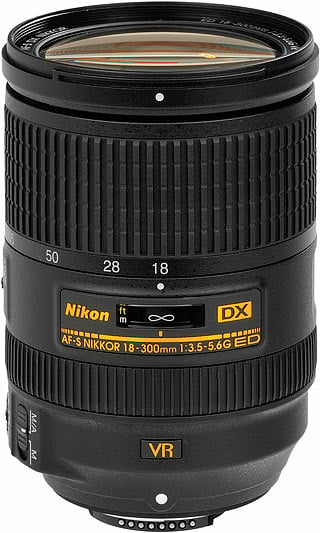 |
18-300mm VR DXFor DX cameras only. 77mm filters, 29.2 oz./828g, 1.5 feet (0.45 m) close focus. 2012 ~ today. |
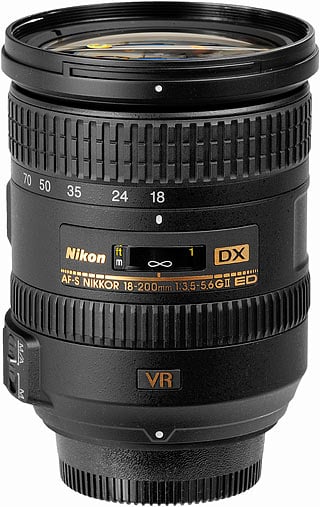 |
18-200mm VR II DXFor DX cameras only. 72mm filters, 19.9 oz. (565 g), 1.6 feet (0.5 m) close-focus. Nikon 18-200mm VR vs. 55-200mm VR 2009 ~ today. |
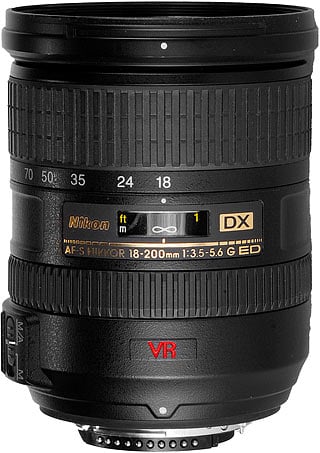 |
18-200mm VR DXFor DX cameras only. 72mm filters, 19.8 oz. (560g), 1.6 feet (0.5 m) close-focus. 2005 ~ 2009 (replaced by 18-200mm VR II DX) |
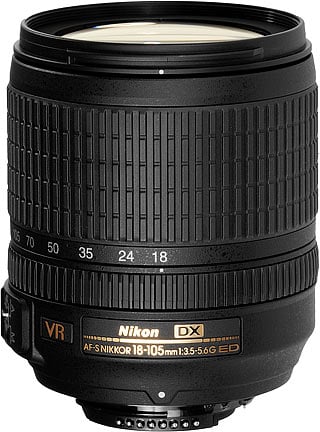 |
18-105mm VR DXFor DX cameras only. 67mm filters, 14.8 oz. (420g), 1.5' (0.45 m) close-focus 2008 ~ today. |
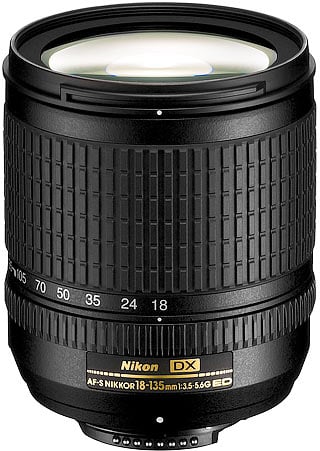 |
18-135mm DXFor DX cameras only. 67mm filters, 13.5 oz. (383.1g), 1.5 feet (0.45 m) close-focus. No VR. 2006 ~ 2008. |
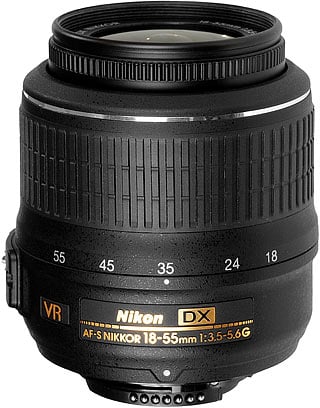 |
18-55mm VR DXFor DX cameras only. 52mm filters, 9.3 oz. (263 g), 0.9 feet (0.28m) close-focus. 2007 ~ 2014 (replaced by Nikon 18-55mm VR II DX). |
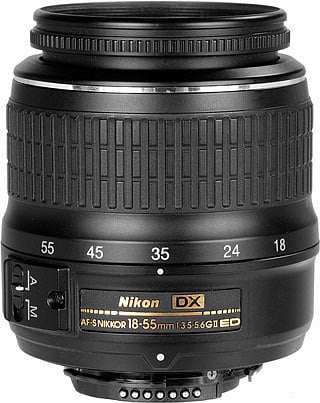 |
18-55mm II DXFor DX cameras only. 52mm filters, 7.2 oz. (203g), 0.9 foot (0.28 m) close-focus. 2006 ~ 2007 (replaced by 18-55mm VR DX). |
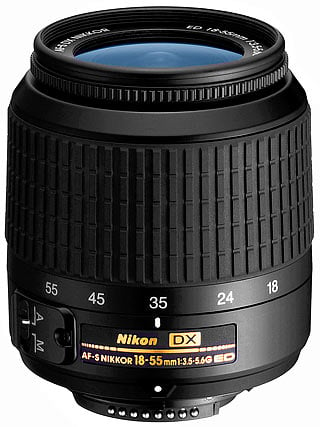 |
18-55mm DXFor DX cameras only. 52mm filters, 7.4 oz. (210 g), 09. foot (0.28 m) close-focus. 2005 ~ 2006 (replaced by 18-55mm II DX). |
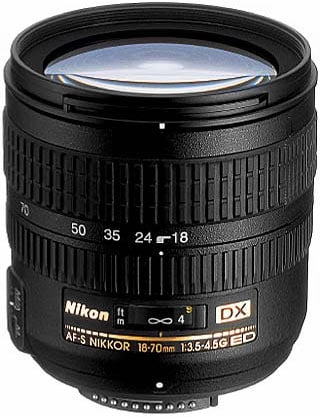 |
18-70mm DXFor DX cameras only. 67mm filters, 10 oz. (390 g), 1.25 feet (0.38m) close-focus. 2004 ~ 2011. |
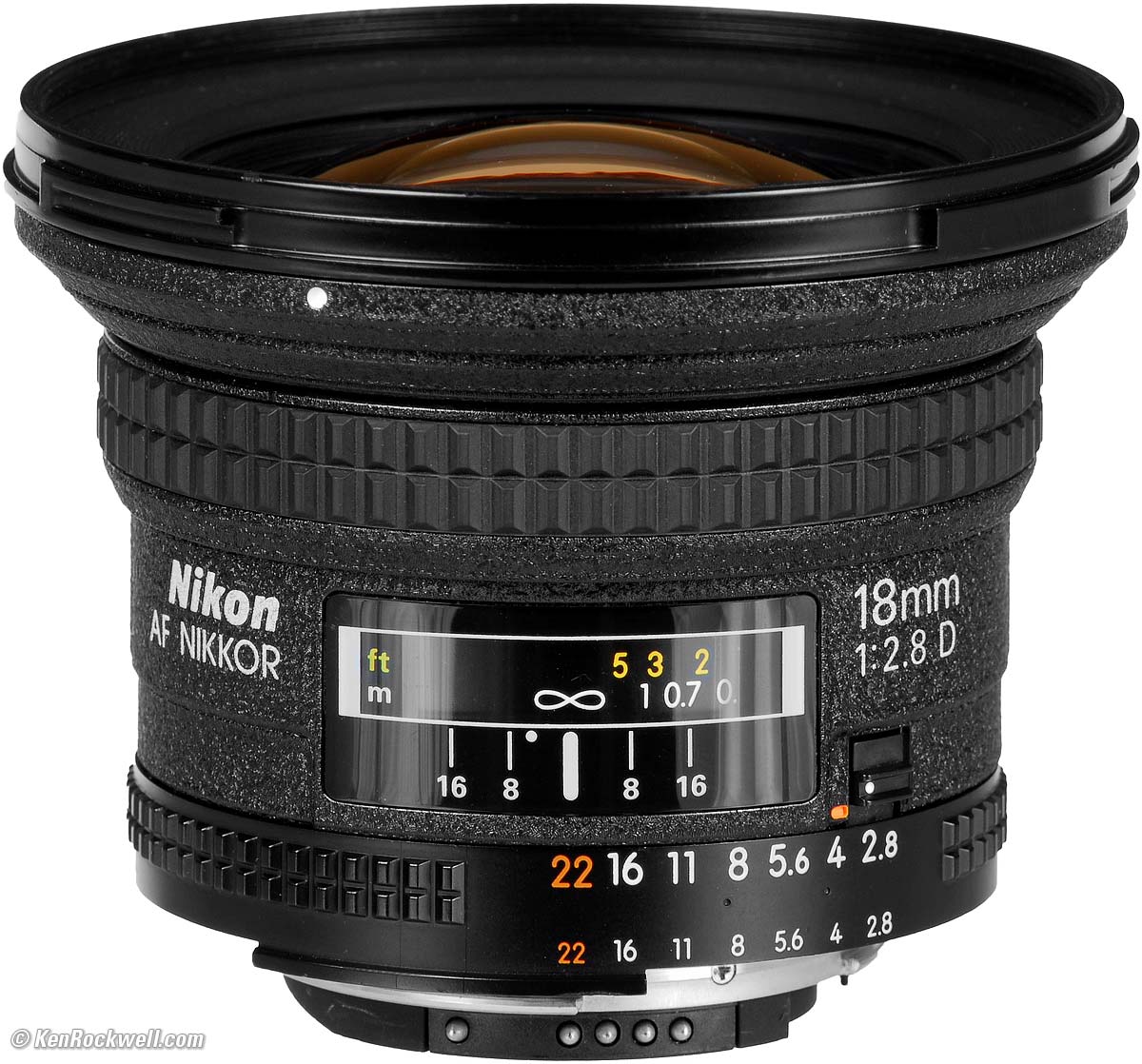 |
18mm f/2.8D FXFor FX cameras. Works on DX cameras, but any DX lens works much better for less money on DX. 77mm metal filter ring, 13.3 oz. (376 g), 0.85 feet (0.25 m) close-focus. 1994 ~ 2006. |
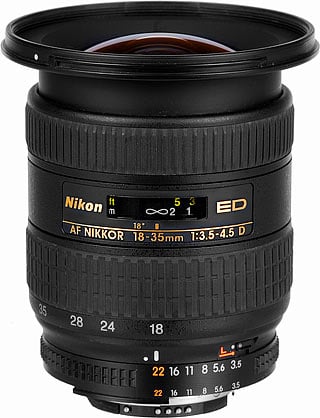 |
18-35mm FXFor FX cameras. Works on DX cameras, but any DX lens works much better for less money on DX. 77mm filters, 13.1 oz/370g, 1.1 feet (0.33 m) close-focus, about $440 new or $250 used. 2000 ~ 2013 (replaced by Nikon 18-35mm G FX). |
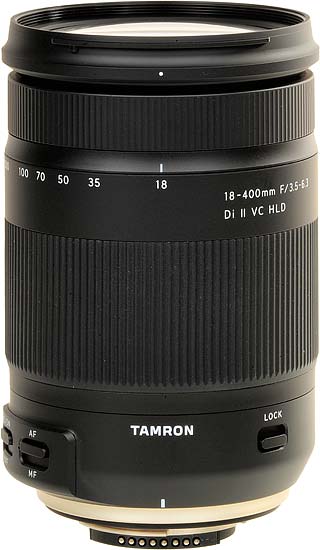 |
Tamron 18-400mmFor APS-C only. 72mm filters, 25 oz./707g, 1.5'/0.45m close focus. Comes for Nikon and for Canon. 05 July 2018 |
19mm AF lens index top
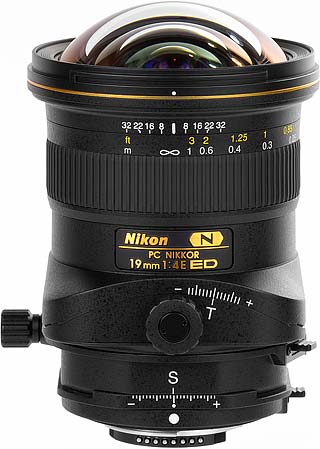 |
19mm f/4 PC-E FXNo filters, manual focus, 31.2 oz. (884 g), 0.8 feet (0.25 m) close-focus, about $3,400. 2016 ~ today. |
20mm AF lens index top
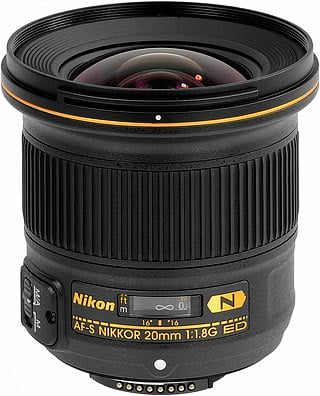 |
20mm f/1.8 G FXFor FX cameras. Works on DX cameras, but any DX lens works much better for less money on DX. 77mm filters, 12.5 oz./354g, 0.66 feet (0.2 m) close-focus, about $800. 2014 ~ today. |
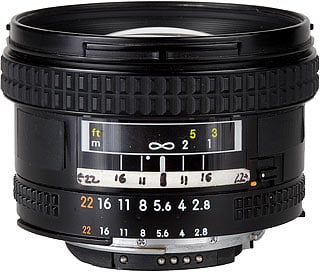 |
20mm f/2.8 FXFor FX cameras. Works on DX cameras, but any DX lens works much better for less money on DX. 62mm filters, 9.1 oz/255g, 0.8 feet (0.25 m) close-focus, about $625 new or about $250 used. 1989 ~ today. |
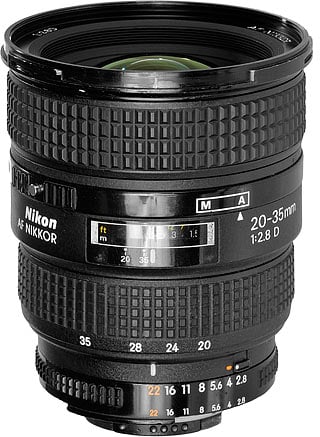 |
20-35mm f/2.8 FXFor FX cameras. Works on DX cameras, but any DX lens works much better for less money on DX. 77mm filters, 20.7 oz. (588g), 1.7 feet (0.5 m) close-focus, about $450 used. 1986 ~ 1999. |
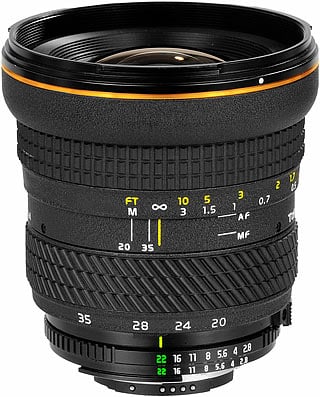 |
Tokina 20-35mm f/2.8 FXFor FX cameras. Works on DX cameras, but any DX lens works much better for less money on DX. 77mm filters, 21.2 oz./601g, 1.7 feet (0.5 m) close-focus, about $175 used. 1990s. |
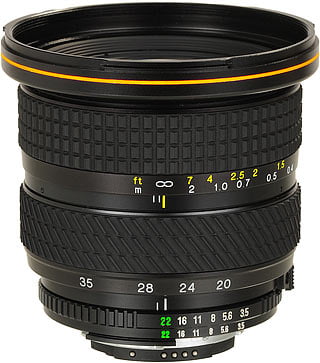 |
Tokina 20-35mm f/3.5-4.5 FXFor FX cameras. Works on DX cameras, but any DX lens works much better for less money on DX. 72mm filters, 17.8 oz. (504 g), 1.7 feet (0.4 m) close focus, about $100 used. 1990s. |
20mm Sharpness Comparison 23 September 2010
Light Falloff Comparison of Every Nikon 20mm Lens 18 February 2008
24-25mm AF lens index top
 |
 |
 |
 |
Best 24-70mm Lenses Compared22 April 2018 |
All 24-70mm Lenses Compared 26 January 2016
All Known Nikon 24mm Lenses and Zooms Compared 14 August 2010
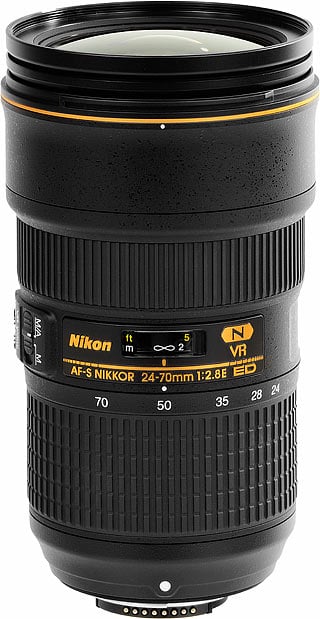 |
24-70mm f/2.8E VR FXFor FX cameras. Works on DX cameras, but any DX lens works much better for less money on DX. 82mm filters, 37.7 oz. (1,070 g), 1.3 feet (0.4 m) close-focus. Check price. 2015 ~ today. |
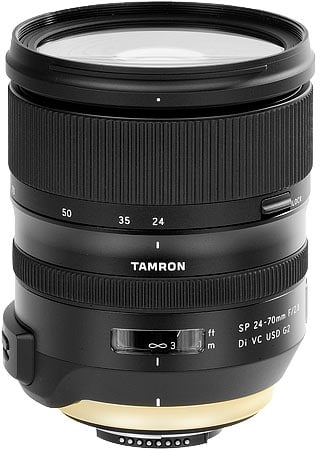 |
NEW: Tamron 24-70mm f/2.8 VRFull frame, works on APS-C, too. 82mm filters, 31.7 oz./898g, 1.25'/0.38m close focus. Check price. 20 April 2018 |
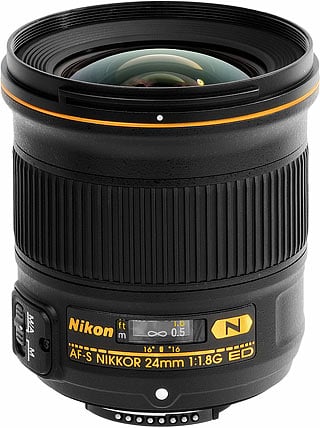 |
24mm f/1.8G FXFor FX cameras. Works on DX cameras, but any DX lens works much better for less money on DX. 72mm filters, 12.5 oz. (355 g), 0.75 feet (0.24 m) close-focus. Check price. 2015 ~ today.
|
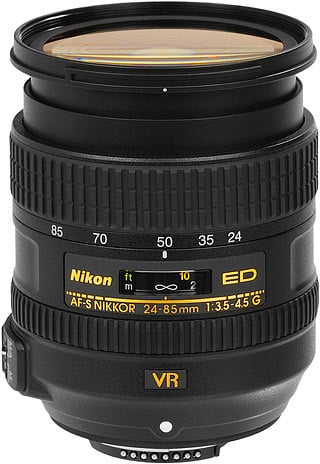 |
24-85mm VR FXFor FX cameras. Works on DX cameras, but any DX lens works much better for less money on DX. 72mm filters, 16.2 oz. (460 g), 1.25 feet (0.38 m) close-focus. Check price new or price used. 2012 ~ today. |
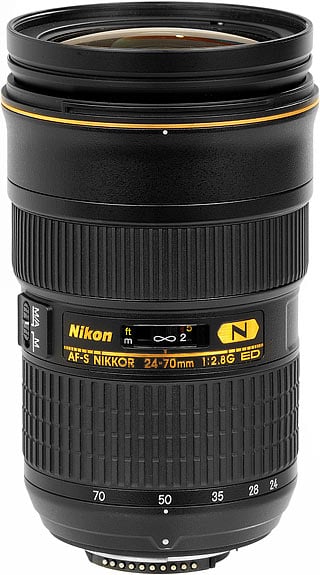 |
24-70mm f/2.8G FXFor FX cameras. Works on DX cameras, but any DX lens works much better for less money on DX. 77mm filters, 31.8 oz. (902 g), 1.2 feet (0.38 m) close-focus. Check price new or get it used. 2007 ~ today. |
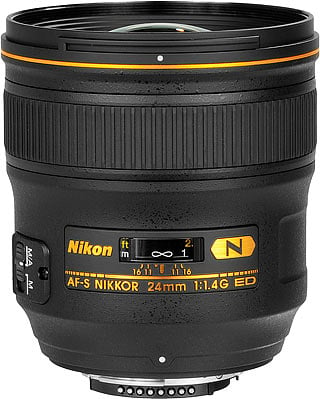 |
24mm f/1.4G FXFor FX cameras. Works on DX cameras, but a DX lens works better for less money on DX. 77mm filters, 21.8 oz. (618 g), 0.82 feet (0.25 m) close-focus. Check price. 2010 ~ today. |
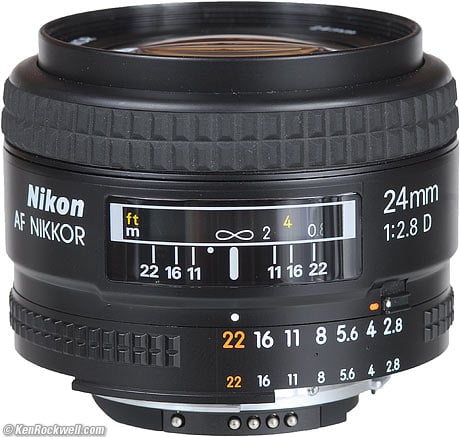 |
24mm f/2.8D FXFor FX cameras. Works on DX cameras, but a DX lens works better for less money on DX. 52mm filters, 9.4 oz. (268 g), 1 foot (0.3 m) close-focus. Check price or find it used. 1986 ~ today. |
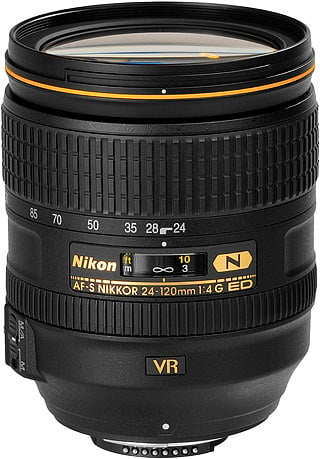 |
24-120mm f/4 VR FXFor FX cameras. Works on DX cameras, but a DX lens works better for less money on DX. 77mm filters, 25.0 oz. (708 g), 1.3 feet (0.40 m) close-focus. Check price or get it used. 2010 ~ today. |
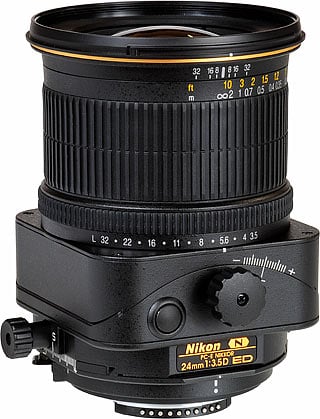 |
24mm f/3.5 PC-E FXFor FX and DX cameras. Tilt-Shift, manual focus, 77mm filters, 25.9 oz. (734 g), 0.7 feet (0.21 m) close-focus. Check price. 2008 ~ today. |
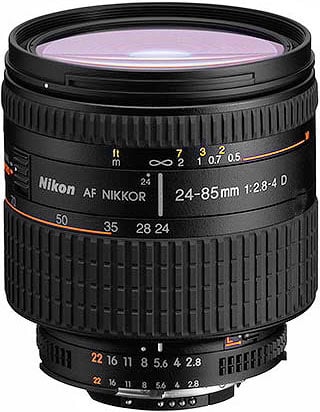 |
24-85mm f/2.8-4D FXFor FX cameras. Works on DX cameras, but a DX lens works better for less money on DX. 72mm filters, 19 oz. (545 g), 0.5 feet (0.21 m) close-focus. Check price. 2000 ~ today. |
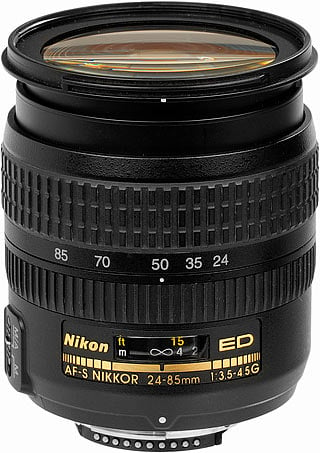 |
24-85mm G FXFor FX cameras. Works on DX cameras, but a DX lens works better for less money on DX. 67mm filters, 14.5 oz. (412 g), 1.2' feet (0.38 m) close focus. Get it used. 2002 ~ 2006 (replaced by Nikon 24-85mm VR FX). |
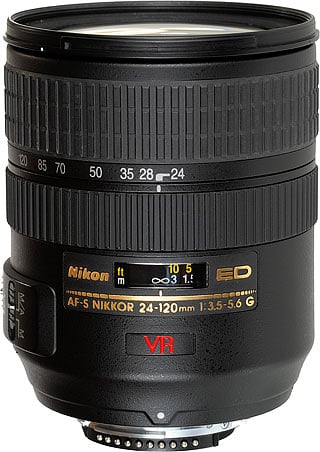 |
24-120mm VR FXFor FX cameras. Works on DX cameras, but a DX lens works better for less money on DX. 72mm filters, 20.0 oz. (568 g), 1.6 feet (0.5 m) close-focus. 2003 ~ 2010. |
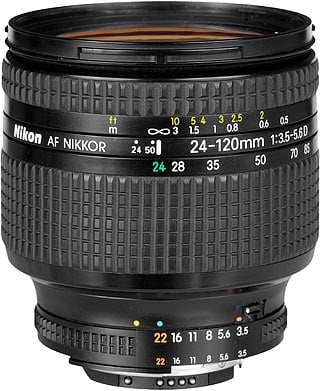 |
24-120mm AF-D FXFor FX cameras. Works on DX cameras, but a DX lens works better for less money on DX. 72mm filters, 20.0 oz. (560 g), 1.5 feet (0.5 m) close-focus. Get it used. 1996 ~ 2002. |
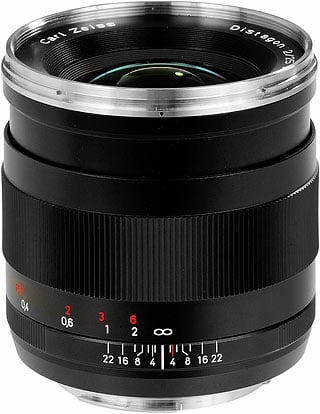 |
Zeiss 25mm f/2For FX cameras. Works on DX cameras, but a DX lens works better for less money on DX. 67mm filters, 21.3 oz. (605 g), 0.83 feet (0.25 m). Check price. 2011 ~ today. |
28mm AF lens index top
Nikon 18-200 vs. 28-300 vs. 18-300 Comparison 11 July 2012
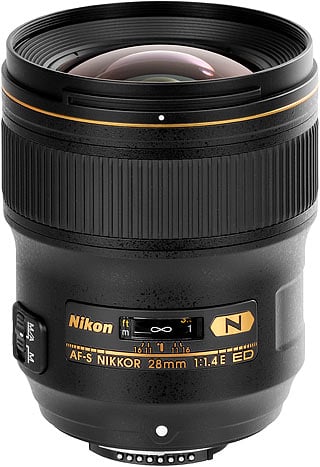 |
28mm f/1.4E FXFor FX cameras. Works on DX cameras, but a DX lens works better for less money on DX. 77mm filters, 22.8 oz, (645 g), 0.92 feet (0.28 m) close-focus. Check price. 2017 ~ today. |
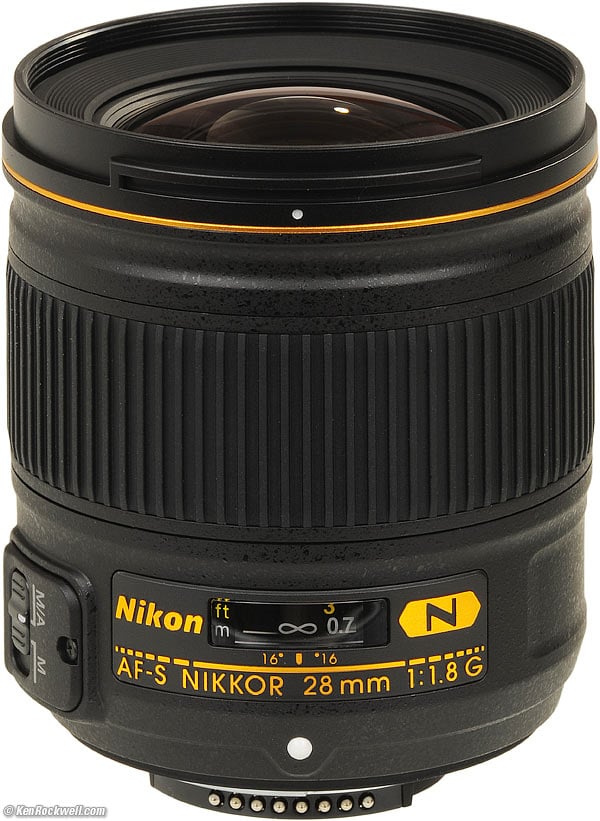 |
28mm f/1.8G FXFor FX cameras. Works on DX cameras, but a DX lens works better for less money on DX. 67mm filters, 11.5 oz (325 g), 0.8 feet (0.25 m) close -focus. Check price. 2012 ~ today. |
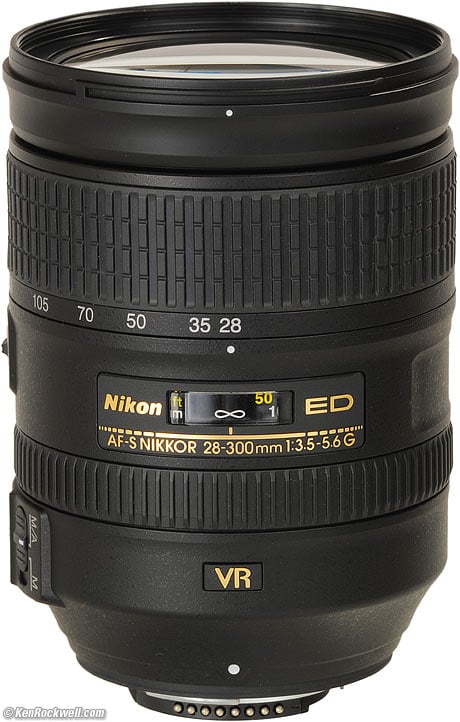 |
28-300mm VR FXFor FX cameras. Works on DX cameras, but the 18-300mm DX does more for less on DX. 77mm filters, 28.1 oz./796g, 1.6 feet (0.5 m) close focus, Check price. 2010 ~ today. |
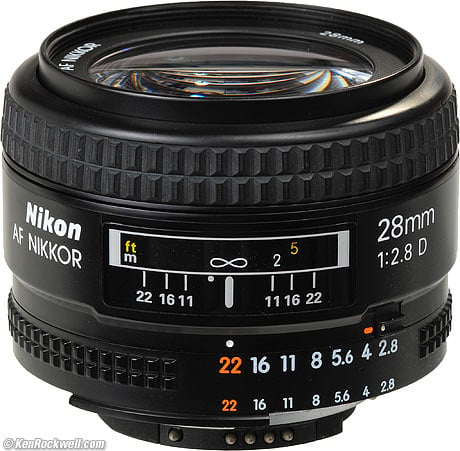 |
28mm f/2.8D FXFor FX cameras. Works on DX cameras, but a 35mm f/1.8 DX works better for less money on DX. 52mm filters, 7.3oz (206 g), 0.8 feet (0.25 m) close-focus. Check price. 1994 ~ today. |
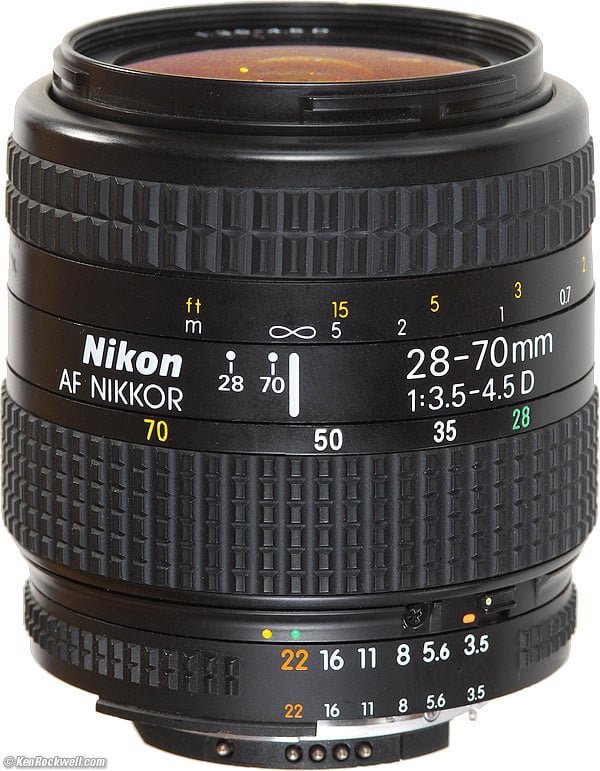 |
28-70mm f/3.5-4.5D FXFor FX cameras. Works on DX cameras, but a DX lens works better for less money on DX. 52mm filters, 9-blade diaphragm, 12.4 oz. (353 g), 1.3 feet (0.4 m) close-focus. Get it used. 1991 ~ 1999 (replaced by the 28-105mm AF-D FX). |
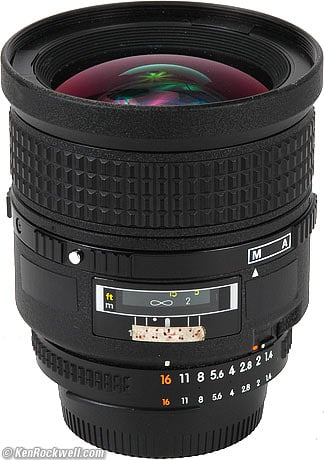 |
28mm f/1.4D FXFor FX cameras. Works on DX cameras, but a 35mm f/1.8 DX or 28mm f/1.8G FX do the same thing for a lot less money on DX. 72mm filters, 18 oz. (520 g), 1.15 feet (0.35 m) close-focus. Get it used. 1994 ~ 2006. |
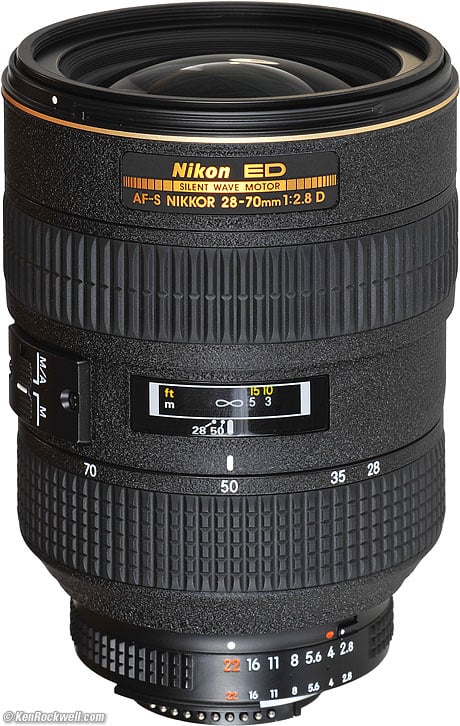 |
28-70mm f/2.8 FXFor FX cameras. Works on DX cameras, but a DX lens works better for less money on DX. 77mm filters, 32 oz. (900 g), 1.5 feet (0.5 meters) close-focus. Get it used. 1999-2007 (relaced by the 24-70mm f/2.8G FX). |
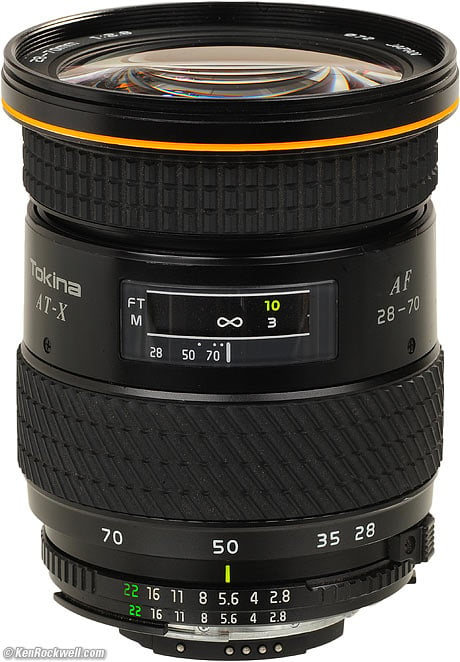 |
Tokina 28-70mm f/2.8 FXFor FX cameras. Works on DX cameras, but a DX lens works better for less money on DX. 72mm filters, 21.4 oz. (608 g), 2.3 feet (0.7 m) close-focus. Get it used. c. 1990. |
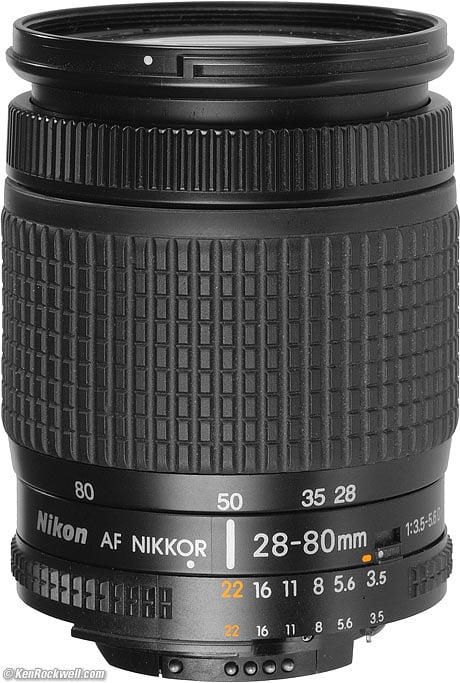 |
28-80mm f/3.5-5.6D FXFor FX cameras. Works on DX cameras, but a DX lens works better for less money on DX. 58mm filters, 9.3 oz. (264 g), 1.3 feet (0.4 m) close-focus. Get it used. 1999 ~ 2001. |
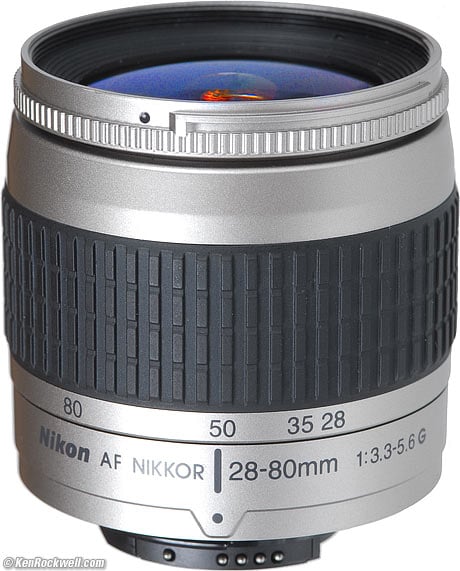 |
28-80mm f/3.3-5.6G FXFor FX cameras. Works on DX cameras, but a DX lens works better for less money on DX. 58mm filters, 6.9 oz. (194 g), 1.15 feet (0.35 m) close-focus. Get it used. 2001 ~ 2006. |
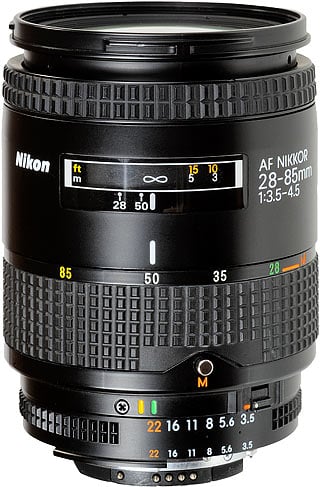 |
28-85mm FXFor FX cameras. Works on DX cameras, but a DX lens works better for less money on DX. 62mm filters, 19.0 oz. (540 g), 2.6 feet (0.8 m) close-focus; macro mode at 28mm only: 0.75 feet (0.23 m). Get it used. 1986 ~ 1999 (replaced by 28-105mm AF-D FX). |
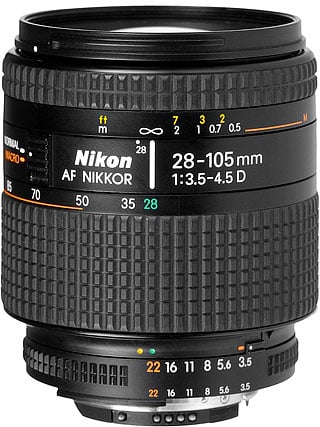 |
28-105mm AF-D FXFor FX cameras. Works on DX cameras, but a DX lens works better for less money on DX. 62mm filters, 15.9 oz. (450 g), 1.7 feet (0.5m) close-focus; macro mode 0.7 feet (0.22 m) from 50~105mm. Get it used. 1998~2006. |
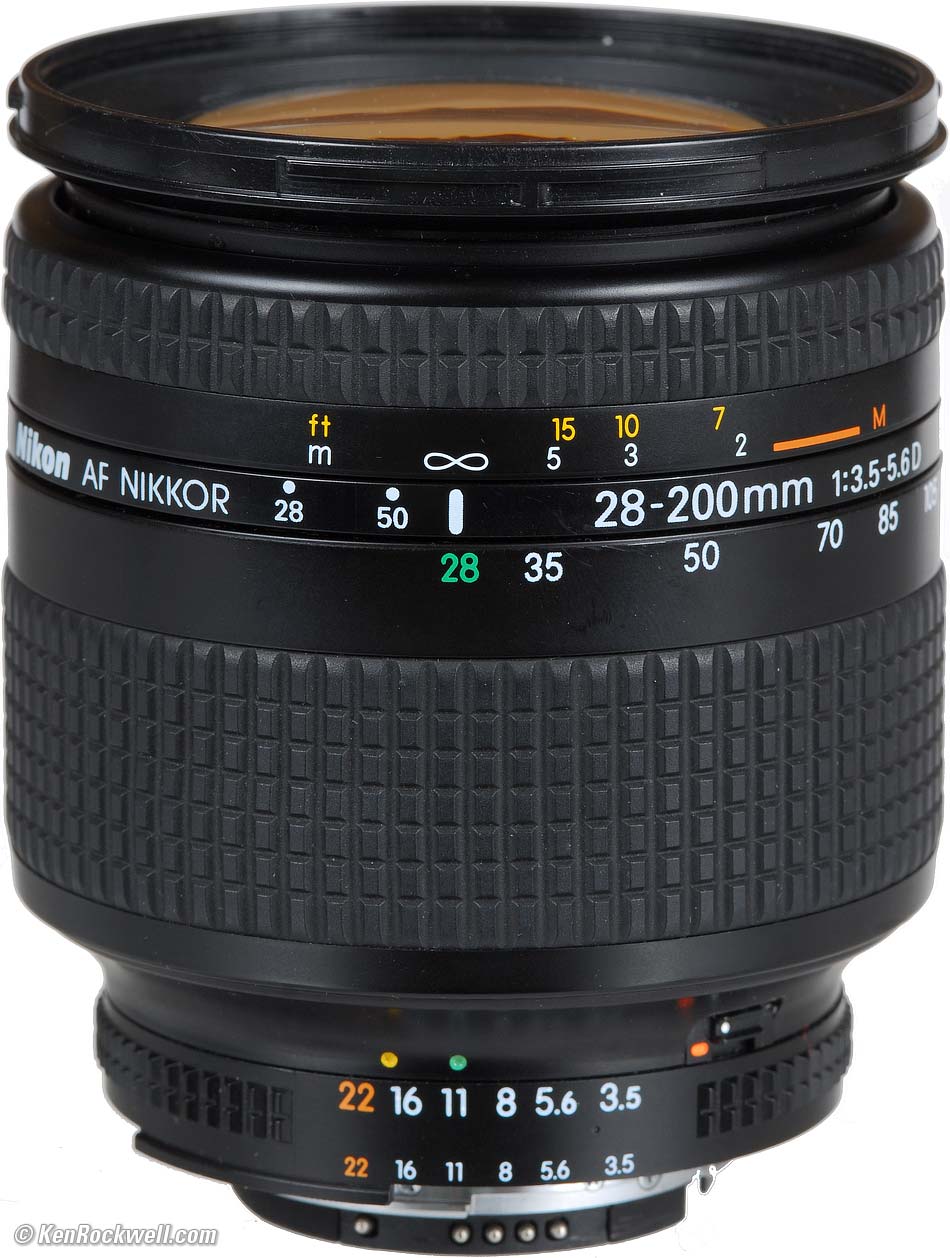 |
28-200mm AF-D FXFor FX cameras. Works on DX cameras, but a DX lens works better for less money on DX. 72mm filters, 18.3 oz. (520 g), 6 feet (2 m) close-focus. Get it used. 1998 ~ 2003, replaced by 28-200mm G FX. |
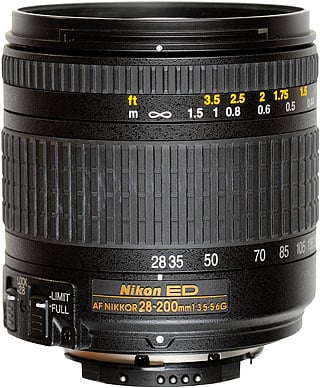 |
28-200mm G FXFor FX cameras. Works on DX cameras, but a DX lens works better for less money on DX. 62mm filters, 12.8 oz. (362 g), 1.4 feet (0.44 m) close-focus. Get it used. 2003 ~ 2006. |
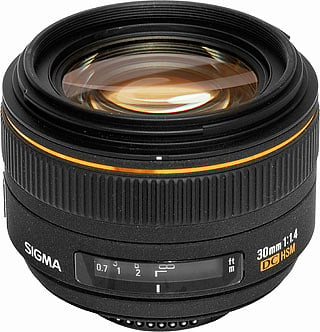 |
Sigma 30mm f/1.4 DXFor DX cameras only. 62mm filters, 14.3 oz. (407 g), 1.25 feet (0.40 m) close-focus. Check price new or get it used. 2007 ~ |
35-40mm AF lens index top
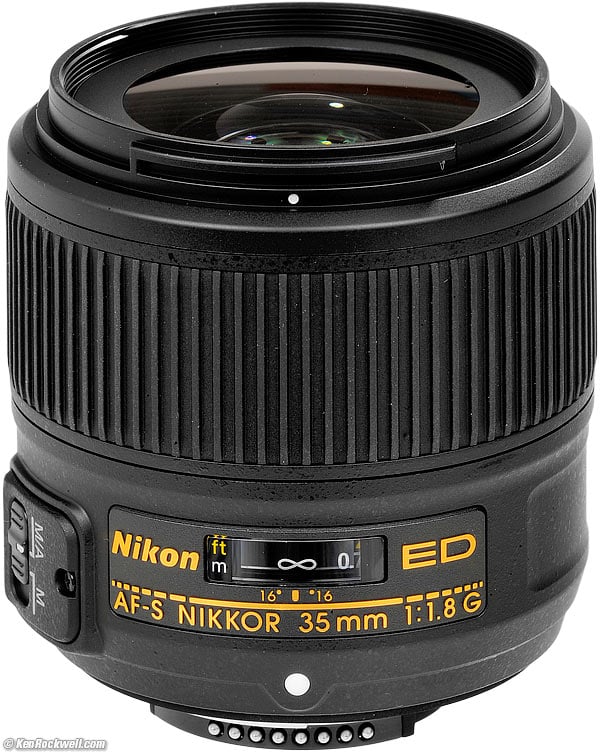 |
35mm f/1.8 G FXFor FX cameras. Works on DX cameras, but the 35mm f/1.8 DX does the same thing for less money on DX. 58mm filters, 10.8 oz. (305 g), 0.85 feet (0.25 m) close focus. 2014 ~ today. |
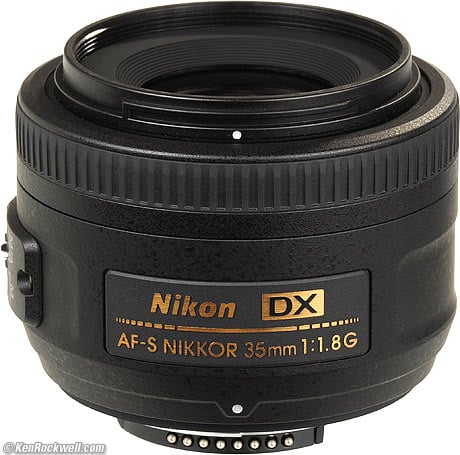 |
35mm f/1.8 DXFor DX cameras only. 52mm filters, 6.95 oz/197.0g, 1 foot/0.3m close-focus. (2009-) |
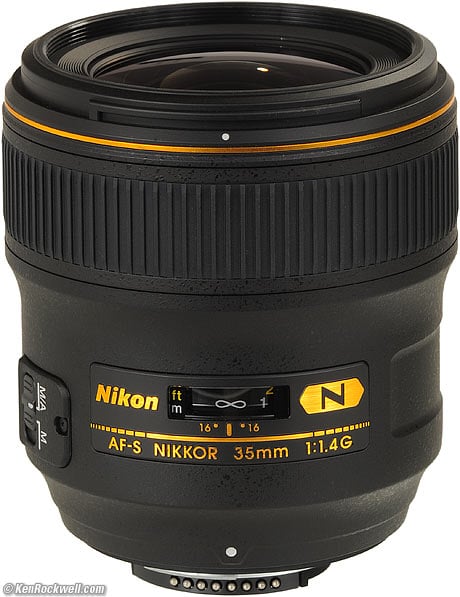 |
35mm f/1.4G FXFor FX cameras. Works on DX cameras, but the 35mm f/1.8 DX does the same thing for less money on DX. 67mm filters, 21.2 oz./600g, 1 foot/0.3m close focus. (2010-) |
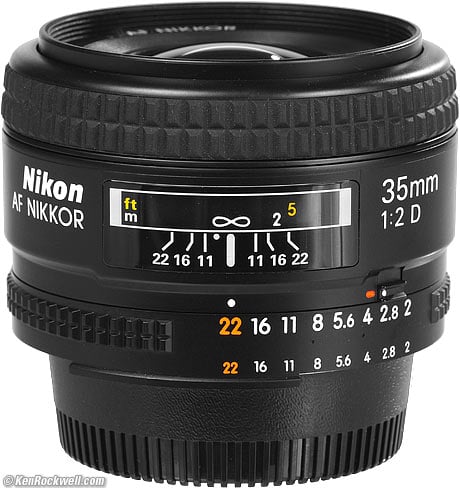 |
35mm f/2 AF-D FXFor FX cameras. Works on DX cameras, but the 35mm f/1.8 DX does the same thing for less money on DX. 52mm filters, 7.0 oz./200g, 0.8'/0.25m close focus. Check price new, or get it used at eBay. (1989-) |
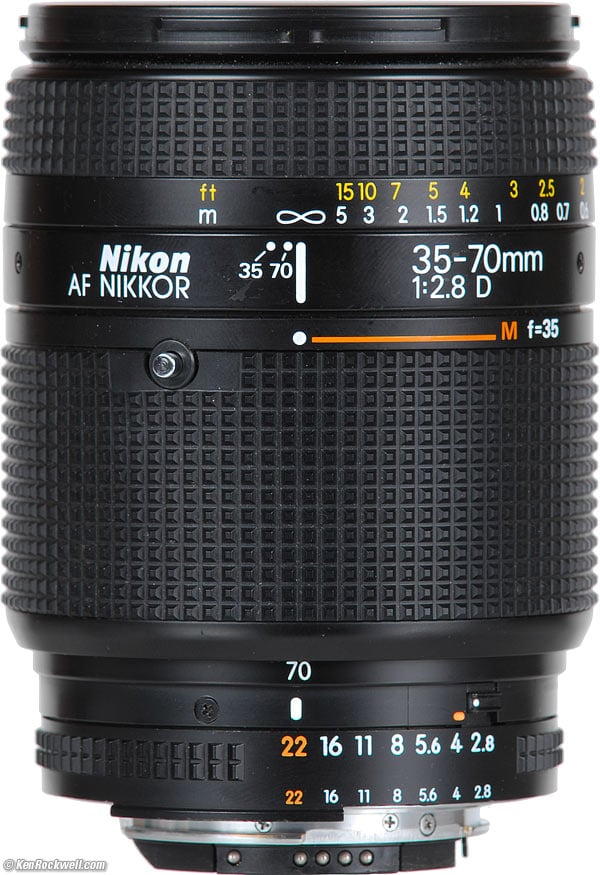 |
35-70mm f/2.8D FXFor FX cameras. 62mm filters, 23.4 oz./664 g, 2'/0.6m close-focus and an additional macro range at the 35mm setting. (1987-2007) |
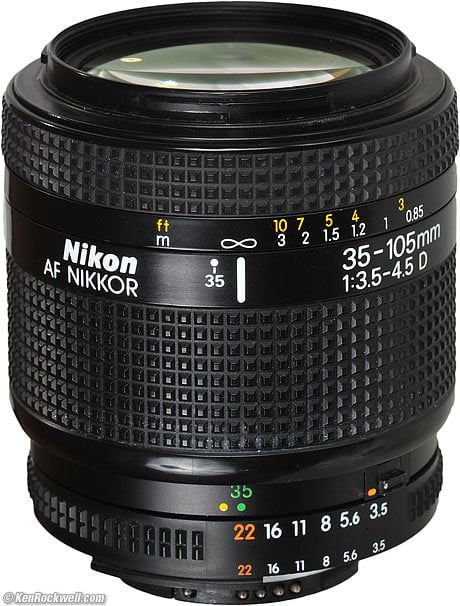 |
35-105mm f/3.5-4.5D FXFor FX cameras. 52mm filters, 14.6 oz./413g, 2.8'/0.85m close focus. (1994-2001) |
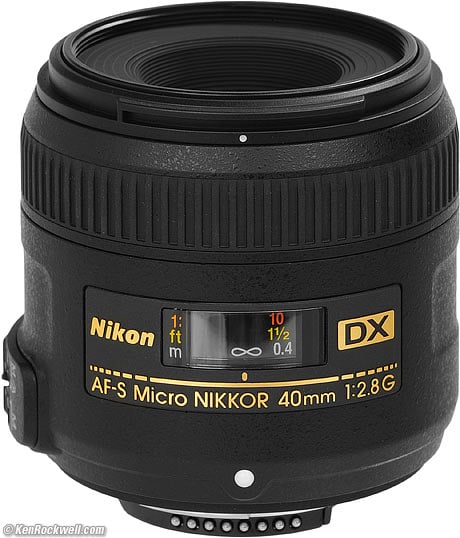 |
40mm f/2.8 Macro DXFor DX cameras only. 52mm filters, 8.0 oz./227g, 0.5'/0.163m (1:1) close focus, 12 July 2011 |
50mm AF lens index top
Nikon 50mm and 58mm Bokeh Comparison 11 December 2013
Nikon High-Speed 50mm Lens Sharpness Comparison 09 Sep 2010
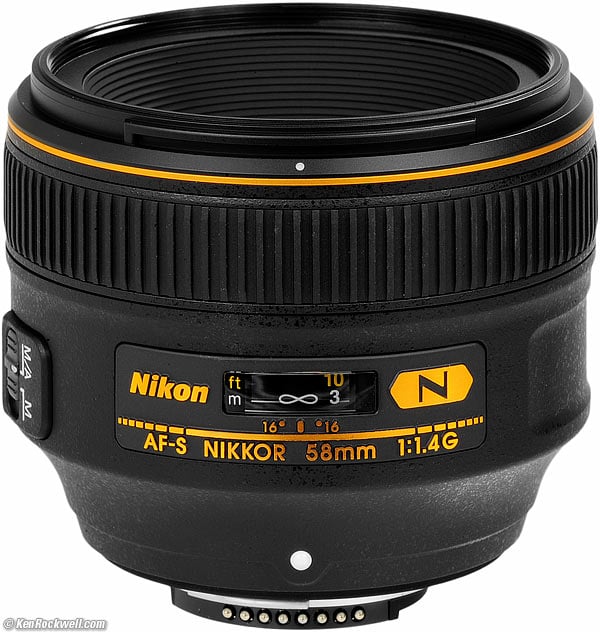 |
58mm f/1.4 G FXFor FX cameras; also works on DX cameras. 72mm plastic filter thread, 13.5 oz./382g, 2'/0.6m close focus. 2013-today. |
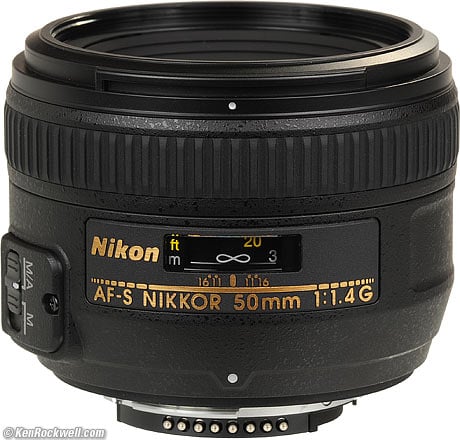 |
50mm f/1.4 G FXFor FX cameras; also works on DX cameras. 58mm plastic filter thread, 9.8 oz./278g., 1.5'/0.45m close focus. 2008-today |
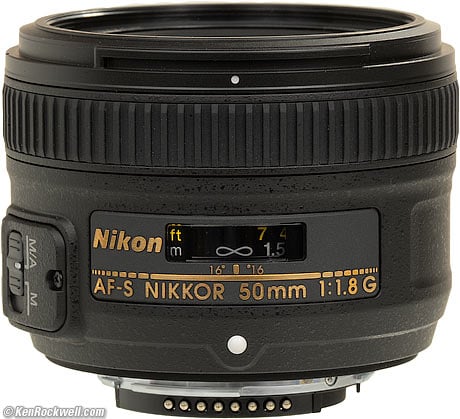 |
50mm f/1.8 G FXFor FX cameras; also works on DX cameras. 58mm plastic filter thread, 6.6 oz./185g., 1.5'/0.45m close focus. 2011-today. |
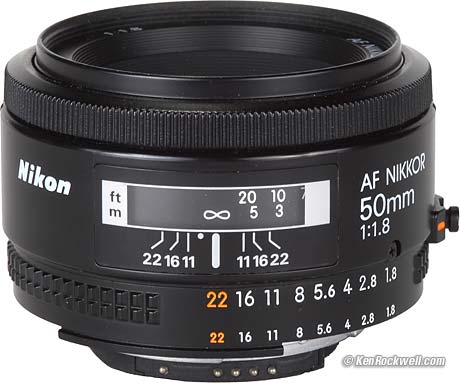 |
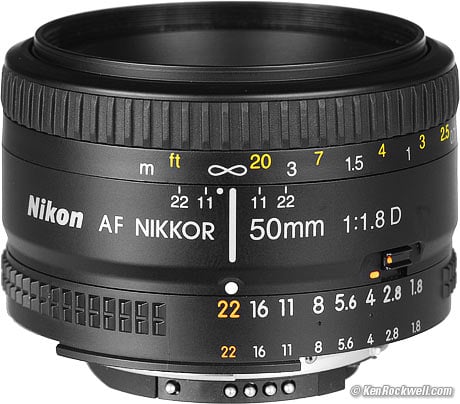
50mm f/1.8 FXFor FX cameras; also works on many DX cameras. 52mm filters, 5 oz./155g, 1.5'/0.45m close focus. 1986-2001 |
 |
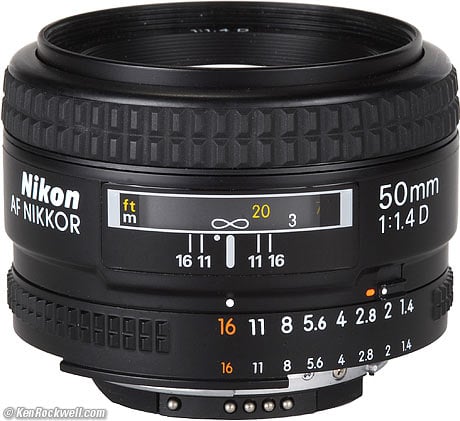
50mm f/1.8 AF-D FXFor FX cameras; also works on many DX cameras. 52mm filters, 5.5 oz./157g, 1.5'/0.45m close focus. 2002-today |
 |
50mm f/1.4 AF-D FXFor FX cameras; also works on many DX cameras. 52mm filters, 8.1 oz./229g, 1.5'/0.45 m close focus. 1986-today |
55mm AF lens index top
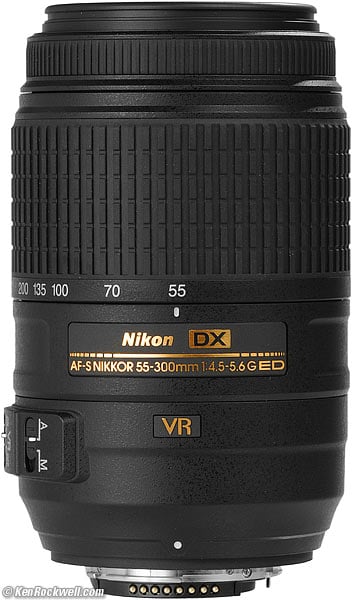 |
55-300mm VR DX19 August 2010 |
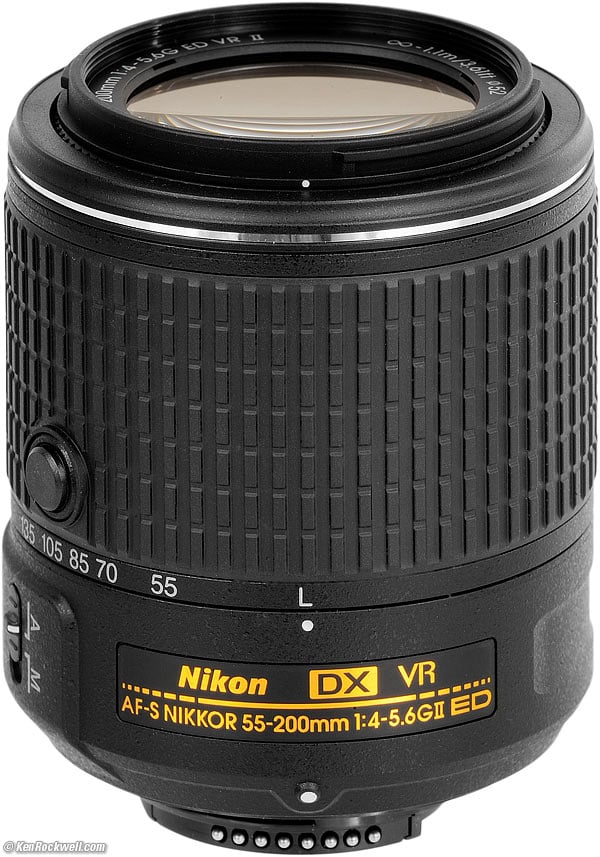 |
55-200mm VR II DX06 January 2015 |
 |
55-200mm VR DX05 March 2007 |
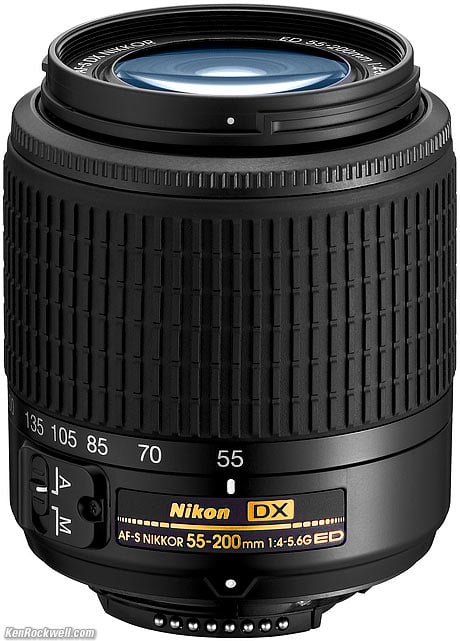 |
55-200mm DX05 October 2005 |
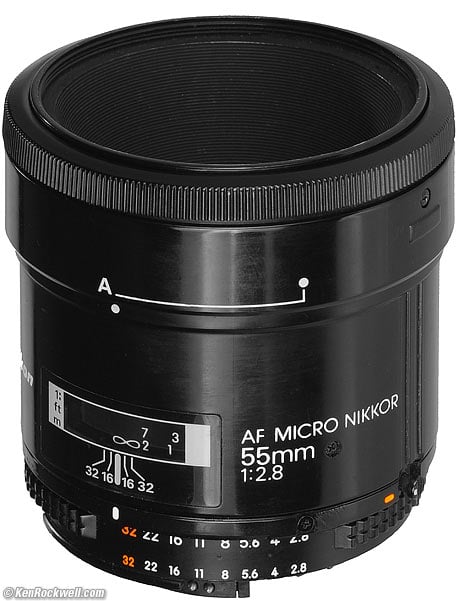 |
55mm f/2.8 Macro FXupdated 17 July 2008 |
60mm AF lens index top
Nikon 60mm G vs. 60mm D Macro Lenses
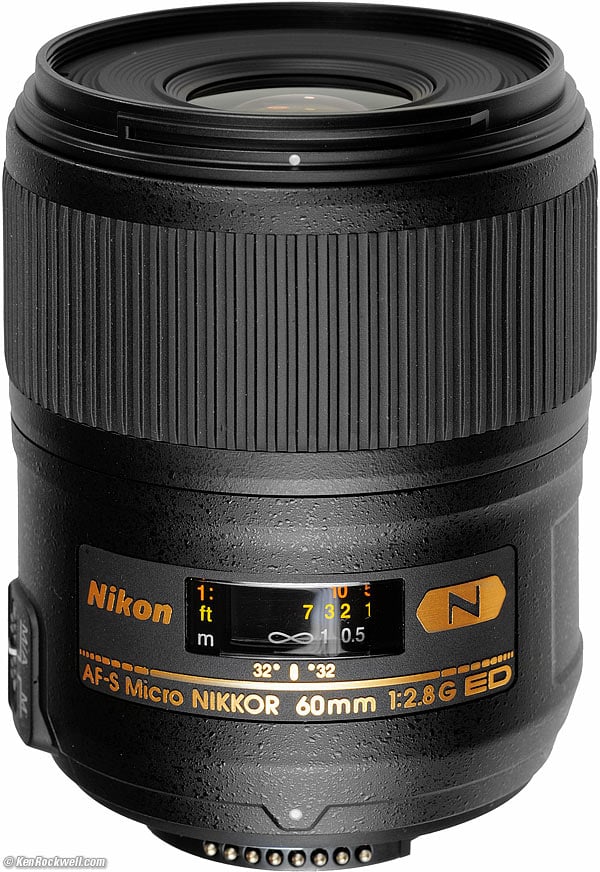 |
60mm f/2.8 G Macro FX31 January 2008 |
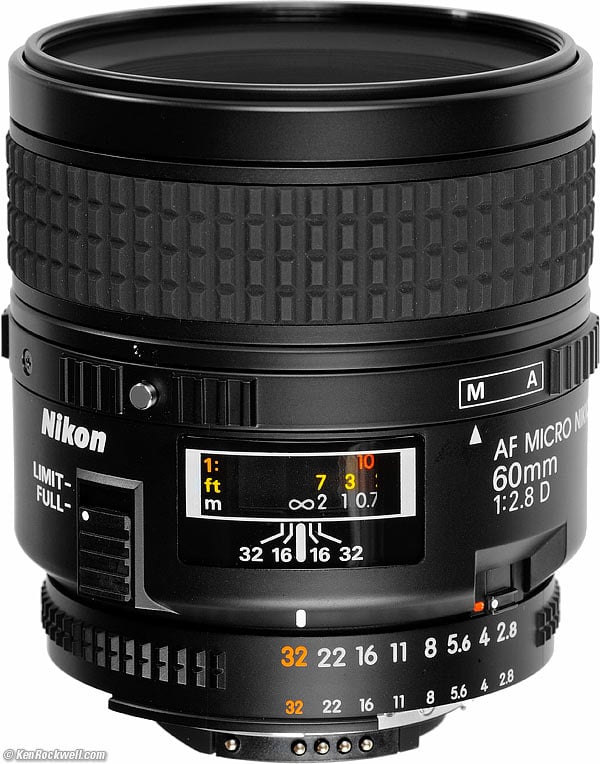 |
60mm f/2.8 D Macro FX12 February 2008 |
70-75mm AF lens index top
|
|
|
|
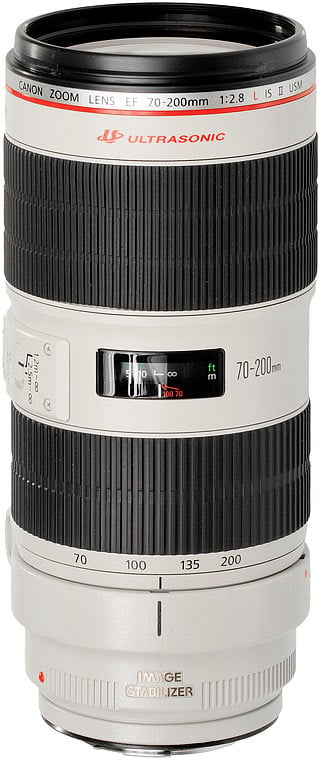
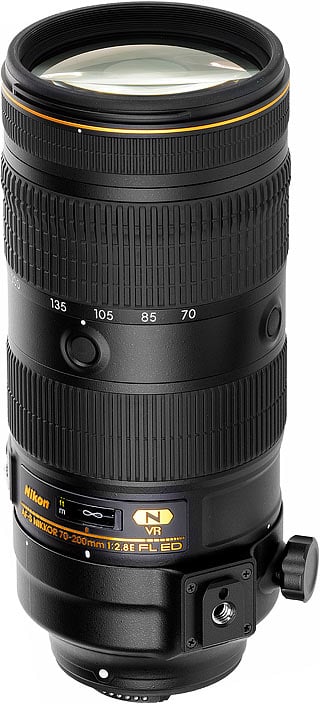
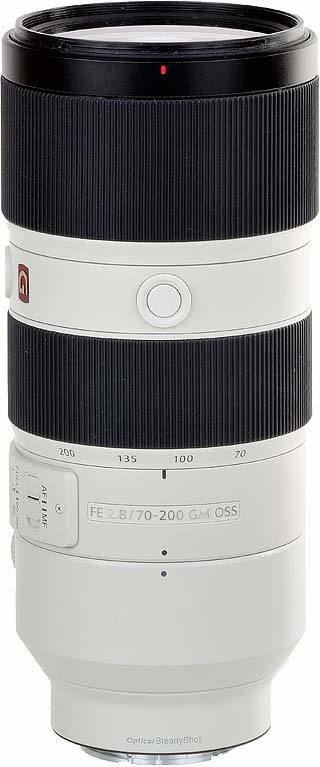
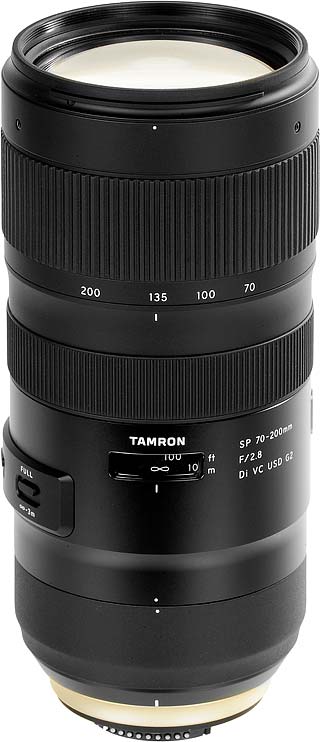
New: Best 70-200mm f/2.8 Lenses Compared22 April 2018 |
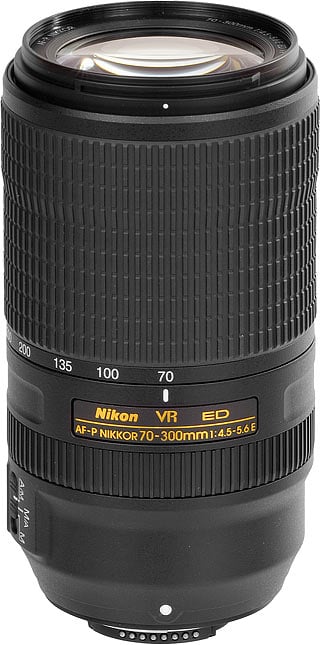 |
70-300mm AF-P VR FX11 July 2017 |
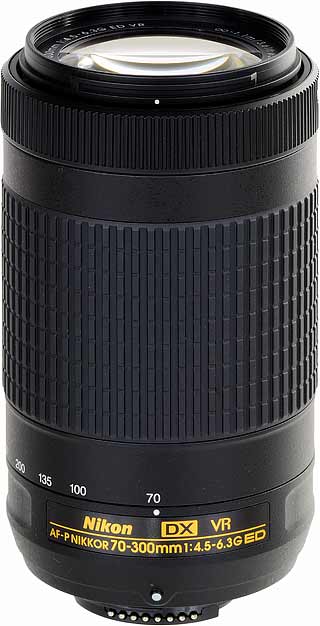 |
NEW: 70-300mm AF-P VR DX17 December 2016. Get this VR version; don't get the non-VR version below: |
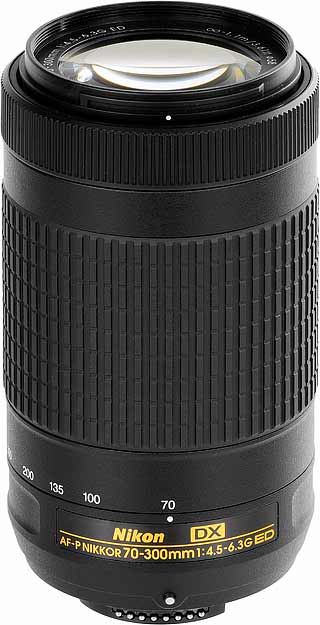 |
NEW: 70-300mm AF-P (non-VR) DX18 December 2016 |
|
NEW: Nikon 70-200mm f/2.8E FL FX19 October 2016 |
|
NEW: Tamron 70-200mm f/2.8 VR/IS Review.Works on Nikon or on Canon full frame, and works on APS-C, too. 77mm filters, 52.1 oz. (1,477g), 3.1 feet (0.95 m) close-focus. Check price. 23 April 2018 |
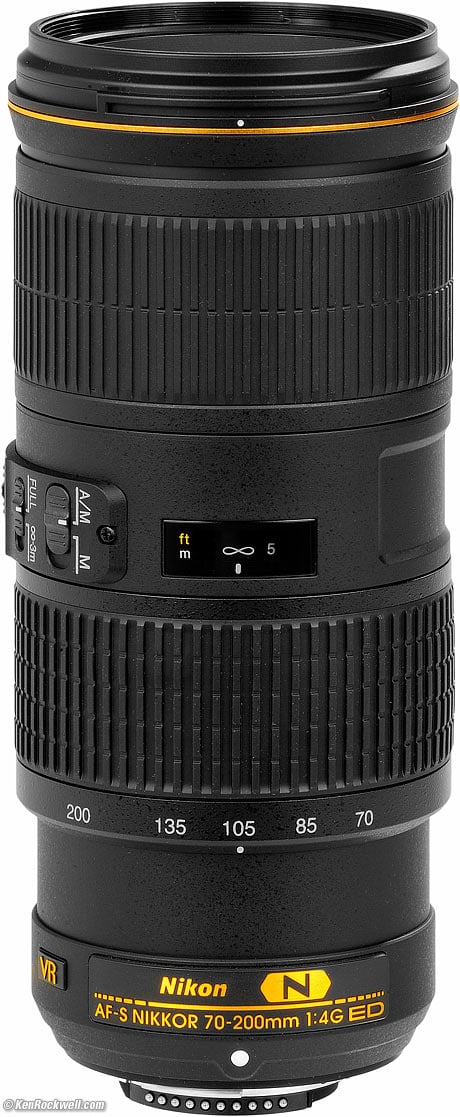 |
70-200mm f/4 VR FXDecember 2012 |
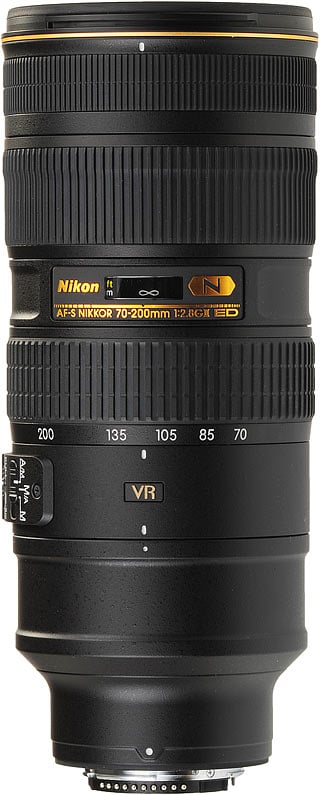 |
70-200mm VR II FXFor FX cameras and works on DX cameras, too. Metal 77mm filter threads, 54.3 oz/1,540g, 4.6'/1.4m close focus, about $1,000 used in 2019 if you know How to Win at eBay. 22 December 2009 Best pro telephoto zoom at a low price. |
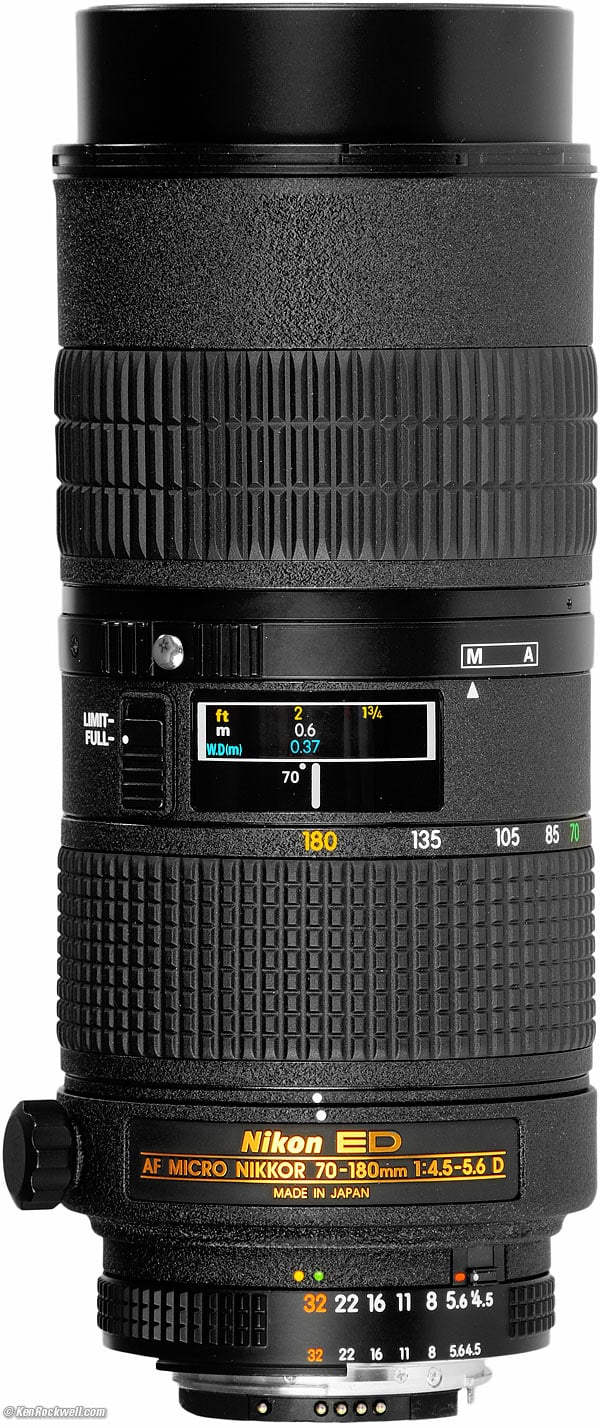 |
70-180mm D Macro FX |
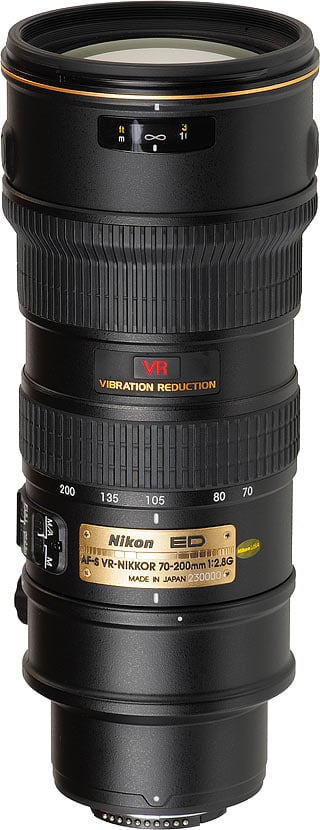 |
70-200mm f/2.8 VR FXFor FX cameras. Works on DX cameras, but the 70-300mm AF-P VR DX does about the same thing better for less money on DX. 77mm filters, 51.8 oz. (1,468g) with tripod collar). Get it used. 2003 ~ 2009. |
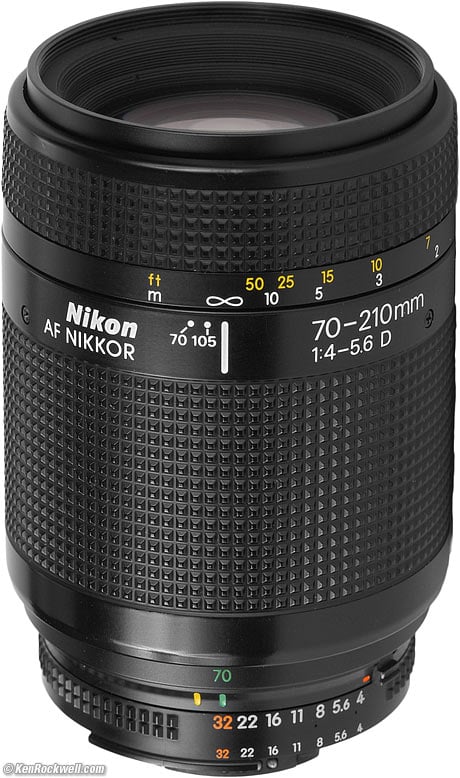 |
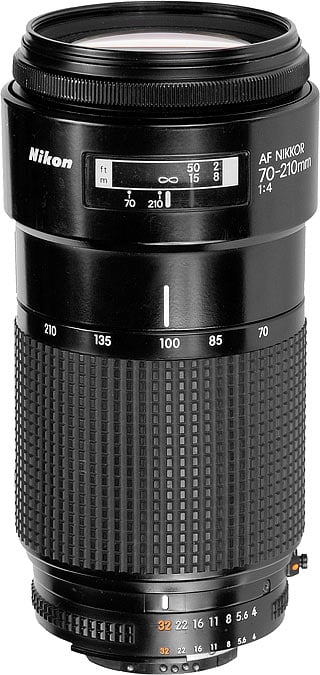
70-210mm f/4-5.6 FXFor FX cameras. Works on DX cameras, but the 70-300mm AF-P VR DX does about the same thing better for less money on DX. 62mm filters, 21 oz. (590g), 4 feet (1.2 m) close-focus. Get it used. 1987 ~ 2000. |
 |
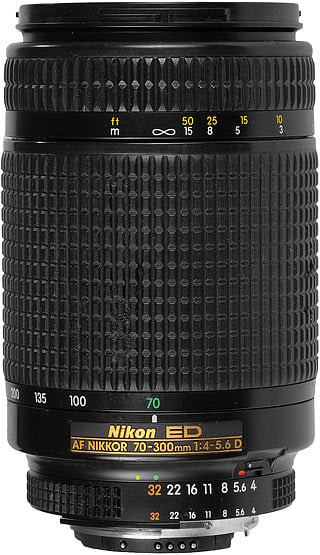
70-210mm f/4 FXFor FX cameras. Works on DX cameras, but the 70-300mm AF-P VR DX does about the same thing better for less money on DX. 62mm filters, 27 oz. (760g), 3.7 feet (1.1 m) close-focus. Get it used. 1986 ~ 1988 (replaced by 70-210mm f/4-5.6D FX). |
 |
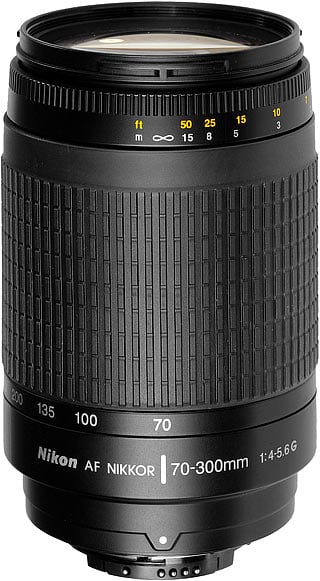
70-300mm ED FX |
 |
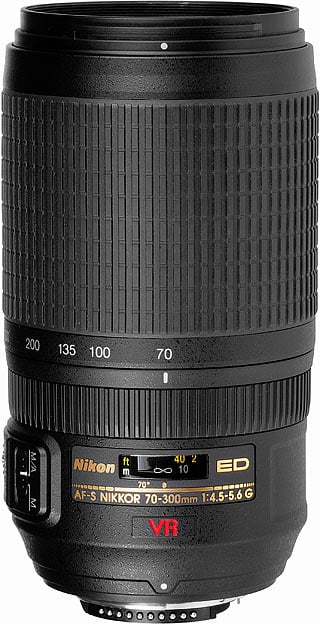
70-300mm G FXFor FX cameras. Works on DX cameras, but the 70-300mm AF-P VR DX does about the same thing better for less money on DX. 62mm filters, 17 oz.(480g), 4.9 feet (1.5 m) close-focus. Check price. 2000 ~ today. |
 |
70-300mm VR FXFor FX cameras. Works on DX cameras, but the 70-300mm AF-P VR DX does same thing much better on DX. 67mm filters, 26.2 oz. (745g), 5 feet (1.5 m) close-focus. Get it used. 2006 ~ 2017 (replaced by 70-300mm VR AF-P FX). |
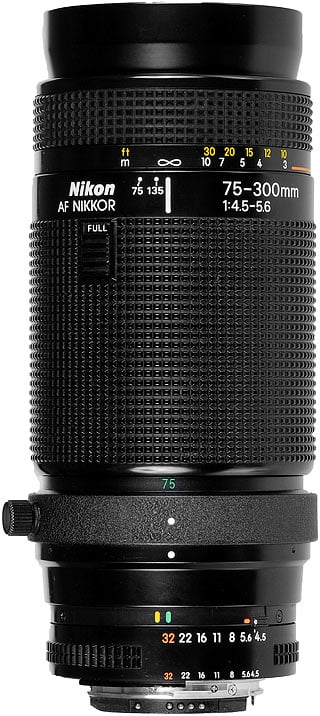 |
75-300mm FXFor FX cameras. Works on DX cameras, but the 70-300mm AF-P VR DX does same thing much better on DX. 62mm filters, 29.3 oz. (831g), 5 feet (1.2 m) close-focus. Get it used. 1989-1999, replaced by the cheap plastic 70-300mm ED FX. A sharp and well-made lens, but needs a tripod or a steady hand and good light for best results because it has no stabilization. |
80mm AF lens index top
 |
 |
 |
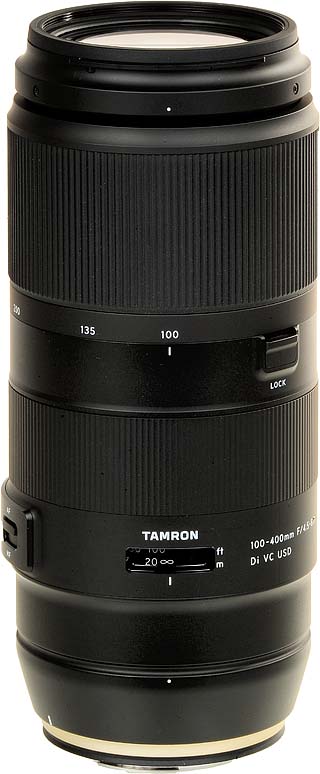 |
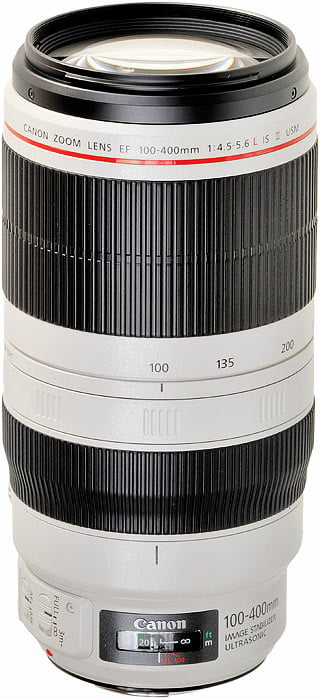
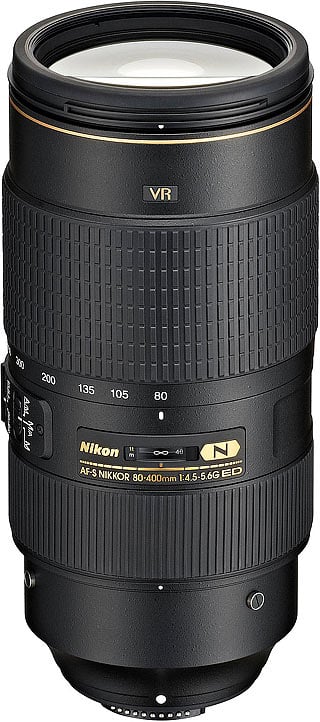
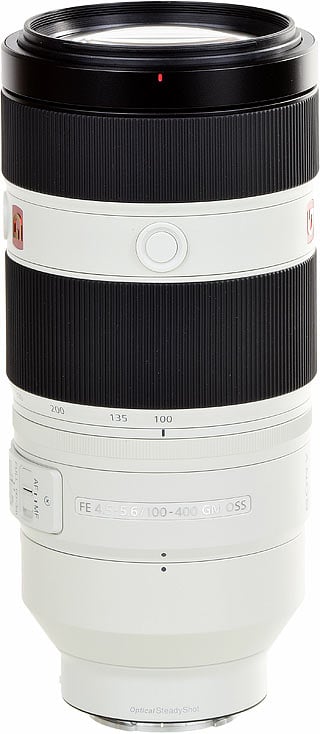
NEW: Best 80-400mm & 100-400mm Lenses Compared.10 July 2018 |
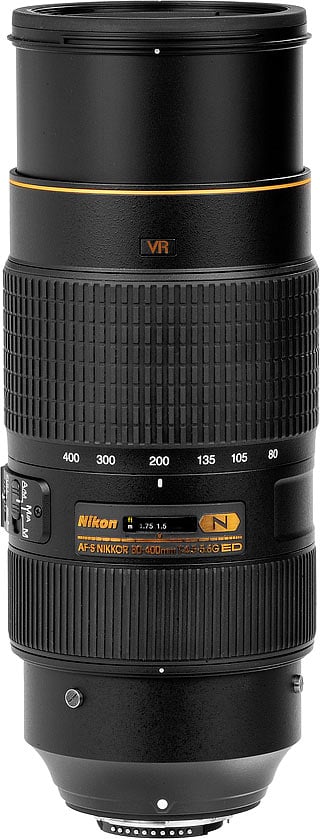 |
80-400mm VR FXJune 2013 |
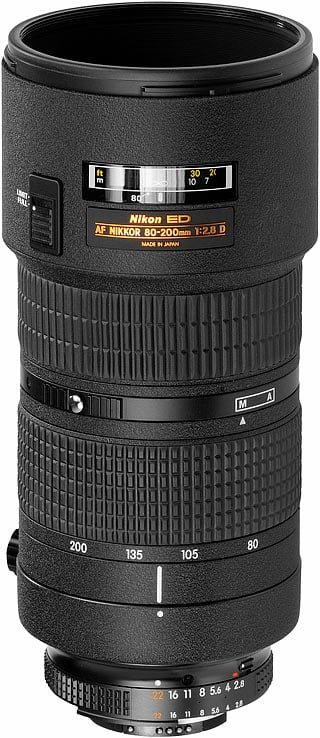 |
80-200mm f/2.8D FXFor FX cameras. Often works on DX cameras, but DX lenses usually are more practical on DX. 77mm filters, 45.0 oz. (1,275g), 4.9 feet (1.5 m) close-focus. Check price new or get it used. 1997-today. |
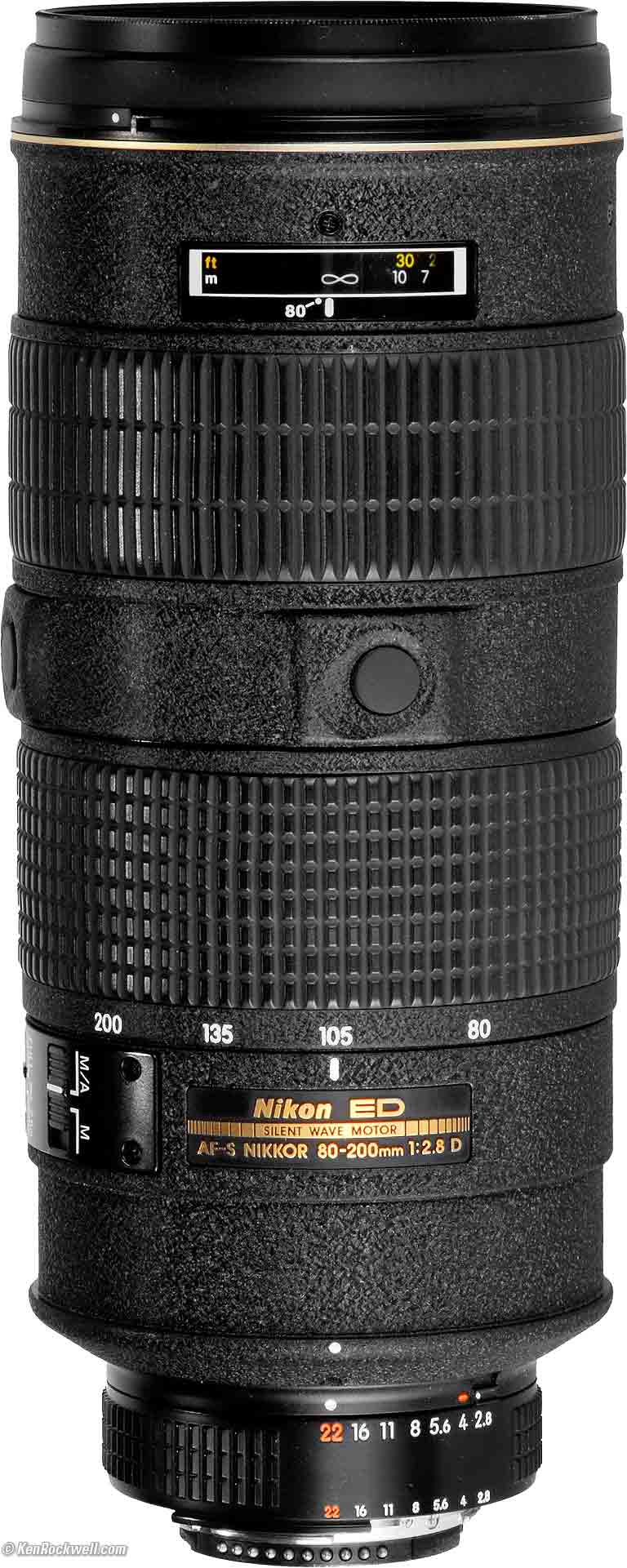 |
80-200mm f/2.8 AF-S FXFor FX cameras. Often works on DX cameras, but DX lenses usually are more practical on DX. 77mm filters, 51.9 oz (1,471g) without collar, 4.9 feet (1.5 m) close-focus. Get it used. 1999-2004 |
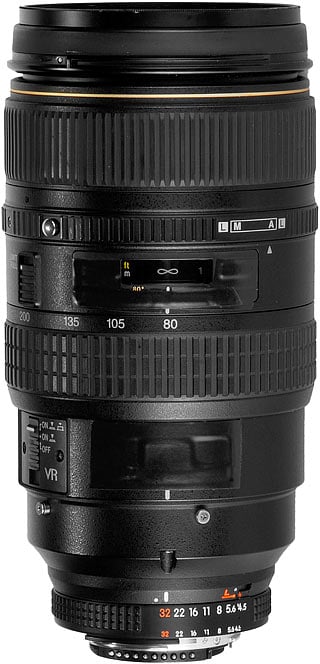 |
80-400mm D VR FXFor FX cameras. Often works on DX cameras, but DX lenses usually are more practical on DX. 77mm filters, 42.7 oz. (1,210g) without tripod collar, 7.5 feet (2.3 m) close-focus. Check price new or get it used. 2000-2013, replaced by 80-400mm VR FX. |
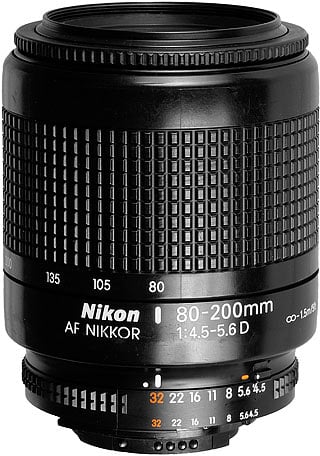 |
80-200mm f/4.5-5.6 FXFor FX cameras. Works on DX cameras, but any DX lens works much better on DX. 52mm filters, 11.7 oz. (333g), 4.9 feet (1.5 m) close-focus. Get it used. 1995-1999. |
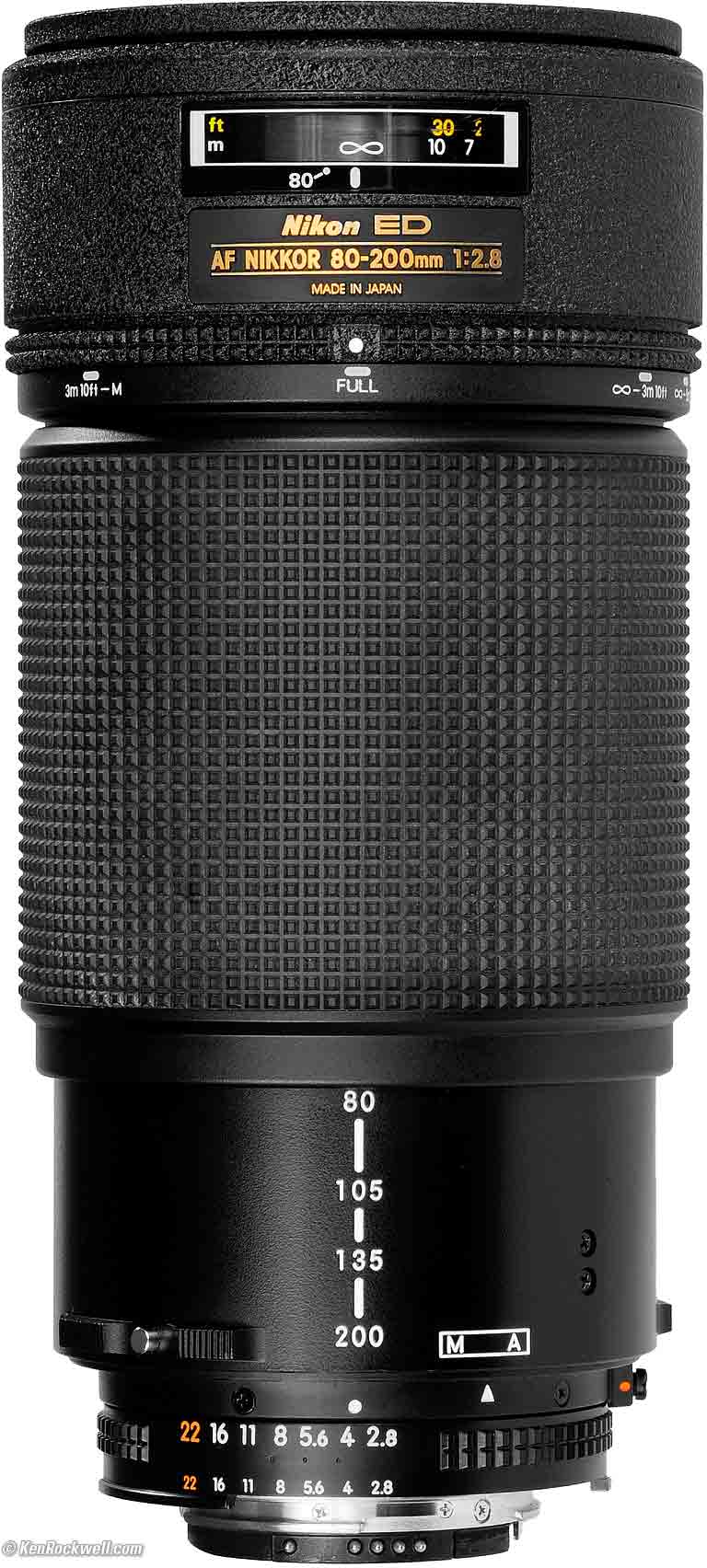 |
80-200mm f/2.8 FXFor FX cameras. Often works on DX cameras, but DX lenses usually are more practical on DX. 77mm filters, 44.8 oz./1,270g, 5 feet (1.5 m) close-focus. Get it used. 1988-1992. |
85mm AF lens index top
85mm Lens Specifications Compared 24 June 2009
Nikon 85mm Lens Bokeh Comparison 26 March 2008
Nikon 85mm Lens Central Sharpness Comparison 23 June 2009
Nikon 85mm Lens Corner Sharpness Comparison 23 June 2009
 |
85mm f/1.4 G FXFor FX cameras. Often works on DX cameras, but DX lenses usually are more practical on DX. |
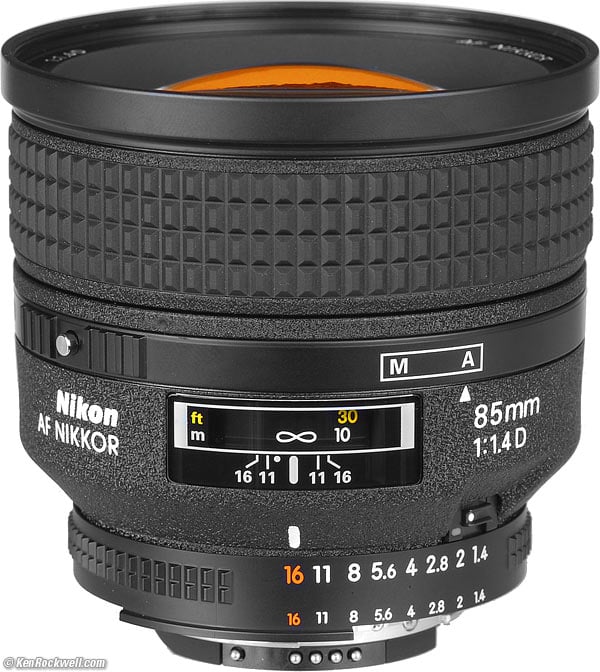 |
85mm f/1.4D FXFor FX cameras. Often works on DX cameras, but DX lenses usually are more practical on DX. |
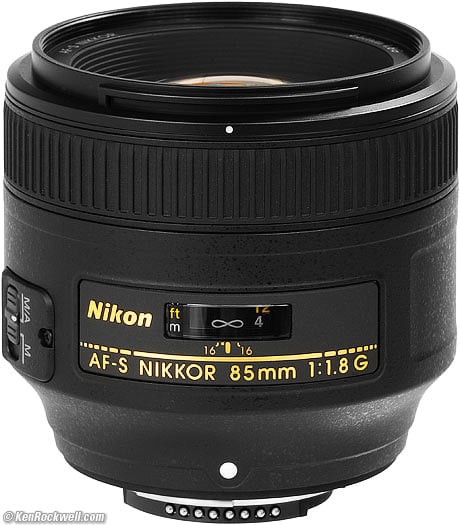 |
85mm f/1.8 G FXFor FX cameras. Often works on DX cameras, but DX lenses usually are more practical on DX. 02 March 2012 |
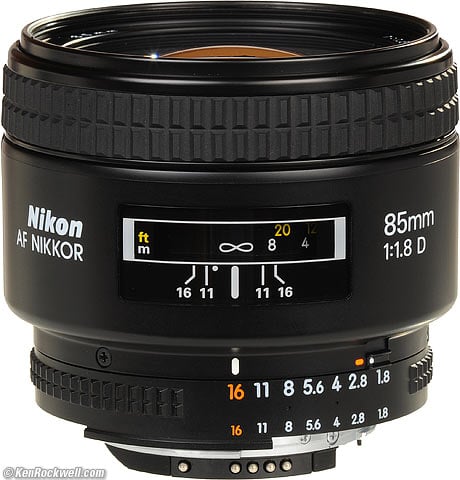 |
85mm f/1.8D FXFor FX cameras. Often works on DX cameras, but DX lenses usually are more practical on DX. |
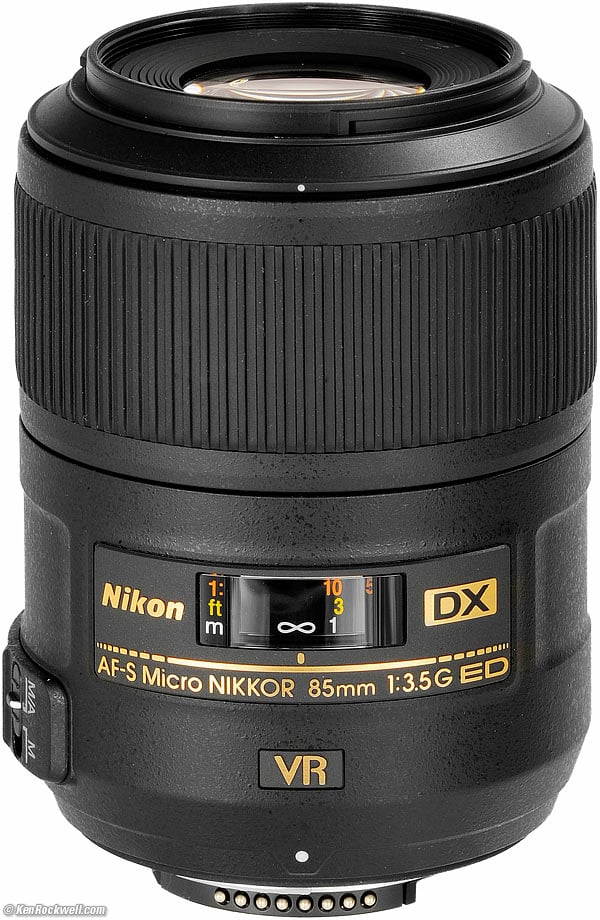 |
85mm f/3.5 VR DXFor DX cameras only. |
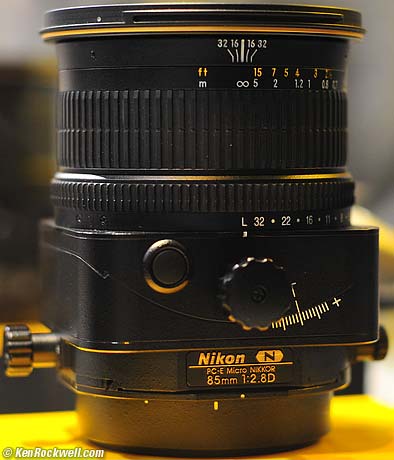 |
85mm f/2.8 PC-E FXmanual focus, 22.4 oz. (635g), 1.3 feet (0.39 m) close-focus. Check Price. 2008-today. |
100-105mm AF lens index top
105mm Center Sharpness Comparison
105mm Corner Sharpness Comparison
|
105mm f/1.4 FX27 July 2016 |
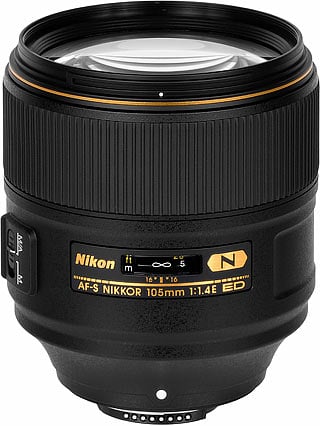
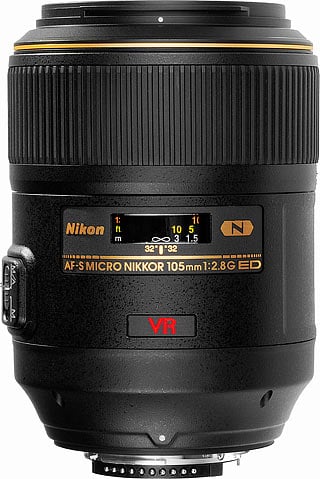 |
105mm f/2.8 VR Macro FX |
|
Tamron 100-400mmNEW: Best 80-400mm & 100-400mm Lenses Compared. Full-frame and APS-C, 67mm filters, 39.9 oz./1,132g, 4.9'/1.5m close focus. Check price. Comes for Nikon and for Canon. 10 July 2018 |
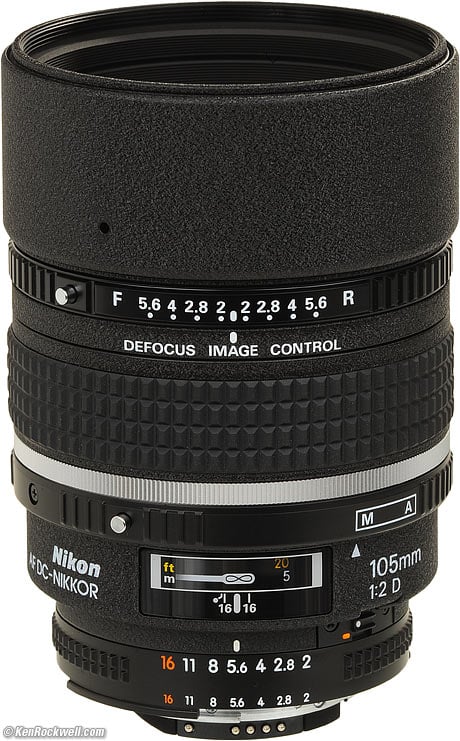 |
105mm f/2 DC FXFor FX cameras. Often works on DX cameras, but DX lenses usually are more practical on DX. 72mm filters, 22.0 oz. (624g), 3 feet (0.9 m) close-focus. I'd get my 105mm f/2 DC used at eBay (How to Win at eBay), at Amazon or at B&H. 1993-2021. |
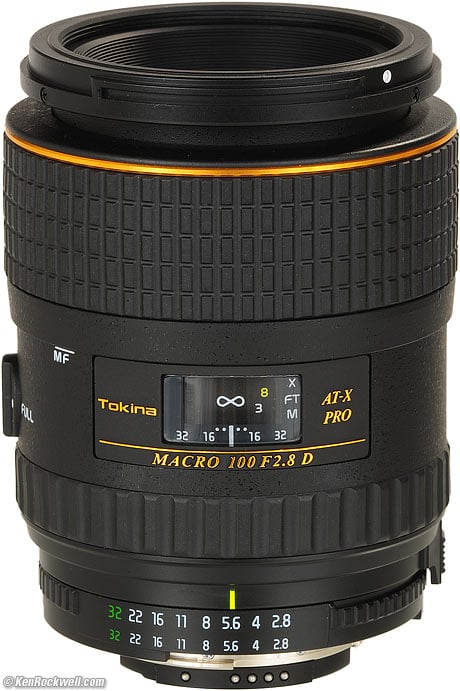 |
Tokina 100mm f/2.8 Macro FXFor FX cameras. Often works on DX cameras, but DX lenses usually are more practical on DX. 55mm filters, 18.1 oz. (513g), 1:1 close focus. Check price. 2006-today. |
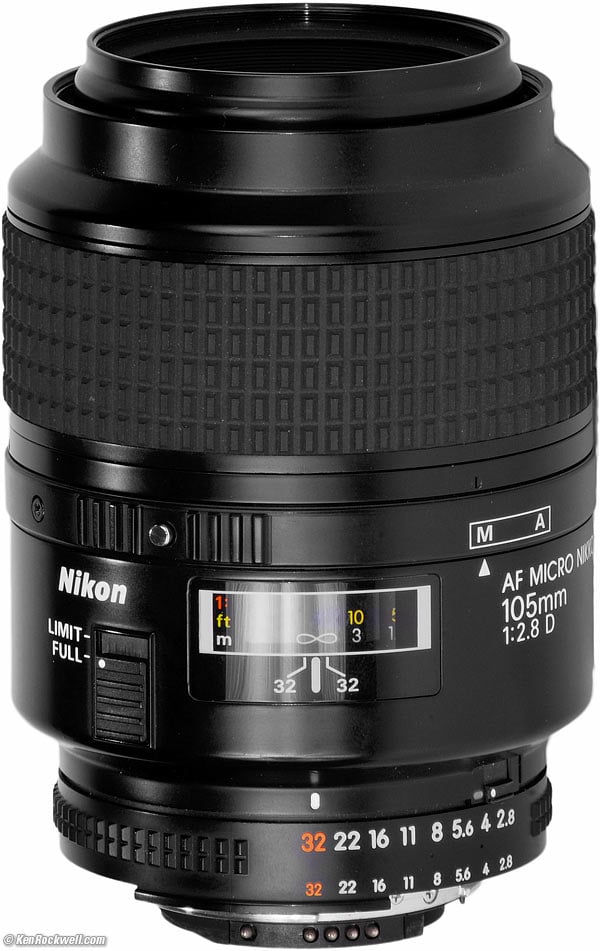 |
105mm f/2.8D Macro FX |
120-150mm AF lens index top
|
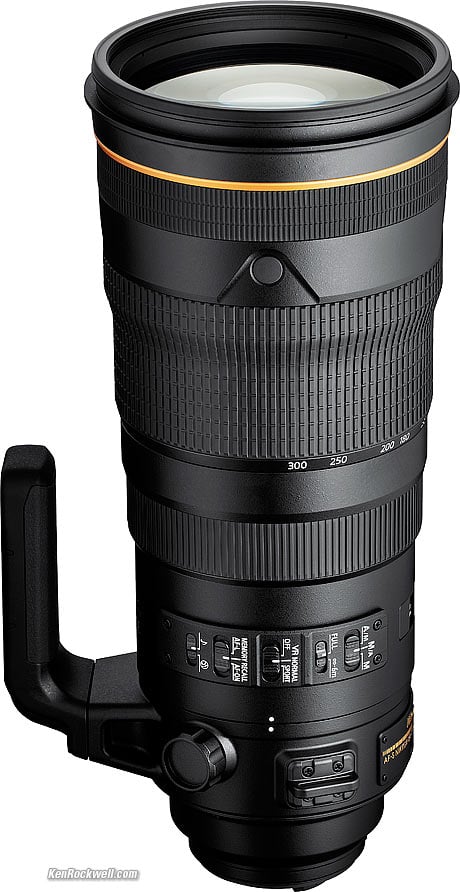
NEW: Nikon 120-300mm f/2.8 FL VR.For FX cameras. Works on DX cameras, too. 112mm filters, 114.6 oz./3,250 g/7.2 pounds, 6.6'/2m close focus. 11 January 2020 |
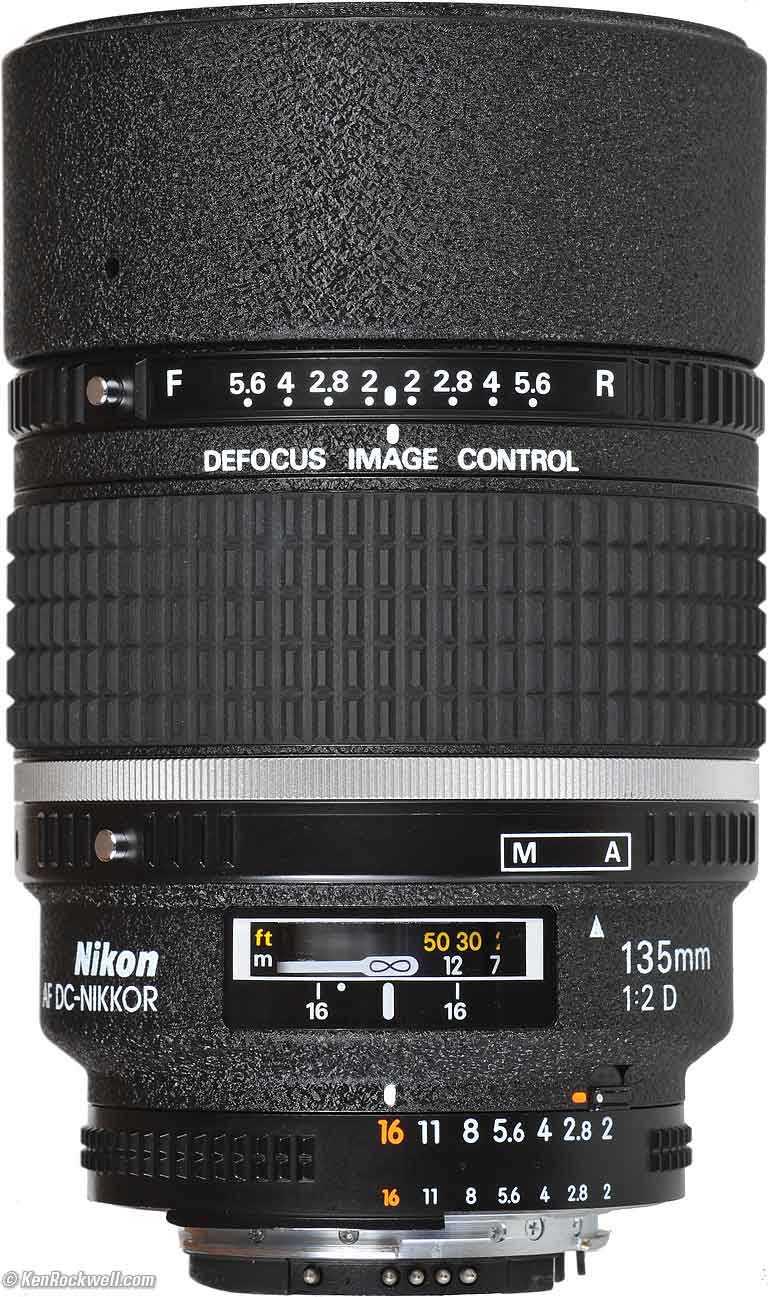 |
135mm f/2 DC FXFor FX cameras. Often works on DX cameras, but DX lenses usually are more practical on DX. 72mm filters, 28.9 oz. (818g), 3.6 feet (1.1 m) close-focus. I got my 135mm f/2 DC at eBay (How to Win at eBay), you also can try Amazon. 1990 ~ 2021. |
|
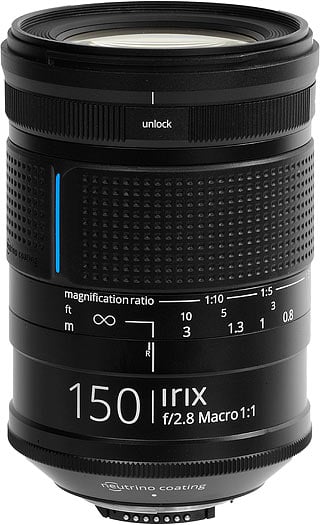
NEW: Irix 150mm f/2.8 Macro.Manual-focus only, 77mm filters, 29.2 oz./828g, 1:1 macro, 1.14'/0.345m close focus. 08 January 2019 |
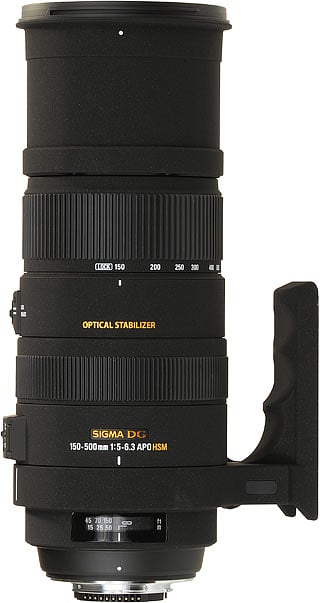 |
Sigma 150-500mm f/5-6.3 FXFor FX cameras. Often works on DX cameras, too. 86mm filters, 63.2 oz. (1,792g) as shown, 7.2 feet (2.2 m) close-focus. Get it used. 2010 ~ ?2014. |
|
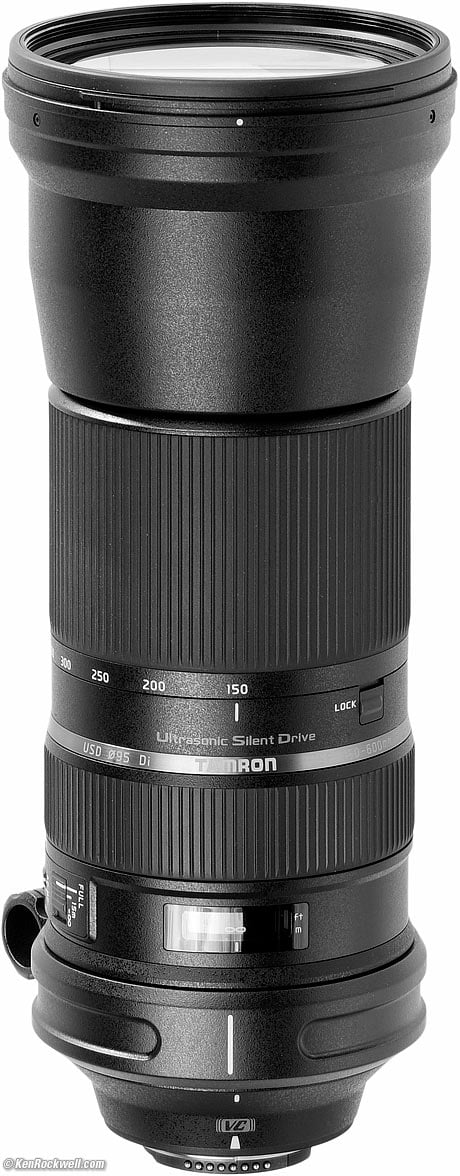
Tamron 150-600mm FX2013 ~ today. |
180mm AF lens index top
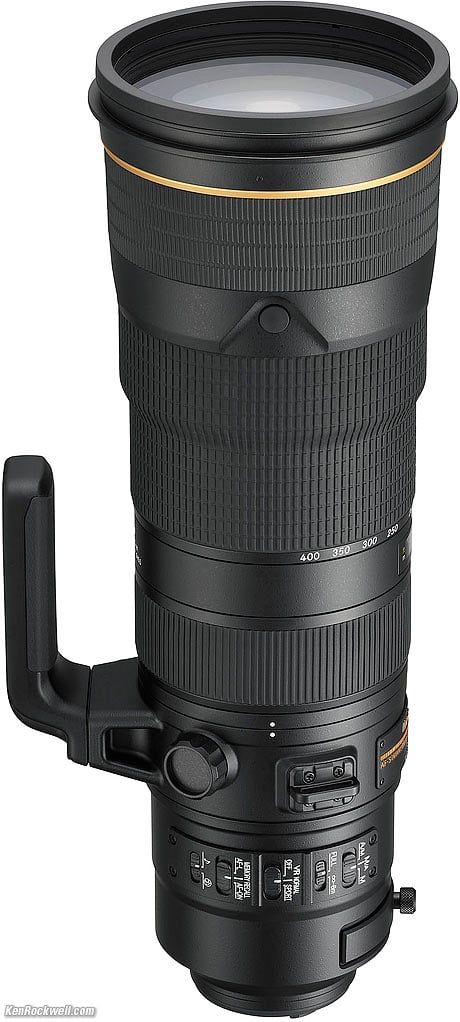 |
NEW: Nikon 180-400mm f/4E VR FL TC FXbuilt-in switchable 1.4x teleconverter, 40.5mm drop-in filters, 123.5 oz./7.72 pounds/3,500g, 6.5 feet (2 m) close focus Announced 08 January 2018 |
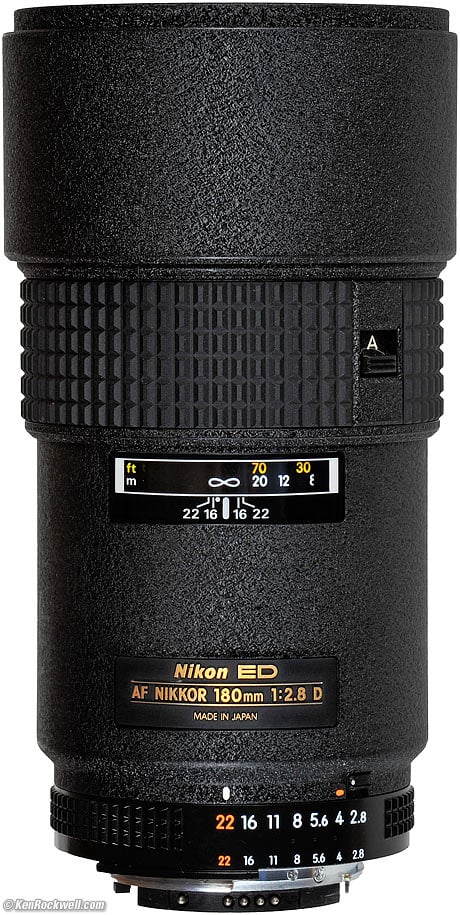 |
180mm f/2.8 FXNikon 180mm f/2.8 History 30 October 2008 |
200mm AF lens index top
200mm Center Sharpness Comparison
200mm Corner Sharpness Comparison
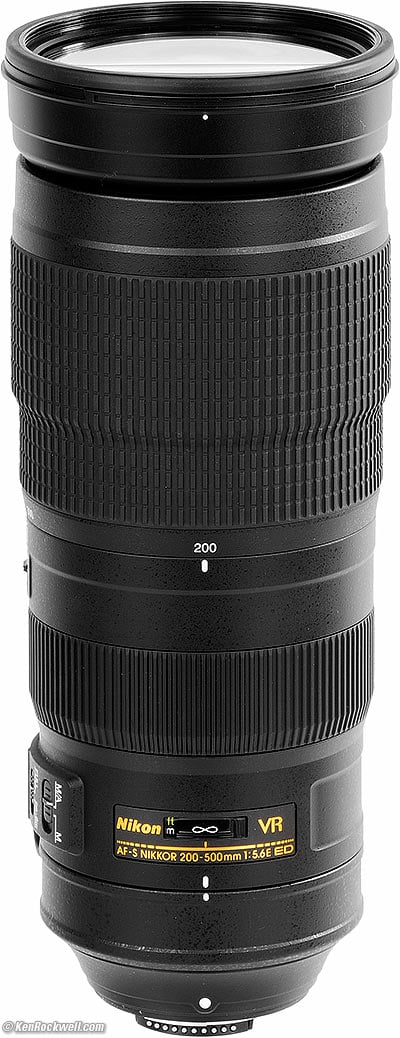 |
200-500mm f/5.6 E VR FX04 August 2015 |
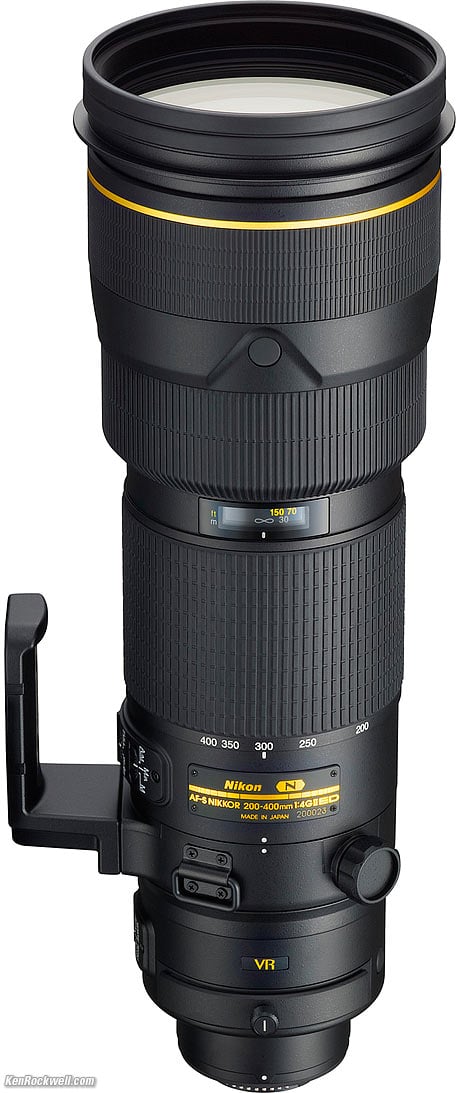 |
200-400mm VR II FX27 April 2010 |
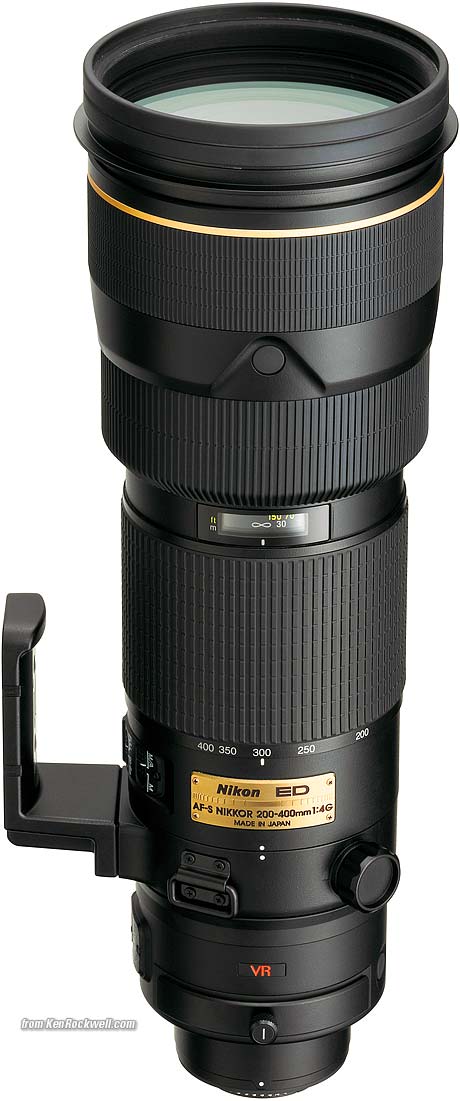 |
200-400mm VR FX27 September 2004 |
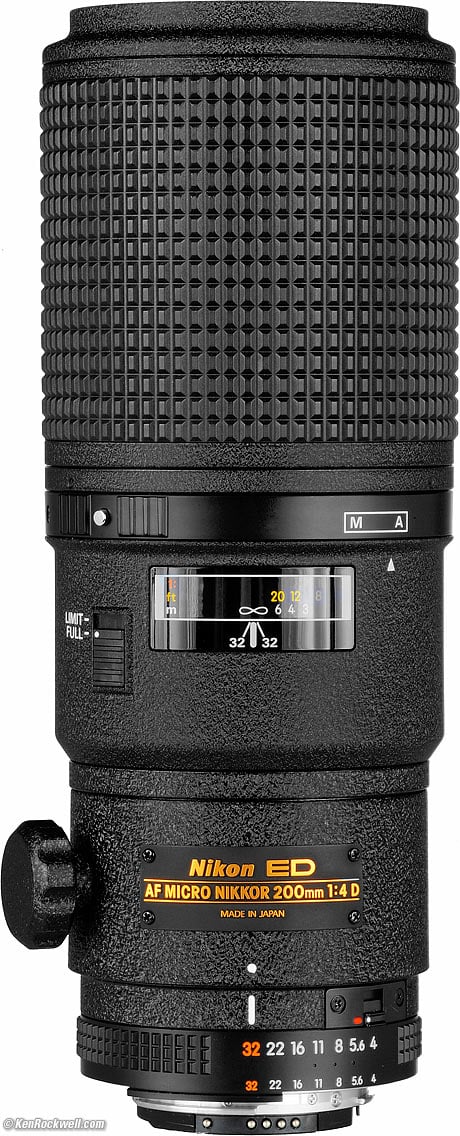 |
200mm f/4 Macro FX13 August 2008 |
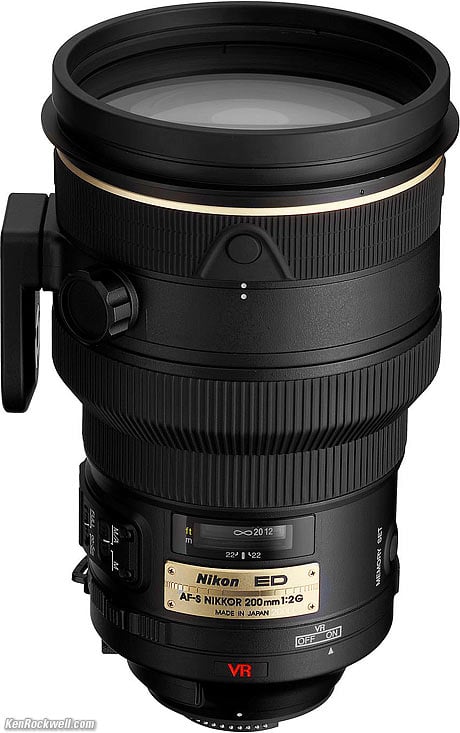 |
200mm f/2 VR FX27 September 2004 |
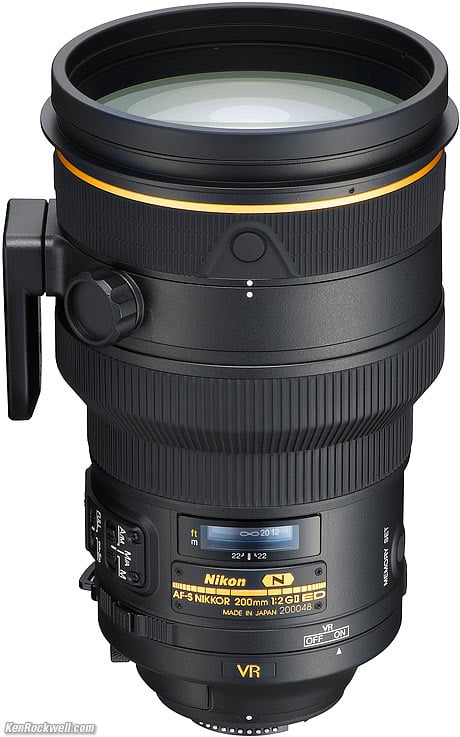 |
200mm f/2 VR II FX15 September 2010 |
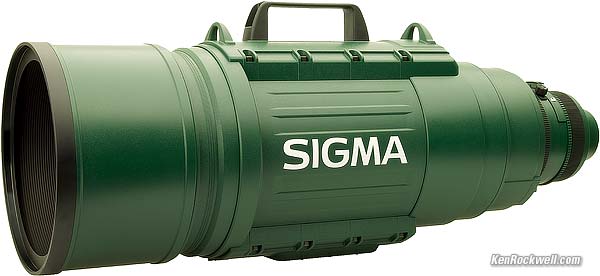 |
Sigma 200-500mm f/2.8 FX12 March 2008 |
300mm AF lens index top
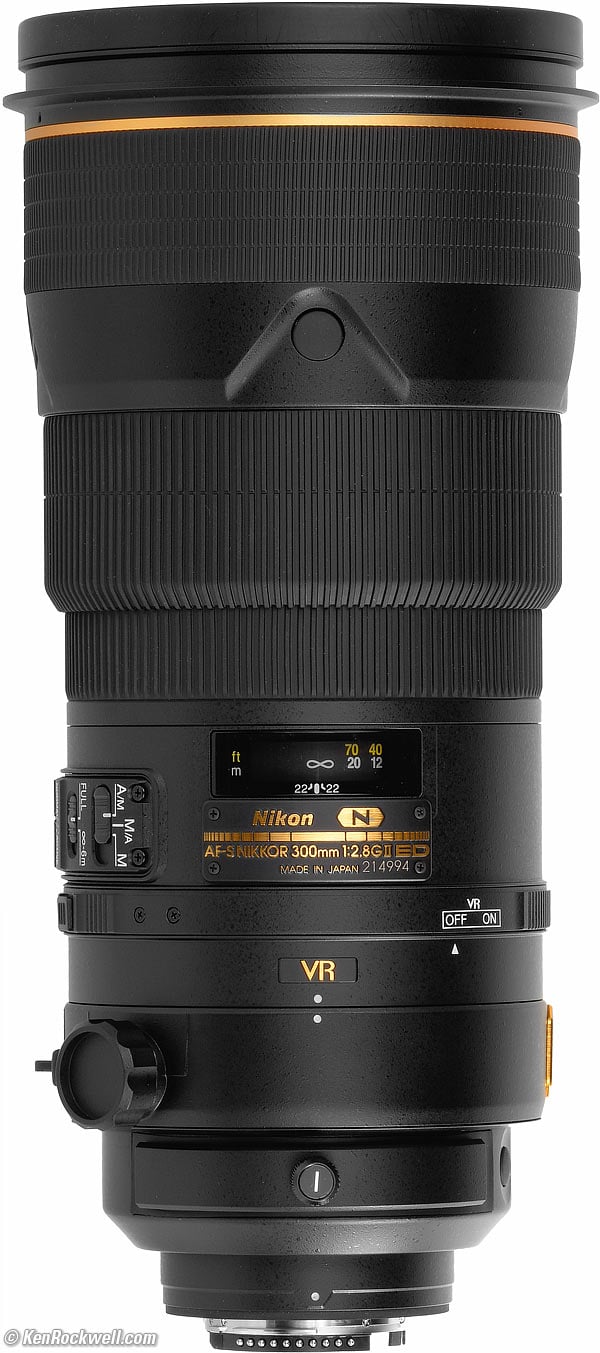 |
300mm f/2.8 VR II FX |
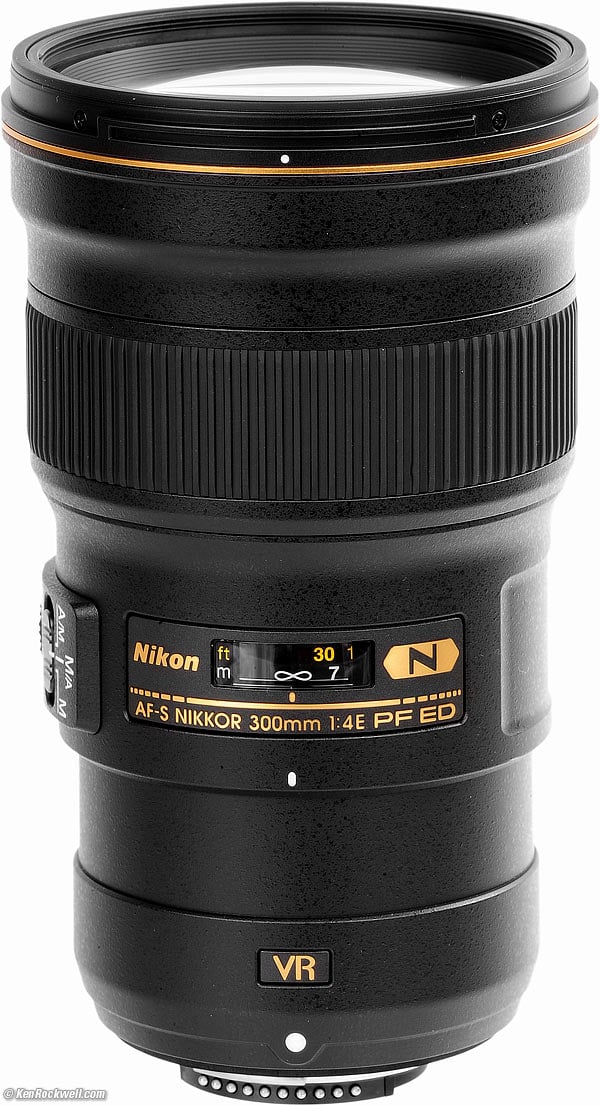 |
300mm f/4 E PF VR FX06 January 2015 |
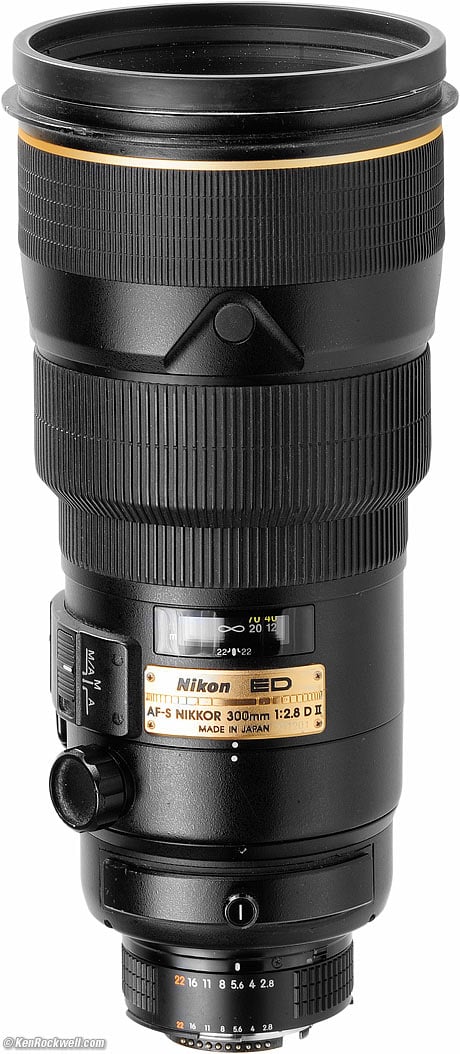 |
300mm f/2.8 AF-S II FX17 December 2014 |
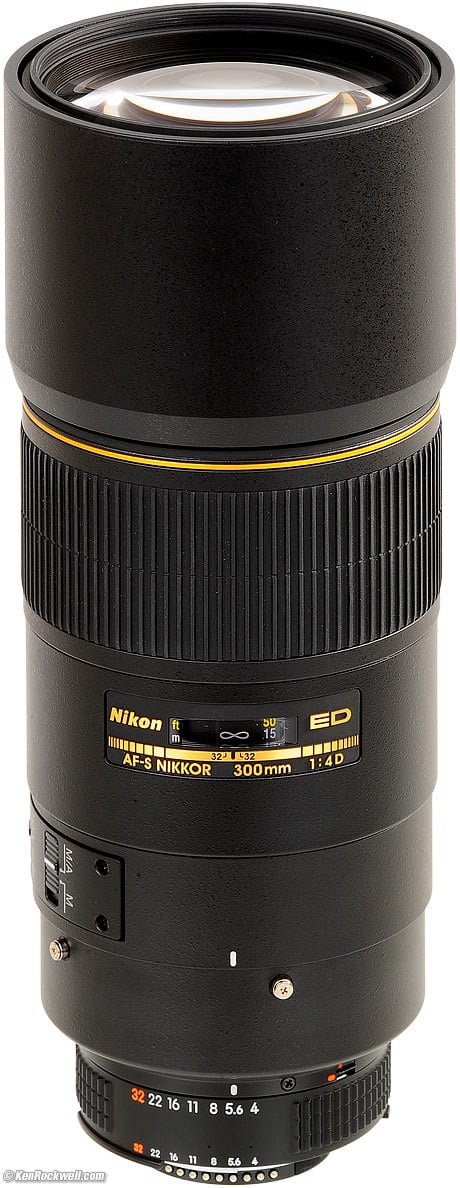 |
300mm f/4 AF-S FX22 November 2014 |
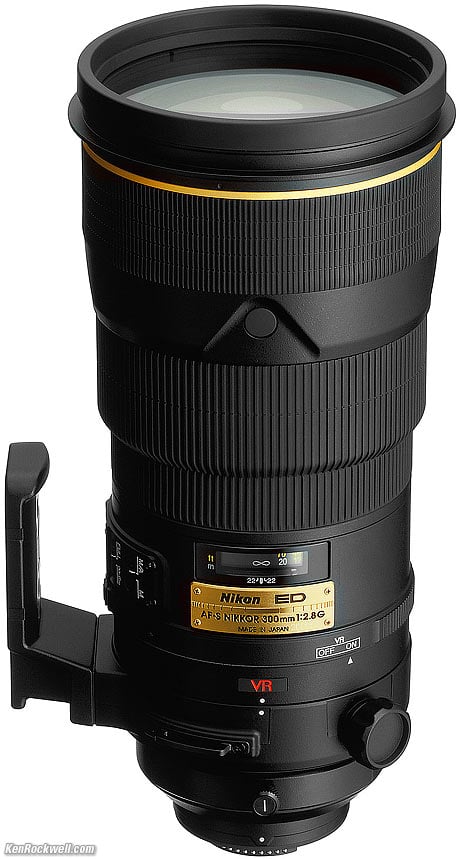 |
300mm f/2.8 VR FX27 September 2004 |
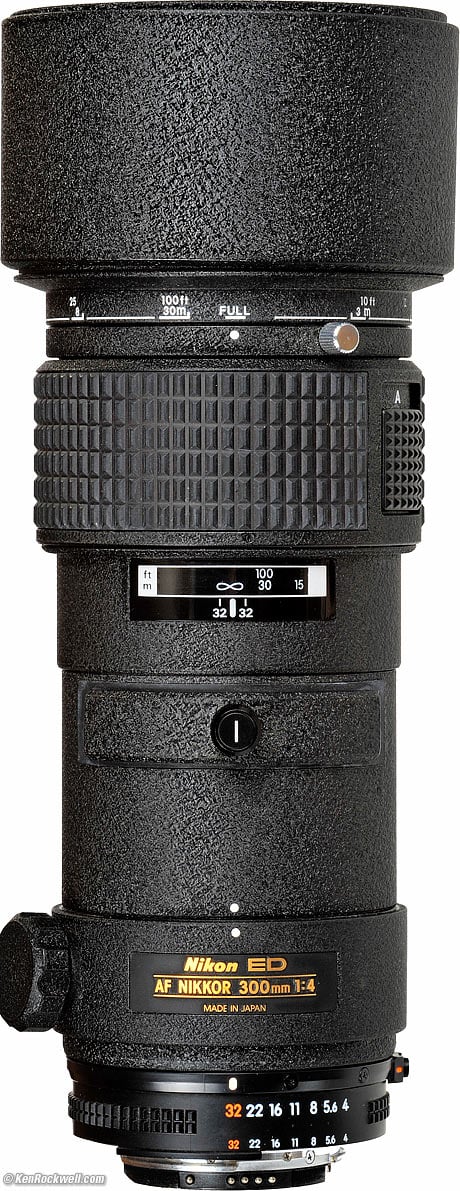 |
300mm f/4 FX |
300mm f/2.8 AF-I FX |
400mm AF lens index top
Nikon 400mm f/2.8 Lenses Compared 09 July 2014
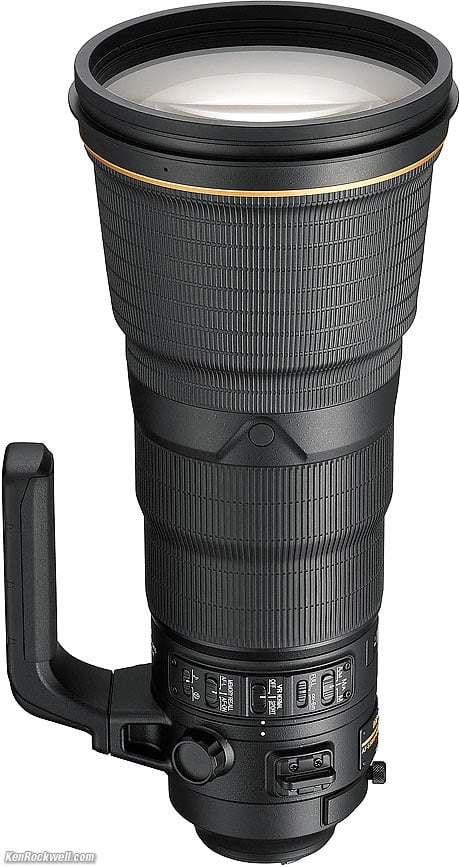 |
400mm f/2.8E FL VR FX(2014-) 40.5mm filters, 134 oz./8.4 pounds/3,800g, 8.5 feet (2.6 m) close focus For all formats. |
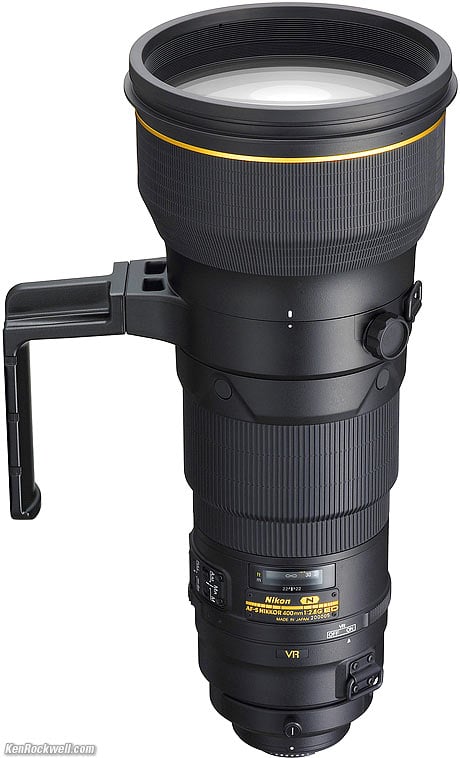 |
400mm f/2.8 VR FX(2007-2014) |
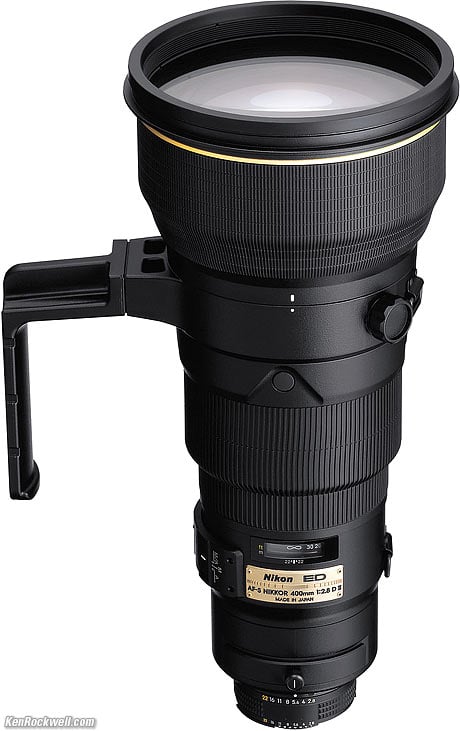 |
400mm f/2.8 AF-S II FX(2001-2007) |
400mm f/2.8 AF-S FX(1998-2001) |
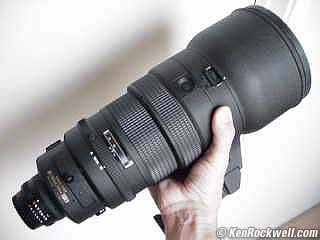 |
400mm f/2.8 AF-I FX(1994-1998) |
500mm AF lens index top
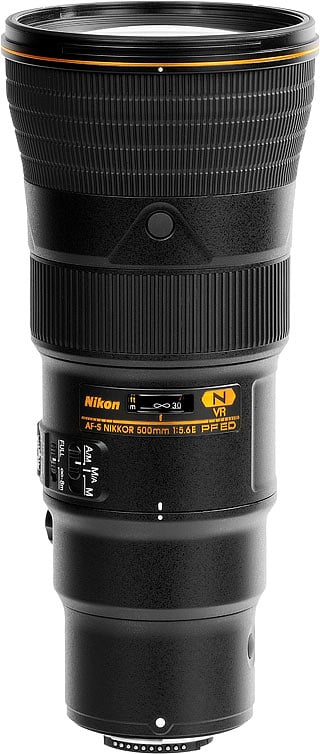 |
NEW: Nikon 500mm f/5.6 PFFor FX cameras, and works on DX cameras. 95mm filters, 51.3 oz./1,463g, 10'/3m close focus. Check Price. 2018 ~ today. |
Nikon AF-S 500mm f/4E FL ED VR
I haven't shot this one yet, and as decades of experiance has shown me, all of Nikon's fast ultra-teles are among the sharpest lenses on the planet, and have super fast autofocus. These are the standards for pro shooting, and I doubt this lens will disappoint.
600mm AF lens index top
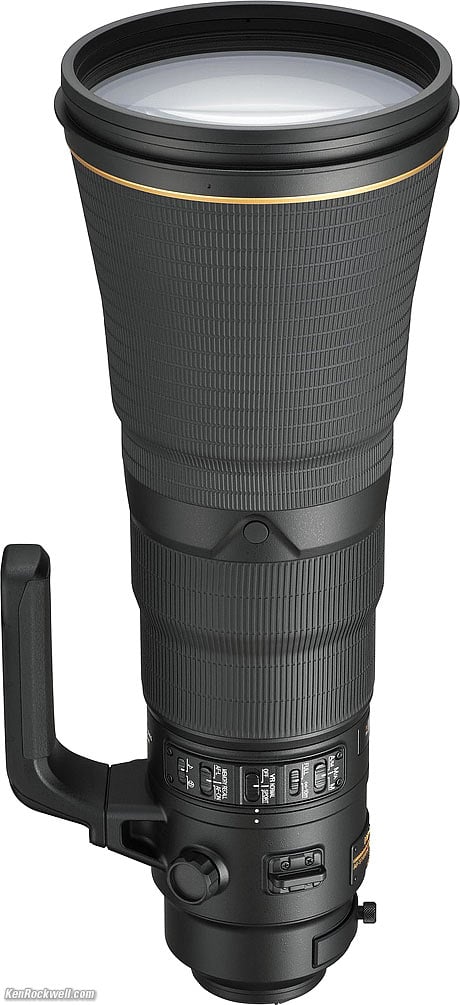 |
600mm f/4E FL VR2015-today |
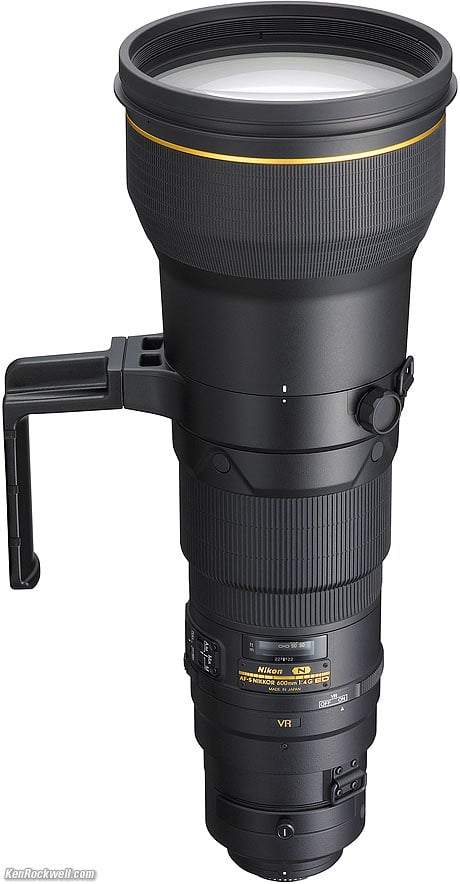 |
600mm f/4 VR FX26 September 2007 |
600mm f/4 AF-I FX |
800mm AF lens index top
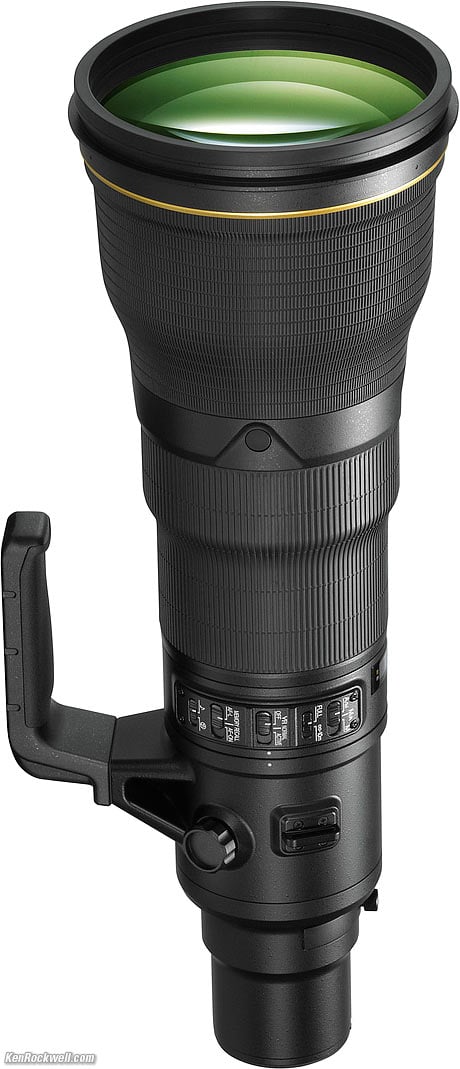 |
800mm f/5.6E FL VR2013-today |
PC & PC-E Tilt/Shift top
PC-E (Tilt & Shift with electronic diaphragm)
|
19mm f/4 PC-E2016- FX and DX coverage, NO filters, manual focus, 31.2 oz./884g, 0.8 feet (0.25 m) close-focus, about $3,400) |
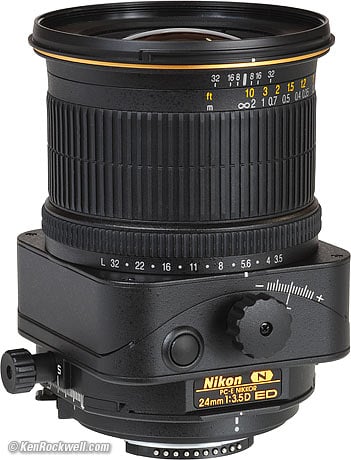 |
24mm f/3.5 PC-E2008- FX and DX coverage, manual focus, 77mm filters, 25.9 oz./734g, 0.7 feet (0.21 m) close-focus, about $2,200. |
|
85mm f/2.8 PC-E2008- FX and DX coverage, manual focus, 22.4 oz./635g, 1.3 feet (0.39 m) close-focus, about $2,000. |
PC (shift-only, manual mechanical diaphragm)
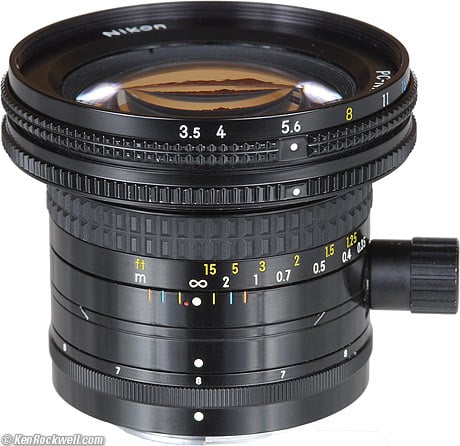 |
Nikon 28mm f/3.5 PC1980-2006 FX and DX coverage, 72mm filters, manual focus, 13.1 oz./372g, 1 feet (0.3 m) close-focus, about $300 used if you know How to Win at eBay. |
Nikon 35mm f/2.8 PC1968-1980 FX and DX coverage, 52mm filters, manual focus, 11.8 oz./335g, 1 feet (0.3 m) close-focus, about $175 used if you know How to Win at eBay. |
Nikon Manual Focus Lenses top
5.6mm 7.5-8mm 11-12mm 13mm 14mm
50mm 55mm 58mm 70-80mm 85-90mm
100-105mm 135-150mm 180mm 200mm
Nikon Pro Normal Zoom Comparison
You can still buy these brand-new, see the selection
Used ones at eBay (there are links from each review and see How to Win at eBay)
5.6mm manual lens index top
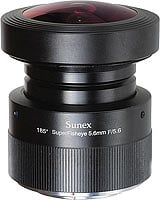 |
Sunex 5.6mm f/5.6 FisheyeBest on DX cameras. 2008 ~ today. |
7.5-8mm Fisheye manual lens index top
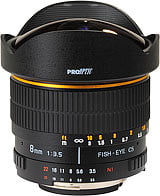 |
Pro-Optic 8mm f/3.5Best on DX Cameras. No filters, 13.8 oz./391g, 1 foot (0.3 m) close-focus. 2009 ~ today. |
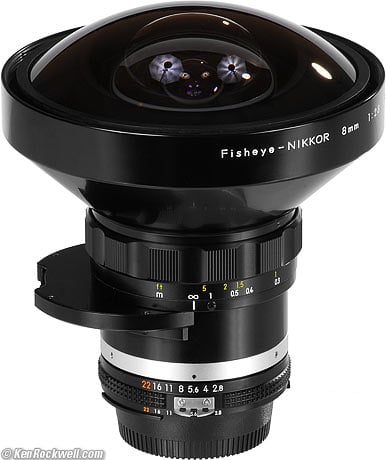 |
8mm f/2.8 FisheyeBest on FX. Filters in internal turret, 38.1 oz. (1,081g), 1 foot (0.3 m) close-focus. Get it used. (1970-1997) |
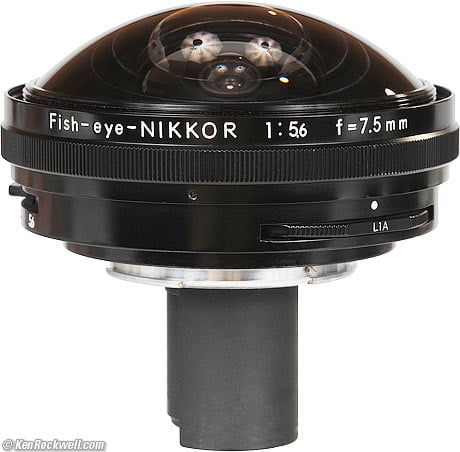 |
7.5mm FisheyeBest on FX. Built-in filters, 10.5 oz. (300 g), fixed pan-focus. Get it used. 1966 ~ 1970 |
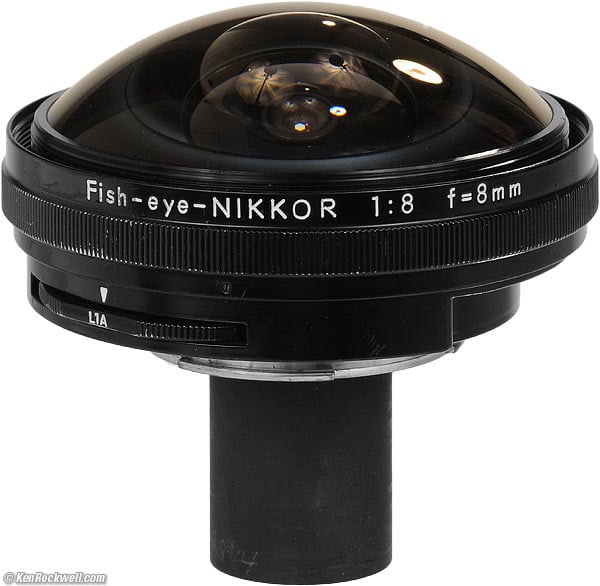 |
8mm f/8 FisheyeBest on FX. Built-in filters, 10.4 oz. (295g), fixed pan-focus. Get it used. 1962-1965 |
11mm & 12mm manual lens index top
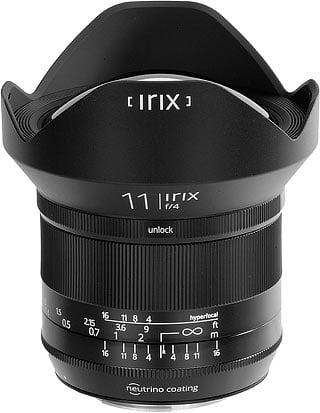 |
NEW: Irix 11mm f/4Full Frame 126º Ultra-Ultrawide. Rear gel flters, 28.9 oz. (820 g), 0.9 feet (0.27 meters) close-focus. 30 April 2018 |
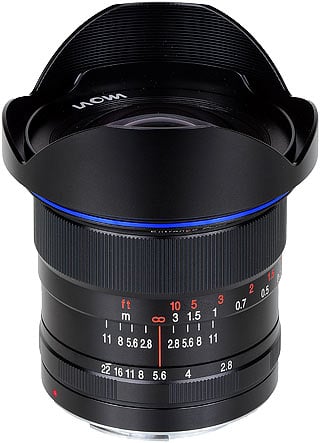 |
Laowa 12mm f/2.8 ReviewFull Frame 12 May 2017 |
13mm manual lens index top
Nikon Ultra-Ultrawide Lens Comparison
 |
Nikon 13mm f/5.6 FXFor FX cameras, including 35mm cameras. Also works on DX cameras. Includes rear bayonet filters, 43.2 oz. (1,225g), 1 foot (0.3 m) close-focus. Get it used. 1976 ~ 1998. |
14mm manual lens index top
 ProOptic 14mm f/2.8 26 October 2010
15mm manual lens index top
Nikon Ultra-Ultrawide Lens Comparison
|
NEW: Irix 15mm f/2.495mm filters, 22.6 oz./642g, 0.8 feet (0.25 m) close-focus 18 May 2017 for all formats, especially 35mm and full-frame |
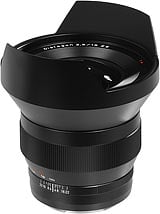 Zeiss 15mm f/2.8 Review 16 March 2012
Nikon 15mm f/5.6 29 February 2008
16mm Fisheye manual lens index top
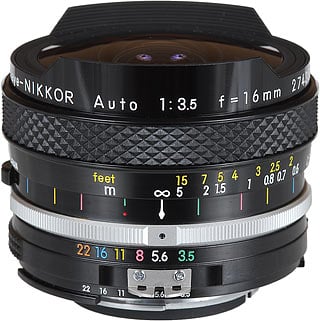 |
16mm f/3.5 Fisheye27 July 2017 |
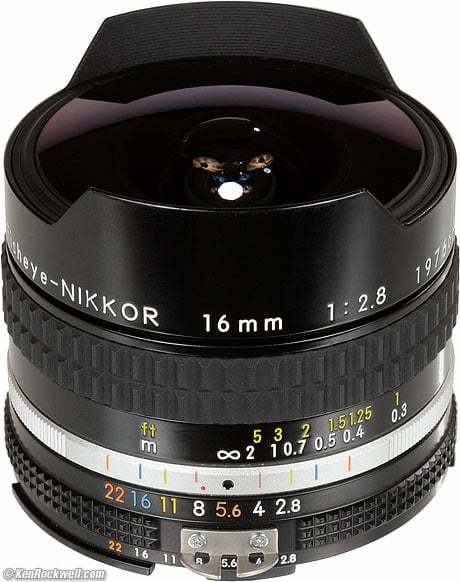 |
16mm f/2.8 AI-s Fisheye |
17mm manual lens index top
17mm and 18mm Lenses and Zooms Compared
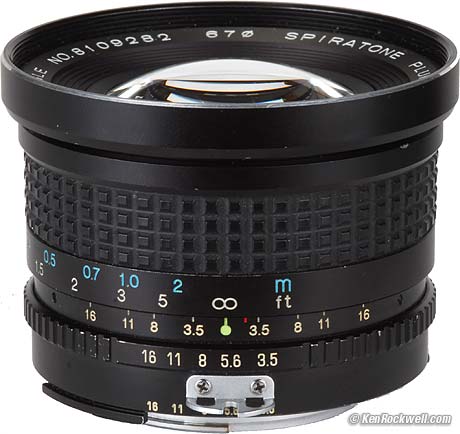 |
17mm f/3.5 Tokina SL11 February 2015 |
18mm manual lens index top
17mm and 18mm Lenses and Zooms Compared
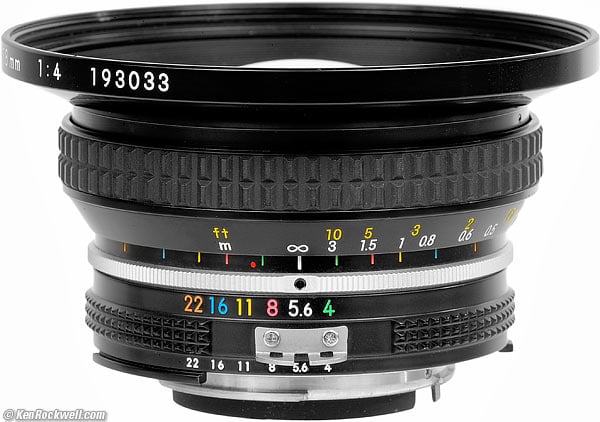 |
18mm f/4 AI-s11 February 2015 |
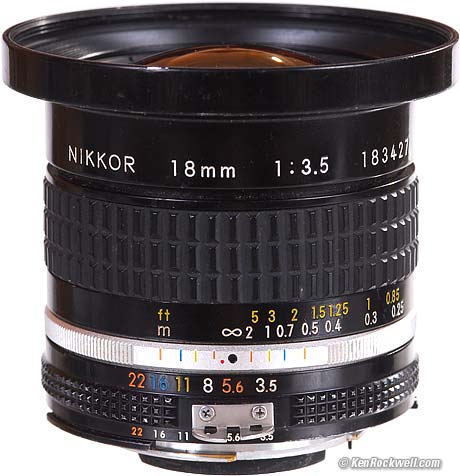 |
18mm f/3.5 AI-s |
 |
Zeiss 18mm f/3.5(Nikon mount, manual focus) 15 December 2009 Zeiss 18mm f/3.5 Compared to Nikon 14-24mm and Canon 16-35mm L II 15 December 2009 |
19mm manual lens index top
|
2016- FX and DX coverage, NO filters, manual focus, 31.2 oz./884g, 0.8 feet (0.25 m) close-focus, about $3,400) |
20~21mm manual lens index top
20mm Sharpness Comparison 23 September 2010
Light Falloff Comparison of Every Nikon 20mm Lens 18 February 2008
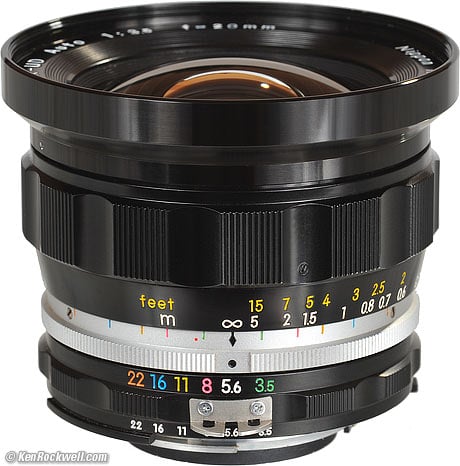 |
Nikon 20mm f/3.5 UD20 September 2010 |
 |
Nikon 20mm f/4Smallest Ultrawide Lens |
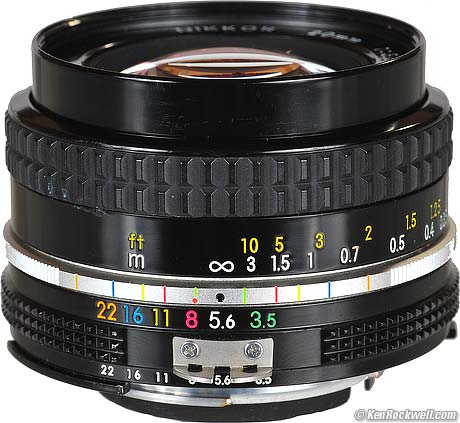 |
Nikon 20mm f/3.521 September 2010 |
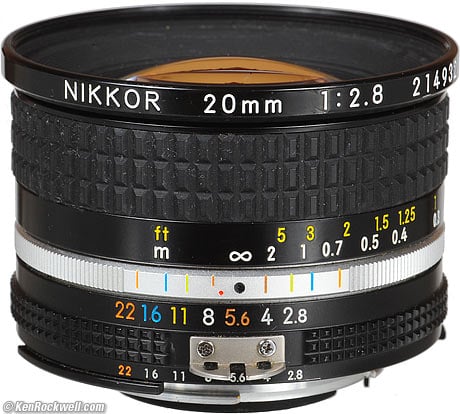 |
Nikon 20mm f/2.8 AI-s21 September 2010 |
 |
Voigtländer 20mm f/3.5 Color-Skopar23 September 2010 |
 |
Zeiss 21mm f/2.8Zeiss 21mm f/2.8 Compared to Nikon 14-24, Canon 16-35 L II and LEICA 21mm f/2.8 ASPH16 December 2009 16 December 2009 |
24mm manual lens index top
All Known Nikon 24mm Lenses and Zooms Compared 14 August 2010
24mm Perspective-Control 31 January 2008
Nikon 24mm PC-E Compatibility 09 April 2008
28mm manual lens index top
|
28~45mm f/4.5 AI(1975~1978) bigger. The Nikon 28~45mm f/4.5 AI was the world's widest zoom lens for a 35mm camera when it came out in 1975. Canon bested it with the FD 28-50mm f/3.5 the next year in 1976, and then with the earth-shattering FD 24-35mm f/3.5 S.S.C. Aspherical of 1978. |

|
28mm f/2.0(1970~2005) 52mm filters, 13 oz./355g, 0.8'/0.25m close focus |

|
28mm f/2.8 AI16 July 2008 |
|
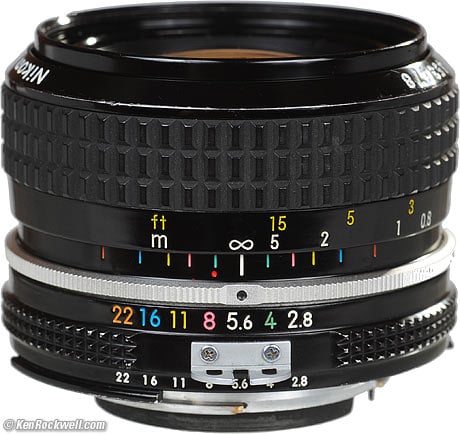
28mm f/2.8 AI-sNikon's sharpest wide angle lens |
|
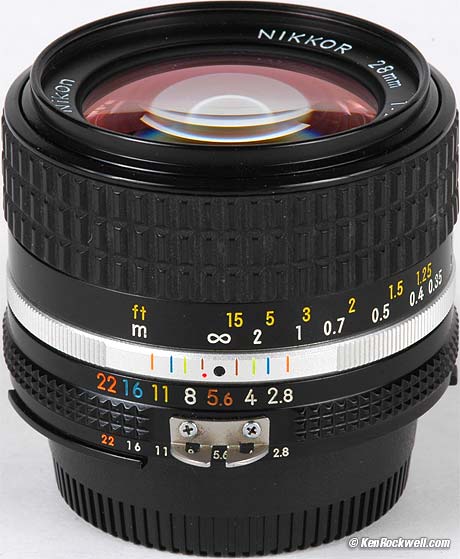
28mm f/3.5 AI04 June 2007 |
|
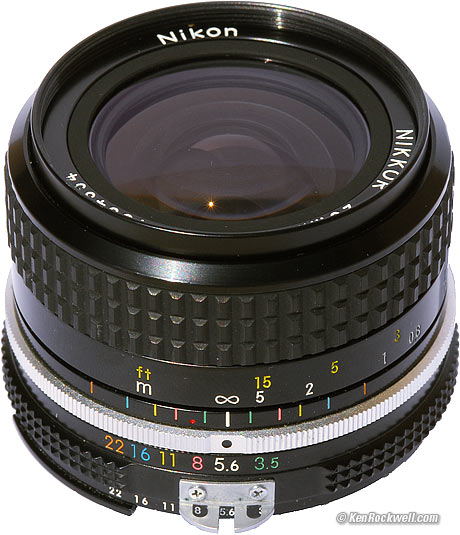
28mm f/3.5 PC15 April 2008 |

|
28-50mm f/3.5 AI-s14 July 2008 |

35~45mm manual lens index top
|
35mm f/1.4 AI-s
|

Nikon 35mm f/2.8 AI 14 December 2007
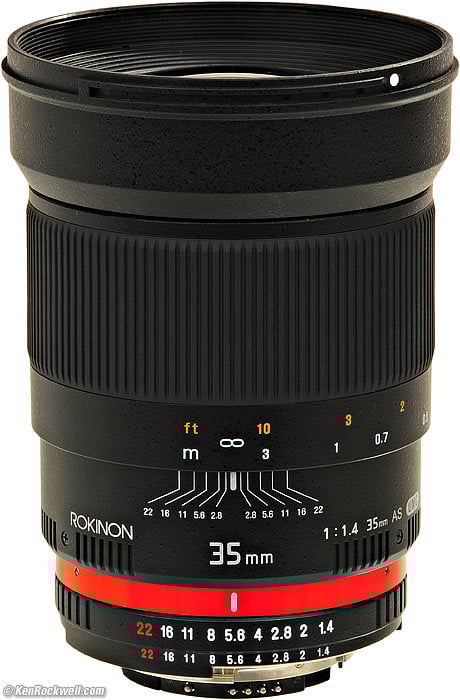 Samyang 35mm f/1.4. 09 July 2011
35mm f/2.8 PC (Perspective Control)
Nikon 35-70mm f/3.5 AI 13 December 2007
Nikon 35-70mm f/3.5 AI-s 18 December 2007
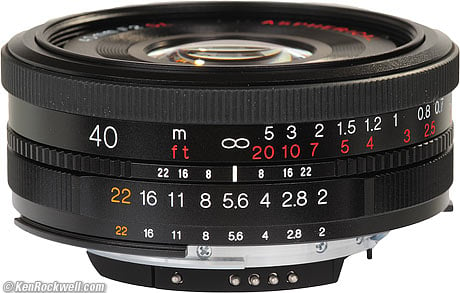 Voigtländer 40mm f/2 AI-P 29 August 2010
Nikon 45mm f/2.8 PC-E July 2008
50mm manual lens index top
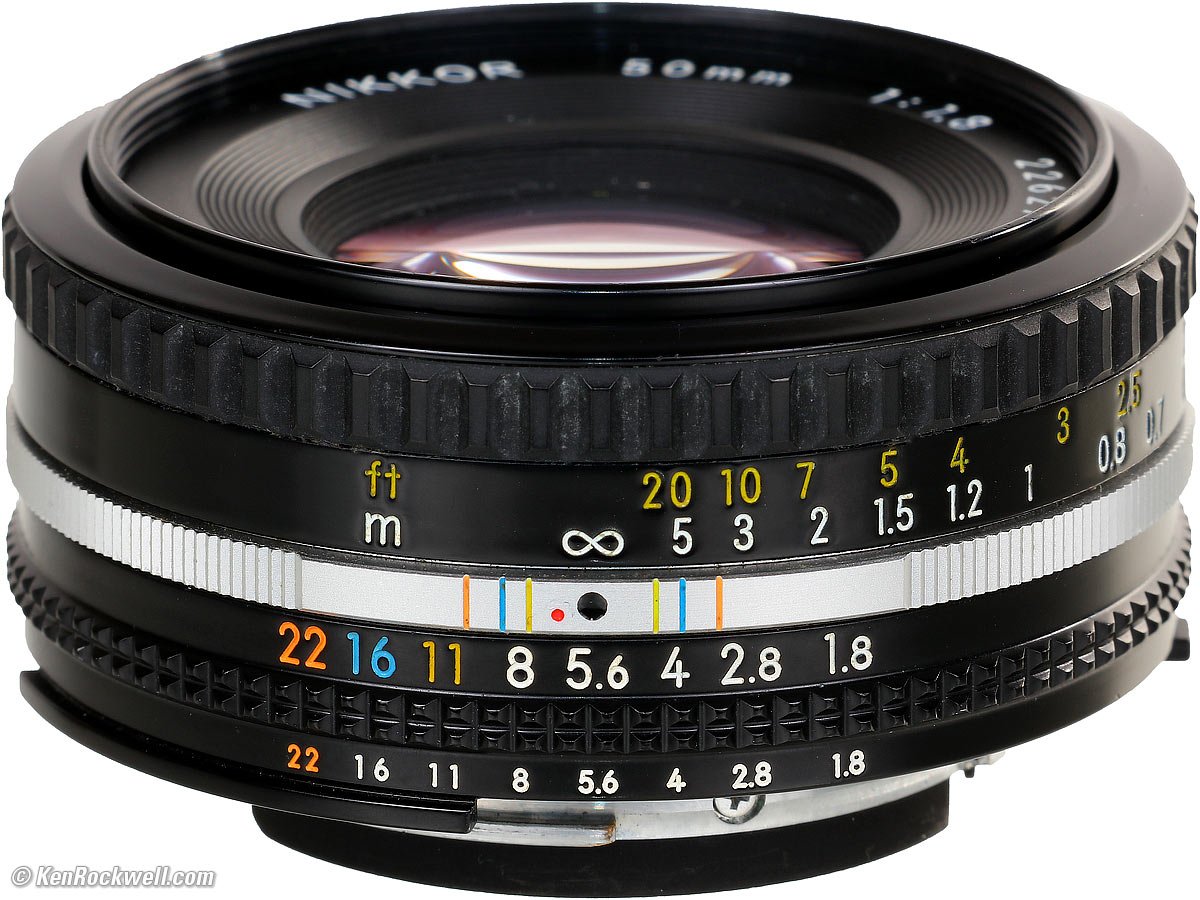 |
NEW: Nikon Pancake-NIKKOR 50mm f/1.8 AI-s18 February 2018 |
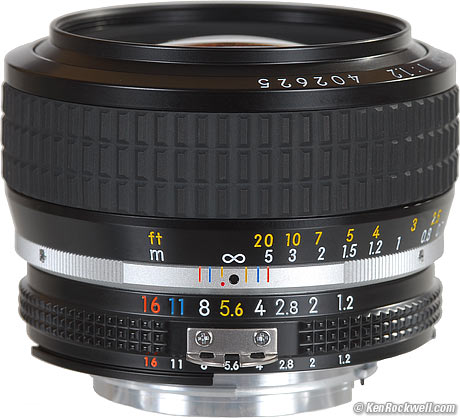 |
Nikon 50mm f/1.2 AI-s11 October 2007 Nikon 50mm f/1.2 Coma Examples 09 September 2010 |
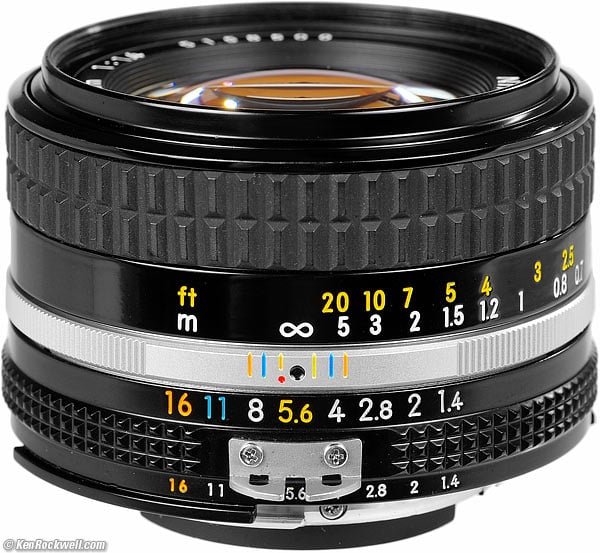 |
50mm f/1.4 AI-s Review (1981-today)52mm filters, 8.8 oz./249g. |
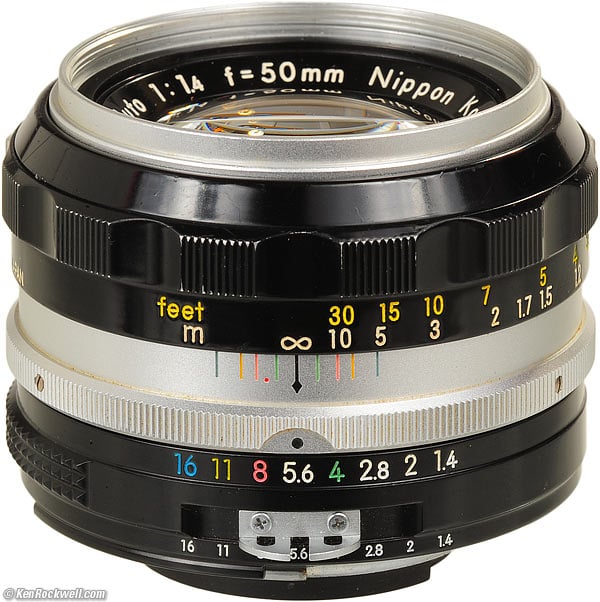 |
Nikon NIKKOR-S Auto 50mm f/1.423 May 2012 |
50mm f/2 Nikkor-H 06 September 2007
50mm f/1.8 AI-s Series E (What are Series E)
Nikon High-Speed 50mm Lens Sharpness Comparison 09 Sep 2010
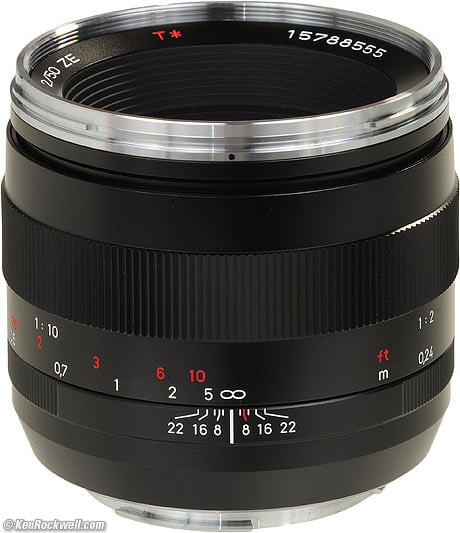 Zeiss 50mm f/2 Makro-Planar Review 10 August 2011
55mm manual lens index top
|
55mm f/1.2 AI52mm filters, 14.5 oz./410g, 1.63'/0.5m close focus. Sold new 1965 ~ 1978, and easy to get it used today. Reviewed December 2012 |

|
55mm f/2.8 Micro AI-s52mm filters, 10 oz./290g. |
|
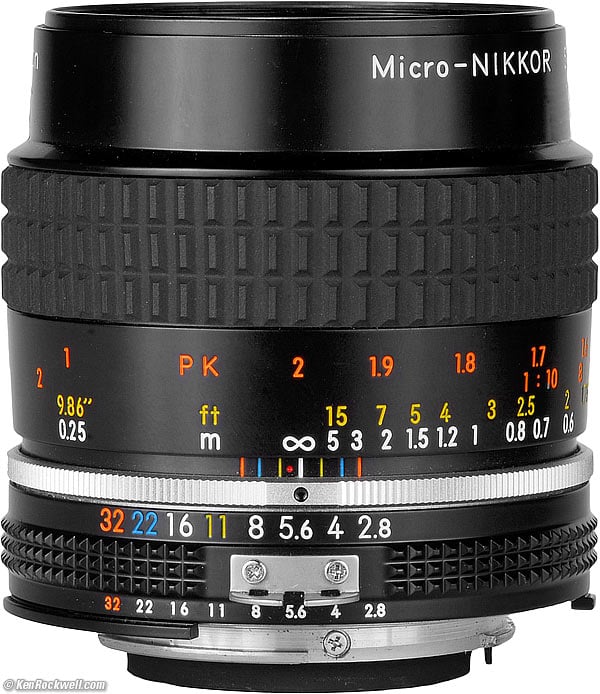
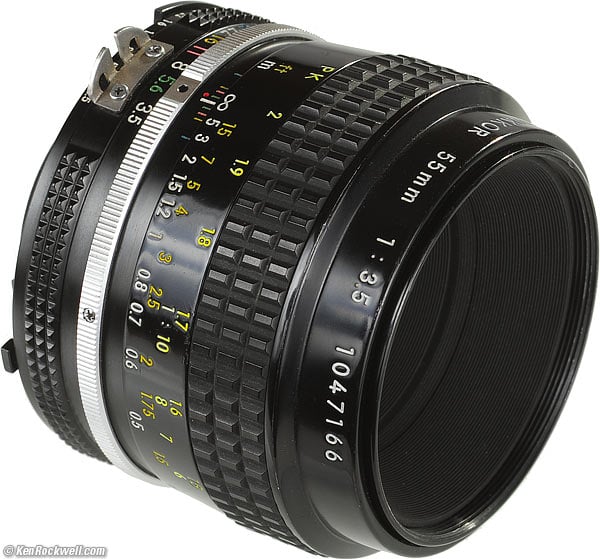
55mm f/3.5 Micro AI52mm flters, 8.5 oz./241g. Sold new 1969 ~ 1979, and easy to get it used today. Reviewed 05 June 2003. |
58mm manual lens index top
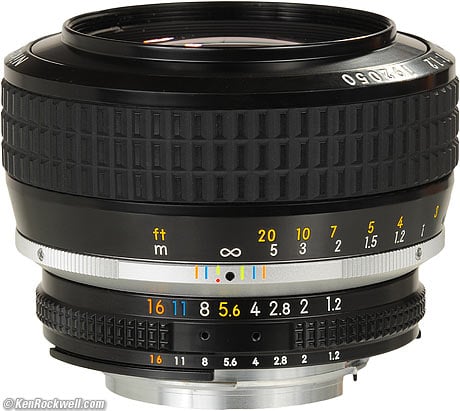 |
58mm f/1.2 Noct-NIKKOR10 September 2010 |
 |
Nikon 58mm f/1.41959-1962: 52mm filters, 12.4 oz./350g. 20 October 2012 |
70-80mm manual lens index top
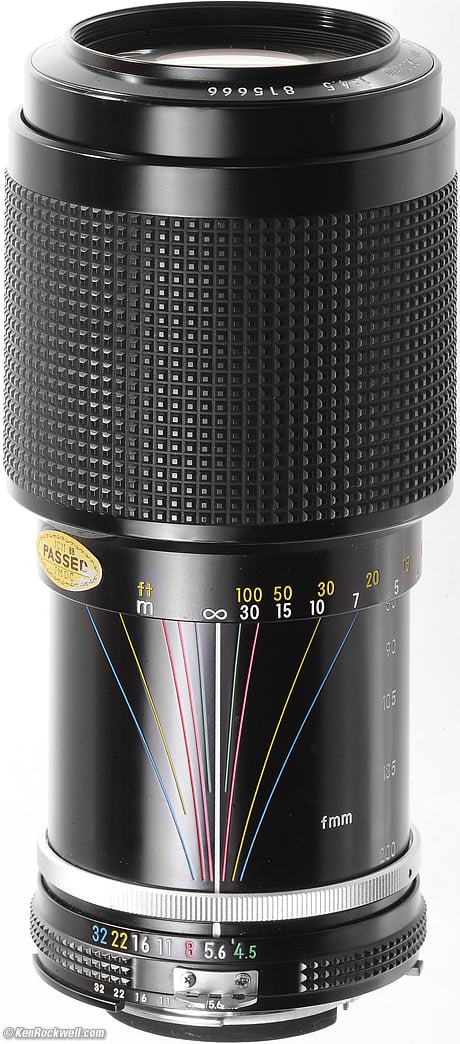 Nikon 80-200mm f/4.5 N Review 08 May 2015
Vivitar 70-210mm Series 1 04 March 2008
80-200mm f/4 AI-s 09 November 2005. Also includes earlier manual tele zooms.
85-90mm manual lens index top
Nikon 85mm f/2.8 PC-E 12 March 2008
85mm Lens Specifications Compared 24 June 2009
Nikon 85mm Lens Bokeh Comparison 26 March 2008
Nikon 85mm Lens Central Sharpness Comparison 23 June 2009
Nikon 85mm Lens Corner Sharpness Comparison 23 June 2009
Nikon 85mm f/1.8 24 June 2009
Nikon 85mm f/1.4 AI-s 09 July 2008
Vivitar 85mm f/1.4 Series 1 24 June 2009
 Voigtländer 90mm f/3.5 APO-Lanthar 22 September 2010
100-105mm manual lens index top
105mm Center Sharpness Comparison
105mm Corner Sharpness Comparison
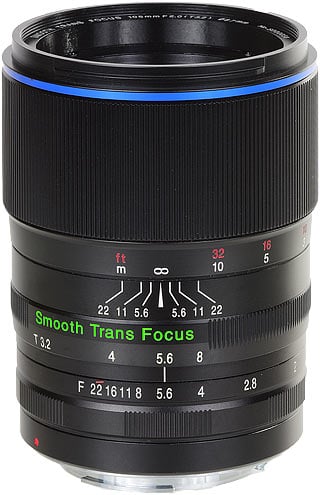 NEW: Laowa 105mm f/2 Smooth Trans-Focus Lens Review 13 September 2016
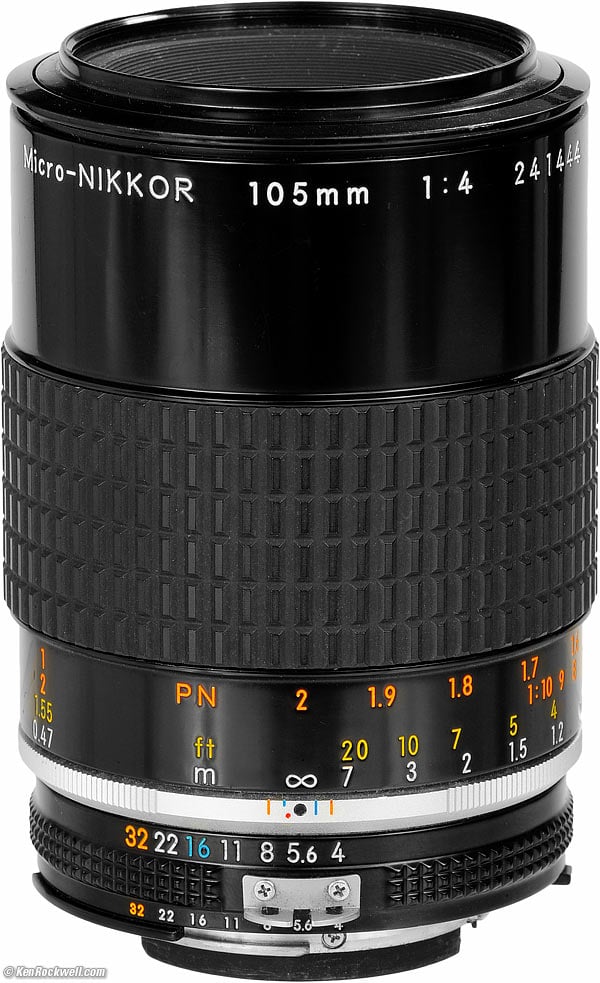 Nikon 105mm f/4 Micro 15 July 2010
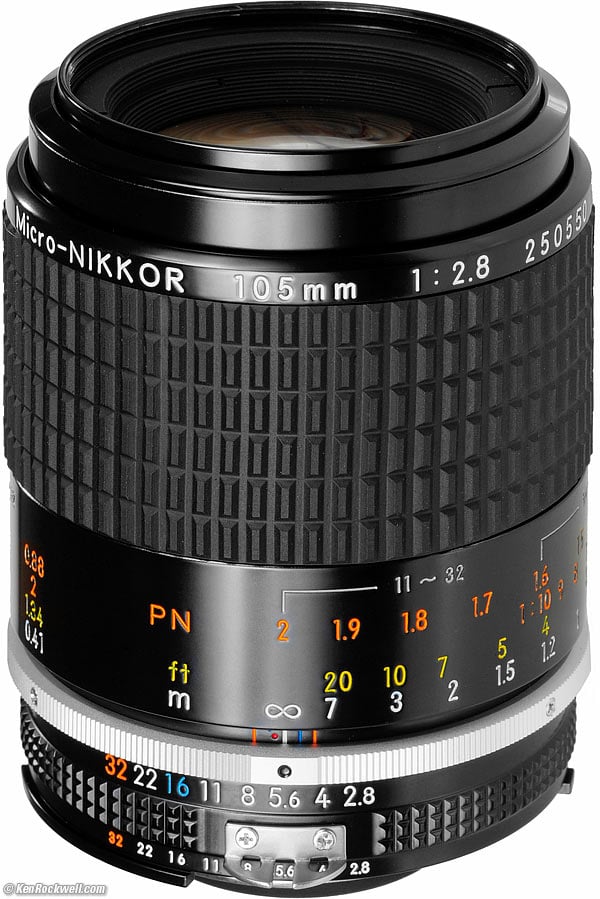 Nikon 105mm f/2.8 AI-s Micro 16 July 2010
|
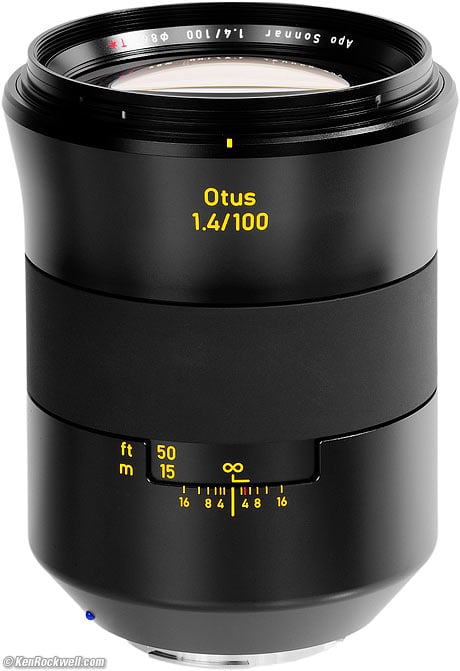
NEW: Zeiss Otus 100mm f/1.4Metal 86mm filter thread, 47.6 oz. (3 pounds or 1,349g), 3.3'/1m close focus. 16 June 2019 |
100mm f/2.8 Series E (What are Series E?)
Tokina 100-300mm f/4 AT-X 28 August 2008
135-150mm manual lens index top
|
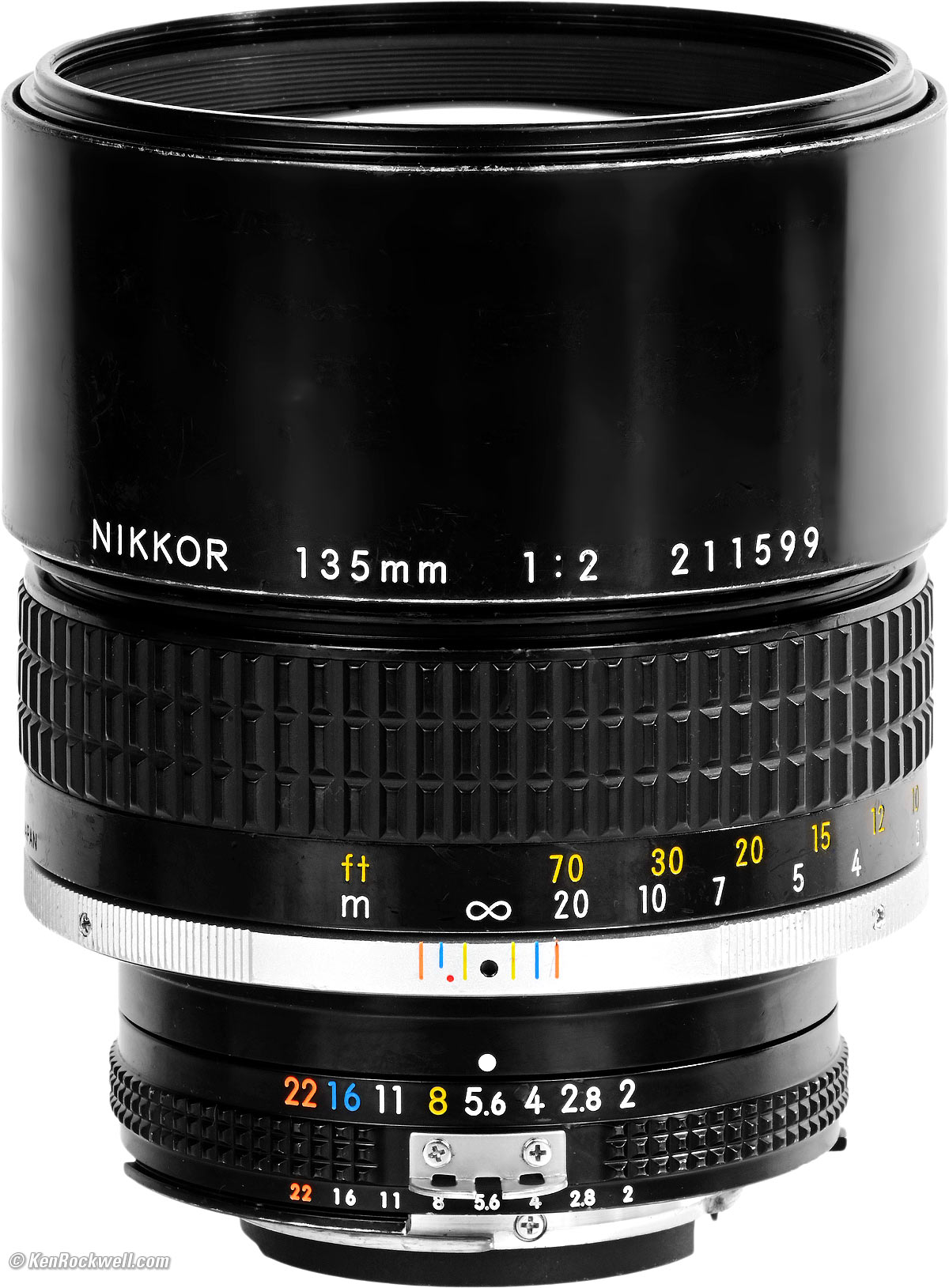
NEW: Nikon NIKKOR 135mm f/2 AI-sFX, DX and 35mm coverage, 72mm metal filter thread, built-in hood, 30.1 oz./854g, 4¼'/1.3m close-focus. Get it used if you know How to Win at eBay. 22 May 2019 |
|
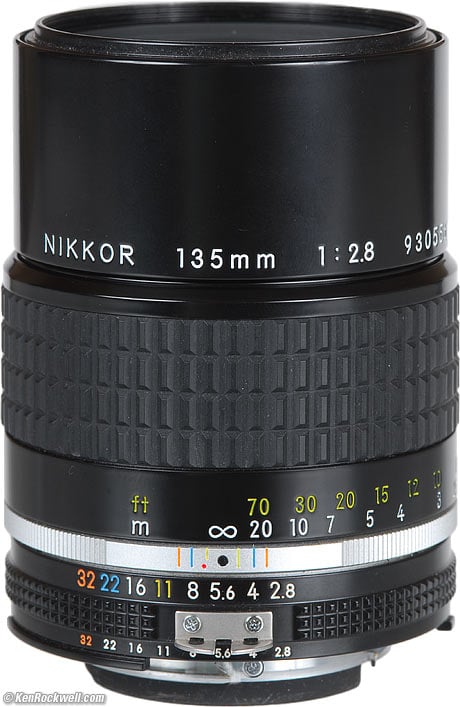
135mm f/2.8 AI-s27 March 2004 |
|
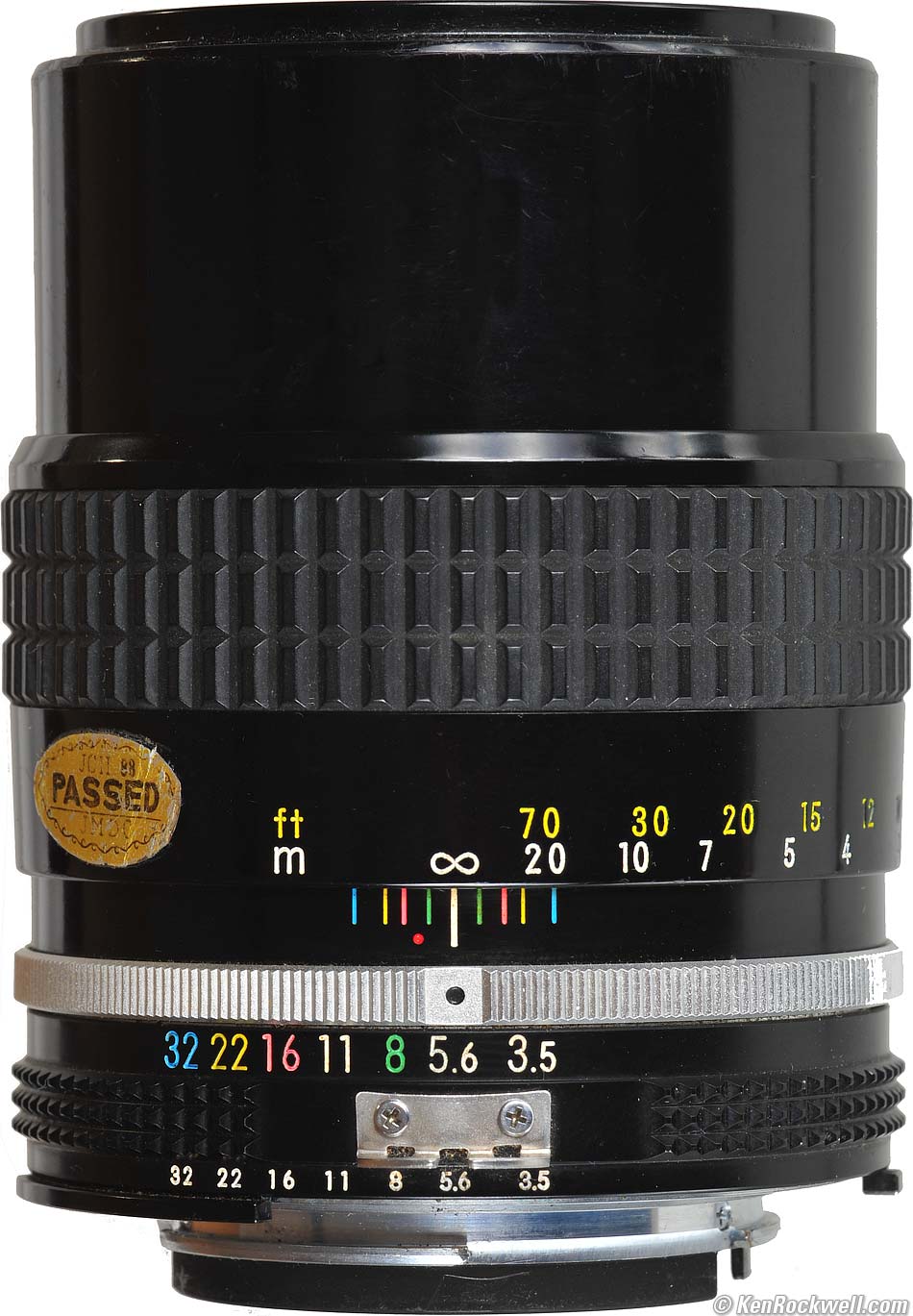
135mm f/3.5 AI10 January 2008 |
|
Irix 150mm f/2.8 Macro.Manual-focus only, 77mm filters, 29.2 oz./828g, 1:1 macro, 1.14'/0.345m close focus. 08 January 2019 |
Tokina 150-500mm 17 May 2008
180mm manual lens index top
|
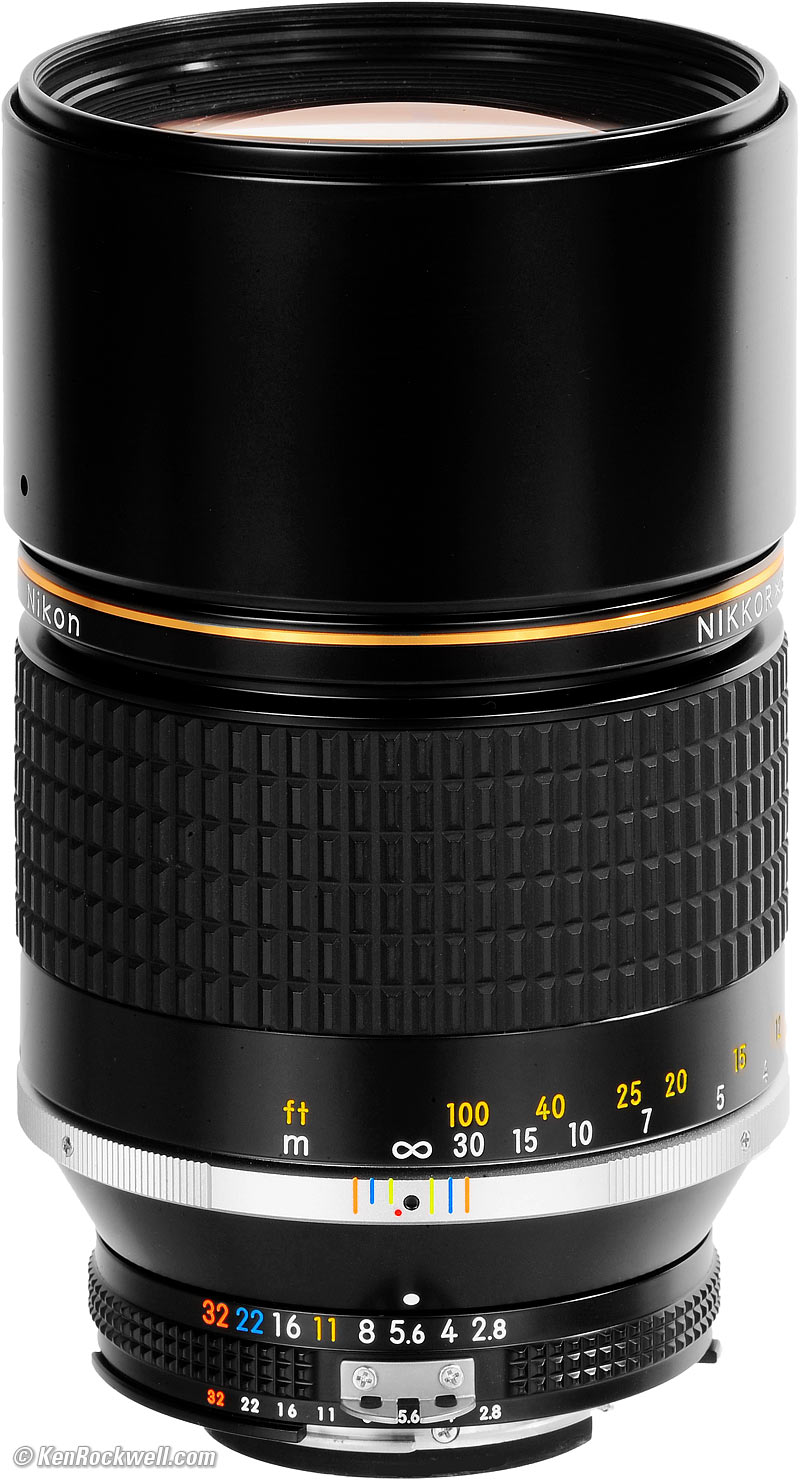
NEW: NIKKOR✱ED 180mm f/2.8 AI-s (1981~2005)FX, DX and 35mm coverage, 72mm metal filter thread, built-in hood, 28.0 oz./793g, 6'/1.8 m close focus. Get it used if you know How to Win at eBay. See also Nikon 180mm f/2.8 History. 19 May 2019 |
|
NEW: Nikon NIKKOR 180mm f/2.8 AI (1970~1981)FX, DX and 35mm coverage, 72mm metal filter thread, built-in hood, 31.2 oz./885g, 6'/1.8 m close focus. Get it used if you know How to Win at eBay. See also Nikon 180mm f/2.8 History. 21 May 2019 |
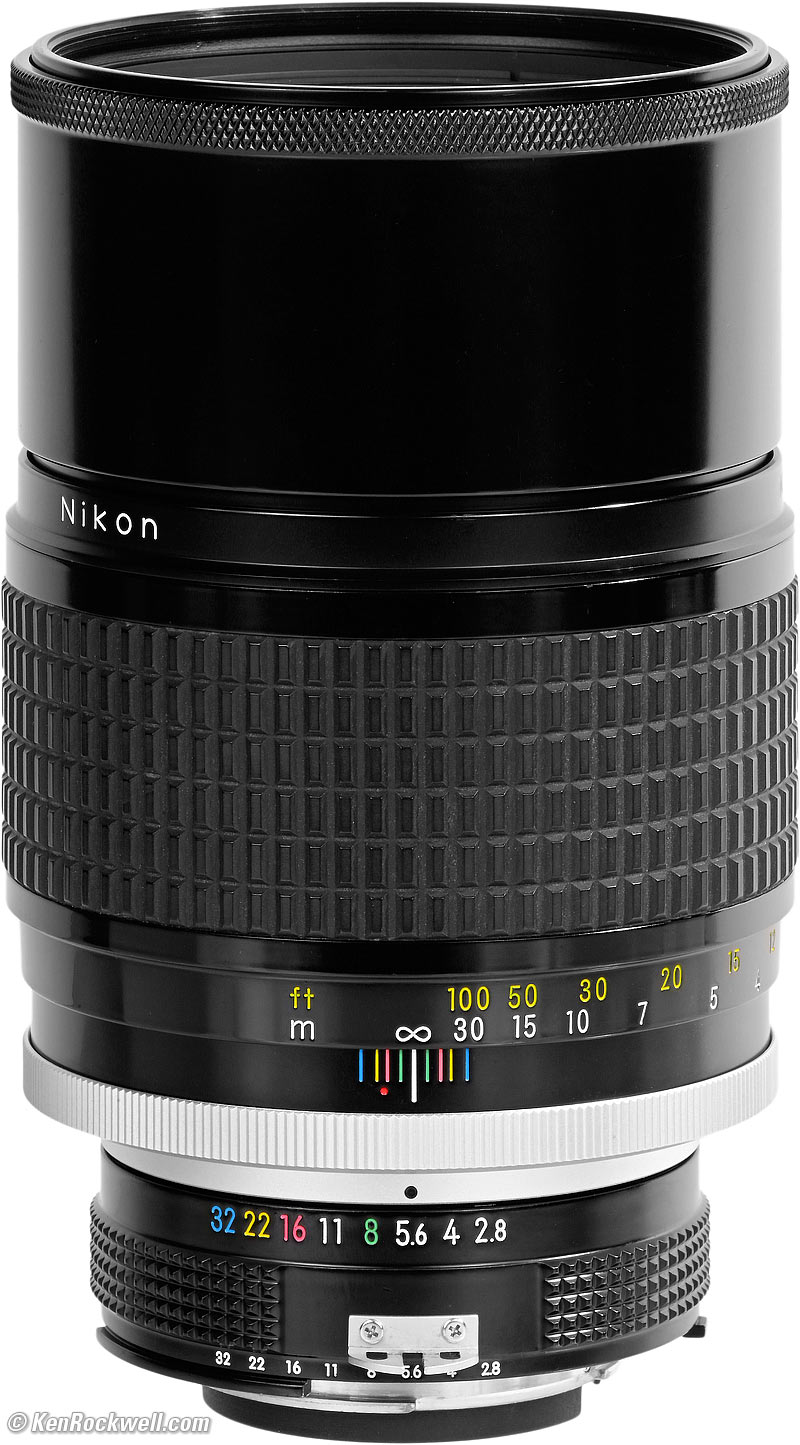
200mm manual lens index top
|
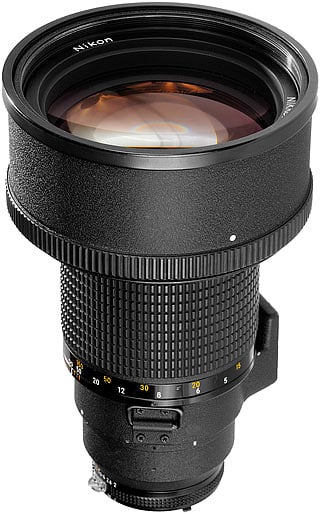
NEW: NIKKOR✱ED 200mm f/2 AI-s (1977~2005)FX, DX and 35mm coverage, metal 122mm filter thread, built-in hood, 84.7 oz./2,400g, 8.2'/2.5m close focus. Get it used if you know How to Win at eBay. 20 May 2019 |
200mm Center Sharpness Comparison
200mm Corner Sharpness Comparison
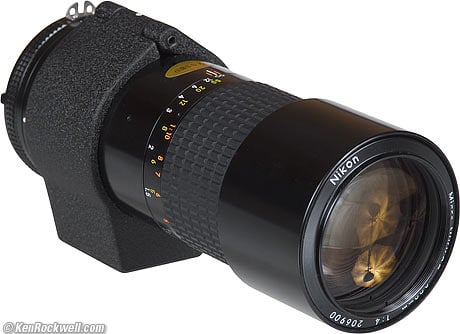 Nikon 200mm f/4 Micro-NIKKOR 17 August 2010
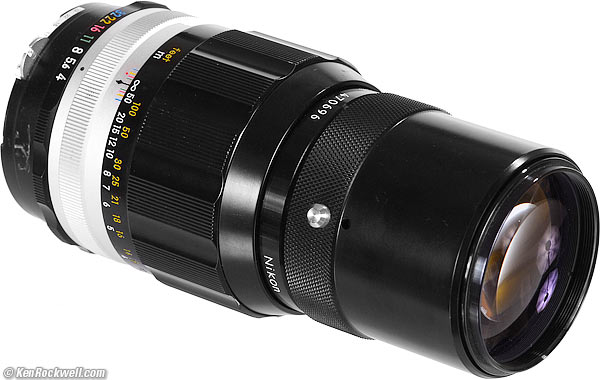
300mm manual lens index top
|
300mm f/2.8 ED-IFFX, DX and 35mm coverage, 122mm, 39mm drop-in or gel filters, 86 oz./2,450g, 13'/4 m close focus Get it used if you know How to Win at eBay. 1977-1982 |
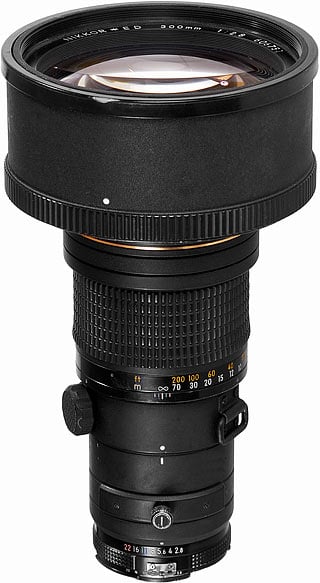
400mm manual lens index top
400mm f/2.8 AI-s(1985-2002) |
500mm manual lens index top
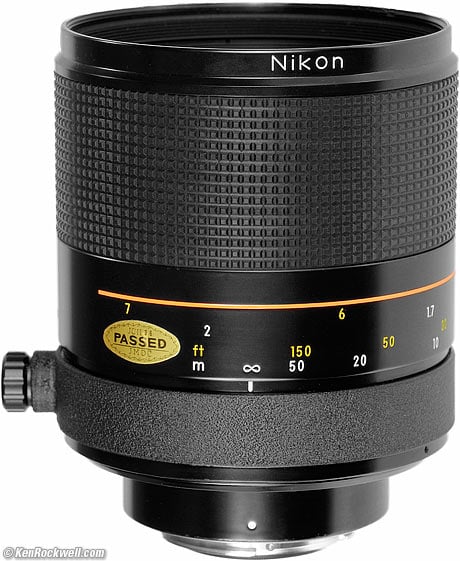
600mm manual lens index top
Nikon 600mm f/5.6 NIKKOR-P 22 July 2008
Nikon CU-1 Focusing Unit 22 July 2008
Lens Scope Telescope Converter top
Nikon Lens Scope Converter |
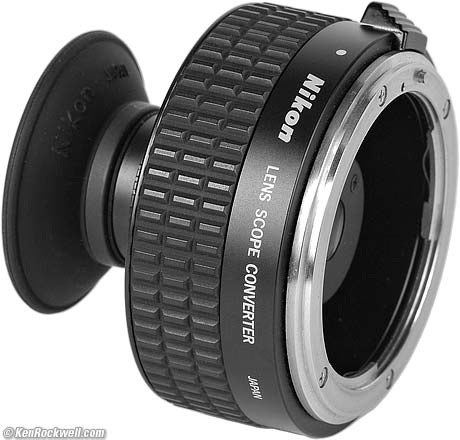
Teleconverters AF lens index top
Autofocus Teleconverters
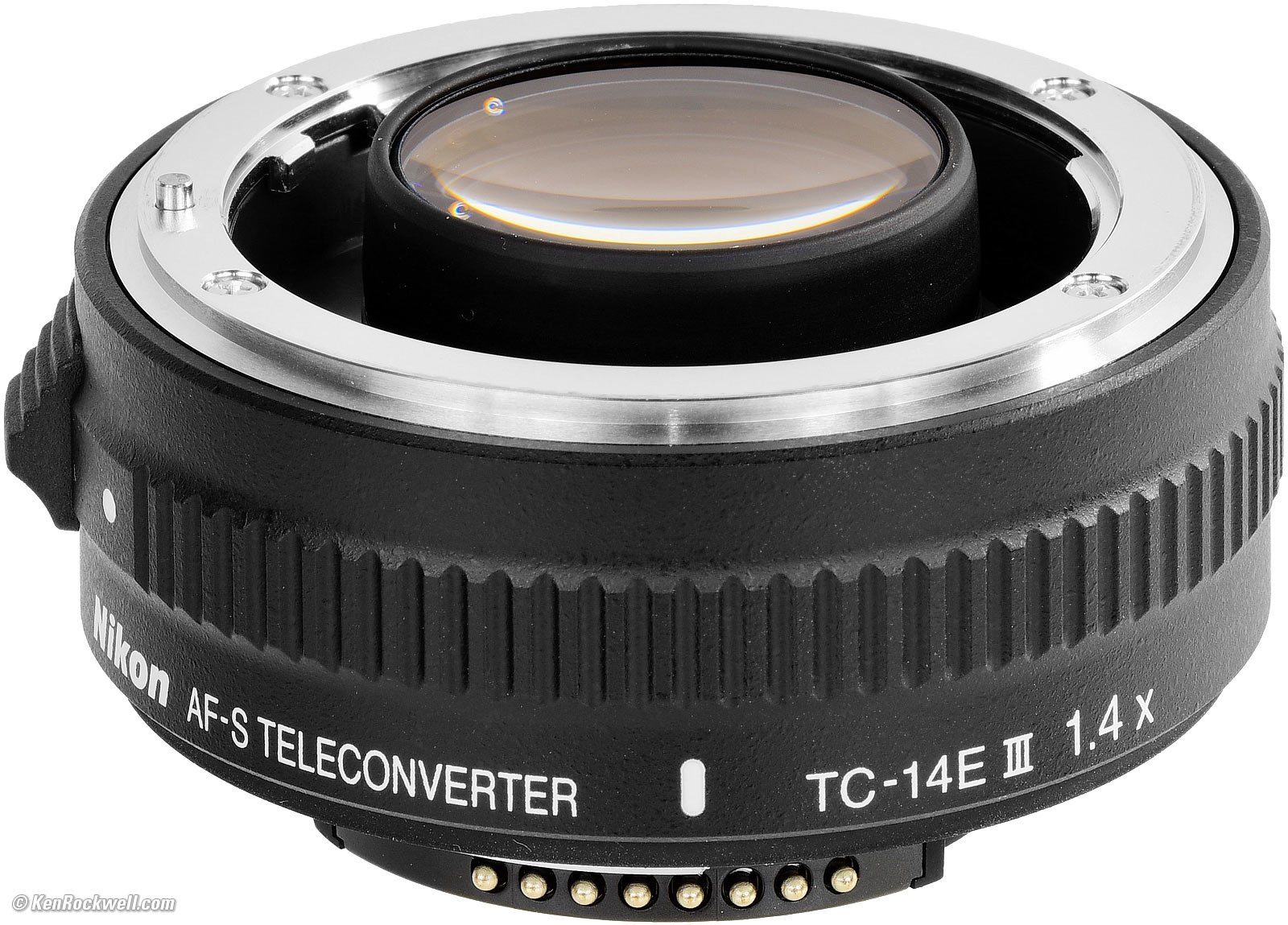
TC-14E AF-I, AF-S Teleconverter
TC-20E AF-I, AF-S Teleconverter
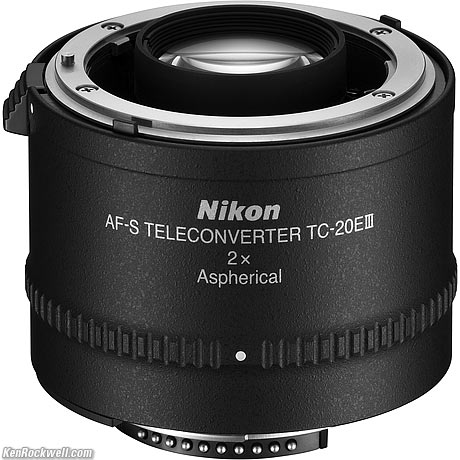 Nikon TC-20E III
Manual Focus Teleconverters
Comparisons top
Most of my individual lens reviews have detailed comparison sections. These below are only some of the broadest comparisons:
|
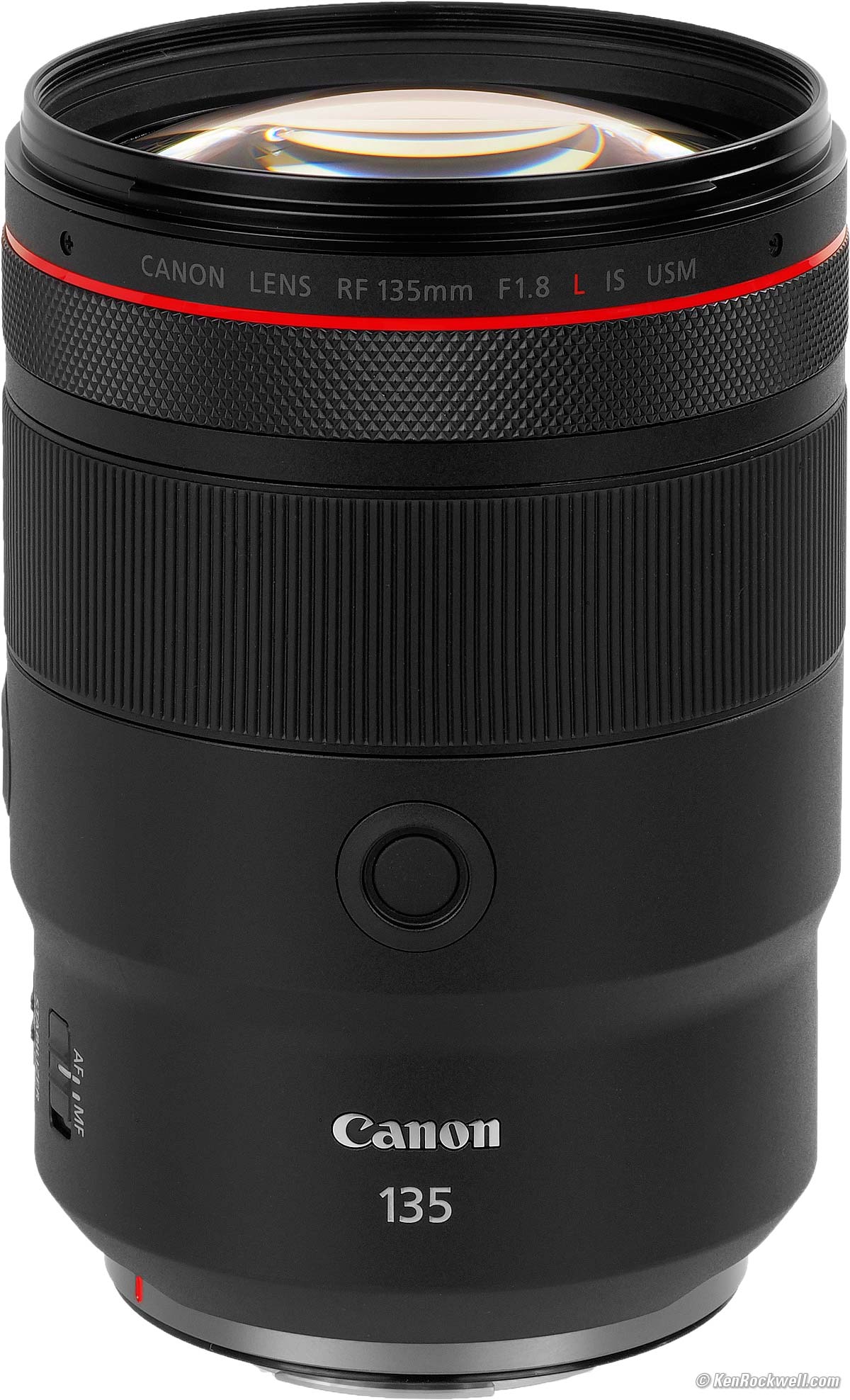
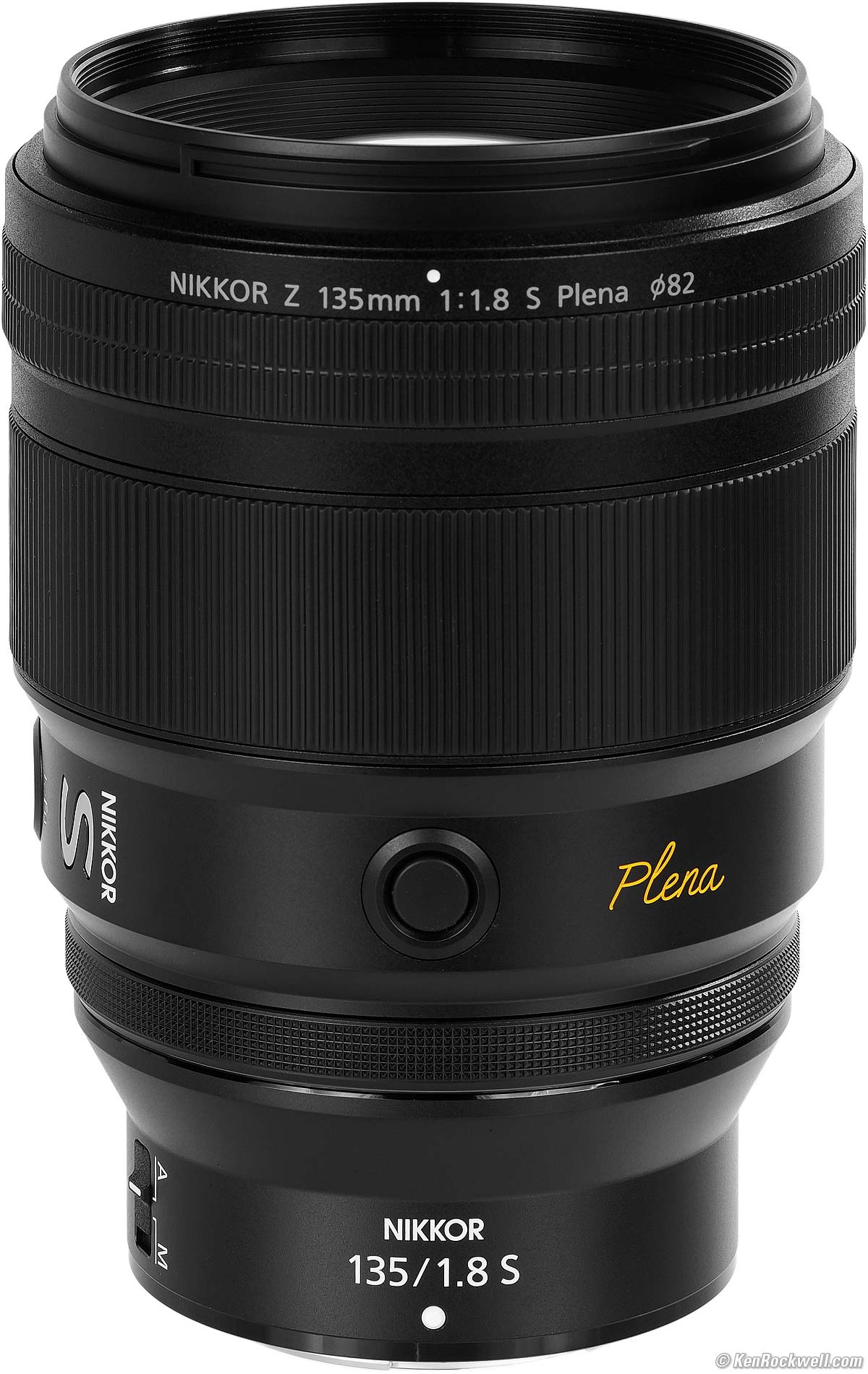
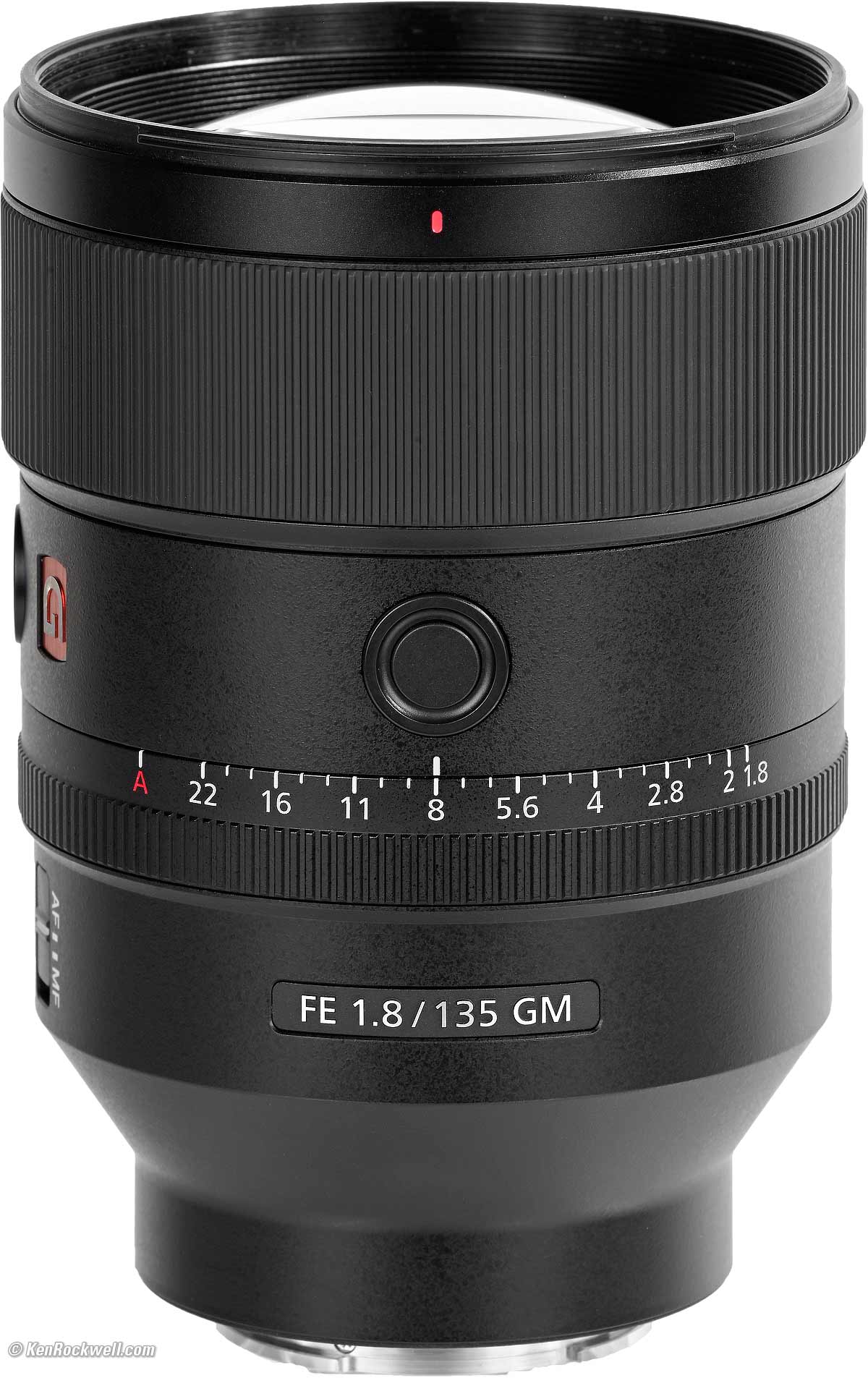
NEW: All 135mm f/1.8 Lenses Compared.05 July 2025 |

|
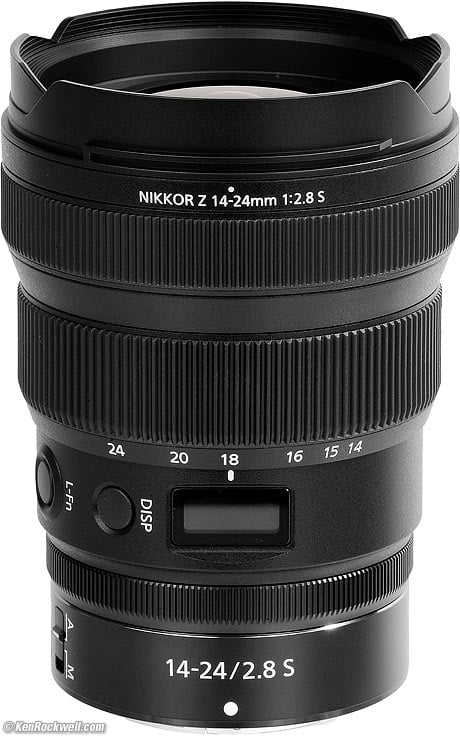
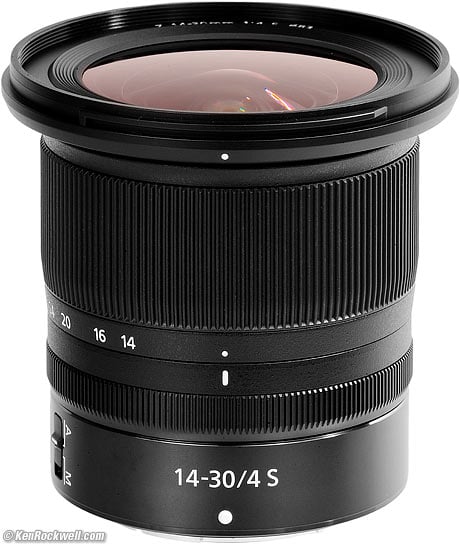
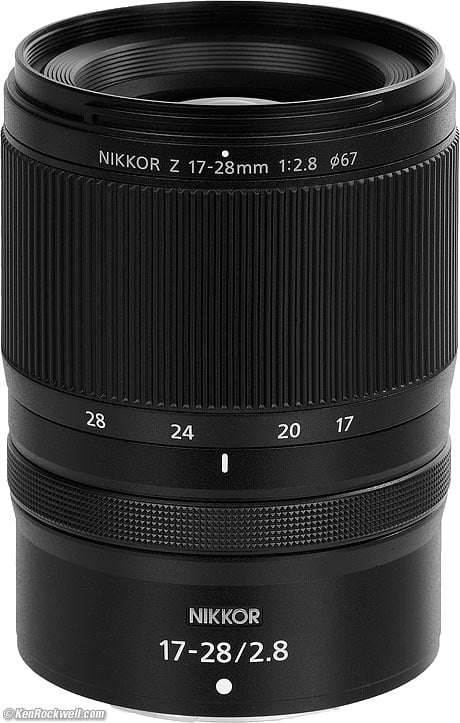
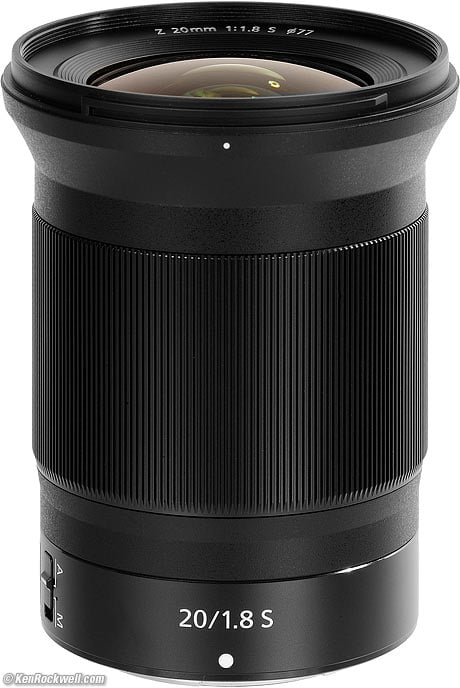
NEW: Nikon Z Full-Frame Ultrawides Compared.06 December 2022. |
|
All Nikon 105mm Macro Lenses Compared.28 July 2022 |
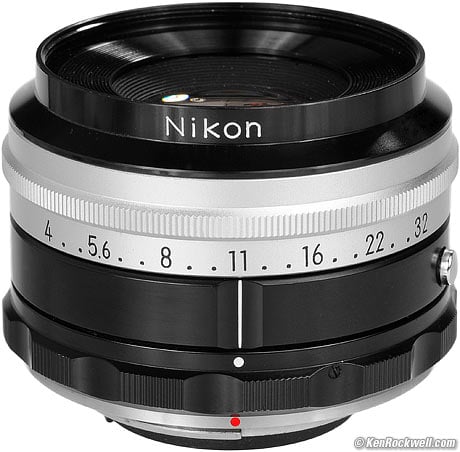
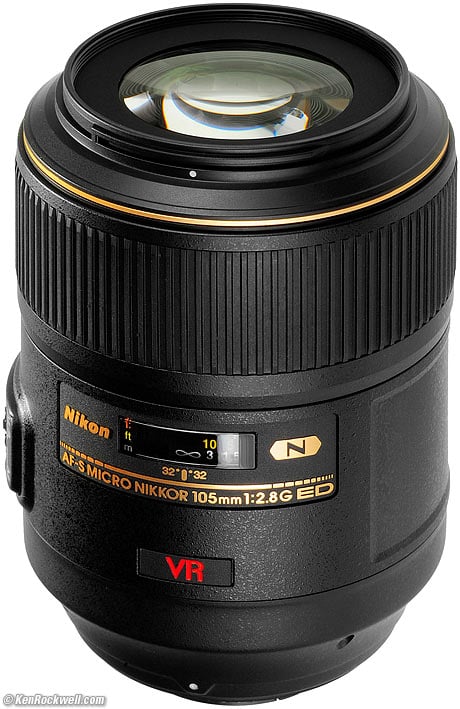
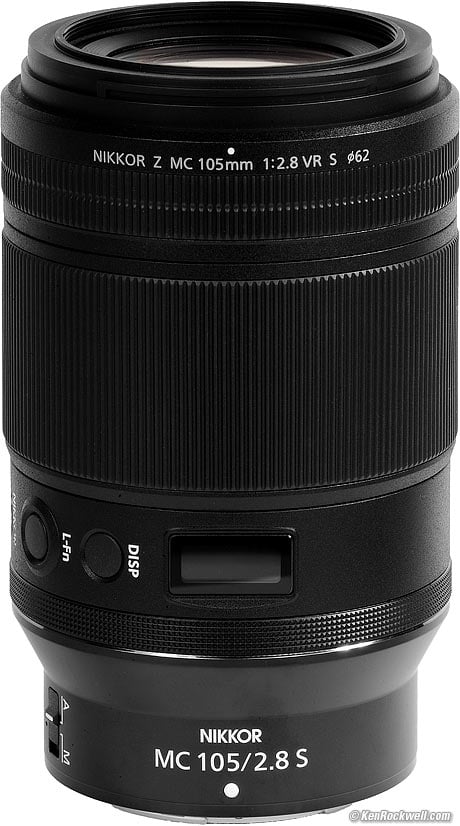
|
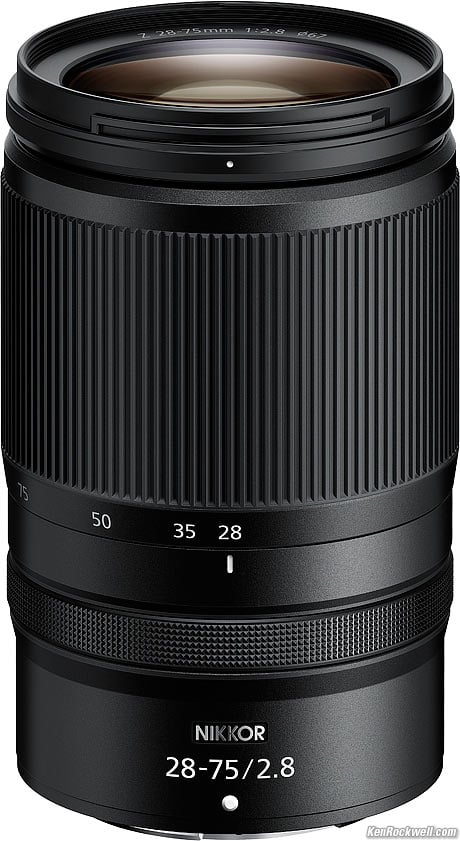
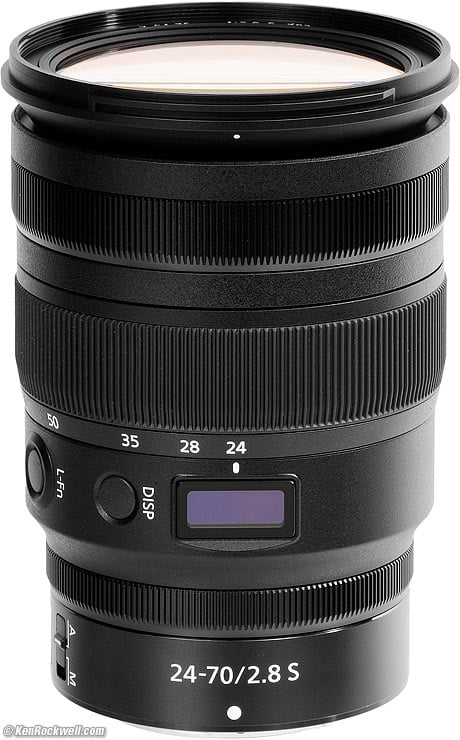
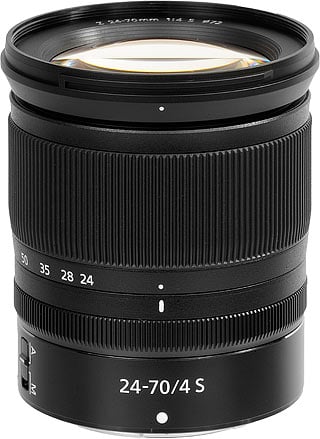
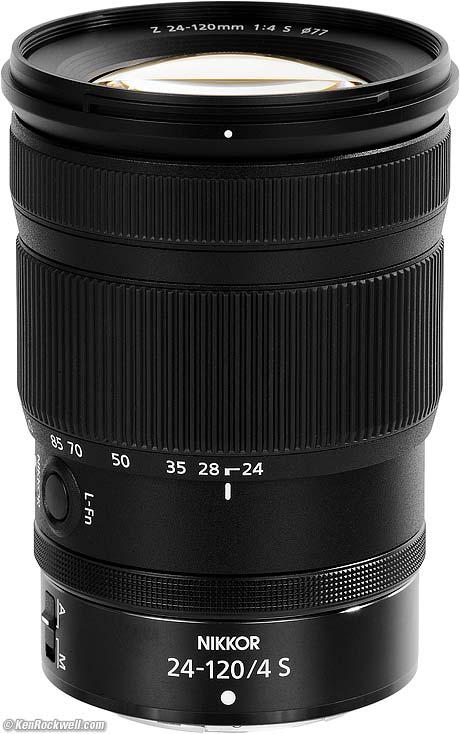
Nikon Full-Frame Z Midrange Zooms Compared.13 May 2022 |
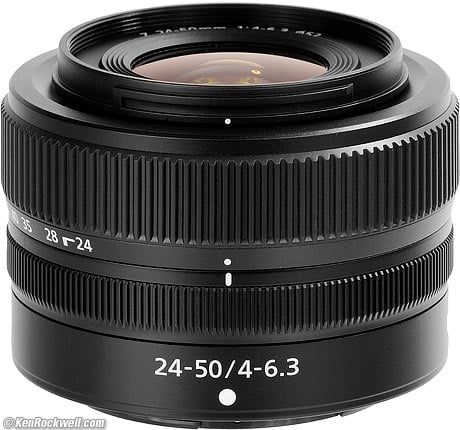
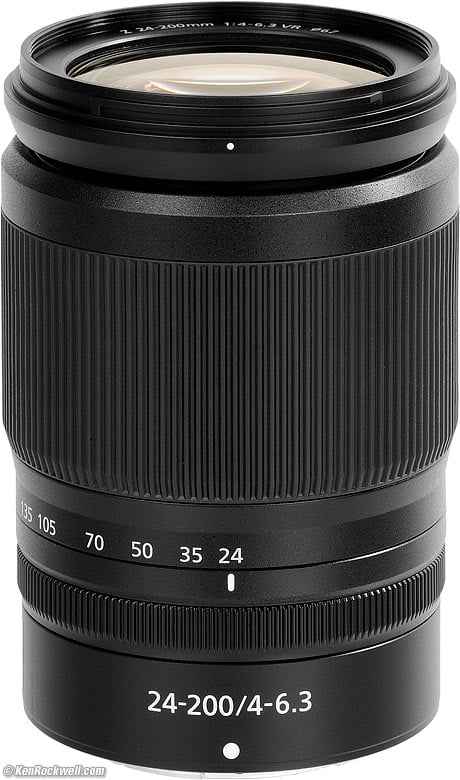

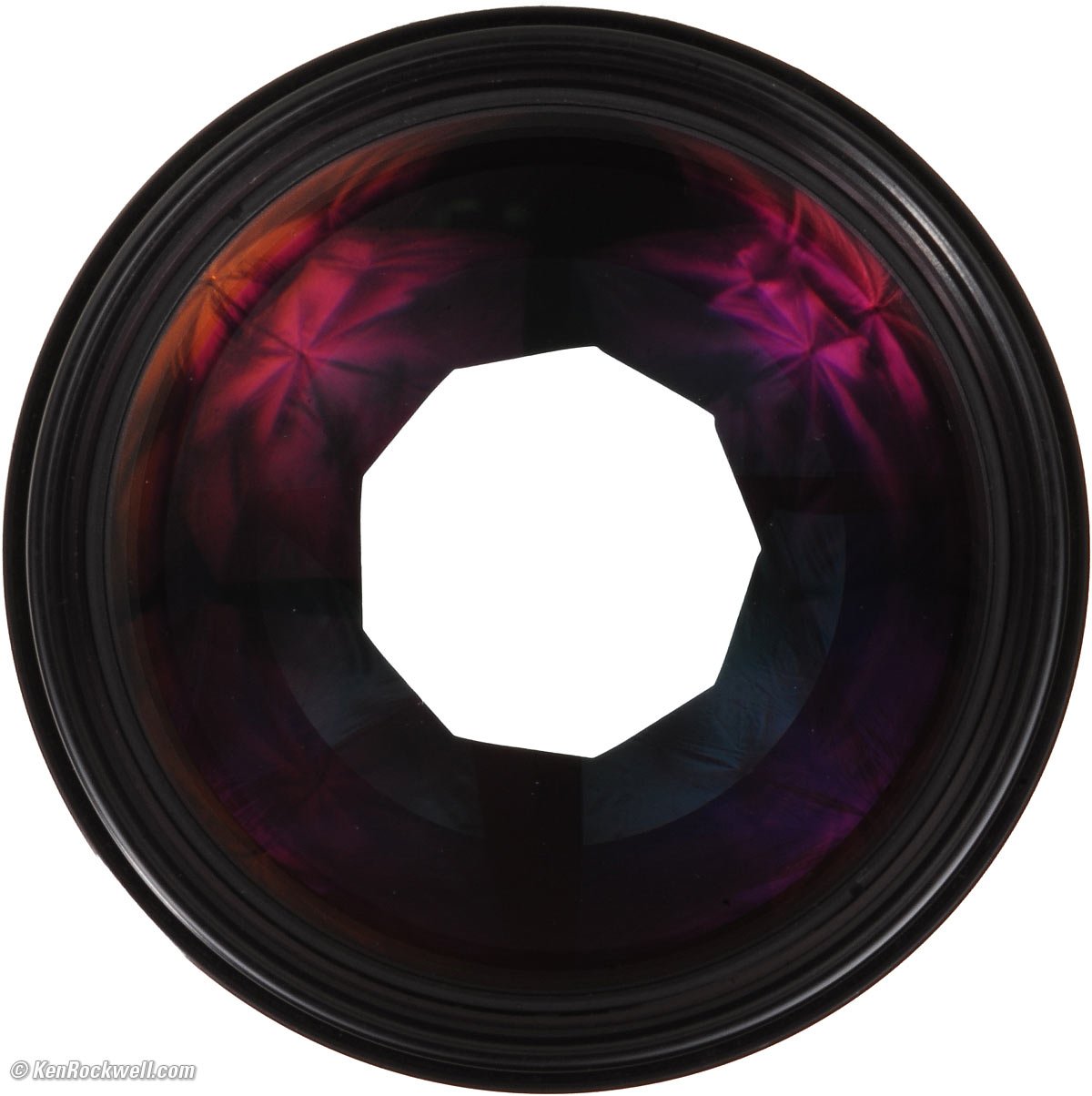
|
|
|
|
Best 80-400mm & 100-400mm Lenses Compared.10 July 2018 |
All Nikon 80-200mm and 70-200mm f/2.8 Lenses Compared
Best 24-70mm Lenses Compared updated 19 April 2018
Best 70-200mm f/2.8 Lenses Compared 22 April 2018
Nikon DX vs. Sony A7 II, 24-70/2.8 GM & 70-200/4 G Comparison Feb 2017
All 24-70mm Lenses Compared 26 January 2016
Ultra-Ultrawides compared 26 March 2015
Premium 50mm lenses compared September 2014
Nikon 400mm f/2.8 Lenses Compared 09 July 2014
Nikon 50mm and 58mm Bokeh Comparison 11 December 2013
Best Macro Lenses 28 June 2013
Nikon FX Ultrawide Zooms Compared
Nikon 18-200 vs. 28-300 vs. 18-300 Comparison 11 July 2012
Nikon Ultra-Ultrawide Lens Comparison 23 December 2008
All Known 17mm and 18mm Lenses and Zooms Compared
Zeiss 18mm f/3.5 Compared to Nikon 14-24mm and Canon 16-35mm L II 15 December 2009
Zeiss 21mm f/2.8 Compared to Nikon 14-24, Canon 16-35 L II and LEICA 21mm f/2.8 ASPH 16 December 2009
20mm Sharpness Comparison 23 September 2010
Light Falloff Comparison of Every Nikon 20mm Lens 18 February 2008
All Known Nikon 24mm Lenses and Zooms Compared 14 August 2010
Nikon Pro Normal Zoom Comparison 20 December 2007
Nikon High-Speed 50mm Lens Comparison 09 Sep 2010
Nikon High-Speed 50mm Lens Sharpness Comparison 09 Sep 2010
85mm Lens Specifications Compared 24 June 2009
Nikon 85mm Lens Bokeh Comparison 26 March 2008
Nikon 85mm Lens Central Sharpness Comparison 23 June 2009
Nikon 85mm Lens Corner Sharpness Comparison 23 June 2009
105mm Center Sharpness Comparison
105mm Corner Sharpness Comparison
Lens Bokeh Comparison at 135mm
200mm Center Sharpness Comparison
200mm Corner Sharpness Comparison
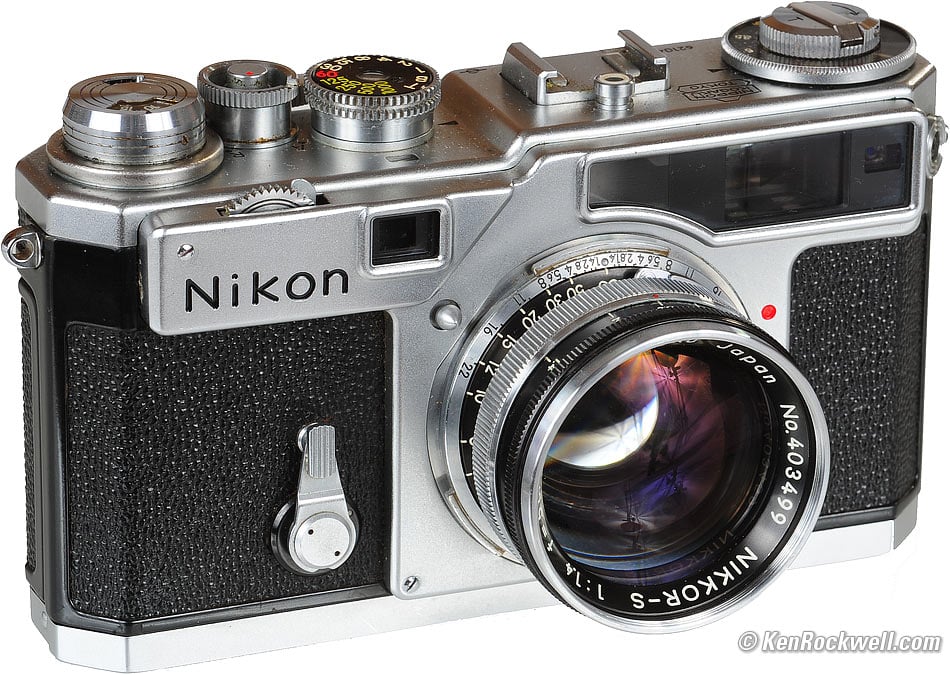
The Nikon Rangefinder System (1946-1964).
Older Lens Suggestions top
Everyone asks me what lens to buy. That's a tough recommendation, since everyone is different. That's why there are so many lenses! Anyone who recommends anything without knowing what you want to do with it should be ignored.
I make specific suggestions below. You'll have to read through some explanations to keep you honest and understand the basis for my suggestions. If you don't want to read, for any DX digital Nikon SLR just get the spectacular new 18-200mm VR which does almost everything imaginable. I love it, but is costs $750! If you're on a budget then get the cheapest (but excellent) 18-55mm II ($160 or less bought with a new camera) and then the 70-300 G ($120) if you need to go longer.
I've personally tested almost all of these lenses out of my own curiosity. I post the results here so I could remember them all. This is the core of what started this website.
There are always so many new lenses and cameras coming out that this page's suggestions can get dated. If this page and an individual review disagree, the individual review pages are newer.
The best lenses to use for 35mm film and FX digital SLRs are completely different from the most practical lenses for DX digital SLRs. Sharpness isn't the issue. The issues are completely different sensor sizes and ISO speeds. You need much shorter lenses for digital and digital's higher ISOs let you get away with slower and therefore less expensive lenses. Therefore I offer two totally different sets of suggestions. When I say "film lens" or "digital lens" I'm referring to the best application of these lenses, not any hard limitation. All film lenses work great on digital cameras and even the DX digital-only lenses can be used on film cameras with varying results.
Before spending as much time agonizing over all this as I have, be sure to read here about how equipment quality has nothing to do with an image's quality. Even the worst of these lenses in the hands of a great photographer is good enough to win a magazine cover, photo contest, or make prints to hang and sell for top dollar in any art gallery.
If sharpness is your only concern then don't even mess with 35mm or digital cameras. Step up to medium or large format cameras which are what professionals have been using for decades. Nikon and Canon and Leica always seem to forget to mention that the only pro use of the smaller formats is news and sports. A $50 used Yashica-MAT 124G (a medium format camera) is sharper than any Nikon, Leica or Canon, and a $200, 50 year old 4 x 5" Crown Graphic (large format) is sharper than any Hasselblad. More at my format page.
Ever wonder why 35mm and digital photographers are always worrying about sharpness? That's because these are such small formats that any loss of sharpness is visible. If you really want sharpness, just forget these and step up up to medium or large format and you'll not have to worry because you'll just get sharp images.
It's very hard to find complete perfection in SLR lenses, especially wide angles and zooms. The special retrofocus design required for wide-angle SLR lenses makes them very difficult to design well, so most of these lenses exhibit barrel distortion and fuzzy corners wide open. That's typical for Nikon and even Leitz.
Remember that everyone has different standards, and every sample of every lens will vary from every other sample. A sad thing about these tests is there is a lot of quality variation among SLR lenses. Lenses that get good reviews here prove that the design is good, but that's no guarantee that the one you buy will be any good. Likewise, if a lens tests poorly here, there's no reason why the one that you have won't be better. I test from the lenses I or my friends have owned, just like the lenses you have. These are not the cherry-picked samples provided to advertiser-sponsored magazines. I hope you benefit from all the film I burned doing this!
Older Suggestions for DSLRs top
Newest Suggested lenses for DX SLRS
Newest Suggested Lenses for FX and Film SLRs
September 2007: This applies to DX SLRs. For the D700 and D3 FX DSLRs, see D700 Lens Suggestions and D3 Lens Suggestions
Information below is older:
Everyone's needs vary. That's why Nikon makes so many lenses. With these caveats let me make suggestions aimed at the beginning photographer with general needs.
General issues for digital SLRs:
1.) Don't bother with manual focus lenses on digital cameras. Optically they work great, however with most cameras you'll have no metering or automation. You can use these in a studio but they are almost useless in the field.
2.) Optically all Nikon lenses ever made work great on all digital Nikons. Nikon designs its digital cameras for their lenses, so ignore the discount brands' barking about magic lenses optimized for digital. Nikon digital SLRs are already designed for Nikon lenses and no discount brand could possibly optimize their lenses for every camera brand simultaneously. Nope, no one pays me or sponsors me; these are just my opinions. In this case I agree with Nikon's marketing, even though their latest slogan about "the camera matters" is baloney. Nikon's "DX" moniker just means these shorter focal length lenses won't cover 35mm film, so don't use them on a film camera. All Nikon lenses are already "digital optimized."
3.) Fixed focal length lenses aren't needed, except for macro or super tele. The faster f/stops of fixed lenses aren't needed with digital's high ISOs. Almost all lens development in the past 20 years has been focused on zooms, so as digital dawns there are few things that zooms can't do better.
Mid Range Zooms for Digital back to top
The new 18 - 200 VR lens is all 90% of everything anyone would want for everything. It's a breakthrough. There's never been anything like it in my over 30 years of photography. Now that I have one it never seems to come off my D200! It's expensive, about $700. If you're considering it I'd advise just getting it. It's unlike any other all-in-one lens I've ever used. You'll love it! It's rare that I need anything longer.
On a more reasonable budget I'd suggest the 18 - 55, which you can get with a camera as a kit. It's inexpensive, about $140, and works as well or better than the more expensive 18 - 70 ($330) and 17 - 55 ($1,500) lenses. There's no reason you can't make tens of thousands of fantastic images with just the 18 - 55. Of course each of those lenses is progressively heavier, more sensitive in low light and more durable, too. If you take care of your gear and make casual use of it I'd go for the cheapest 18 - 55. If you beat your gear, or are a full time pro, by all means pay ten times as much for the 17 - 55, just don't expect to see a visible difference in the images.
Digital SLRs have a sensor only 67% as big as film, so any lens used on digital gives a smaller field of view similar to a lens of 1.5 times the focal length. Take the focal length you use on your film camera and divide by 1.5 to get the focal length you need on a digital camera for the same effect. For instance, a 28 - 105 mm lens is about perfect on a film camera, which means for a digital camera you want an 18 - 70 mm lens. AHA! You'll notice the big issue is that there are very few zooms that start around 18mm and then go all the way out to 70mm.
Zooms starting at 24 mm or 28 mm are NOT useful as mid range zooms on digital. 24 or 28 mm is great for film camera, but the smaller sensors of digital cameras require shorter lenses to get the same effect as they do on film. For instance, a 28mm lens on a digital camera has the same angle of view as a 40mm lens on a film camera. 40mm isn't wide; it's normal. For instance, my favorite 24 - 85 mm film lens used on a digital camera gives similar views as a 37 - 122mm lens does on a film camera.
Forget the film 18 - 35 film lens since it costs more and does less than the 18 - 70. Of course if you have one use it, just don't buy a new one for digital. Zooms starting at 17 or 18 mm give the same results as a zoom starting at 26 mm on a film camera, very useful indeed.
28 - 200 mm lenses are NOT useful as a do-everything lenses on digital, since they only start at the equivalent of 43mm. In digital one needs an 18 - 135mm lens too cover the same range. An 18 - 200 lens covers the equivalent of 28 - 300.
I avoid discount brands.
Pro Combos
Before the 18 - 200 everyone carried a combination of a wide zoom and a telephoto zoom, skipping the middle lens entirely. You won't miss the range between the two zooms.
Add a mid zoom to these two if you still want to have just one lens you can grab for social events, but you'll notice over time that the mid zoom sits around a lot if you have the two others.
The wide zoom will be very expensive and the telephoto zoom can be almost free. Mortgage yourself to buy the wide zoom and pay with what you'll save on the telephoto compared to film days.
Digital SLRs are so new that there are few lenses designed with the shorter focal lengths more appropriate to their smaller sensors. Therefore there are fewer choices, making these suggestions much easier.
Wide Zooms for Digital back to top
I love super wide lenses. Before I got my 18 - 200 a month ago my Nikon 12 - 24 was what I used 75% of the time. If you want a super wide lens of course I suggest the 12 - 24.
If cost is an issue I'm soon to test all the 3rd party versions, however before I do I'd suggest the Tokina 12-24mm f/4 as a safe bet for half the price of the Nikon I have. Nikon was the only super wide DSLR lens made in 2004 when I bought mine.
If you photograph landscapes or real estate you need this lens. You can read about it in depth here.
Telephoto Zooms for Digital back to top
This is easy! The 1.5x factor that wreaks havoc for getting normal or wide zooms makes telephotos trivial. Digital's higher ISOs also eliminate the need for the heavy, expensive fast f/2.8 zooms of film days, except of course if you want shallow depth of field for portraits.
Your best bet on a budget is to go get any used Nikkor 70 - 210 mm AF zoom. It might cost you $100 - 150. Every one Nikon has made is great. The oldest 70 - 210 f/4 constant aperture version from the 1980s is a winner. It focuses as fast as both of today's new 70 - 300 AF lenses, is a stop faster, focuses twice as close and has the smoothest, almost angelic, zooming action of any lens I've ever used. Likewise, the newest 70 - 210 mm f/5.6 AF-D lens, discontinued in 2000, is very small, very well built and focuses much faster and closer than any of the brand new or older 70 - 300 zooms. The 70 - 210 f/5.6 (non-D) AF lens made in between these two is almost the same as the newer lens, but only focuses as fast as the older f/4 lens.
If you buy new, which is just a luxury, you have the choice of quite a few lenses. Nikon makes two versions of their 70 - 300 mm lens. The 70 - 300 G version is cheap and sells for about $99 - 150 brand new. The more solidly made 70 - 300 ED version sells for about $300. Either should be fine and each focuses as slowly as the 1980's 70 - 210. The 70 - 210 AF-D focuses much more quickly than any of these.
Of course my favorite, and the lens I use most of the time as of 2006, is my 18 - 200 VR. It costs more than any of these above, but focuses faster and, except for correctable distortion, is better still than any of the others. It adds VR, focuses to a foot and a half and zooms out to wide angles, too.
The great news about digital is that the fast ISOs usually excuse you from the need for an expensive f/2.8 lens. The f/4 - 5.6 lenses above are usually fine even in less than optimum light. For sports your prime concern is how fast they focus. For this you'll want the discontinued 70 - 210 AF-D, or the 18 - 200 VR which are much faster than any other under-$800 tele. These two focus faster than most of the older 80 - 200 f/2.8 AF lenses that might tempt you as used lenses. Again, skip here to see this explained under film telephotos. The only fast focusing f/2.8 telephoto zooms are the AF-S versions and only the very latest AF-D version with the factory tripod collar. The newest 18 - 200 VR also focuses very, very fast and for a digital camera replaces not just the tele, but the mid-range zoom as well.
If you want to spend more and carry heavy lenses then feel free to get an f/2.8 or the other lenses I cover under telephotos for film here. Personally I love my 80 - 400 mm zoom as explained below under film.
Old Suggestions for AF SLRs top
Nikon makes so many lenses because peoples' needs and budgets vary. Since I don't know your specific predicament, I can only be so helpful. With these caveats let me make suggestions aimed at the photographer with general needs.
Depending on what you want you may not even want a 35mm Nikon. Read my film format page before you waste any money on Nikons if you want to do landscape photography, for instance. People forget that personally I shoot 4 x 5" or at least 6 x 7 cm for the photos you see on my site. 35mm film died in 1999 with the introduction of the Nikon D1 for newspapers; today you should be using larger format film or digital.
You'll either want just one medium zoom lens, or if you want to get fancy you'll instead want a separate wide and another tele zoom, forgetting about the medium one. By all means if you get both a wide and tele zoom feel free also to get a medium zoom, just know that you'll really only be using the medium zoom if you have to run out with just one lens some day, or for party and wedding and event photos.
If you are a beginner then the lens that comes included as a package is usually all you need. Don't let eager salespeople sell you a ton of glass until you can master what you already have.
Are you shooting prints or slides? I shoot slow 50 speed slide film in all sorts of dark light so I need and use the speed of the expensive f/2.8 pro zooms and f/1.4 fixed lenses. If I shot prints or digital only then I'd use the slower zooms instead and you should, too. Of course I don't suggest you shoot print film, but if you do you'll be happy with any lens. If you shoot prints then just use whatever medium zoom that comes as a kit with your camera (or sells new for $100 alone) and you'll do great, or get the two cheapest zooms I mention below.
Let's now presume you are serious about starting and will be shooting slides.
Medium Zooms for Film Cameras back to top
If you just want one lens my favorite is the newest AF-S 24-85mm f/3.5-4.5G that costs $360. It's cheap, small, light, easy and fun to use and gives fantastically sharp images. For $540 the 24-120 VR may be more fun; I'll let you know when I get more time with one. I prefer this to the much heavier and expensive 28-70 f/2.8 AFS for practicality's sake.
If you go for the two zoom solution instead you have a couple of great ways to go depending on your weight and dollar budget. Remember with the two-zoom system you probably don't need or want the midrange zoom above. You simply don't need the small range between 35 and 80mm.
Wide Zooms for Film Cameras back to top
I suggest the AF 18 - 35mm f/3.5-4.5D ED-IF. It sells for about $450 after the rebate. I use the AF-S 17 - 35mm f/2.8 ED-IF that weighs a ton and costs $1,500 and which I bought before the smaller 18 - 35 was introduced. For rational people the 18 - 35 gives exactly the same quality images as my $1,500 lens without all the weight. If you want to be picky by all means go for the $1,500 lens, just remember that the $450 one wasn't available when I bought my 17 - 35 so I didn't have the choice you do. The 18 - 35 is a very well made, easy to use, light, fast focusing, focuses very close and is a very sharp lens. I suggest it for everyone so long as you're not shooting a lot of architecture. Read my reviews for all the details. This again is an easy recommendation since it's so good. I have never seen either of these new lenses used so I can't vouch for buying them that way, just buy them new at discount at the links on each page. Zoom lenses have internal cams that can wear and degrade the performance of a lens over time.
Telephoto Zooms for Film Cameras back to top
For the telephoto zoom I'd strongly suggest saving for the AF 80-200mm f/2.8D ED w/tripod collar for about $800 after rebate. It's a superb fully professional lens and will last you for your next ten years of photography regardless of which camera, film or digital, you may have in 2015. You'll never wish you had something else. I suggest this one strongly since it's a bargain and I'm not that impressed by the cheaper, lighter alternatives of the current AF 70-300mm f/4-5.6D ED ($310) or AF 70-300mm f/4-5.6G ($130). If you'd rather not deal with the price and weight of the 80-200 now then look around for a used AF 70-210mm f/4-5.6D from the 1990s or even the AF 70-210mm f/4 from the 1980s, each of which may cost you about $150 used. Since a brand new 80-200 is so inexpensive avoid used 80-200s, since all the earlier models focus much slower, and I've also bought used 80-200s that looked new on the outside but were misaligned on the inside and gave fuzzy results. Heck, you have to pay almost as much for the crummier discount brands, too. Again, if you have $800 this is a very easy recommendation to make. Don't even consider second and third rate brands like Sigma or Tamron simply because you can get genuine Nikon for about the same price.
Oddly I've heard a few complaints about inaccurate focusing at the 200 mm setting of the AF 80-200mm f/2.8D ED w/tripod collar at f/2.8 on a D70. If you plan to use this particular combination check this carefully. Other than that observation by others this lens has worked remarkably well for me.
If you have $1,400 for the telephoto zoom then I use the AF VR 80 - 400mm f/4.5 - 5.6D for most things and the discontinued AF-S 80 - 200mm f/2.8D ED-IF for action and low light. See the reviews for the specifics. If I was smarter back when I bought these I may have bought the AF 80 - 200mm f/2.8D ED w/tripod collar instead. As of 2004 the 80 - 200 AFS has been replaced by the 70 - 200 VR, which for action and low light is the best lens ever made. If you don't have an extra $1,000 lying around the basic 80 - 200 above is almost as good; the only real difference is the vibration reduction which doesn't stop action but does help eliminate the need for a tripod in dim light.
Unless you shoot slow 50 speed film as I do and blow it up into huge enlargements there is no reason to spend for the expensive lenses. All they will do is lighten your wallet and weigh you down every place you go. I love and use my expensive lenses, but remember I'm a little crazy and shoot slow film handheld at night. That's what I meant above when I cautioned you about taking advice from people without them asking what you do. All because I use one lens doesn't mean that it's right for you, or that I even would make the same choice again as you see. If you shoot print film then the very cheap G lenses (including the one that may come with your camera as an outfit) are all you'll need; on prints smaller than 8 x 10" one never can see any differences between lenses. You only see this if you blow up to 16 x 20" and larger.
I don't bother with discount lenses like Tamron and Sigma. Sigma is very poorly made (actually I've been told the name is derived from SIGnificant MAlfunction), so of course it costs less. When you go to sell the lenses you get much more much faster for real Nikkor lenses so I see no reason for the false economy of cheap lenses. Of all the cheapies I'd try Tokina first. More here about why your local camera store probably is pushing the cheaper (but higher-profit) discount lenses on you. In spite of what camera stores tell you, I know of NO professional photographers or even decent amateurs who use anything other than camera brand lenses. And no, no one pays me anything to do this site and no one's giving or even loaning me free cameras; this is what I've learned over decades of buying and selling all this for my own personal photography.
Old Suggestions for Manual Focus Cameras top
Nikon makes so many lenses because peoples' needs and budgets vary. Since I don't know your specific predicament, I can only be so helpful. With these caveats let me make suggestions aimed at the photographer with general needs.
DO NOT use manual focus lenses on autofocus and digital cameras. If you already own these lenses as I do fine, but it's silly to buy a new manual lens because you lose almost all the features you need, like metering, with manual lenses used on modern cameras. I very deliberately titled this section "... for Manual Focus Cameras" because I only suggest these manual lenses for use on manual cameras.
Manual focus cameras work with all the AF lenses suggested above except the G series. Please read this section above about film cameras above if you haven't already, since it all applies here and you need to know about the differences between lens choices if you shoot film or shoot slides. I have more about what lenses work on which cameras here.
Feel free to use the AF zooms I suggest above since they work great on manual cameras. Optical quality for most purposes is better in today's zooms. Why? 25 years of innovation. These manual focus lenses were all designed about 30 years ago even if they're still sold new today. Nikon develops newer, better zooms every month. The 17 - 35 AF is a better lens than the 20 mm f/4 AI below, but it costs and weighs ten times as much. I don't suggest any manual focus zooms since they are also 30 year old designs and usually inferior to even the cheapest new AF zooms today.
The reasons you might want to step backwards to manual focus lenses are:
1.) Lower cost
2.) Smaller size and lower weight.
3.) Faster f/stops ideal for use with slides hand-held in low light, also with lower size, weight and cost compared to zooms
4.) Standardized 52mm filters. You can have every lens from 20 mm to 200mm, including PC shift and macro lenses, take the same 52mm filters.
5.) Much better mechanics. The manual lenses are works of mechanical art with their very high quality metal construction and flawless precision. The focus rings can be operated with a single finger and work at all temperatures. The manual lenses feel much better than AF lenses when used manually.
6.) Easier focusing. The AF lenses are a little skittish when focused manually, since they are designed for speed on AF cameras. By comparison the manual lenses are a joy to focus by hand. Also fixed lenses are easier to focus manually, since zoom lenses focused manually usually focus too slowly at wide and too fast at tele.
Here's what I suggest for manual focus 35mm Nikon lenses:
1.) Ultrawide lens. Personally I prefer my rare 20mm f/4 AI for its size and superb image quality. It also takes standard 52mm filters for compatibility with the rest of the suggested lenses.
2.) Short tele. I use the 85mm f/2 AI-s. I love the focal length and size and standard 52mm filter. I find 105mm too long for the way I see things.
These two lenses cover almost everything I shoot. For a normal lens I use a 35mm, not 50mm, lens. My favorite 35mm lens is the
3.) Normal lens: 35mm f/1.4 AI-s. This gives me the speed I need for use in available light handheld. It's been made ever since 1969 and is the same lens with just mechanics that change over the decades. The 35mm f/2 AF or 28mm f/1.4 AF lenses are second choices. The 35 AF has had reliability problems with oil on the diaphragm blades. The 28/1.4 is extraordinary, however it costs $1,800 and takes larger 72mm filters, albeit with much better optics than the old 35/1.4. I never liked my 35mm f/2 AI-s. It had a problem with ghosting for night photography.
4.) Long tele: 200 mm f/4 AI or AI-s. Inexpensive, sharp, small and takes 52mm filters like all the other lenses I just suggested. Built-in hood. The 180mm f/2.8 ED is great, but much heavier and thus it usually sat home.
More Information top
Nikon Lens Technology and Alphabet Soup
Nikon's index of current manual-focus lenses
How to Fix Lens Distortion in Photoshop
DxO Software corrects most optical issues perfectly.
Roland Vink's Nikon SLR lens data
Robert Rottmerhusen's AF Lens CPU serial numbers
John White (AI conversions of old lenses). I've used him with great results.
Legacy2Digital.com does AI-P conversions.
© Ken Rockwell. All rights reserved. Tous droits réservés. Alle Rechte vorbehalten.
Help Me Help You
I support my growing family through this website, as crazy as it might seem.
The biggest help is when you use any of these links when you get anything. It costs you nothing, and is this site's, and thus my family's, biggest source of support. These places always have the best prices and service, which is why I've used them since before this website existed. I recommend them all personally.
If you find this page as helpful as a book you might have had to buy or a workshop you may have had to take, feel free to help me continue helping everyone.
If you've gotten your gear through one of my links or helped otherwise, you're family. It's great people like you who allow me to keep adding to this site full-time. Thanks!
If you haven't helped yet, please do, and consider helping me with a gift of $5.00.
As this page is copyrighted and formally registered, it is unlawful to make copies, especially in the form of printouts for personal use. If you wish to make a printout for personal use, you are granted one-time permission only if you PayPal me $5.00 per printout or part thereof. Thank you!
Thanks for reading!
Ken Rockwell