Home Donate New Search Gallery Reviews How-To Books Links Workshops About Contact
Nikon
70-210mm f/4-5.6
NIKKOR AF and
AF-D (1987-2000)
©
Ken Rockwell.com. All rights reserved.

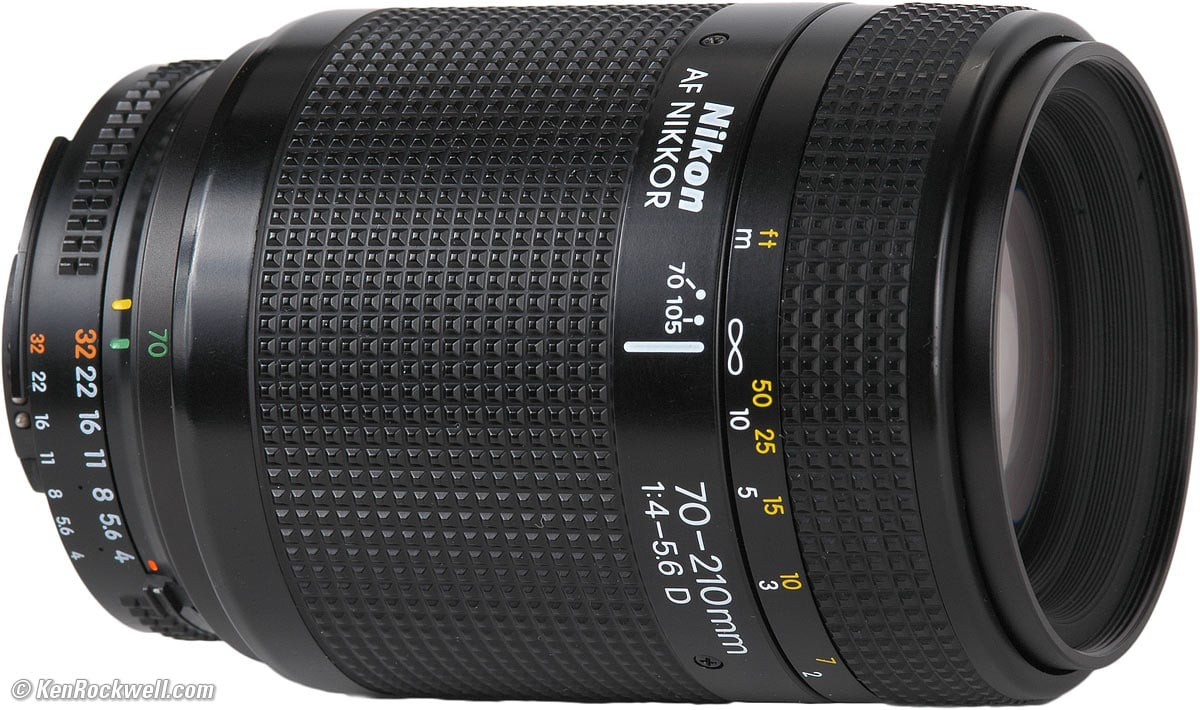
Nikon 70-210 mm f/4-5.6 D set to 70 mm. enlarge. (62mm filters, 21 oz./590g, 4'/1.2m close focus, about $100 used). enlarge. This free website's biggest source of support is when you use any of these links, especially this direct link to this lens at eBay (see How to Win at eBay) when you get anything, regardless of the country in which you live. Thanks! Ken.
April 2018 Nikon Reviews Nikon Lenses All Reviews
Introduction top
Intro Specs Performance Recommendations
This was an exceptionally great lens for the price when I bought it new on closeout in 1999 for $249. No one wanted 70-210mm lenses since the rage was 70-300mm lenses, so these went unwanted. The AF-D version (1993-2000) has excptionally fast focussing.
It was a deal for $249 brand new in 1999, but my positive review below jacked up the used prices to $500 or more in 2005. They fell to about $150 used in August 2011, and as of 2018 they sell for about $100 for the AF-D version.
It was discontinued in the US around 2000. I love it because it focuses much faster than any other telephoto lens priced under $800 today, it's super sharp, has very little distortion, focuses very close, is super compact and well built.
Because it focuses so much more quickly than any other telephoto zoom this side of the f/2.8 professional models its used price has skyrocketed to around $500. One guy was even getting $750 on eBay! None of the new models under $800 focuses anywhere near as fast. This is no big deal for portraits or landscapes, but is very important for sports, kids, pets or anything that moves fast.
It is extremely well made. It's from the same family as the 35-70/2.8 zoom. It has a great solid metal filter thread, metal jacket over one half of the lens barrel, and assembled with screws, not mushed together plastic.
I bought it for use on my F100 film camera because I demanded its superior sharpness for shooting professional transparency film. For digital cameras I'd suggest one of the new plasticy 70 - 300 mm zooms if you can't find a used 70-210.
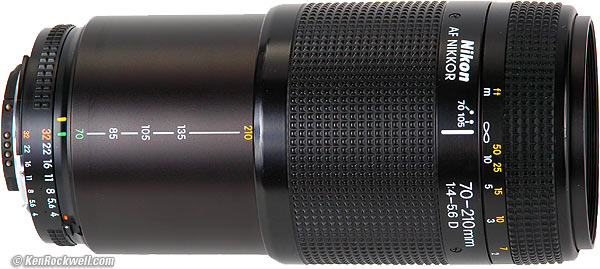
Nikon 70 - 210 mm f/4 - 5.6 D set to 210 mm.
The biggest advantage of this D version of the 70 - 210mm zoom is that it focuses faster than any other tele lens other than the newest $900 80 - 200 f/2.8 or $1,500 70 - 200 VR lenses.
As an AF-D lens it is completely compatible with every feature of every digital camera like the D50, D70s, D200 and D2X, as well as every film camera made since 1977.
There's nothing else out there as good unless you splurge for a new 80-200 2.8. For $500 I'd start thinking about a brand new 80-200 2.8 for a few hundred dollars more brand new which is better in every way, except way too big to stick in a pocket.
Remember that sample variation is rampant; I know I got a good one, but the vibe this lens has associated with it today all comes back to this page that I wrote about mine. All because I like mine DOES NOT mean you ought to pay $750 for a used one or that any other sample will work as well. I love mine because of the optical quality, unusually fast focusing and small size.
For used lenses also consider the older f/4 which is better in low light and still sells for about $150 used. It doesn't focus as fast, and the f/4 aperture is a huge bonus. The f/4 also focuses closer but is much heavier than either of the f/5.6 versions.
Don't confuse this 70 - 210 mm AF-D lens with the 70-210 f/4.5-5.6 manual focus lens now resold by Nikon that appears to be made by Cosina. The manual focus lens sells for about $120 and is a completely different lens. Actually, don't confuse this lens with any other lens. There are many, many different lenses in this range. Look at the pictures and pay very close attention to every digit of the lens' name to make sure we are thinking of the same lens.
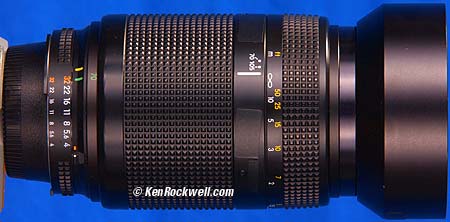
Set to 70 mm with screw-in metal hood and Tiffen filter.
What about the new 18 - 200 VR?
My 70 - 210D sat unused for a few years and I listed it for sale, waiting a few months for a local buyer. Nikon then announced the 18 - 200 VR less than three days after I sold my 70 - 210. If I had known an 18 - 200 VR was coming I would have held onto the 70 - 210 for comparison, sorry. Of course the 18 - 200 VR won't be shipping until at least December 2005.
The 18 - 200 VR is about the same size and weight as the 70-210, but costs $699 MSRP. I ordered mine for $669.95 from Adorama here.
Only time will tell, but I predict that the 18 - 200 VR probably won't focus as fast and will probably have much more distortion and of course only works on digital cameras, not both as the 70 - 210D does. The 18 - 200 VR does focus closer and of course has a wider zoom range and VR to eliminate the need for a tripod in most cases.
Thus I cautiously still recommend the 70 - 210 D as a compact lens for sports and action over the 18 - 200 VR. When I get my 18 - 200 VR I'll let you know. I suspect the 70-210D is still the best for optical quality and speed while the 18 - 200 VR is probably better for convenience.
D vs. the Older Non-D Version
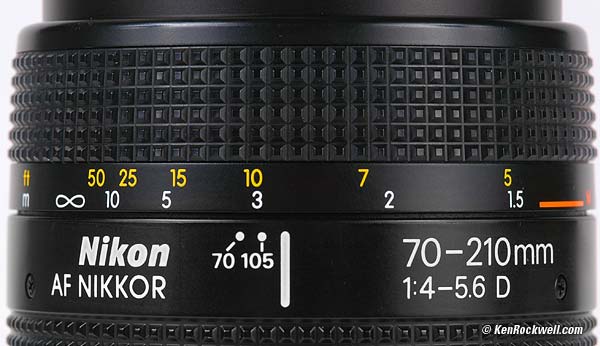
This is the D version. Note the D after 1:4 - 5.6.
"D" means this lens tells the camera the distance to the subject. This helps the matrix meter be more accurate, especially with flash. It's not that big a deal.
A much more important reason to get the newest D version has nothing to do with the D moniker. It simply is because the gearing is much faster on the D version so it focuses twice as fast.
I explain "D" here. You can tell this is a D version by the D after 1:4 - 5.6. The earlier non-D version just says 1:4 - 5.6.
The earlier 70 - 210 non-D lens has the same optics. The only way to see the difference is the D after 1:4 - 5.6.
The AF speed is slower on the non-D lens since the D lens is geared faster. One turn of the AF screw on the D lens brings you from infinity to 17;' on the non-D lens it only brings you to 40.' Thus it takes longer for the non-D lens to focus.
Either one works great on the newest cameras like the D70s and D200, although the D feature may help the flash exposure to be a little more accurate on the newest cameras
Specifications top
Intro Specs Performance Recommendations

I buy only from these approved sources. I can't vouch for ads below. |




It has twelve elements in nine groups.
This is a very compact lens taking 62mm filters. Vignetting is no problem with this lens, feel free to stack on a couple of filters, too, at the same time. The threads rotate only during focusing.
It takes the HN-24 screw-in metal hood.
It is a push-pull zoom.
It weighs 21 oz (590g).
It's 2.9" (74mm) around by 4.3" (109mm) long at the 70mm setting. It's 6.1" (154mm) long at the 210mm setting. It zooms by pushing and pulling, changing the length.
It has a seven-bladed diaphragm stopping down to f/32 at 70mm and f/45 at 210mm.
It is the closest focusing non-micro zoom recently made by Nikon in this range. It focuses directly down to four feet at all focal lengths, unlike the far more expensive 80-200 AF-S that only makes it to five feet. Only the 20 year old 70-210 f/4 AF (constant aperture) and 70-180 f/4.5-5.6 micro ($800) focus closer.
Performance top
Intro Specs Performance Recommendations
This is a very sharp lens under almost all conditions. This is unusually good performance for any zoom lens.
It has only fair bokeh for backgrounds 210mm. Bokeh is good at 135mm and neutral at 70mm.
It has a very, very slightly cool color rendition. You can ignore this. I do.
On my F100 it autofocuses 80% as fast as my 80-200 AF-S. This is exceptional.
All other telephoto zooms under $800 new focus more slowly. The popular 70-300/4-5.6ED and 70-300/4-5.6G and big old 75-300/4.5-5.6, as well as older used 80 - 200 2.8 ED lenses are much slower.
One full turn of the AF screw focuses the lens from infinity to just 17.' That's why this lens focuses so fast.
Distortion
70 mm: almost no barrel
85 mm: no distortion
105 mm: pincushion
135 mm: strong pincushion
210 mm: pincushion
It has no ghosts, superior to the 80-200 AF-S
The variable f/4-5.6 aperture is generous: it is still f/4.5 at 135mm. Therefore you really only start losing light at the very longest end of the range.
For you polar bears out there, this lens works great after sitting in my freezer at 0 degrees F. overnight.
Some ask why Photodo, whose results I almost always agree with, doesn't think so much about this lens while I love it. Possibly it's because photodo ONLY tests sharpness with an MTF test. There are many other aspects to lens performance in addition to just sharpness. The performance of the 70-210 is UNIFORM across the field with no fall off in sharpness. An obvious change in sharpness is more visible than a lens which may be less sharp, but uniform, and again this is why a lens can test only so-so but give great images.
Tripods and Shutter Speeds
Used on a tripod with an amateur camera like my F100 without mirror lock up I get the following results with the 70-210:
No blur at 1/60 and above or at 1/2 second and below.
The results are blurry at 1/30 through 1/4 second. Adjust your aperture to stay out of this range on a tripod with an F100 on a tripod.
Hand held on my F100 I get OK results at 210mm at 1/80 and faster.
Ergonomics
I prefer a zoom ring over a push-pull zoom. Honestly this lens is also very handy because of the huge grippable surface. The entire middle of the lens has a waffle pattern to it for easy grip, even if your hands are slippery.
Recommendations top
Intro Specs Performance Recommendations
If a slow f/5.6 maximum aperture is OK for you, then this is your telephoto zoom. I have played with a great many lenses in this focal range, and this one is clearly superior. I'm unsure how much of this is due to my luck at getting a good sample, or if they all are good. I bought mine brand-new for $240 in 1999. I don't know how well used ones hold up. The cams can wear and this can make used zooms less sharp than when they were new.
Again, don't get suckered into the 70-210mm f/4.5 - 5.6 manual focus lens that Nikon sells today. It's an OK lens, but is a completely different lens than this AF-D lens. If you want a $100 lens then you also may want to try the plasticy made-in-China 80-200 AF-D f/4.5-5.6 sold by Nikon.
I've never played with the non-D AF version. The D feature is meaningless. The non-D, older version is probably a bargain used. From what one reader tells me, the AF speed is slower on the non-D lens since one turn of the AF screw only brings one into 40', not 17' as in the D version. This would make the non-D version as slow as the new 70-300s and the original 70-210 f/4.
This 70-210 AF-D is as sharp as my 80-200 AF-S, better built, focuses almost as fast and focuses closer, and has fewer ghosts. The AF-S lens is handier if you need to go quickly between AF and manual focusing, and of course if you need f/2.8. Also having tested the actual focal lengths, the 70-210 AF-D also goes longer AND shorter than the 80-200, just as the specs suggest.
The 70-210 AF-D lens focuses faster than any of the 80-200 f/2.8 lenses without the factory tripod collar, and faster than any other telephoto zoom lens.
It's great for digital, but for film skip the current popular plastic 70-300/4-5.6 that many people love (the one apparently made by Tamron for Nikon). This 70-210 is better at everything and less expensive, although you lose is a little bit of "reach" at 300mm. I prefer this tradeoff: sharp photos at every setting instead of less sharp images over a slightly broader zoom range. There isn't that much difference between 210mm and the almost 300mm the other lens tries to make. I also prefer the ruggedness and faster autofocusing of the 70-210. If you are only shooting one-hour prints you'll never see any of the sharpness differences I mention, probably ought to get the 70-300 instead if you want it and the AF is fast enough for you.
As if you haven't gathered, this is a lens to get if you need small, sharp, close focusing, inexpensive and don't need the f/2.8 aperture.
The older, bigger and heavier and equally excellent 75-300 f/4.5 - 5.6 AF is also nice and not that expensive used. Unfortunately it focuses as slowly as everything else today in the under-$800 category.
More Information
Reviewed in Popular Photography, September 1996, page 70.
Help me help you top
I support my growing family through this website, as crazy as it might seem.
The biggest help is when you use any of these links to Adorama, Amazon, eBay, B&H, Ritz, Calumet, J&R and ScanCafe when you get anything, regardless of the country in which you live. It costs you nothing, and is this site's, and thus my family's, biggest source of support. These places have the best prices and service, which is why I've used them since before this website existed. I recommend them all personally.
If you find this page as helpful as a book you might have had to buy or a workshop you may have had to take, feel free to help me continue helping everyone.
If you've gotten your gear through one of my links or helped otherwise, you're family. It's great people like you who allow me to keep adding to this site full-time. Thanks!
If you haven't helped yet, please do, and consider helping me with a gift of $5.00.
As this page is copyrighted and formally registered, it is unlawful to make copies, especially in the form of printouts for personal use. If you wish to make a printout for personal use, you are granted one-time permission only if you PayPal me $5.00 per printout or part thereof. Thank you!
Thanks for reading!
Mr. & Mrs. Ken Rockwell, Ryan and Katie.
Home Donate New Search Gallery Reviews How-To Books Links Workshops About Contact