Nikon 75-300mm
FX f/4.5-5.6 AF (1989-1999)
Intro Format Compatibility Specifications

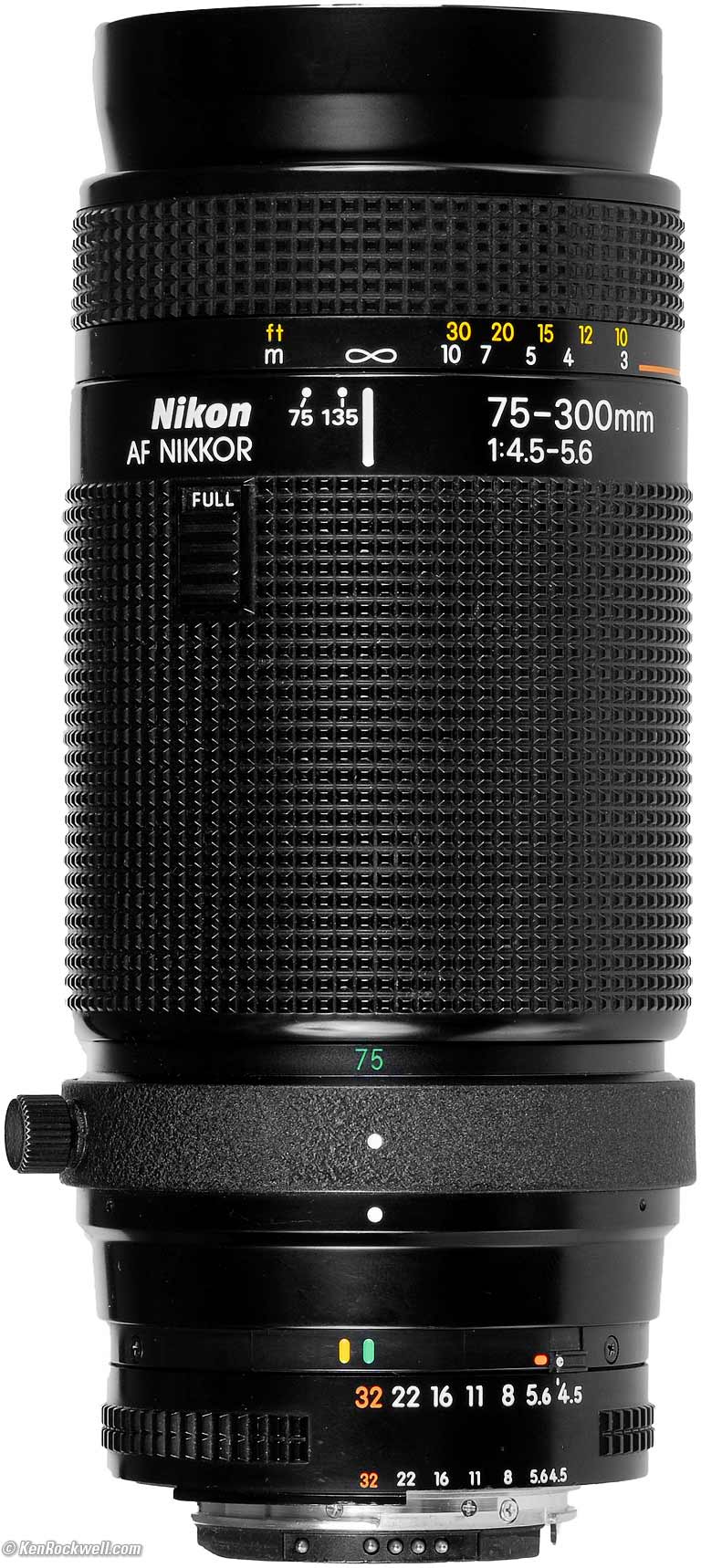
Nikon 75-300mm f/4.5-5.6 AF, set to 75mm. It gets longer at longer focal lengths. (62mm filters, 29.3 oz./831g, 5'/1.2m close focus, about $200 used if you know How to Win at eBay). bigger. I got mine at this direct link to them at eBay.
This all-content, junk-free website's biggest source of support is when you use those or any of these links to approved sources when you get anything, regardless of the country in which you live. Buy only from the approved sources I use myself for the best prices, service, return policies and selection. Thanks for helping me help you! Ken.
April 2018 Nikon Reviews Nikon Lenses Nikon Flash All Reviews
Introduction
Top Intro Format Compatibility Specs

I buy only from these approved sources. I can't vouch for ads below. |



This is the original 75-300mm AF zoomfrom 1989, and yes, today it's still super-sharp even on the D850, so long as you hold it steady (it has no stabilization).
It was replaced in 1999 by the 70-300mm f/4-5.6ED AF zoom, which is a much cheaper, lighter, and smaller plastic lens. This original version is by far the better lens; I presume it just cost Nikon too much to make to be able to sell it profitably at what the market would bear today.
The lens reviewed here is mostly metal and is very similar in construction quality and style as the 35-70 f/2.8D and 70-210 f/4-5.6D AF push-pull AF zooms of the same era.
It has a great built-in tripod adapter that cannot be removed, and does not get in the way of hand holding.
Format
Top Intro Format Compatibility Specs
This is a full frame FX lens, and I'm reviewing it as such.
You may make the usual inferences on DX cameras.
Compatibility
Top Intro Format Compatibility Specs
This lens works perfectly with every FX digital camera.
It also works on better DX cameras, but won't autofocus on many DX cameras. For DX cameras, any DX telephoto is worlds ahead of this old lens.
This lens works great with most 35mm Nikon cameras made since 1977. Of course it won't autofocus on manual-focus cameras, but otherwise everything works great.
See Nikon Lens Compatibility for details on your camera. Read down the "AF, AF-D (screw)" column.
Specifications
Top Intro Format Compatibility Specs
Name
Nikon calls this the Nikon AF NIKKOR 75-300mm f/4.5-5.6.
AF: Autofocus.
NIKKOR: Nikon's brand name for all their lenses.
Also has:
∅62: 62mm filter thread.
Optics
13 elements in 11 groups.
Front-group focusing.
Push-pull pumper zoom.
Multicoated.
Coverage
Diaphragm
9 blades.
Stops down to f/32-40 in full-stop clicks.
You can set any intermediate aperture.
Focal Length
75~300mm.
When used on DX cameras, it sees the same angle of view as a 115-450mm lens sees when used on an FX or 35mm camera.
See also Crop Factor.
Focus Scale
Yes.
Infinity Focus Stop
Yes.
Depth of Field Scale
No.
Reproduction Ratio Scale
No.
Infrared Focus Index
Yes, for 75 and 135mm.
Close Focus
5 feet (1.5 meters).
Filters
Metal 62 mm filter thread.
Rotates with focus but not with zoom.
Hood
HN-24 metal screw-in hood (the same hood as the 70-210 f/4-5.6D AF and 70-210 f/4 AF.)
Size
It's 2.8" (72mm) around.
It is 6.5" (165mm) long at the 75mm setting and 7.7" (197mm) long at the 300mm setting (extension from the lens mount focused at infinity).
Weight
29.299 oz. (830.6 g).
Rated 30 oz. (850g).
Quality
Made in Japan.
Introduced
1989.
Replaced
Replaced by the cheap plastic 70-300mm ED FX in 1989.
Price, USA
About $100 used if you know How to Win at eBay, April 2018.
About $200 used if you knew How to Win at eBay, August 2011.
About $225 used if you knew How to Win at eBay, July 2002.
$370 at closeout new at B&H in 1999.
$575 at deep discount new at B&H in 1995.
$425 at deep discount new at B&H in December 1991, which is the same as $630 in 2018.
Performance
Top Intro Format Compatibility Specs
Overall Autofocus Manual Focus
Overall
This is a very well made full-frame telephoto zoom.
Newer lenses like the 70-300mm VR AF-P FX outperform it, but they're 30 years newer and only work on modern cameras.
Autofocus
Accuracy: It's dead on. This is very good, since you'll be shooting at almost full aperture most of the time.
AF is slow! One turn of the AF screw focuses the lens from infinity to about 48.' This is one-quarter as fast as the AF 70-210 f/4-5.6D and AF 80-200 f/2.8D. It also is about 30% slower then the newer 70-300mm f/4-5.6ED AF zoom.
There is a FULL / LIMIT switch on the front of the zoom ring. Leave it at FULL, unless your AF system is taking too much time hunting back and forth down to 5 feet (1.5m) and back. Set it to LIMIT and the AF system won't be able to focus closer than 10 feet (3m).
Manual Focus
Manual focus requires moving the switch on your camera. Once set to M, just turn the front ring.
There is no instant manual focus override.
Distortion
Distortion is the lowest I've seen in a zoom, and therefore exceptional for a 4x zoom. The newer 70-300 ED by comparison has awful distortion.
75mm: slight barrel
100mm: none
135mm: none
200mm: vanishingly low pincushion
300mm: very slight pincushion
Ergonomics
The cut of the zoom cams squeezes the zoom range between 200 and 300mm into a small range, making precise adjustment tough between 200 and 300mm.
It's long and light, so that if you have it on your D1 it is not heavy enough to keep the whole thing pointed down. Therefore you'll have a constant woodie poking straight out from your body if you carry thing around your neck.
The non-removable rotating tripod collar is excellent.
The zoom tension is light enough that the lens slides out to 300mm whenever the camera is pointed straight down.
Another reason you always should buy Nikon: this lens, introduced in the 1980s, has all the encoders into it so that all the focal length setting data is recorded by today's newest digital cameras!
Falloff
There is little to no darkening of the corners, even at full aperture. Shoot wide open if you want; this is better, even at the same f/number, than the performance of the 80-200 f/2.8 lenses.
75mm none
100mm none
135mm none
200mm little falloff
300mm some falloff
Flare & Ghosts
I saw none shooting straight into the sun. This again is great performance.
Mechanical Quality
It is very well made. It has all metal innards. This is much better than the plastic 70-300 ED.
HN-24 Hood
Solid alloy.
Filter Threads
Metal.
Front Barrel
Metal.
Focus Ring
Rubber-covered plastic.
Zoom Ring
Rubber-covered plastic.
Mid & Rear Barrel
Metal.
Tripod Collar
Metal.
The collar doesn't come off the lens.
Identity
Printed around the top of the barrel
Internals
Seem like all metal!
Dirt Seal at Mount
No.
Mount
Dull chromed metal.
Markings
Paint.
Serial Number
Laser engraved in black-on-black on bottom of aperture ring.
Date Code
None found.
Noises When Shaken
Moderate to strong clunking and clattering.
Made in
Japan.
Sharpness
It's pretty sharp all over at all apertures and focal lengths.
It is softer at 300mm, and much softer at 5 feet at f/5.6 at 300mm. It's much better at 300mm at f/8. At far distances it's as sharp as other Nikkor 300mm lenses.
This is great, I have nothing to whine about here.
Sunstars
With a straight 9-blade diaphragm, it ought to make great 18-pointed sunstars on brilliant points of light.
Recommendations
Top Intro Format Compatibility Specs
By all means find one of these over the plastic 70-300 ED. Personally I use the smaller and faster focusing 70-210 or much more expensive 80-400 because I actually own them. This 75-300 was loaned to me by a fan for testing.
This is an unusually well made, well performing lens available today for a bargain price.
I use a clear (UV) protective filter instead of a cap. I only use a cap when I throw this in my bag, otherwise I leave a clear filter on my lens at all times.
The very best protective filter is the Hoya multicoated HD3 62mm UV which uses hardened glass and repels dirt and fingerprints.
For less money, the B+W 62mm 010 is an excellent filter, as are the multicoated version and the basic multicoated Hoya filters, but the Hoya HD3 is the toughest and the best.
Filters last a lifetime, so you may as well get the best. The Hoya HD3 stays cleaner than the others since it repels oil and dirt.
I got my 75-300 at this direct link to them at eBay.
This all-content, junk-free website's biggest source of support is when you use those or any of these links to approved sources when you get anything, regardless of the country in which you live. Nikon does not seal its boxes in any way, so never buy at retail or any other source not on my personally approved list since you'll have no way of knowing if you're missing accessories, getting a defective, damaged, returned, non-USA, store demo or used lens. I use the stores I do because they ship from secure remote warehouses where no one gets to touch your new camera before you do. Buy only from the approved sources I use myself for the best prices, service, return policies and selection.
Thanks for helping me help you!
Ken, Mrs. Rockwell, Ryan and Katie.
© Ken Rockwell. All rights reserved. Tous droits réservés. Alle Rechte vorbehalten.
Help Me Help You
I support my growing family through this website, as crazy as it might seem.
The biggest help is when you use any of these links when you get anything. It costs you nothing, and is this site's, and thus my family's, biggest source of support. These places always have the best prices and service, which is why I've used them since before this website existed. I recommend them all personally.
If you find this page as helpful as a book you might have had to buy or a workshop you may have had to take, feel free to help me continue helping everyone.
If you've gotten your gear through one of my links or helped otherwise, you're family. It's great people like you who allow me to keep adding to this site full-time. Thanks!
If you haven't helped yet, please do, and consider helping me with a gift of $5.00.
As this page is copyrighted and formally registered, it is unlawful to make copies, especially in the form of printouts for personal use. If you wish to make a printout for personal use, you are granted one-time permission only if you PayPal me $5.00 per printout or part thereof. Thank you!
Thanks for reading!
Mr. & Mrs. Ken Rockwell, Ryan and Katie.