Home Donate New Search Gallery Reviews How-To Books Links Workshops About Contact
Nikon
35-70mm f/2.8
AF ZOOM-NIKKOR (1987-2007)
©
2012 KenRockwell.com. Al rights reserved
Intro Specifications Performance Compared Recommendations

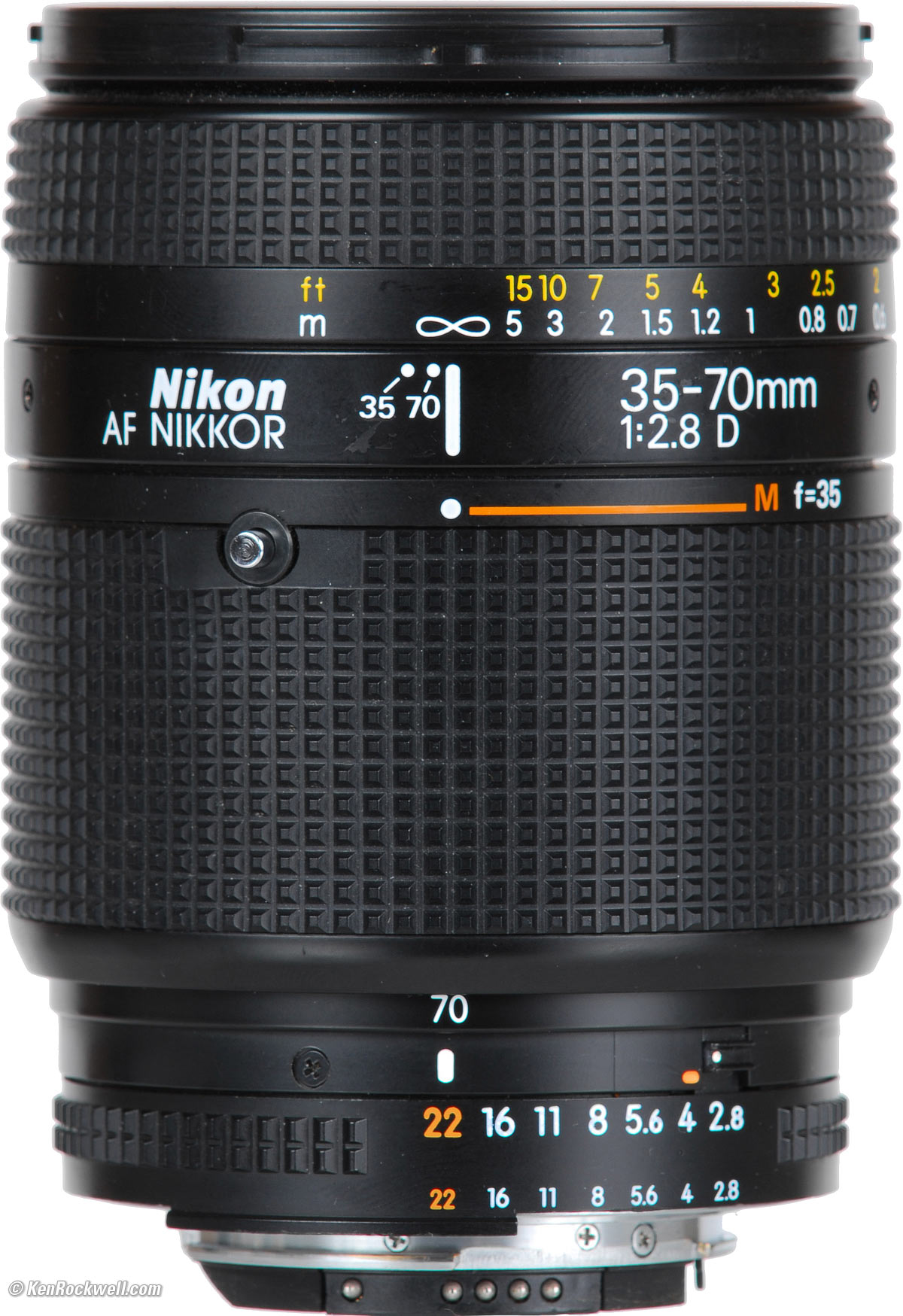
Nikon AF Zoom-Nikkor 35-70mm f/2.8D (62mm filters, 23.4 oz./664 g, about $400 used). enlarge. This free website's biggest source of support is when you use these links, especially this link directly to this lens at eBay (see How to Win at eBay), when you get anything, regardless of the country in which you live. Thanks! Ken.
October 2012 Nikon Lenses Nikon Reviews All Reviews
See my Nikon Professional Normal Zoom Comparison for exhaustive side-by-side image examples, and links to newer and older versions.
Introduction top
Intro Specifications Performance Compared Recommendations

Adorama pays top dollar for your used gear.
I use these stores. I can't vouch for ads below.
|

This 35-70mm f/2.8 AF-D was Nikon's flagship professional midrange zoom of the 1990s, and has pretty much the same optical performance as the newest 24-70mm f/2.8 AFS, with a lot less size, weight and cost.
Instead of paying $1,750 for the 24-70mm f/2.8 AFS, which is so big that it's a pain to carry around my neck, this 35-70mm f/2.8 does the same thing for one-fifth the price with 30% less weight, and it's built tougher than the newer 24-70mm f/2.8 AFS!
This 35-70mm f/2.8 is much smaller and lighter than any of the AFS lenses and has less distortion, too. It weighs more than you might think looking at its small size; it's made mostly of metal and is loaded with lots of professional glass, but still light enough to make the difference between being carryable and being a pain in the neck. For me, the AFS lenses are only for use in a fixed location, not for carrying all day.
This 35-70mm lens was so good that Nikon continued to make it even after the 28-70mm f/2.8 AF-S was introduced in 1999. Even though amateurs are impressed by the huge 28-70mm f/2.8 AF-S and today's even bigger 24-70mm f/2.8 AFS, pros still demanded this smaller, tougher lens.
This is an FX lens, and works perfectly on all FX and auto- and manual-focus 35mm Nikons, and also works great on most DX Nikons except the very cheapest, on which it won't autofocus.
It works fantastically on manual-focus cameras like the F2AS, F3, FE and FA, since it has real manual-focus and aperture rings that work exactly as they should.
The 35-70mm f/2.8 works great with almost every film and digital Nikon camera made since 1977. If you have a coupling prong added to the diaphragm ring, it's perfect with every Nikon back to the original Nikon F of 1959.
The only incompatibility is that it will not autofocus with the cheapest D40, D40x, D60, D3000, D3100, D3200, D5000 or D5100, but if you focus manually, everything else works great. These cameras have in-finder focus confirmation dots to help you. It won't autofocus on an F3 either!
On the newest cameras with Automatic Distortion Control, oddly this lens appears to be incompatible and the feature is grayed-out in the menus. Peripheral Illumination Control works fine.
See Nikon Lens Compatibility for details on your camera. Read down the "AF, AF-D (screw)" column for this lens.
1987-1992
Nikon made about 130,000 AF versions.
1992-2007
Nikon made about 430,000 AF-D versions from 1992 - 2005.
Nikon made plenty, so even after they went out of production in 2005, B&H Photo Video had them in stock through 2007.
The price is low today, but it's the best professional lens Nikon could make for a decade, and priced accordingly.
Corrected for inflation, 2011** |
Dollars at the time** |
|
1991 |
$815 |
$489.95 |
| 1992 | $825 |
$509.95 |
1994 |
$950 |
$624.95*** |
1995 |
$1,050 |
$699.95 |
1996 |
$865 |
$599.95 |
1997 |
$850*/$985 |
$600*/$700 |
1998 |
$750*/$865 |
$540*/$625 |
1999 |
$750*/$815 |
$550*/$600 |
2000 |
$800*/$875 |
$610*/$670 |
2005 |
$650*/$675 |
$565*/$580 |
2007 |
$515 |
$470 |
2011 |
||
2011 |
* Gray market.
** At full NYC discount. Very few people bought their lenses this inexpensively before 2005.
*** After rebate.
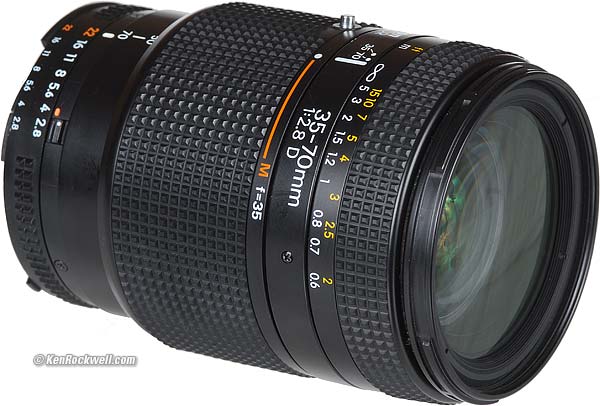
Nikon 35-70mm f/2.8 set to 50mm.
Specifications top
Intro Specifications Performance Compared Recommendations
Name
Nikon calls this the Nikon AF Zoom-Nikkor 35-70mm f/2.8D.
Optics
15 elements in 12 groups.
Traditional spherical design.
Multicoated.
Diaphragm
Traditional seven-bladed diaphragm.
Stops down to f/22.
Infra-Red Focus Indices
Yes, at 35mm and 70mm.
Close Focus
2 feet (0.6m).
It has a separate manual macro mode, only at 35mm, which gets much closer.
Maximum Reproduction Ratio
1:4 at 35mm in macro mode.
Filter Thread
62mm, metal.
Rotates with focus.
Size
3.725" extension from flange by 2.815" diameter (94.60 x 71.51mm), measured when set to 70mm focal length and focused at infinity.
Zooming to 35mm extends the lens by an additional 0.880" (22.34mm).
Focusing to 2' (0.6m) extends the lens an additional 0.195" (4.94mm).
Nikon specifies 3.7" by 2.8" (94 x 71mm).
Weight
23.430 oz. (664.25 g), as measured by me.
Nikon specifies 24 oz. (670g).
Hood
HB-1 plastic bayonet. The lens' bayonet and filter threads are metal.
Performance top
Intro Specifications Performance Compared Recommendations
See my Nikon Professional Normal Zoom Comparison for exhaustive side-by-side image examples.
Sharpness
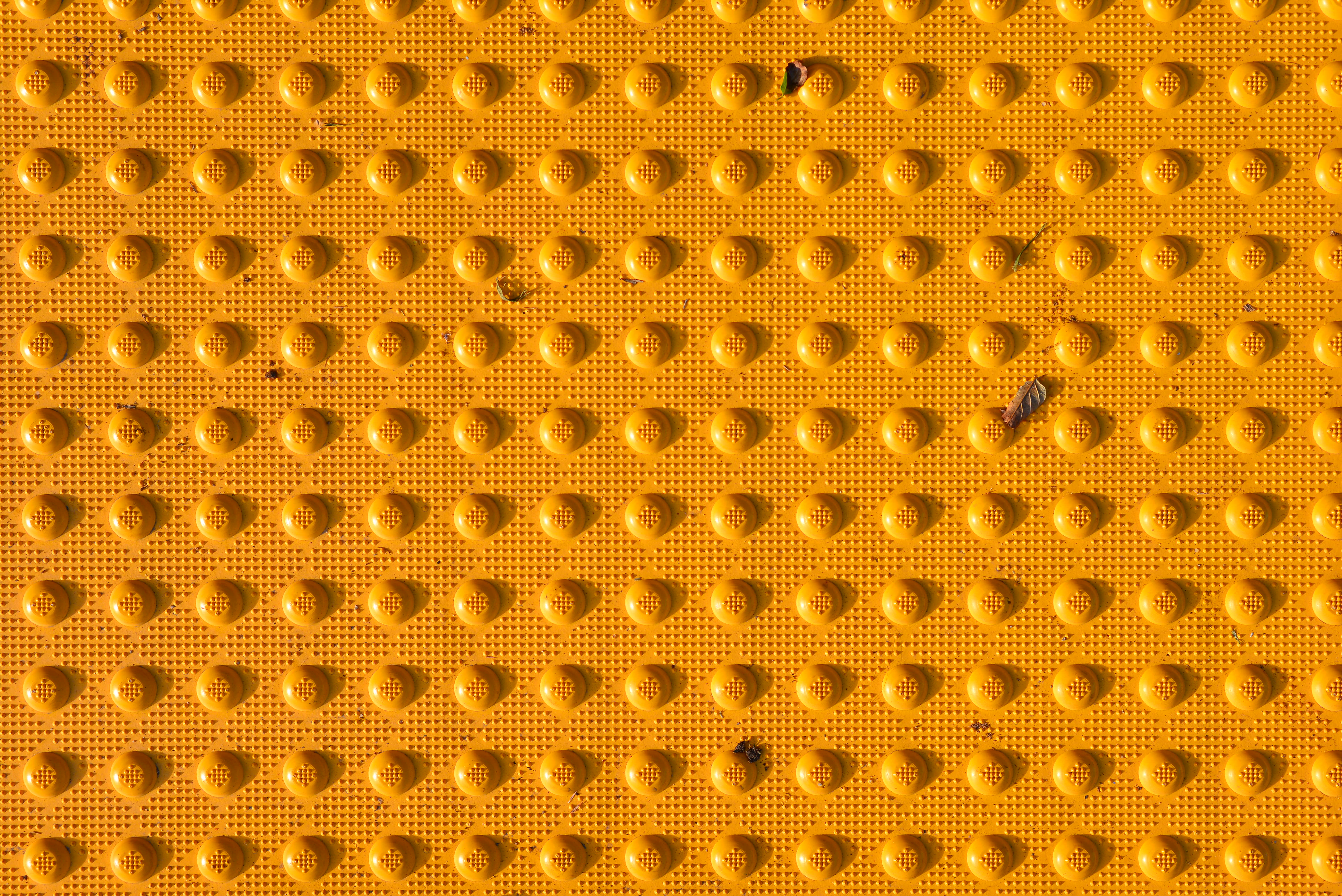
Yellow, 03 October 2012. 35-70/2.8 AFD at 52mm, 24MP D600, 6 sharpening, f/6.3 at 1/160. Camera-original 24MP file.
See my Nikon Professional Normal Zoom Comparison for exhaustive side-by-side image examples to every other Nikon pro normal zoom.
Sharpness is great.
It's sharp in the center at all settings.
On Nikon FX cameras, it's a little softer wide open in the corners, and sharpens up a stop or two down. Even wide open it's pretty good and much better than the cheaper zooms.
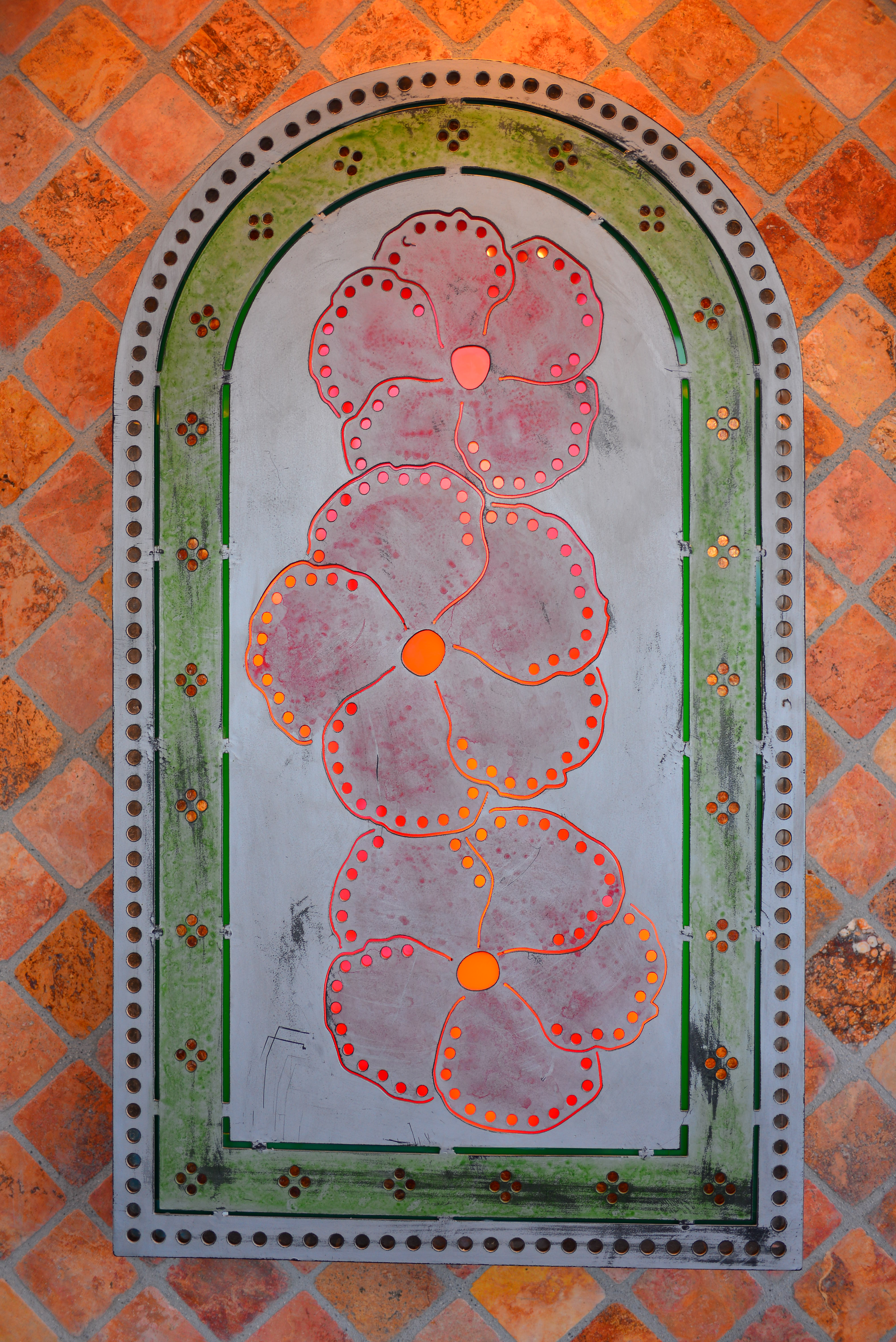
Door. D600, 35-70/2.8D at 40mm, f/2.8 at 1/40 hand-held at ISO 320. Original © BASIC LARGE JPG file, white balance with A4 M1 trim, VIVID Picture Control with +3 Saturation, 6 sharpening.
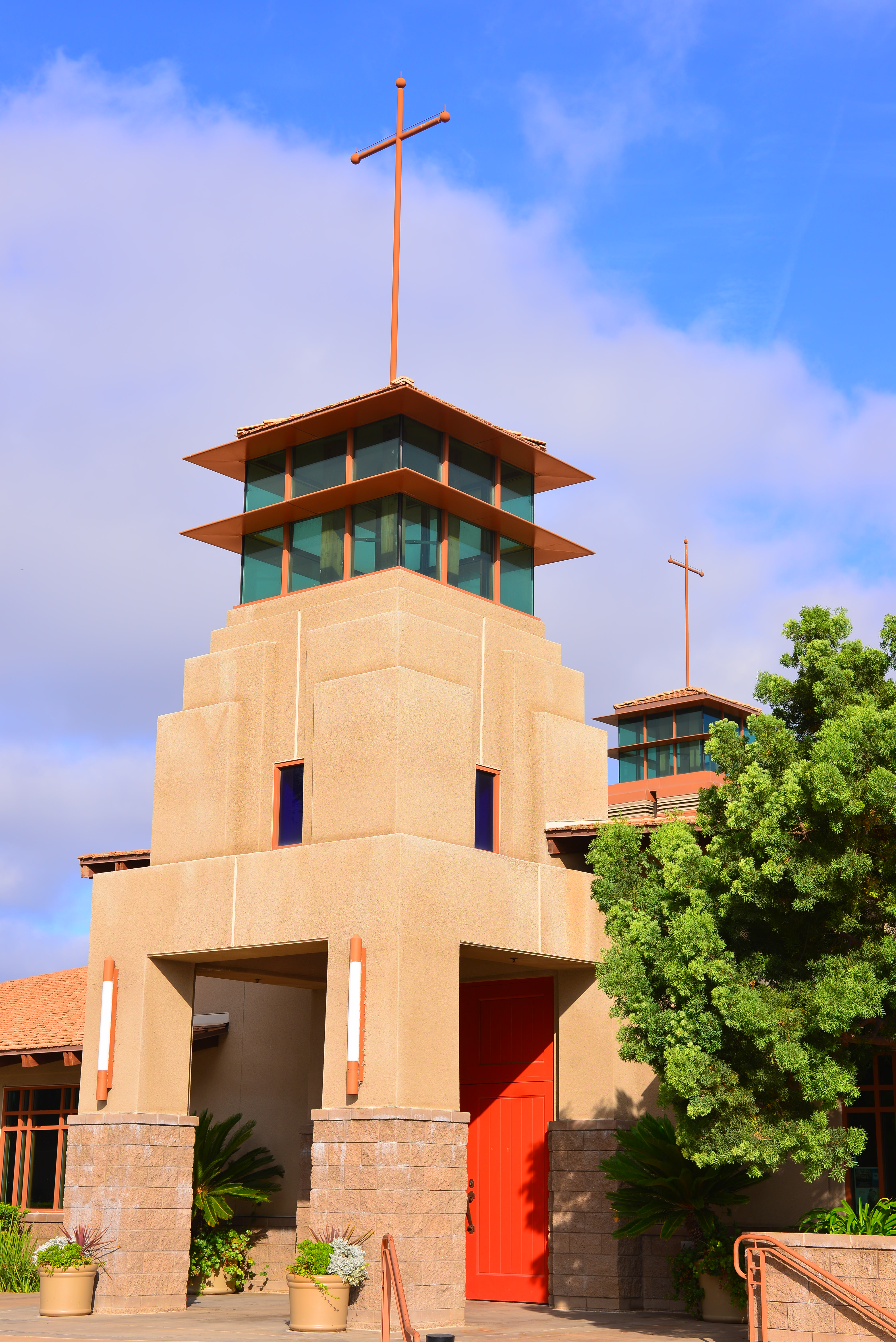
Church. (Nikon D600, Nikon 35-70mm f/2.8 AF-D at 52mm, program auto gave f/9 at 1/320 at Auto ISO 100, AUTO white balance with A4 M1 trim, VIVID Picture Control with +3 Saturation, 6 sharpening. Camera-original © LARGE BASIC JPG file.
Compared directly to the $1,890 24-70mm f/2.8 AFS, the 35-70mm f/2.8 is only a little softer in the corners wide open on FX. This is only visible by setting up a deliberate test where the corners have subject material that will be in perfect focus at f/2.8 and then looking at the images at 100% on my monitor.
On film, I doubt I'd see any of the corner softening even on tests. It's only visible deliberately shooting from a mountain top at infinity, so that there are details to see, in focus, in the far corners. Real subjects we shoot at f/2.8 aren't flat like the Earth, so I've never seen this in anything but deliberate test photos.
If you sweat this, then sure, get the 24-70mm and lug it around. If you just want great photos and no neck pain, get this 35-70mm.
Focusing
The front filter ring rotates during focus, but not with zooming.
AF
AF speed is fast, with one full turn of the AF screw bringing one from infinity to 9 feet.
The focus ring turns during AF action. I've never had a problem with my fingers getting in the way.
The two-foot (0.6m) close focus distance is just fine for most shooting, and if not, the macro mode also works great.
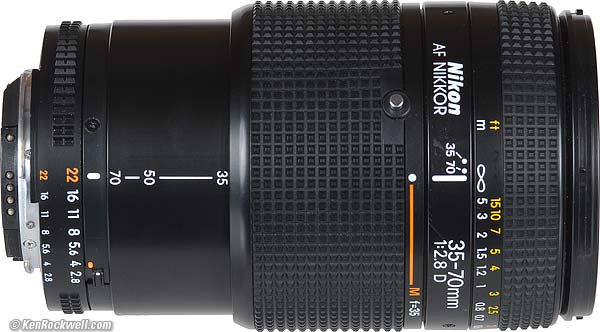
Nikon 35-70mm f/2.8 set to 35mm.
Manual Focus
On digital and AF cameras, manual focus demands you move a switch on your camera.
An advantage of this corny arrangement is that I can grab the entire lens for stable hand-holding after focusing, and that I won't accidentally move the focus as I do with the 24-70mm AFS.
The focus ring is well calibrated for manual-focus cameras. It's just right and never too fast or too slow.
Ergonomics
While much smaller and lightter than the newer AFS and G f/2.8 zooms, this is still a much heavier lens than you'd expect for its size because it's loaded with a lot of glass and metal, not just plastic and air.
It's almost all metal, and feels good in-hand.
Pointed down, it tends to flop-out to the 35mm setting.
The zooming is push-pull: 70mm is collapsed, and 35mm is fully extended.
The zoom range is fluid between 35mm and 50mm. It becomes a little cramped between 50mm and 70mm, requiring a little more attention to set an exact composition, since the zoom moves so little at the longer end.
Macro
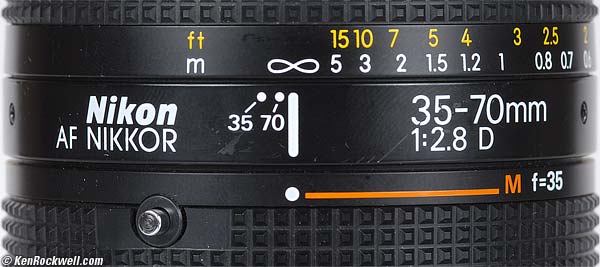
Nikon 35-70mm f/2.8 macro mode control.
The macro mode is easier to use than to explain. Just zoom to 35mm, press the left button with your thumb, and focus by rotating the entire zoom ring to the left. It gets closer than I need.
Focus is manual in the macro mode. Even if you have AF set, it is disengaged automatically. This is great, because I prefer to focus manually in macro modes.
It's easy to focus manually: I look at the finder's ground glass and turn the ring. I get perfect results even at f/2.8. I could use the electronic rangefinder, but it's easier just to look at the image.
The Macro mode gets plenty close, one-quarter life size at the image plane, and is super-sharp:
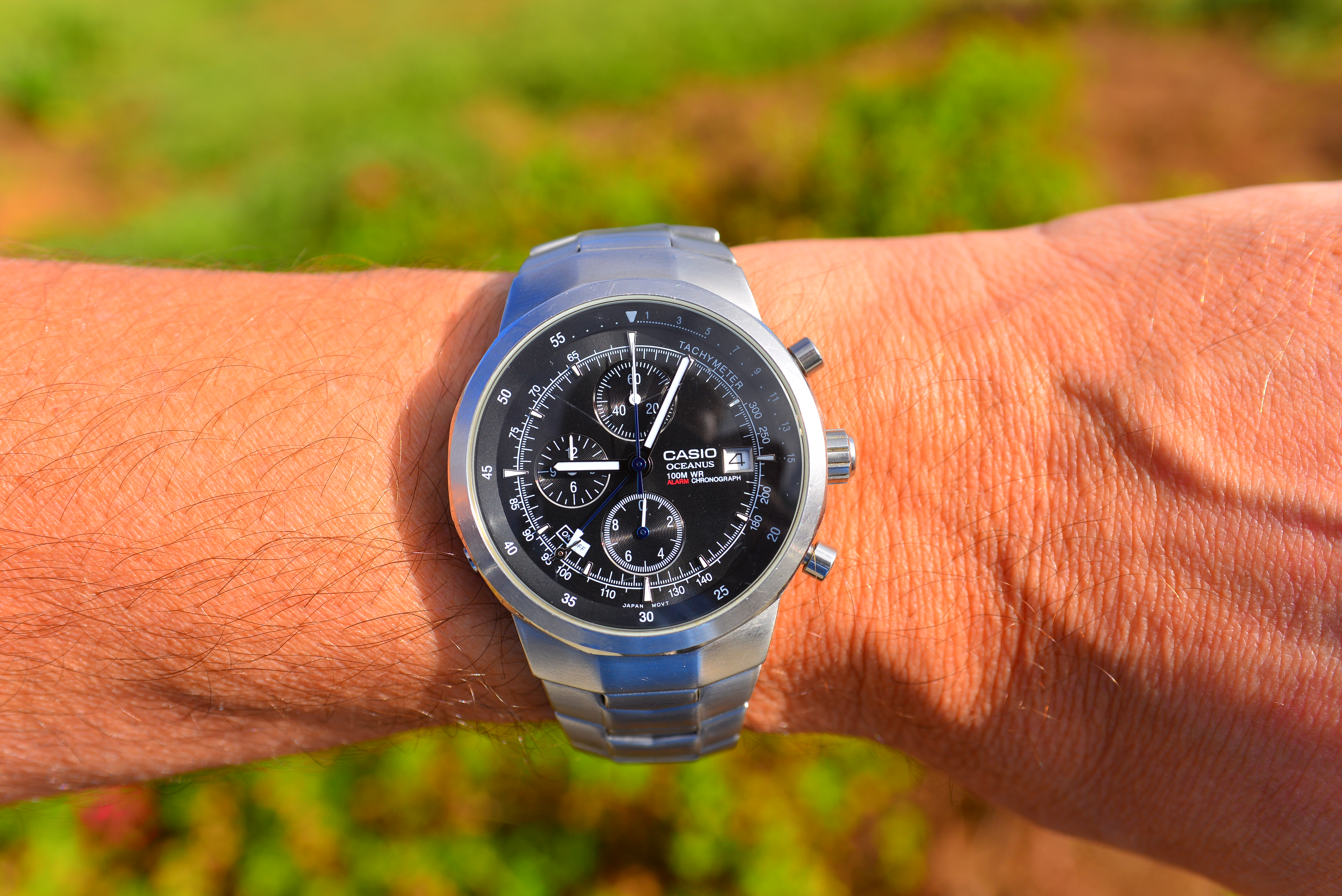
At closest macro distance on FX (D600, f/9 at 1/320, ISO 100.) Camera-original 24MP file
Crop from above 24MP image at 100%. If this is 6" (15cm) wide on your screen, you printed the entire camera-original 24MP file at the same magnification, the print would be 40 x 60" (over 1 x 1.5 meters).
Distortion
The Nikon 35-70mm f/2.8 has the least distortion of any Nikon professional zoom.
On FX, it has some barrel distortion at 35mm and some pincushion distortion at 70mm. On a DX camera it almost has none, care of the crop factor.
Plug these figures into Photoshop CS2's lens distortion filter to correct the distortion. These aren't facts or specifications, they are the results of my research that requires me to climb a bluff on a very clear day and shoot the ocean's horizon.
at infinity: |
FX and Film |
|
35mm |
+3.0 |
+1.5 |
50mm |
-0.3 |
0.0 |
70mm |
-2.0 |
-0.5 |
© 2011 KenRockwell.com
Flare and Ghosts
Flare is this lens' weakest poiint. Pointed into the light, there is often veiling flare, and if the sun is in the image, expect a few ghosts:
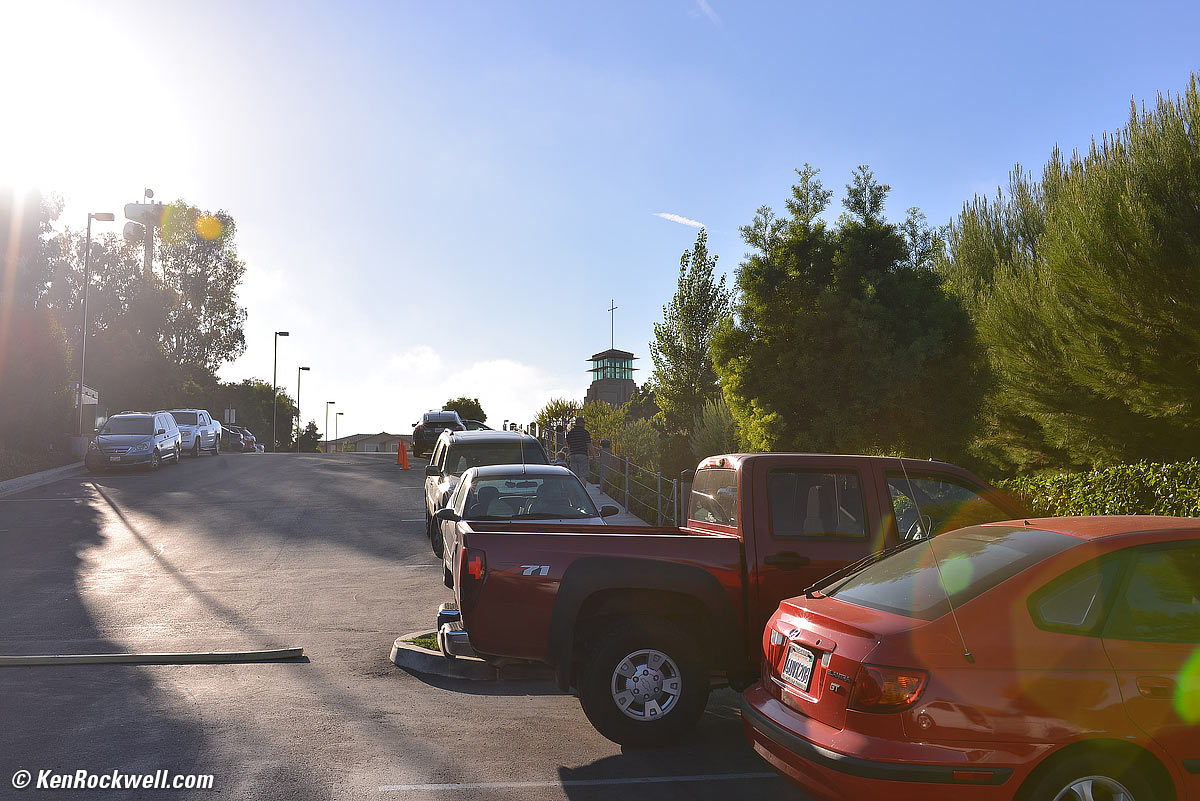
The Sun. Shot on FX D600 at 35mm, f/9 at 1/320 at ISO 100. bigger.
Construction and Mechanics
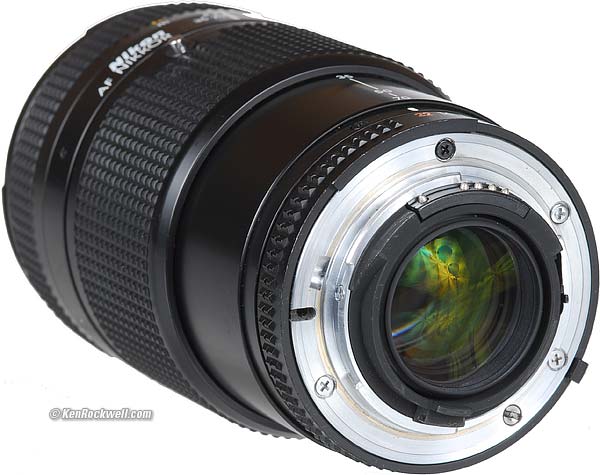
Nikon 35-70mm f/2.8 set at 35mm.
The Nikon 35-70mm f/2.8 is much tougher than you might think. It was Nikon's top professional midrange zoom for over a decade, and built to take it.
Filter Threads and Bayonet Mount
Anodized Aluminum.
Focus and Zoom Rings
Metal, covered with waffle-pattern rubbery plastic.
Barrel
Metal.
Aperture Control Ring
Plastic.
Markings
Paint.
Internals
Looks like metal.
Lens Mount
Metal.
Serial Number
Laser-engraved on bottom of aperture control ring.
Quality
Made in Japan.
Compared top
Intro Specifications Performance Compared Recommendations
See my Nikon Professional Normal Zoom Comparison for exhaustive side-by-side image examples.
Overall, this was Nikon's top professional professional midrange zoom for over ten years, and even with the introdiuctuion of the 28-70 AFS in 1999, pros continued to buy this lens instead for its much smaller size. It's a winner!
The newer AFS and G lenses differ by being as sharp, but doing it over a wider zoom range, but they're also bigger, heavier, more expensive, and have a heck of a lot more distortion as they go wider.
If you're carrying a wide zoom anyway, I see no reason to go to all the effort of buying a newer, heavier lens just to get to 28mm or 24mm if your wide zoom covers that anyway.
Recommendations top
Intro Specifications Performance Compared Recommendations
Want a screaming bargain on a fast professional midrange zoom? This is the one.
This 35-70/2.8 has the same optical performance as today's 24-70mm f/2.8 AFS, for one-fifth the price with a lot less size and weight. This 35-70mm has a metal filter thread while the the 24-70mm f/2.8 AFS' is merely plastic, and this older lens has less distortion, too!
Previously I've questioned the utility of any lens which can only zoom 40% either way from 50mm, and is far bigger, slower and more expensive than any fixed 50mm lens, but I've become more open minded in my old age. For those of you who need to zoom instead of move forward and back, this is a great lens. Personally, I own this and a 24-70mm f/2.8 AFS, and I still prefer to carry a 50mm f/1.8 instead for its greater speed and smaller size, but that's just me.
If you find this review helpful, this free website's biggest source of support is when you use these links, especially this link directly to this lens at eBay (see How to Win at eBay), when you get anything, regardless of the country in which you live. Thanks! Ken.
Deployment
Filters and Caps
I'd pitch the flat Nikon cap that came with this lens new, and get a new "pinch" type cap. I'm not kidding: the new fatter caps are much easier to use in the field.
I'd leave either a 62mm Nikon Clear (NC - UV) filter, or a 62mm Hoya Super HMC UV on the lens at all times.
If I was working in nasty, dirty areas, I'd forget the cap, and use an uncoated 62mm Tiffen UV filter instead. Uncoated filters are much easier to clean, but more prone to ghosting.
For color slides like Velvia 50, I use a 62mm Nikon A2 or a 62mm Hoya HMC 81A outdoors.
For B&W film outdoors, I'd use a 62mm Nikon Y48 or 62mm Hoya HMC K2 Yellow, or 62mm Nikon O56 or 62mm Hoya HMC Orange.
For integration within a larger professional Nikon system, you may want to use a 62mm -> 77mm adapter ring, and treat this as 77mm lens for the sake of your own sanity. If you do, than I'd forget 62mm filters and caps, and then:
Get a new 77mm Nikon front cap.
I'd leave either a 77mm Nikon Clear (NC - UV) filter, or a 77mm Hoya Super HMC UV on the lens at all times.
If I was working in nasty, dirty areas, I'd forget the cap, and use an uncoated 77mm Tiffen UV filter instead. Uncoated filters are much easier to clean, but more prone to ghosting.
For color slides like Velvia 50, I use a 77mm Hoya HMC 81A or Nikon A2 filter outdoors.
For B&W film outdoors, I'd use a 77mm Hoya HMC Yellow K2 or 77mm Hoya HMC Orange.
Other Lenses
With a 62mm filter thread, adding the Nikon 20mm f/2.8 AF-D and your choice of the the Nikon 70-210mm f/4 AF, 70-210mm f/4-5.6 AF-D or Nikon 75-300mm AF-D lets you cover every possible subject, all with the same filter size.
Help me help you top
I support my growing family through this website, as crazy as it might seem.
The biggest help is when you use any of these links when you get anything, regardless of the country in which you live. It costs you nothing, and is this site's, and thus my family's, biggest source of support. These places have the best prices and service, which is why I've used them since before this website existed. I recommend them all personally.
If you find this page as helpful as a book you might have had to buy or a workshop you may have had to take, feel free to help me continue helping everyone.
If you've gotten your gear through one of my links or helped otherwise, you're family. It's great people like you who allow me to keep adding to this site full-time. Thanks!
If you haven't helped yet, please do, and consider helping me with a gift of $5.00.
As this page is copyrighted and formally registered, it is unlawful to make copies, especially in the form of printouts for personal use. If you wish to make a printout for personal use, you are granted one-time permission only if you PayPal me $5.00 per printout or part thereof. Thank you!
Thanks for reading!
Mr. & Mrs. Ken Rockwell, Ryan and Katie.
Home Donate New Search Gallery Reviews How-To Books Links Workshops About Contact