Nikon 70-200mm f/2.8 VR
FX G (2003-2009)
Intro Format Compatibility Specs

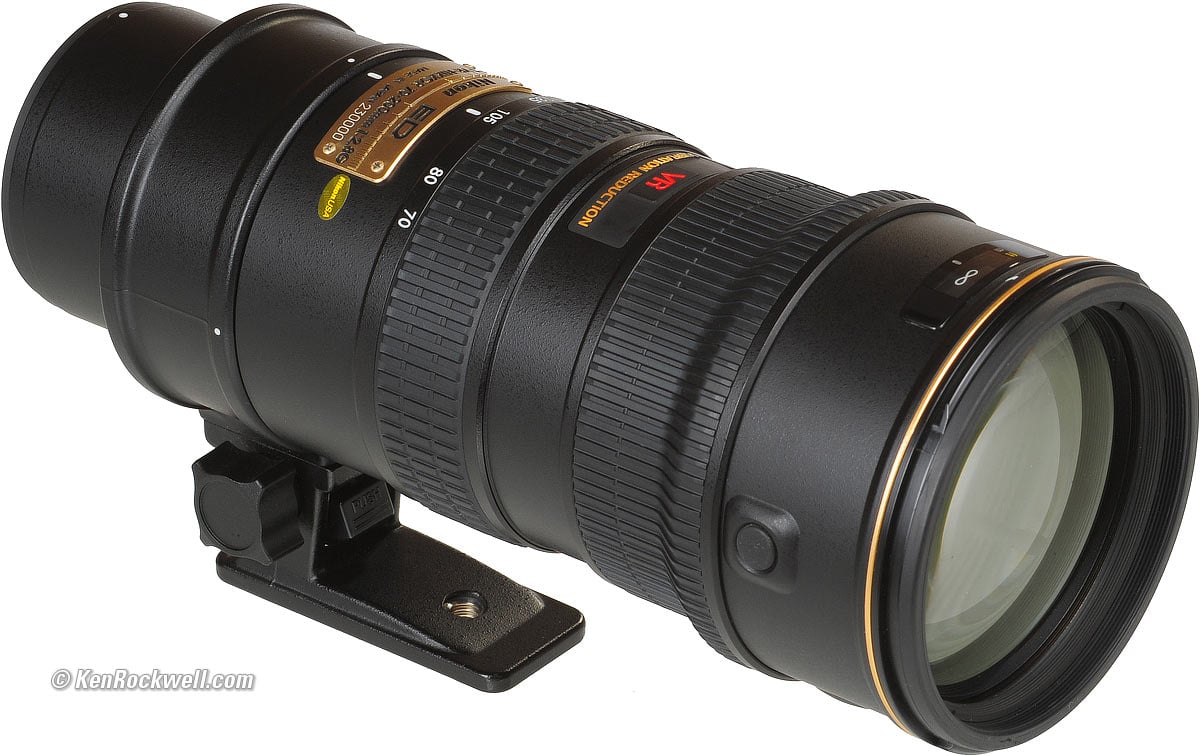
Nikon 70-200mm f/2.8 VR (77mm filters, 51.8 oz/1,468g with tripod collar, about $900 used if you know How to Win at eBay). bigger. I'd get mine at Amazon or at eBay.
This all-content, junk-free website's biggest source of support is when you use those or any of these links to approved sources when you get anything, regardless of the country in which you live. Buy only from the approved sources I use myself for the best prices, service, return policies and selection. Thanks for helping me help you! Ken.
April 2018 Nikon Reviews Nikon Lenses Nikon Flash All Reviews
Replaced by the 70-200mm VR II as of Fall, 2009. Nikon 70-200mm history & timeline.
| Optics: |
|
| Ergonomics: |  |
| Usefulness: | |
| Availability: | easy to find used |
| Overall: | found around the neck of every pro in the 2000s |
 for tripod-huggers just reading about it online
 Ideal for: All-purpose pro tele zoom. Perfect for news, sports, indoor sports and theatre.
Not for: Manual focus film cameras.
Introduction
Top Intro Format Compatibility Specs

I buy only from these approved sources. I can't vouch for ads below. |



This Nikon 70-200mm VR was Nikon's top professional zoom for news and sports photographers from its introduction in 2003 through the Fall of 2009 when it was replaced by the very similar 70-200mm VR II. Today this original 70-200 VR is still a remarkable professional lens. The only things the newer lenses do is focus a little more closely, weigh a little less, or maybe have a hair more sharpness visible only in the laboratory.
The only reason not to get this lens is the price, size and weight, all of which are to professional standards. You can get the same superb optical performance in lenses that cost much less, but they won't have VR, or they'll require moving a switch to get to manual focus, or they won't zoom, or they won't autofocus. If you're shooting DX, the 55-200mm DX VR is just about as sharp, but doesn't move as fast or take as much of a beating.
The reason the 70-200mm VR costs ten times what other equally sharp lenses might cost are because the 70-200 VR also offers:
1.) Fast f/2.8 speed for low light, soft backgrounds and action-stopping shutter speeds.
2.) Built tough: all metal except for rubber gaskets and bumpers.
3.) Built to last: many markings are engraved to outlast all of us.
4.) Fast, quiet AF with a silent wave motor. You won't scare sensitive subjects as other AF lenses might.
5.) Instant manual-focus override: just grab the focus ring at any time
6.) Vibration reduction so you can leave the tripod at home.
7.) Three AF-Lock buttons to lock focus when pressed and held. These are extremely handy once you learn to use them.
8.) Better bokeh than most other Nikkor lenses.
This 70-200mm f/2.8 VR is one of the two lenses used by most professional photographers every day. The other lens is usually a wide zoom on a second body.
Nikon's other 80-200 f/2.8 AF costs much less and offers the same great optics and fast f/2.8 aperture as the VR lens, but doesn't offer advantages 4~7 above. Nikon's previous 80-200mm f/2.8 AF-S offered most of the advantages of this 70-200mm VR, except for vibration reduction.
If you're contemplating getting this lens, just get it. If you're more familiar with the plasticy $500 - 1,500 VR lenses like the 18-200mm VR, 70-300mm VR, 24-120mm VR or the 80-400mm VR, then you've in for a pleasant surprise. The mechanical quality of the 70-200mm VR is several steps above any sub-$1,500 lens. It's completely metal, completely solid, and a pinnacle of professional durability, optical quality and precision.
The 70-200 VR is a little lighter than my $1,500 80-200mm AF-S.
Format
Top Intro Format Compatibility Specs
This is a full frame FX lens, and I'm reviewing it as such.
It works great on DX cameras, too, on which you may make the usual inferences.
Compatibility
Top Intro Format Compatibility Specs
This AF-S lens works perfectly with every Nikon DX and FX digital SLR.
It also works perfectly with any but the very cheapest or oldest Nikon AF film cameras. It sings on the D3 as well as the D40.
Because it's gelded ("G," or has had its aperture ring removed to save cost) it's 99% useless with manual focus cameras. For manual focus cameras, the much less expensive 80-200mm f/2.8 AF-D works much better.
See Nikon Lens Compatibility for details with your camera. Read down the "AF-S" and "VR" columns for this lens.
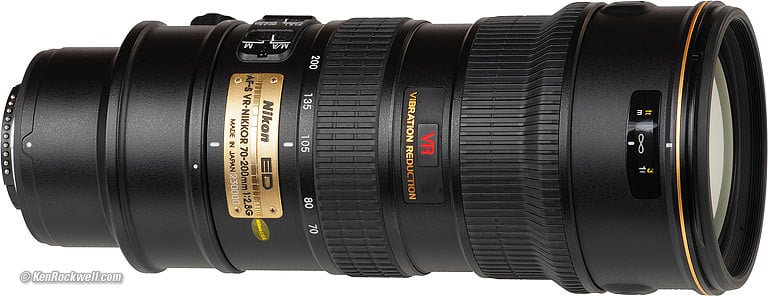
Nikon 70-200mm f/2.8 VR. enlarge.
Specifications
Top Intro Format Compatibility Specs
Name
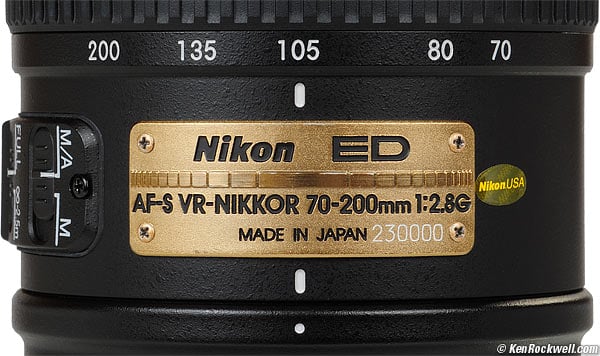
Identity Plate: Nikon 70-200mm f/2.8 VR.
Name: Nikon calls this the Nikon AF-S VR Zoom-Nikkor 70-200mm f/2.8G ED-IF.
AF-S and SWM: Silent Wave Autofocus Motor.
VR: Vibration Reduction, for shooting still subjects without a tripod.
G: Gelded, meaning the aperture ring was omitted to save cost. Won't work on manual focus cameras.
ED: Extra-low Dispersion glass for sharper pictures.
IF: Internal Focusing Nothing moves externally as you zoom or focus.
∅77: 77mm filter thread.
Also has:
D: Couples distance information to the Matrix Meter.
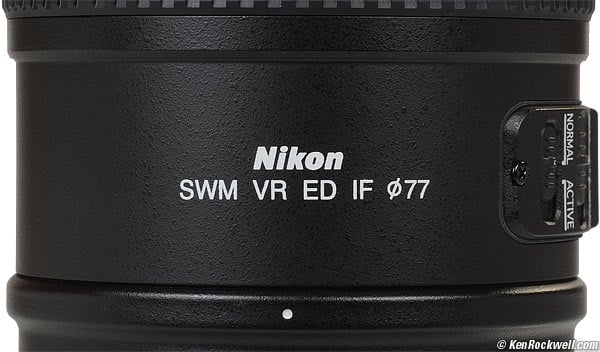
Bottom, Nikon 70-200mm f/2.8 VR.
Optics
21 elements in 15 groups.
5 ED extra-low dispersion elements, which help reduce secondary axial chromatic aberration.
Multicoating.
Diaphragm
9 blades.
Round at larger apertures, nonagonal at smaller apertures.
Coverage
Focal Length
70~200mm.
Used on a DX camera, it sees angles of view similar to what a 105~300mm lens would give on an FX or 35mm film camera. See also Crop Factor.
Autofocus
Internal focus.
No external movement as focused, so no air or dust is sucked in.
Focus Scale
Yes.
Infinity Focus Stop
No.
Depth of Field Scale
No.
Reproduction Ratio Scale
No.
Infrared Focus Index
No.
Close Focus
5 feet (1.5 meters), marked.
It gets a little closer than that. AF stops just short of the manual focus stop, so if you're at the edge, twist the focus ring by hand and you may get what you need.
Maximum Reproduction Ratio
1:5.6 (0.18 ×).
(only 1:6.1 if you stop where the AF stops.)
Filters
77 mm, metal threads with rubber bumper.
Hood
HB-29 plastic bayonet hood included.
Case
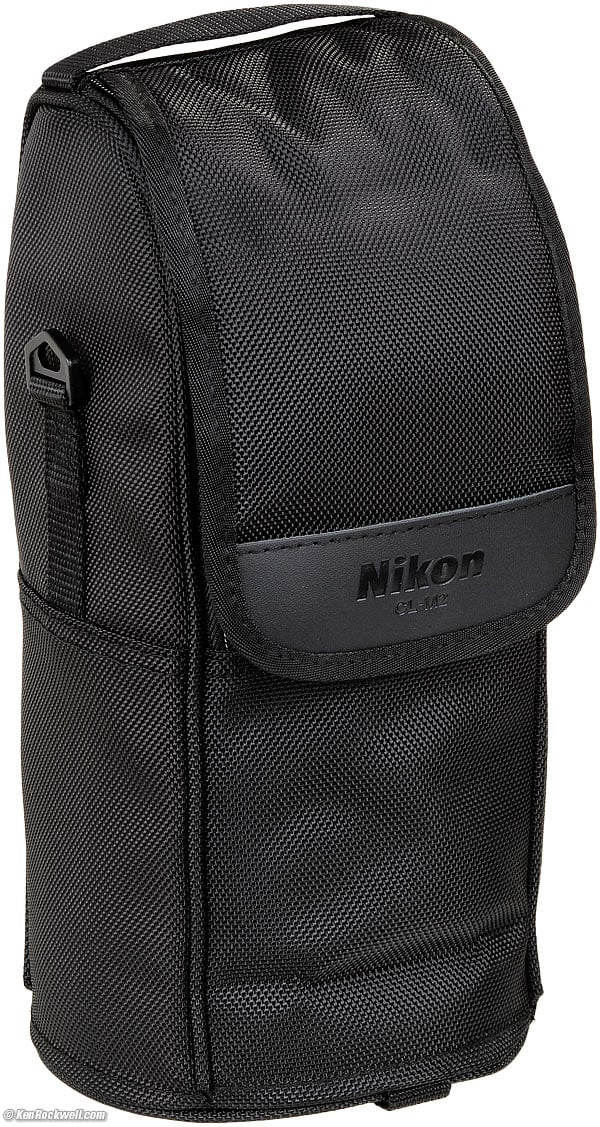
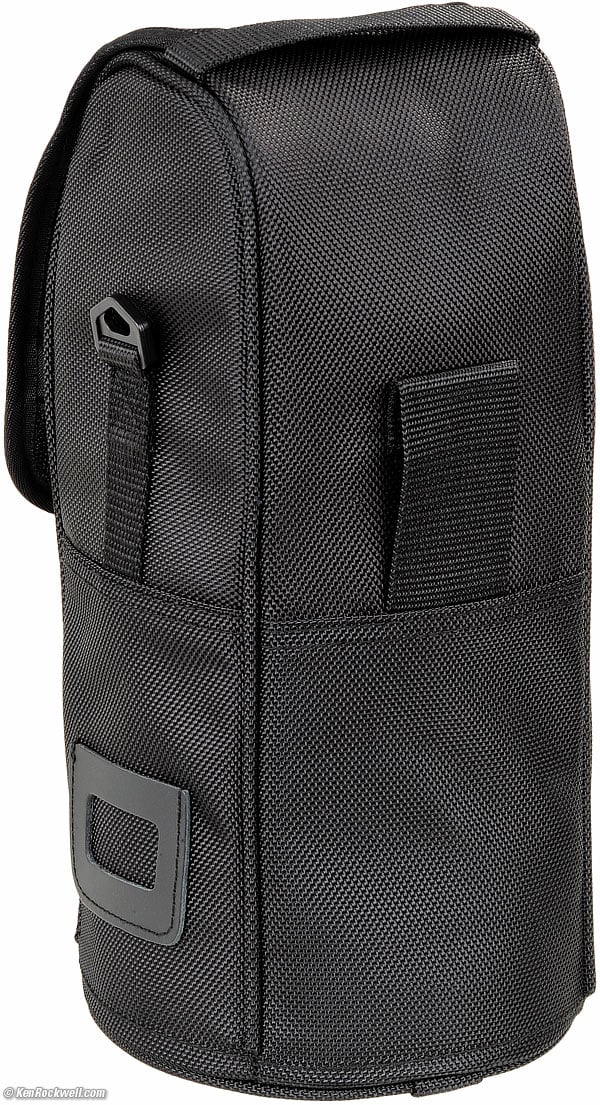
CL-M2 case included.
|
|
Nikon CL-M2 case. bigger. |
Nikon CL-M2 case. bigger. |
Size
8.465" extension from flange by 3.439" diameter (215.0 x 87.35mm), measured.
Nikon specifies 3.4 inches (87mm) around and 8.5" (215mm) long.
Nothing changes when focused or when zoomed.
Weight
51.790 oz. (1,468.15g), measured, with tripod collar.
Nikon specifies 50 oz. or 1,430 g, a little lighter than the 80-200mm AF-S or a little heavier than the 80-200mm AF-D.
Quality
Made in Japan.
Development Announced (teaser):
Announced
Announced as a real product: 12 December 2002.
Available Since
Spring 2003.
Included
Lens, caps, case and hood.
Nikon Product Number
2139.
Price, USA
About $900 used if you know How to Win at eBay, April 2018.
$1,650 new in 2008.
Performance
Top Intro Format Compatibility Specs
Overall AF Bokeh Color Distortion Falloff Ghosts Color Fringes
Mechanics Sharpness Teleconverters Vibration Reduction Zooming
Overall back to Performance back to top
As Nikon's best professional moderate telephoto zoom, one of these (or one of its earlier siblings) is in almost every professional photographers' bag.
Its optics and mechanics are superlative for everything a full-time career professional news or sports photographer would want to shoot with it, on any Nikon digital or modern film camera.
The only reason I don't have one myself is because I usually use my 80-400mm VR instead, since I shoot things that don't move and prefer the longer range.
There was a review posted on a very popular digital camera website in May 2008 that caused some confusion amongst hobbyists. That website, founded by a photo hobbyist and bought-out by a big corporation, decided to try to review lenses. They got their review of the 70-200mm VR all wrong since they lacked the perspective of a pro photographer, familiarity with optics, and most importantly, any history of shooting full-frame film.
Pros laughed at that review. Pros wrote me from all over the world telling me how their 70-200mm is the best lens they've ever owned, how they earn their living with it day-in and day-out, in the dark, in the rain, indoors and outdoors, and how other pros call them asking what lens was used for such-and-such shot since it was so sharp. One pro wrote that he's glad he never read that review, since if he did he might never take his 70-200 out of his bag!
Since that other website is written by and for amateurs, it missed the boat when it came to reviewing a pro lens. Like many reviews of just about anything, reviews are only meaningful when the person writing the review has the perspective to understand the product.
Something that confuses the innocent, as well as that other popular website, is that the 70-200 VR has a rear nodal point much further forward than other zooms, about 5" (12cm) in front of the lens mount. Most Nikon SLR lenses have their rear nodal points about an inch and a half (4cm) forward of the lens mount, and Nikon SLR viewfinders have had their condensers optimized for that ever since the 1950s.
When you use a lens with its rear nodal point so far forward, the corners of the finder often take on a darker, fuzzier double-image look because the condenser lenses and Fresnel screens are looking in the wrong place! The corners of the finder look awful, but the image on film and on-sensor are unaffected by the finder image. The original 50-300mm f/4.5 and other super-teles have suffered from this same ugly-finder effect for the same reason.
What this gobbledygook means is that you can't tell how sharp this lens is by looking through the finder. The corners will always look dark and blurry because Nikon's finders aren't optimized for this lens.
On film, DX and FX digital, this is a very, very sharp lens from edge-to-edge on full-frame, even at f/2.8.
If you look beyond the edges, and out to the farthest few millimeters of the corners of the full FX frame where important parts of the image shouldn't be, the 70-200mm VR is among Nikon's softest lenses, but so what! Pros rarely, if ever, compose with important details in the far corners. With a tele, the corners are usually out-of focus anyway. Pros don't put distracting details, which weaken their images by leading eyes out away from the center, off in the corners. This far corner (on full-frame only) softness might irk amateurs out shooting test charts, but I've never met any pros with anything other than the highest praises for this lens. It is trivial to make photos that show this and post them on the Internet for all to see, but you won't see this in real photos composed properly. Nikon is honest about this: their MTF curves clearly show the meridional sharpness plummeting beyond 17mm from the center of the frame. (Nikon's MTF curves.)
See Lens Sharpness for more.
Focus back to Performance back to top
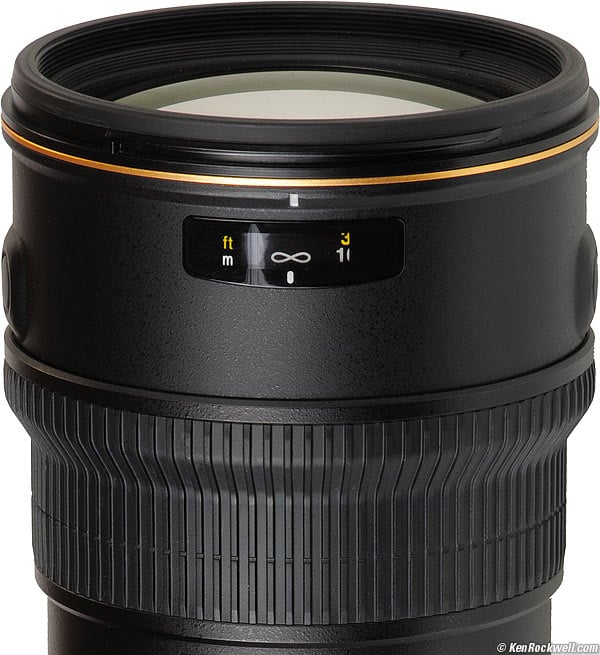
Nikon 70-200mm VR Focus Ring: Simple!
Focus is fast and sure.
Manual focus is easy: simply move the focus ring at any time. It just works. Tap the shutter button again for AF.
Manual focus has two speeds: normal and slightly slower. For normal speed, grab the longer part of the manual focus ring. For slightly more precise manual focus, move your fingers forward to the slightly larger diameter section. It really does make a difference.
There are three very useful focus lock buttons.
Bokeh back to Performance back to top
Bokeh looks great. It's better than most Nikkor lenses.
Color Rendition back to Performance back to top
Color is neutral and matches my other AF Nikkors.
Distortion back to performance back to top
As in most zoom lenses, there is barrel (bulging) distortion at the shorter end and pincushion (sucking) distortion at the longer end.
Luckily it's trivial to correct the distortion by plugging these figures into Photoshop CS2's lens distortion filter. + means barrel distortion, and - means pincushion distortion. These aren't facts or specifications, they are the results of my research that requires hours of photography and calculations on the resulting data.
FX at ∞ |
FX at 50' (15m) |
FX at 10' (3m) |
FX at 5' (1.5m) |
DX at ∞ |
DX at 50' (15m) |
|
70mm |
+4.0 |
+4.0 |
+3.0 |
+1.5 |
+1.4 |
+1.2 |
80mm |
+2.7 |
+2.2 |
+2.0 |
+1.0 |
+1.0 |
+1.0 |
105mm |
0.0 |
0.0 |
-0.5 |
-1.0 |
0.0 |
0.0 |
135mm |
-1.2 |
-2.0 |
-2.0 |
-1.5 |
-0.8 |
-1.0 |
200mm |
-3.0 |
-3.0 |
-3.0 |
-2.5 |
-1.0 |
-1.0 |
© 2008 KenRockwell.com. All rights reserved.
Falloff (darker corners) back to Performance back to top
Falloff isn't a problem with the 70-200mm VR, unless you shoot blank walls at 200mm at f/2.8. Shoot normal subjects, or shoot at less than 200mm, or stop down, or shoot in DX, and any falloff becomes invisible. As explained at Overall, the finder shows a lot of vignetting that isn't on the film or sensor.
I've greatly exaggerated the falloff below by shooting a blank target and then presented the images against a gray background. The only time any of this is visible is at f/2.8 at 200mm, and when you're shooting at those extremes, falloff isn't likely to be a concern.
On DX it's a non-issue, since only the middle of these images is used. (see crop factor).
Nikon 70-200mm VR falloff on FX at infinity.
|












Ghosting back to Performance back to top
There is one ghost opposite the center of the image if I deliberately point it into a bright light on a black background.
Lateral Color Fringes back to performance back to top
None, on either a D3 or D300.
Mechanics back to performance back to top
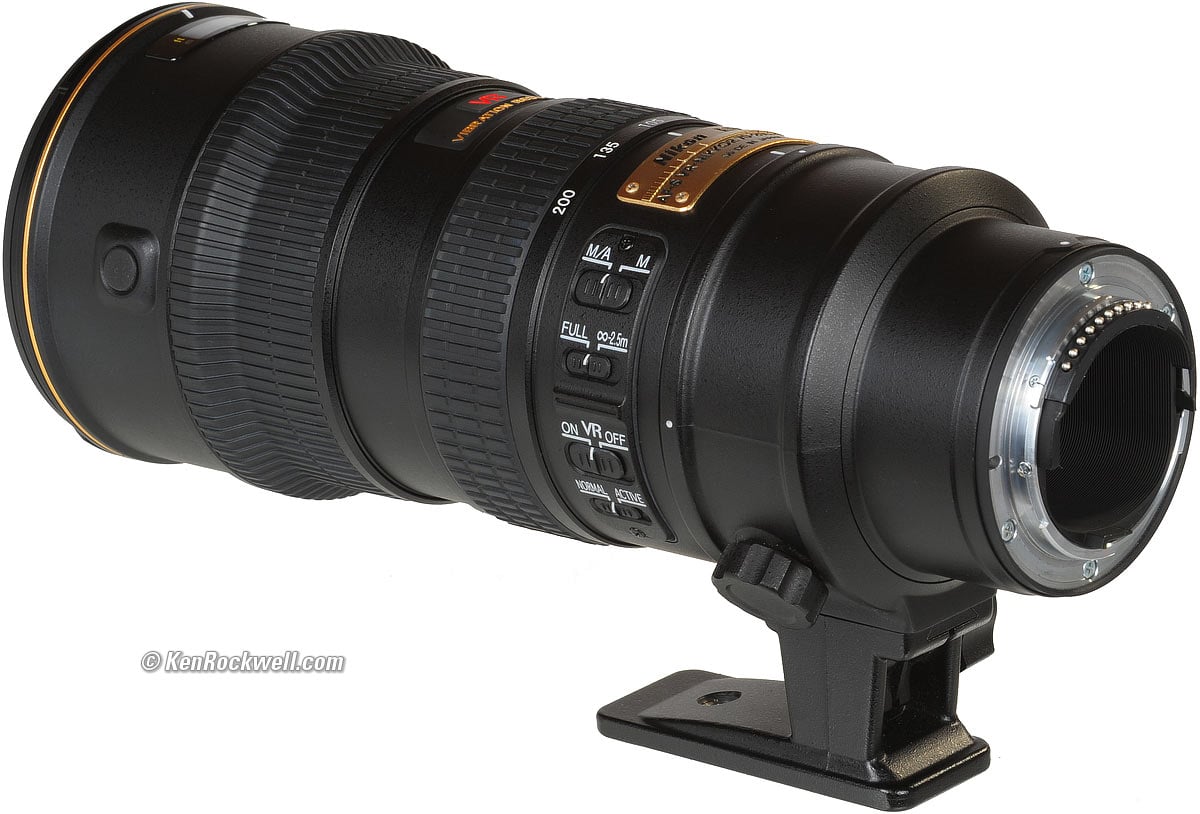
Nikon 70-200mm f/2.8 VR. enlarge.
Outer Body
Epoxy-coated metal.
Filter Bumper
Rubber.
Filter Threads
Metal.
Hood
Plastic, with metal pawl and pawl cover.
Bayonet Hood Mount
Plastic.
Focus Ring
Rubber-covered metal.
Zoom Ring
Rubber-covered metal.
Markings
Zoom ring: engraved.
Identity plate: engraved metal.
Switches and under-barrel gibberish: paint.
Lens Mount
Nikon standard dull chromed brass.
Rear Gasket
Rear dust and rain barrier: Yes.
Made in
Japan.
Serial Number
Engraved on identity plate.
USA Version shown by
Yellow and black "Nikon USA" sticker next to identity plate.
Sharpness back to Performance back to top
Of course it's sharp! It's among the sharpest zooms I've used. Its sharp on my D3 from edge to edge at every setting.
It is soft at 200mm in the farthest corners on FX. This isn't a problem for pros who actually own and use the 70-200mm every single day, but if you're shooting landscapes on a tripod with a D3X, try something else, like the manual focus 80-200mm f/4.5n AI instead.
If you're a tripod-hugger who demands the very highest sharpness in the corners at 200mm, you'll prefer the 200mm f/4 AF Micro-NIKKOR instead at 200mm. Normal people and pros love the 70-200 VR.
See more at Lens Sharpness.
Teleconverters, use with back to Performance back to top
Oddly, if you're a tripod-hugger who looks too hard in the far corners where real photographers would never put their subjects, the TC-14E and TC-17E give sharper corners than the lens alone!
The TC-14E doesn't give much additional magnification, and doesn't lose any performance, either.
EXIF and exposure data read correctly with the TC-14E, meaning the camera and EXIF read the effective f/stop, which now starts at f/4, and the effective focal length, which goes from 100~280mm.
Performance seems the same, on a D3, as the lens alone, except now it's a 100~280mm f/4. If you're on a tripod and looking at images at 100%, it's just a teensy bit softer wide open (f/4) and is wonderful by f/5.6, one-stop down.
AF seems as fast.
The TC-17E also gives excellent results. The results with the TC-17E are as sharp as the 70-200 VR alone.
In fact, corner sharpness is better than the 70-200mm naked, since with the TC-17E the corners are always sharp, and the 70-200mm alone has softer corners at many focal lengths if you're looking to hard. How can this be? Easy: the TC is throwing away the corners.
EXIF and exposure data read correctly with the TC-17E, meaning the camera and EXIF read the effective f/stop, which now starts at f/4.8, and the effective focal length, which goes from 120~340mm.
AF seems almost as fast and sure. It's not quite as fast as without a TC, but not much slower either.
The 70-200mm VR isn't very hot on the TC-20E. If you have all three TCs and do a direct comparison as I did, the results from the TC-20E and 70-200 VR combination are clearly inferior to any other combination, looking at D3 output at 100%.
Sharpness has little to do with real image quality, but if you count your pixels, skip the TC-20E with the 70-200mm VR.
AF, at the same resultant focal length, is slower.
AF can take longer and get more confused as the focal length creeps up, so since with the TC you'll most likely be shooting at longer effective focal lengths. The more you push it with a TC, the more likely it is to hang up.
Vibration Reduction back to Performance back to top
These are the slowest speeds at which I get perfectly sharp shots 50% of the time. See Why VR Matters for details.
On a D3
At 70mm: 1/10. At 200mm: 1/15.
With TC-20E: at 140mm: 1/25. At 400mm: 1/30.
On a D1H
at 70mm:
1/125:
OK
1/60: OK
1/30: OK
1/15: OK
1/8: slight blur
1/4: blur
1/2: blur
at 200mm:
1/125:
usually OK
1/60: slight blur and usually OK
1/30 Blur
1/15: OK
1/8: OK
1/4: slight blur
1/2: very blurry
No, I have no idea why there is a sweet spot around 1/10 second but blur around 1/100 at 200mm. It may be chance or the design of the lens. I'll have to test it further when I can get a sample for a while. I did see these effects repeated a couple of times.
Zoom Ring back to Performance back to top
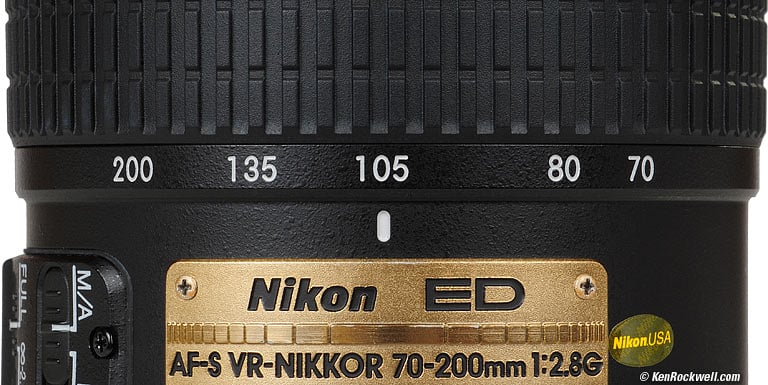
Zoom Ring, Nikon 70-200mm VR.
The zoom ring is well done. It's mostly linear, with equal rotation anyplace along the range giving an equal percentage change in magnification. (Mathematicians call this logarithmic, not linear, but if I told you all it was the correct Log scale then I'd confuse you all.)
The zoom ring is engraved metal with white paint filling in the engraving, just as it ought to be. It's not simply painted as most other lenses today. Engraving doesn't wear off.
It's a little more damped than I'd prefer. This prevents it from creeping. I suspect with continued daily professional use it would loosen up.
Usage top
Top Intro Format Compatibility Specs
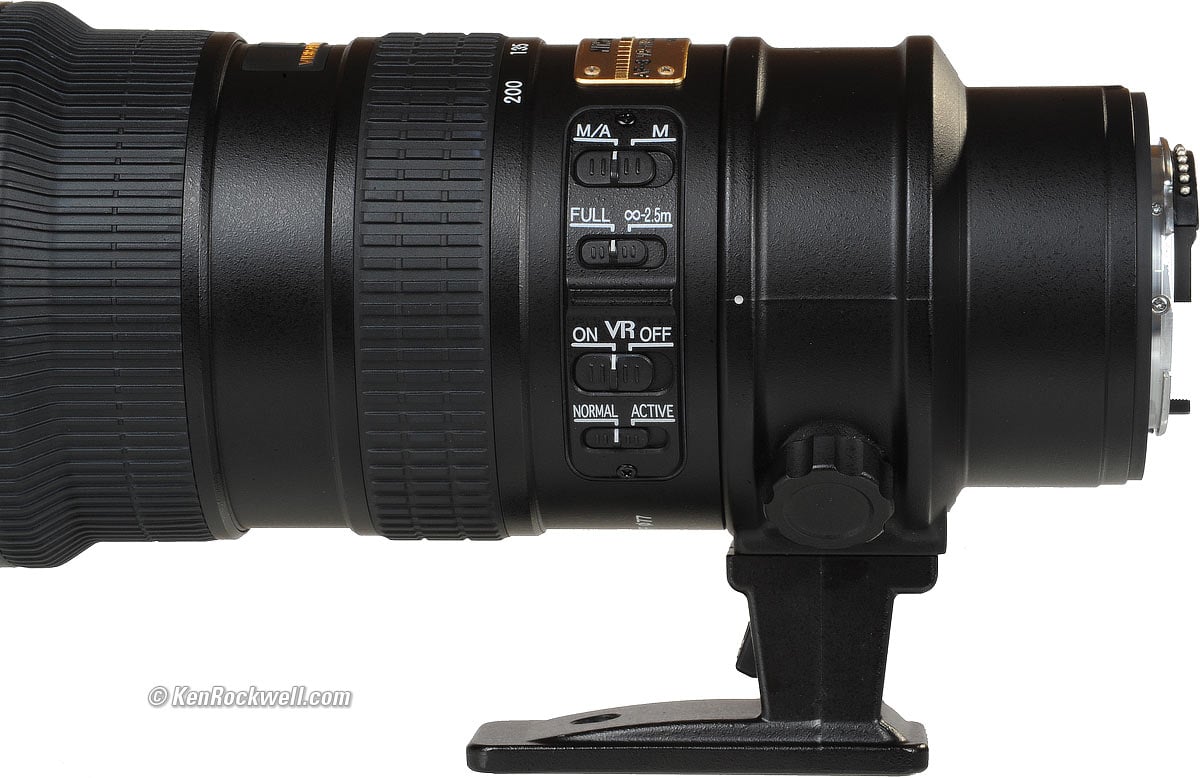
Nikon 70-200mm VR Switches. enlarge.
M/A — M: Nikon has a typo here. Just scratch off the "M/" on the left of the top switch. The "M/A" position is a left-over name from when having instant manual override was still a new sales feature. In M/A, you're really in AF, but you also may grab the focus ring for instant override The "M" position locks it in manual focus.
FULL — ∞-2.5m: This limits the autofocus range in the ∞-2.5m position.
VR ON — OFF: Vibration Reduction. leave it on, but turn it off if you still have a tripod.
VR NORMAL — ACTIVE: Use NORMAL for hand-holding from a fixed position. Use ACTIVE if you're in a helicopter, sand rail, or motorcycle.
Focus Lock Buttons back to Usage back to top
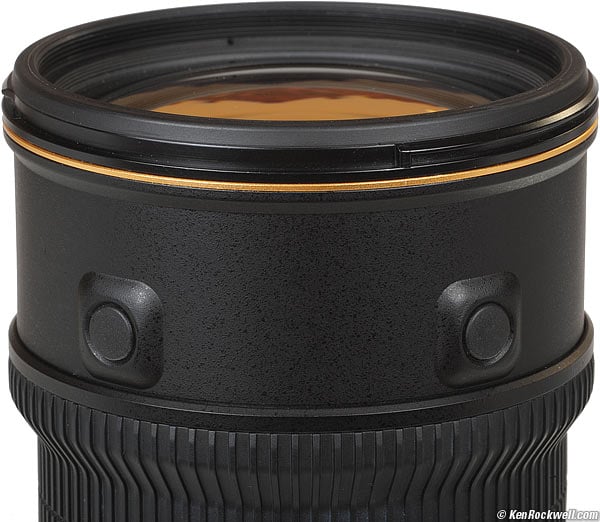
Nikon 70-200mm f/2.8 VR Focus Lock Buttons (two of three).
Turn the 70-200mm over and you'll see three perfectly positioned rubber-covered buttons. These are AF lock buttons. On most cameras, hold them to lock focus. You have no idea how handy these are until you've used them.
Most cameras also allow you to program, in the camera's custom functions menus, to have these buttons do other things, like start AF.
They all do the same thing. There are three so you have one for horizontal shots, and one for each vertical orientation. You're on you're own shooting upside-down.
On old cameras that only had limited number of AF points, we would use these to hold focus while we recompose. I don't need these with the latest D3. (see my favorite AF settings on the D3.)
Compared
Top Intro Format Compatibility Specs
See Nikon 70-200mm history & timeline.
Recommendations
Top Intro Format Compatibility Specs
This was the standard lens of the pros from 2003-2009, and today remains as a top professional lens. It's not cheap, even used.
If you're a pro or rich amateur, this is the lens for news, sports and action. For you weekend portrait shooters, this is also your lens. For serious portraits, I prefer the 135mm f/2 DC or longer lenses.
I like this lens for it's light weight (compared to other Nikon f/2.8 zooms) and ease of use.
If you want to afford it by all means go get one. You'll love it. Everyone else I've met who owns one loves it to death.
For serious amateurs and for photographing your kids at soccer, the $500 70-300mm AF-P VR FX is the lens to get if you don't want to afford this one.
Again, this 70-200mm f/2.8 VR (or the 80-200mm AF-D) is one of the two lenses used by every professional photographer every day. The other lens is usually a wide zoom on a second body. This is Nikon's latest professional workhorse lens.
I use a clear (UV) protective filter instead of a cap. I only use a cap when I throw this in my bag, otherwise I leave a clear filter on my lens at all times.
The best protective filter is the 77mm Hoya multicoated HD3 UV which uses hardened glass and repels dirt and fingerprints.
For less money, the B+W 77mm 010 is an excellent filter, as is the multicoated version and the basic multicoated Hoya filters or the 77mm Nikon Clear (NC - UV), but the Hoya HD3 is the toughest and the best.
Filters last a lifetime, so you may as well get the best. The Hoya HD3 stays cleaner than the others since it repels oil and dirt, and will outlast this lens.
For color slides like Fuji Velvia 50, I use a 77mm Nikon A2 or 77mm Hoya HMC 81A outdoors.
For B&W film outdoors, I'd use a 77mm Nikon Y48 or O56 filter, or a 77mm Hoya HMC Yellow K2 or 77mm B+W Orange. Use a yellow filter for normal results outdoors on B&W, and I prefer the orange for stronger clouds. If you use no filter the skies and clouds will be washed-out because B&W film is overly sensitive to blue and ultra-violet light; a yellow filter gives a natural rendition.
I'd get my 70-200/2.8 at Amazon or at eBay.
This all-content, junk-free website's biggest source of support is when you use those or any of these links to approved sources when you get anything, regardless of the country in which you live. Nikon does not seal its boxes in any way, so never buy at retail or any other source not on my personally approved list since you'll have no way of knowing if you're missing accessories, getting a defective, damaged, returned, non-USA, store demo or used lens. I use the stores I do because they ship from secure remote warehouses where no one gets to touch your new camera before you do. Buy only from the approved sources I use myself for the best prices, service, return policies and selection.
Thanks for helping me help you!
Ken, Mrs. Rockwell, Ryan and Katie.
Acknowledgment: Many thanks to Michael Hagen for loaning me this lens in 2008.
© Ken Rockwell. All rights reserved. Tous droits réservés. Alle Rechte vorbehalten.
Help Me Help You
I support my growing family through this website, as crazy as it might seem.
The biggest help is when you use any of these links when you get anything. It costs you nothing, and is this site's, and thus my family's, biggest source of support. These places always have the best prices and service, which is why I've used them since before this website existed. I recommend them all personally.
If you find this page as helpful as a book you might have had to buy or a workshop you may have had to take, feel free to help me continue helping everyone.
If you've gotten your gear through one of my links or helped otherwise, you're family. It's great people like you who allow me to keep adding to this site full-time. Thanks!
If you haven't helped yet, please do, and consider helping me with a gift of $5.00.
As this page is copyrighted and formally registered, it is unlawful to make copies, especially in the form of printouts for personal use. If you wish to make a printout for personal use, you are granted one-time permission only if you PayPal me $5.00 per printout or part thereof. Thank you!
Thanks for reading!
Mr. & Mrs. Ken Rockwell, Ryan and Katie.