Home Donate New Search Gallery Reviews How-To Books Links Workshops About Contact
Nikon 17-35mm f/2.8
AF-S Zoom-NIKKOR (1999-2021)
Intro Specs Performance Compared Recommendations
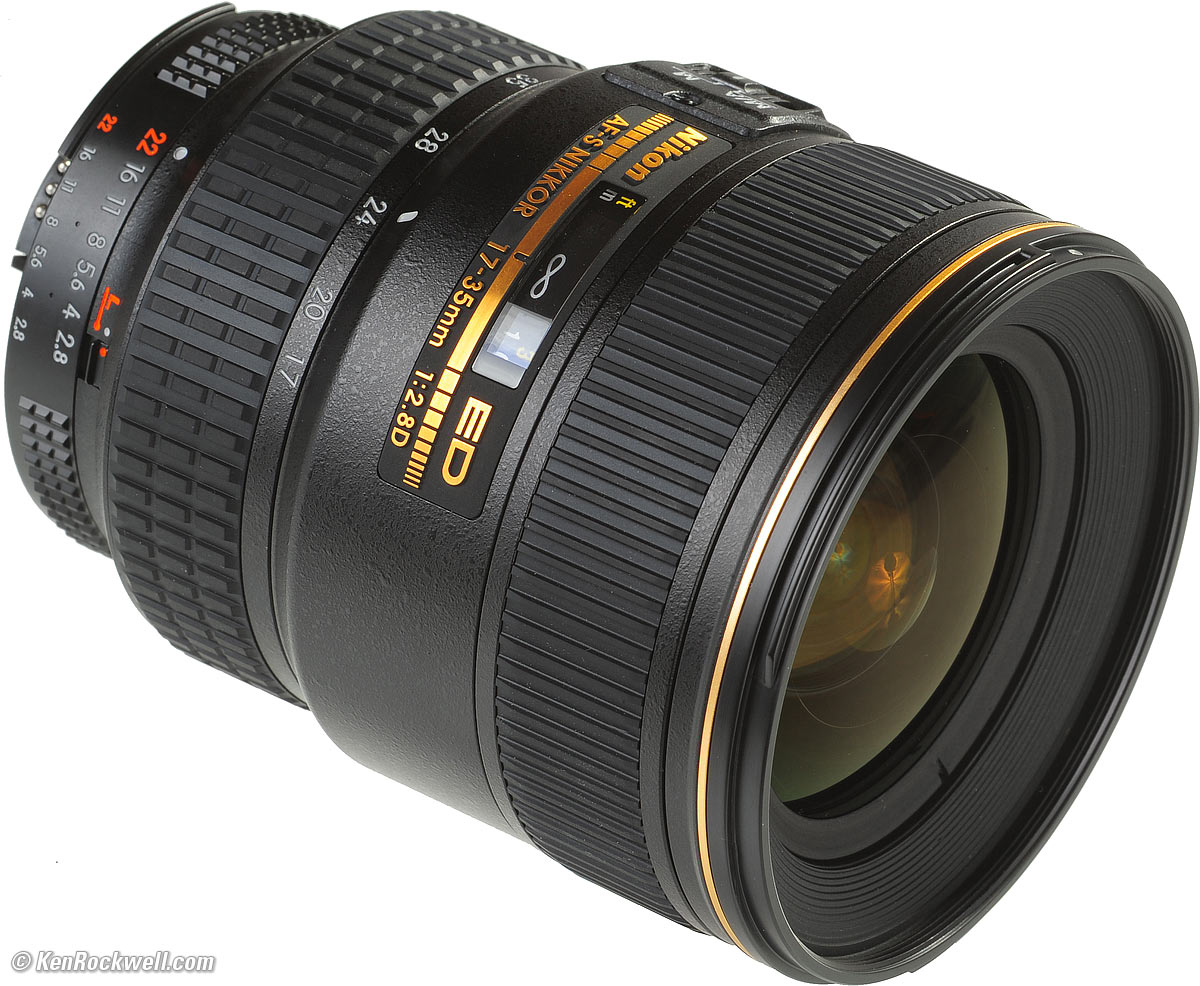
Nikon 17-35mm f/2.8 AF-S. (FX, DX and 35mm coverage, metal 77mm filter thread, 25.8 oz./730g, 1'/0.28m close focus, about $300 used if you know How to Win at eBay). bigger.
This all-content, junk-free website's biggest source of support is when you use those or any of these links to my personally-approved sources when you get anything, regardless of the country in which you live. Nikon does not seal its boxes in any way, so never buy at retail or any other source not on my personally approved list since you'll have no way of knowing if you're missing accessories, getting a defective, damaged, returned, non-USA, store demo or used lens. Get yours only from the approved sources I use myself for the best prices, service, return policies and selection. Thanks for helping me help you! Ken.
December 2023 Better Pictures Nikon Mirrorless Mirrorless Lenses All Nikon Lenses Nikon Flash All Reviews
Full-Frame Ultrawide Lenses Compared 24 June 2017
Sharpness Comparison to all other 18mm lenses
Sharpness Comparison to all other 24mm lenses
Nikon Ultrawide Zooms Compared
| Optics: |  for pro news and sports use for pro news and sports use  for tripod-huggers for tripod-huggers |
| Ergonomics: | |
| Usefulness: | |
| Availability: | |
| Overall: | |
Ideal Uses: Was Nikon's top professional wide-angle zoom for FX digital and film cameras.
Not for: I wouldn't bother with this on a DX camera because any of the 17-55mm f/2.8 DX or 18-55mm DX kit lenses are smarter ideas.

Introduction top
Intro Specs Performance Compared Recommendations
Compatibility History Production Pricing
The 17-35mm f/2.8 AF-S was Nikon's basic wide-angle professional zoom for film and FX Digital for 20 years. Almost every pro had one of these on one body, and a 70-200mm VR on his other body. It is one of the two or three lenses everyone with a D700, D3 or F6 should own.
By comparison, the 14-24mm f/2.8 AF-S is a special-purpose ultra-ultra wide angle lens, not a lens for most people for day-to-day use like this 17-35mm. The 14-24mm is not a lens to be considered in place of this 17-35mm; these are lenses to be used alongside each other for different things.
The 17-35mm was a spectacular lens which outperforms all of Nikon's previous fixed wide angles, like the 20mm AF lens it replaced for me. The 14-24mm has better optical performance in the corners wide-open in the 17mm range, but the huge 14-24mm can't use filters and only covers a very limited zoom range.
This 17-35mm is sharp at all apertures, has great ghost resistance, less falloff than fixed lenses, only moderate distortion, is built like a tank and weighs about as much, too. It's made of solid metal, not the toy-store painted plastic. The only gotcha is that if you are dumb enough to shoot at f/2.8 in daylight at 17mm and then look in the farthest corners with a microscope, it's soft. Pros don't do that, but online experts might.
Manual focus is easy: just grab the ring at any time.
It focuses to within just a few inches of the front of the lens at all focal lengths.
If you don't mind the significant weight and price, just go get one and skip the rest of the review. This lens is fantastic for FX Digital like the D3 and film cameras. It is not a wide angle lens for DX digital cameras; for DX digital cameras get the 12-24 mm DX or Tokina 11-16mm instead.
I got my AF-S 17-35mm f/2.8 ED used at eBay (How to Win at eBay).
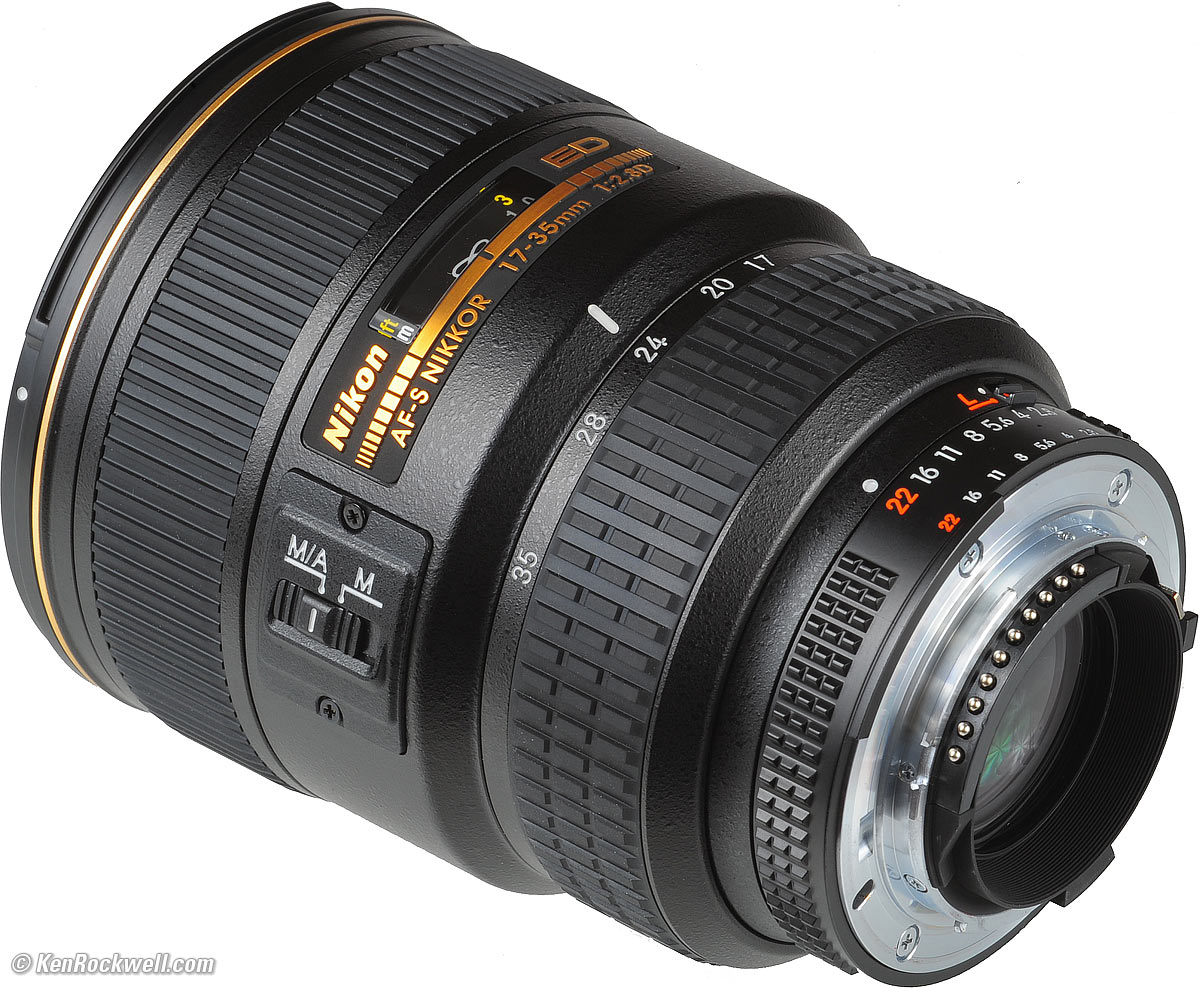
Rear, Nikon 17-35mm f/2.8D AF-S. enlarge.
Compatibility back to intro back to top
I got my AF-S 17-35mm f/2.8 ED used at eBay (How to Win at eBay).

I buy only from these approved sources. I can't vouch for ads below. |



Everything works perfectly on every digital Nikon, both FX and DX.
It's also perfect on film cameras like the F6, F100, F5, N90s, N80, N75, N70, F4, F3, F2AS, FE and etc.
The only incompatibility is that it will not autofocus with some of the oldest (like N2020) or cheapest (like N55) AF film cameras. If you focus manually, everything else works great. Even if it won't autofocus, these cameras have in-finder focus confirmation dots to help you.
If you have a coupling prong added to the diaphragm ring, it's perfect with every Nikon back to the original Nikon F of 1959, otherwise, stick to cameras newer than 1977 for meter coupling.
See Nikon Lens Compatibility for details on your camera. Read down the "AF-S, AF-I" column for this lens.
History back to intro back to top
I got my AF-S 17-35mm f/2.8 ED used at eBay (How to Win at eBay).
1993-2001
Nikon's first ultrawide zoom was the 20-35mm f/2.8 D AF, which is still an excellent professional lens. It's a little smaller and lighter. Unlike this 17-35mm, the older 20-35mm needed a goofy mechanical clutch to switch between auto and manual focus.
1999-today
Nikon introduced this 17-35 lens at the same time as the original D1, whose smaller sensor demanded shorter lenses to get anything even vaguely resembling wide angles. Used on DX cameras, this 17-35mm acts like a ho-hum 25-50mm.
In 2006 Nikon changed the wording a bit on the bottom of the barrel, shortening "Silent Wave Motor" to "SWM" and adding "Aspherical" and the 10-year rotating trash cycle symbol. It also lost 0.5 oz (15g) of weight.
2000-today
Nikon also made a pretty good and lightweight 18-35mm f/3.5-4.5 for use on regular film cameras. It's much lighter than any of these pro lenses.
2006-today
The 14-24mm f/2.8 is a special-purpose ultra-ultrawide zoom.
It's crazy design prevents it from being able to use any filters, and if you get the front dirty, it will show in your photos.
2010-2021
The 16-35mm VR is a consumer lens.
It is sharper than this 17-35mm, but it's also slower and much less sturdily built.
Production back to intro back to top
I got my AF-S 17-35mm f/2.8 ED used at eBay (How to Win at eBay).
Nikon has made about 150,000 of these 17-35/2.8 lenses as of 2014.
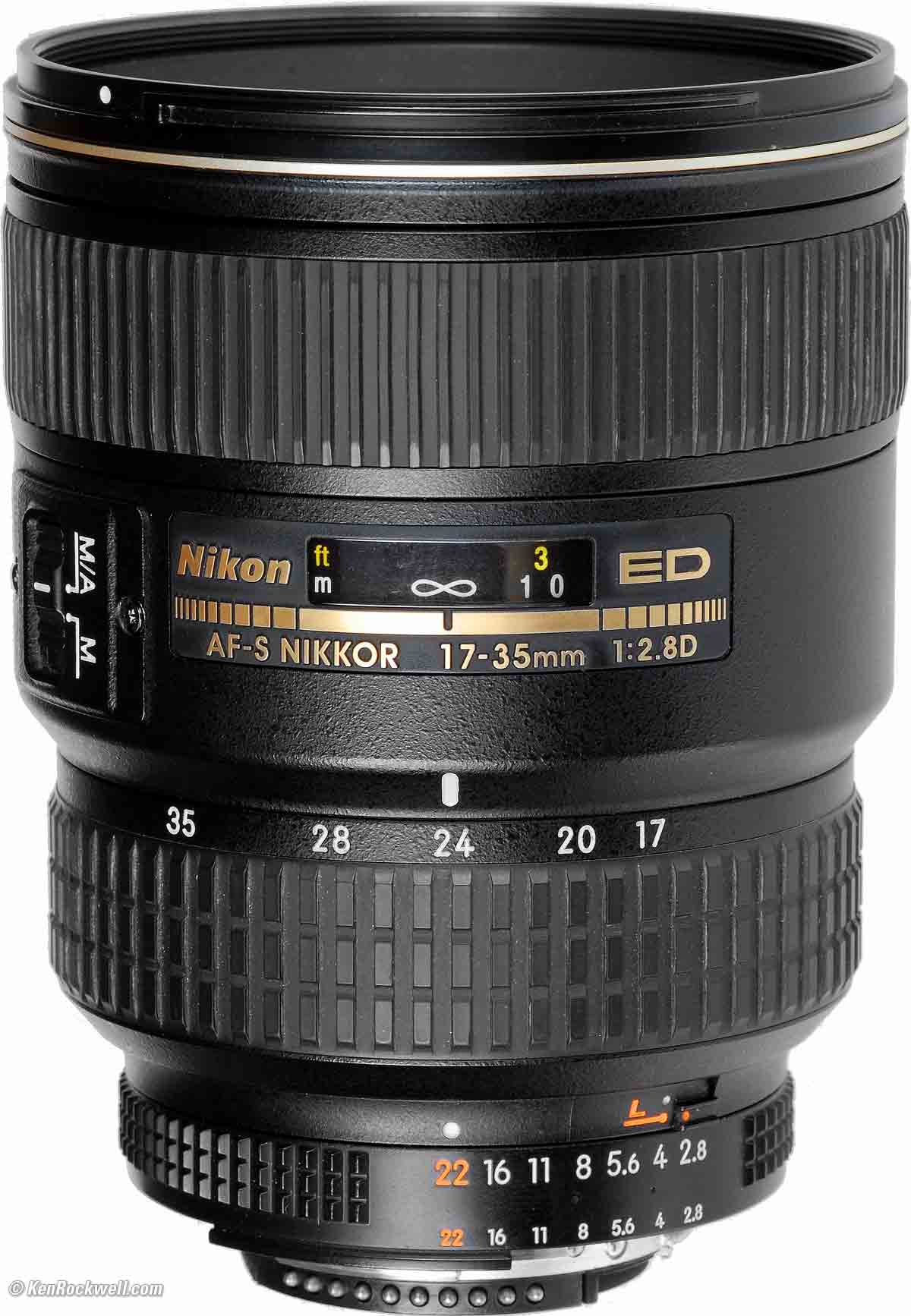
Nikon 17-35mm f/2.8 AF-S. bigger.
Specifications top
Intro Specs Performance Compared Recommendations
I got my AF-S 17-35mm f/2.8 ED used at eBay (How to Win at eBay).
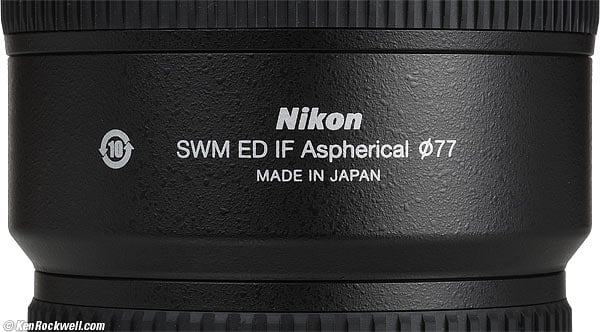
Bottom Printing, 2008. 2001 version read "Silent Wave Motor ED IF ø77."
Optics
13 elements in 10 groups, including two ED glass and three aspherical elements. Two of these are molded glass aspherics, and one is a "composite." Composite means a piece of plastic glued to a glass substrate.
It's multicoated, which Nikon calls Nikon Super Integrated Coating.
Close Focus
Marked: 1 foot (0.28m) from the image plane (rear of the camera). Actual: 10-1/2" (27cm) from the film plane, which is only 4-1/2" (12cm) from the front of the lens!
Maximum Reproduction Ratio
1:4.6.
Hard Infinity Focus Stop?
No.
Focus Scale
Yes.
Depth-of-Field Scale
No.
Infra-Red Focus Index
No.
Diaphragm
9 rounded blades, which are pretty round down to about f/8. It stops down to f/22.
Aperture Ring
Plastic, full-stop clicks.
Filter Thread
77mm, metal.
Does not rotate, ever.
Size
Nikon specifies 4.2" (107mm) extension from flange by 3.3" (84mm) diameter.
Weights
(actual measured):
2001 Production: 26.250 oz (744.1g)
2008 Production: 25.765 oz. (730.4g).
Nikon specifies 26.3 oz. (745g).
Hood
HB-23 plastic bayonet, included. This is the same hood as the 18-35mm and 12-24mm DX.
Case
CL-76, included.
Teleconverters
TC-200/201 and TC-14A, but why?
Introduced
June, 1999.
Available
The 17-35 was very hard to get until 2001.
Nikon Product Number
1960.
Price, USA back to intro back to top
This has always been a $1,800 lens, considering inflation. Even used today it sells for about $1,000.
Price, new,* USA |
New, Gray |
used** |
|
2001 |
$1,350 |
||
2005 |
$1,385 |
||
2008 |
$1,500 |
||
2010 |
$1,760 |
$1,200 |
|
9/2014 |
$1,760 |
||
6/2017 |
|||
3/2018 |
|||
11/2022 |
n/a |
n/a |
|
12/2023 |
n/a |
n/a |
* At full NYC discount at Adorama, Amazon and B&H Photo-Video. Very few people bought their lenses this inexpensively back in 2001.
** If you know How to Win at eBay.
Packaging
USA: "History of Nikon" single-wall box, inner corrugated liner. Plastic bag holds literature wrapped around outside of carry case. The lens with attached hood sits inside the case in one plastic bag, and the strap is inside its own plastic bag in the air space next to the lens.
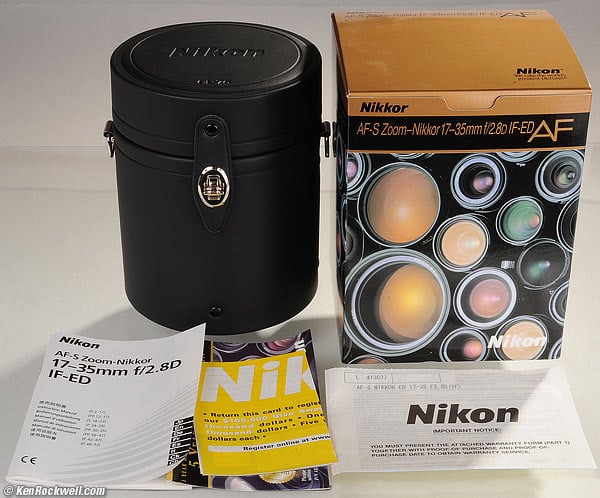
Shipped Ensemble, Nikon USA.
Performance top
Intro Specs Performance Compared Recommendations
Overall Focus Bokeh Cold Weather Color Coma Distortion
Ergonomics Falloff Filters Ghosts Hood Lateral Color Fringes
Macro Mechanics Sharpness Zooming Comparisons
I got my AF-S 17-35mm f/2.8 ED used at eBay (How to Win at eBay).
Overall back to Performance back to top
The 17-35mm f/2.8 D AF-S is a solid professional lens. It's got great optics, mechanics and performance, and you pay for it.
Focus back to Performance back to top
Nothing moves externally. The focus is entirely internal.
The focus rings turns continuously, even after you hit either end of the focus range. This is normal. It only moves when you move it yourself.
AF Speed
Like most wide lenses, AF speed is just about instantaneous.
AF Accuracy
My focus is always on; no problems here.
As with most, if not all, AF zoom lenses, the exact position of the infinity mark when focused at infinity will vary with zoom position. This is because in the design of a zoom lens one has a little slack in the exact tracking of the back focus. This is precisely why the lens can focus a little beyond the infinity mark.
Manual Focus
Manual focus is easy and sure. Just grab the focus ring at any time.
M/A - M Switch
Nikon goofed. This switch is supposed to be labeled "A - M."
The "M/A" position means autofocus. It's called "M/A" because back in the old days, when Nikon had almost caught up to Canon who had been doing this for ten years before, Nikon was trying to show off that you could focus manually while in the AF position.
Paint over the extra M if you're easily confused.
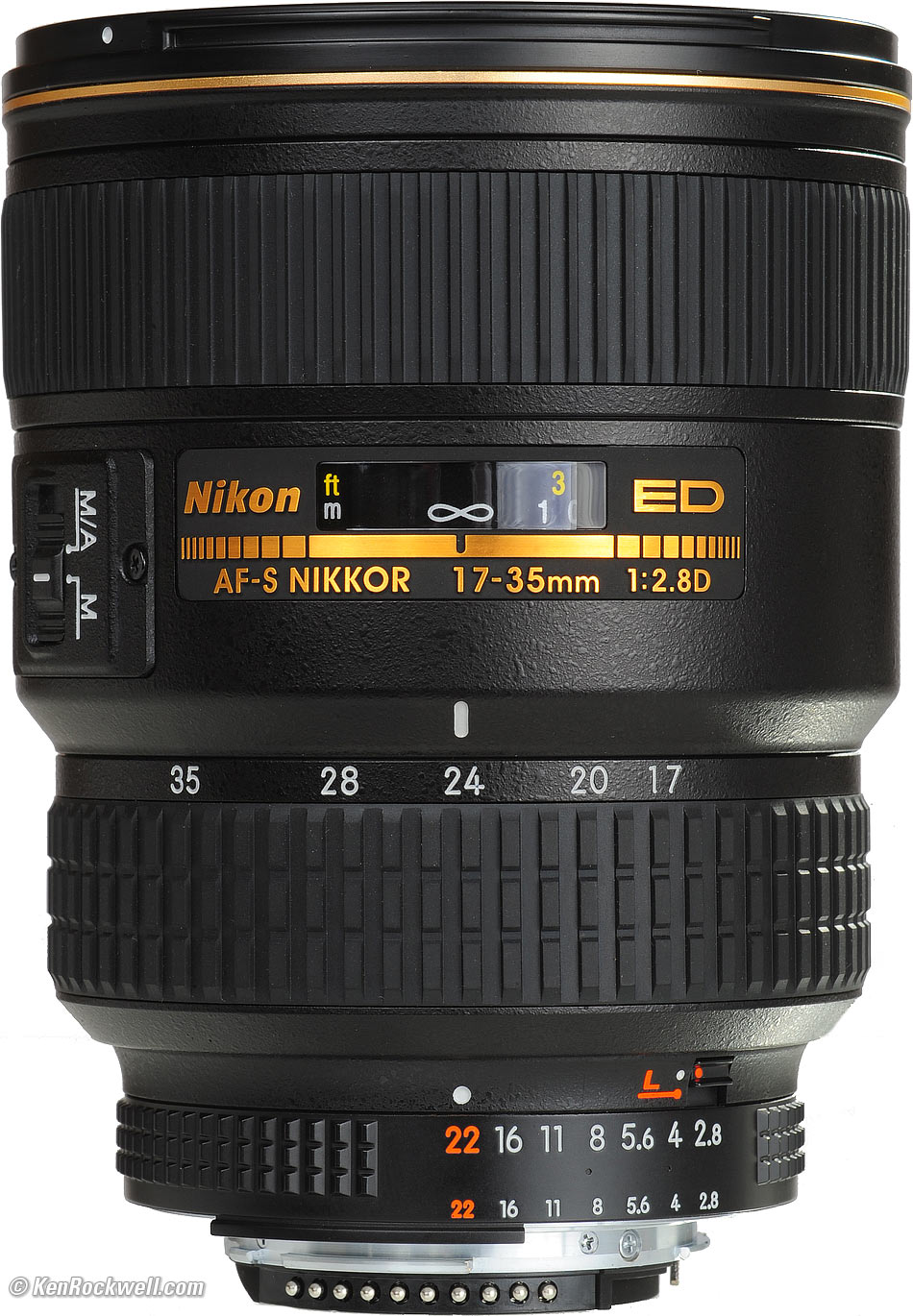
Nikkor 17-35mm f/2.8. enlarge.
Bokeh back to Performance back to top
Bokeh is fairly good.
At ordinary distances at 17mm stopped down, bokeh is neutral to good
At closer than 2' at 35mm, it seems very neutral.
Cold Weather back to Performance back to top
I've only had it out all day in temperatures as low as 30º F (0º C). It worked the same as it does at 70º F (20º C).
This shows that Nikon is still using the good grease that does not get stiff in the cold, as the grease in my Mamiya lenses do.
I suspect the 17-35 will work great over a broader range of temperatures than I can.
Color Rendition back to Performance back to top
The color rendition seems the same as my other modern Nikkors.
Coma back to Performance back to top
Coma (saggital coma flare) is weird smeared blobs that appear around bright points of light in the corners.
There is some wide open at 17mm which goes away by f/5.6.
There is very little at 35mm at f/2.8, and it's gone by f/4.
Distortion back to performance back to top
If you're looking for it, there is barrel (bulging) distortion at the 17mm end and just a little pincushion (sucking) distortion at the 35mm end.
Distortion isn't much of a a problem as it can be for the less expensive Nikkor 18-35mm f/3.5-4.5D AF-S. If you really worry about this, the older 20-35mm has the least distortion of these three.
If you insist on photographing brick walls and seaside horizons, shoot at at around 22-24mm and it goes away, or correct it with the figures below.
Distortion seems to be the same at all distances. This is better than the fixed focal length lenses in which the distortion often gets worse at close distances. 20 years of advancement in lens design shows.
Plug these figures into Photoshop CS2's lens distortion filter to fix the distortion. It's not always perfect, since some of the distortion can be complex. These aren't facts or specifications, they are the results of my research that requires hours of photography and calculations on the resulting data.
FX and Film |
FX and Film at 50' (15m) |
FX and Film |
DX at ∞ |
|
17mm |
+2.5* |
+4.0* |
+4.0* |
+3.5 |
20mm |
-0.2* |
+0.5* |
+0.2* |
+2.0 |
24mm |
-2.0 |
-1.2 |
-1.5* |
+0.5 |
28mm |
-2.3 |
-2.0 |
-2.0* |
0 |
35mm |
-3.0 |
-2.0 |
-2.2 |
-0.1 |
© 2008-2010 KenRockwell.com. All rights reserved.
* Some waviness remains.
Ergonomics (handling and ease-of-use) back to performance back to top
Great!
It's easy to hold, focus and zoom. This may seem simple, but many lenses aren't able to do these simple things without getting in your way.
Falloff (darkened corners) back to performance back to top
Falloff on FX is not a problem. You won't see it except a little at f/2.8 and 17mm.
It won't be an issue at all on DX (see crop factor).
This 17-35mm outperforms all of the fixed focal length lenses against which I compared it directly, except maybe the 28mm f/1.4D AF.
There is some minor falloff at f/2.8. It's completely gone at f/4 from 20-35mm. At 17mm there is still a little falloff at f/4 and it's all gone at f/5.6, as far as real photos are concerned.
Even at f/2.8 the falloff is invisible unless you are pathetic enough to be photographing blank walls.
For comparison, one needs to stop down the 20/2.8 AF to between f/4 and f/5.6 to have as little falloff as the 17-35mm has wide-open at 20mm!
Most pre-1990 design Nikkor fixed focal length lenses require stopping down two stops to eliminate falloff. This 17-35mm outperforms these old designs.
I've exaggerated this by shooting a gray field and placing these on a gray background. You won't see this with real images.
Nikon 17-35mm f/2.8 AF-S falloff on FX and film at infinity.
|















Filters, Use with back to Performance back to top
The filter ring never rotates. The lens elements move around inside the filter ring.
Even on film or an FX camera, the Nikon 17-35mm AF-S works great with no vignetting with one 77mm filter of any kind, even a rotating ND Grad or ordinary non-Nikon polarizer.
With two stacked 77mm filters there is no vignetting at 20mm and longer.
With three stacked 77mm filters you'll want to stay at 24mm or longer. This is great performance for those of us who love to use filters.
You'd need to have a lot of filters stacked on top of each other ever to see any problems on a DX camera.
Ghosts back to Performance back to top
Freedom from flare and ghosting is excellent. It is as good or better than my fixed 20mm lenses. How can this be? Simple: because this zoom uses aspherical elements, it only has as many elements as a fixed ultra-wide lens. The rest is luck and the possibility that the coatings are more advanced.
Put the sun in your image? No problem. If a bright sun is just outside the image at the short end of the range you might get two tiny, bright magenta spots that you also can see through the viewfinder. Just use your hand to block the sun.
I don't bother with the silly scalloped hood since it won't fit in my bag on the lens. My hood sits in the box for whenever I give this lens away.
Hood back to Performance back to top
The HB-23 plastic bayonet hood is included.
Lateral Color Fringes back to Performance back to top
There are no lateral color fringes on the D3 (FX), which largely corrects whatever the 17-35 might have.
If you really push it with backlit trees at the wide end in the corners, you might be able to see some minor yellow/cyan fringes on digital. I never saw them on film.
Macro back to Performance back to top
The 17-35mm focuses really close.
The specs only mention the closest marked distances of 1 foot and 0.28 meters. Big deal, every ultra wide lens focuses this close or closer.
What the specs don't say is that the actual close focus distance is only 10-1/2" (27cm) from the film plane, which is only 4-1/2" (12cm) from the front of the lens!
The complex optics of this lens move the front nodal point (the point out of which the lens "sees") much further forward than compared to a fixed lens. Therefore one can get in far closer than one suspects.
At 17mm the smallest horizontal field is 13." At 35mm the smallest horizontal field is 6," a 1:4 macro ratio.
At 20mm the smallest horizontal field is 11," a tad smaller than the fixed 20mm f/2.8 AF lens that has a closer marked focusing distance. How can this be? Simple, as mentioned above the front nodal point of this lens gets closer to the subject at this lens' close focus distance than the same point does on the fixed 20mm lens. This is that advantage of trying something instead of reading manufacturers' specifications.
This is one of the few lenses I've used that always can focus as close as I want it to. With most other lenses I often am limited by their close focus distances. With the 17-35mm you run out of the ability to light your subject before you run out of range on the focus ring. Bravo!
Mechanics back to Performance back to top
The 17-35mm is a tough lens. The only plastic is the aperture ring and the auto/manual focus switch.
It's very, very well made. Even the filter threads are metal and the focal length markings are engraved as they ought to be. If you worry about wanting your expensive lenses to feel that way, this is for you.
The finish is not "Armourlite" or "synthetic leather" or any of the other weird things I've read in the sales brochures. It's just semi-matte black sputtered epoxy paint over alloy. It is more slippery than the traditional crinkle paint I would prefer. This is an easy lens to drop due to the very high weight concentration and slippery finish.
There is a tiny bit of rotational play in the zoom ring. This is normal. There is no play in the focus ring, which is impressive.
Barrel Exterior
Metal.
Filter Threads
Metal.
Hood
Plastic bayonet.
Focus Ring
Metal; rubber covered.
Zoom Ring
Metal; rubber covered.
Depth-of-Field Scale
None.
Internals
Metal.
Aperture Ring
Plastic, engraved and filled with paint.
Mount
Dull-chromed brass.
Identity Plate
Embossed and planed metal on top of barrel; paint on bottom.
Serial Number
Laser engraved onto bottom rear of aperture ring.
Dust seal at mount
No.
Noises When Shaken
A little klunking.
Made in
Japan.
Weaknesses
I've seen many used ones offered for sale with broken AF-S motors, which tells me that these break. Since Nikon still produces this lens, I doubt there is any problem paying to have it fixed. USA versions have 5-year warranties.
Sharpness back to Performance back to top
On a D3, FX at 12 MP
17-24mm
It's super-sharp even wide open, except in the corners, where they also sharpen up by f/5.6 or so.
28mm
It's super sharp, but softer in the corners at f/2.8. It's much better in the corners by f/4.
35mm
It's sharp, even in the corners, at f/2.8.
f/16 and f/22
Diffraction limits performance.
Warning 1: Image sharpness depends more on you than your lens.
Warning 2: Lens sharpness doesn't mean much to good photographers.
Used properly, 17-35mm is super sharp.
The only stupid thing you can do, as with all other similar lenses from Nikon and Canon of this era, is to shoot at 17mm at f/2.8 in broad daylight and then look in the farthest corners of FX with a microscope. If you do all this, they will be soft, just like Canon's competitive 16-35mm L II. Shoot at f/5.6 or longer focal lengths, and it's super-sharp everywhere in the frame. The AF-s 16-35mm f/4 VR is much sharper.
You have to do a combination of six things at once to make it look bad, so don't worry. I can only see this stuff when I go out of my way to make a lens look bad in the process of testing it.
I've tested both a new 2008 lens, and a lens bought new in 2001. They are identical.
If you need perfect sharpness at f/2.8 in the corners in daylight on FX at 17mm when seen through a microscope, buy the 14-24mm instead.
Zooming back to Performance back to top
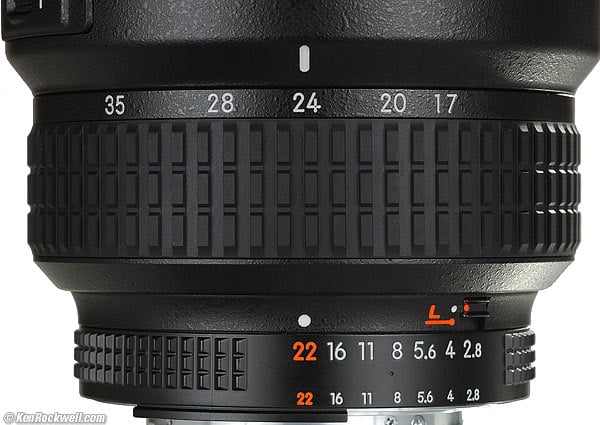
Zoom and Aperture Rings, Nikon 17-35 2.8 D.
Zooming is excellent. All the focal lengths are well spread out along the zoom ring. It's easy to set any precise framing, and to flick the zoom from one end to the other with a fingertip.
it works as well pointed up, down sideways, or in any direction.
The front group rotates and moves via a cam while zooming.
EXIF Encoding Accuracy
The EXIF data is never more than one millimeter different from the setting on the lens.
Compared top
Intro Specs Performance Compared Recommendations
I got my AF-S 17-35mm f/2.8 ED used at eBay (How to Win at eBay).
Full-Frame Ultrawide Lenses Compared 24 June 2017
Nikon Ultrawide Zooms Compared 08 March 2010
Compared to the the 14-24mm
These are lenses for different purposes. I have this comparison at my 14-24mm page.
Compared to the 20-35mm
The 17-35mm is bigger and heavier than the 20-35mm.
The 17-35mm is much easier to use and handle than the 20-35mm , because it needs no switches to convert between auto and manual focus.
Compared to the 18-35mm
The 18-35mm is a plastic-barreled lens. It weighs much less.
For manual focus, you need to move a switch on your camera, while with the 17-35 all you do is grab the ring.
The optics of the 18-35mm aren't quite as good as the 17-35 and 20-35 at the 35mm end.
Compared to the 20mm f/2.8 AF
I've referred to this throughout the text. The 20/2.8 is much smaller and one-third as expensive, with the same optical quality. It has more falloff at f/2.8.
Recommendations top
Intro Specs Performance Compared Recommendations
I got my AF-S 17-35mm f/2.8 ED used at eBay (How to Win at eBay).
The 17-35mm was the wide-lens ticket for the D700, D3x and D3.
It's not a wide angle lens for DX digital cameras; for DX digital cameras get the 12-24 mm DX or Tokina 11-16mm instead. The 17-35 works on DX, it's just bigger, costs more and works less conveniently than lenses designed to for DX.
I get great results handheld as slow as 1/8 second on Fuji Velvia 50 on an F100. I think the heavy weight helps stabilize it against the mirror whipping.
It works great on manual-focus 35mm cameras. The focus action feels great.
Its continuous close focus abilities open up new creative avenues that previously required extension tubes for bug's-eye views. The biggest limitation is your ability to get light on your subject, since it focuses up to a few inches away from the front of the lens.
Most professional photojournalists and travel photographers who use 35mm or FX cameras carry one of these on one body, and the 70-200mm VR on a second body.
Nikon didn't screw around here. If you need the best, don't mind the weight on your shoulders and the lightness in your wallet, this is for you. The 14-24mm f/2.8 is a special purpose lens that can't use filters (or even a real lens cap), and is too darn heavy unless you're a 14mm nutcase like myself. See also my Comparison to the 14-24mm.
I got my AF-S 17-35mm f/2.8 ED used at eBay (How to Win at eBay).
Deployment
I'd leave either a 77mm Nikon Clear (NC - UV) filter, or ideally a 77mm Hoya multicoated HD3 UV which uses hardened glass and repels dirt and fingerprints, and is also multicoated.
For less money, the B+W 77mm 010 is an excellent filter, as are the multicoated version and the basic multicoated Hoya filters, but the Hoya HD3 is the toughest and the best.
Filters last a lifetime, so you may as well get the best. The Hoya HD3 stays cleaner than the others since it repels oil and dirt.
If I was working in nasty, dirty areas, I'd forget the cap, and use an uncoated 77mm Tiffen UV filter instead. Uncoated filters are much easier to clean, but more prone to ghosting.
I'd leave the hood in the box for resale time.
© Ken Rockwell. All rights reserved. Tous droits réservés. Alle Rechte vorbehalten.
Help me help you top
I support my growing family through this website, as crazy as it might seem.
The biggest help is when you use any of these links to approved sources when you get anything, regardless of the country in which you live. It costs you nothing, and is this site's, and thus my family's, biggest source of support. These places have the best prices and service, which is why I've used them since before this website existed. I recommend them all personally.
If you find this page as helpful as a book you might have had to buy or a workshop you may have had to take, feel free to help me continue helping everyone.
If you've gotten your gear through one of my links or helped otherwise, you're family. It's great people like you who allow me to keep adding to this site full-time. Thanks!
If you haven't helped yet, please do, and consider helping me with a gift of $5.00.
As this page is copyrighted and formally registered, it is unlawful to make copies, especially in the form of printouts for personal use. If you wish to make a printout for personal use, you are granted one-time permission only if you PayPal me $5.00 per printout or part thereof. Thank you!
Thanks for reading!
Ken Rockwell.
Home Donate New Search Gallery Reviews How-To Books Links Workshops About Contact