Nikon 14-24mm f/2.8
AF-S NIKKOR G ED N (2007~today)
Works great on mirrorless with the FTZ or FTZ II
Sample Image Files Introduction Specs
Performance Compared Recommendations
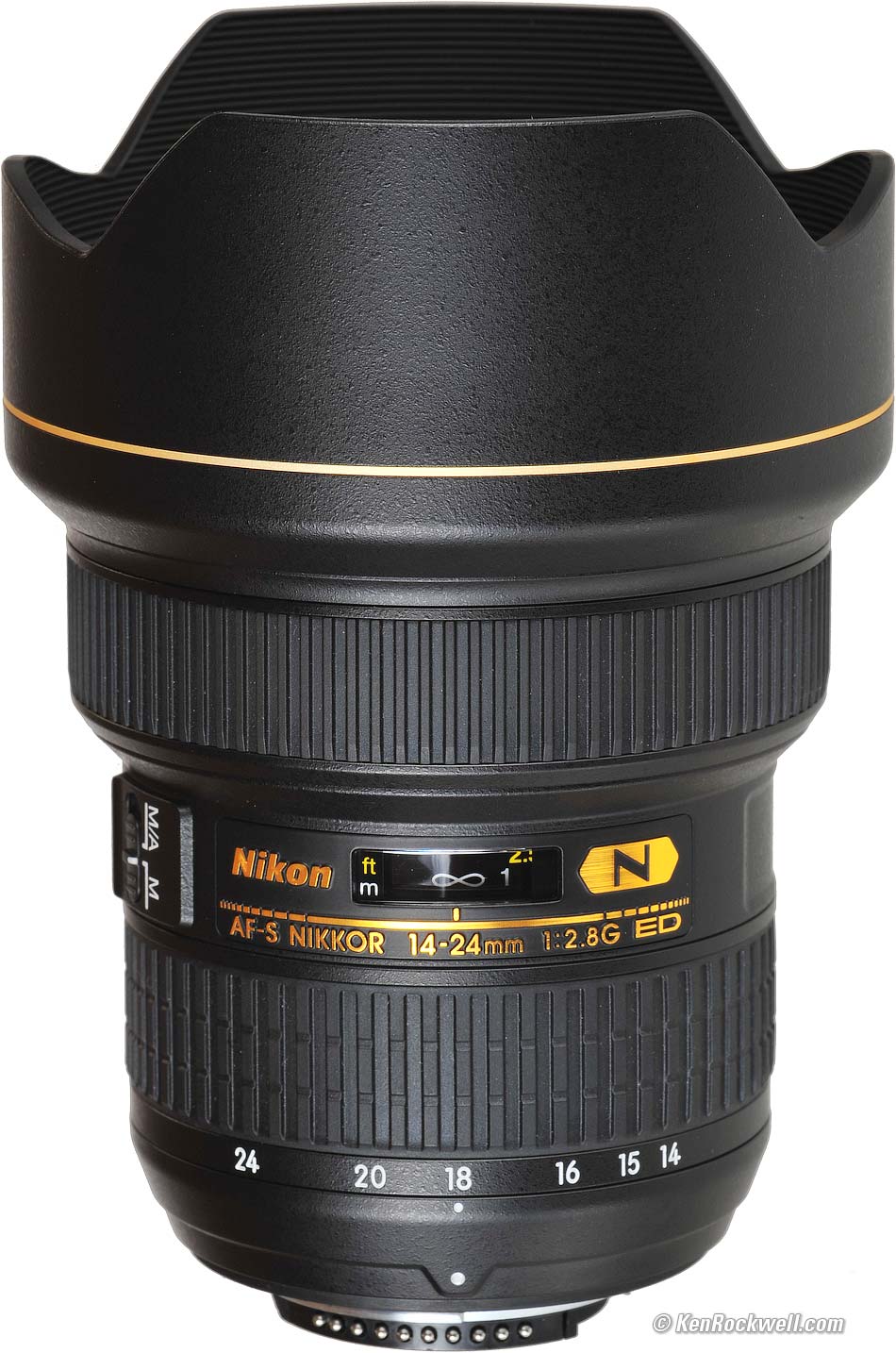
Nikon 14-24mm AFS f/2.8 G ED (takes no filters, 34.3 oz./972g, $1,747 new or about $550 used if you know How to Win at eBay). enlarge.
I'd get my Nikon 14-24mm for $1,747 new at B&H (gray-market), even less open-box, or $1,097 new at Adorama, about $690 ~ $1,200 used at Amazon, about $550 used if you know How to Win at eBay, or $573 ~ $755 used at KEH.
This all-content, junk-free website's biggest source of support is when you use those or any of these links to approved sources when you get anything, regardless of the country in which you live. Thanks for helping me help you! Ken.
September 2025 Nikon Reviews Nikon Lenses All Reviews
NEW: Nikon Z 14~24mm f/2.8 June 2021
Full-Frame Ultrawide Lenses Compared 24 June 2017
Ultra-Ultrawides compared 26 March 2015
Sharpness Comparison to all other 24mm lenses August 2010
Nikon 16-35mm f/4 VR 10 March 2010
Nikon Ultrawide Zooms Compared 08 March 2010
Zeiss 21mm f/2.8 Compared to Nikon 14-24, Canon 16-35 L II and LEICA 21mm f/2.8 ASPH16 December 2009
Zeiss 18mm f/3.5 Compared to Nikon 14-24mm and Canon 16-35mm L II 15 December 2009
Nikon Ultra-Ultrawide Lens Comparison23 December 2008
How to Use Ultrawide Lenses 11 August 2008
Sample Image File top
Sample Image Files Introduction Specs
Performance Compared Recommendations

Oaks, California, May 2008. Nikon D3, 14-24mm f/2.8 at 14mm, f/11 at 1/8, ISO 200. camera-original © JPG file.

Introduction top
Sample Image Files Introduction Specs
Performance Compared Recommendations

I buy only from these approved sources. I can't vouch for ads below. |



The Nikon 14-24mm f/2.8 AF-S is an ultra-ultra wide zoom. It's not a fisheye; straight lines stay straight. It is intended for use on FX and and 35mm cameras. It works great on DX, but you're paying dollars and pounds just to use the center of the image. The 12-24mm DX and Tokina 11-16mm are smarter ideas for DX cameras.
The Nikon 14-24mm f/2.8 AF-S set a new standard in ultra-ultra wide angle lenses. It was the best on the planet, by a large margin, until Nikon's newer 16-35mm VR raised the bar even higher. This 14-24mm is significantly sharper than any other fixed or zoom ultrawide from Canon or Nikon that I've ever used, and I've used both Canon and Nikon's 14mm, 18mm and ultra-wide zoom lenses extensively.
The 14-24mm does things no lens before has done. It is sharper wide-open at 14mm in the far corners than my fixed 14mm f/2.8 is stopped down at f/5.6! For sharpness, the 14-24mm is blazingly sharp and devoid of any coma or softness at every aperture, everywhere in the full film and FX field. It's just nuts! Optically, if you're looking too close, it makes the other ultra-wides look like poo-poo. Of course if you're just taking pictures, any of the other lenses (20-35mm, 17-35mm, 18-35mm) works fine, and they take filters which the 14-24mm can't.
The Nikon 14-24mm f/2.8 is the sharpest 14mm and 18mm lens I've ever used, by far. I know, because I've shot it head-to-head against my 14mm f/2.8, 18mm AF and 18mm f/3.5 AI-s on the D3.
The 14-24mm is sharper in the corners at f/2.8 than anything. It's so good, it's crazy to those of us who know how difficult it is to do this. The 14-24mm is sharp all over at every aperture. It's a little softer at f/2.8 at 14mm in the far corner of an FX frame, but it's as insanely good at Nikon's MTF curves claim. No other ultra-wide comes close. The 14-24mm is as free from dark corners and as sharp wide-open as my 14mm AF is at f/5.6!
Not that you'll see this sharpness improvement in most photos, but you will see it if you're looking in the corners of the FX frame wide open at the wide settings The older lenses simply can't get this sharp out there, but you can put filters on the front of most of the older lenses which you can't with the new 14-24mm. They all look the same when stopped down to f/8, but you still can't put filters on the front of the 14-24mm.
24mm is no big deal. The world has never had a really sharp 14mm before, but we have had sharp 24mm lenses for decades.
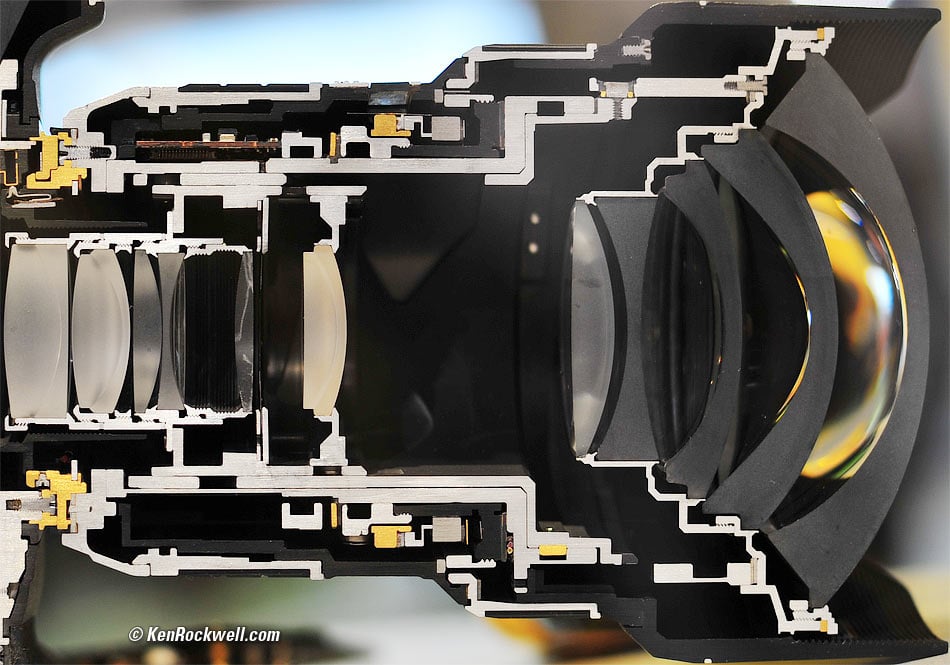
Cutaway Nikon 14-24mm. enlarge.
Flare and ghosts seem well tamed, with just a dot or two if you've got the sun shining on the lens.
I almost forgot to mention lateral color fringes, because there aren't any!
There is some eyeblow: zooming the 14-24mm puffs a little air out the D3's eyepiece. I suspect the D3 I used may have been missing an eyepiece cover.
Another scary thing about the 14-24mm, at least to those of us who've been around 14mm lenses for a long time, is that there is almost no falloff (corner darkening) wide open on the D3 full-frame camera! The 14-24mm is far superior to the previous 14mm and 18mm lenses; I can't see any falloff wide open looking at only one image without another for comparison.
The 14-24mm's zoom ring is engraved metal. The front integral hood is thick, tough plastic. The front cap design will be important. I didn't get to test it, and it seems like a plastic contrivance.
The front elements move in and in behind the big hood as you zoom. Focus is internal, and the focus ring moves with a quick flick of one finger.
Except that I can't use my ND grad or any front filters with it, the 14-24mm is as perfect as it can get. Get one while you can; other insanely great Nikon lenses like the 28mm f/1.4 AF were also so expensive that few people bought them. Now that Nikon stopped making the 28mm f/1.4, you can sell used ones for double what they sold for new just a few years ago.
I'm an ultrawide junkie so I love this thing. I'll probably never shoot it at longer than 18mm. For sane people, the 17-35mm AFS is a far more practical lens, because it covers a more practical zoom range and can use front protective and creative filters.
These comments are using the 14-24mm on a full-frame FX or film camera. It's foolish to use this 14-24mm on a DX camera like the D300, because the 12-24mm DX is a much smarter choice for its wider zoom range, smaller size, lower price and ability to use normal filters, if you're using a smaller-format camera. (see Crop Factor.)
I'd get my Nikon 14-24 at Adorama, at B&H or at Amazon, or used at eBay (How to Win at eBay) or used at Amazon.
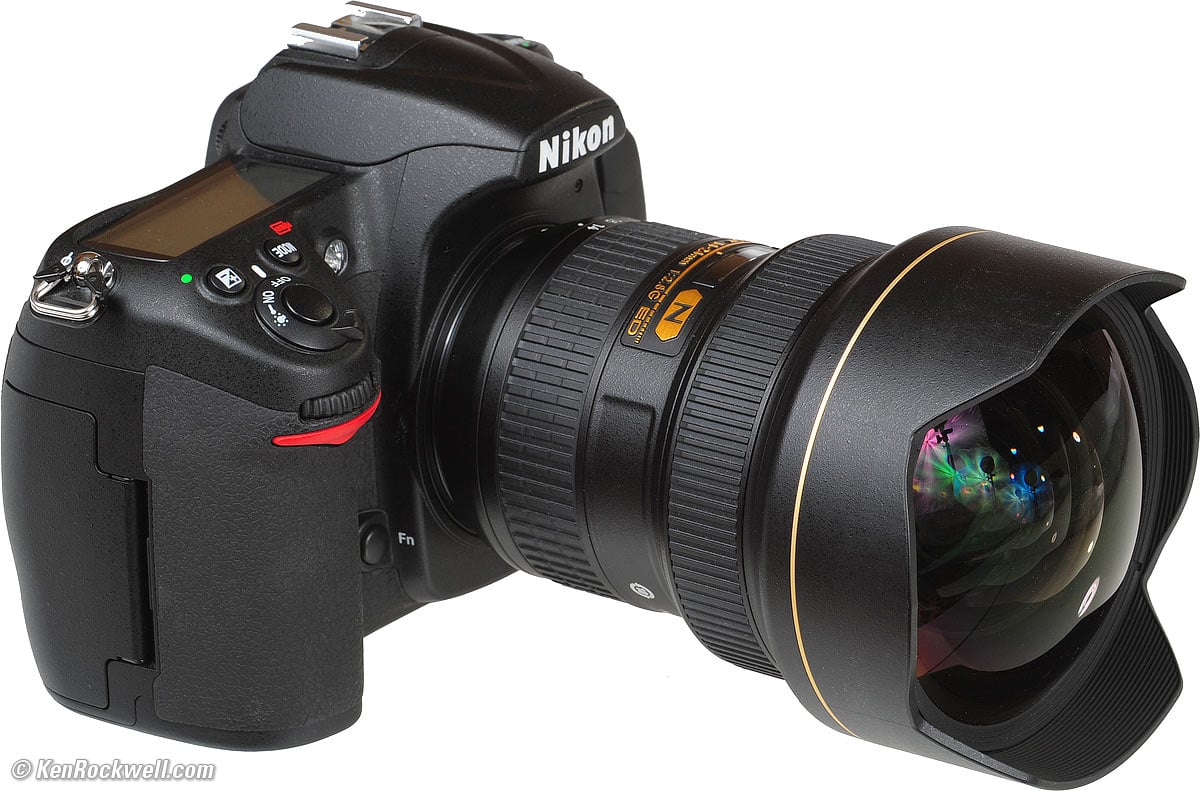
14-24mm dwarfing a D300. enlarge.
My 14-24mm f/2.8 AFS is optically perfect on my D300. I'm not saying "perfect" like I call my wife perfect; I'm saying the 14-24mm is so optically perfect its as if Nikon suddenly exempted itself from the laws of optics which have fettered us for the past 150 years.
The 14-24mm is as sharp at 14mm wide open at at f/2.8 in the far corners of my D300 as my normal lenses are in the center stopped down! The 14-24mm has no lateral color at any setting anywhere in the field of the D300. It has perfect sharpness and contrast even at f/2.8! This is crazy.
It has very little little distortion, much less than any other lens in this range on a DX camera. If it bothers you, it's trivial to remove in Photoshop.
This 14-24mm is decades ahead of anything else from anyone! OK, if you have to find something less than perfect, there are some tiny ghosts if the sun is in the wrong place, but the ghosts are nothing more than cute little micro-rainbow spots.
How does Nikon do it? Simple: Nikon has always known how to make lenses this good, but has never known how to manufacture them in quantity for less than five or six figure prices. What's changed is Nikon's ability to manufacture aspherical elements efficiently, as it does with the dinky but superb 18-55mm kit lens. Nikon really has made the 14-24mm out of the same stuff it puts in these plastic fantastic lenses which outperform the classics. When Nikon drops almost two grand worth of its considerable manufacturing prowess into a lens like this 14-24mm, the results are extraordinary. Armchair experts are going to have a hard time finding any fault with it, which makes it an easy lens to review. It wins.
I suspect the 14-24mm may become a future classic that sells for $3,500 a pop used, as does the 28mm f/1.4 AF. The 14-24mm is impractical because it can't use filters either for protection or artistry (it has no threads and no rear gel slot), it's huge, it's heavy and it costs a mere $1,800. It probably won't sell well after today's initial newness wears off. How many people are going to drop almost two Gs on a lens like this, when more practical lenses for the D3 and D300 cost less?
The 28mm f/1.4 never sold well either, it sold for the same real price as the 14-24mm does and it was far more practical. When people stop buying them, Nikon stops making them. Nikon sometimes shoots too high and makes a lens too good and too expensive. Only after they stop making it does everyone figure it out, and then used ones skyrocket in value, as like the 58mm Noct-Nikkor has. The people who own Noct-Nikkors don't think that much of them, and from a few hours of use, I think a lot about the 14-24mm. As an ultrawide junkie, the 14-24mm is the lens! Of course I got it for the upcoming D3; for the D300, the 12-24mm DX is far more practical.
I'd get my Nikon 14-24 at Adorama, at B&H, at Amazon, at Crutchfield or used at eBay (How to Win at eBay).
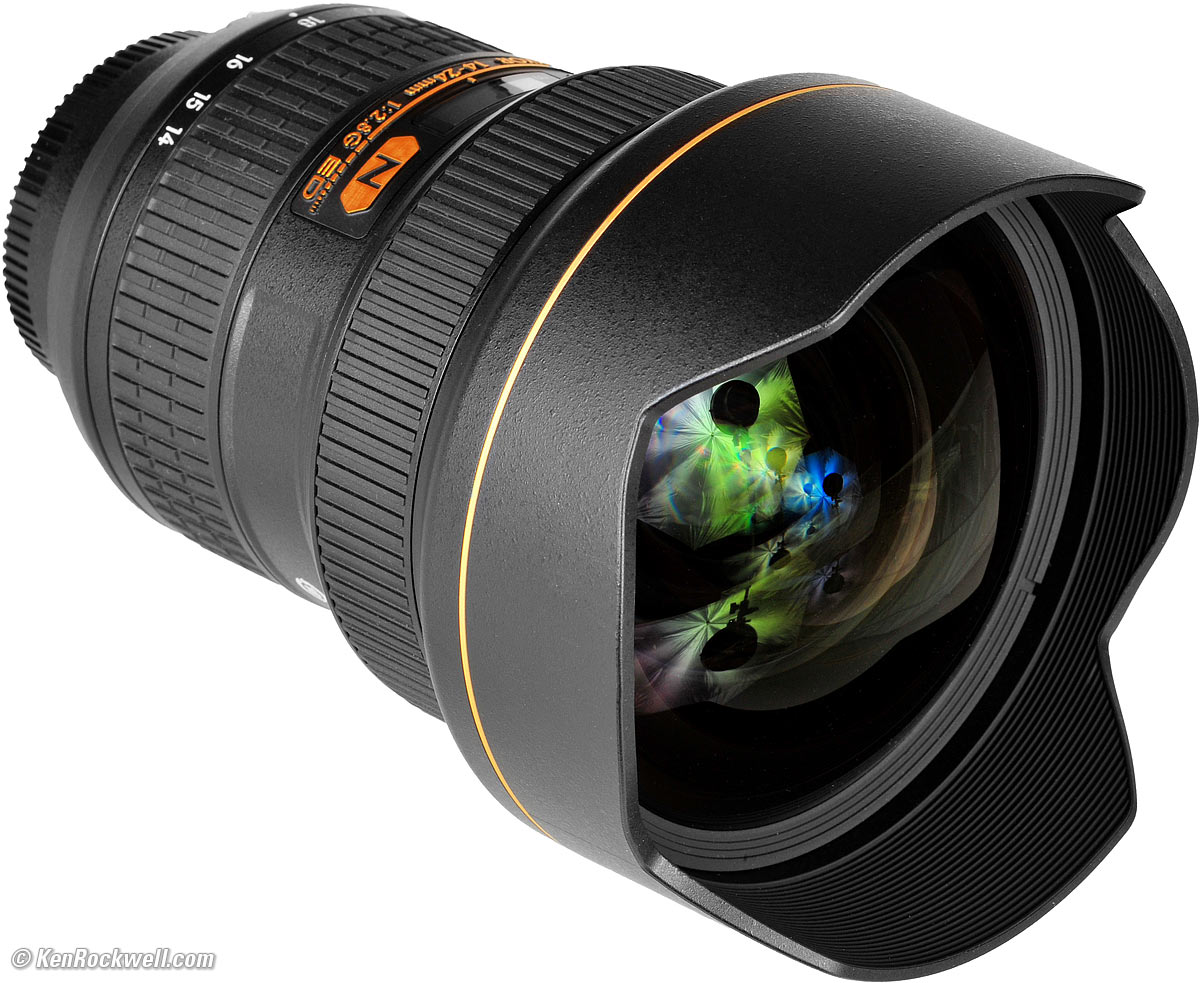
Nikon AFS 14-24mm f/2.8. bigger.
Compatibility
This 14-24mm AF-S G works perfectly on every digital SLR. It is a waste to use it on a DX camera, since you are paying a huge price, filtration and weight premium for the fact that it covers the full FX and film format. For DX cameras, the 12-24mm f/4 DX is a much better idea.
This 14-24mm AF-S G works perfectly on almost every AF film camera, although you won't get autofocus with the cheapest or oldest AF film cameras like the N55 or N2020. If your camera can't drive the AF-S focus motor, no big deal: just turn the focus ring manually or buy a used newer AF film body, like an N75, F4, F5 or F6 depending on your taste. Film cameras, except the F6, are almost free today. The F4s is a budget favorite of mine. You can get perfectly good used F4s for around $250.
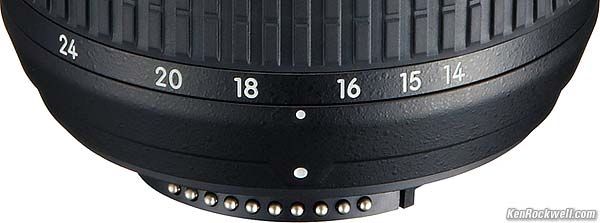
Look ma - no aperture ring!
The Nikon 14-24mm is a G lens, meaning Nikon removed the aperture ring to save costs. This means that the 14-24mm is useless on manual focus film cameras, unless you jam a match stick into the automatic diaphragm lever to preset your favorite f/stop. For the pro cameras, this means forget it with the F, F2, FM, FE, FA, F3HP and FM3a.
It works great on every pro camera since the F4. Even on the 1988 F4 you get super fast autofocus, Matrix metering and P and S automatic exposure modes.
My 14mm f/2.8 AF fixed lens has an aperture ring (it's not a G lens), so it works perfectly on every digital and film camera made since 1977, and with some modification, back to 1959. The 14mm f/2.8 AF works perfectly on every AF camera back to the first 1985 N2020. The only camera on which AF doesn't work for my fixed 14mm is my D40, but focusing is trivial with lenses this wide and the D40 does have an electronic focus assist with the fixed 14mm lens.
Introduction
Nikon announced this astonishing 14-24mm f/2.8 ultra-ultra wide zoom on August 23rd, 2007, along with its sister 24-70mm f/2.8 lens and the full-frame Nikon D3 body. it runs about $1,800 and those who have already ordered them ought to start getting them in November 2007.
Record Setting
This huge, record-setting lens is designed for ultra-ultra wide angles on film and full-frame FX digital SLRs, which means that 14mm is an insanely wide 14mm equivalent, a 114 degree diagonal angle of view. 14-24mm on FX is equivalent to a 9.2 - 16mm lens on a conventional DX digital Nikon.
The Nikon 14-24mm is the world's first f/2.8 ultra-ultra wide angle zoom. If we discount the slower discount brands like the 15-30mm Sigma and 12-24mm Sigma, this 14-24mm Nikon is the world's first ultra-ultra wide angle professional zoom ever. (I define ultra-ultra wide angle starting as 15mm and shorter, ultra-wide as 16mm through 21mm and wide as 24mm through 35mm.)
The widest f/2.8 zooms before were the 16-35mm Canons. 2mm is a huge change in angle of view at these short focal lengths, adding 7 degrees diagonally beyond Canon's 16-35mm.
14mm adds over 10 degrees of diagonal angle of view over Nikon's next widest 17-35mm f/2.8 mm lens. (114 degrees vs. 104 degrees.) Canon's 16-35mm only sees 107 degrees.
Huge
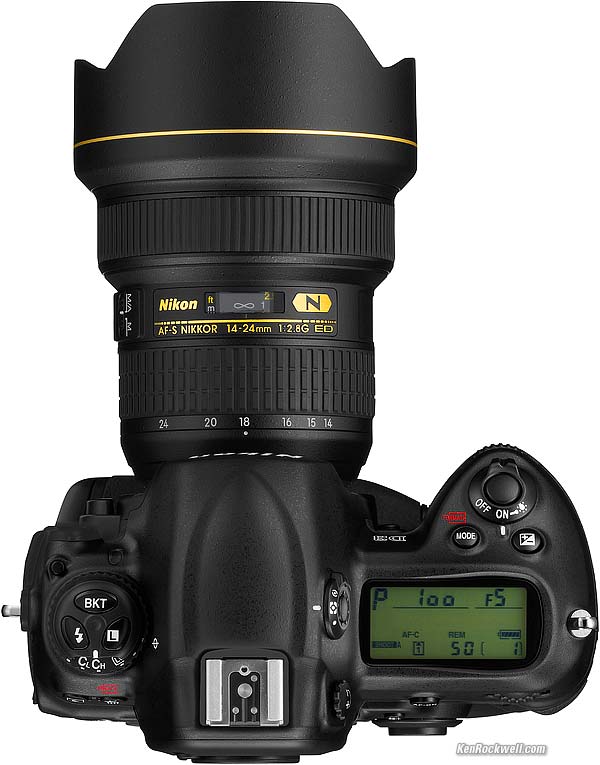
The huge Nikon D3 dwarfed by the even bigger 14-24mm.
This photo is smaller than actual size on most computers.
The Nikon 14-24mm is much bigger and heavier than the already huge fixed 14mm lens. Look at the small lens mount. That's not a small lens mount; it's a huge lens reduced to fit the camera! The lens expands from the lens mount to the larger-than-normal zoom ring and gets even fatter from there.
The front of the Nikon 14-24mm is 4 inches (98mm) in diameter! That's not much smaller than a 300mm f/2.8! The 14-24mm is 5 inches (131.5mm) long and weighs over two pounds (35.3 oz or 1kg). It cannot use front filters either for protection or for artistic effect. You've got $1,800 worth of unprotected exotic glass around your hopefully very thick neck.
Nano Crystal Coating
Forget about this. There is only one internal surface with this coating. It's just another letter for Nikon to use to push new lenses on people. It means nothing to photographers.
A lens' ghost, flare and contrast performance depend on many, many many factors. It depends more on the wisdom of the lens designer than a coating on one surface of one element. The other zillion surfaces have Nikon's traditionally excellent Super Integrated Multicoating (SIC).
Forget Manual Focus 35mm Cameras
This is the first Nikon ultrawide on which Nikon has removed the aperture ring to save money. These G lenses are useless with manual focus cameras.
For manual cameras, get the older 14mm f/2.8 AF fixed lens, which works flawlessly on just about every Nikon camera ever made.
Specifications top
Sample Image Files Introduction Specs
Performance Compared Recommendations
I'd get my Nikon 14-24mm for $1,747 new at B&H (gray-market), even less open-box, or $1,097 new at Adorama, about $690 ~ $1,200 used at Amazon, about $550 used if you know How to Win at eBay, or $573 ~ $755 used at KEH.
Name
Nikon calls this the AF-S Nikkor 14-24mm f/2.8G ED.
AFS: Quiet focusing SWM (silent wave motor) with instant manual focus override.
G: No aperture ring. Useless on manual focus cameras. Only works on AF cameras newer than about 1992, depending on camera. Works great on the 1988 Nikon F4 in P and S modes.
ED: Magic glass for sharper images.
It also has IF: Internal Focusing.
All this and more explained in greater depth on my Nikon Lens Technology page.
Focal Length
14-24 mm. This lens is intended for use on film and full frame cameras, on which it is obviously a 14-24mm equivalent..
Used on a DX digital SLR, which is stupid because the 12-24mm DX costs less, weighs less, takes regular filters and goes wider on a DX camera, it gives angles of view similar to what a 21-36mm lens would give on a 35mm film or FX camera. Calculated in reverse, you would need a 9.2-16mm lens on a DX camera to replicate the angles of view that this 14-24mm lens gives on FX and film cameras. See also Crop Factor.
Diagonal Angle-of-View
114° - 84° on 35mm and FX cameras.
90° - 61° on DX cameras.
Optics
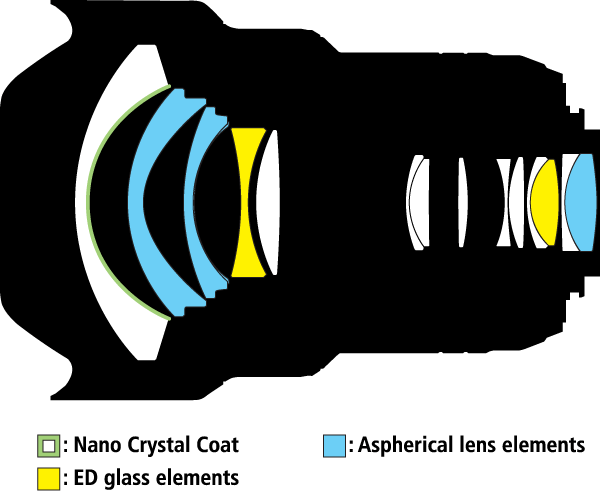
14 elements in 11 groups. Two of these are ED glass, which helps reduce color fringing. Three are glass-molded aspherical. The inside of the front element (only) has Nikon's special Nano Crystal anti-reflection coating. That's the big N logo on the lens.
Diaphragm
9 blade rounded.
Stops down to f/22.
Filters
NONE.
No front filters, and no rear gels.
Close Focus
From 18-24 mm: 0.9' (0.28 m) from the image plane (the back of the camera), marked.
Unspecified at shorter than 18mm. (14mm fixed lens has an 0.67' (0.2m) close focus distance)
Maximum Reproduction Ratio
1:6.7.
Infrared Focus Index?
None.
Mechanics
Dust and moisture resistant
Metal zoom ring has engraved markings.
Size
3.9" diameter x 5.2" extension from lens mount (98 x 131.5mm).
Weight
34.285 oz. (972.0 g) actual measured weight.
Rated 35.3 oz. (1kg).
Hood
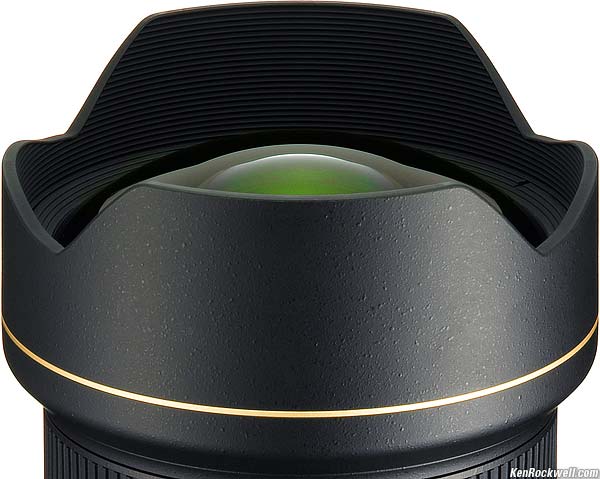
Front of Nikon 14-24mm.
No hood.
Like fisheyes and ultra-ultra wides, the petals on the front of the lens are to protect the lens when you carry it around or put it down on a table face-first. You can look at the 14-24mm from outside of the picture angle and still see glass, which means that stray light can hit that glass, too. I use my hand to block the sun when needed.
Nikon refers to this permanent design of the lens barrel as a hood, which does serve a hood's purpose against damage and fingers, but not much against stray light. The good news is that modern lenses like this have little problem with stray light, unlike the awful old 15mm f/3.5 AI-s.
Case top
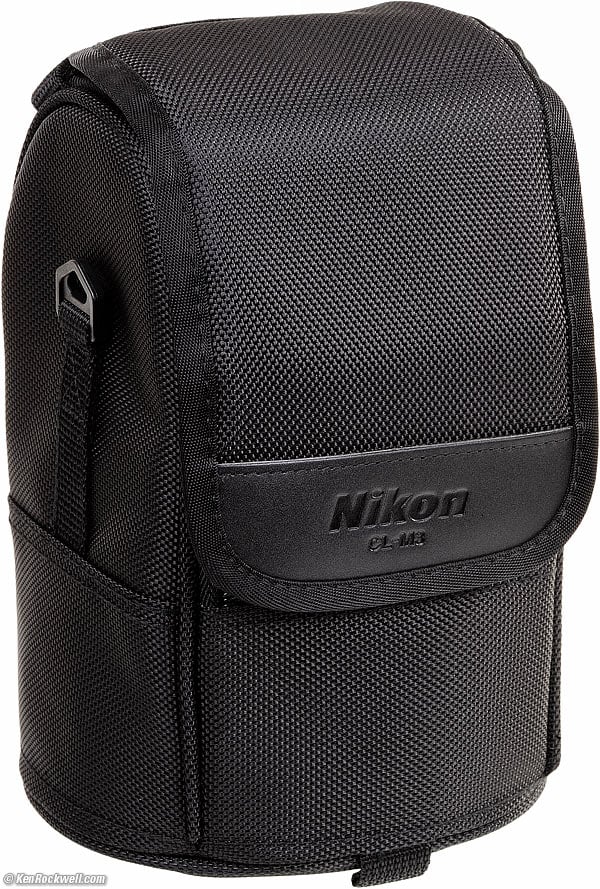
Nikon CL-M3 padded nylon case. bigger.

Rear, Nikon CL-M3 padded nylon case. bigger.
CL-M3 padded nylon case, included.
It's the same case included with the 300mm f/4 E VR PF and the 24-70/2.8G.
Belt loop, velcro and dual-zipper closure.
Nikon Product Number
2163.
Introduced
23 August 2007.
Shipping Since
November 2007.
Price, USA top
September 2025
$1,747 new at B&H, gray-market.
About $690 ~ $1,200 used at Amazon
About $550 used if you know How to Win at eBay, or $573 ~ $755 used at KEH.
October 2024
$1,747 new at Adorama, at B&H and at Amazon.
About $540 used if you know How to Win at eBay, or about $600 used at Amazon.
Sad June 2021
About $900 used if you know How to Win at eBay.
Hot June 2019
$1,597, or about $900 used if you know How to Win at eBay.
June 2017
$1,897, or about $1,200 used if you know How to Win at eBay.
May 2015
$1,997, or about $1,350 used if you know How to Win at eBay.
March 2015
$1,797.
Christmas 2010
$1,785.
April 2010
$1,800.
December 2009 ~ March 2010
$1,830.
2008
$1,600.
August, 2007 (introduction)
Nikon 14-24mm box.
Performance top
Sample Image Files Introduction Specs
Performance Compared Recommendations
I'd get my Nikon 14-24mm for $1,747 new at B&H (gray-market), even less open-box, or $1,097 new at Adorama, about $690 ~ $1,200 used at Amazon, about $550 used if you know How to Win at eBay, or $573 ~ $755 used at KEH.
The Nikon 14-24mm set a new world standard for ultra-wide lenses, exceeded only today by Nikon's 16-35mm VR. This 14-24mm is sharper than any other 14mm lens ever made. It also has the lowest levels of ghosting I've ever seen. It's so good that people are buying it to use with adapters on the Canon 1Ds Mk III! Its that good, and puts the Nikon 13mm f/5.6, 15mm f/5.6, 15mm f/3.5 and 14mm f/2.8 back into their spots in history. The only thing the Nikon 13mm f/5.6, 15mm f/5.6 and 15mm f/3.5 do better is have less distortion, however the distortion of this 14-24mm is trivial to correct in Photoshop.
I've made extensive side-by-side shots with Nikon's four other ultra-ultra wide lenses, and the 14mm has the least ghosting , the least falloff, the least peripheral color shift and by far the most sharpness, especially in the corners wide open. I'll be presenting this as I get to it.
You can use a rear gel with the 14mm f/2.8, but no filters whatsoever with this 14-24mm.
Construction
There's a rubber gasket on the mount to help seal out crud.
It's made of a lot of engraved metal alloy. The fixed hood is plastic.
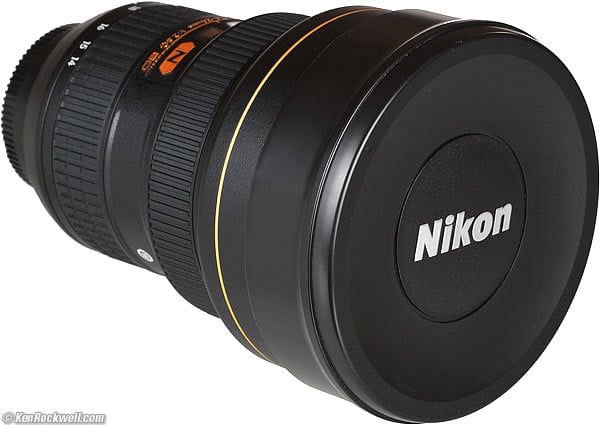
Nikon 14-24mm with caps.
The dedicated front cap is dinky plastic. It has eight ribs that will mar the outside of the lens with extended use and leave space for dust to enter.
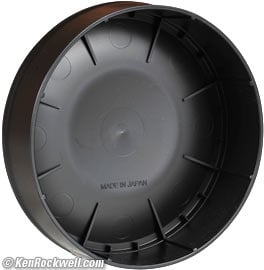
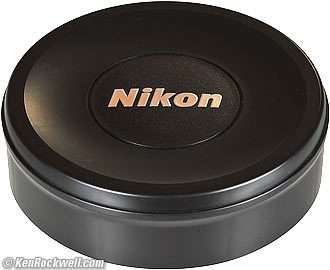
Two views, Nikon 14-24mm dinky plastic front cap.
I wish Nikon, or a third party, would sell a proper metal cap with a felt lining, as the 15mm f/5.6 and 15mm f/3.5 lenses and earliest 16mm fisheyes have always had.
Nikon's users manual rightly cautions not to grab the lens by the cap, because it will slip off and drop your 14-24mm (and camera) to the ground if the lens slips out of the cap. Always grab it by the barrel.
Nikon could have used a genuine leather drawstring front lens cover or a real felt-lined metal cap for this $2,000 lens, but no.
The rear cap is the usual Nikon bayonet. You can buy spares for nine bucks each. God only knows what this front cap will cost me.
Distortion
Distortion is healthy, and thankfully easy to correct.
Plug these figures into Photoshop CS2's lens distortion filter to correct the distortion. These aren't facts or specifications, they are the results of my research.
10' (3m) FX |
||
14mm |
+4.0 |
+1 |
15mm |
+3.0 |
|
16mm |
+2.0 |
|
18mm |
+0.5 |
+0.2 |
20mm |
0.0 |
|
24mm |
-0.1 |
-0.2 |
© 2010 KenRockwell.com
Distortion is doubled if you're shooting at only a few feet, so double these figures.
Eyeblow performance top
As this 14-24mm zooms in and out, air pumps in and out, and can blow out of a camera eyepiece.
I often feel this using this lens on my D3.
This also means sensors and cameras will suck-in dust and dirt. The Tokina 16-28mm has much less eyeblow.
Falloff (darkened corners) performance top
I've exaggerated this by shooting a gray field and placing these on a gray background.
Nikon 14-24mm f/2.8 G AF-S falloff on FX and film, no correction.
© 2010 KenRockwell.com. All rights reserved.
|











Sharpness: Rated MTF
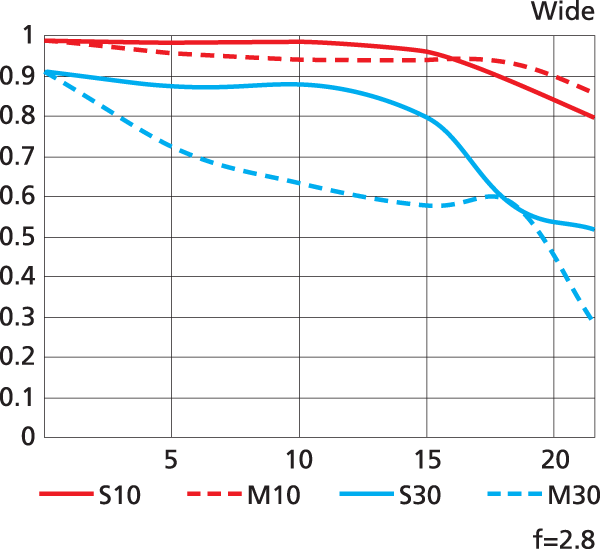
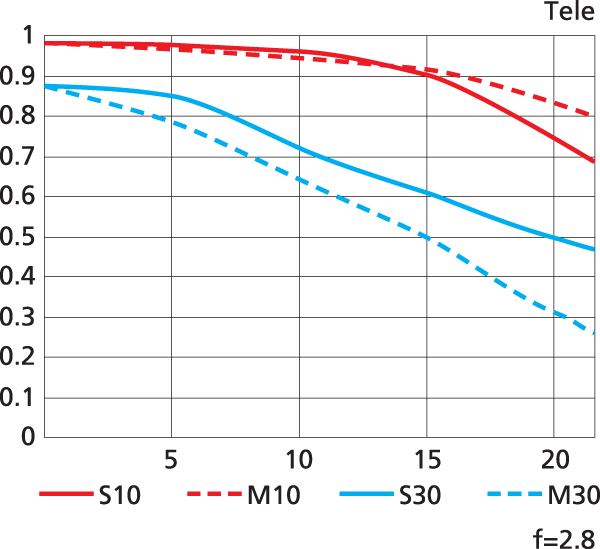
Nikon's published MTF graphs rate the 14-24mm as incredibly good, the best 14mm ever made in the history of mankind.
Although Nikon's PR said it "rivals fixed lenses," its published MTF is far better than my fixed 14mm f/2.8 AF, and far better than Canon's original 14mm f/2.8 L and Canon's brand new 14mm f/2.8 L II. I love my Nikon 14mm f/2.8 fixed lens' performance, so if the zoom keeps the distortion reasonable, it's a big winner.
Of course these MTFs are dreams, which mean they are calculated, not measured from real lenses. Nothing is said if the published graphs are monochromatic, polychromatic, or integrated over white light, so they mean very little for comparison to real samples of lenses. Don't lose sleep over any of this.
Zooming
The zoom ring is very well spread out, which makes precise zooming and composition a breeze. It has perfect logarithmic spacing, which I love.
Compared top
Sample Image Files Introduction Specs
Performance Compared Recommendations
I'd get my Nikon 14-24mm for $1,747 new at B&H (gray-market), even less open-box, or $1,097 new at Adorama, about $690 ~ $1,200 used at Amazon, about $550 used if you know How to Win at eBay, or $573 ~ $755 used at KEH.
NEW: Full-Frame Mirrorless Ultrawide Lenses Compared 25 June 2019
See also Nikon Ultrawide Zooms Compared and Full-Frame Ultrawide Lenses Compared.
Size Comparison among all other Nikon ultra-ultra wide lenses. enlarge.
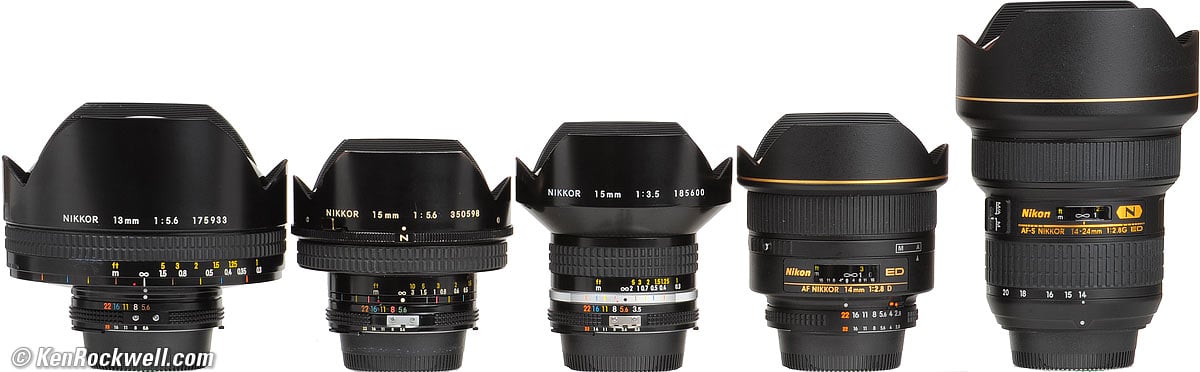
Nikon 13mm f/5.6, 15mm f/5.6, 15mm f/3.5, 14mm f/2.8 and this 14-24mm f/2.8.
Compared to the 17-35mm AF-S
This 14-24mm and the 17-35mm AFS are two entirely different lenses for entirely different purposes. If you are comparing the two for purchase, you're misunderstanding what they do. They do not replace or compete against one another.
I suggest the 17-35mm AFS for normal people. The 14-24mm is a special purpose lens.
I love ultrawide lenses like this 14-24mm. I use this 14-24mm because I'm crazy and love 14mm lenses. It replaces my 14mm f/2.8. It does not replace a regular wide lens like the 17-35mm. When I say I use the 14-24mm most of the time on my D3, it's because it replaces a fixed 14mm lens for me.
This 14-24mm lens is a special-purpose lens for ultra-ultra wide angle shots. It can't take filters, it's huge and cannot wear a prophylactic filter for protection from dirt or use creative filters like graduated NDs, which are often needed with wide lenses. Its limited zoom range (1.7:1) covers only the rather bizarre ultra-ultra wide to really-wide range. If you want ordinary wide shots, you'll still need another lens, like the no-longer made 20-35mm or 24-50mm AF to cover it along with the 14-24mm.
The 17-35mm f/2.8 is a much better lens for normal people buying just one wide zoom. The 17-35 covers a far more useful and larger zoom range (2:1) from ultra-wide to almost normal. It takes pro-standard 77mm filters, like all the other Nikon pro zooms and fixed lenses like the 80-200/2.8, 70-200/2.8 VR, 85/1.4 and the 80-400 VR. Filters are important, especially in digital photography, and the 14-24mm can't use any while the 17-35mm uses everything you've already got in your bag.
Pros buy new lenses and put the boxes, warranty cards and cases away in their closets. They take the lens out and shoot the heck out of it. When the bare front element of the 14-24mm becomes too pitted for serious use (any small damage will be in focus on the image!), the pro packs it back in the box and sells it on eBay to unwitting amateurs, always claiming the small "cleaning marks" have "no effect on image quality," and the box and papers always let the pro fetch top dollar. Pros aren't called pros for nothing.
Sure, this 14-24mm is much sharper in the corners on FX than the 17-35mm, but so is the $120 made-in-China 50mm f/1.8. All three of these lenses are for entirely different purposes. The 17-35mm AF-S is what you want if you're just buying just one wide zoom, unless you're a nut job like me who loves the bizarre effects I can stir up with a 14mm lens.
Recommendations top
Sample Image Files Introduction Specs
Performance Compared Recommendations
I'd get my Nikon 14-24mm for $1,747 new at B&H (gray-market), even less open-box, or $1,097 new at Adorama, about $690 ~ $1,200 used at Amazon, about $550 used if you know How to Win at eBay, or $573 ~ $755 used at KEH.
This 14-24mm is a huge, expensive and special-purpose lens. For 99% of the people reading this, the newer 16-35mm f/4 VR is a much better lens because it is smaller, lighter, has a more useful zoom range, it's easier to use, takes filters and is slightly sharper, too.
This 14-24mm is for people who need the insane point of view of ultrawide lenses. I love my fixed Nikon 14mm and Canon 14mm lenses I already use on film and my full-frame Canon 5D cameras. You can see examples at my 2007 Route 66 and 2007 Death Valley galleries.
My fixed 14mm lenses are big, but still much more compact that the 14-24mm.
This is not a lens for the faint of heart. Not only is it a back-breaker, but ultrawides are the most difficult lens to use. Ultrawides are not for "getting it all in!"
Most people use ultrawides too sheepishly, and get crummy results with a tiny subject dwarfed in the middle of a blank frame. When I use my 14mm I have to force myself to get closer and to pay rapt attention to the sides of my viewfinder, which too often are blank.
The correct way to use an ultrawide is to jam it into whatever you are photographing, which effectively rubs the viewer's nose in your subject. Ultrawides are for jamming into the face of an enraged wino brandishing a feces-covered broken bottle to exaggerate his crazed anger and his crude weapon. Ultrawides are to suck the viewer into the middle of an intimate landscape or situation.
Camera position is critical with ultrawides. Even a fraction of an inch (cm) gives a huge change in composition.
My 14mm fixed lens is much smaller and lighter, but not as sharp at larger apertures and has more peripheral color shift.
I'd get my Nikon 14-24mm for $1,747 new at B&H (gray-market), even less open-box, or $1,097 new at Adorama, about $690 ~ $1,200 used at Amazon, about $550 used if you know How to Win at eBay, or $573 ~ $755 used at KEH.
Filters
Forget using any filters with it.
There are some crazy adapters made for large square filters, but watch out: you'll often have problems with the lens is seeing behind it via reflections off the rear of the filters!
These adapters also usually don't work on full-frame cameras, which again makes the pretty useless.
© Ken Rockwell. All rights reserved. Tous droits réservés. Alle Rechte vorbehalten. Alla rättigheter förbehållna. Toate drepturile rezervate. Niciun vampir nu a fost implicat în crearea acestei lucrări. Omnia jura reservata. Ken Rockwell® is a registered trademark.
Help me help you top
I support my growing family through this website, as crazy as it might seem.
The biggest help is when you use any of these links to approved sources when you get anything, regardless of the country in which you live. It costs you nothing, and is this site's, and thus my family's, biggest source of support. These places have the best prices and service, which is why I've used them since before this website existed. I recommend them all personally.
If you find this page as helpful as a book you might have had to buy or a workshop you may have had to take, feel free to help me continue helping everyone.
If you've gotten your gear through one of my links or helped otherwise, you're family. It's great people like you who allow me to keep adding to this site full-time. Thanks!
If you haven't helped yet, please do, and consider helping me with a gift of $5.00.
As this page is copyrighted and formally registered, it is unlawful to make copies, especially in the form of printouts for personal use. If you wish to make a printout for personal use, you are granted one-time permission only if you PayPal me $5.00 per printout or part thereof. Thank you!
Thanks for reading!
Ken Rockwell
Home Donate New Search Gallery Reviews How-To Books Links Workshops About Contact