Home Donate New Search Gallery Reviews How-To Books Links Workshops About Contact
Nikon 35mm f/1.4
F, AI and AI-s NIKKOR (1969-2023)
Intro Specifications Performance Recommendations

Nikon AI NIKKOR 35mm f/1.4s (52mm filters, 13.5 oz./381g, about $475 used at eBay (How to Win at eBay) or at Amazon). enlarge.
This all-content, junk-free website's biggest source of support is when you use those or any of these links to approved sources when you get anything, regardless of the country in which you live. Thanks for helping me help you! Ken.
October 2024 Nikon Reviews Nikon Lenses All Reviews
NEWER: Nikon 35mm f/1.4G AF-S. First real update in 40 years!
NEWEST: Nikon Z 35mm f/1.4.
Nikon 35mm f/1.8 DX (2009-today, about $200)
Samyang 35mm f/1.4 (2011-today)
Sample Images
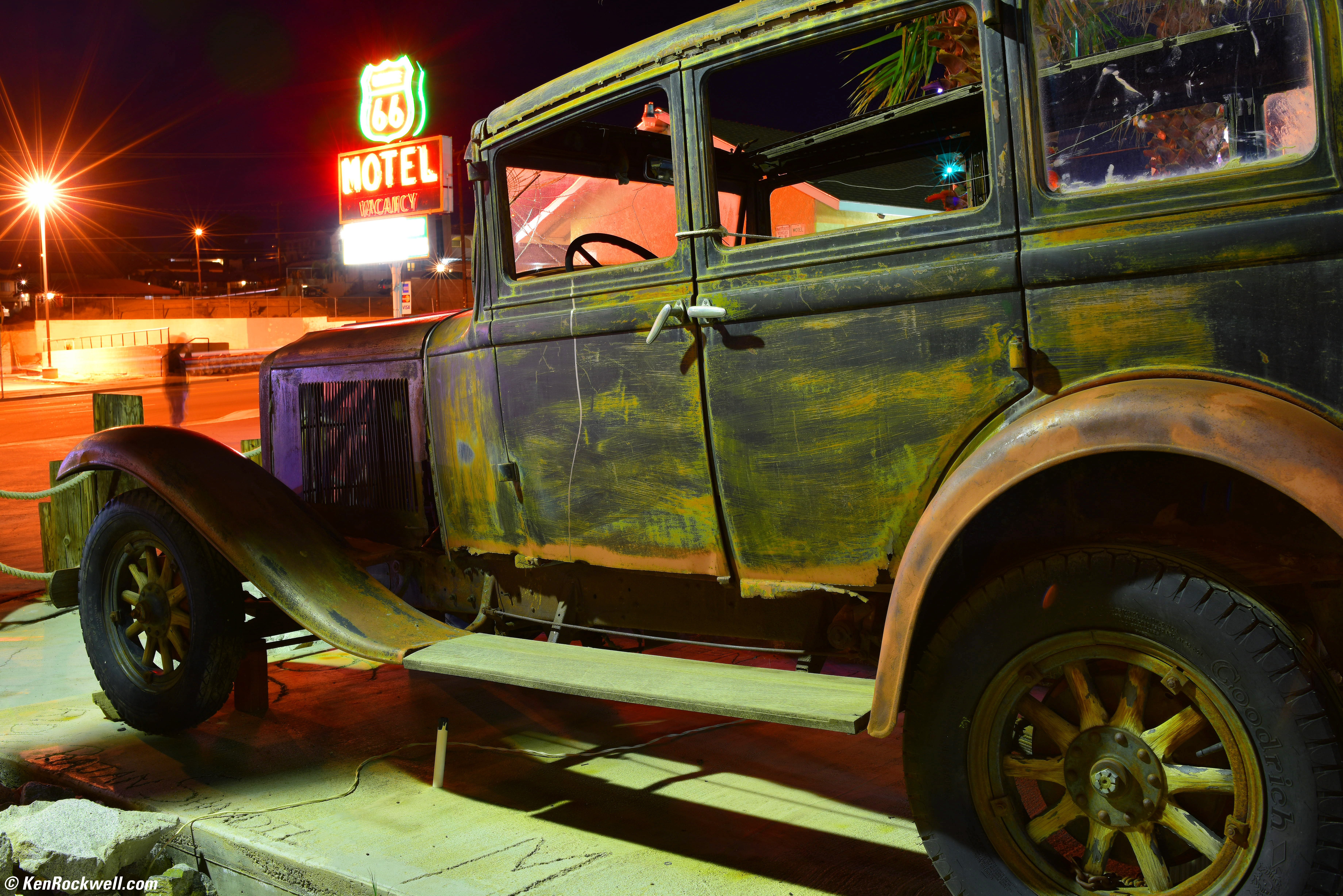
Route 66, 06 February 2015. Nikon D810, NIKKOR 35mm f/1.4 AI-s, f/11 at 30 seconds at ISO 100 on $50 Dolica GX600B200 tripod with Mini Magic Ball head, processed in Perfectly Clear. 1 MP or full 36 MP resolution.

Last Light on Dunes Motel Sign, West Barstow, 5:07 PM, 06 February 2015. Nikon D810, Nikon 35mm f/1.4 NIKKOR AI-s, f/11 at 1/60 at Auto ISO 100. bigger.
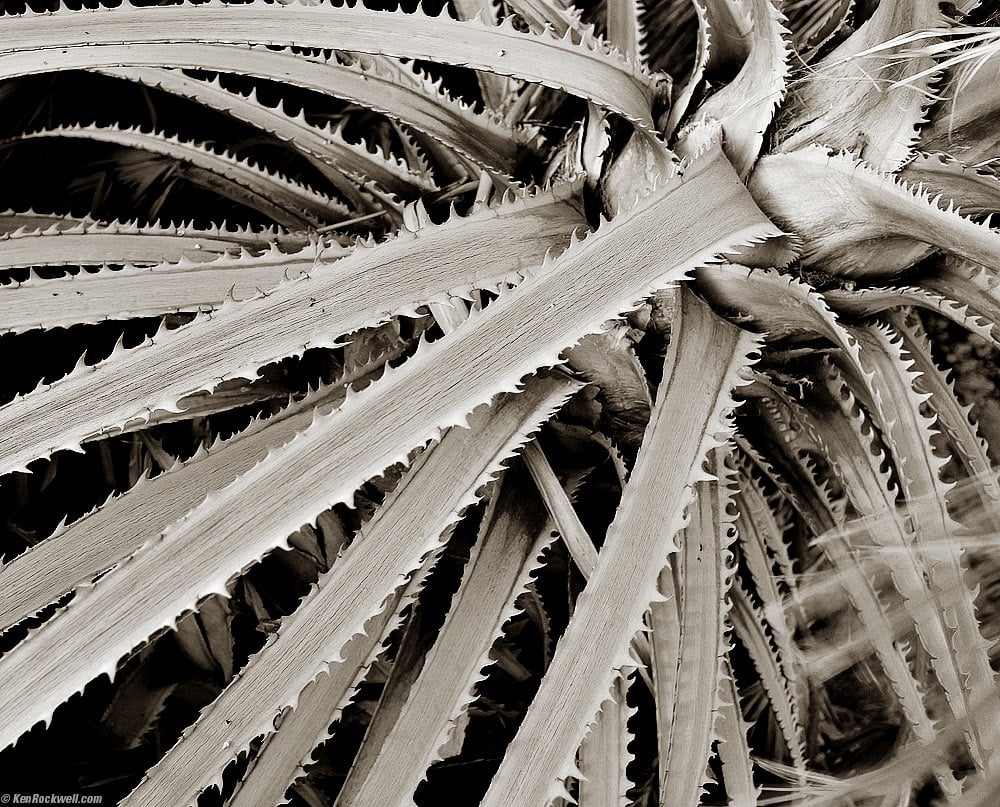
Some Kind of Tropical Plant in Black-and-White, West Barstow, 5:07 PM. Nikon D810, Nikon 35mm f/1.4 NIKKOR AI-s, split-toned print. bigger.
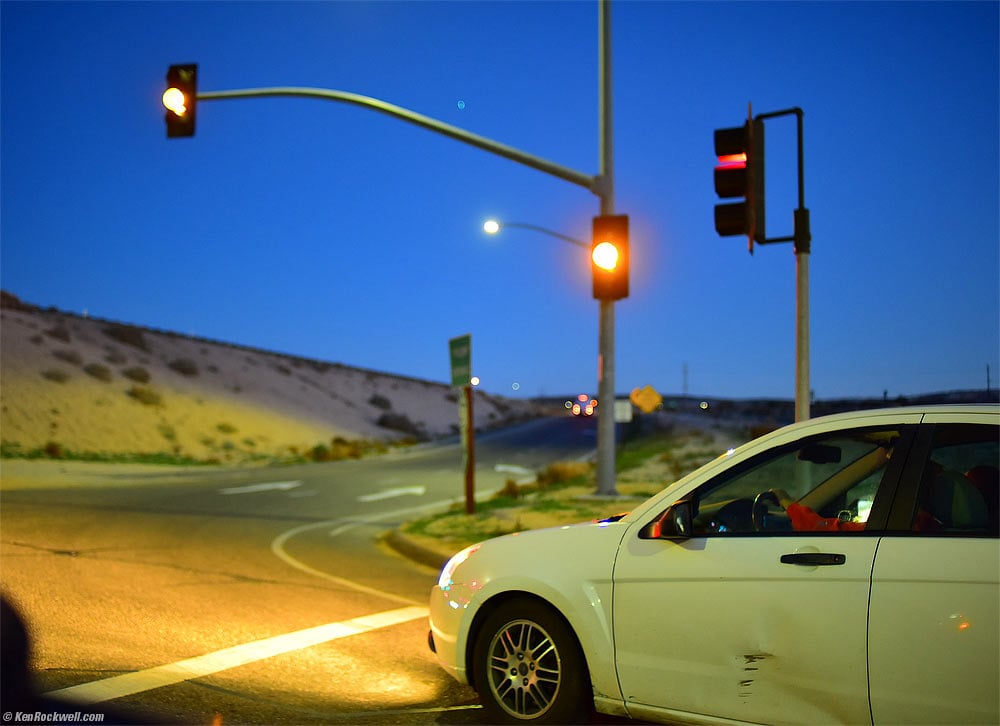
Colorful Intersection in Twilight, 5:49 PM. Nikon D810, Nikon 35mm f/1.4 NIKKOR AI-s, f/1.4 at 1/40 at Auto ISO 1,000. The dot in the sky is a planet rising. bigger.
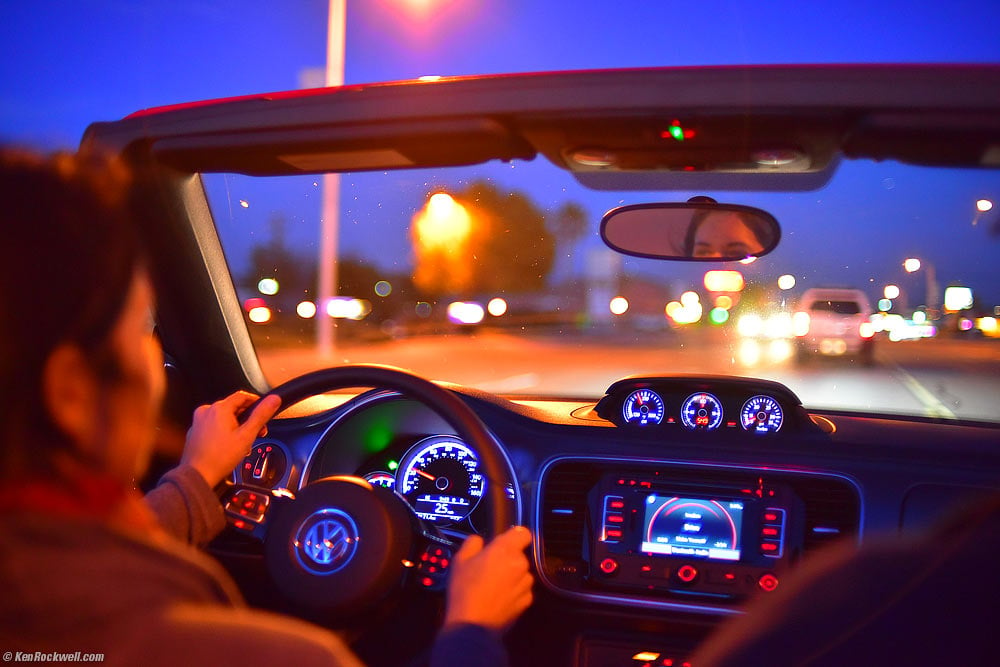
Riding in VW Beetle Convertible along Colorful City Street in Twilight, 5:52 PM. Nikon D810, Nikon 35mm f/1.4 NIKKOR AI-s, f/1.4 at 1/40 at Auto ISO 2,800. bigger.
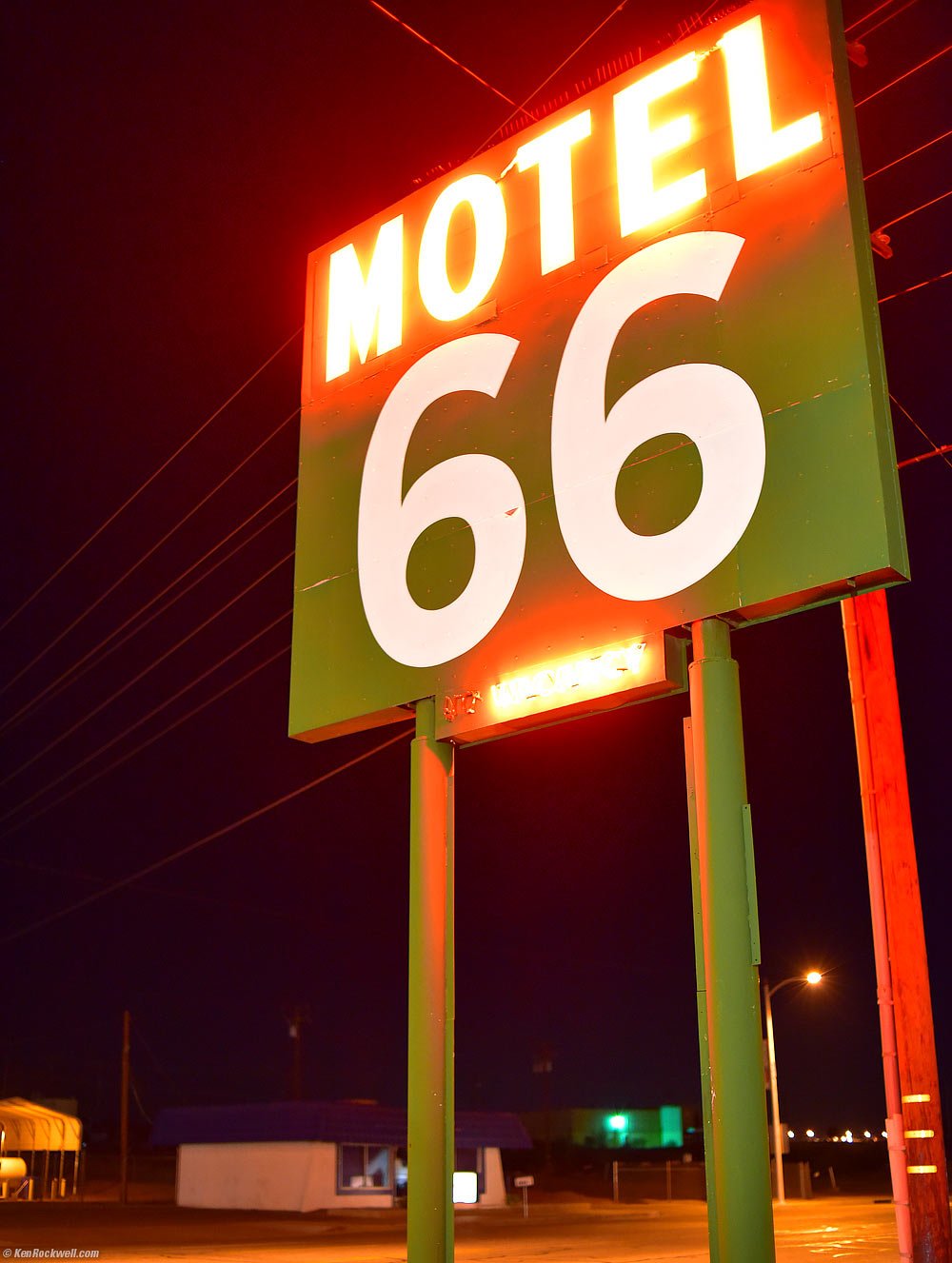
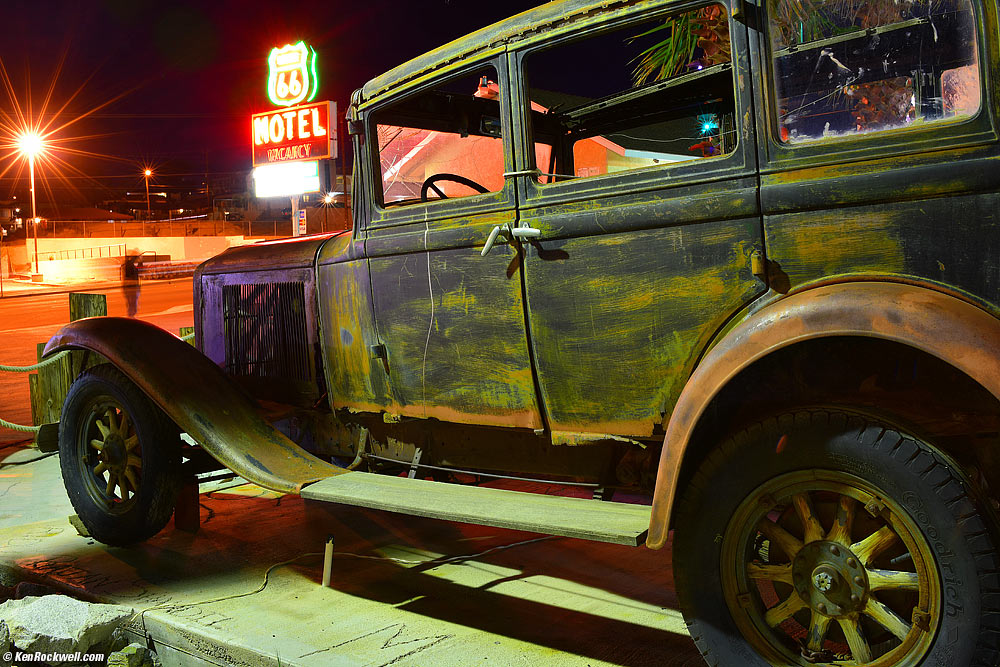
Motel 66 Sign at Night, 8:34 PM. Nikon D810, Nikon 35mm f/1.4 NIKKOR AI-s, f/2 at 1/20 hand-held at Auto ISO 2,500. bigger.
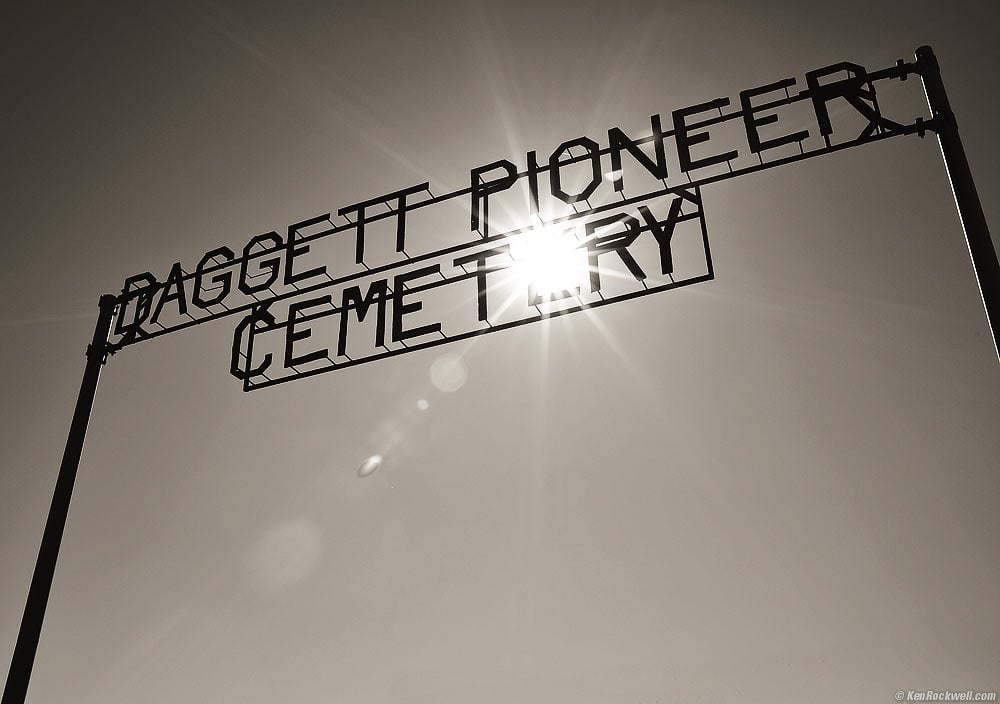
<Sun Shining Through Daggett Pioneer Cemetery Sign, 10:56 AM, 07 February 2015.Nikon D810, Nikon 35mm f/1.4 NIKKOR AI-s, f/16 (for big sunstars) at 1/60 at Auto ISO 100, split-toned print. bigger.
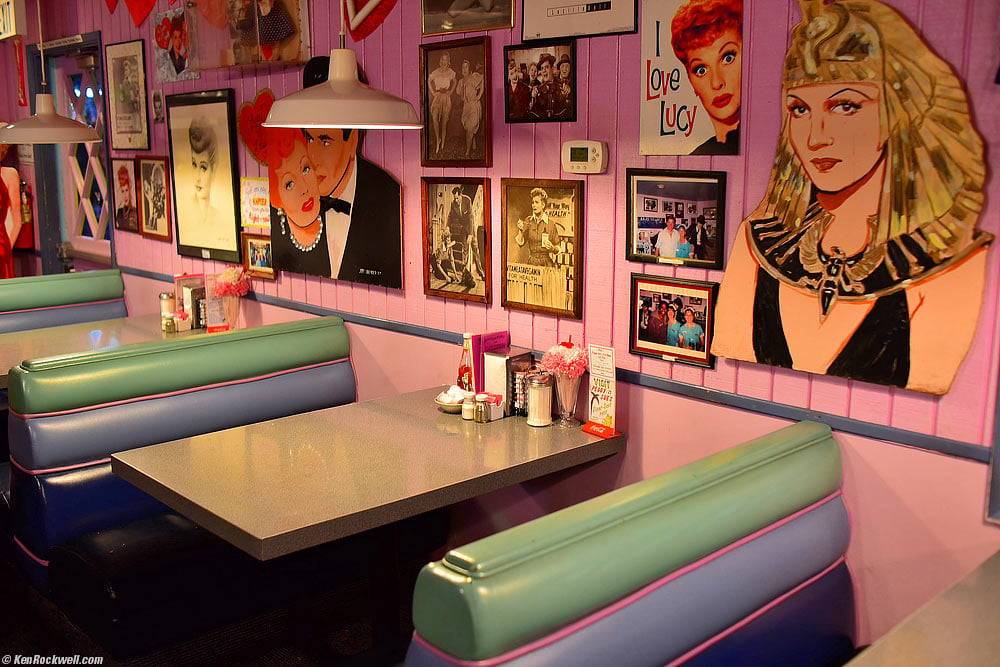
Booths at Peggy Sue's Restaurant, Yermo, 6:43 PM, 07 February 2015. Nikon D810, Nikon 35mm f/1.4 NIKKOR AI-s, f/2.8 at 1/20 hand-held at Auto ISO 500. bigger.

Counter and Stools at Peggy Sue's Restaurant, Yermo, 6:47 PM, 07 February 2015. Nikon D810, Nikon 35mm f/1.4 NIKKOR AI-s, f/5.6 at 1/20 hand-held at Auto ISO 1,400. I flipped the negative in Photoshop so the picture reads properly from left to right. bigger.

Front Door at Night, Peggy Sue's Restaurant, Yermo, 8:19 PM, 07 February 2015. Nikon D810, Nikon 35mm f/1.4 NIKKOR AI-s, f/2 at 1/20 hand-held at Auto ISO 320. bigger.
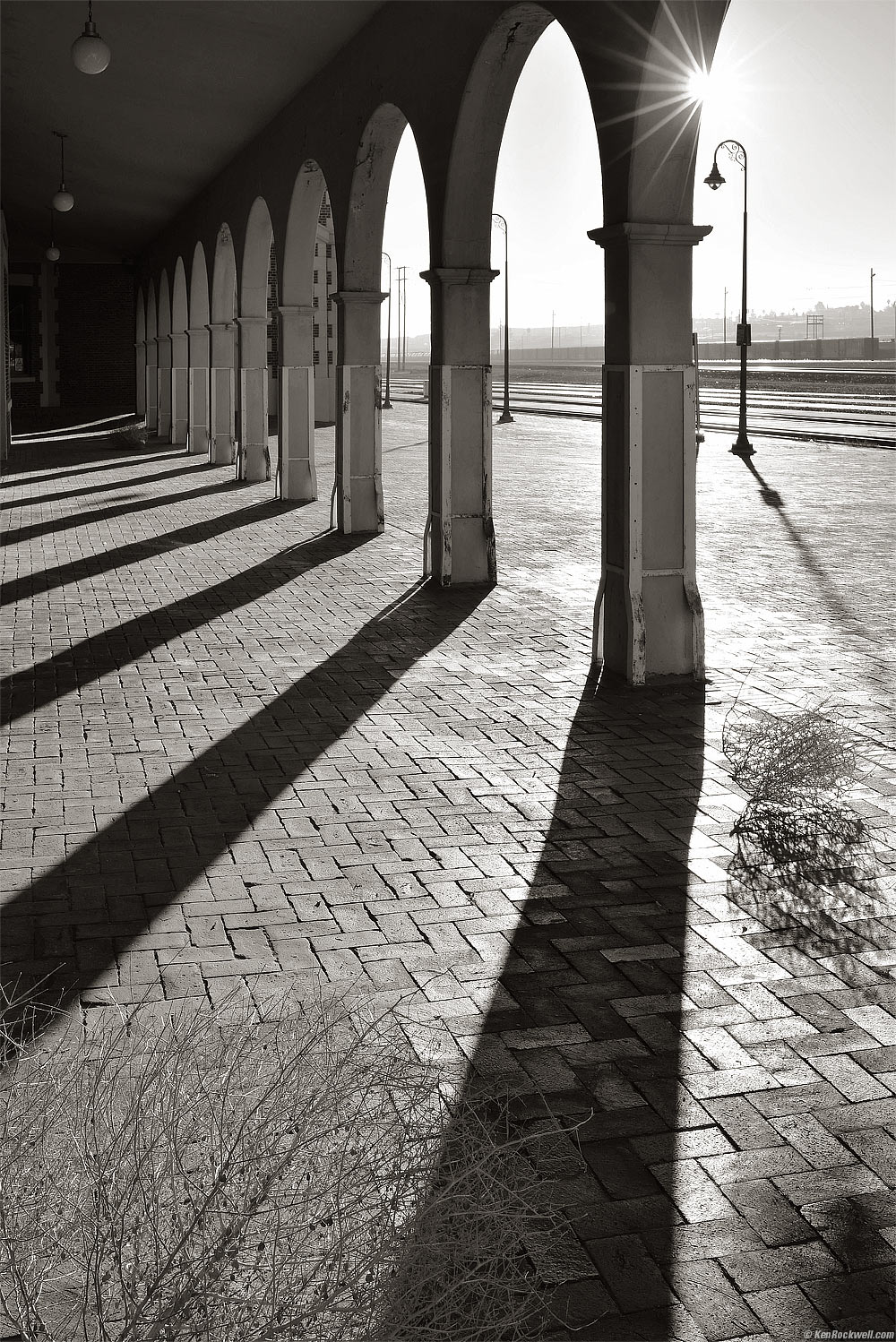
Backlit Columns at Barstow Station in Black and White, 7:41 AM. Nikon D810, Nikon 35mm f/1.4 NIKKOR AI-s, f/16 (for big sunstars) at 1/60 at Auto ISO 100, split-toned print. bigger.

Cambria, 13 April 2013, 7:53PM. bigger. (Nikon EL2, NIKKOR 35mm f/1.4 AI-s, French-made 52mm CROMOFILTER P2 rotating tobacco grad filter, Fuji Velvia 50, f/8 at AUTO 4 seconds, NCPS scan, Athentech Perfectly Clear plug-in.)

Bubble Gum Wall, San Luis Obispo. 11:31 AM, 11 April 2012. bigger. (1977 Nikon EL2, 1997 Nikon 35mm f/1.4 AI-s, Nikon A2 (81A) filter, Fuji Velvia 50, f/2.8 at 1/30, process and scan at NCPS, Perfectly Clear.)
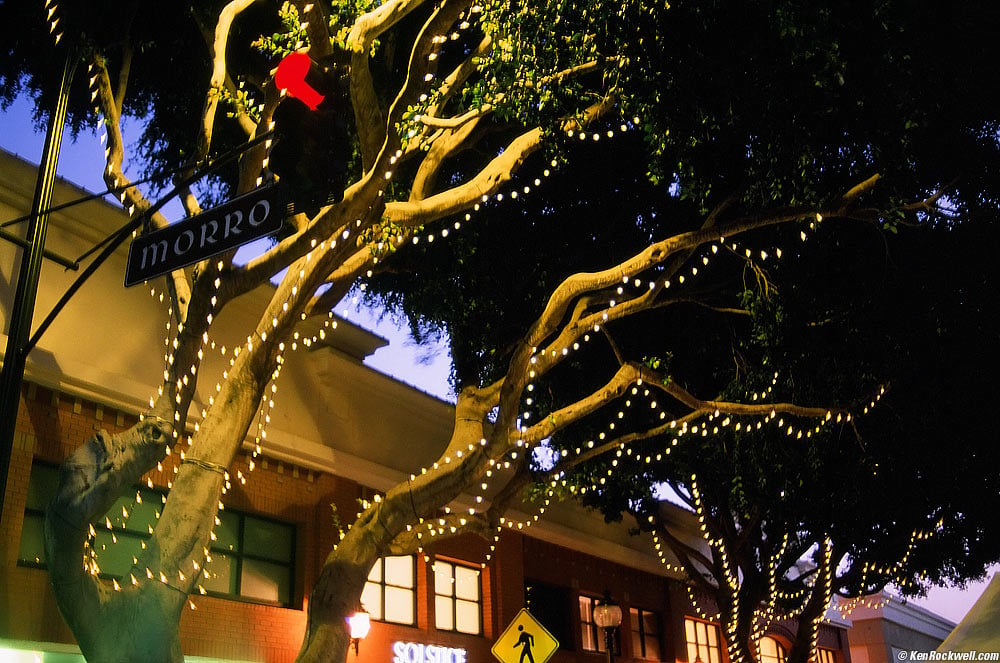
Trees at Chorro, San Luis Obispo, 7:54 PM, 11 April 2012. bigger. (1977 Nikon EL2, 1997 Nikon 35mm f/1.4 AI-s, Nikon A2 (81A) filter, Fuji Velvia 50, f/1.4 at 1/2 second hand-held (no bracing; just standing in the street), process and scan at NCPS.)

Introduction top
Intro Specifications Performance Recommendations

|


The Nikon 35mm f/1.4 was found in every photojournalist's bag throughout the 1970s and 1980s as their standard lens.
As of 2000, with faster films and good f/2.8 zooms, they had been largely abandoned.
As of 2010 with digital, they have been forgotten, although they work extremely well on Nikon FX cameras.
The Nikon 35mm f/1.4 is a full-frame FX lens. It works on DX digital, but I won't cover that here.
The Nikon 35mm f/1.4 was introduced, in the original F mount, in 1969. It was Nikon's first multicoated lens and has been used by NASA in space. Its optics have remained the same throughout both AI and AI-s versions, and is still manufactured today. All versions share exemplary mechanical quality.
Optically this is your father's 35mm f/1.4. Its performance, outstanding for the 1970s, has been surpassed by the modern 35mm f/2.0D AF and the 28mm F/1.4D AF.
I'd get my 35mm f/1.4 AI-s used at eBay (How to Win at eBay) or used at Amazon.
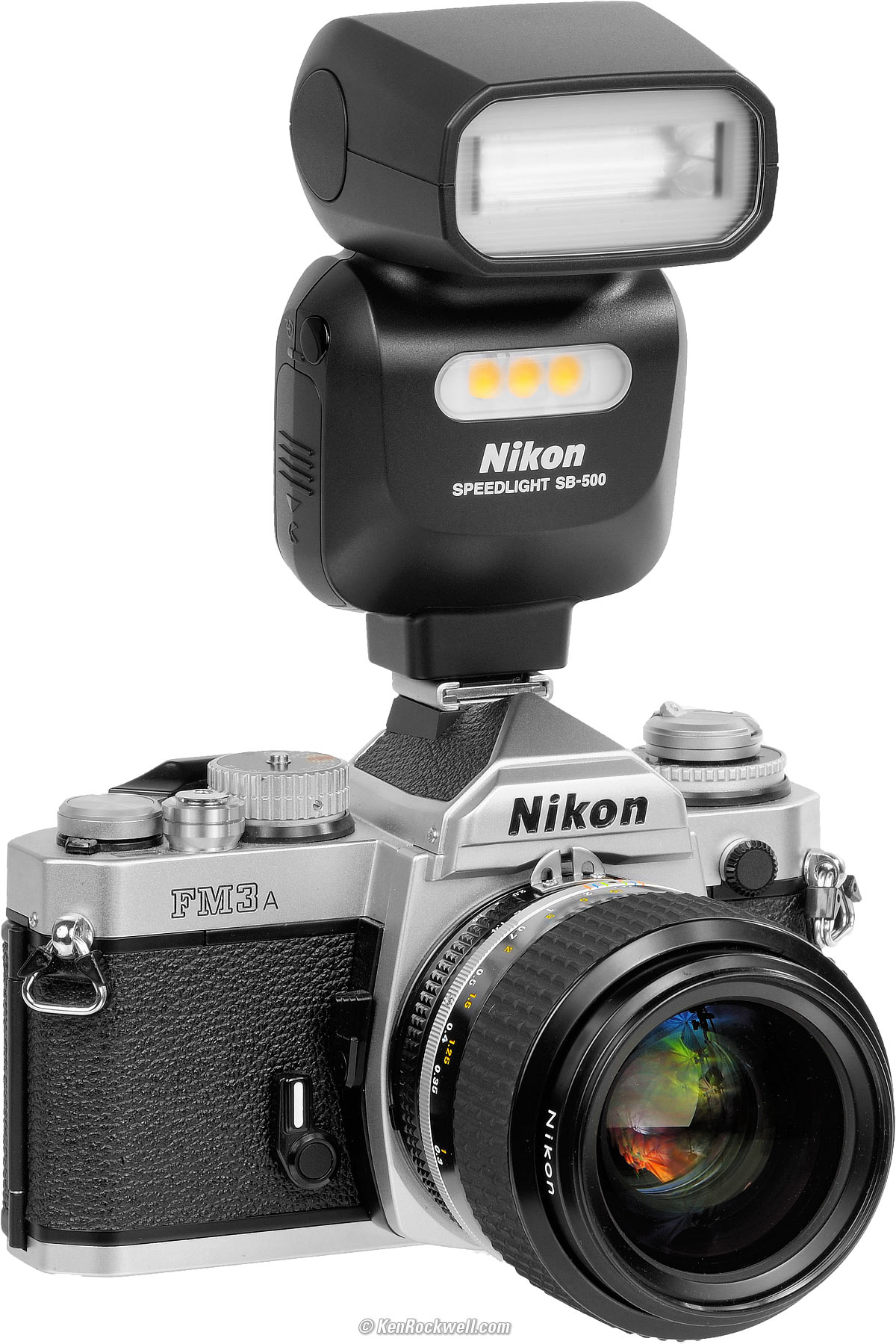
FM3a with NIKKOR AI 35mm f/1.4s and SB-500 flash. bigger.
Specifications top
Intro Specifications Performance Recommendations
I'd get my 35mm f/1.4 AI-s used at eBay (How to Win at eBay) or used at Amazon.
Name
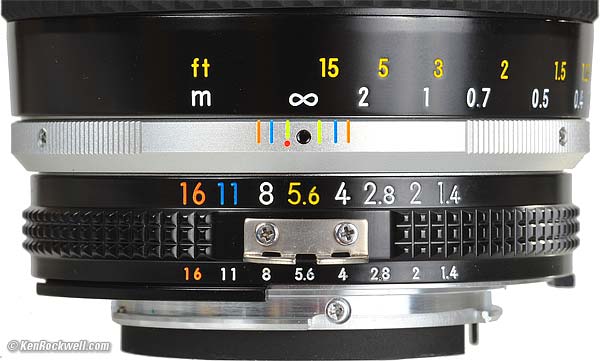
Nikon calls this The Nikon Nikkor 35mm f/1.4 AI-s.
Optics
9 elements in 7 groups.
Traditional spherical design with floating elements for close-range correction (CRC).
Multicoated; actualy it was Nikon's first multicoated lens back in 1970.
Diaphragm: 9 blades on today's AI-s version (1981-today), 7 blades on early AI (1977-1981) and K (1975-1977) versions.
Diaphragm
|
|
At f/1.4. bigger. |
At f/5.6. bigger. |
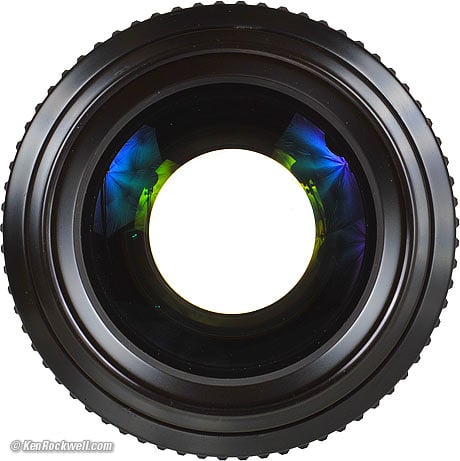
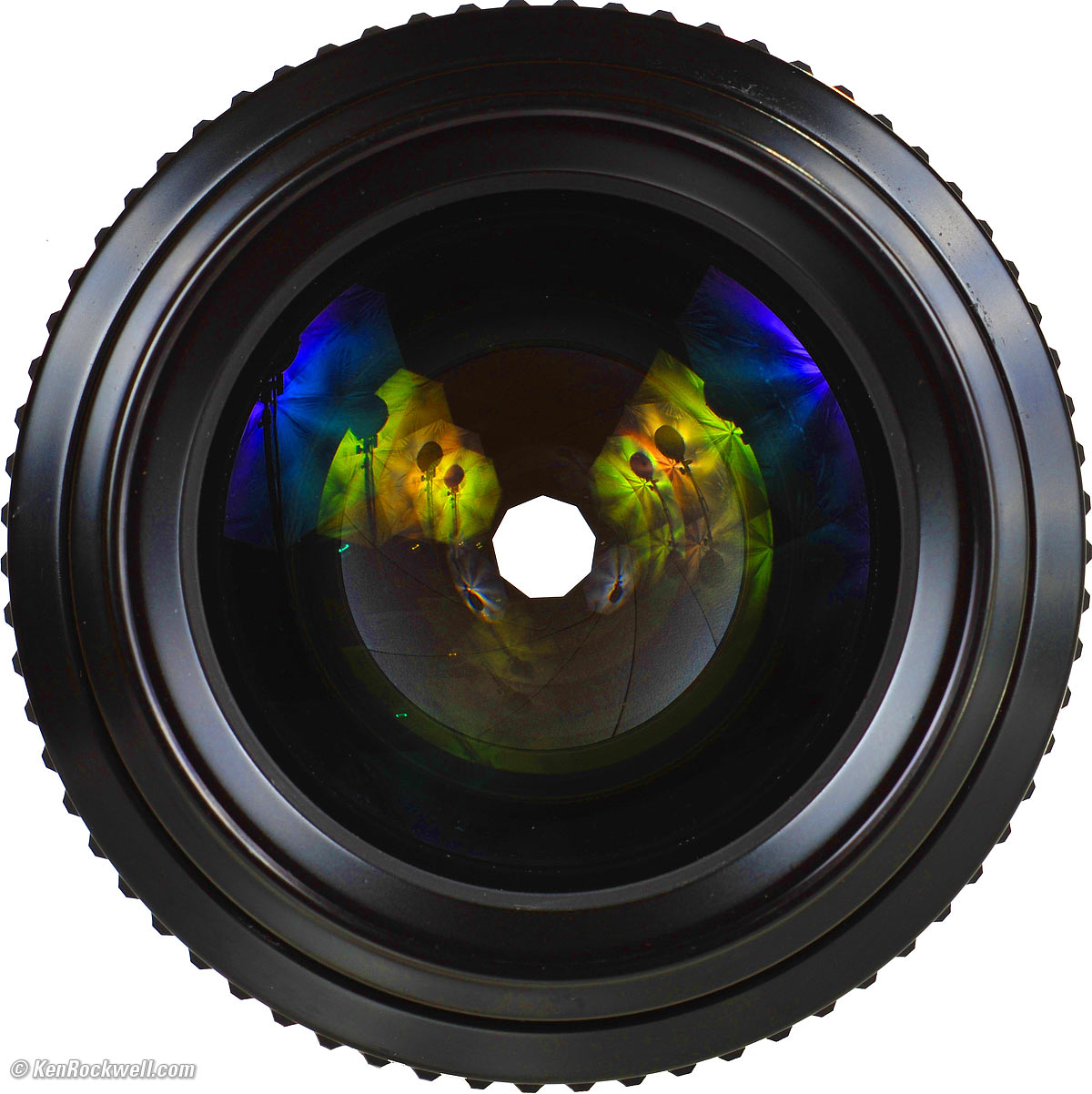
9 blades.
Stops down to f/16.
Close Focus
1 foot (0.3m).
Maximum Reproduction Ratio
1:5.5
Actual Focal Length
36.0mm.
Diaphragm
Wonderful nine-bladed diaphragm.
Stops down to f/16.
Size
2.4444" extension from flange x 2.6425" diameter (62.11 x 67.12mm), measured.
Nikon specifies 2.7" (67.5mm) around by 2.9" (74mm) long.
The fattest part is the focus ring.
Weight
13.450 oz. (381.25g), measured.
Nikon specifies 14 oz. (400g).
Hood
HN-3 screw-in metal hood.
I don't use it; ghosts aren't a problem.
Nikon Catalog Number
1429, April 2010.
Price, USA
October 2024
About $475 used if you know How to Win at eBay.
August 2024
About $436 used if you know How to Win at eBay.
February ~ September 2022
$1,099 new or $500 used.
June 2015
April 2013
April 2010
$1,165, USA catalog price, New.
Performance top
Intro Specifications Performance Recommendations
I'd get my 35mm f/1.4 AI-s used at eBay (How to Win at eBay) or used at Amazon.
Overall
Typical performance for a spherical f/1.4 wide lens: sharp but lower contrast in the center at f/1.4, blurry at f/1.4 in the corners, improving greatly as stopped down. This was state-of-the art until the introduction of the 28mm f/1.4 AF-D aspherical in 1993.
Coma performance top
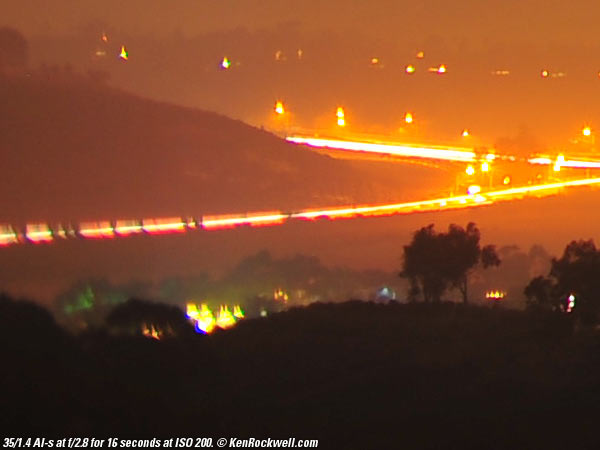
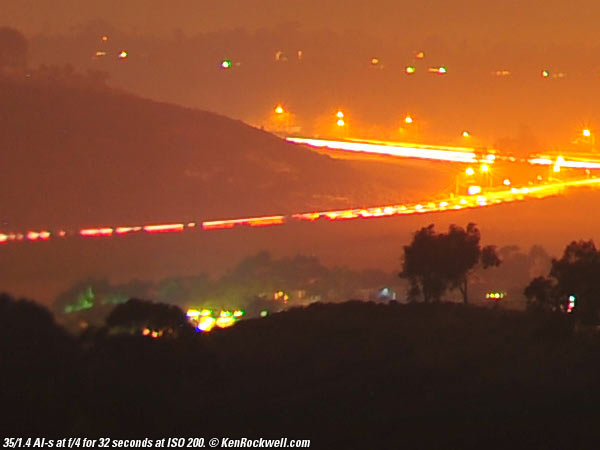
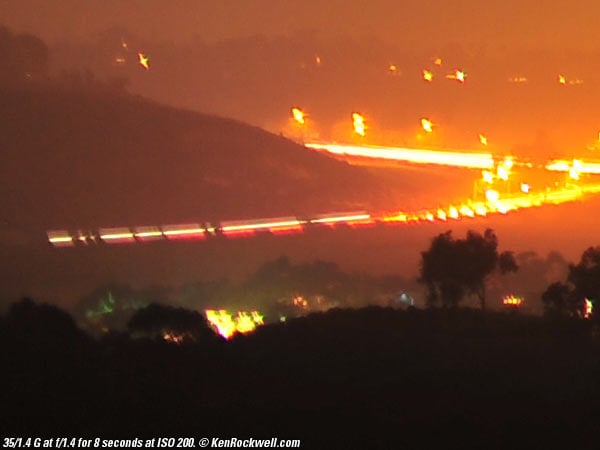
This 35/1.4 is loaded with coma. THe new 35/1.4 G is much, much better.
Coma (saggital coma flare) often causes weird smeared blobs to appear around bright points of light in the corners of fast or wide lenses at large apertures. In lenses that have it, coma goes away as stopped down.
Here is an overview of the entire 12MP FX D3 frame:
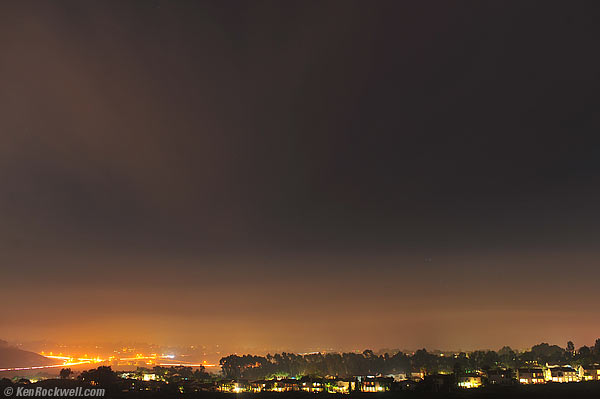
Guide image.
Here are crops from 100% images from the far lowest left corner:
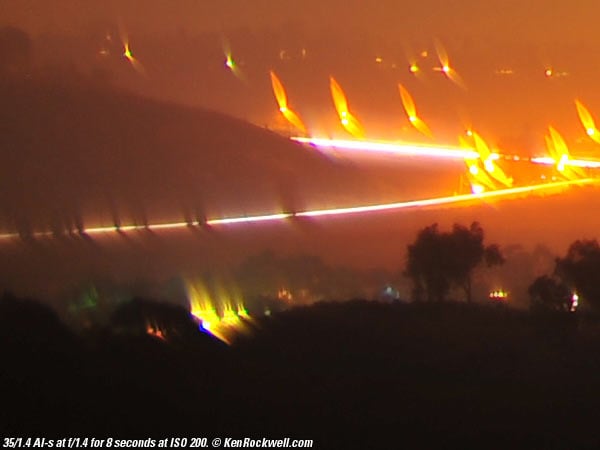
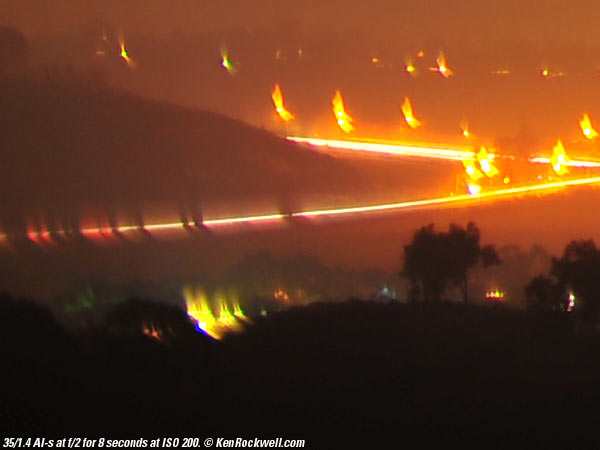
For comparison, here's the 35mm f/1.4 G AF-S at f/1.4:
Sharpness on the Nikon D3:
f/1.4
Low contrast everywhere due to the veiling effects of spherical aberration. Very blurry in corners with loads of coma. Sharp most places, just veiled.
f/2.0
Sharp and contrasty in center since spherical aberration is now gone. Gets softer toward sides. Corners still very soft and loaded with coma.
f/2.8
Sharp and contrasty throughout most of frame, with a softer band at about a 15mm radius. Far corners still blurry.
f/4
Very sharp almost everywhere. Slightly softer at r=15mm, far corners softer.
f/5.6
Sharp all over. Farthest corners just a little softer.
f/8
Excellent all over, optimum aperture overall.
f/11
Excellent all over, farthest corners optimum.
f/16
Slightly softer due to diffraction.
Lateral Color Fringes
None on the D3.
It has some lateral magenta/green secondary chromatic aberration on film.
Flare and Ghosts
It has next to no ghosts if you have your light source in the image.

Nikon 35mm f/1.4 AI-s. bigger.
Distortion
It has typical barrel distortion. At infinity on film or FX digital, use +1.5 in Photoshop CS2's lens distortion filter to rectify it at infinity. This isn't a fact or a specification, it's the result of my research that requires me to climb a bluff on a very clear day and shoot the ocean's horizon.
Falloff (darkened corners) performance top
Typical for its era, there is strong falloff wide open (f/1.4) on film and FX digital. The $1,800 35mm f/1.4 G AF-S is the same, so I guess Nikon accepts this.
It improves greatly at f/2, and is gone by f/2.8.
I've exaggerated this by shooting a gray field and placing these on a gray background.
Nikon 35mm f/1.4 AI-s falloff on FX and film at infinity, no correction.
© 2010 KenRockwell.com. All rights reserved.
|




Macro
It has close-range-correction (CRC) and focuses very close, to about a foot. Although you can get down to about a 5" x 7" subject, there is a good deal of barrel distortion.
Vibration Reduction
Handheld on an FA I get sharp results consistently at 1/15.
This lens has no internal optical stabilization, however it works with internal sensor-shift Image Stabilization (IS or VR (Vibration Reduction)) in some of Nikon's mirrorless Z cameras with the FTZ adapter.
"Percent Perfectly Sharp Shots" are the percentage of frames with 100% perfect tripod-equivalent sharpness I get when I'm shooting hand-held while free-standing with no support or bracing. This is a very strict test; in actual shooting at typical print sizes I get acceptable sharpness at much slower speeds, but for the purposes of seeing how much improvement an IS system gives, this is the most precise method.
Hand tremor is a random occurrence, so at marginal speeds some frames will be perfectly sharp while others will be in various stages of blur — all at the same shutter speed. This rates what percentage of shots are perfectly sharp, not how sharp are all the frames:
| % Perfectly Sharp Shots on Z9 on FTZ | 1 |
1/2 |
1/4 |
1/8 |
1/15 |
1/30 |
1/60 |
1/125 |
1/250 |
| Stabilization ON | 0 |
0 |
50 |
100 |
100 |
100 |
100 |
100 |
100 |
| Stabilization OFF | 0 |
0 |
0 |
17 |
0 |
17 |
67 |
100 |
100 |
I see about a four stop real-world improvement.
Performance on Fuji Velvia film:
f/1.4
Lots of light falloff. Lots of coma in corners and spherical aberration in center give low contrast all over. Resolution is good.
f/2.0
Falloff. Coma. Getting sharp.
f/2.8
Vvery sharp, no more falloff.
Odd loss of definition in 9-11 o'clock sector 15mm out
f/4.0
Very sharp.
Odd loss of definition in 9-11 O'clock sector 15mm out
f/5.6
great.
f/8
great
f/11
great
f/16
Swell. Random underexposure with FA in aperture-priority (A) mode. Press the depth-of-field preview button and hold it while you make the exposure to cure this, with the FA.
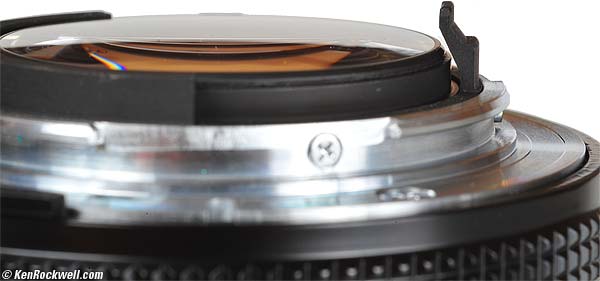
Nikon 35mm f/1.4. Note delicate rear element protector pin. bigger.
Recommendations top
Intro Specifications Performance Recommendations
I'd get my 35mm f/1.4 AI-s used at eBay (How to Win at eBay) or used at Amazon.
Try not to use this lens at f/1.4 where the image quality is relatively poor. It has low contrast due to various kinds of spherical aberration and a lot of light falloff. It also has a lot of coma, so points of light at the sides will instead look like little batwings.
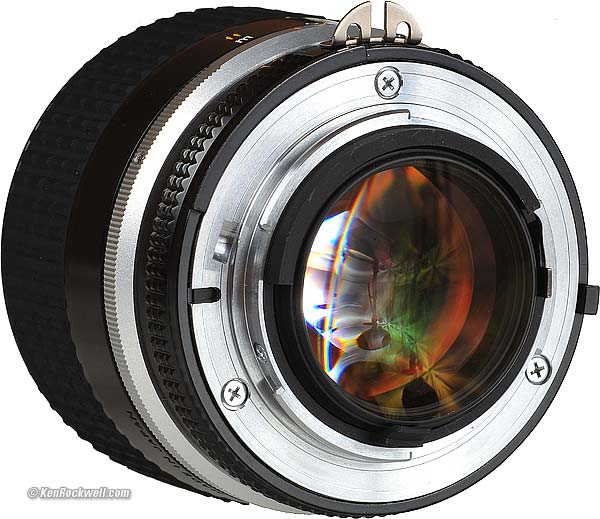
What a lot of light falloff at f/1.4 means is that even though it's f/1.4 in a center hotspot of the image, at the sides you really are only getting the light equivalent to f/2 or f/2.8.
Use this lens is if you typically shoot at about f/2.8, at which aperture it performs better than most other lenses.
If you shoot at smaller apertures you don't need this expensive f/1.4 lens.
If you really shoot at larger apertures (as I do) you'll prefer the very, very expensive 28mm f/1.4D AF.
Generally the much more recently designed and far less expensive 35mm f/2.0D AF lens gives better performance at every aperture, although the 35/2 AF gets softer when you are too close. The 35/2 AF also focuses much closer.
If you are fixated on the f/1.4 aperture, remember that due to the huge light falloff that you really are only getting f/1.4 in a hotspot in the center of the image, and that at f/2 both the 35/2 AF lens and the 35/1.4 are giving the same image quality.
I think that this fine lens' time has passed.
I saw lower sharpness 15mm from the center of the image at f/2.8 in two different samples of lens in two different media, telling me that this is inherent in the design of the 35mm f/1.4. I saw it with this lens pictured here on my D3, and I saw it with the first sample I owned back in the 1990s on film.
© Ken Rockwell. All rights reserved. Tous droits réservés. Alle Rechte vorbehalten. Ken Rockwell® is a registered trademark.
Help Me Help You top
I support my growing family through this website, as crazy as it might seem.
The biggest help is when you use any of these links when you get anything. It costs you nothing, and is this site's, and thus my family's, biggest source of support. These places always have the best prices and service, which is why I've used them since before this website existed. I recommend them all personally.
If you find this page as helpful as a book you might have had to buy or a workshop you may have had to take, feel free to help me continue helping everyone.
If you've gotten your gear through one of my links or helped otherwise, you're family. It's great people like you who allow me to keep adding to this site full-time. Thanks!
If you haven't helped yet, please do, and consider helping me with a gift of $5.00.
As this page is copyrighted and formally registered, it is unlawful to make copies, especially in the form of printouts for personal use. If you wish to make a printout for personal use, you are granted one-time permission only if you PayPal me $5.00 per printout or part thereof. Thank you!
Thanks for reading!
Ken.