Home Donate New Search Gallery Reviews How-To Books Links Workshops About Contact
Nikon
135mm f/3.5
NIKKOR AI and AI-s (1977-1986)
© 2011 KenRockwell.com
Intro Specifications Performance Recommendations

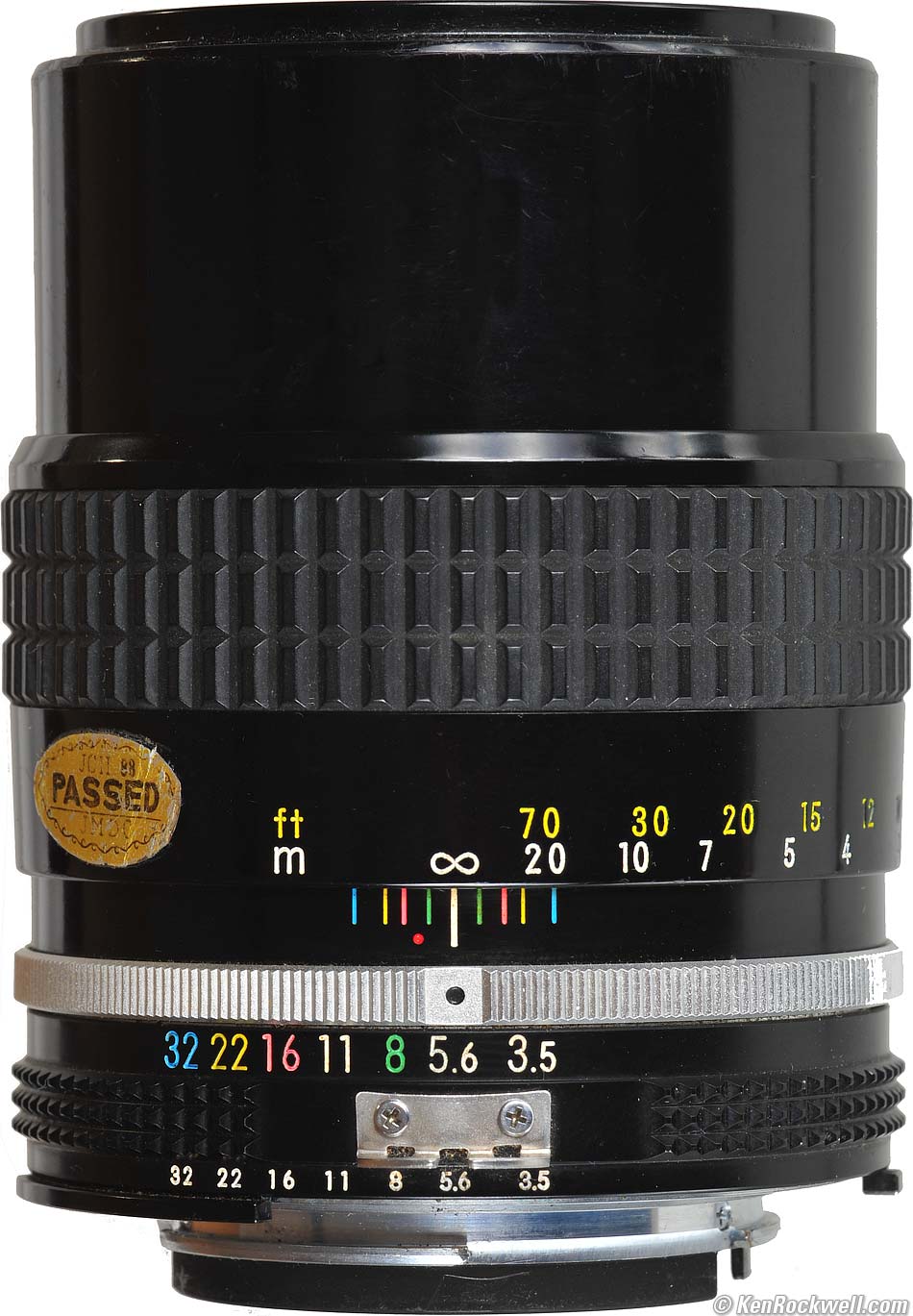
Nikon Nikkor 135mm f/3.5 AI.(52mm filters, 14.4 oz. /409 g, 4.5'/1.3m close focus, about $75 used.) enlarge. This free website's biggest source of support is when you use any of these links, especially this direct link to this lens at eBay (see How to Win at eBay), or used at Adorama, when you get anything, regardless of the country in which you live. Thanks! Ken.
August 2011, January 2008 Nikon Reviews Nikon Lenses All Reviews
See also:
Introduction top
Intro Specifications Performance Recommendations
|



This was Nikon's cheapest telephoto lens for many years. It is the discount alternative to the 135mm f/2.8 AI-s and exotic 135mm f/2. This 135mm f/3.5 may be inexpensive, but it's still built for decades of continuous 24/7 professional use, unlike the dinkier 135mm f/2.8 Series E.
The Nikon 135mm f/3.5 has extremely high image quality and works wonderfully on the Nikon D3.
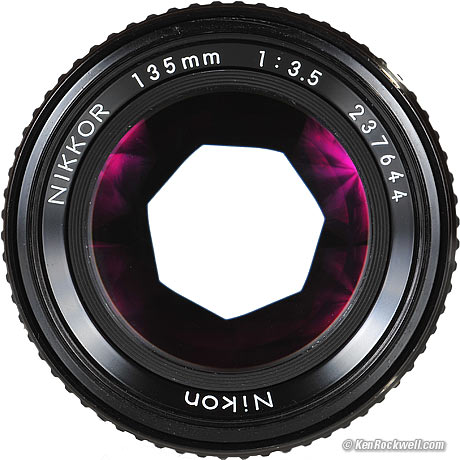
Nikon 135mm f/3.5 AI at f/5.6.
Compatibility
The manual-focus lens works great with most Nikon cameras, 35mm and digital.
It works flawlessly with every manual focus Nikon ever made, from the F of 1959 through the FM3a and today's FM-10.
On the D3X, D3s, D3, D7000, D700, D300, D200, D2 and F6, use the "Non-CPU Lens Data" menu option to set 135mm and f/3.5 to get full color matrix metering, EXIF data and finder read-out of set aperture. It works great in aperture-preferred as well as manual modes on these cameras.
It works perfectly on every professional 35mm camera (F, F2, F3, F4, F5, F6), and adds Matrix metering on the FA, F4 and F6.
The meters of cheaper digital (D90, D5000 and below) and cheaper film cameras (N80 and below) will not couple (or work at all) with this lens, so you'll be on your own guessing exposure using the rear LCD or an external meter, or get a tiny Gossen Digisix meter and hotshoe adapter to meter manually.
See Nikon Lens Compatibility for details on your camera. Read down the "AI, AI-s" column for this lens.
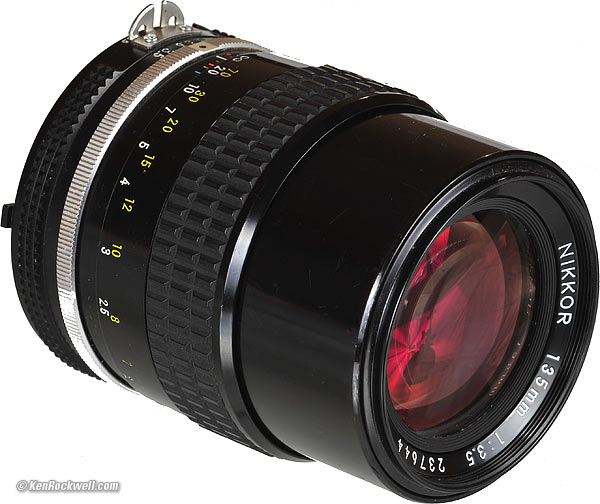
Nikon 135mm f/3.5 AI.
Production History
1950-1963
Nikon has been making 135mm f/3.5 lenses since 1950 for cameras like the Nikon SP; longer than Nikon has been making SLRs.
The rangefinder lens had 4 elements in three groups.
1959-1969
The first SLR 135mm f/3.5 came out with the Nikon F in 1959.
It also was a 4 element, 3 group design.
1969-1979
Another 4 element, 3 group design came out in 1969 and was made through 1977.
1977-1986
The newest multicoated, 4 element, 4 group design (as seen in this lens) was made from 1977 and was available new until about 1986.
There have been numerous mechanical variations. The AI version seen here was made from 1977 through 1981. The newer, but optically identical, AI-s version replaced it in 1981.
In June 1986 at bottom NYC discount prices, the f/3.5 AI-s version sold new for only $70, while the 135mm f/2.8 AI-s sold for $170 and the 135mm f/2 AI-s sold for $410. General consumer-price inflation, excluding the huge increase in the value of the Yen versus the US Dollar, these prices would be double today in 2011.
Nikon has made about 400,000 F-mount 135mm f/3.5 lenses. Of these, 100,000 were AI like this one, and 20,000 were AI-s.
Specifications top
Intro Specifications Performance Recommendations
Name
Nikon calls this the Nikon Nikkor 135mm f/3.5 AI.
Focal Length
135mm. Used on a DX camera it gives angles of view similar to what a 206mm lens would give on an FX or 35mm film camera. See also Crop Factor.
Optics
4 elements in 4 groups.
Multicoated.
Traditional spherical design.
Diaphragm
Classic Nikon 7 blades.
Stops down to f/32.
Close Focus
4.5 feet (1.3m).
Maximum Reproduction Ratio
1:7.5.
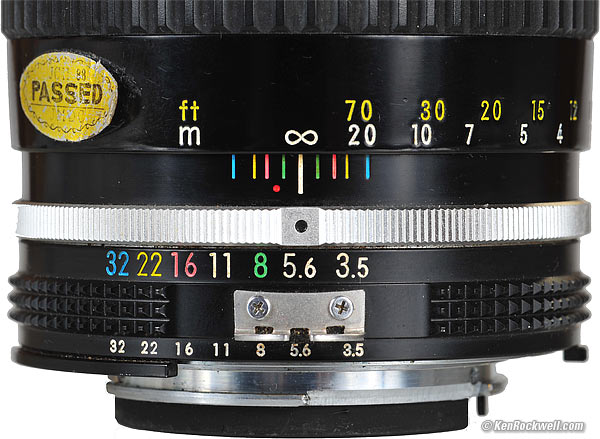
Nikon 135mm f/3.5 AI focus panel.
Depth-of Field Scale?
Yes.
Infra-Red Focus Index?
Yes.
Filter Thread:
52mm, Nikon's standard since 1959.
Size:
3.211" extension from flange (focused at infinity) x 2.530" diameter (81.56 x 64.26 mm), measured.
The widest thing is the focus ring rubber.
Weight
14.435 oz. (409.25 g), measured, including JCII sticker.
Hood
Built-in telescoping.
No lock, often gets pushed back in use.
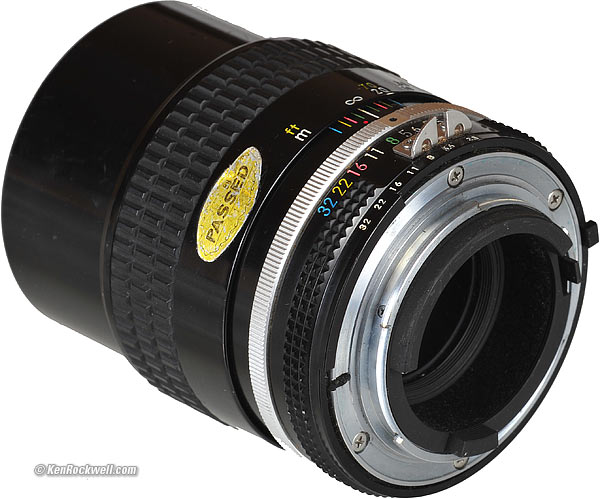
Nikon 135mm f/3.5 AI.
Performance top
Intro Specifications Performance Recommendations
The Nikon 135mm f/3.5 AI works great. Optically, it puts many more expensive lenses to shame.
This is because its a simple lens with an easy job to do. It doesn't have to zoom or autofocus or be fast or have a long or short focal length or have VR. All it has to do is focus light. Its optics aren't subject to any mechanical play: they are bolted together in solid metal forever, unlike zooms.
Therefore the 135mm f/3.5 is extremely sharp and has no visible distortion.
Bokeh
Bokeh is only fair. The backgrounds, even though well out-of focus, still retain some bothersome detail.
Want great bokeh? Get the extraordinary 135mm f/2 DC.
Distortion
Distortion is invisible, unless you shoot a D3, blow it up to 200% and drop a ruler on it in Photoshop.
If you need to split pixels, plug these figures into Photoshop CS2's lens distortion filter to correct the distortion. These aren't facts or specifications, they are the results of my research that requires me waiting for an extraordinarily clear day at the beach and then hours of data collection and computation.
FX and Film |
||
Infinity |
-0.2 |
-0.05 |
© 2008 KenRockwell.com
Mechanics and Construction
The 135mm f/3.5 AI is made like they used to. It is built to the highest mechanical standard I have ever experienced.
Filter Threads
Metal.
Retraceable Hood
Metal, internally flocked.
Barrel
Metal.
Focus Ring
Metal, rubber covered.
Aperture Ring
Metal.
Finish
Black enamel over black anodize.
Mount
Chromed brass.
Internals
Metal.
Markings
All engraved and filled.
Noises when Shaken
Clicking from the diaphragm blades.
Sharpness
Sharpness is excellent.
Sharpness on the D3 full-frame camera:
The Nikon 135mm f/3.5 is sharp and contrasty at every aperture, edge-to-edge on the D3. Who hoo! It seems to have a tiny bit less resolution at f/3.5, but not enough to notice in anything but side-to-side 100% comparisons of test subjects at infinity.
Sharpness on the D200 camera:
The Nikon 135mm f/3.5 is a tiny bit less sharp and contrasty at f/3.5, and perfect from f/5.6. I'd never notice this except in side-to-side 100% comparisons of test subjects at infinity.
Sharpness on the D300 camera:
The D300 is tough on lenses because of it's very high linear resolution. Even with this, the 135mm f/3.5 looks great. It's a tiny bit softer at 3.5, and excellent by f/5.6. Even at f/3.5, it's much better than many other lenses.
Recommendations top
Intro Specifications Performance Recommendations
Want a super-sharp, compact, inexpensive lens to run your D3 to its technical limits? Get one of these.
The 135mm f/2.8 AI-s is faster and not much bigger, but from very preliminary tests I don't think it was quite as good at the largest apertures.
I'll be doing head-to-head comparisons one of these days of the f/3.5. f/2.8, and f/2 AI-s and f/2 DC 135mm lenses.
Help me help you top
I support my growing family through this website, as crazy as it might seem.
The biggest help is when you use any of these links to Adorama, Amazon, eBay, B&H, Ritz, Calumet, J&R and ScanCafe when you get anything, regardless of the country in which you live. It costs you nothing, and is this site's, and thus my family's, biggest source of support. These places have the best prices and service, which is why I've used them since before this website existed. I recommend them all personally.
If you find this page as helpful as a book you might have had to buy or a workshop you may have had to take, feel free to help me continue helping everyone.
If you've gotten your gear through one of my links or helped otherwise, you're family. It's great people like you who allow me to keep adding to this site full-time. Thanks!
If you haven't helped yet, please do, and consider helping me with a gift of $5.00.
As this page is copyrighted and formally registered, it is unlawful to make copies, especially in the form of printouts for personal use. If you wish to make a printout for personal use, you are granted one-time permission only if you PayPal me $5.00 per printout or part thereof. Thank you!
Thanks for reading!
Mr. & Mrs. Ken Rockwell, Ryan and Katie.
Home Donate New Search Gallery Reviews How-To Books Links Workshops About Contact