Home Donate New Search Gallery How-To Books Links Workshops About Contact
Nikon
28-105mm f/3.5-4.5
AF-D NIKKOR (1998-2006)
©
2010 KenRockwell.com
Intro Specifications Performance Recommendations

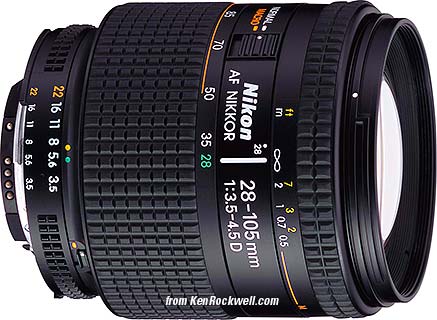
Nikon 28-105mm f/3.5-4.5 AF-D. (62mm filters, 15.9 oz./450g, about $175 used). This free website's biggest source of support is when you use these links, especially these directly to it at eBay (see How to Win at eBay), at Amazon and at Adorama, when you get anything, regardless of the country in which you live. Thank you! Ken.
September 2010 More Nikon Reviews
Good
Sharp.
9-bladed diaphragm.
Great Macro ability.
Very low distortion.
Bad
Need to move a switch to go between macro and regular modes, but even the regular mode gets very close.
Need to move a switch on the camera to get between auto and manual focus modes.
Introduction top
Intro Specifications Performance Recommendations
I personally buy from Adorama, Amazon, Ritz, B&H, Calumet and J&R. I can't vouch for ads below.
|



This 28-105mm lens is a very flexible and high-quality lens for use on any FX or 35mm camera.
It was introduced in 1999 as an upgrade over the also excellent Nikon 28-70mm f/3.5-4.5 AF-D often kitted new Nikon F100.
At about $175 used in 2010, this 28-105mm is a steal for a first-quality, super-tight macro, low-distortion, general-purpose FX zoom.
Compatibility
This is an FX lens, and works especially well with on FX, film and DX Nikons like the D700, D3X, D300s and F6. It works fine on manual-focus cameras like the F2AS, F3, FE and FA, since it has manual-focus and aperture rings.
The 28-105mm AF-D works great with almost every film and digital Nikon camera made since 1977. If you have a coupling prong added to the diaphragm ring, it's perfect with every Nikon back to the original Nikon F of 1959.
The only incompatibility is that it will not autofocus with the cheapest D40, D40x, D60, D3000, D3100 or D5000, but if you focus manually, everything else works great. These cameras have in-finder focus confirmation dots to help you.
See Nikon Lens Compatibility for details on your camera. Read down the "AF, AF-D (screw)" column for this lens.
Specifications top
Intro Specifications Performance Recommendations
Optics
16 elements in 12 groups.
One is a hybrid aspherical element: an aspherical piece of plastic glued to one of the glass elements.
Diaphragm
9-bladed diaphragm.
(The user's manual incorrectly says 8 blades.)
Close Focus
1.7 feet (0.5m) at all focal lengths.
By moving a mechanical switch, will allow focusing as close as 0.7 feet (0.22m), at focal lengths between 50mm and 105mm.
Maximum Reproduction Ratio
1:5.2, normal mode at 105mm and 1.7 feet (0.5m).
1:2 in macro mode at 105mm.
1:2.74 in macro mode at 50mm.
Macro mode 0.7 feet / 0.22m. In Macro mode, internal focusing changes the focal length slightly to get the crazy close-focus capabilities.
Filter Threads
62mm, plastic.
Rotates with zoom, but not with focus.
Case
CL-49 hard case, optional.
Pouch 62, optional.
Hood
HB-18 plastic bayonet, optional.
Size
2.9" (73mm) around by 3.2" (82mm) long, specified.
Weight
17 oz. (480g) and 16 oz. (455g), specified.
Hood: HB-18 bayonet, optional.
15.855 oz. (449.5g), serie 3222 from about 2002, measured.
The one I bought and returned in 1999 measured 16 oz. (455g).
Teleconverters
TC-200, TC-201 and TC-14A on manual-focus cameras.
Don't bother with AF or digital cameras; you'll loose autofocus.
Price
$285 new in 1999 (that's $375 corrected for inflation in 2010).
$150 used in 2010.
Performance top
Intro Specifications Performance Recommendations
Autofocus
The AF action is relatively slow because there is a lot of reduction in the mechanical gear drive. One full turn of the AF screw focuses the lens from infinity to 8 feet.
Manual focus is fast, but not precise, because only a small turn of the focus ring results in a large change in focus.
Distortion
Distortion is much better than most zoom lenses. It is invisible at all but the 28mm setting at infinity.
This lens has among the lowest levels of distortion I've seen in a mid-focal-length-range zoom lens.
This can be corrected for critical use by plugging these figures into Photoshop's lens distortion filter. These aren't facts or specifications, they are the results of my research that requires hours of photography and calculations on the resulting data.
FX at 3m (10') |
FX at ∞ |
|
28mm |
+1.2* |
+2.2* |
35mm |
0.0* |
+0.2* |
50mm |
-0.7* |
-0.4 |
70mm |
-1.0 |
-0.5 |
85mm |
-1.0 |
-0.5 |
105mm |
-1.0 |
-0.5 |
© 2010 KenRockwell.com. All rights reserved.
* Some waviness remains
Falloff (darkened corners) performance top
Falloff on FX is minimal. it's invisible except at f/3.5 at 28mm, and even then, usually invisible if you've got vignette correction turned ON.
It will be even less of an issue on DX (see crop factor).
I've exaggerated this by shooting a gray field and placing these on a gray background.
Nikon 28-105mm falloff on FX and film at infinity, no correction.
© 2010 KenRockwell.com. All rights reserved.
|


















Ghosts
It has reasonably good resistance to ghosting when pointed into the sun. That's good. It's better than the old 28-85/3.5-4.5AF.
Macro
The 28-105 gets to 1:2, which is the same as all of Nikon's 55mm, 105mm and 200mm manual-focus micro lenses. That's awesome!
At 2 feet there is obvious barrel distortion at 28mm, and no distortion at 50mm and 105mm. The corners are soft at 105mm at 2 feet.
Closer than 2 feet in the macro mode there was no distortion, however it was soft in the corners even stopped down.
The macro mode switch is a pain. You have to preset the lens to between 50mm and 105mm in order to move the switch in to macro mode. You have to move the switch out of macro mode to get to shorter focal lengths than 50mm, but you can't do that until you have prefocused the lens to beyond 2 feet.
In other words, the close-up ability is handy, but no replacement for a real macro lens. In fact, its softness would be obvious even in 1-hour lab prints back in 1999, but the version I borrowed in 2010 seems just fine, at least stopped-down to f/22 for use under studio strobes.
Maximum Aperture |
|
28mm |
f/3.5 |
35mm |
f/3.8 |
50mm |
f/4 |
70mm |
f/4.5 |
85mm |
f/4.5 |
105mm |
f/4.5 |
Mechanics
Plastic hood mount and filter ring.
Plastic on the outside.
Metal inner forebarrel.
Plastic zoom ring.
Plastic rear barrel.
Painted markings.
Seems like plastic and metal inside; a good compromise for low weight, moderate cost and decent durability.
Sharpness
2010, on a 12MP FX D3
It's sharp at all settings, except soft on the sides at larger apertures at 105mm.
1999, on an F100 on Velvia
It is a little soft in the corners at 105mm wide open, and soft all over at 28mm wide open on my F100 when autofocus due to AF system errors.
Zooming
The zoom ring is congested at the wide end and unresponsive at the long end. It doesn't give equal percentage change in image size per unit of rotation, unfortunately it's incorrectly designed to give relatively uniform change in millimeters per unit rotation.
EXIF Coding
The millimeters agreed exactly to what was read on the lens' zoom ring.
Recommendations top
Intro Specifications Performance Recommendations
I wasn't that impressed with the sample I got in 1999 for use on an F100, but in 2010, the sample that came to me from Dick in Rancho Mirage is just fine. It's sharp, has very little distortion, and covers a very handy focal length and macro-focus range.
The focus errors I saw in 1999 were important to picky people like myself who need to shoot at full aperture with 50-speed film. Most people would never even see the defect I saw, other samples of this lens will differ, and if you see it, Nikon's FX camera allow precise AF offset user adjustment anyway.
Today, this is a great, solid lens for use on any FX or 35mm camera.
I wouldn't bother with it on DX; on DX, I'd use a DX kit lens instead.
Help me help you top
I support my growing family through this website, as crazy as it might seem.
If you find this as helpful as a book you might have had to buy or a workshop you may have had to take, feel free to help me continue helping everyone.
If you've gotten your gear through one of my links or helped otherwise, you're family. It's great people like you who allow me to keep adding to this site full-time. Thanks!
If you haven't helped yet, please do, and consider helping me with a gift of $5.00.
The biggest help is when you use any of these links when you get anything. It costs you nothing, and is this site's, and thus my family's, biggest source of support. These places always have the best prices and service, which is why I've used them since before this website existed. I recommend them all personally.
Thanks for reading!
Ken
Home Donate New Search Gallery How-To Books Links Workshops About Contact