Home Donate New Search Gallery Reviews How-To Books Links Workshops About Contact
Canon 50mm f/1.2 L
(Continued from first page)
© 2015
KenRockwell.com. All rights reserved.
Intro Specs Performance Compared Recommendations

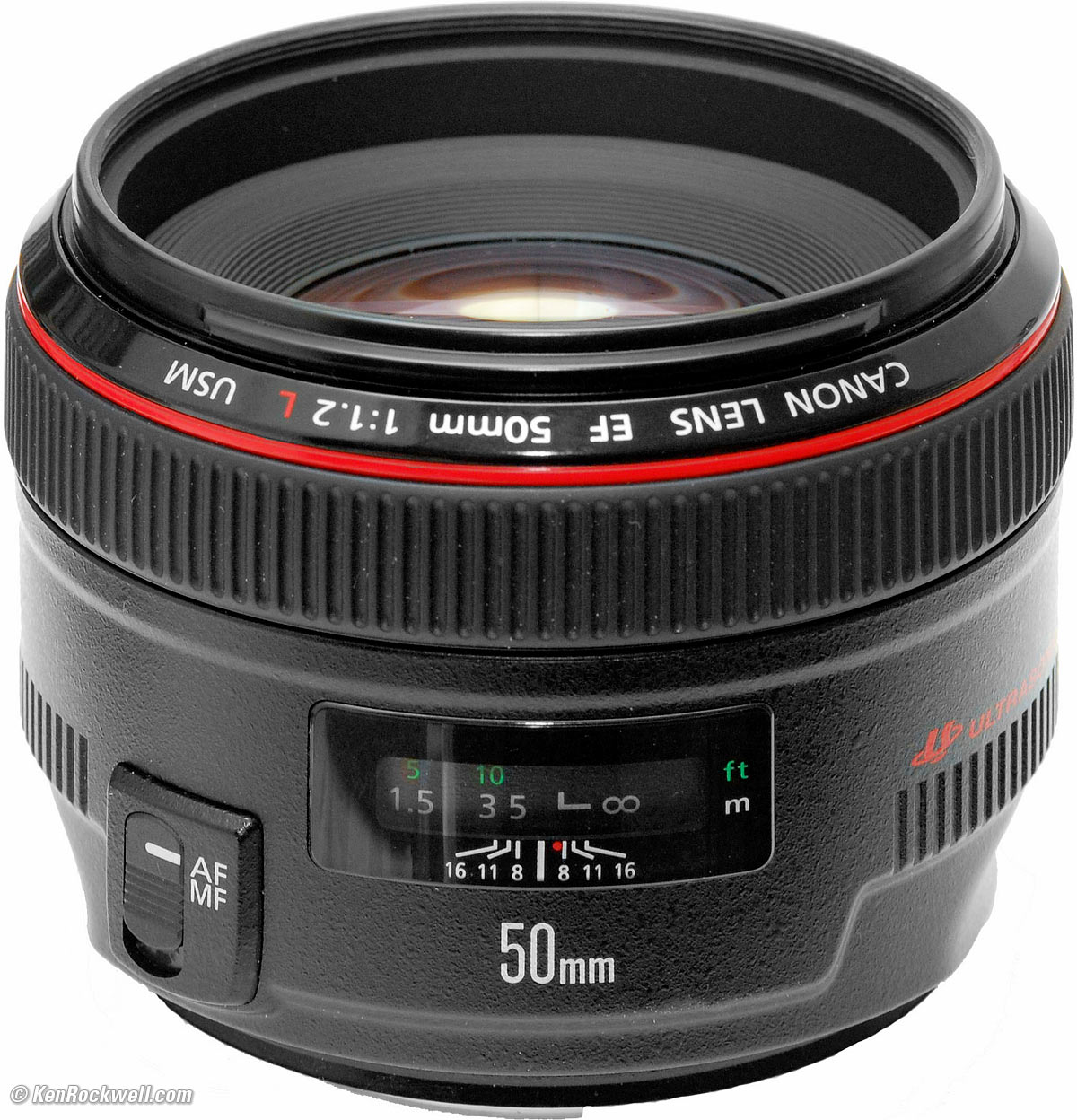
Canon EF 50mm f/1.2L (full-frame and APS-C coverage, 72mm filters, 20.9 oz./592g, 1.5'/0.45m close-focus, about $1,600). bigger.
< < Back to first page of review
Color Rendition performance top
I see no differences from my other Canon lenses.
Construction Quality performance top
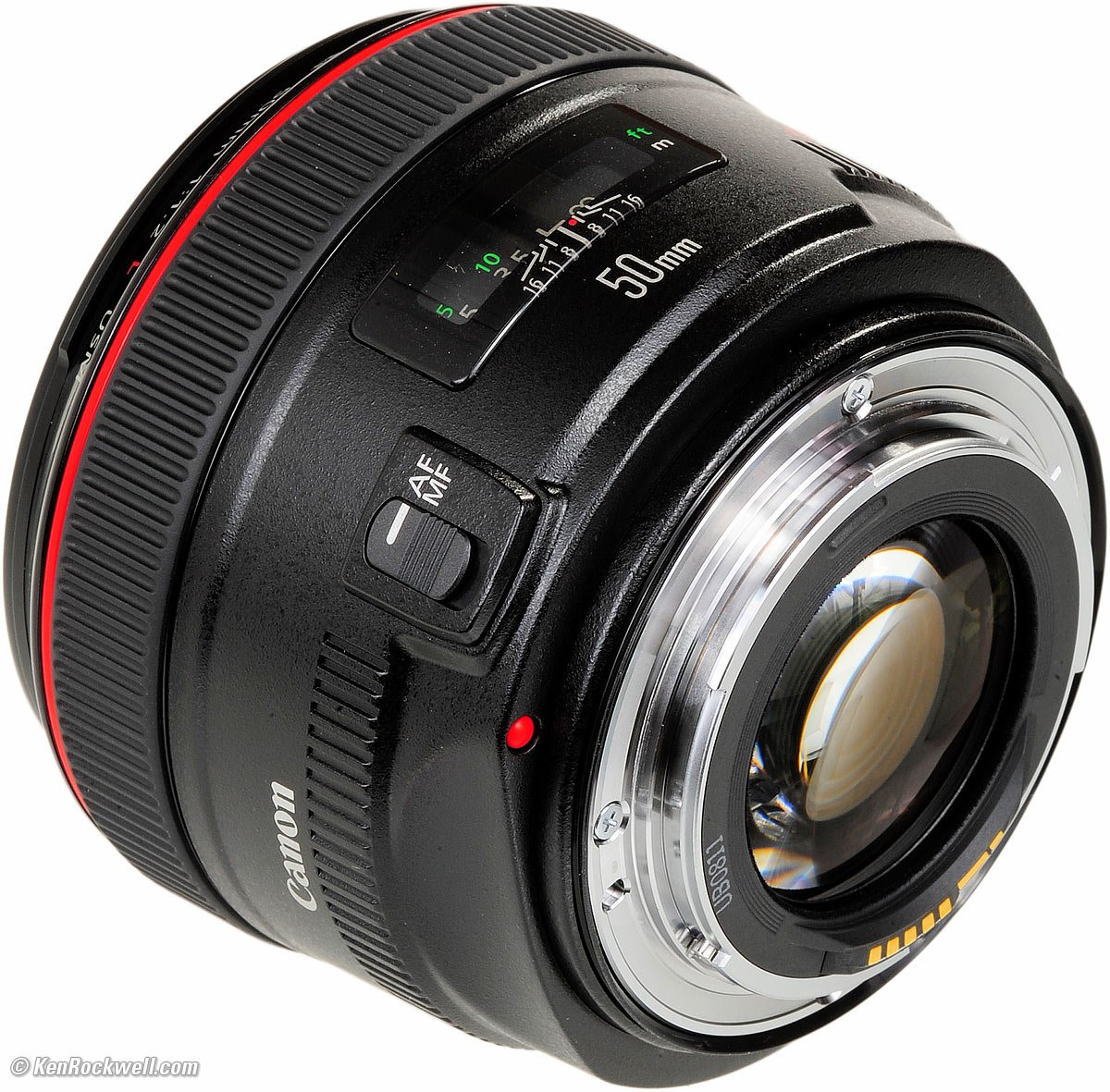
Rear, Canon EF 50mm f/1.2 L. bigger.
It has a rubber gasket on the lens mount to help keep crud out of your camera.
Filter Threads
Plastic.
Hood Mount
Plastic.
Focus Ring
Plastic, rubber covered.
Markings
Silver paint.
Switches
Plastic.
Mount
Metal.
Internals
Seems like plastic and metal.
Noises when shaken
Plenty of klunking. This is normal.
Made in
Lens Made in Japan.
Hood Made in Japan.
Case Made in China.
Distortion performance top
Distortion is typical, to a little bit better than normal, for an ultra-speed lens.
It's trivial to correct in Photoshop if it bothers you.
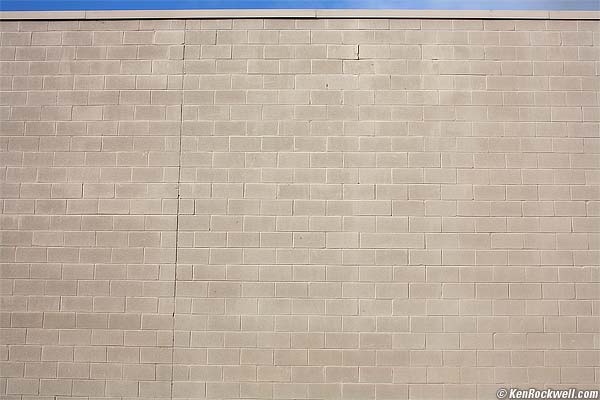
Wall of Shame. Roll mouse over to see correction in Photoshop CS2's lens distortion filter.
Plug +1.4 into Photoshop CS2's lens distortion filter to correct the distortion. It takes me hours to calculate this stuff and its all © and registered, so you'll need permission to use these figures for anything else. Thanks! Ken.
Ergonomics performance top
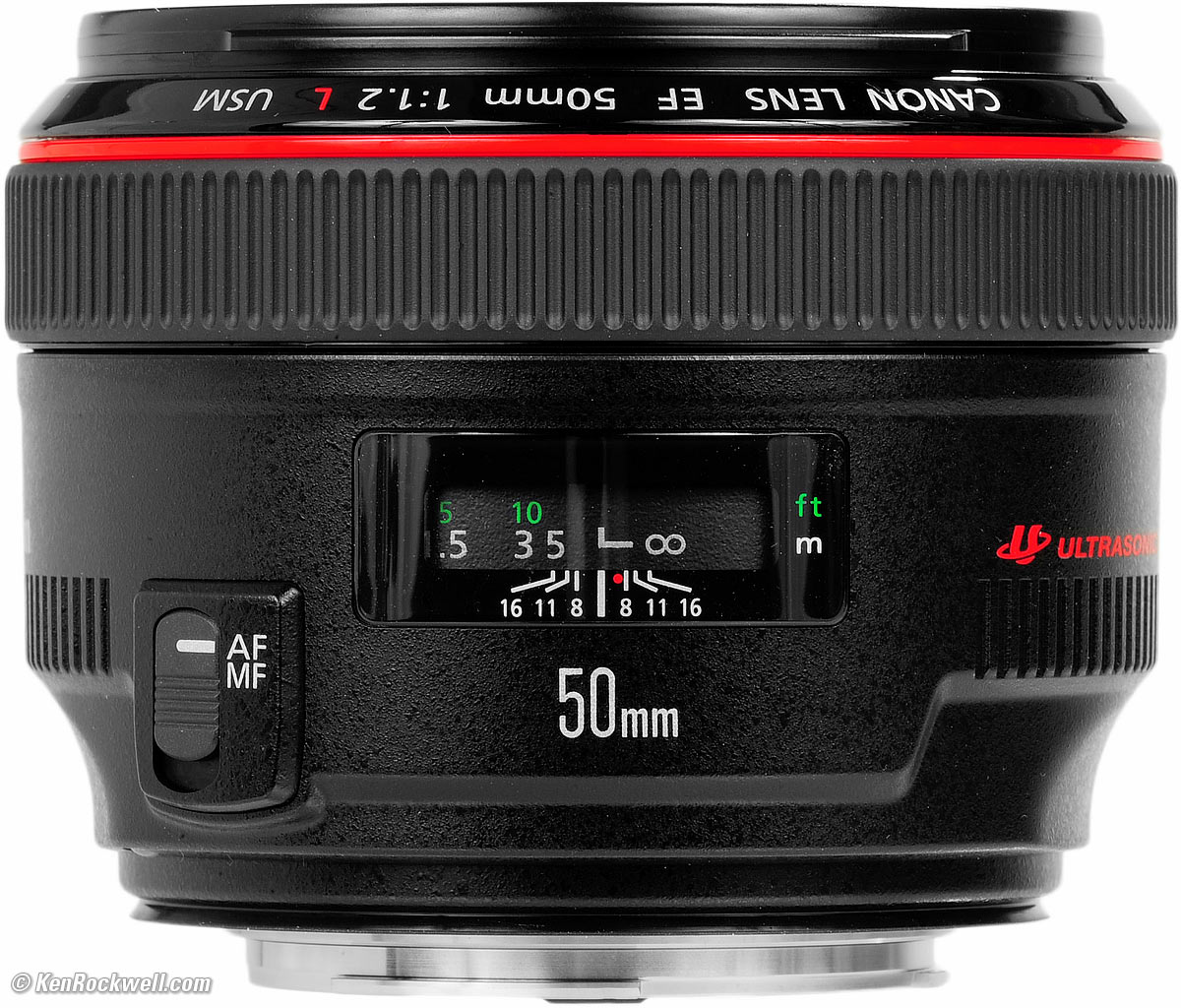
Canon 50 1.2. bigger.
It handles well. Controls and manual focus are fine. It feels good and solid, and not nose-heavy beast like the 50/1.0 L.
Manual focus is reasonably firm and very damped as the other good USM lenses. You can't flick it around as you could with Nikon's AI-s manual focus lenses from the 1970s and 1980s.
Oddly it feels very good on an XTi, since you hold the lens and the body is only along for the ride. It's a solid little package.
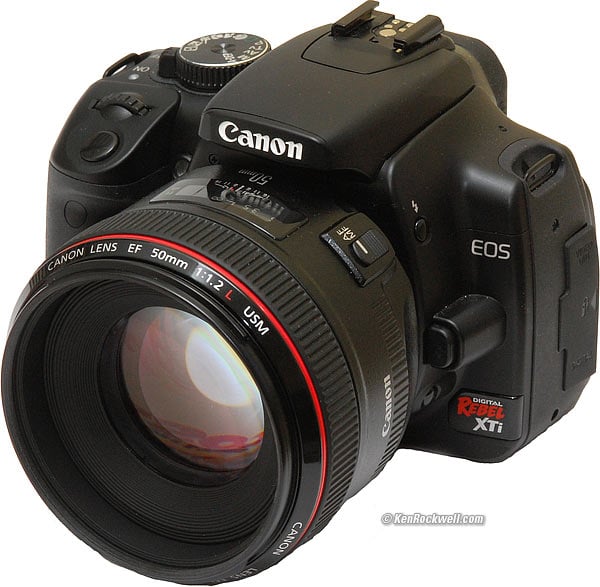
Canon 50mm f/1.2L on a black Canon Rebel XTi.
Falloff (Darkened Corners) performance top
For portraits and many other subjects, falloff makes a better picture by concentrating the viewer's attention on the subject and away from the corners. I like the falloff in the f/1.2 gazebo shot above.
For photos of blank sky or brick walls it's bad, but Canon's newer DSLRs all have profiles to correct it, so who cares?
At f/1.2 on a full frame camera it's got a lot of falloff.
Shooting flat fields and laying them on another flat field is a tough test which exaggerates even the slightest falloff. You'll never see it this bad in normal photography.
Canon 50mm f/1.2 L falloff on full frame at infinity, no correction.
© 2013 KenRockwell.com. All rights reserved.
Canon 50mm f/1.2 L falloff on APS-C at infinity, no correction.
© 2013 KenRockwell.com. All rights reserved.
|








35mm EOS Cameras, use with performance top
Perfect; the Canon 50mm f/1.2L is designed for them, too.
Filters, use with performance top
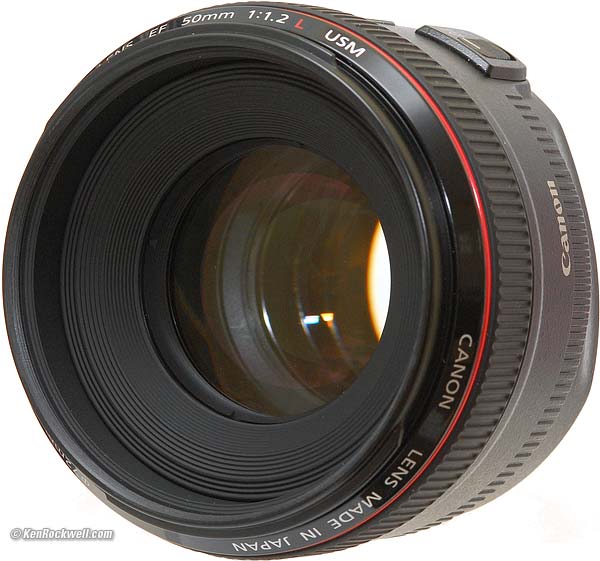
Canon EF 50mm f/1.2L
Easy! The 72mm thread is much bigger than the lens' glass.
Throw any thick filter or combination of stacked filters you want on it — it's not going to vignette.
Flare and Ghosts performance top
It's great. You'll go blind trying to get it to ghost or flare.
You'll notice in the examples below that the sky is completely washed out — it's much brighter than it appears and this lens is doing a great job.
This Canon 50mm f/1.2L is is better than the 85mm f/1.2L II, which isn't bad either, and much better than the 50/1.0 L.
I see no difference with or without a Hoya HMC multicoated filter.
These examples are with a very bright sun - it isn't sunset yet!
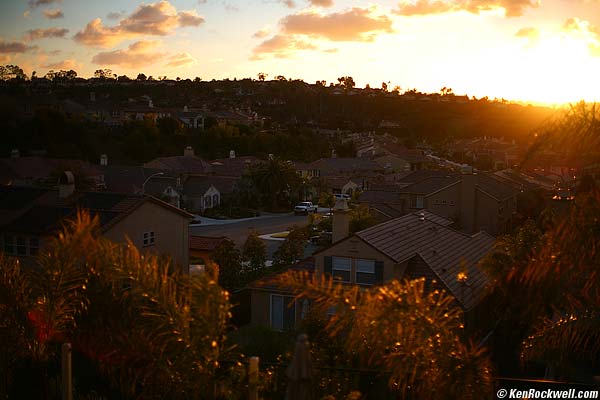
Ghosts at f/1.2: a slight blob in the lower left.
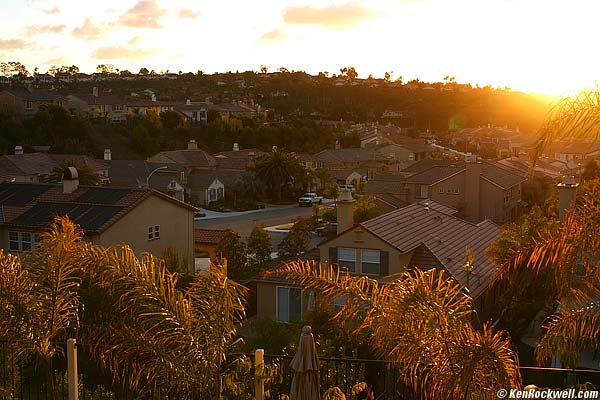
Ghosts at f/5.6: a slight green ghost just inside of the the sun radially.

Flare blob with filter in lower left at f/13, 17 January 2015. bigger.
Built-in Flash, use with performance top
Built-in flashes are often so close to the camera that wide lenses can see far enough down to see their shadow cast by a built-in flash.
No problems with this lens, even at 1.5 feet (0.45m) with my XTi.
Macro performance top
Close focus distance is typical for a fixed 50mm lens. No news here. This example is from my 1.6x Rebel XTi. It will be a much looser composition on a 1.3x or full-frame camera.
The optics are great at close focus distances.
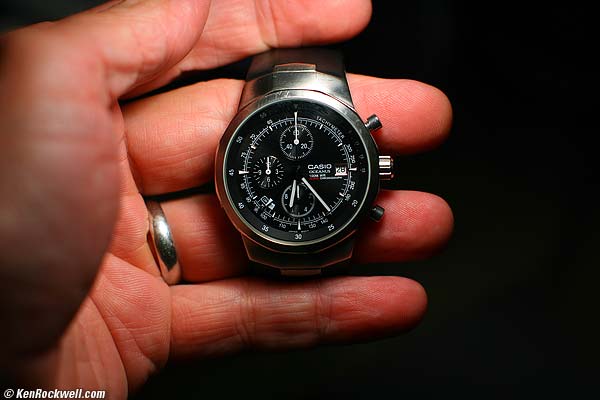
At closest focus at f/2.8, full image from 1.6x Rebel XTi.
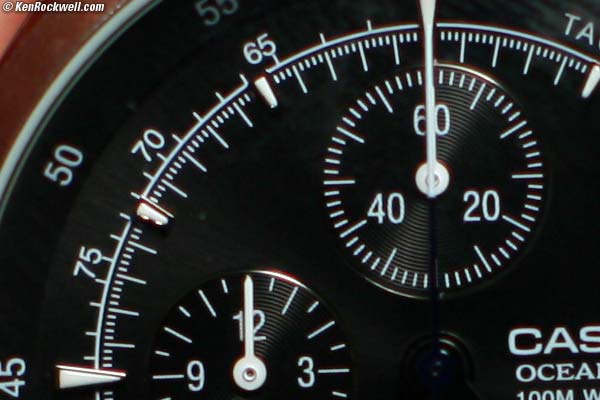
Unsharpened crop from above image at 100%, no extra sharpening.
If you print the entire image at the same 100% magnification as the crop above, you'll have a 38" (1m) wide print!
Program Exposure Mode performance top
Every camera chooses its favorite combinations of apertures and shutter speeds. These may or may not be your favorites. Canon bugs me because even though every modern SLR lets you shift these preferences, Canons revert to their own preferences every time the meter turns itself off. Nikons stay where you put them unless you turn off the camera yourself.
My 5D and XTi choose:
f/1.4 @ 1/60
f/2 @ 1/125
f/2.8 @ 1/250
f/4 @ 1/500
f/5.6 @ 1/1,000.
Serial Number performance top
The serial number is engraved in the lens mount and filled with black paint. You have to remove the lens from a body or remove the rear cap to see it.
Sharpness performance top
This lens is very sharp. This Canon 50mm f/1.2L is the sharpest high-speed 50mm I've ever used; it's just as sharp as slow 50mm lenses, which are the sharpest lenses there are.
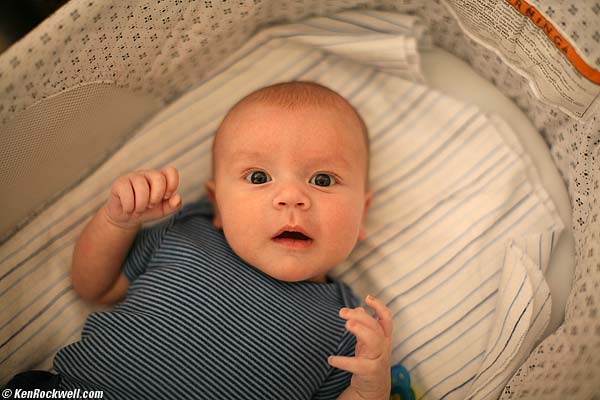
Who cares about sharpness?
This is how much isolation (shallow depth-of-field) you get at f/1.4 on a 5D, one of the main reasons people shoot fast lenses.
No real photographer buys an f/1.2 lens for shooting subjects that care about sharpness. You buy it to throw almost everything out of focus, or to shoot in crappy available darkness where you're happy to see anything at all.
These strong caveats aside, this Canon 50mm f/1.2L is so good that it's as sharp as it can get by about f/2.8.
To see how sharp it is you need to be shooting flat test targets, Walls of Shame or landscapes at infinity.
If you're shooting landscapes at infinity and want sharp, use the 50mm Macro (or 60mm Macro on the 1.6x cameras). If you're doing astronomy and want insane sharpness edge-to-edge at f/1.2, get the Canon 85mm f/1.2L II instead.
Focus is everything with an f/1.2 lens shot at f/1.2. Your AF system is probably going to be your biggest limitation to sharpness at f/1.2, not this lens.
Diffraction is usually the sharpness-limiting factor for all lenses, especially digital SLRs, at about f/11 and above. See also How Sharpness Varies with Aperture.
Here are my observations, presuming unreasonably perfect focus each time. Letters correspond to center - side - corner, or center - corner. Possible ratings are E - VG - G - F - P. These are subjective. Don't fret over differences between adjacent grades. You're never going to see how sharp this lens is in most actual use, since subjects and realities of focus will obscure it.
f/1.2 |
f/1.4 |
f/2 |
f/2.8 |
f/4 |
|
| 5D | VG - F - F |
E - F - F |
E - G - F |
E - VG- VG* |
E - E- E* |
| 1.3x body | E - F |
E - F |
E - G |
E - VG |
E - E |
| 1.6x body | VG - F |
E - F |
E - G |
E - G |
E - VG |
* The last millimeter suffers a little.
Here's a comparison to the inferior combination of a Zeiss 50mm f/1.4 on my Nikon D200 (Sorry, I didn't have them both at the same time):
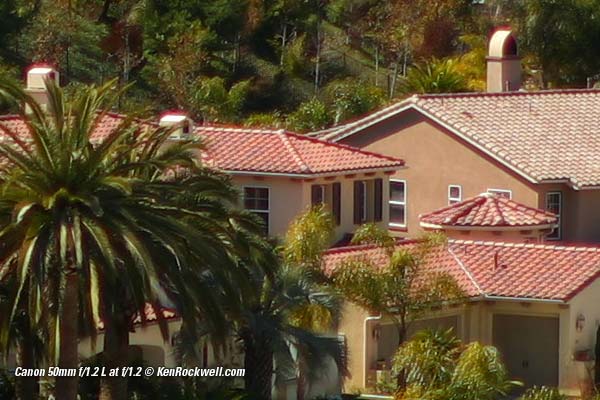
Crop from center of 100% 5D image with Canon 50mm f/1.2L at f/1.2.
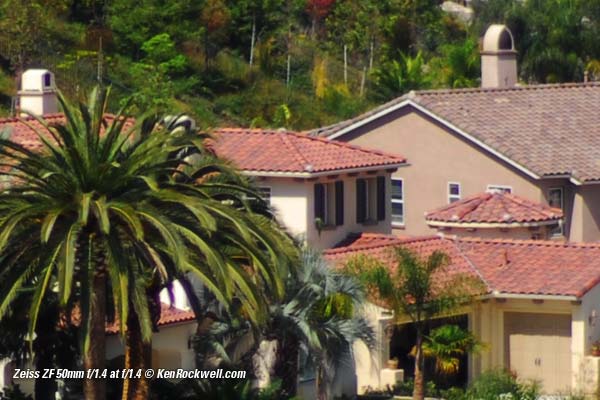
Crop from center of Nikon D200 image with Zeiss ZF 50mm f/1.4 at f/1.4.
Most lenses, including the Zeiss, are common spherical designs. They have high resolving power wide open, but the spherical aberration gives rise to a veiling haze, which gets really bad at the corners. The Canon 50mm f/1.2L uses an aspherical element to eliminate most of the spherical aberration, which clears away the haze at large apertures.
All these differences go away stopped down. By f/2.8 to f/4 all 50mm lenses look the same on these cameras, if they're in perfect focus.
Spherochromatism performance top
Spherochromatism, sometimes mistakenly called "color bokeh" by laymen, is a common aberration in fast lenses which adds color fringes to out-of focus highlights.
The 50/1.2 a reasonable amount of spherochromatism. Out-of-focus foreground highlights may show magenta fringes and background highlights may show green fringes.
Sunstars performance top
Sunstars at f/13, 17 January 2015. bigger.
Sunstars will are ordinary 8-pointed stars on brillaint points of light.
The rounded diaphragm of the 50/1.2 will attenuate sunstars; the 50/1.0 L ought to have stronger sunstars, while the 50/1.8 II has even better 10-pointed sunstars.
Image Stabilization performance top
see also Why IS is Important.
There is NO image stabilization, however I tested the slowest speeds at which I could hold it.
This is the percentage of sharp shots that I get at each speed, hand held without bracing any part of my body above my waist.
Percent perfectly sharp shots held free-hand:
1 |
1/2 |
1/4 |
1/8 |
1/15 |
1/30 |
1/60 |
1/125 |
|
5D |
0 |
7 |
10 |
15 |
33 |
85 |
100 |
100 |
XTi |
0 |
0 |
0 |
15 |
33 |
75 |
85 |
100 |
This data tells me that 50% of the time I get a perfectly sharp shot at 1/20 of a second.
I wouldn't take any of the slight differences between cameras seriously. I was getting bored by the time I ran the XTi test. They are the same; I was looking to see if there was any significant difference between the two. There isn't.
By "sharp" I'm applying the highest standard. Sharp for the purposes of this test is perfect tripod-sharpness when viewed at 100% magnification, which is equivalent to a 40' (1m) wide print. We're all usually printing smaller, in which case slower speeds work even better. For instance, here's what I flunked for sharpness shot at 1/2 second on the XTi, which has higher liner resolution and magnification than my 5D:
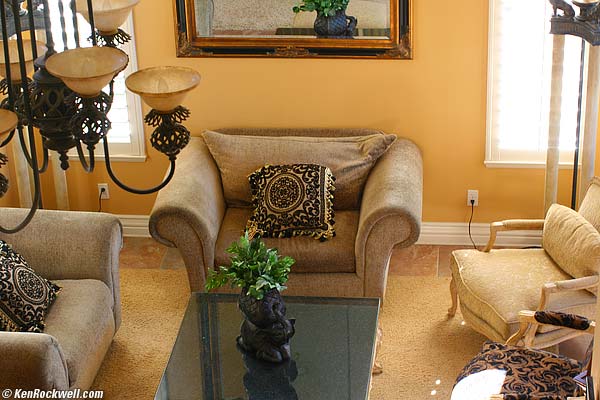
Full XTi image, shot free-hand at 1/2 second, which looks perfect here.
Seen at 100% I consider this blurred.
The bad shots at faster speeds were even better. When I say I got 33% of my shots sharp at 1/15, that means one out of three were absolutely perfect. The other two weren't bad either. That means you can make a three-shot burst and usually pull one absolutely perfect one out of it.
Since marketing people use the old-wives-tale speed of 1/focal length as a minimum sharp speed, we can Lie with Statistics as they do and claim that, even without IS, I get a 1-1/3 stop improvement with this Canon 50mm f/1.2 lens.
Compared top
Intro Specs Performance Compared Recommendations
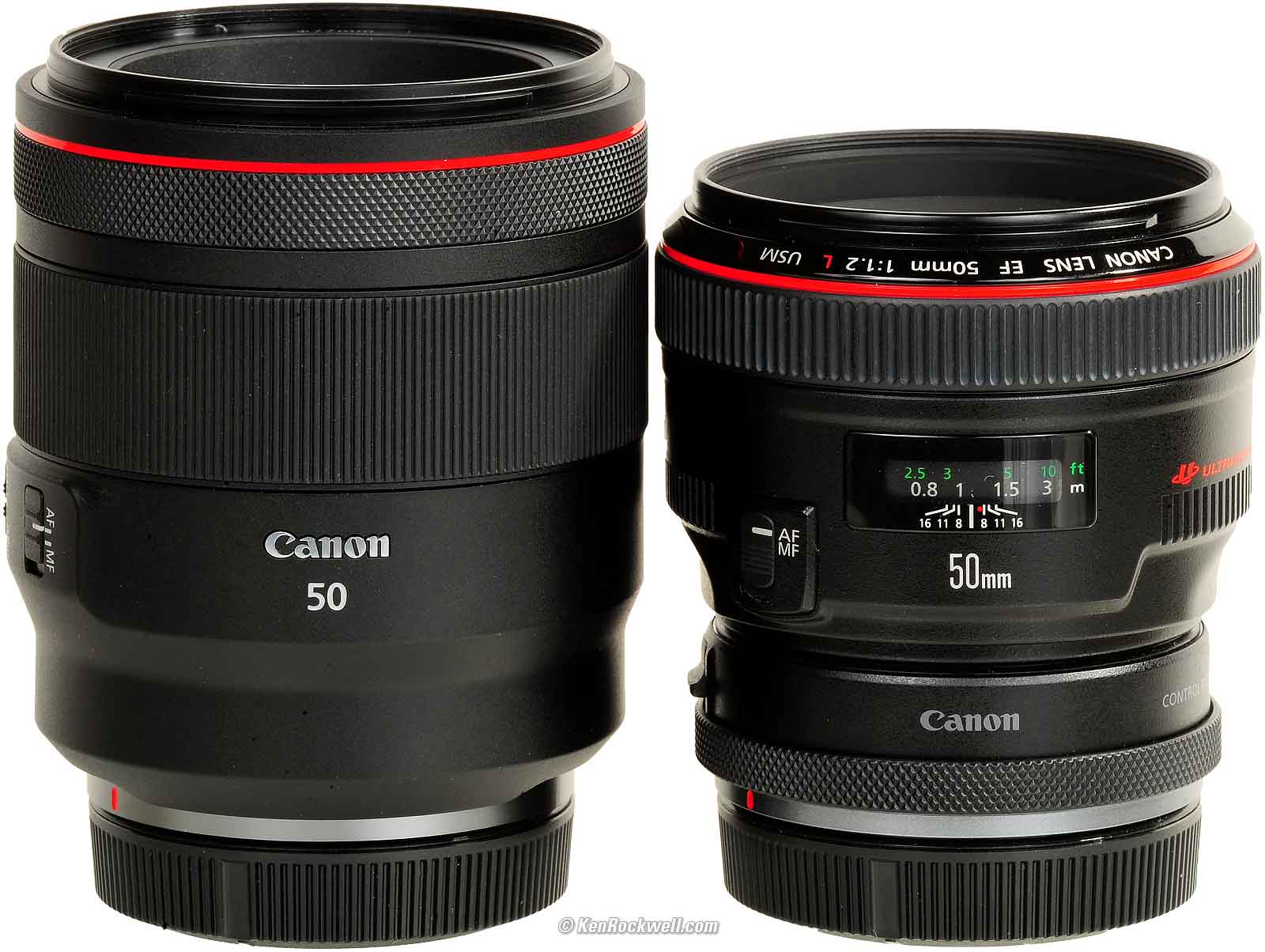
Canon RF 50mm f/1.2L and Canon EF 50mm f/1.2L on EF to RF adapter. bigger.
Premium 50mm Lenses Compared 04 September 2014
Canon 50mm Lenses Compared 05 Nov 2013
Recommendations top
Intro Specs Performance Compared Recommendations
This is the sharpest 50mm high-speed lens I've ever used at large apertures, presuming it's in perfect focus.
If you need a fast 50mm, this is much sharper than the 50/1.4 USM at large apertures.
If you need sharpness at normal apertures, the 50/1.8 II is just as good, but lacks instant manual focus override.
For instance, this shot was made at f/11 with the f/1.2 lens, where all these lenses look alike:
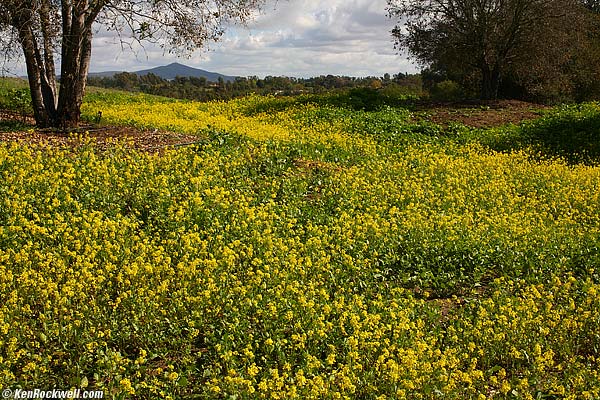
Rancho Santa Fe, California.
The f/1.4 has better rated MTF (sharpness) at f/8 than the f/1.2 version, but there isn't any visible difference. The f/1.4 offers the same excellent "just grab the ring" instant manual focus.
The f/1.8 has better rated MTF than any of these three 50mm lenses at f/8, although its images look the same. The 1.8 requires you to slide a switch to focus manually. For $125 you won't be disappointed, so long as moving a switch for auto or manual focus is acceptable.
If you're an astronomer you'll prefer the insane flat-field and corner performance of the 85mm f/1.2L II over the merely very good performance of this 50mm f/1.2, and you won't mind the slow AF of the 85mm. The 85mm f/1.2L II autofocuses more accurately and slowly than this 50mm f/1.2L, although the 85mm is a pig to use and carry.
For the very best performance with manual focus Canon makes special focus screens optimized for fast lenses. Live View is the most accurate method for auto or manual focus at large apertures, no screen required.
If you're a collector, the 50mm f/1.0 is built better and is a much higher class of lens, but it's a pig to carry around and doesn't focus as fast. The results are surprisingly the same.
For low-light shots, the Canon 35mm f/1.4L will give much better depth of field and can be hand-held at slower speeds because of its lower magnification.
As an all-around practical and professional 50mm lens that can be used to shoot anything and everything, this 50mm lens is unsurpassed
Help me help you top
I support my growing family through this website, as crazy as it might seem.
The biggest help is when you use any of these links when you get anything, regardless of the country in which you live. It costs you nothing, and is this site's, and thus my family's, biggest source of support. These places have the best prices and service, which is why I've used them since before this website existed. I recommend them all personally.
If you find this page as helpful as a book you might have had to buy or a workshop you may have had to take, feel free to help me continue helping everyone.
If you've gotten your gear through one of my links or helped otherwise, you're family. It's great people like you who allow me to keep adding to this site full-time. Thanks!
If you haven't helped yet, please do, and consider helping me with a gift of $5.00.
As this page is copyrighted and formally registered, it is unlawful to make copies, especially in the form of printouts for personal use. If you wish to make a printout for personal use, you are granted one-time permission only if you PayPal me $5.00 per printout or part thereof. Thank you!
Thanks for reading!
Mr. & Mrs. Ken Rockwell, Ryan and Katie.
Home Donate New Search Gallery Reviews How-To Books Links Workshops About Contact