Home Donate New Search Gallery Reviews How-To Books Links Workshops About Contact
Canon 24-70mm f/2.8 L II
World's Sharpest Midrange Zoom
Full-Frame EF USM (2012-today)
Intro Specs Performance Compared Recommendations More
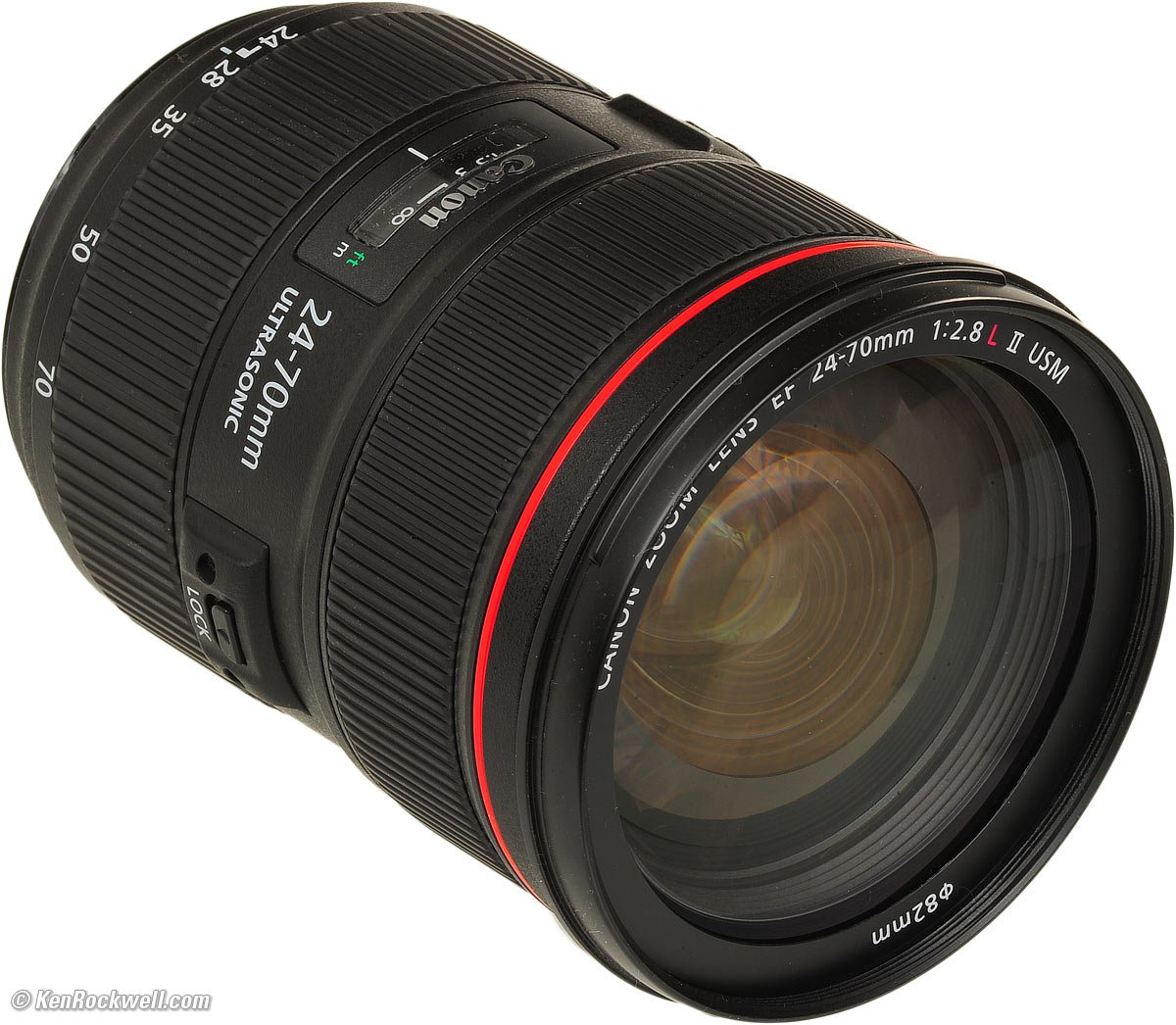
Canon EF 24-70mm f/2.8 L II USM (82mm plastic filter thread, 1.25 feet/0.38m close-focus, 28.4 oz./804g, $2,199 new or about $911 used if you know How to Win at eBay). enlarge. I got mine at Adorama I'd also get it at Amazon, at B&H or at Crutchfield, or get it used at eBay (How to Win at eBay), or get it used at KEH.
This free website's biggest source of support is when you use those or any of these links when you get anything, regardless of the country in which you live. Thanks! Ken.
February 2026 More Canon Reviews Canon Lenses All Reviews
Tokina 24-70mm f/2.8 05 October 2015. Almost as good, but heavier, for $800 less.
Canon 24-70mm/2.8 L II vs Zeiss 24-70/4 vs Sony 16-50 OSS 18 September 2015.
24-70mm f/4 L IS (2012-)
24-70mm f/2.8 L (2002-2012)
24-105mm f/4 IS L (2005-today)
Sample Images top
Sample Images Intro Specs Performance
See also Yosemite and the Eastern Sierra, October 2015.
There are plenty more sample files in the review below.

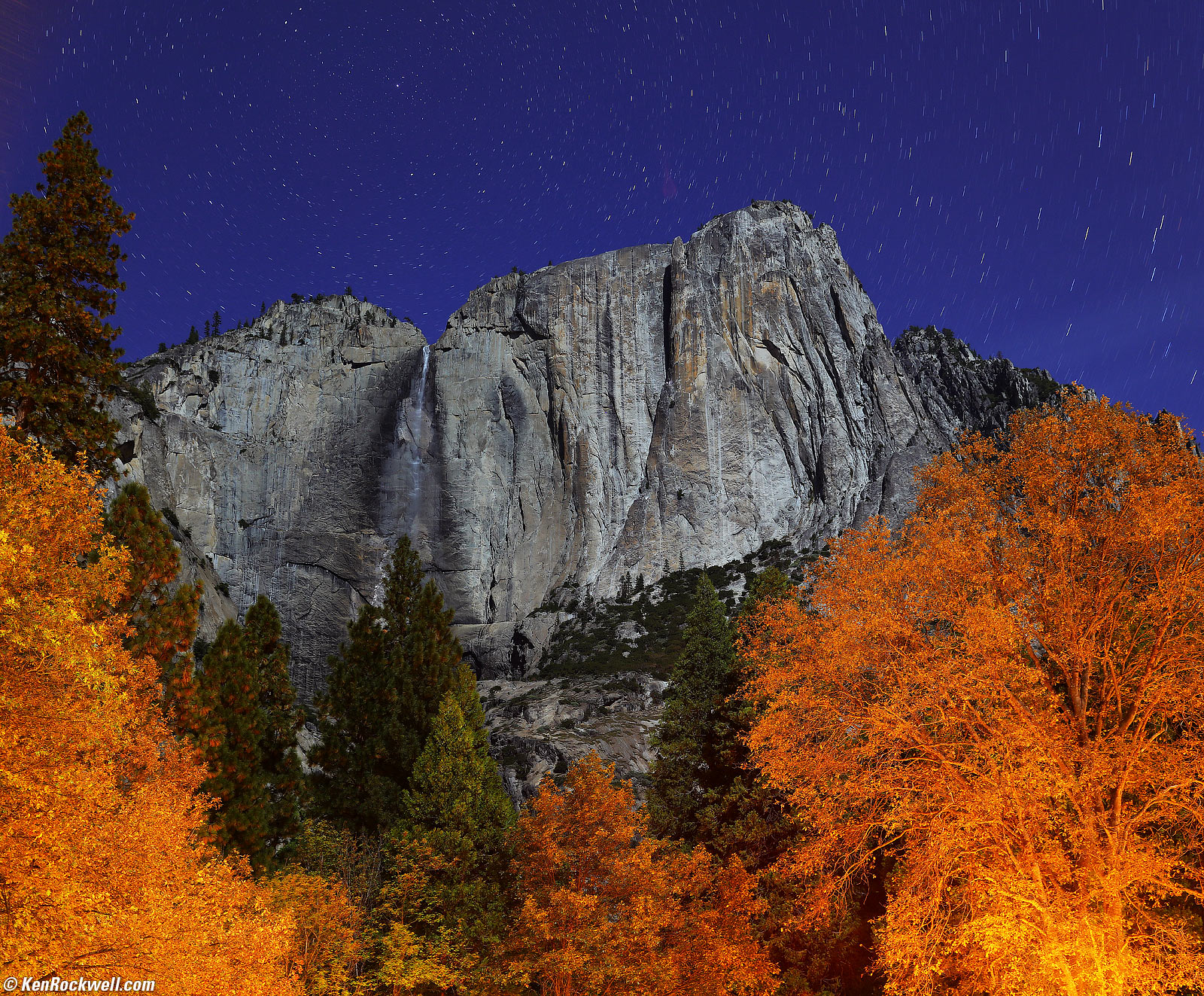
Yosemite Falls by Moonlight, October 2015, 8:17 P.M. The moon was a waxing gibbous, 9¼ days old, 69% illuminated; the full moon will be five days later on the 27th. Canon 5DS R, Canon 24~70mm L II at 39mm, four minutes at f/2.8 at ISO 100, Perfectly Clear. bigger or full 50 MP (20MB JPG) file to explore on your computer (mobile devices rarely can display this resolution properly).

Stately Home. Canon 5DS, Canon 24-70mm f/2.8 L II at 25mm at f/8 at 1 second at ISO 100 with Aperlite YH-700C flash at full power, shot as a normal JPG and processed in Perfectly Clear. Full-resolution.

Library. Canon 5D Mark III, Canon 24-70mm f/2.8 L II at 24mm, f/11 at 1/500, AUTO ISO 100, 6 sharpening, 4 saturation, AUTO WB A4. Camera-original © file.
In this snap, notice the lack of distortion, as well as corner-to-corner sharpness. The 24-105 IS is loaded with distortion at 24mm, while this new 24-70 II has much less distortion at 24mm.

Parking lot under sodium light. Canon 5D Mark III, Canon 24-70mm f/2.8 L II at 24mm, f/2.8 at 1/40, AUTO ISO 500, 6 sharpening, 4 saturation, AUTO WB A4 . Camera-original © file.
Notice not only the edge-to-edge sharpness wide-open, but also the astounding complete lack of flare, ghosts and coma, even with the multicoated CONTAX L39 filter I used for protection.

Palm. Canon 5D Mark III, Canon 24-70mm f/2.8 L II at 39mm, f/8 at 1/80, AUTO ISO 100, 6 sharpening, 4 saturation, AUTO WB A4 . Camera-original © 10 MB file.

Katie and the globe. (Canon 5D Mk III at Auto ISO 250, f/2.8 at 1/125, Canon 24-70mm f/2.8 L II at 70mm, Athentech Perfectly Clear plug-in.) Camera-original © file.

Sharp enough? Palm Trunk, 17 January 2015. (Canon 7D Mk II, Canon EF 24-70mm f/2.8 L II, f/9 at 1/100, Perfectly Clear V2.) Unprocessed camera-original file. If it's this sharp on APS-C at 20 MP, it's this sharp on full-frame at 52 MP. Remember that trunks are curved, so only the central strip is in focus.
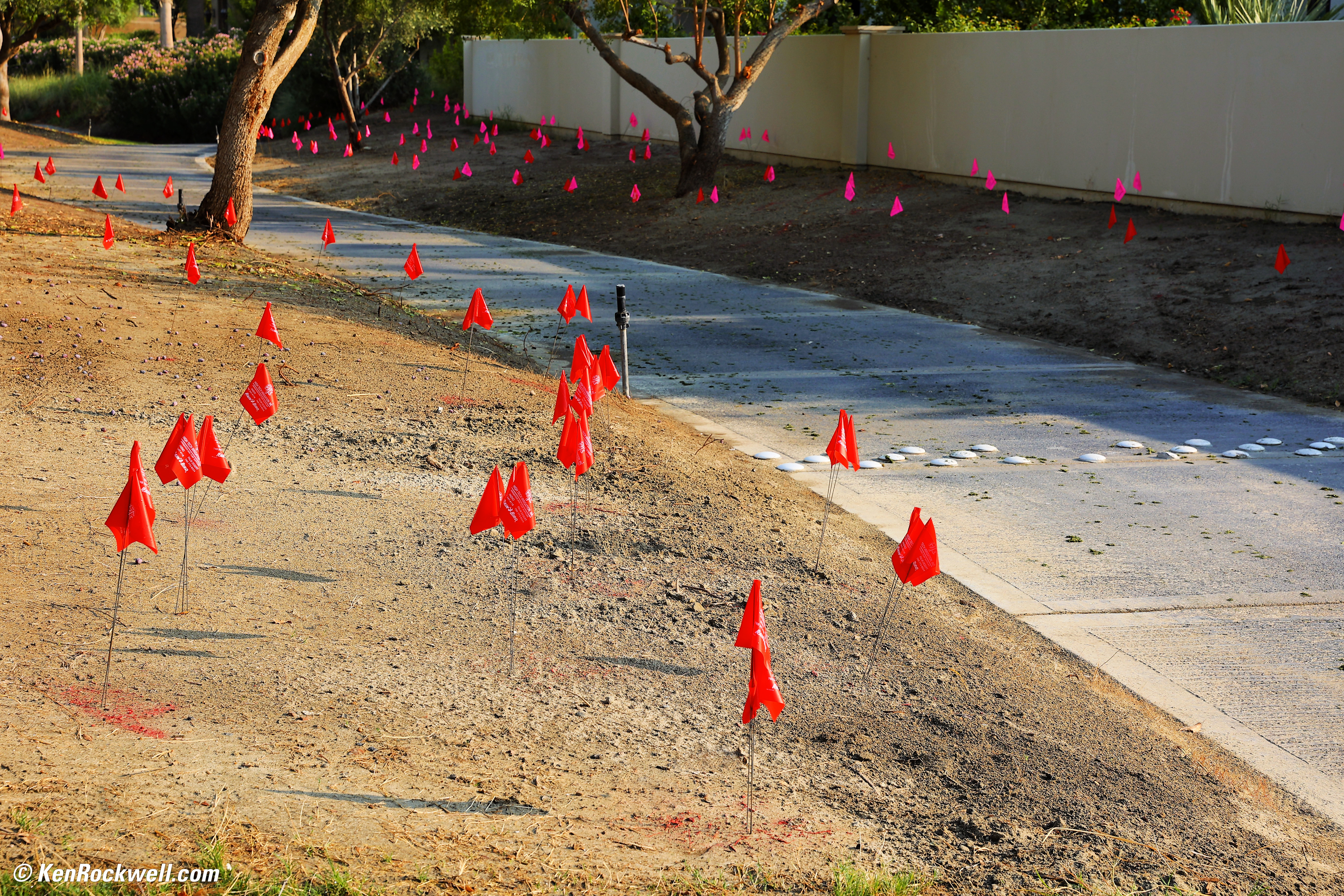
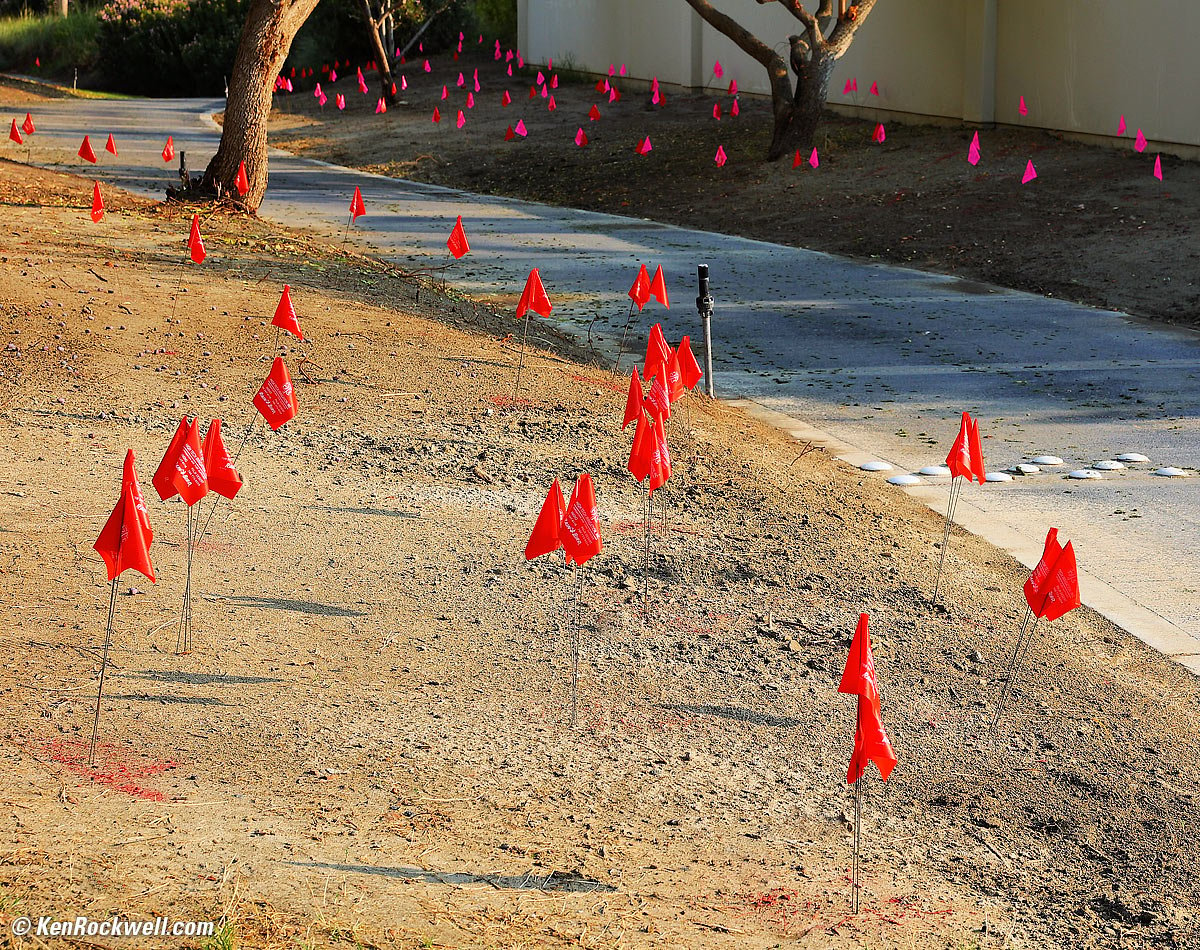
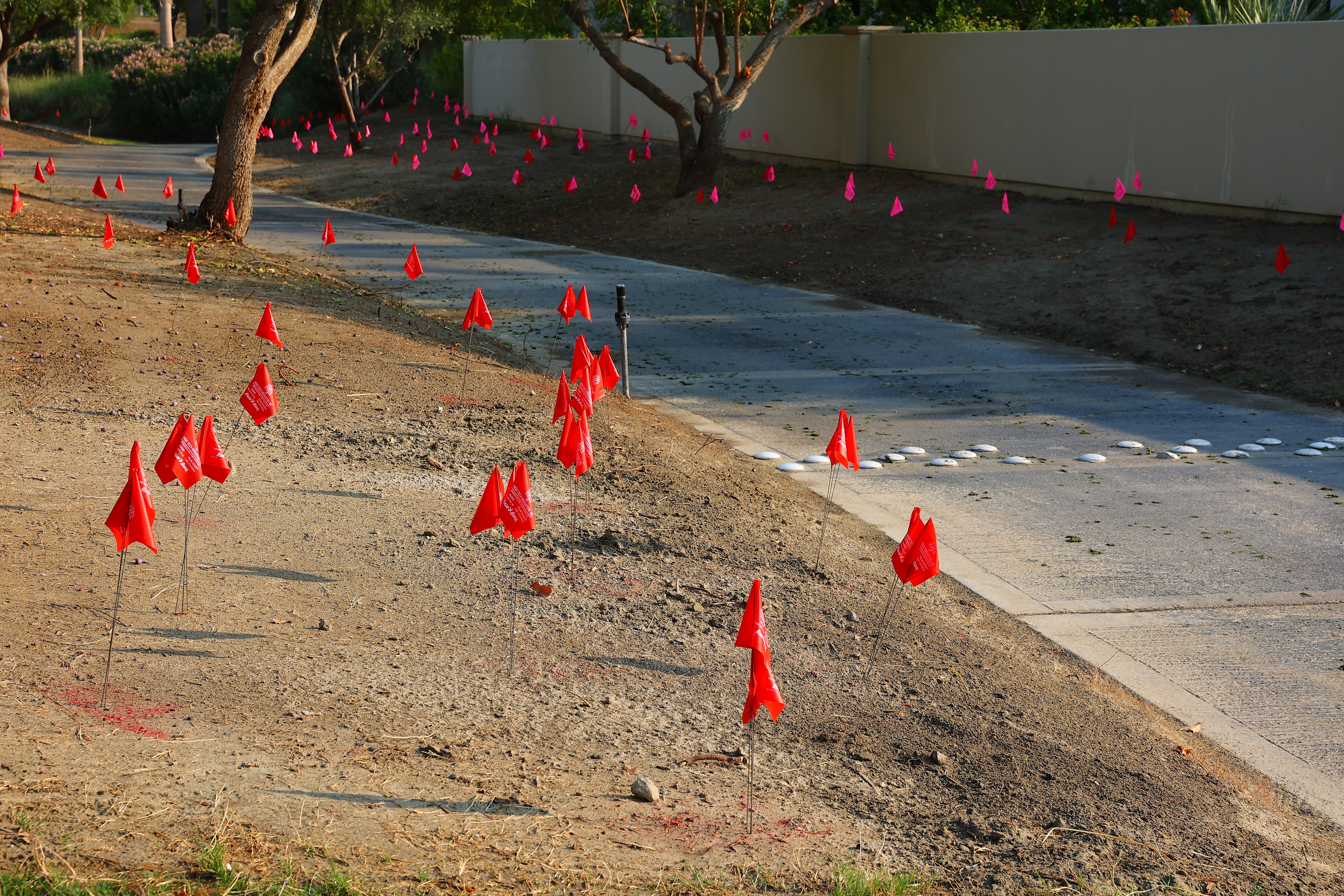
Red Flag Warning, 8:22 AM, 14 September 2020. Canon EOS R6, Canon EF 24-70mm f/2.8L II at 65 mm at f/11 hand-held at 1/125 at Auto ISO 100, -0.7 stops exposure compensation (LV 14.0), Perfectly Clear. bigger, full-resolution or camera-original © JPG file.

Introduction top
Sample Images Intro Specs Performance

|



The Canon EF 24-70mm f/2.8 L II is among Canon's best lenses ever. It is significantly sharper than the previous 24-70mm f/2.8 L, and also much sharper than Nikon's 24-70/2.8G if you're counting pixels.
This new II version replaces the already excellent 24-70mm f/2.8 L of 2002, adding sharper optics and a lot more plastic compared to the original lens. It costs nearly twice as much as the previous lens — thus the "II" designation — and weighs less than the previous beast.
This new 24-70/2.8 II is so sharp that it's actually sharper than my reference 50mm f/1.8 II and 50mm f/1.4 USM lenses at larger apertures! I can't recall ever testing a midrange zoom that was sharper than fixed 50mm lenses. At f/8 most decent lenses are the same, while at f/2.8 and f/4, this new 24-70 is much sharper if you're counting each pixel and looking in the corners.
Also significantly improved over the old 24-70mm f/2.8 L is a 9-bladed diaphragm that begets magnificent 18-pointed sunstars on brilliant points of light. Long gone are the dorky 8-pointed stars of the old lens.
Another intangible over the less expensive plastic zooms I usually carry day-to-day with my kids is that this new 24-70 L II seems to add a little more overall contrast and color. It's subtle, and it might be imaginary, but possibly due to better internal stray light control, images from this new lens often have more "pop" than from my older, cheaper lenses when shot in low light at larger apertures.
I felt ripped-off as I opened the box for my new $2,300 lens and realized that it's mostly plastic, compared to the mostly metal and far less expensive original 24-70mm f/2.8 L. However, after shooting with this new lens for only an hour or so its images were so subtly and strongly better than the original lens that I was hooked. Other full-time pros have also fallen immediately in love with this lens. If you're shooting it at f/2.8 it's much sharper and more contrasty than the previous lens.
The 24-70 is extremely popular with professional wedding and event photographers. Amateurs usually prefer the Canon 24-105mm f/4 IS because it costs and weighs a little less and has a longer zoom range, however full-time pros prefer this 24-70 because its a stop faster (f/2.8) and has less distortion at the wide end, and because the zoom range between 24mm and 35mm isn't all bunched together as it is with the 24-105mm.
This is a full-frame lens. The 24-70mm range shot on Canon's 1.6x cameras becomes a 38-112mm equivalent lens, which is a very handy range.
AF is immediate and quiet, but not silent. You can grab the big manual focus ring for instant manual focus override at any time.
This lens focuses to within 8 inches (20 cm) or closer in front of the lens at all focal length settings, which means that I never have to move back to get something in focus.
Zooming has just the right amount of space between focal lengths to allow precise selection of any focal length, especially at the wide end. The zoom is reasonably stiff, so you'll usually want to use at least two fingers for zooming. I have no idea why there's a lock; there's no drift on my new lens.
While the cheaper and lighter 24-105mm f/4 IS has Image Stabilization (IS) for sharp hand-held shots of still subjects in dim light, the faster f/2.8 speed of this 24-70mm allows photographing people and action in lower light than with the 24-105mm. Image Stabilization is of no help with moving subjects; IS only helps with camera shake, not subject motion.
I got mine at Adorama I'd also get it at Amazon, at B&H or at Crutchfield, or get it used at eBay (How to Win at eBay), or get it used at KEH.
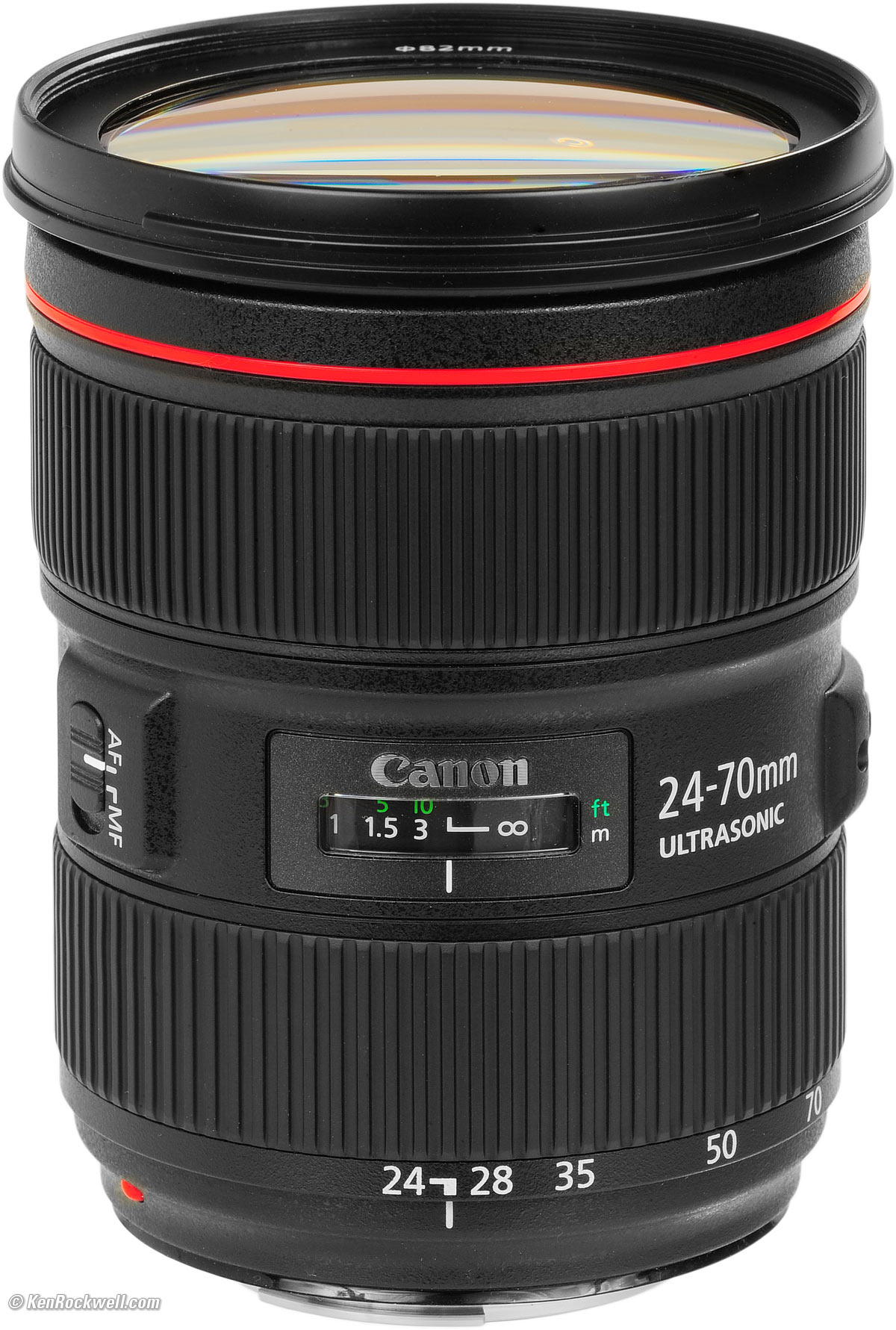
Canon 24-70mm f/2.8 L II. enlarge.
Compatibility
This L lens is optimized for 35mm film and full-frame digital, and of course works on 1.3x and 1.6x Canon cameras.
This Canon EF EOS 24-70mm f/2.8 L II works perfectly with every Canon EOS camera ever made, meaning every Canon DSLR and every Canon autofocus film camera made since 1987.
This means of course it works great on today's 5D Mark III, 6D and Canon 7D, but it works just as well on my original Canon EOS 650 from 1987!
As a full-frame lens, I am reviewing it as such for full-frame bodies.
Specifications top
Sample Images Intro Specs Performance
I got mine at Adorama I'd also get it at Amazon, at B&H or at Crutchfield, or get it used at eBay (How to Win at eBay), or get it used at KEH.
Name
Canon calls this the CANON ZOOM LENS EF 24-70mm f/2.8 L II USM.
EF means "electronic focus," meaning that there is an autofocus motor in the lens itself. All Canon lenses since 1987 have been EF.
L only means as expensive as L; it means nothing technically.
II means twice as expensive as the first 24-70mm f/2.8 L.
USM means Ultra-Sonic Motor. This means autofocus is almost silent, and that you can grab the big focus ring for instant manual focus override at any time.
Optics top
18 elements in 13 groups.
Internal focus: nothing moves externally as autofocused.
Pumper zoom, grows as zoomed towards 70mm.
Two aspherical elements.
1 Super UD and 2 UD glass elements.
Multicoated, branded as "Optimized Super Spectra Coating."
Fluorine coatings on front and rear elements to help repel fingerprints.
Focal Length top
24~70mm.
On 1.3x Canon cameras it will see angles-of-view similar to what a 30~90mm lens would see on a 35mm camera.
On 1.6x Canon cameras it will see angles-of-view similar to what a 38~115mm lens would see on a 35mm camera, which is actually a very useful zoom range.
Angle of View (on 35mm and full-frame cameras)
84º - 34º diagonal.
53º - 19.5º vertical.
74º - 29º horizontal.
Close Focus top
1.25 feet (0.38m), specified, from the image plane.
Since this lens is so big, this actually means that it focuses to within about 8 inches (20 cm) of the front of the lens at the 70mm setting, and even closer as the lens gets longer at the wider settings.
Maximum Reproduction Ratio top
1:4.76 (0.21x).
Minimum Field Size top
5.28 x 7.95" (134 x 204 mm).
Extension Tubes top
Use the Canon EF12 II to get close-ups to 0.63x life-size at the image sensor.
Use the Canon EF25 II to get close-ups to about 3/4 life-size at the image sensor.
Diaphragm top
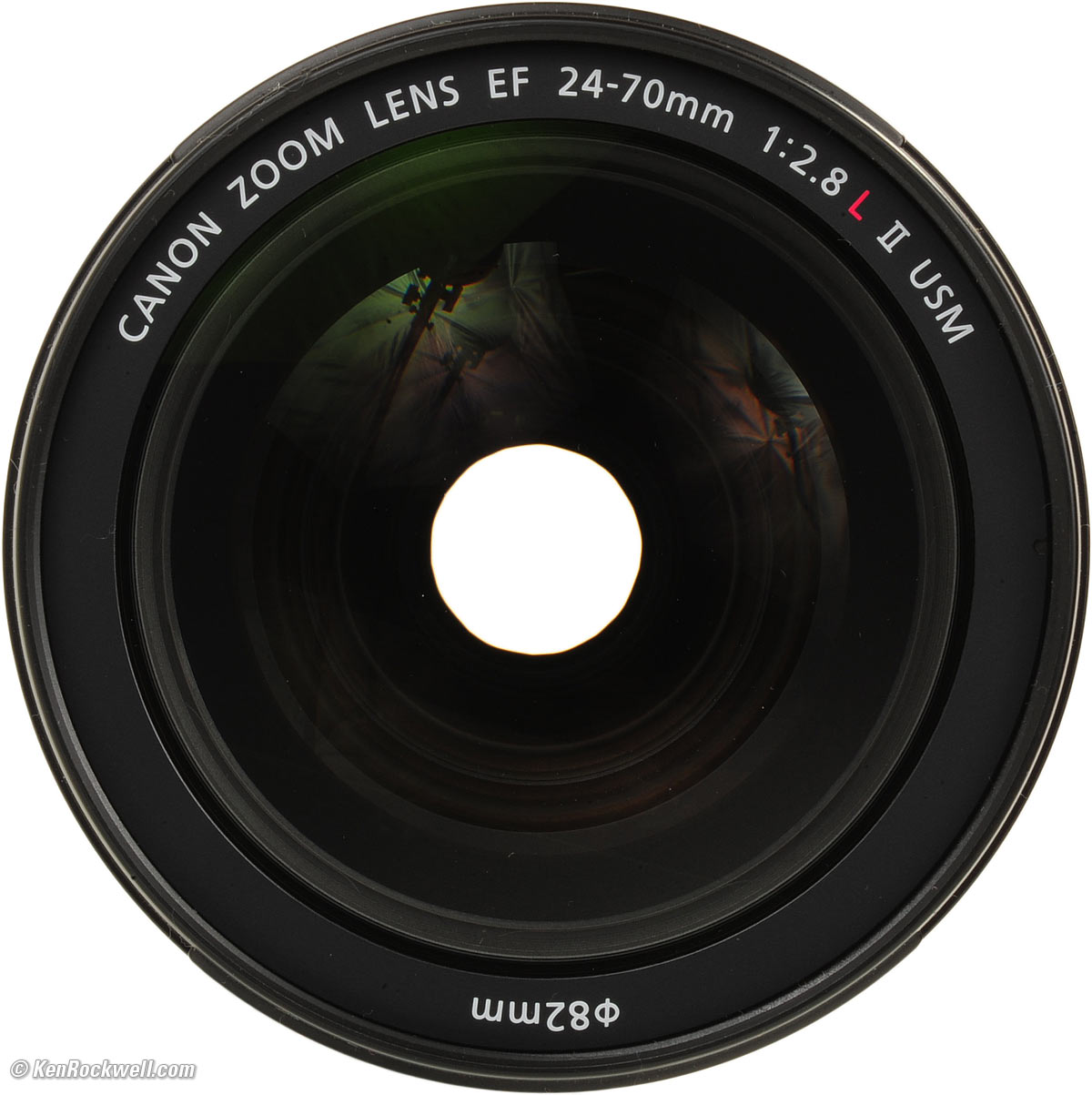
24-70mm f/2.8 II wide-open at f/2.8 at 50mm. (EF diaphragm not visible). enlarge.
9 rounded blades.
Reasonably round at large apertures to f/5, and straight-sided (nonagonal) from f/8 and smaller for great sunstars. Perfect!
Stops down to f/22.
Hard Infinity Focus Stop? top
No.
You have to let the AF system focus for you at infinity.
Focus Scale top
Yes.
The ring turns from infinity to the closest macro focus distance in about 120.º
Depth-of-Field Scale top
No.
Infra-Red Focus Indices top
No. Use the original 24-70mm, which has them.
Filter Thread top
82mm.
Plastic.
Does not rotate and doesn't move with focus, but does move in and out with zooming.
Size top
Canon specifies 3.48" (88.5mm) diameter by 4.45" (113mm) long.
It extends as zoomed to longer focal lengths.
Weight top
28.377 oz. (804.5g), measured.
Canon specifies 28.4 oz. (805g).
Hood top
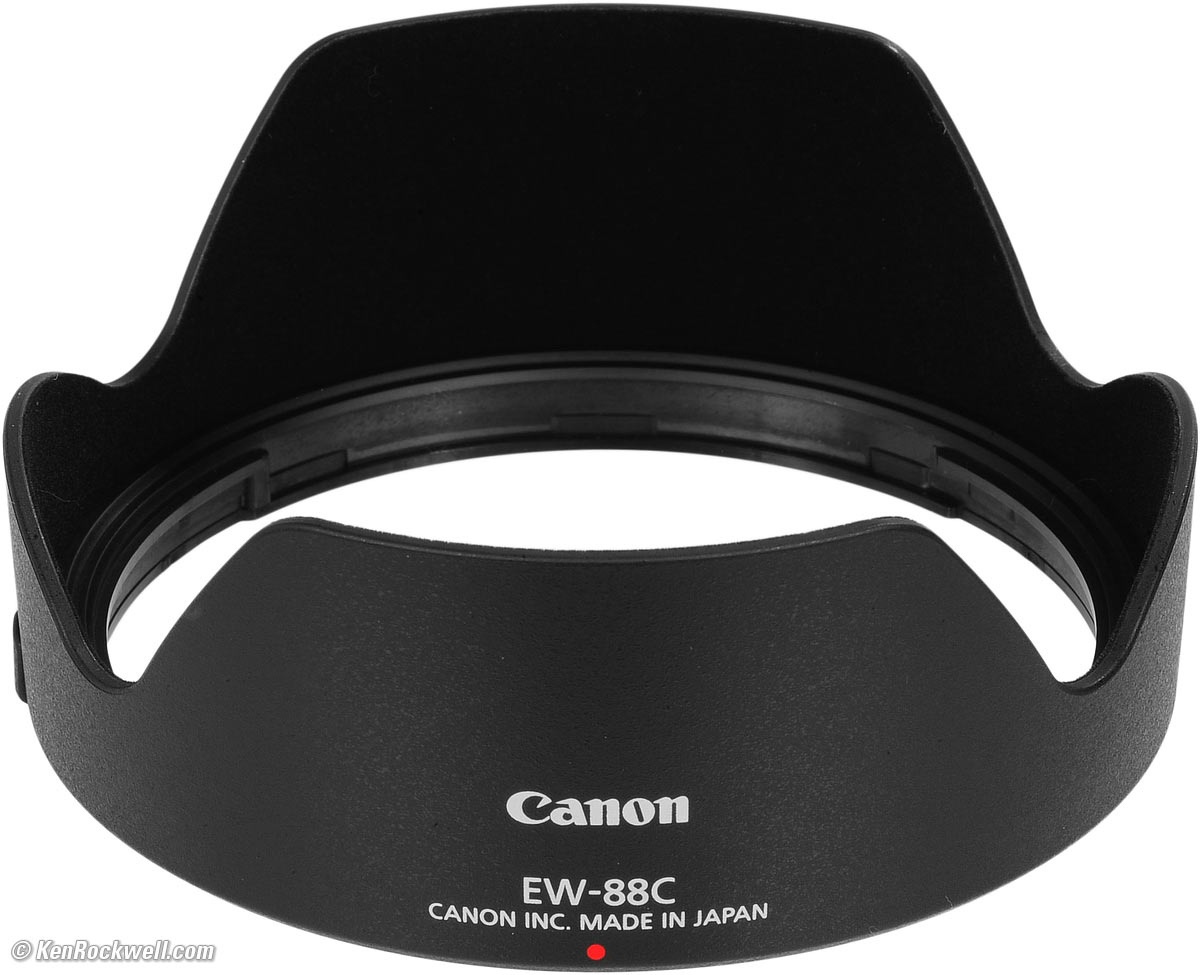
Canon EW-88C Hood. enlarge.
$55 EW-88C plastic bayonet hood, included.
As of September 2012, only fits this 24-70mm lens.
Case top
$30 LP1219 sack, included.
Caps top
Oversize 82mm E-82U front, included.
Standard EOS cap rear, included.
Introduced top
07 February 2012.
Shipping Since top
Canon originally had promised it for Summer 2012, but it didn't start to ship to photographers until Wednesday, 12 September 2012.
Quality top
Made in Japan.
Price, USA top
February 2026
$2,199 new at Adorama, at Amazon, at B&H and at Crutchfield.
About $911 used if you know How to Win at eBay.
January 2023
$1,699 new at Adorama, at Amazon, at B&H or at Crutchfield.
About $900 used if you know How to Win at eBay.
September 2020: $1,699 new at Adorama, at Amazon, at B&H or at Crutchfield, or about $1,250 used if you know How to Win at eBay.
December 2019: $1,599 new at Adorama, at Amazon, at B&H or at Crutchfield, or about $1,000 used if you know How to Win at eBay.
February 2019: $1,699.
June 2016: $1,749 after $150 instant rebate.
September 2015 - January 2016: $1,799 after $100 instant rebate.
February-June 2015: $1,899 after $100 mail-in rebate.
2014 Christmas-2015 January: $1,849 after $150 rebate.
Christmas 2013: $1,699 ($1,999 with $300 rebate).
2012 September - 2013 Christmas: $2,300.
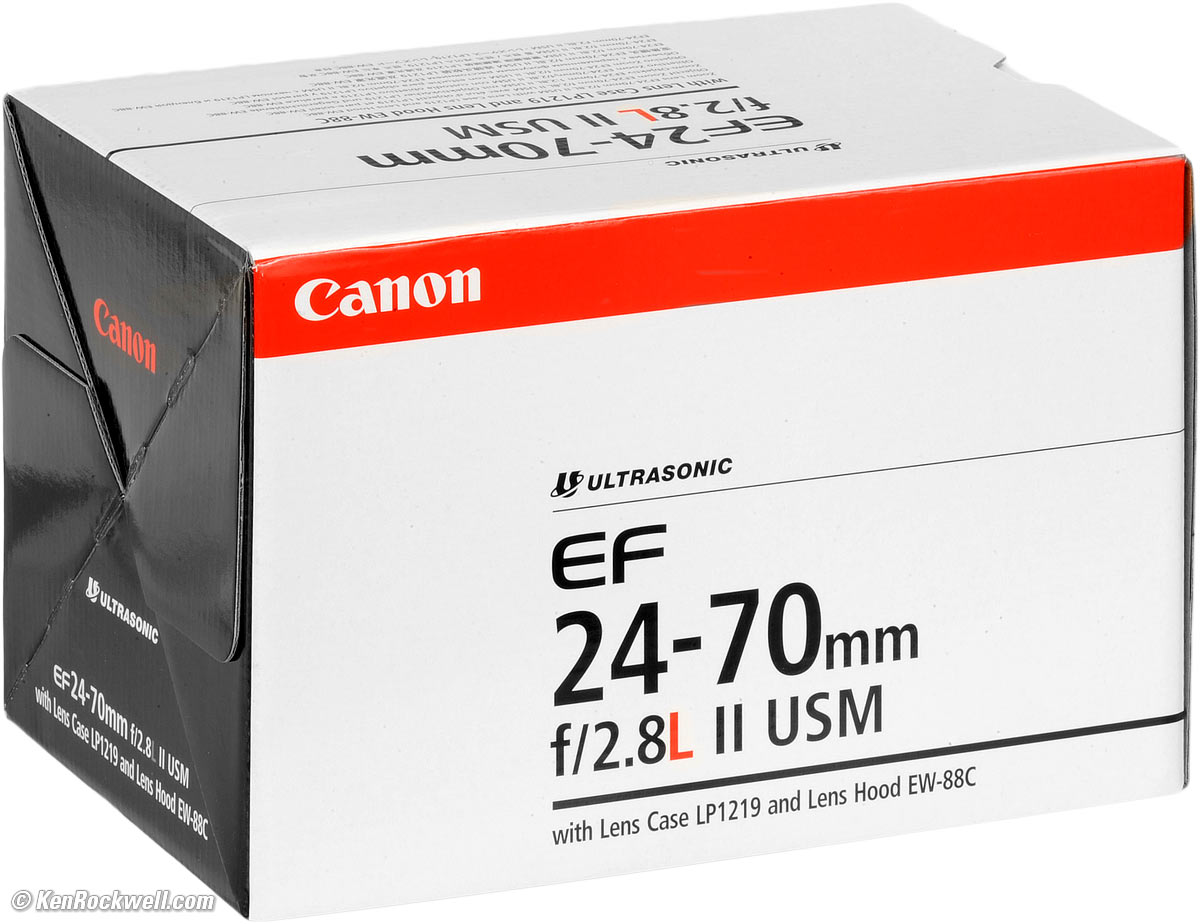
Box, Canon 24-70/2.8 L II. enlarge.
Performance top
Sample Images Intro Specs Performance
Overall Autofocus Bokeh Breathing Color Coma
Distortion Ergonomics Eyeblow Falloff Filters
Flare & Ghosts Lateral Color Fringes Macro Mechanics
Sharpness Spherochromatism Stabilization Sunstars
I got mine at Adorama I'd also get it at Amazon, at B&H or at Crutchfield, or get it used at eBay (How to Win at eBay), or get it used at KEH.
Overall performance top
The Canon 24-70mm f/2.8 L II is optically superb and handles very well. I wish everything were this good.
It's heavy, expensive, and superb!
Autofocus performance top
Autofocus is fast and nearly silent, as we take for granted with Canon. For the still subjects I shoot, it's almost instantaneous.
Auto/Manual Switching
Just grab the focus ring at any time for instant manual-focus override.
Only move the AF-MF switch if you want to disable the camera from auto focusing.
AF Speed
AF is fast!, as Canons always are.
The AF motor is silent, but you will hear some internal sliding.
In the dark
If it's super-dark (ISO 25,600 territory), sometimes the camera will have a hard time seeing anything, too, to focus, and will be balky. This is normal.
AF Accuracy and Consistency
I saw no autofocus error on my Canon 5D Mark III.
Especially at f/2.8, every shot is dead-on at every focal length.
Yes! Perfection!
Focus with zooming
Focus shifts slightly as zoomed, so focus last.
Manual Focus
Manual focus is easy; just grab the ring.
It takes only 110º to go from end-to-end of the focus scale.
Bokeh performance top
Bokeh, the quality of out-of-focus areas as opposed to the degree of defocus, is fair to good. It's reasonably good at f/2.8, but gets worse at smaller apertures where it's not as likely to be that important.
Of course the background rarely gets very far out of focus at 24mm; if you want soft backgrounds, shoot at 70mm, keep your subject close and shoot at f/2.8. Subject distance and focal length are more important to throwing backgrounds out of focus than simply shooting at f/2.8.
Focus Breathing performance top
Focus breathing (the image changing size as focused) is mostly of interest to cinematographers who don't want the image changing size ("breathing") as the lens is focused among different subjects.
The image from the Canon 24-70mm f/2.8 L II gets smaller as focused more closely, at all focal length settings.
Color Rendition performance top
The color balance of this 24-70mm f/2.8 L II seems the same as my other Canon EF lenses.
Coma performance top
Coma, or saggital coma flare, is when points of light in the corners turn into batwing-shaped blobs. This is often a problem with fast normal or wide lenses.
To my astonishment, this Canon 24-70 II is completely devoid of any coma.
Here's what it looks like at 24mm at f/2.8 on full-frame:
Shot at f/2.8 at 24mm at ISO 500 on 5D3. Camera-original © file.
Crop from lower left of above at 100%. Camera-original © file.
Distortion performance top
The Canon 24-70mm f/2.8 II has significantly more distortion than I expect in a premium midrange zoom, especially in the critical 35-70mm range. The original 24-70/2.8 L is usually better, except at 24mm and 28mm, where this new lens is better than most similar zooms.
At 24 and 28mm, this lens has very little distortion, but goes strongly pincushion by 35mm through 70mm, and is worst at 50mm, where it probably will be used most often and where other lenses have their least distortion.
Use these values in Photoshop's Lens Distortion tool to remove it:
Full-Frame and 35mm at 3m (10') |
(Original 24-70/2.8 L) |
|
24mm |
+1.5* |
+2.5* |
28mm |
0.0* |
+1.5* |
35mm |
-1.7 |
+0.5 |
50mm |
-3.0 |
-0.7 |
70mm |
-2.7 |
-2.0 |
© 2012 KenRockwell.com. All rights reserved.
* Some waviness remains.
Ergonomics performance top
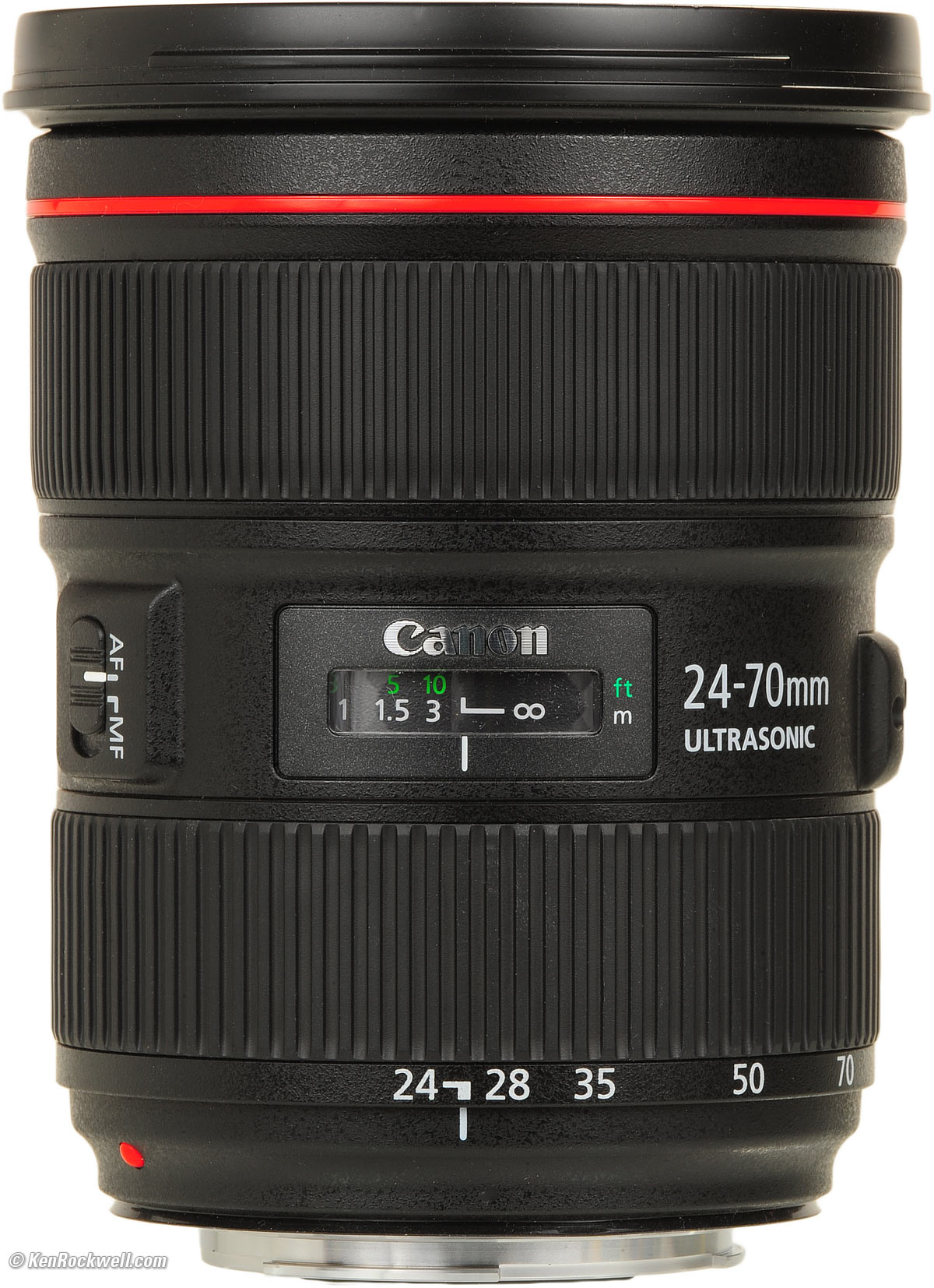
Canon 24-70/2.8 L set to 40mm. enlarge.
Ergonomics are as expected for a big, fat zoom.
Focus is perfect, but a bit of a reach. I prefer the smaller, closer and easier to feel focus rings of smaller lenses like the 28-105mm USM II and similar.
The AF - MF switch falls right under your thumb.
Focus shifts slightly as zoomed, so focus last.
Zooming is very evenly spaced and never crowds any range together, however it's rather stiff and ideally demands two fingers to zoom. Zooming with one finger takes a very strong and determined finger. The sample I bought certainly has no zoom creep, so I'm perplexed as to why it has a zoom lock. There is no bright fluorescent warning when you flip-on the zoom lock.
The zoom and focus rings are made of rubber-covered alloy, while everything else is plastic. Since the alloy rings are covered by rubber, the whole thing feels as if it may as well be plastic.
Eyeblow performance top
As a "pumper" zoom that pumps in and out as zoomed, the air has to come and go somewhere.
Enough air pumps through the back of this lens that sometimes I can feel a little bit blowing on my eye as I zoom back to the wide end.
Yes, like many zooms, this does pull air through your camera and viewfinder.
Falloff (darkened corners) performance top
With a lens profile on my Canon 5D Mark III or similar camera, falloff is never visible at any setting.
Falloff is visible on film at f/2.8, and gone by f/4.
I've greatly exaggerated this by shooting a flat gray target and presenting it against a gray background.
Canon 24-70mm f/2.8 L II falloff on full-frame 5D Mk III peripheral illumination control enabled:
© 2012 KenRockwell.com. All rights reserved.
5D Mk III peripheral illumination control disabled (same results on film):
© 2012 KenRockwell.com. All rights reserved.
|
























Filters, Use with performance top
Filters are easy, since the huge 82mm filter size is generous.
Sadly, Canon cheaped-out and the filter threads are plastic, so be careful not to cross-thread.
The great news is that there's never any vignetting on full-frame (or any other format) with any filter, even big, fat thick ones.
There is certainly is no need for expensive "thin" polarizers or grads, thank goodness.
You asked, so I tried it with a 77mm filter in an 82mm to 77mm step-down ring. It actually works very well, with only the slightest vignetting at 24mm. It's most obvious at f/22 and invisible at f/2.8, and goes away as zoomed to longer focal lengths.
In fact, vignetting is only very minor even with two stacked standard filters (12.5mm total thickness excluding rear threads). It's minor at 24mm, a bit less at 35mm and 50mm, and gone at 70mm — with two thick stacked filters:
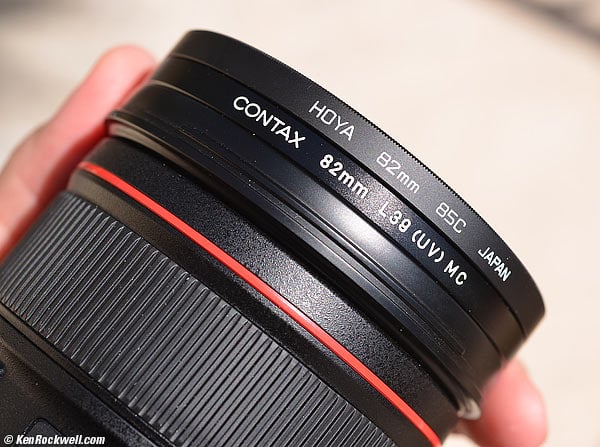
Canon 24-70mm f/2.8 L II with two stacked filters.
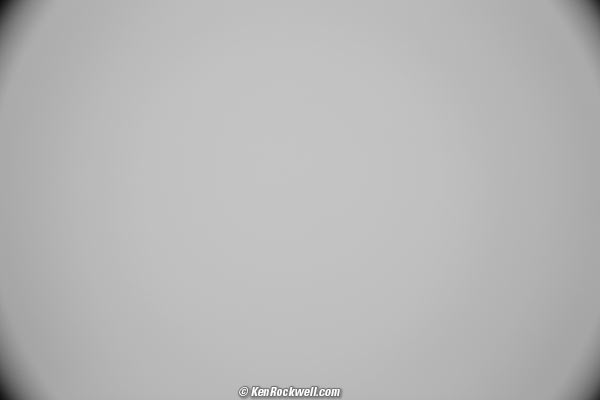
Worst-case vignetting with two stacked filters at 24mm at f/2.8 on full-frame.
To lessen this, stop-down or zoom-in, and you can use two stacked filters on full-frame with no problem. Of course on 1.3x or 1.6x cameras, this is no problem at all due to the crop factor.
Flare and Ghosts performance top
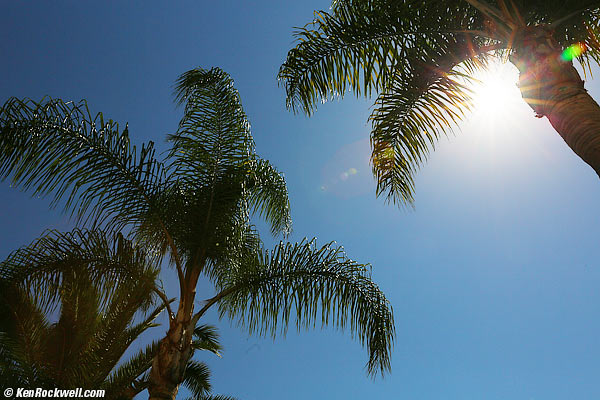
At 31mm at f/14, direct view of mid-day tropical sun.
Flare and ghosts are very well controlled, but if you push it, you will get a green dot or two.
As you can see at Coma, under any difficult but still real-world condition, flare and ghosts are a non-issue.
Lateral Color Fringes performance top
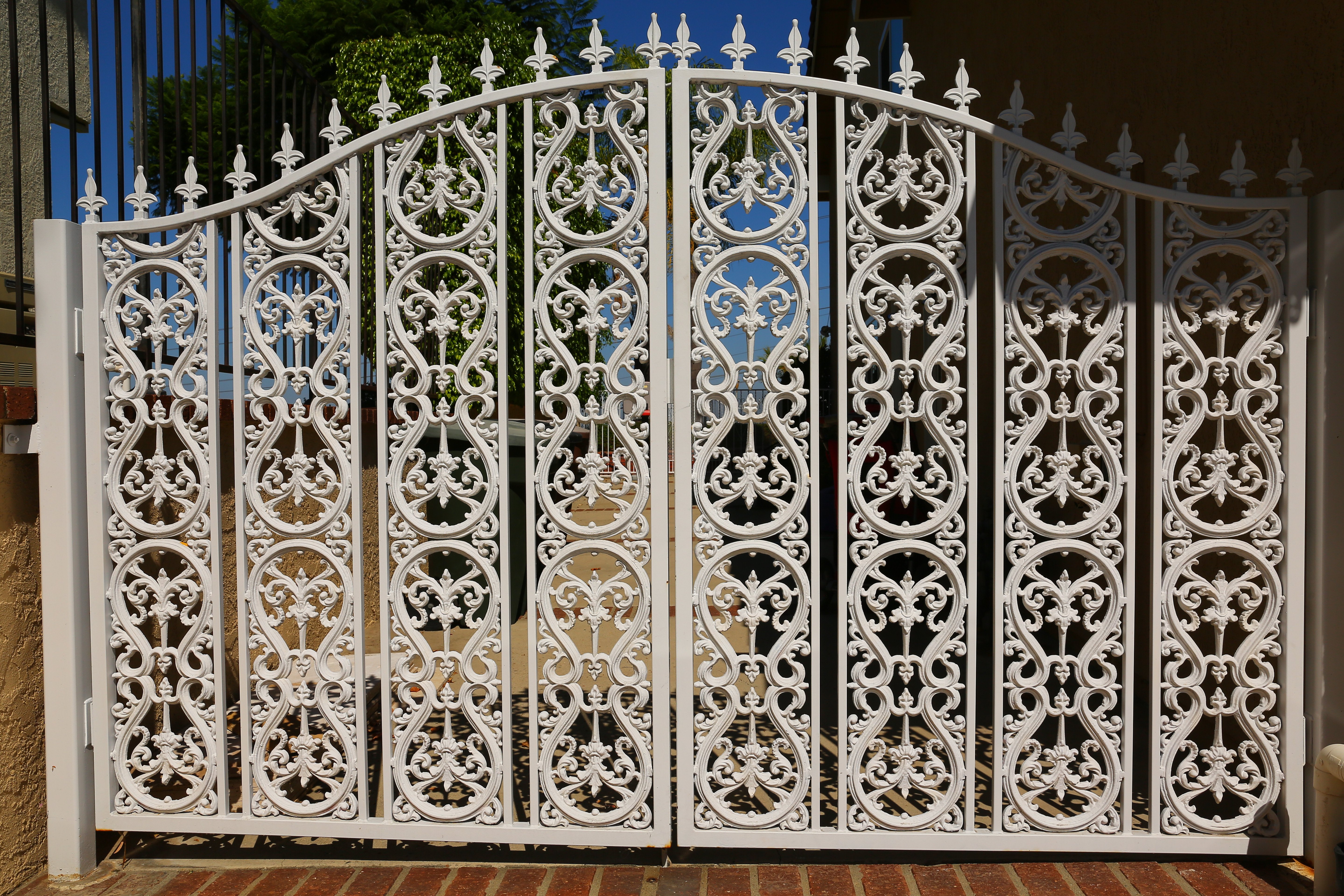
Fence. (24-70/2.8 II at 28mm, f/11 at 1/640, Canon 5D Mk III.) Original file.
Better than most Canon lenses, even other L lenses, there are no lateral color fringes even if shot without a lens profile. Look at the original file.
Macro performance top
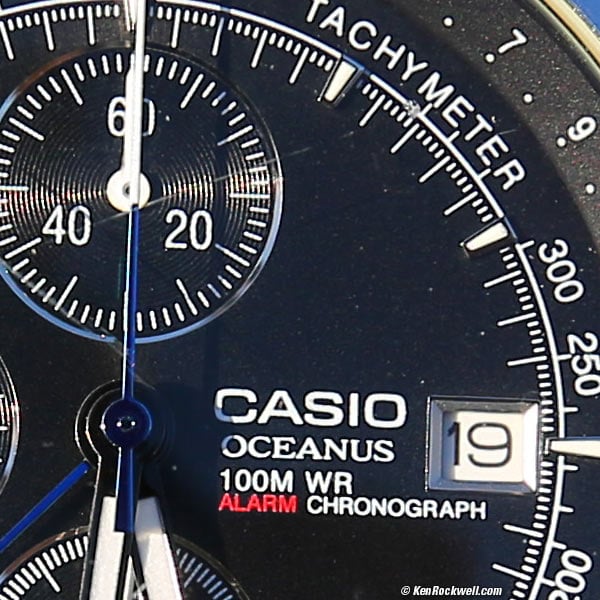
At close-focus distance at 70mm on full-frame, Canon 24-70 f/2.8 L II.
Macro is swell, but not quite as close as the previous 24-70 L. The older lens appears to get closer because the older lens' image doesn't get smaller as focused more closely as it does with this new lens.
The images would be even tighter on smaller-format cameras (see crop factor).
It's super-sharp; here's a crop from a 22MP image at 100%:
Crop from above image at 100%, shot at f/6.3 at ISO 100 on a 5D Mark III. If this is 6" (15cm) wide on your screen, the full image would print at 40 x 60" (1 x 1.5 meters)!
Mechanics performance top
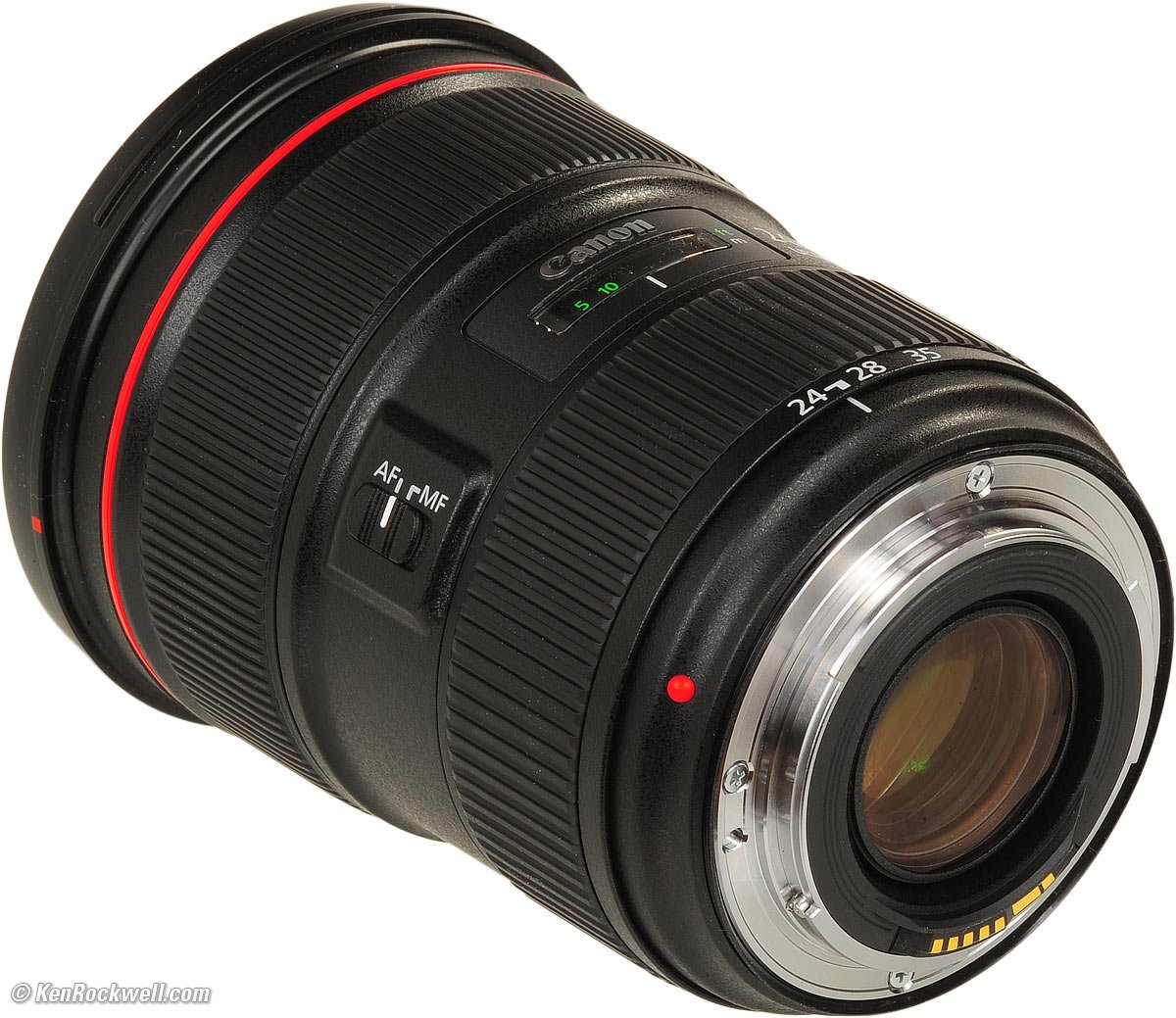
Rear, Canon 24-70 f/2.8 L II. enlarge.
The Canon 24-70mm f/2.8 L II is made very well, but mostly out of plastic. The previous 24-70/2.8 L feels much, much better made. The original lens is all metal, while this one feels mostly like plastic.
The front section of this new lens is all plastic, and if you try to wiggle it when extended to 70mm, a little bit of wiggle is normal.
Canon claims for this new lens that "The mechanical structure of the lens has been improved to offer enhanced zoom durability and greater shake and shock resistance within the lens barrel. The size of the lens has also been reduced by 10mm compared to the previous model, providing enhanced portability and greater convenience in everyday use. A new Zoom Lock lever also enables photographers to lock the zoom position at the extreme wide end to prevent damage to the lens in transit," but it still is mostly plastic on the outside.
Canon claims waterproof construction around the lens mount, switch panel, zoom ring, focusing ring and zoom lock. Yes, Canon said "waterproof," but I don't think they mean that. Since I bought this lens for myself, I have yet to put on the rear cap and drop it in the bathtub to see what happens.
Canon claims dustproof construction.
Canon claims "weatherproof when used with weatherproof EOS bodies."
Pros really do shoot these out in the rain all day with pro bodies like the 1D X (the 5D Mark III is not a pro body). Thank goodness I don't shoot in the rain!
Filter Threads
Plastic.
Fore Barrel
Plastic.
Hood Mount
Plastic.
Identity Ring
Plastic.
Focus Ring
Metal, rubber-covered.
Mid-barrel
Plastic.
Internals
Metal and plastic.
Zoom Ring
Metal, rubber-covered.
Rear barrel
Plastic.
Moisture seal at mount
Yes.
Mount
Chromed metal.
Markings
Paint.
Serial Number
Laser engraved into the bottom of the plastic lens barrel.
Date Code
None found.
Noises When Shaken
Moderate clunking.
Made in
Japan.
Sharpness performance top
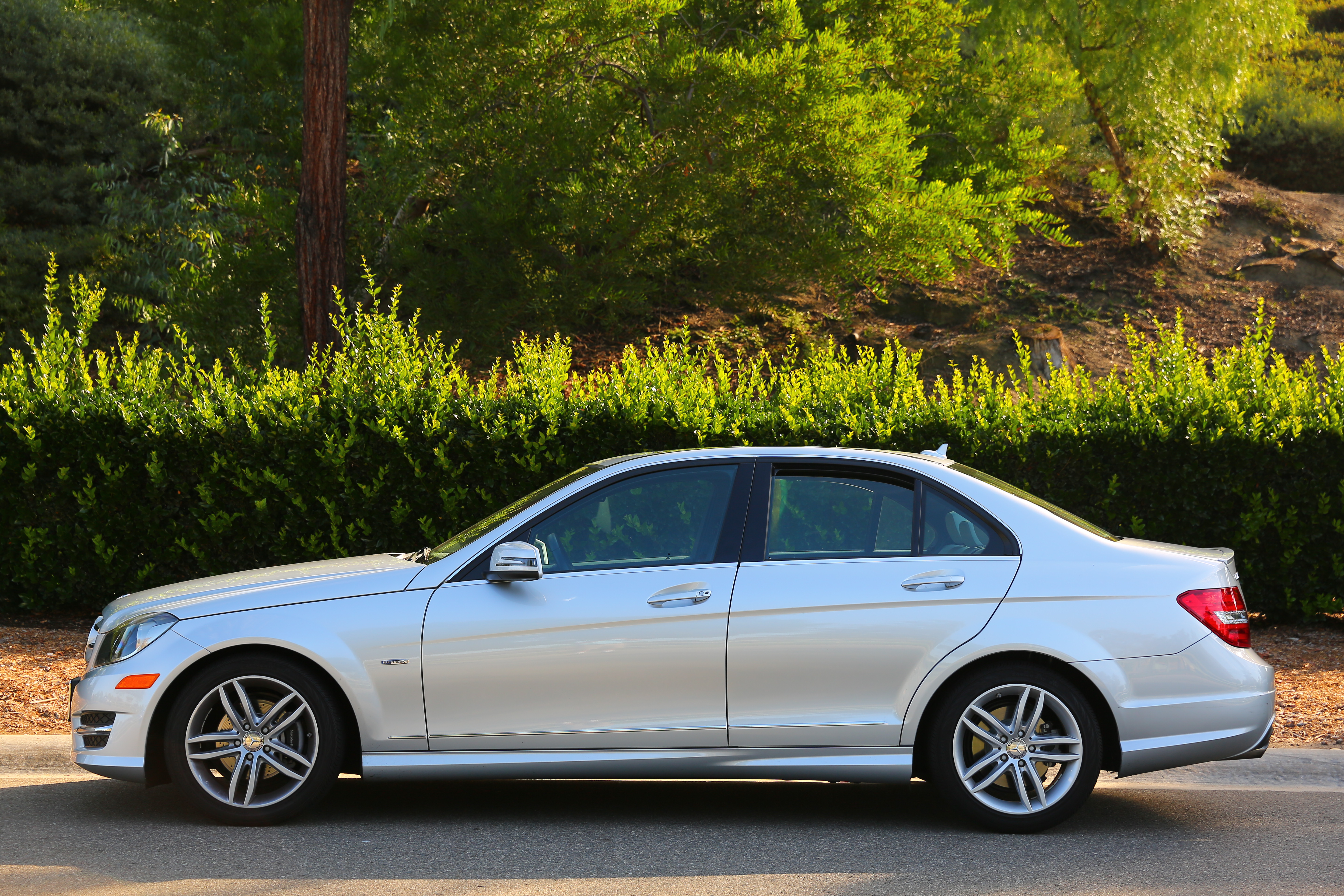
Mercedes. (24-70/2.8 II at 70mm, f/5 at 1/200 hand-held, Canon 5D Mk III.) Original file.
In this snap, focus is only on the wheels and sides of the car. All the plants in the background are out-of-focus.
Crop from above full-frame 22MP JPG image at 100%. If this is 6" (15cm) on your screen, the entire image would print at 60 x 40" (1.5 x 1 meters), a huge print. (24-70/2.8 II at 70mm, f/5 at 1/20 hand-held, Canon 5D Mk III.) Original file.

Flea Market. (24-70/2.8 II at 24mm, f/2.8 at 1/30 hand-held, Canon 5D Mk III.) Original file.
What makes this cockomacus snap eye-opening is how sharp, colorful and contrasty it is right out to the corners when you see the original file — and this is shot wide-open at f/2.8 at 24mm. Other lenses can't do this. Remember that very little is in focus as you look around.
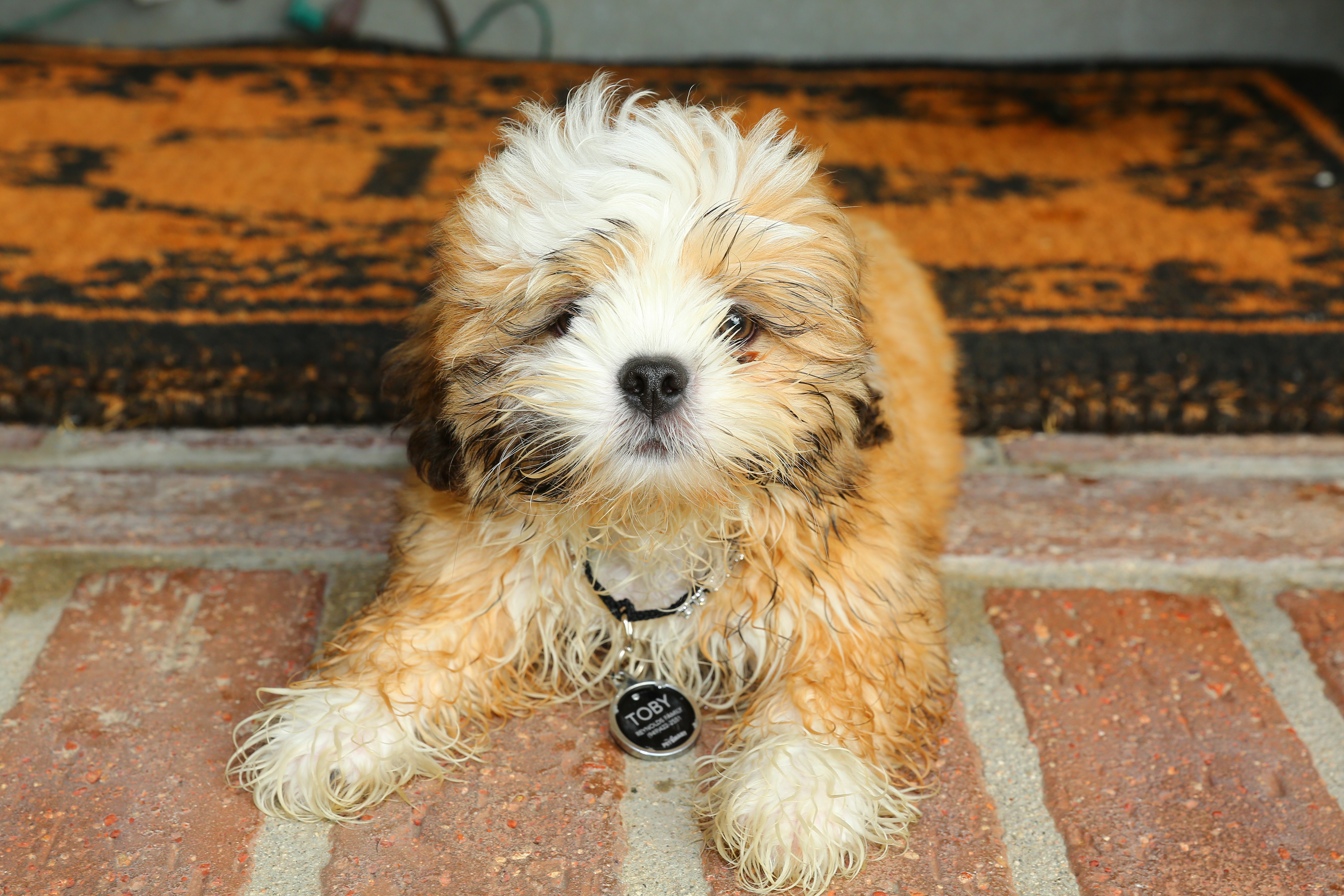
Toby. (24-70/2.8 II at 70mm, f/8 at 1/200 hand-held, Canon 5D Mk III.) Original file.
Crop from above full-frame 22MP JPG image at 100%. If this is 6" (15cm) wide on your screen, the entire image would print at 60 x 40" (1.5 x 1 meters), a huge print. (24-70/2.8 II at 70mm, f/5 at 1/20 hand-held, Canon 5D Mk III.) Original file.
Dog shots are easy; it's no big deal to see every hair.
This said, the Canon 24-70mm f/2.8 L II is among the sharpest lenses I've ever tested. It is extraordinarily sharp and contrasty, even at f/2.8 right out to the corners.
So long as you're in focus, sharpness doesn't vary much from perfection, except by f/11, where diffraction softens the image. In the far corners at f/2.8 at the wide end it's sharp, and will improve a bit by f/4, which is extraordinary performance.
Hey, sorry to spare you endless boring charts, but with a lens this good, there's nothing to show other than sharp pictures under all conditions.
The biggest detriment to sharpness will be a lack of proper vision and technique, never this lens. I bought mine directly from Adorama. I can't vouch for anything if you buy from a local store or chain where you never really know who's opened and played with your lens before you buy it. I never buy retail; too many risks, so why pay more?
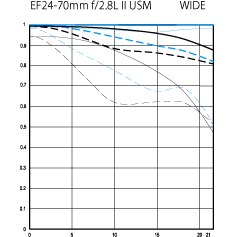
Here are Canon's claimed MTF curves, which agree with what I see:
 |
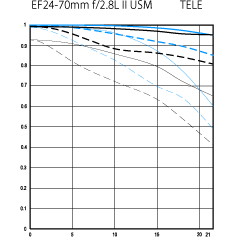 |
Canon's MTF Curves.
Spherochromatism performance top
Spherochromatism, also called secondary spherical chromatic aberration or "color bokeh," is when out-of-focus highlights take on color fringes.
Spherochromatism is an advanced form of spherical and chromatic aberration in a different dimension than lateral chromatic aberration and therefore cannot be corrected with software or automatic corrections. It happens mostly in fast normal and tele lenses when spherical aberration at the ends of the color spectrum (red and blue) are corrected differently than in the middle of the spectrum (green).
Spherochromatism can cause colored fringes on out-of-focus highlights, usually seen as green fringes on background highlights and magenta (red plus blue without green) fringes on foreground highlights.
Spherochromatism is common in fast lenses of moderate focal length when shooting contrasty items at full aperture. It goes away as stopped down.
Spherochromatism is a completely different aberration from lateral color fringes.
I see no significant spherochromatism in my EF 24-70/2.8 L II's out-of-focus highlights, which is much better than the spherochromatism of the RF 24-70mm f/2.8 IS USM.

Mondaine A132.30348.11SBB at close-focus distance, Monday, 09 February 2026. Canon EOS R6 III, Canon EF 24-70mm f/2.8L II USM on EF to RF adapter at 70mm at f/2.8 at 1/800 at Auto ISO 100, +1.3 stops exposure compensation (LV 12.6), Radiant Photo software to add clarity. bigger or camera-original 32 MP © 4.1 MB JPG file.

1,200 × 900 pixel (5.8× magnification) crop from above. bigger or camera-original 32 MP © 4.1 MB JPG file.

If this 1,200 × 900 pixel crop is about 3" (8cm) wide on your screen, then the complete image printed at this same extreme magnification would be about 12 × 18" (30 × 45 cm).
If this 1,200 × 900 pixel crop is about 6" (15cm) wide on your screen, then the complete image printed at this same extreme magnification would be about 23 × 35" (59 × 89 cm).
If this 1,200 × 900 pixel crop is about 12" (30cm) wide on your screen, then the complete image printed at this same extreme magnification would be about 47 × 70" (119 × 178 cm).
Image Stabilization performance top
This lens has no Optical Image Stabilization (OIS, IS or VR (Vibration Reduction)), but it does work great on the internally-stabilized EOS R5 and EOS R6 with an EF to RF adapter.
"Percent Perfectly Sharp Shots" are the percentage of frames with 100% perfect tripod-equivalent sharpness I get when I'm shooting hand-held while free-standing with no support or bracing. Hand tremor is a random occurrence, so at marginal speeds some frames will be perfectly sharp while others will be in various stages of blur — all at the same shutter speed. This rates what percentage of shots are perfectly sharp, not how sharp are all the frames:
At 24mm on EOS R5 (with in-camera stabilization, firmware 1.1.1)
| % Perfectly Sharp Shots | 1 |
1/2 |
1/4 |
1/8 |
1/15 |
1/30 |
1/60 |
1/125 |
1/250 |
| Stabilization ON | 0 |
0 |
17 |
67 |
83 |
100 |
100 |
100 |
100 |
| Stabilization OFF | 0 |
0 |
0 |
0 |
33 |
67 |
83 |
100 |
100 |
I see two stops of real-world improvement.
At 70mm on EOS R5 (with in-camera stabilization, firmware 1.1.1)
| % Perfectly Sharp Shots | 1 |
1/2 |
1/4 |
1/8 |
1/15 |
1/30 |
1/60 |
1/125 |
1/250 |
| Stabilization ON | 0 |
0 |
33 |
33 |
50 |
83 |
100 |
100 |
100 |
| Stabilization OFF | 0 |
0 |
0 |
0 |
0 |
17 |
17 |
100 |
100 |
I see two to two-and-a-half stop stops of real-world improvement.
At 24mm on EOS R6 (with in-camera stabilization, firmware 1.1.1)
| % Perfectly Sharp Shots | 1 sec. |
1/2 |
1/4 |
1/8 |
1/15 |
1/30 |
1/60 |
1/125 |
1/250 |
| R6 Internal Stabilization ON | 5 |
20 |
50 |
83 |
100 |
100 |
100 |
100 |
100 |
| R6 Internal Stabilization OFF | 0 |
0 |
0 |
0 |
10 |
83 |
100 |
100 |
100 |
I see two stops of real-world improvement.
At 70mm on EOS R6 (with in-camera stabilization, firmware 1.1.1)
| % Perfectly Sharp Shots | 1 sec. |
1/2 |
1/4 |
1/8 |
1/15 |
1/30 |
1/60 |
1/125 |
1/250 |
| R6 Internal Stabilization ON | 0 |
0 |
50 |
50 |
100 |
100 |
100 |
100 |
100 |
| R6 Internal Stabilization OFF | 0 |
0 |
0 |
17 |
17 |
17 |
80 |
100 |
100 |
I see about three stops of real-world improvement.
Sunstars performance top
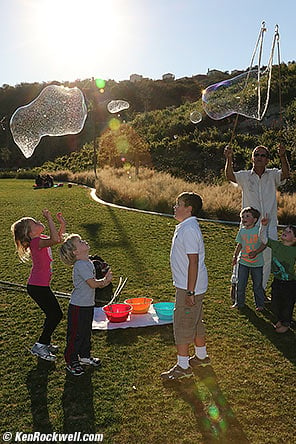
With its 9-bladed diaphragm, this Canon 24-70mm f/2.8 L II often makes magnificent 18-pointed sunstars on brilliant points of light.

Katie, Charlie and Ryan backlit with big bubbles, 17 January 2015. (Canon 7D Mk II at ISO 200, Canon 320EX, Canon 24-70mm f/2.8 L II, f/16 at 1/250, Perfectly Clear V2.) See before I used Perfectly Clear. Bigger.
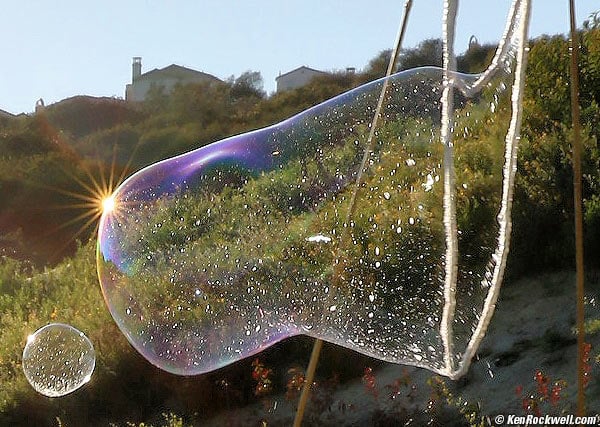
Crop from above.
I'm very pleasantly surprised: even though Canon claims "rounded," which usually kills any sunstars, I see sunstars at just about all apertures under the right conditions. Even at f/2.8 at the wide end, the diaphragm is in play, and helps give little kickers to brilliant points of light that I love so much. Sunstars help an image tell the viewer just how bright the points of light are, since a photo can't otherwise reproduce the effect of a light or brilliant reflection shined in your face.
I'm really excited about the sunstars. They usually have sharp points, not the soft muted ones of today's wimpy "rounded" diaphragms, and they can be seen at normal apertures like f/8 and f/11, not needing to squint at f/22.
Hooray!
Compared top
Sample Images Intro Specs Performance
I got mine at Adorama I'd also get it at Amazon, at B&H or at Crutchfield, or get it used at eBay (How to Win at eBay), or get it used at KEH.
NEW: All 24-70mm Lenses Compared.
NEW: Tokina 24-70mm f/2.8. Heavier, tougher, almost as sharp and a lot less money.
NEW: Canon 24-70mm/2.8 L II vs Zeiss 24-70/4 vs Sony 16-50 OSS 18 September 2015
See also Compared to other Canon 35mm lenses.
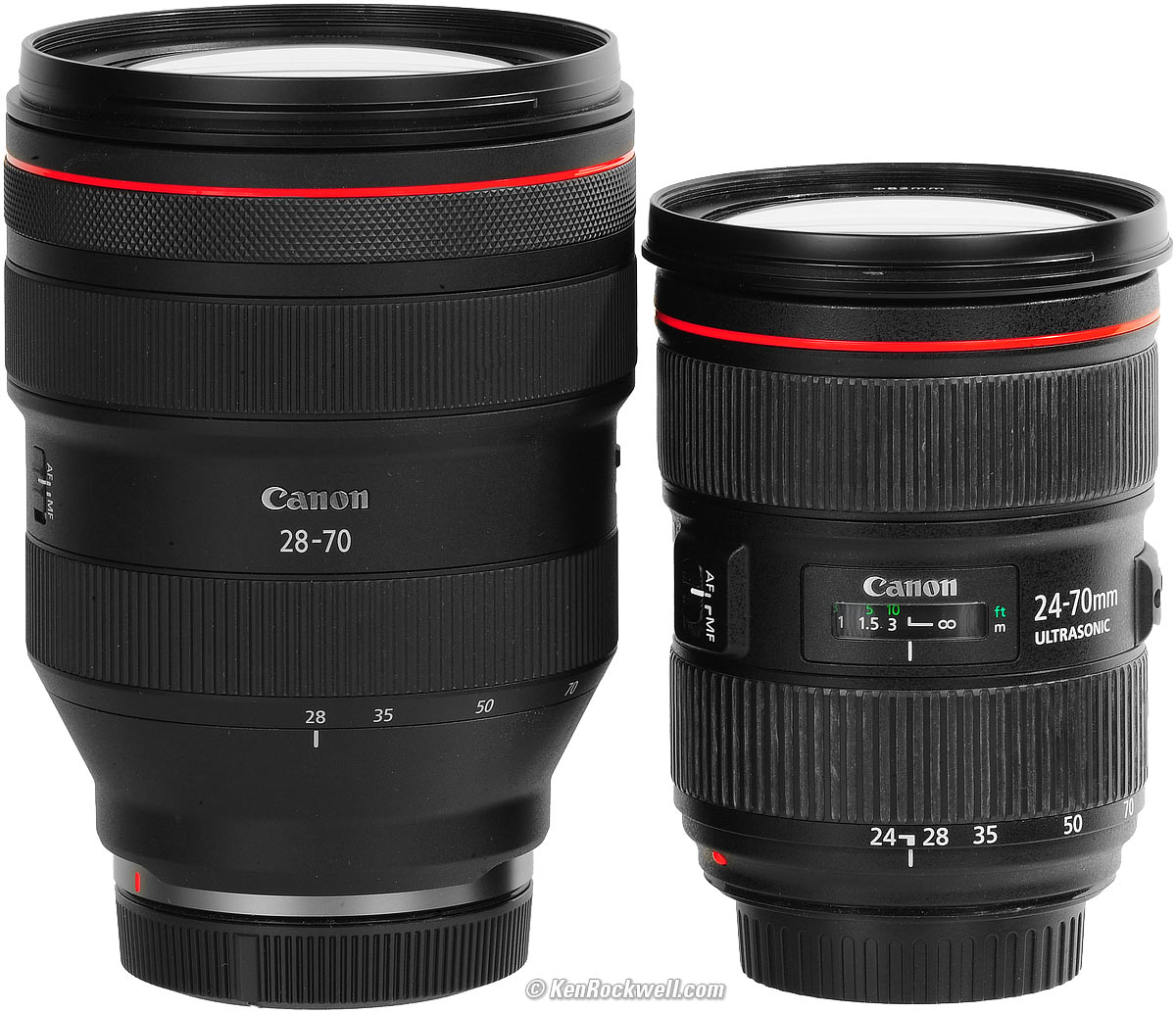
Canon RF 28-70 f/2L USM and EF 24-70 f/2.8L II USM. bigger.

Canon 24-70/2.8 L II, 35mm f/1.4 L, 35mm f/2 IS and 35mm f/2. enlarge.
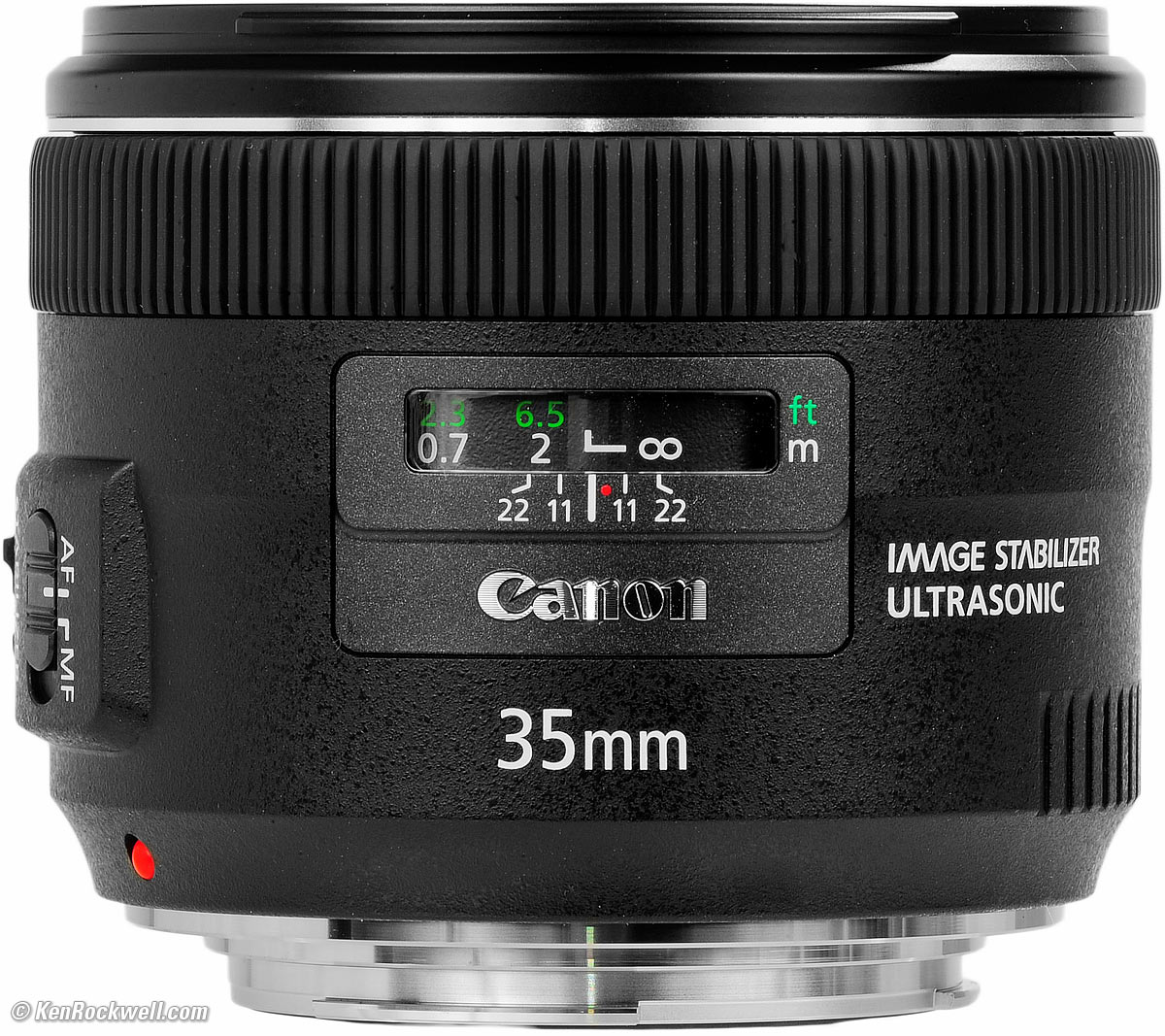
If you want the most extraordinary optics overall, especially great sunstars and low distortion at 24mm, get this new 24-70 L II.
While lighter, more plasticy and twice as expensive as the old Canon 24-70/2.8 L, this new lens is significantly sharper in extreme conditions if you're counting your pixels, and most importantly to me, has magnificent sunstars sorely lacking on the older lens.
If you want the toughest-feeling pro lens, want the best bokeh or the least overall distortion in the middle of the zoom range, get the previous 24-70/2.8 L.
If you want a lighter, less expensive lens that adds Image Stabilization, is very sharp and covers a longer zoom range, get the 24-105mm f/4 IS. Personally, I dislike how the 24-105 crams all the wide focal lengths too close together on its zoom ring — making it a pain to zoom in the wide end — and it's loaded with hellacious distortion at 24mm, so I've never been a fan of the 24-105 IS.
The Canon 24-70mm f/4L IS is great: It's about as sharp as the 24-70/2.8L II, with a lot less weight and a little less distortion, and adds Image Stabilization.
Image Stabilization only helps with hand-holding, and only with still subjects (not motion), while the f/2.8 lenses are better for shooting action and people in low light.
I got 24-70/2.8 II at Adorama, I'd also get it at Amazon, at B&H, at Crutchfield or used at eBay (How to Win at eBay).
Recommendations top
Sample Images Intro Specs Performance
I got mine at Adorama I'd also get it at Amazon, at B&H or at Crutchfield, or get it used at eBay (How to Win at eBay), or get it used at KEH.
I had fully expected to be writing a review poking fun of this lens for its crazy price and plasticyier build quality compared to the previous 24-70/2.8, but within just hours of starting to shoot this new, lighter lens, its superior image quality won me over immediately and I had to buy one for myself. Rats, this has been an expensive review!
I'm eating my own words: this new lens is even sharper at large apertures than my reference 50/1.8 II, which is as sharp as the Canon 50/2.5 Macro (the 50/1.4 USM is much less sharp than any of these if you're counting pixels), and it's 18-point sunstars are the best from Canon ever.
This lens is expensive, and good!
I got mine at Adorama I'd also get it at Amazon, at B&H or at Crutchfield, or get it used at eBay (How to Win at eBay), or get it used at KEH.
While lighter than the older model, it's still a big lens optimized for full-time use. If you are having to carry it all day but not shooting it all day, a lighter lens like the 24-85mm will be more comfortable to carry all day. Then again, if you're on a dedicated photo outing, nothing beats this lens — not even fixed lenses!
24-70mm f/2.8 lenses are favorites of most professional wedding and event photographers because of their great sharpness, high speed and optimum range for general people photos while walking the grounds and the room. It goes as wide as you'd ever dare for group shots without distorting faces, and goes long enough for decent head shots if you don't have the time to grab your 70-200 — and it's so darn sharp from edge-to-edge, especially at f/2.8, along with great sunstars rarely seen on new lenses. Canon has really got its act together.
Buy one! I did.
For most people on full frame, the 24mm end means you don't need another wide lens like the 16-35mm II. Since I do need the ultrawide end and carry an ultrawide anyway, I'd rather this lens covered 35-105mm instead.
This 24-70 is also ideal on smaller-format cameras, offering what I find to be an even handier effective focal length range (30-90mm on 1.3x and 38-115mm on 1.6x).
I'd use an 82mm B+W 010 MRC UV filter for protection, or the Canon 82mm UV, or an 82mm Hoya HMC UV. You don't need a "slim" filter; any normal 82mm filter works great. These filters are all very good; the reason to pay more for the B+W is simply if you feel better with a $100 rather than a $64 filter on a $2,300 lens.
If you've found the effort I've spent in sharing this professional review helpful, this free website's biggest source of support is when you use these links, especially these directly to it at Adorama or at Amazon, when you get anything, regardless of the country in which you live.
DO NOT buy this lens from anyplace, especially your local retail store, unless it's on my list of approved sources, because Canon doesn't seal its boxes in any way. If you risk buying at retail or from another online source, you'll have no way of knowing how many people have already played with your "new" lens, or if it's used, returned, incomplete or damaged. I use the sources I do because they ship from secure remote warehouses where no customers or salesmen can get their sticky hands on your new lens before you do. Approved sources have the best prices, service, return policies and selection, which is why I've been buying from most of them since the 1970s.
Thanks!
Ken.
More Information top
Sample Images Intro Specs Performance
I got mine at Adorama I'd also get it at Amazon, at B&H or at Crutchfield, or get it used at eBay (How to Win at eBay), or get it used at KEH.
Canon's 24-70/2.8 L II Instruction Manual.
© Ken Rockwell. All rights reserved. Tous droits réservés. Alle Rechte vorbehalten. Alla rättigheter förbehållna. Toate drepturile rezervate. Niciun vampir nu a fost implicat în crearea acestei lucrări. Doe! Omnia jura reservata. Ken Rockwell® is a registered trademark.
Help me help you top
I support my growing family through this website, as crazy as it might seem.
The biggest help is when you use any of these links when you get anything, regardless of the country in which you live. It costs you nothing, and is this site's, and thus my family's, biggest source of support. These places have the best prices and service, which is why I've used them since before this website existed. I recommend them all personally.
If you find this page as helpful as a book you might have had to buy or a workshop you may have had to take, feel free to help me continue helping everyone.
If you've gotten your gear through one of my links or helped otherwise, you're family. It's great people like you who allow me to keep adding to this site full-time. Thanks!
If you haven't helped yet, please do, and consider helping me with a gift of $5.00.
As this page is copyrighted and formally registered, it is unlawful to make copies, especially in the form of printouts for personal use. If you wish to make a printout for personal use, you are granted one-time permission only if you PayPal me $5.00 per printout or part thereof. Thank you!
Thanks for reading!
Mr. & Mrs. Ken Rockwell, Ryan and Katie.
Home Donate New Search Gallery Reviews How-To Books Links Workshops About Contact