Nikon Digital History
List of all Nikon Mirrorless & DSLR Cameras
Nikon Mirrorless Mirrorless Lenses All Nikon Lenses Nikon Flash All Reviews
List of Nikon FX Cameras List of Nikon DX Cameras
Introduction
This is an historical summary of all Nikon mirrorless and DSLR cameras. Click the links to individual reviews for details and comparisons. I cover 35mm and Pronea cameras as well as the Nikon 1 system elsewhere.
A year in digital cameras is equal to 25 regular years. A camera introduced 2-1/2 years ago may as well be 62 years old. It's completely obsolete.
This article reads backwards. The newest is on top. Click any photo to get to its review.
2025

Nikon Z5 II and Z 24-50mm.
Thursday, 03 April 2025: Stabilized FX 24 MP, 15 (30) FPS, ISO 100~64,000 (50~204,800), 4K60, two slots for SD cards, 24.7 oz./700g with battery and one card.
2024

Nikon Z50 II and Nikon Z 16-50mm DX VR.
Thursday, 07 November 2024: 21 MP DX @ 30 FPS, 4K/60, ISO 100~51,200 (204,800 H2), 19.4 oz./550g with battery and card, one SD card slot, $907 at introduction.

Nikon Z6 III and Nikon Z 24-120mm f/4.
17 June 2024: Stabilized 24MP FX to 60 FPS, DX to 120 FPS, ISO 100~64,000 (50L~204,800H), 6K/60, 26.8 oz./760g with battery and one card, has one SD card slot and a second XQD card slot that also works with CFexpress type B cards, $2,497 at introduction.
2023
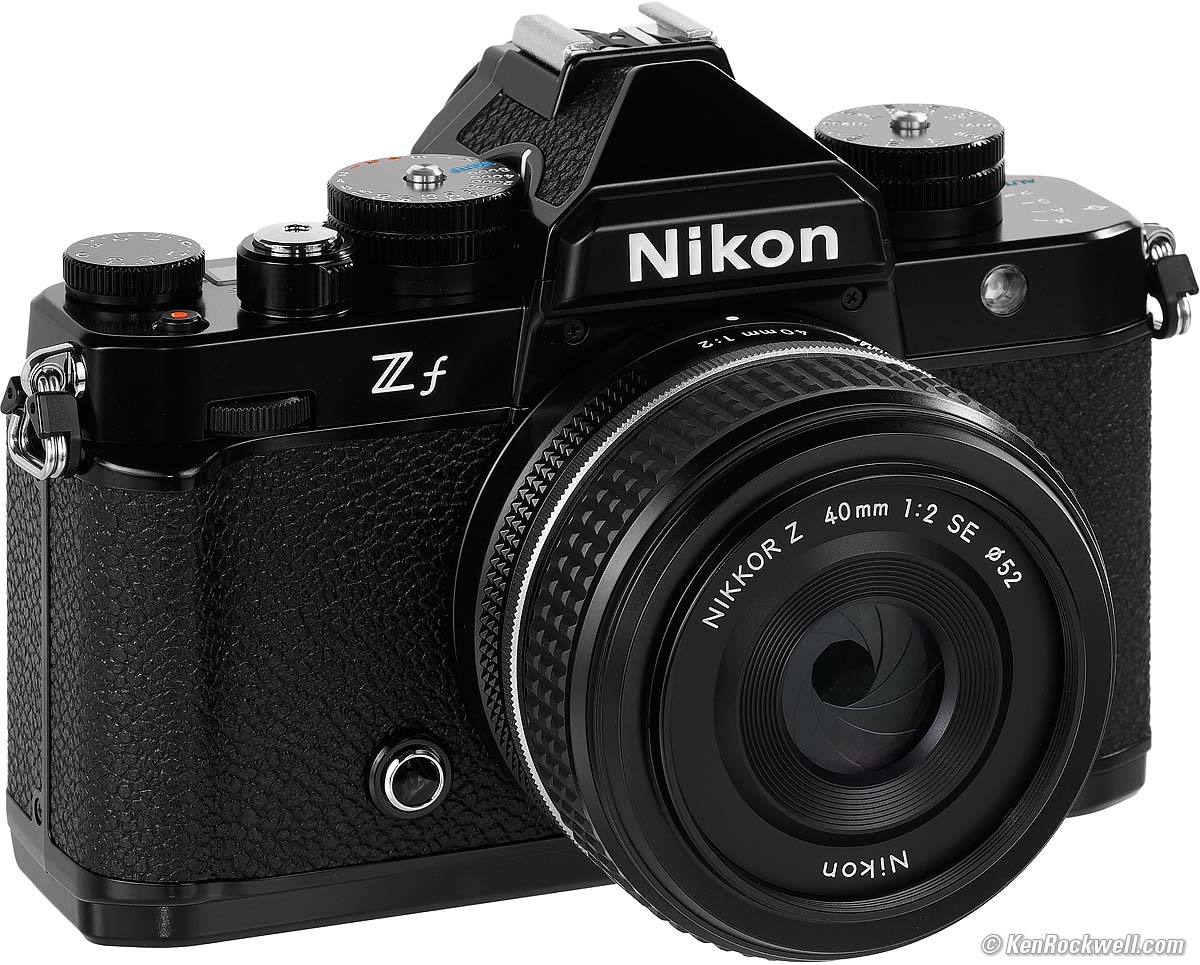
Nikon Zf and Nikon Z 40mm f/2 Special Edition.
19 September 2023: Mirrorless stabilized 24MP FX, ISO 100~64,000 (50L~204,800H), Silent 14 FPS, 4K60, 25.1 oz./710g with battery and one SD card, also has a second micro SD slot, $1,997 at introduction.
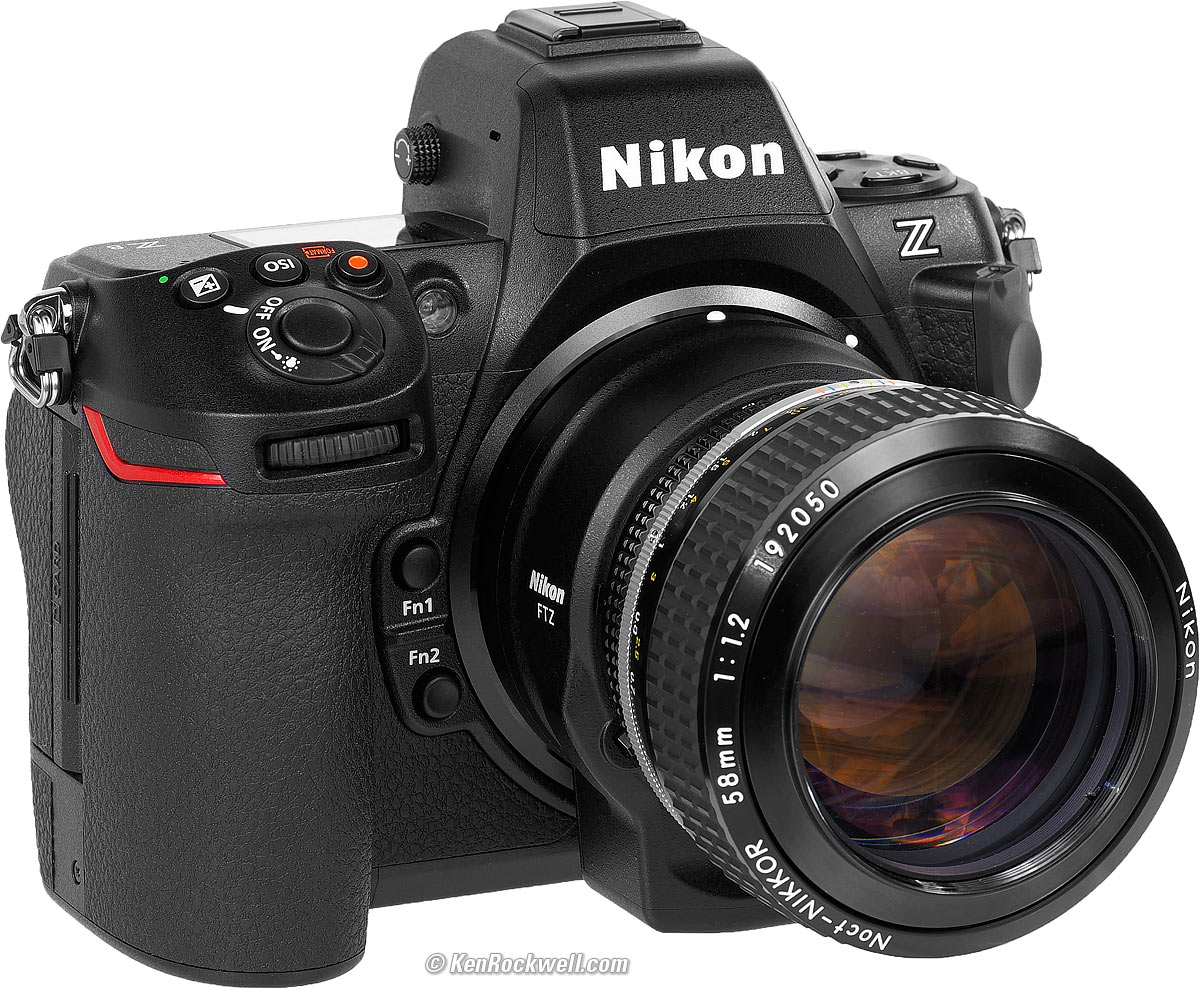
Nikon Z8 and Nikon AI Noct-NIKKOR 58mm f/1.2s on FTZ.
10 May 2023: FX stabilized mirrorless: 120 FPS @ 11 MP, 30 FPS @ 45MP (20 FPS raw) w/PreCapture, 8.3K/60, 4K/120, ISO 64~25,600 (32L~102,400H), 31.7 oz./899g with battery and one card, two slots: one takes your choice of CFexpress type B or XQD and the other takes an SD card. $3,997 at introduction,
2022
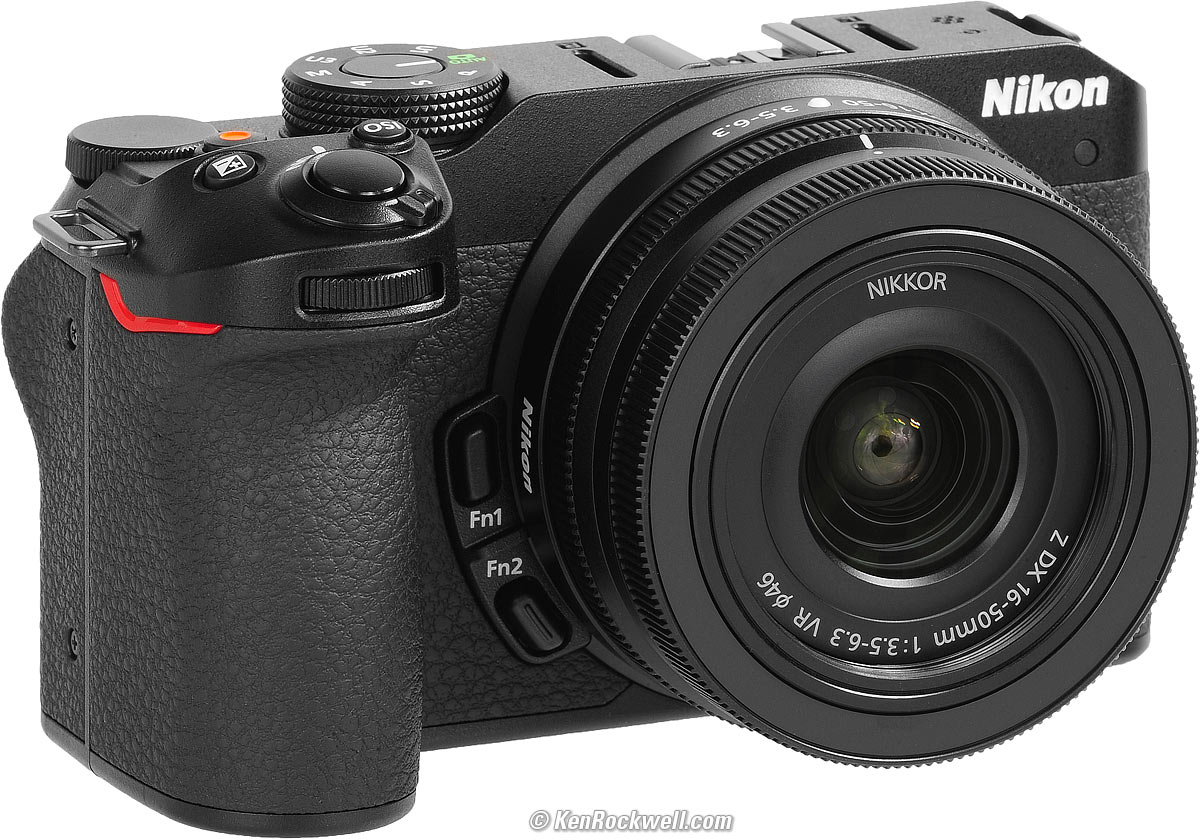
Nikon Z30 and Nikon Z 16-50mm VR.
29 June 2022: No Viewfinder, 21 MP APS-C DX, 11 FPS, 4K/30, ISO 102,400, 3" flip LCD, 14.2 oz./404g with battery and SD card.
2021
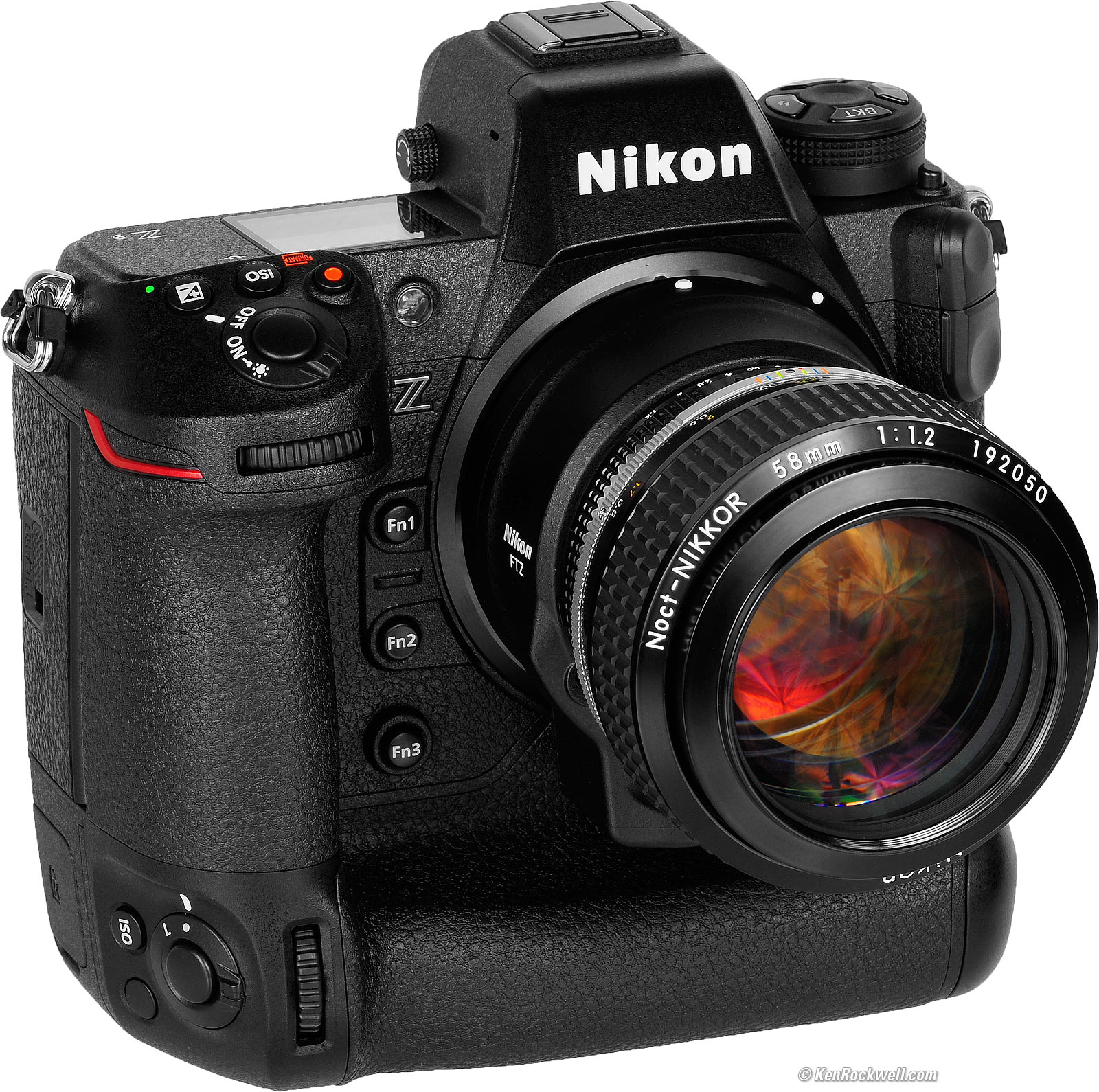
Nikon Z9 and Nikon AI Noct-NIKKOR 58mm f/1.2s on FTZ.
28 October 2021: FX Mirrorless, 45 MP @ 30FPS (20FPS in raw), 11 MP @ 120 FPS, 8K/29.97 video, 47.3 oz./1,340g with battery and one card, two slots for CFexpress type B or XQD cards, $5,496.95 at introduction. (Even as of March 2021 was in such demand that used ones sold for about $7,500 over eBay if you know How to Win at eBay.)
Only became orderable with full specifications and photos on 28 October 2021; Nikon teased us with just the model number "Z9" on 09 March 2021, and only revealed 30 FPS (but nothing else) on 16 June 2021.
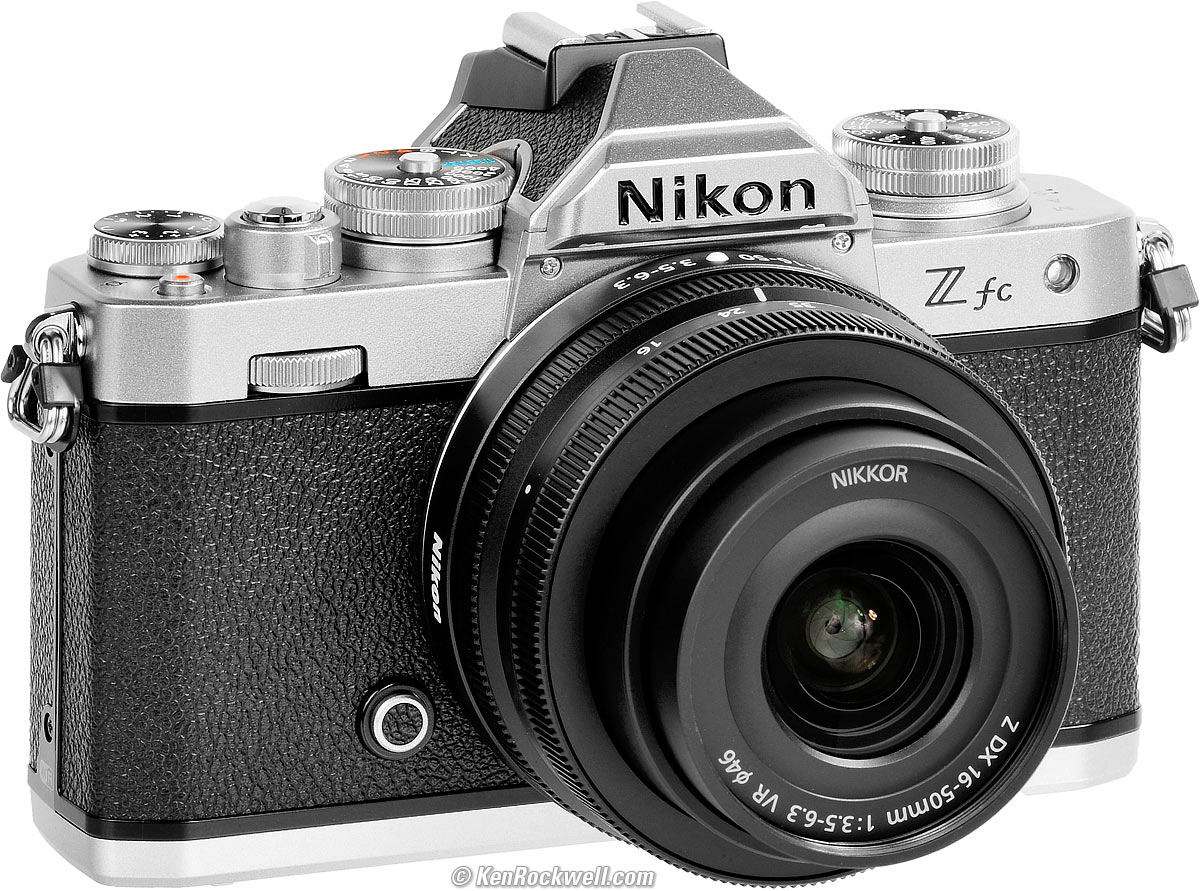
Nikon Z fc and Nikon Z 16-50mm DX VR.
29 June 2021: 21 MP DX @ 11 FPS, ISO 51,200/204,800, 4K, 15.7 oz./445g with battery and SD card, $957 at introduction.
2020
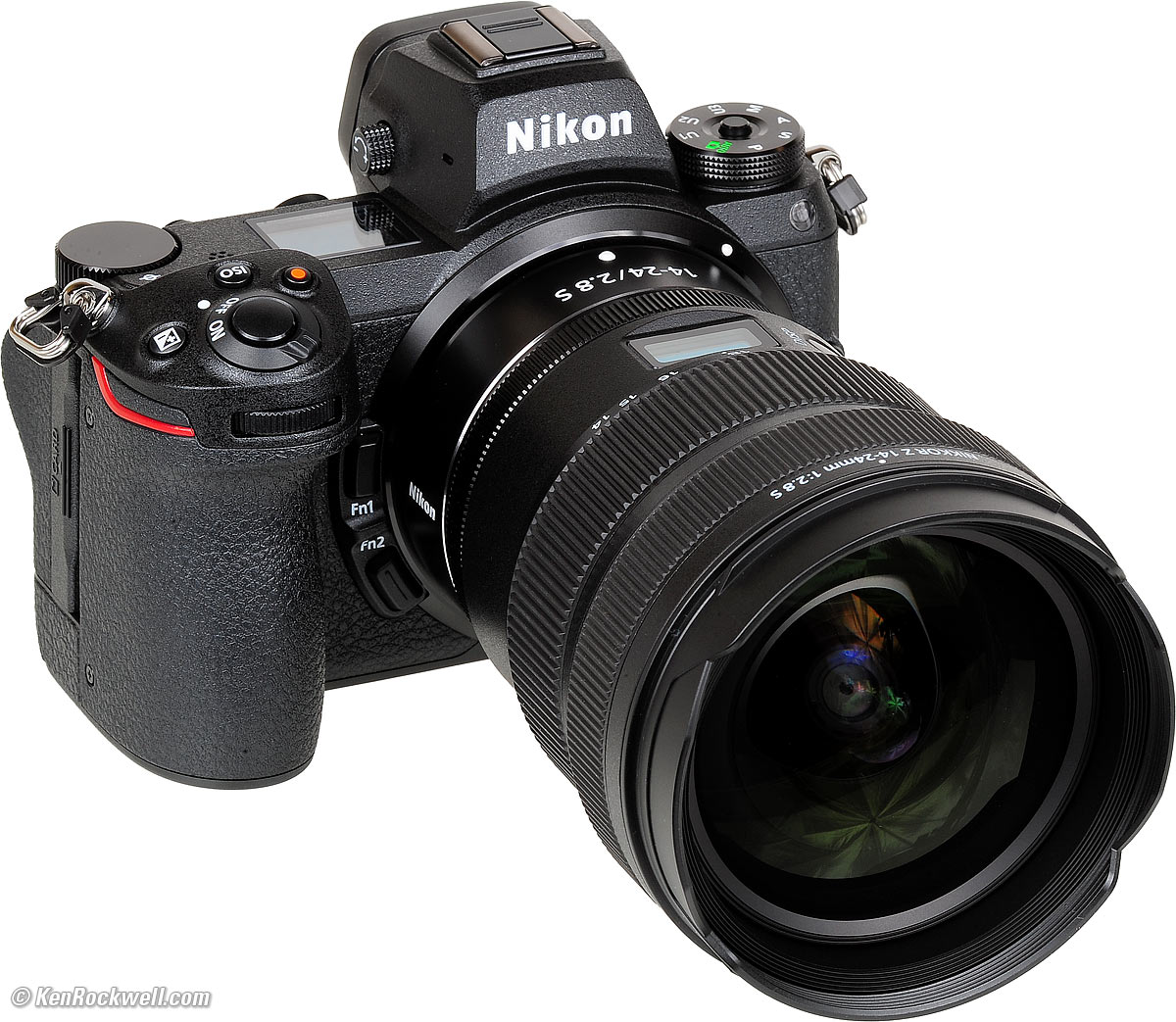
Nikon Z7 II and Nikon Z 14-24mm f/2.8 S.
14 October 2020: 45 MP FX Mirrorless, 10 FPS, ISO 102,400, $2,997, 24.9 oz./705g with battery and one card, has one SD card slot and a second XQD card slot that also works with CFexpress type B cards.
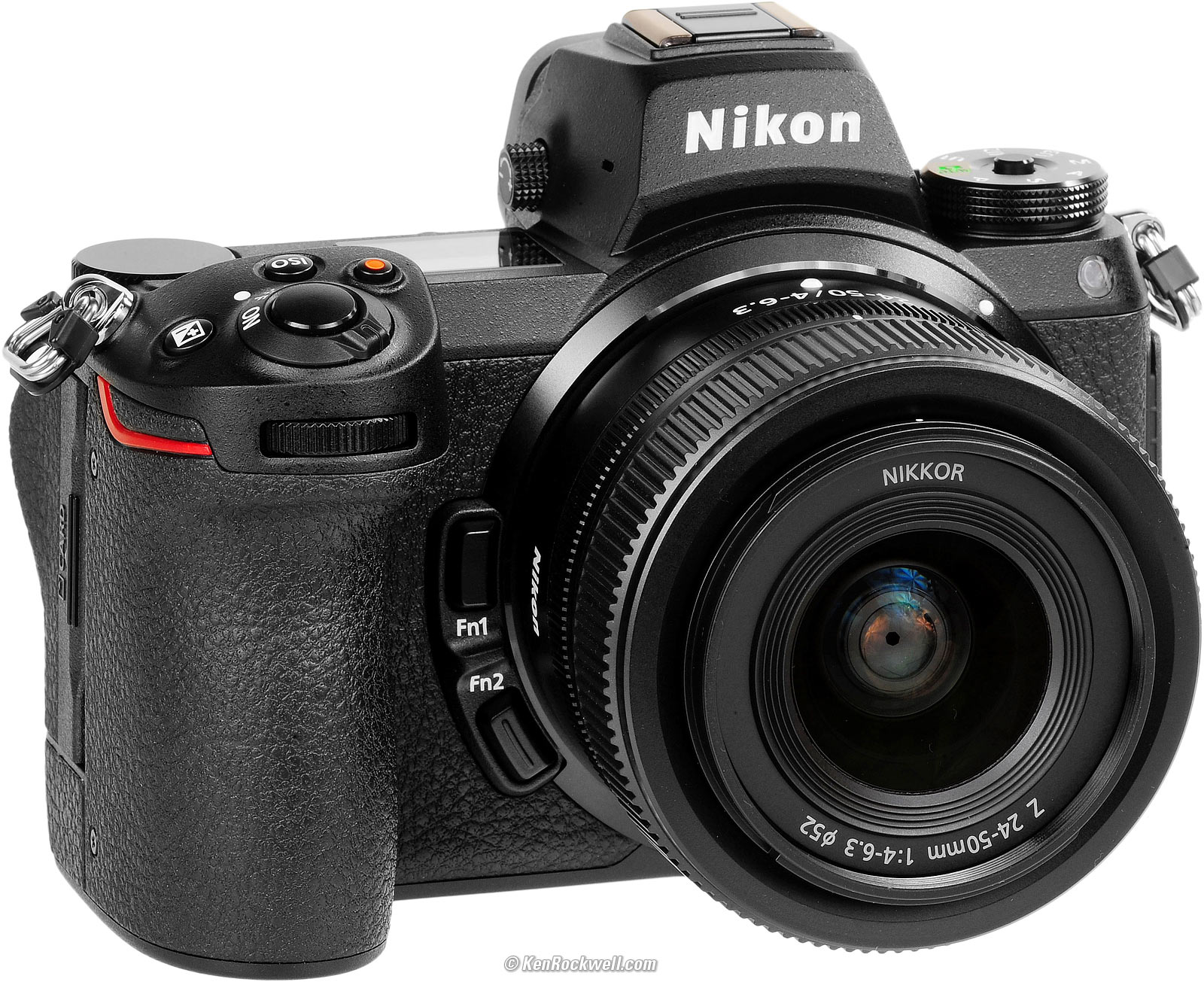
Nikon Z6 II and Nikon Z 24-50mm.
14 October 2020: 24 MP FX Mirrorless, 14 FPS, ISO 204,800, $1,997, 24.9 oz./705g with battery and one card, has one SD card slot and a second XQD card slot that also works with CFexpress type B cards.
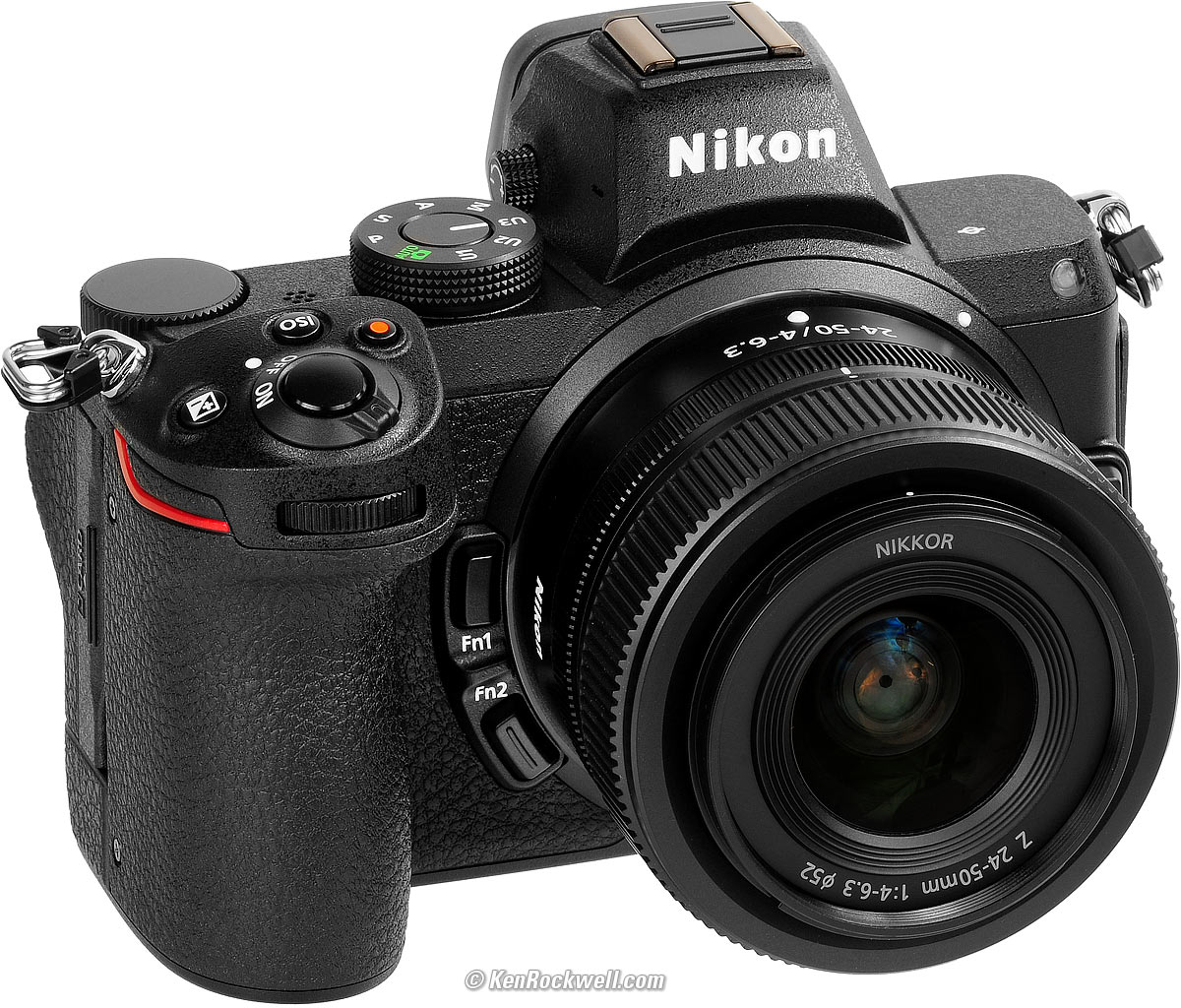
Nikon Z5 and Nikon Z 24-50mm f/4-6.3.
21 July 2020: 24 MP FX Mirrorless, 4½ FPS, ISO 102,400, 23.8 oz./675g with battery and SD card, $1,397.
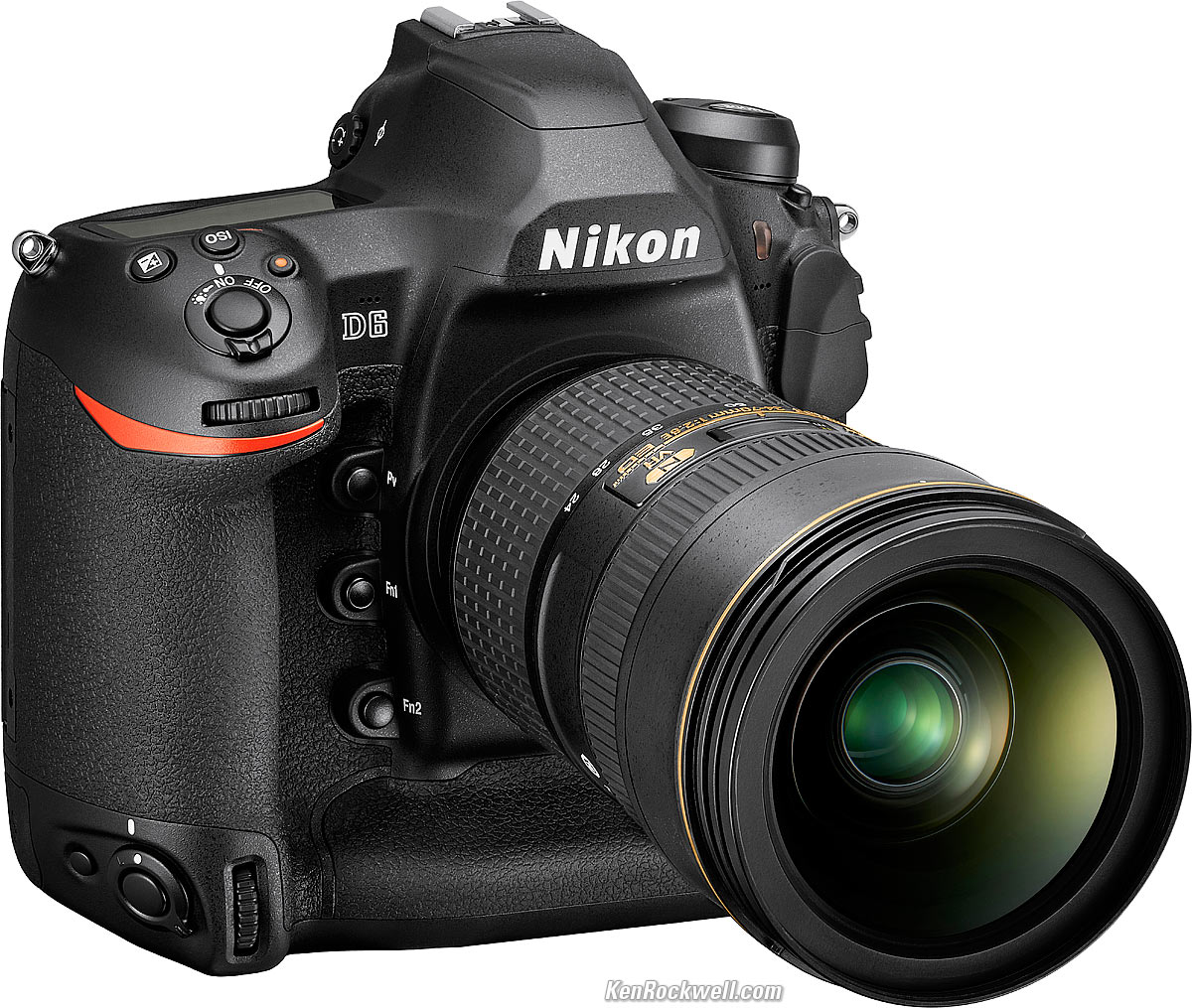
Nikon D6 and 24-70mm f/2.8E VR.
12 February 2020: 20⅔ MP FX, 14 FPS, ISO 102,400, two CFexpress card slots, 51.2 oz./1,450g with battery and 2 CFexpress cards, $6,497.
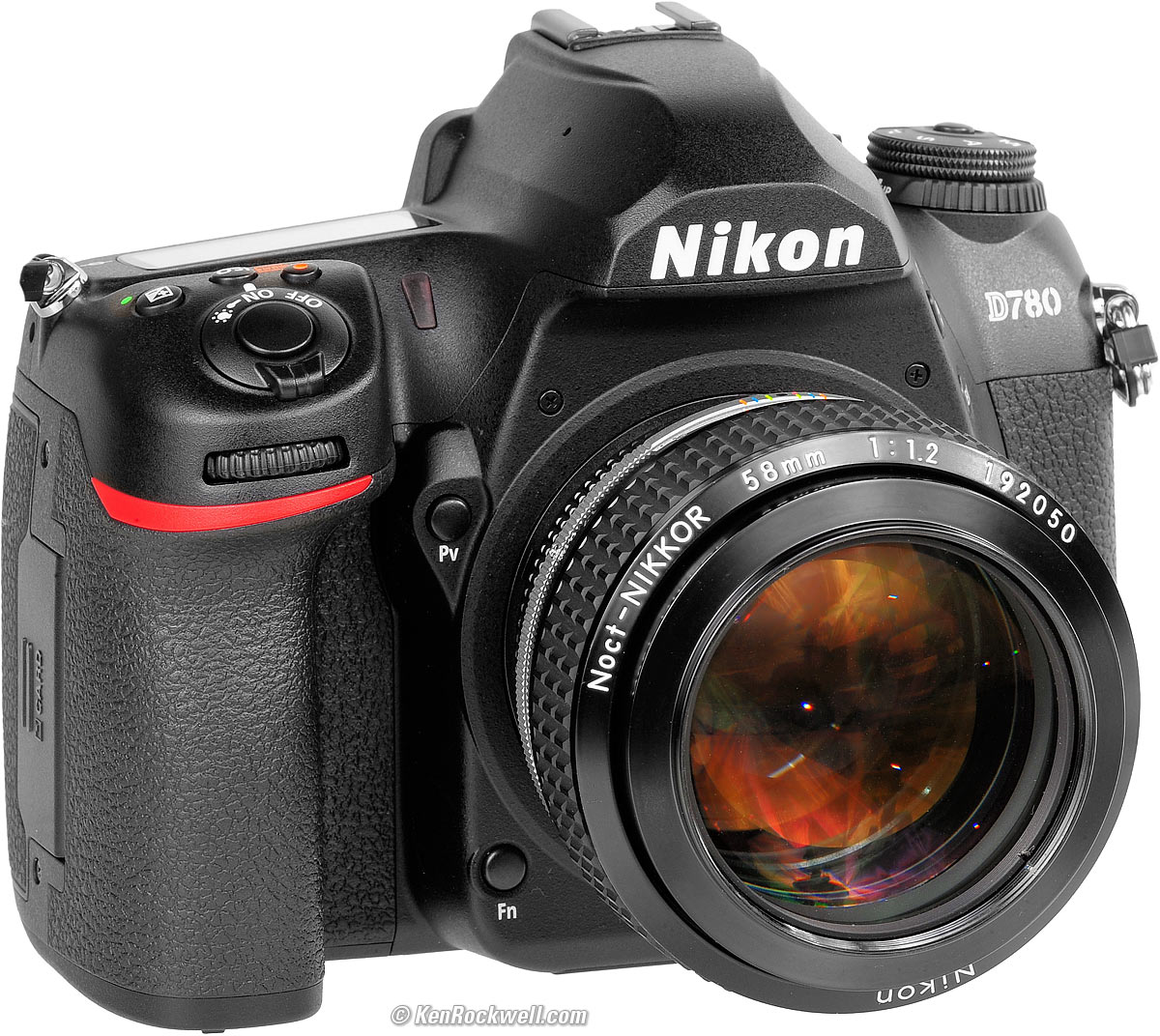
Nikon D780 and Nikon 58mm f/1.2 Noct-Nikkor.
07 January 2020: 24 MP FX, 7 FPS, 29.7 oz./840g with battery and card, two SD slots, $2,297.
2019
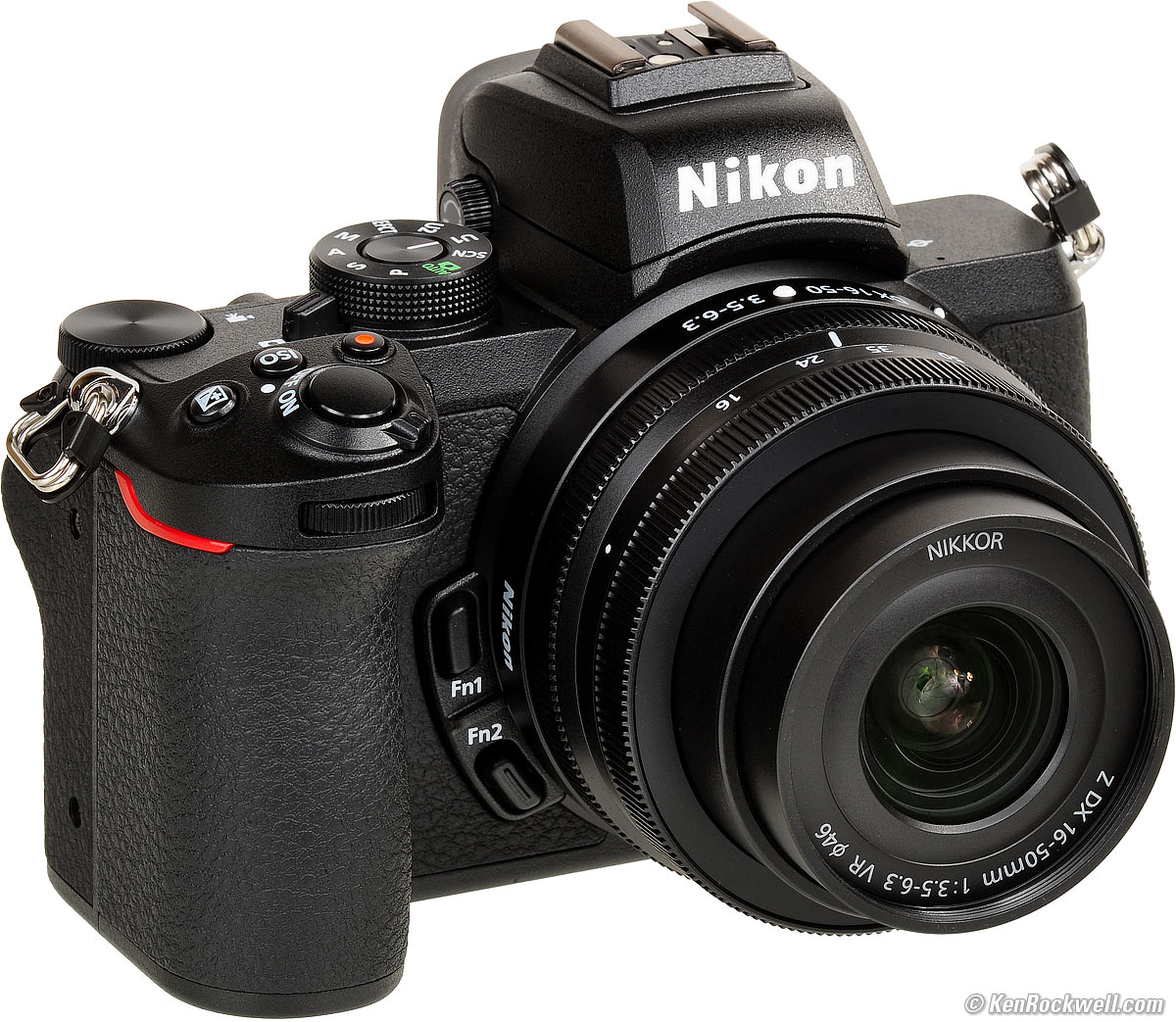
Nikon Z50 and 16-50mm VR DX.
10 October 2019: 21 MP DX Mirrorless, 11 FPS, 15.7 oz./446g with battery and card, one SD card slot, $857.
2018
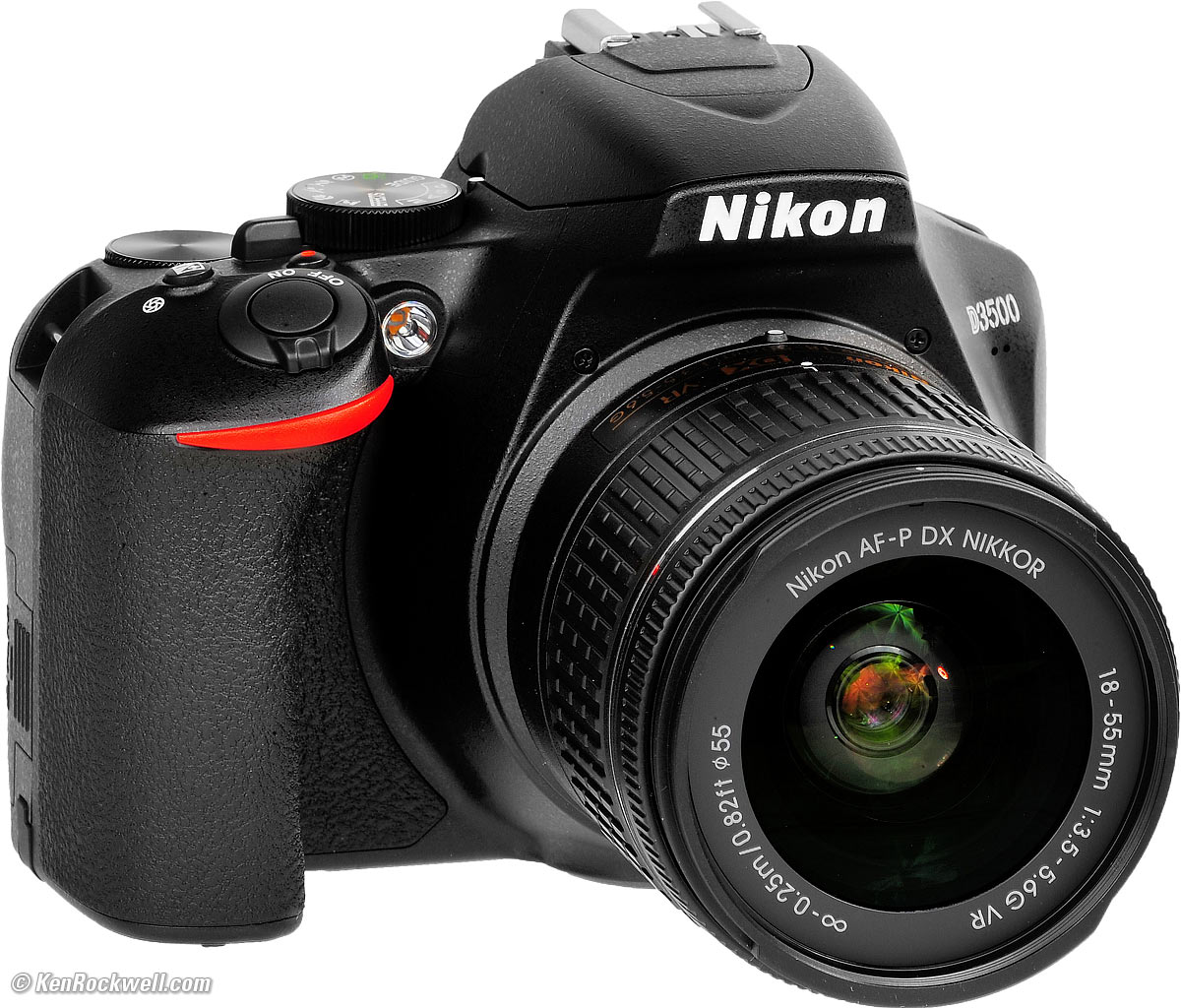
Nikon D3500 and included 18-55mm VR DX AF-P.
30 August 2018: 24 MP DX, 5 FPS, $497 with lens.
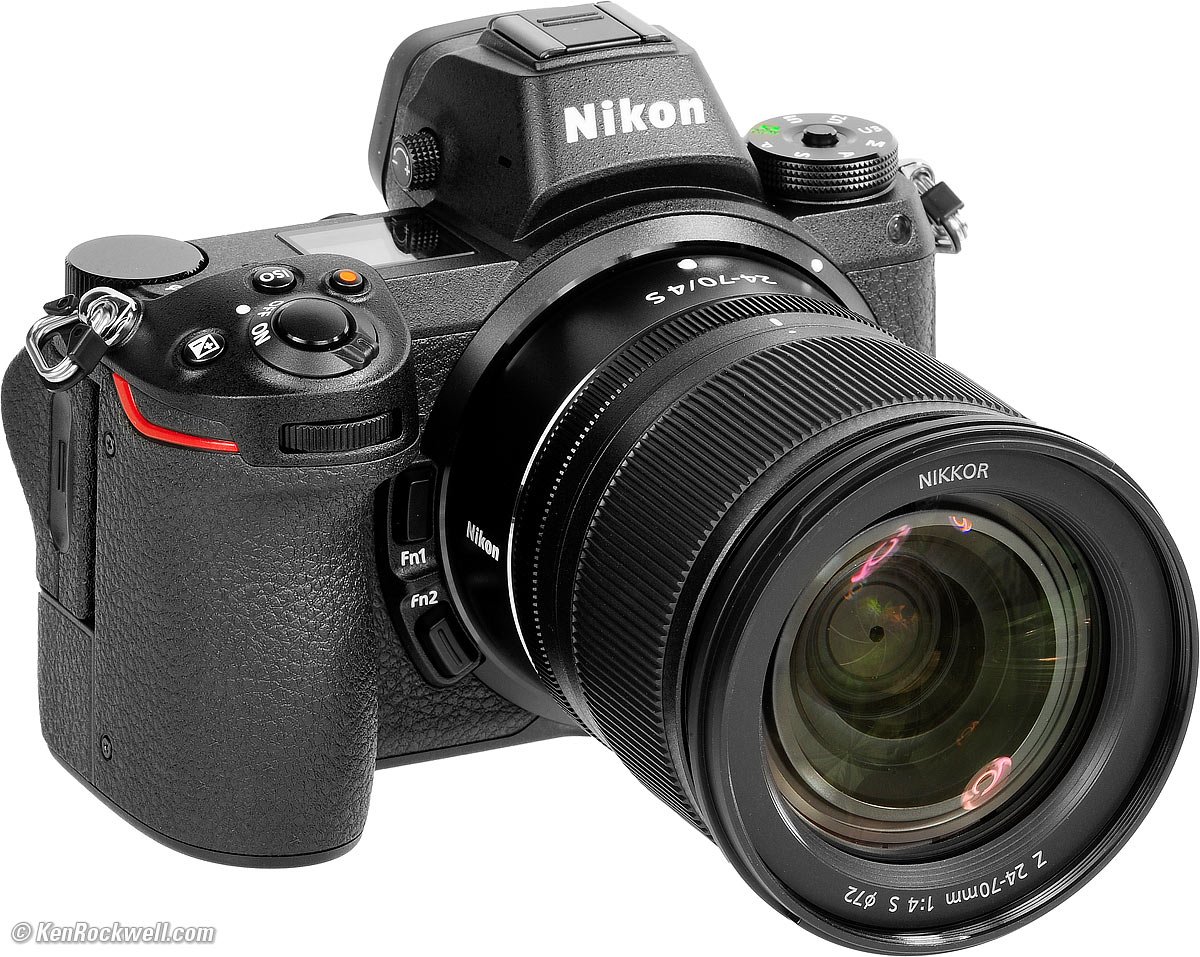
Nikon Z7 and Z 24-70/4 S.
23 August 2018: 45 MP FX Mirrorless, 9 (5.5) FPS, 23.8 oz./675g with battery and XQD card, $3,397, promised for 27 September 2018.
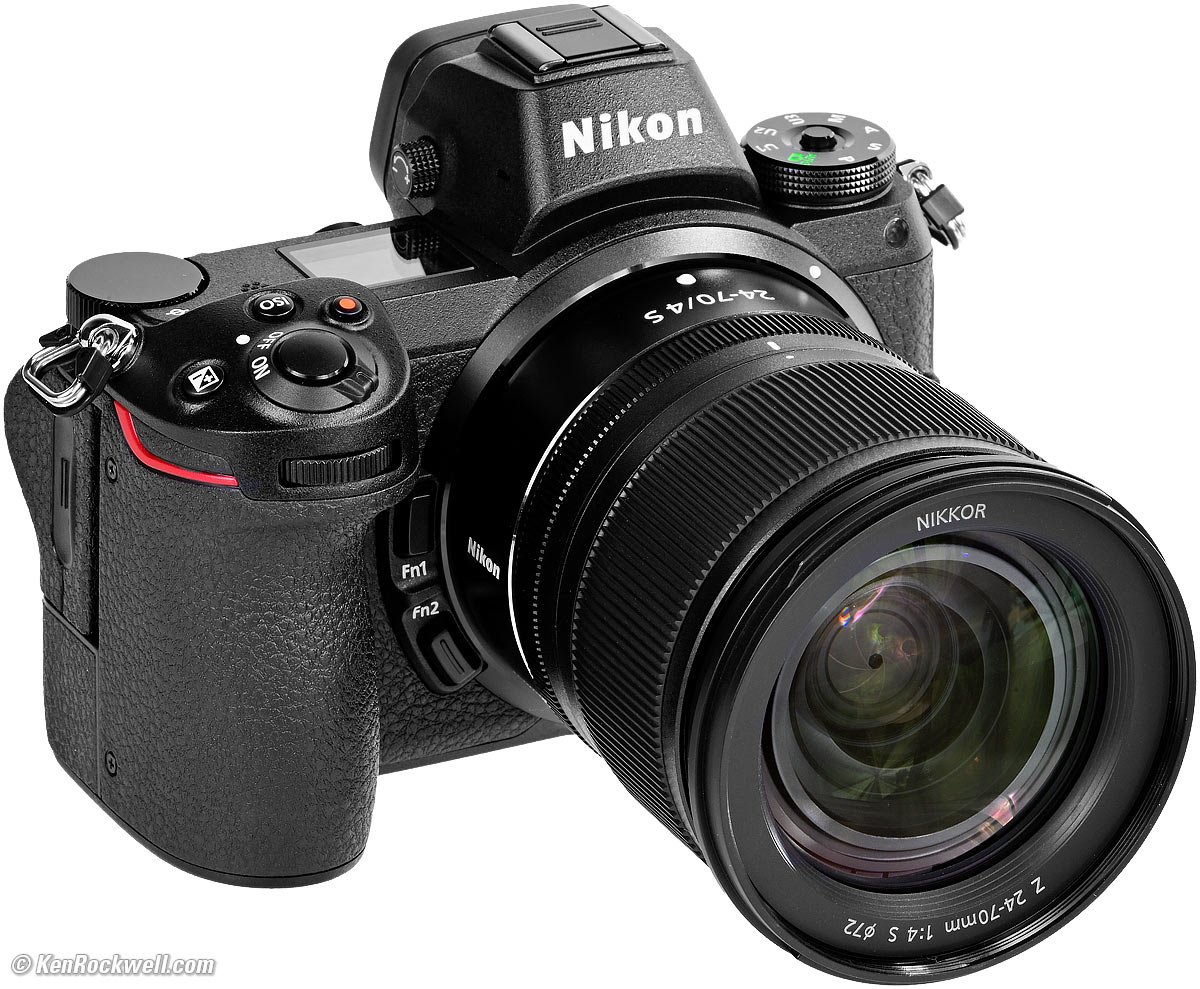
Nikon Z6 and Z 24-70/4 S.
23 August 2018: 24 MP FX Mirrorless, 12 (5.5) FPS, 23.8 oz./675 g with battery and XQD card, $1,997, promised for late November 2018.
2017
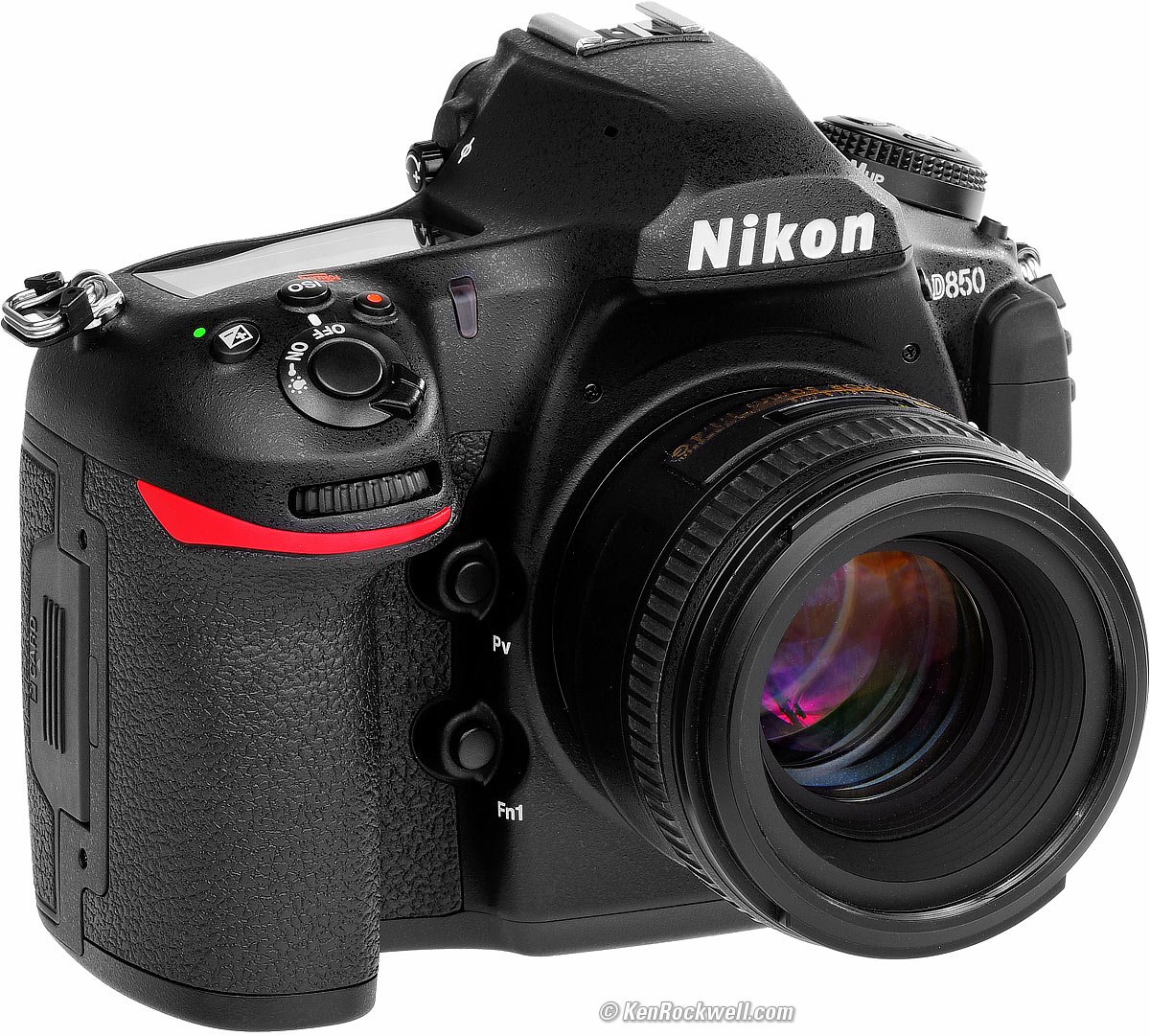
Nikon D850 and 50mm f/1.4G.
24 August 2017: 45 MP FX, 7 FPS, 32.2 oz./913g with battery and SD card, about $3,297.
The D850 updates 2014's D810 by adding the hot-rod AF system from the D5, 45MP and WiFi and bluetooth, but removing the built-in flash. It has two slots: one SD and one XQD. LCD size is the same 3.2."
It also adds a rear thumb nubbin, flip touch LCD, partially lit buttons, a new "Natural Light" Auto White Balance setting and an "Auto" picture control setting that attempts to optimize each imager automatically depending on what it thinks is in the picture.
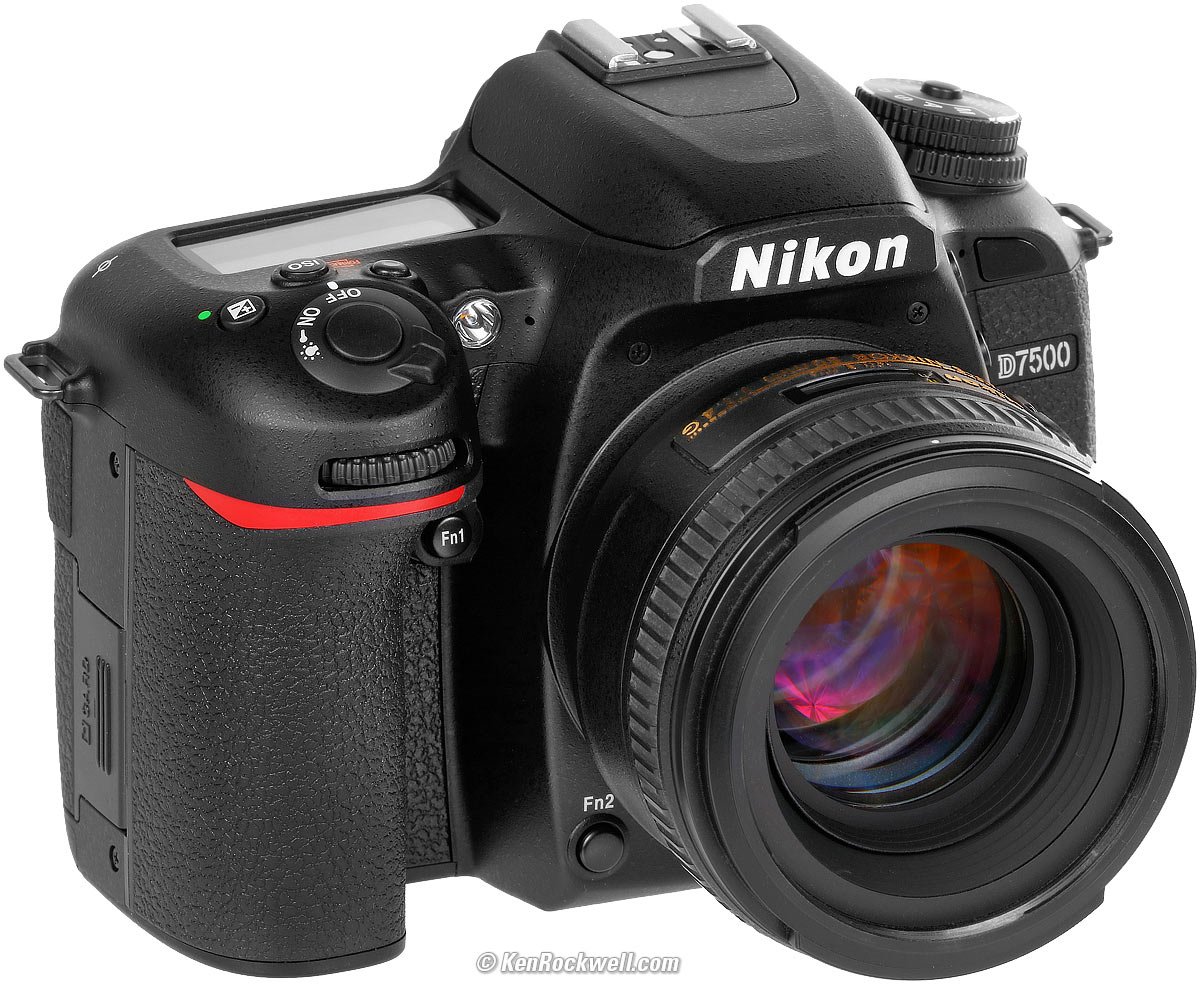
Nikon D7500 and 50mm f/1.4G.
12 April 2017: 21 MP DX, 8 FPS, 25.4 oz./720 g with battery and card, $1,249 or $1,747 as a kit with 18-140mm VR DX.
The D7500 has the image sensor, light meter and processor of the top-of-the-line DX Nikon D500 and puts them in a D7200 body, keeping the D7200 mode dial and AF system and adding Bluetooth, 4K video and a flipping touch LCD.
The D7500 has the D500's same crazy expanded ISO 50 ~ 1,638,400 range, and bumps frame rate to 8 FPS from the D7200's 6 FPS.
2016
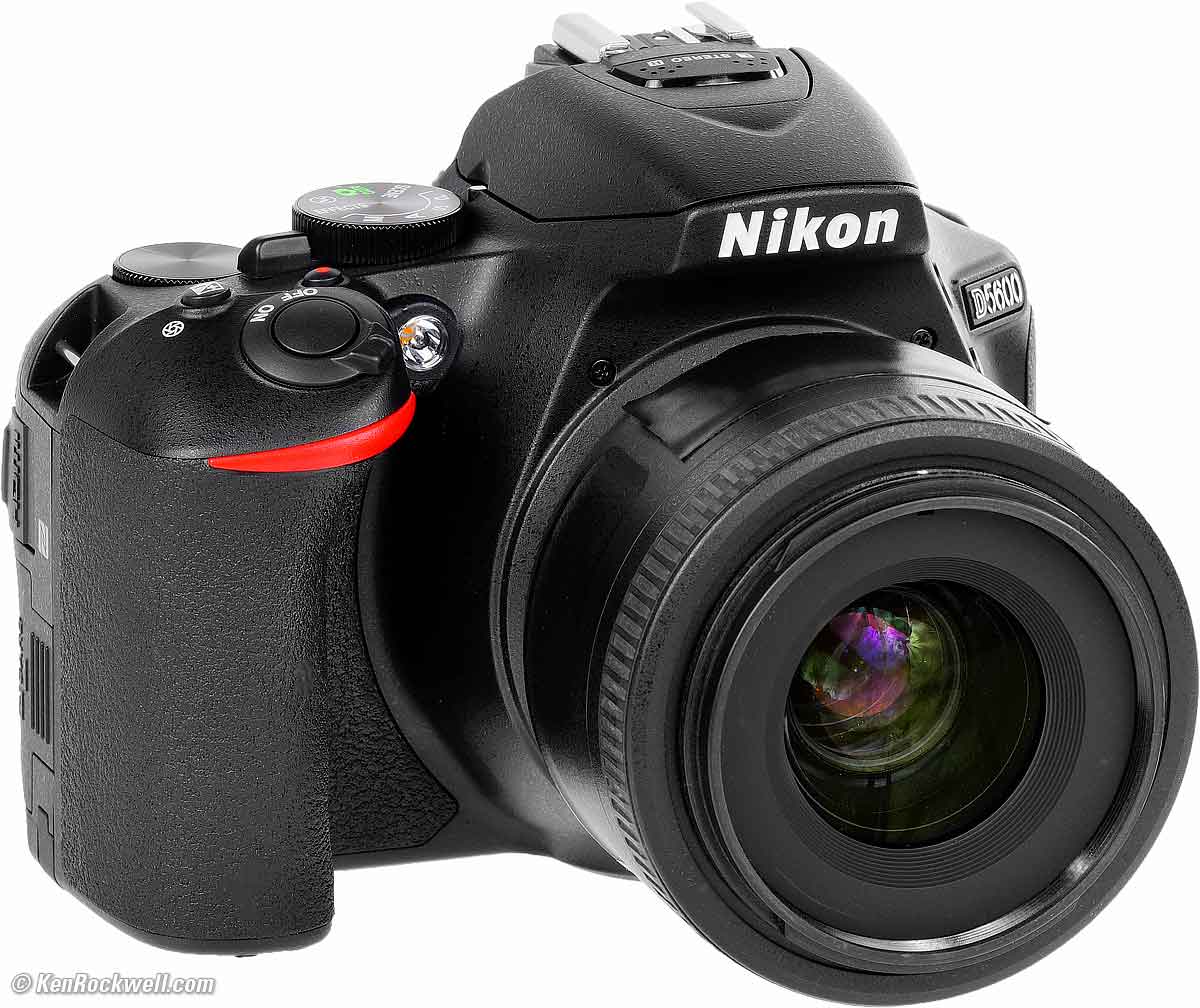
Nikon D5600 and Nikon 35mm f/1.8 DX.
10 November 2016 (delayed until 04 January 2017 in USA): adds Bluetooth and removes analog video outputs from the otherwise identical D5500.
24 MP, 5 FPS DX, $699 body-only.
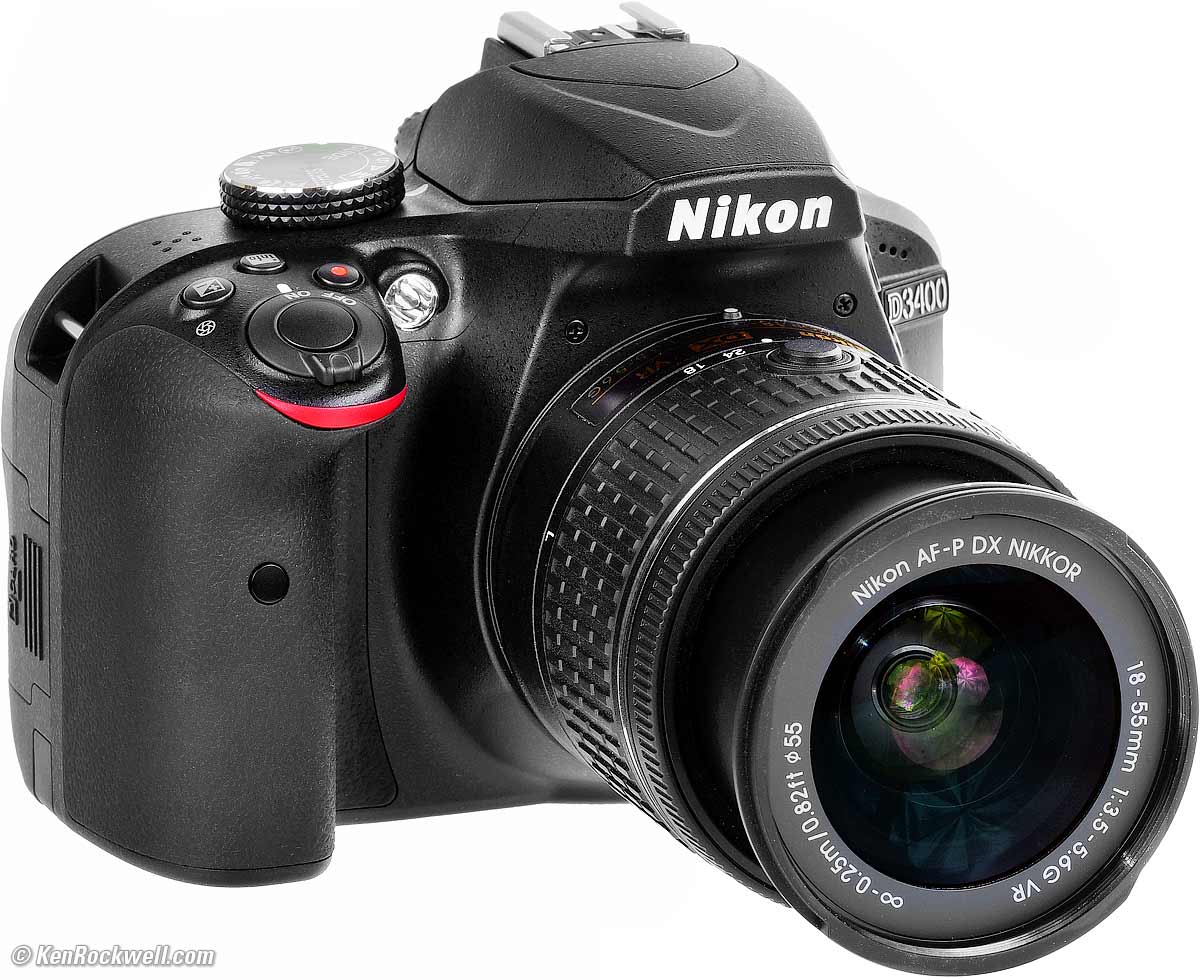
Nikon D3400 and included 18-55mm VR AF-P.
17 August 2016: Adds Bluetooth to the D3300, but has only half the power in the built-in flash.
24 MP, 5 FPS DX, $650 with lens.
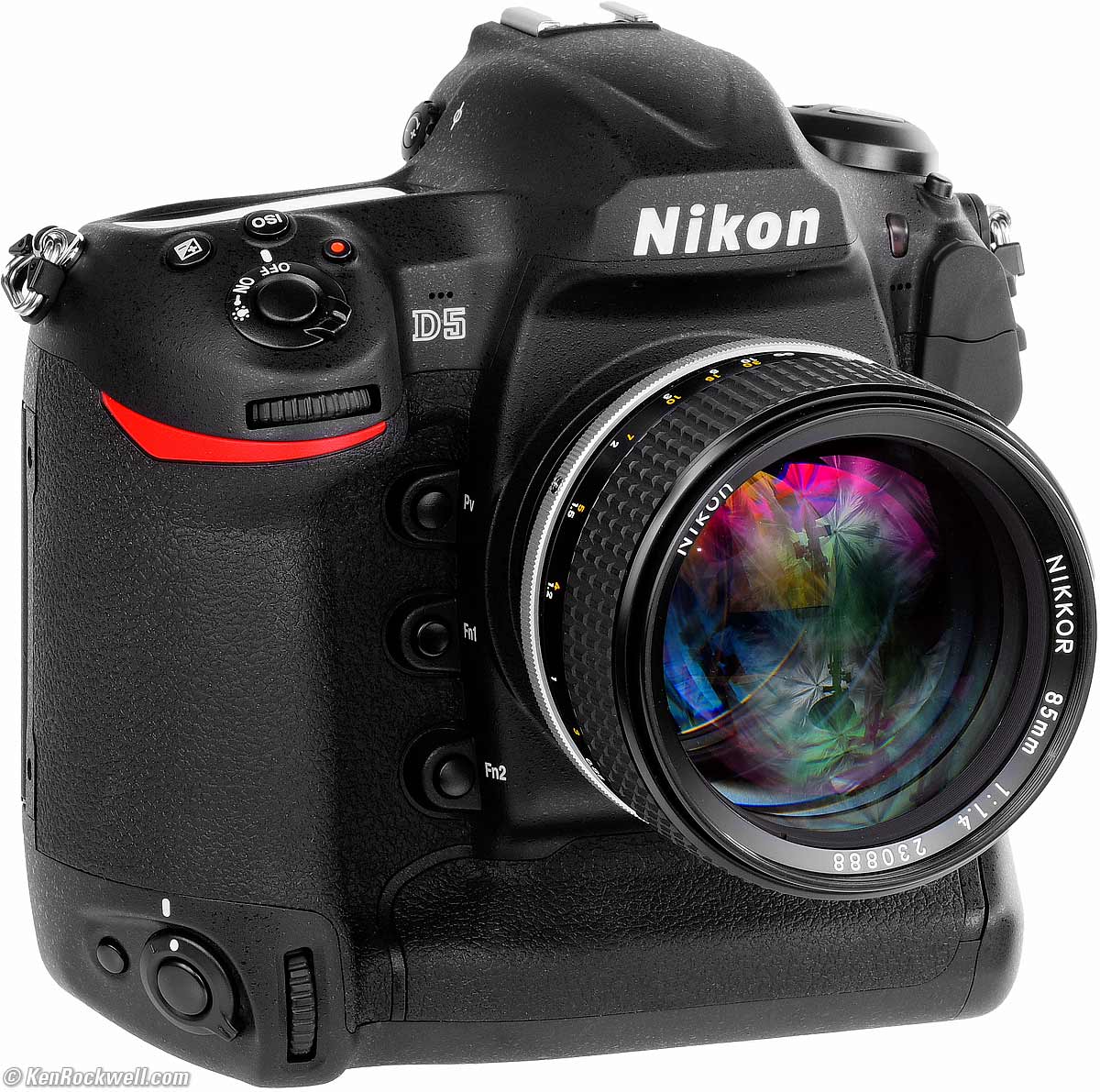
Nikon D5 with 85mm f/1.4 AI-s.
05 January 2016: Nikon's tenth professional SLR. Adds 12 FPS, radio strobe control and a touch screen. Has same AF system as D500.
12FPS, 20⅔ MP FX, 4K video, 49.9 oz./1,415 g. with battery and two CF cards. $6,500 in either two CF-card slot version or two XQD-card slot version.
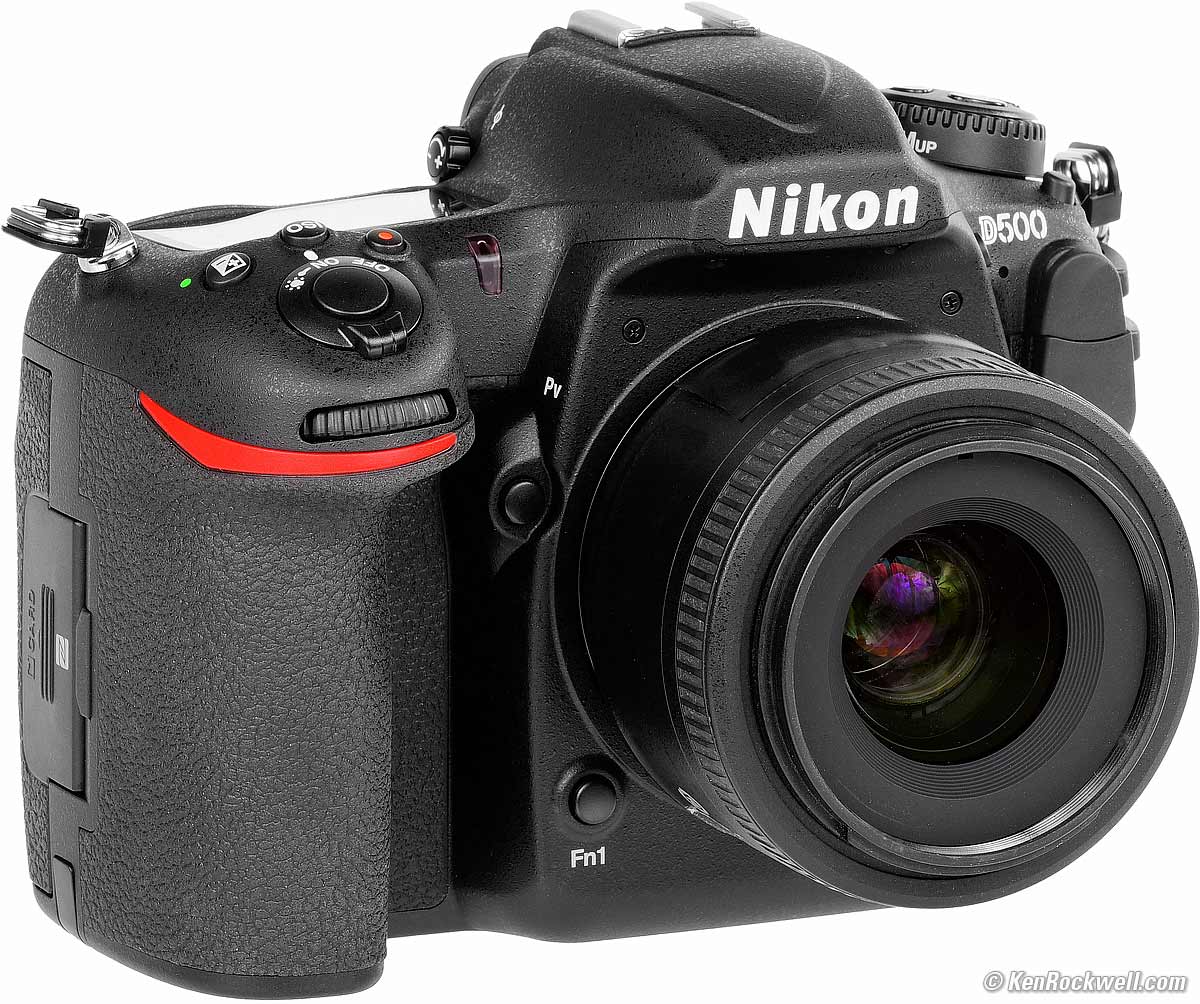
Nikon D500 and Nikon 35mm f/1.8 DX.
05 January 2016: First DX to run at 10 FPS, but has no built-in flash. Has same AF system as D5.
10 FPS, 20 MP DX, 4K video, 30.4 oz./860g with battery and XQD card, $1,999. or $3,070 for kit with 16-80 lens.
2015
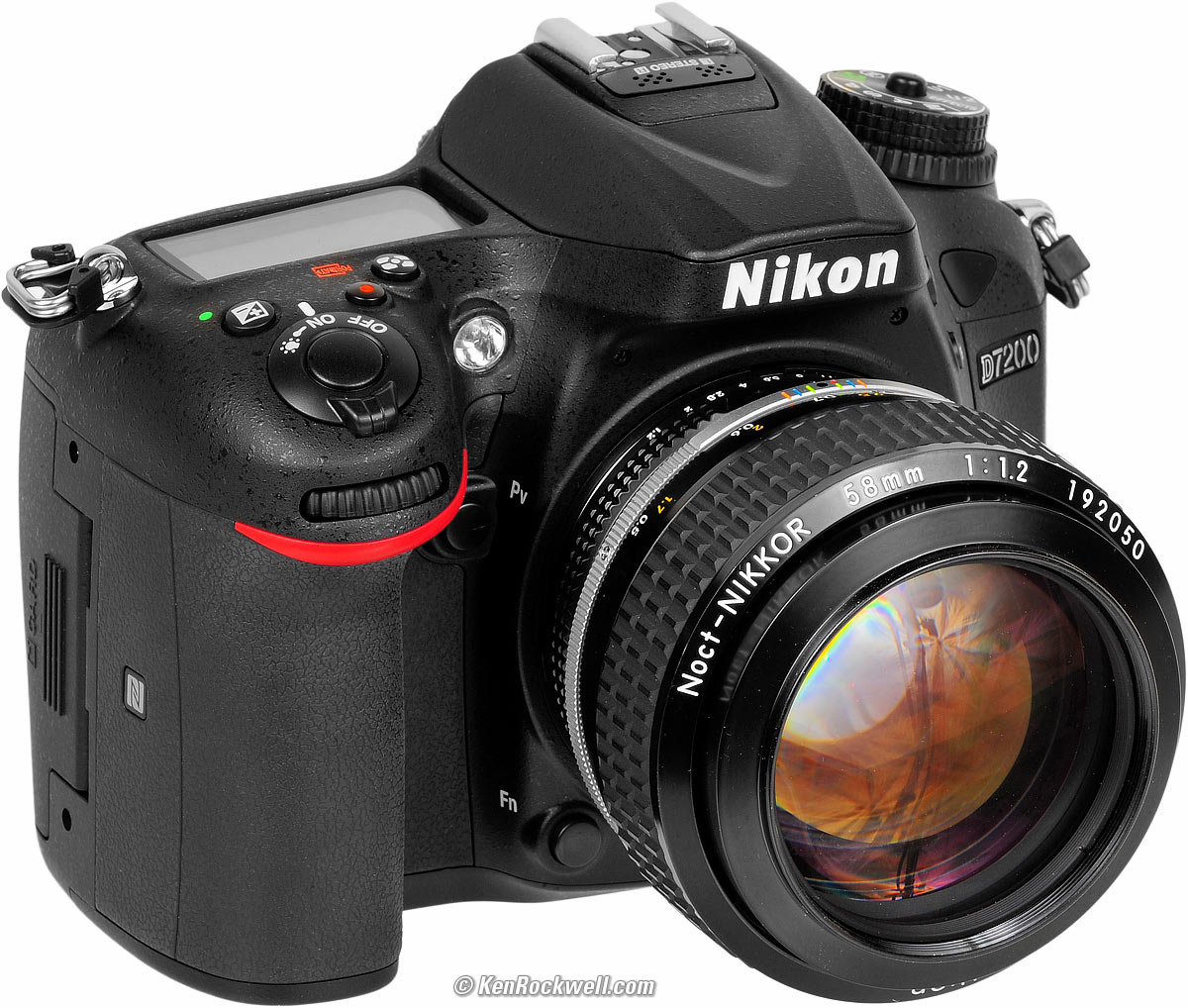
Nikon D7200 and 58mm f/1.2 Noct-NIKKOR.
02 March 2015: Adds NFC and Wi-Fi to the D7100.
24 MP DX, 6 FPS, 27.0 oz./765g with battery and card (takes 2-SD), $1,199 body-only, $1,699 with 18-140mm.
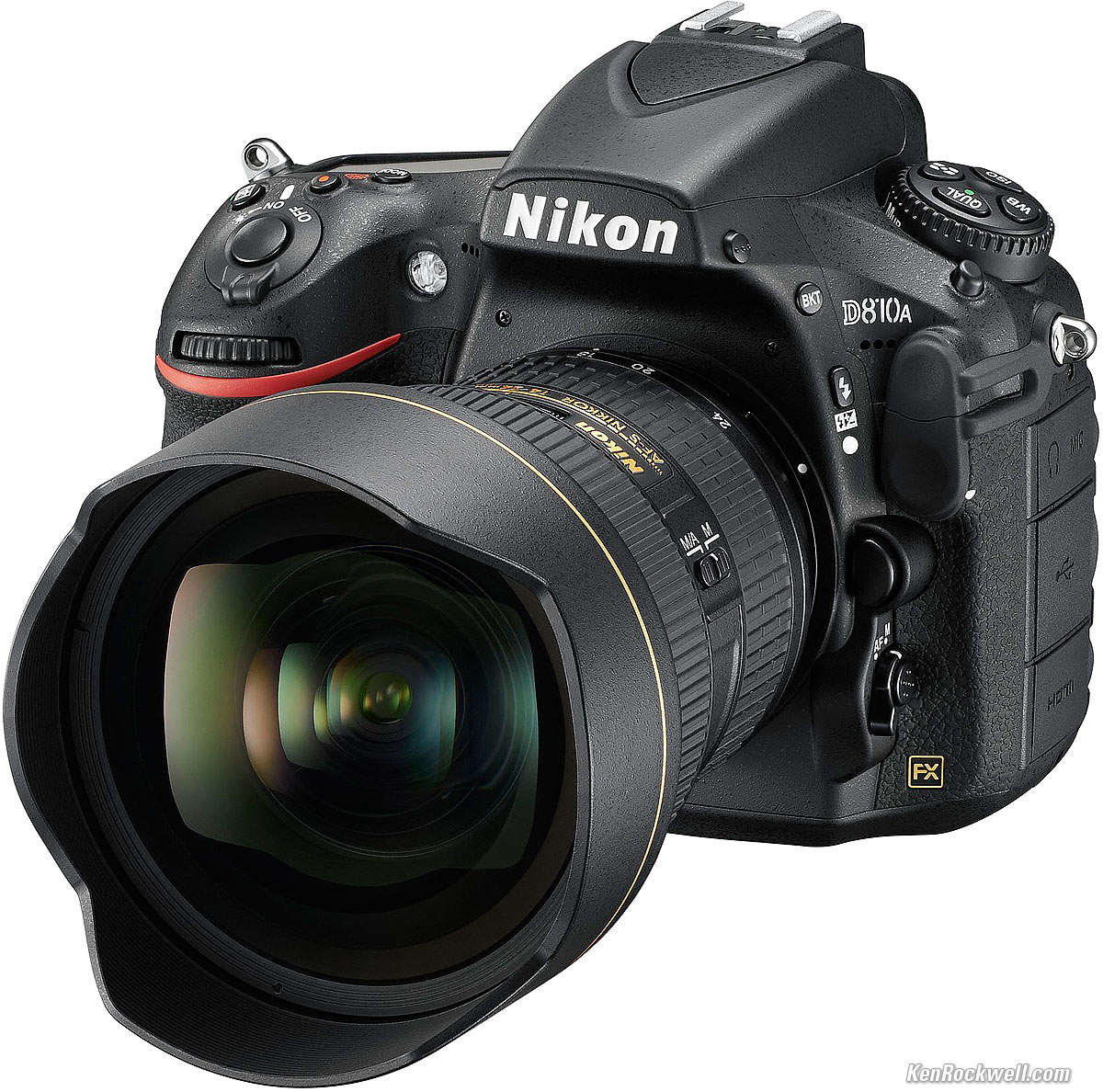
Nikon D810A and 14-24mm f/2.8.
10 February 2015: For astrophotography; passes the 656 nanometer hydrogen alpha line.
36 MP FX, 5 FPS, 34.6 oz./980g with battery and CF card, $3,799.
It's the same as the D810, with a different IR-cut filter, ISOs starting at ISO 200, and the option for exposures as long as 15 minutes.
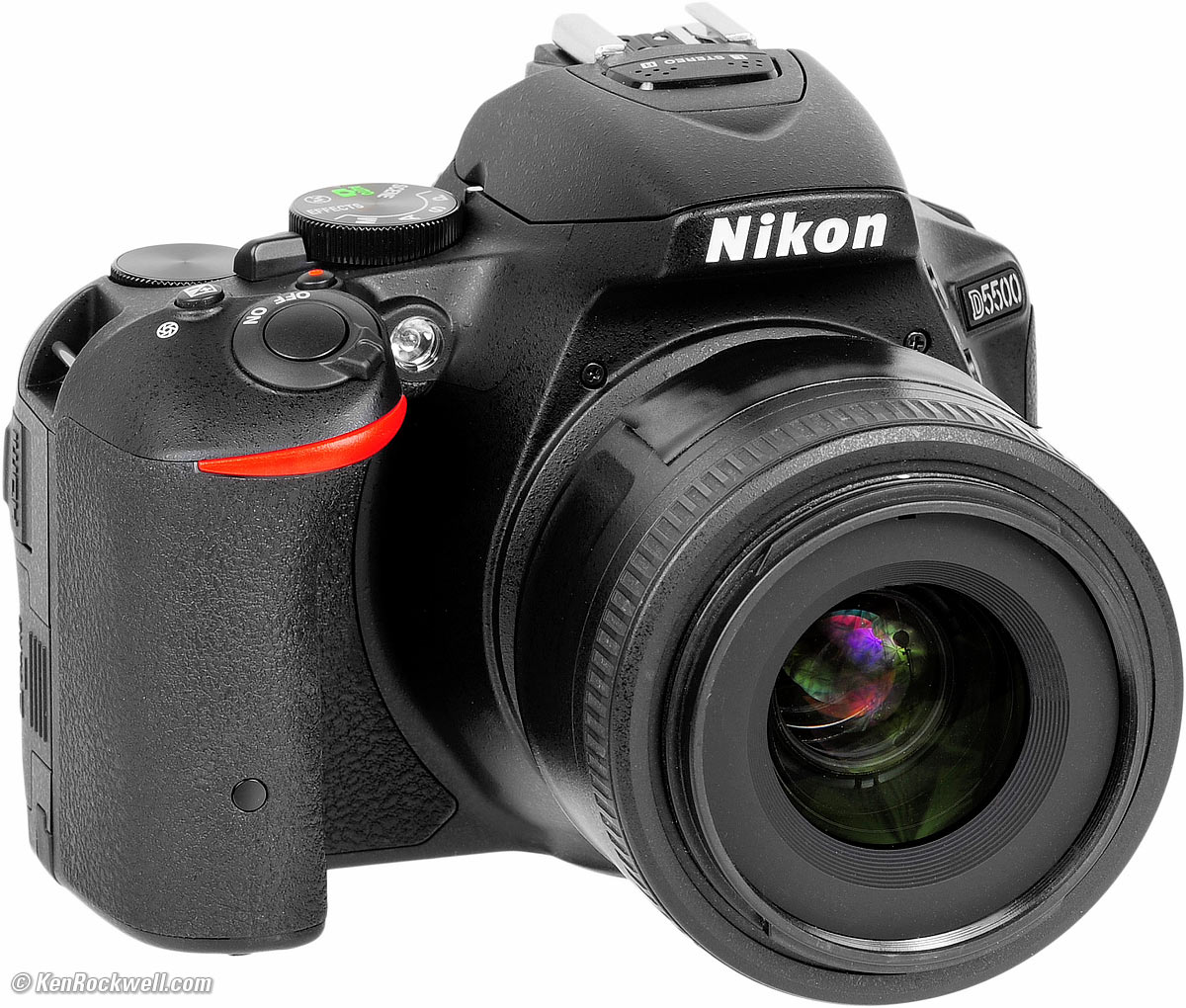
Nikon D5500 and Nikon 35mm f/1.8 DX.
05 January 2015: 24 MP DX, 5 FPS, 16.6 oz./470 g with battery and card, $899 body-only.
The D5500 adds a touch screen to the D5300, and takes away GPS and two ounces of weight.
2014
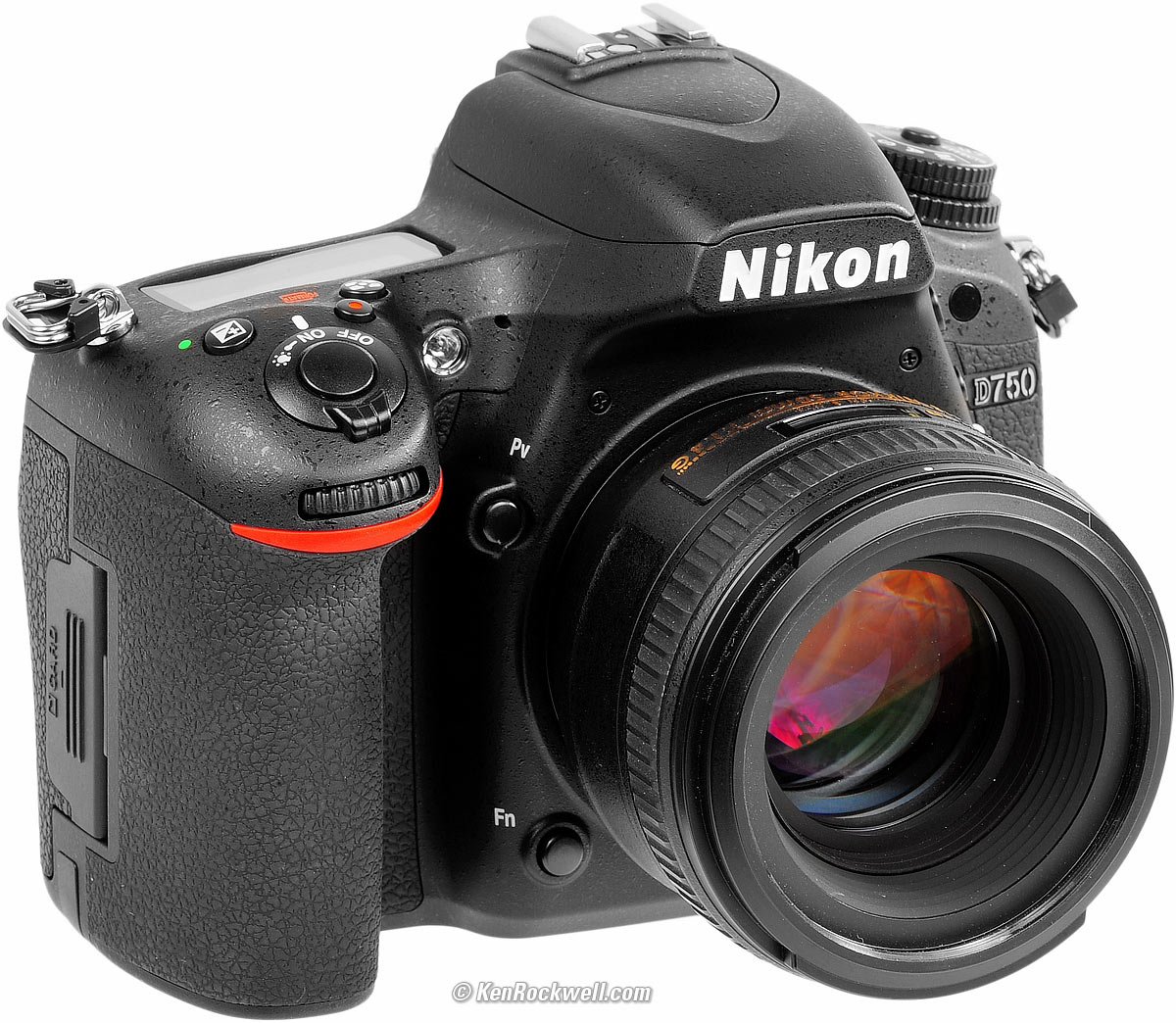
Nikon D750 and 50mm f/1.4 G.
12 September 2014: 24 MP FX, 6.5 FPS, 29.7 oz./840g with battery and card, $2,300.
The D750 adds the superior AF system of the D810 to the D610, as well as more speed than either at 6.5 FPS. It also adds a flippy screen, Nikon's first on a full-frame DSLR.
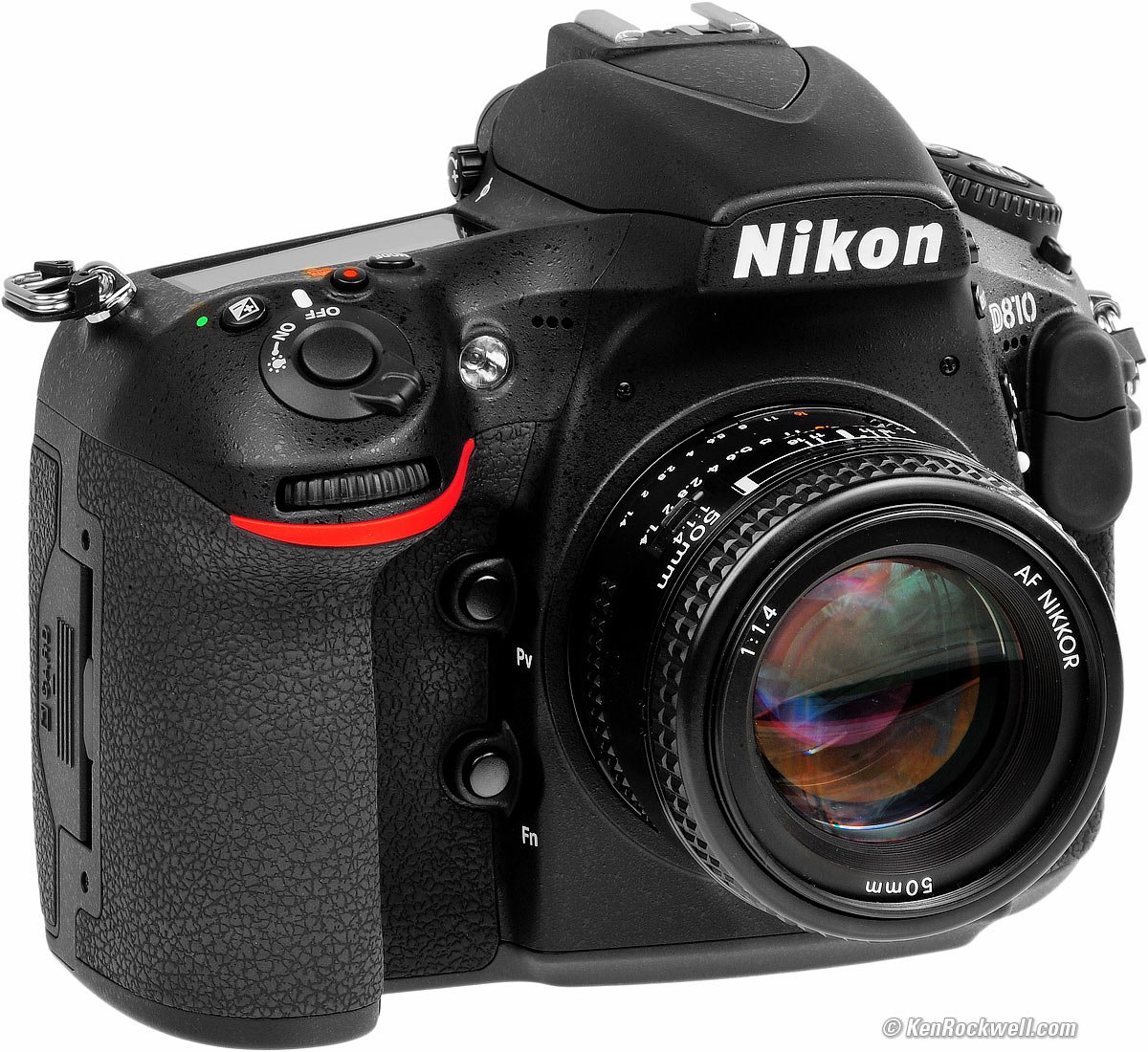
Nikon D810 and 50m f/1.4 AF.
26 June 2014: 36 MP FX, 5 FPS, 34.6 oz./980g with battery and CF card, $3,300.
The D810 adds 5 FPS and a stereo mic to the old D800 and D800e.
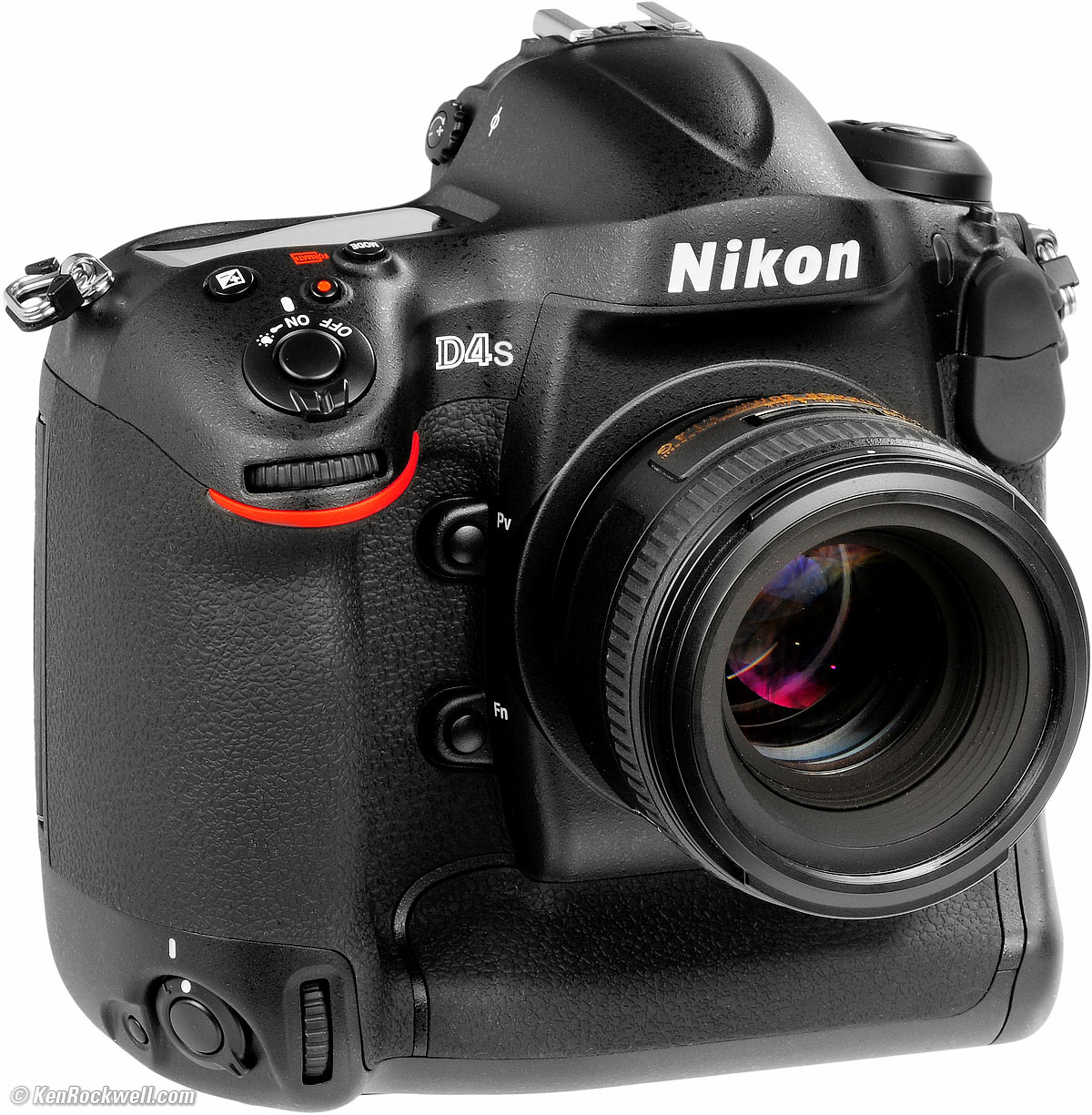
Nikon D4S and 50mm f/1.4 G.
25 February 2014: 16 MP FX, 11 FPS, 47.3 oz./1,337g, $6,500.
The D4s is a D4 with a faster computer to allow more noise reduction to give a foolish ISO 409,600 setting, 11 frames per second up from 10, and a bunch of other small features changes. The D4S development was announced 07 January 2014 at CES 2014.
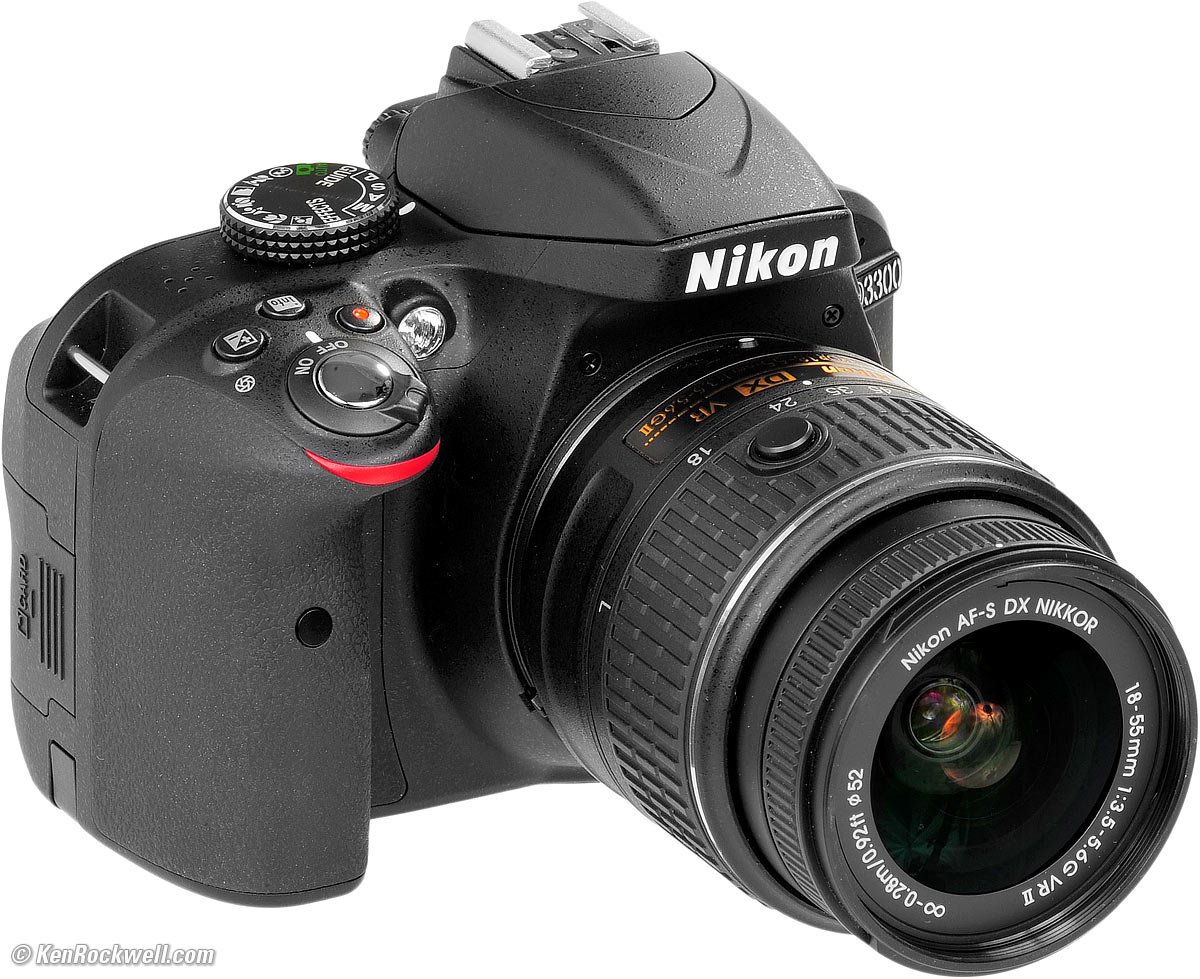
Nikon D3300 and 18-55mm VR II.
07 January 2014: 24MP DX, 16.2 oz./460g with battery and SD card, ISO 100 - 12,800 (25,600), 11-point AF, 3" LCD, 5 FPS, 1080p video, mono mic. $650 with lens; also comes in gray and comes in red for the same price.
A minor revision to the D3200 of 2012; adds a gray color version and 45g lighter; same AF and resolution as D3200.
2013

Nikon Df and 1970 Nikon GN Auto NIKKOR 45mm f/2.8.
05 November 2013: 16 MP FX, ISO 50 ~ 204,800, 5.5 FPS, 3.2" 921k dot LCD, no video or mic, 27.0 oz./765 g with battery and card. $2,749, or $3,000 with lens. Also comes in black.
Unlike every other Nikon DSLR ever, the Nikon Df is a completely new camera, taking the ergonomic brilliance of the Nikon FE and stuffing the digital guts of a D4 into it. The Df is an all-metal piece of excellence with real knobs and buttons, not the push-multifunction-button-and-spin-dial cost-cutting baloney of Nikon's SLRs since the 1990s.
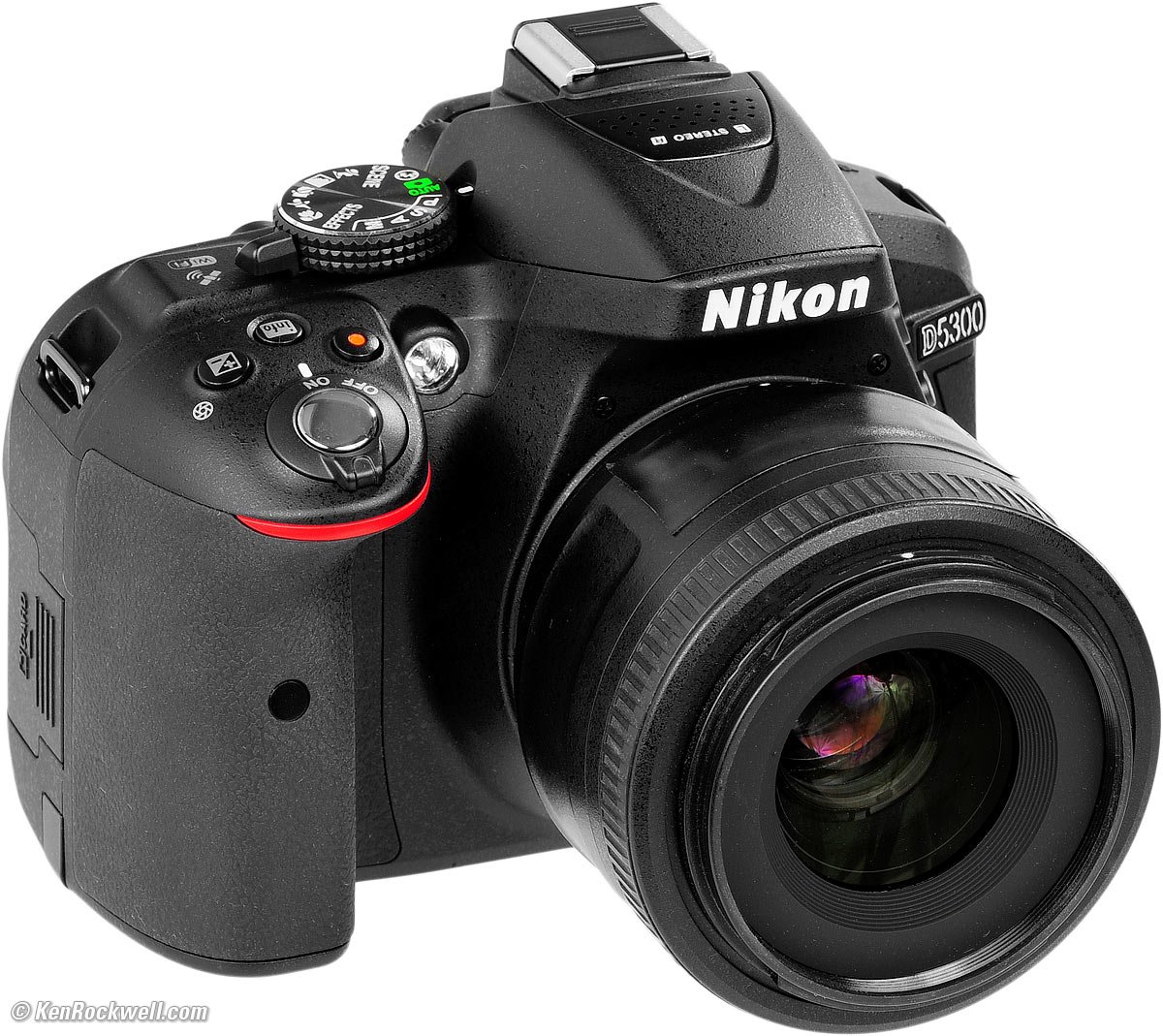
Nikon D5300 and Nikon 35mm f/1.8 DX.
17 October 2013: 24 MP DX, 5 FPS, 3" flip LCD, 1080p video, mono mic, 30.0 oz./850 g with battery and card. $799, or $1,400 with lens.
The D5300 is the same as last year's D5200, adding built-in Wi-Fi and GPS.
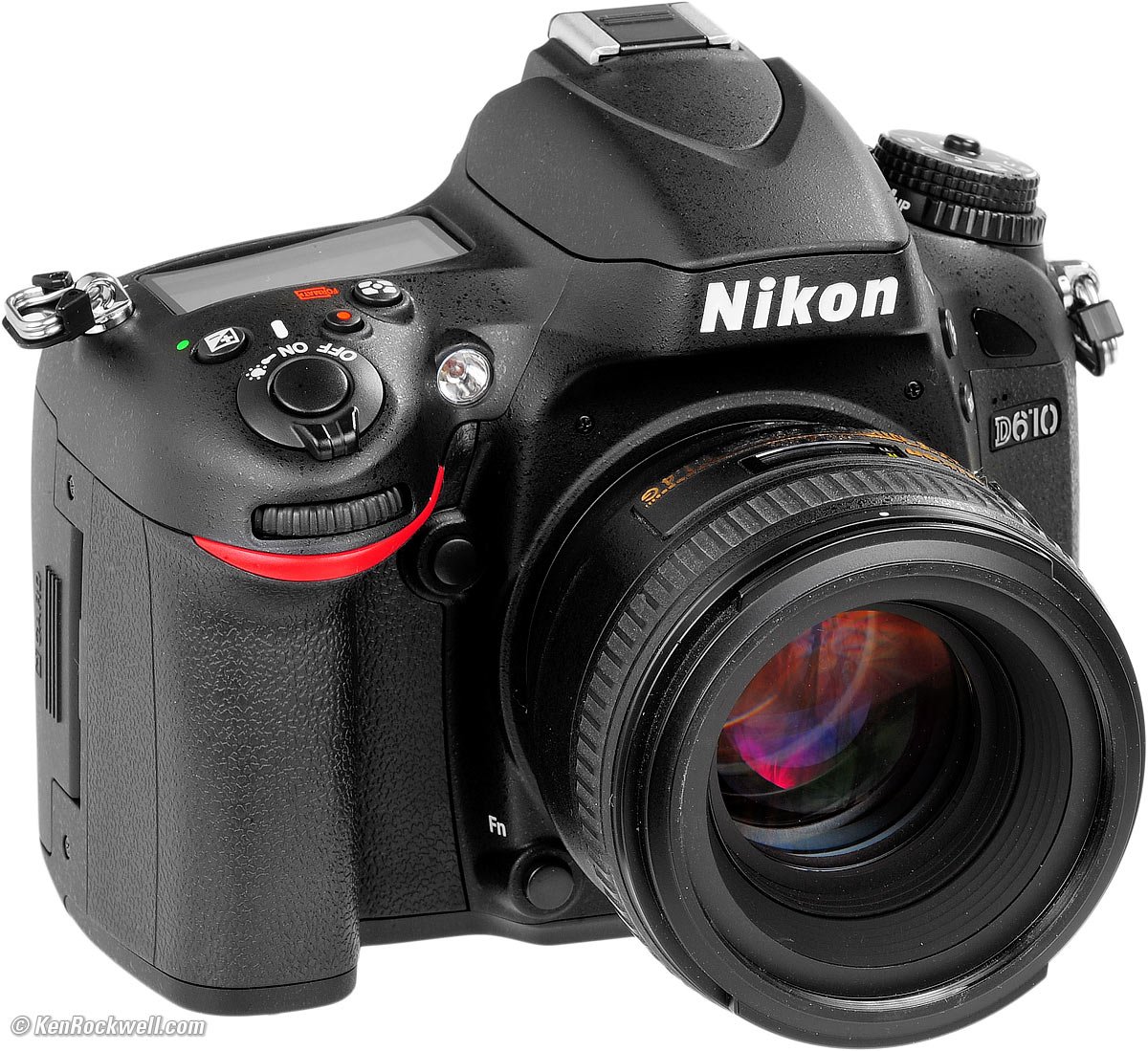
Nikon D610 and 50mm f/1.4 G.
08 October 2013: 24 MP FX, 6 FPS, 3.2" LCD, 1080p video, mono mic, 30.0 oz./850 g with battery and card, $1,999.
The D610 is the same as the D600, supposedly with a "new shutter" that begets 6 FPS and a 3 FPS "quiet" mode.
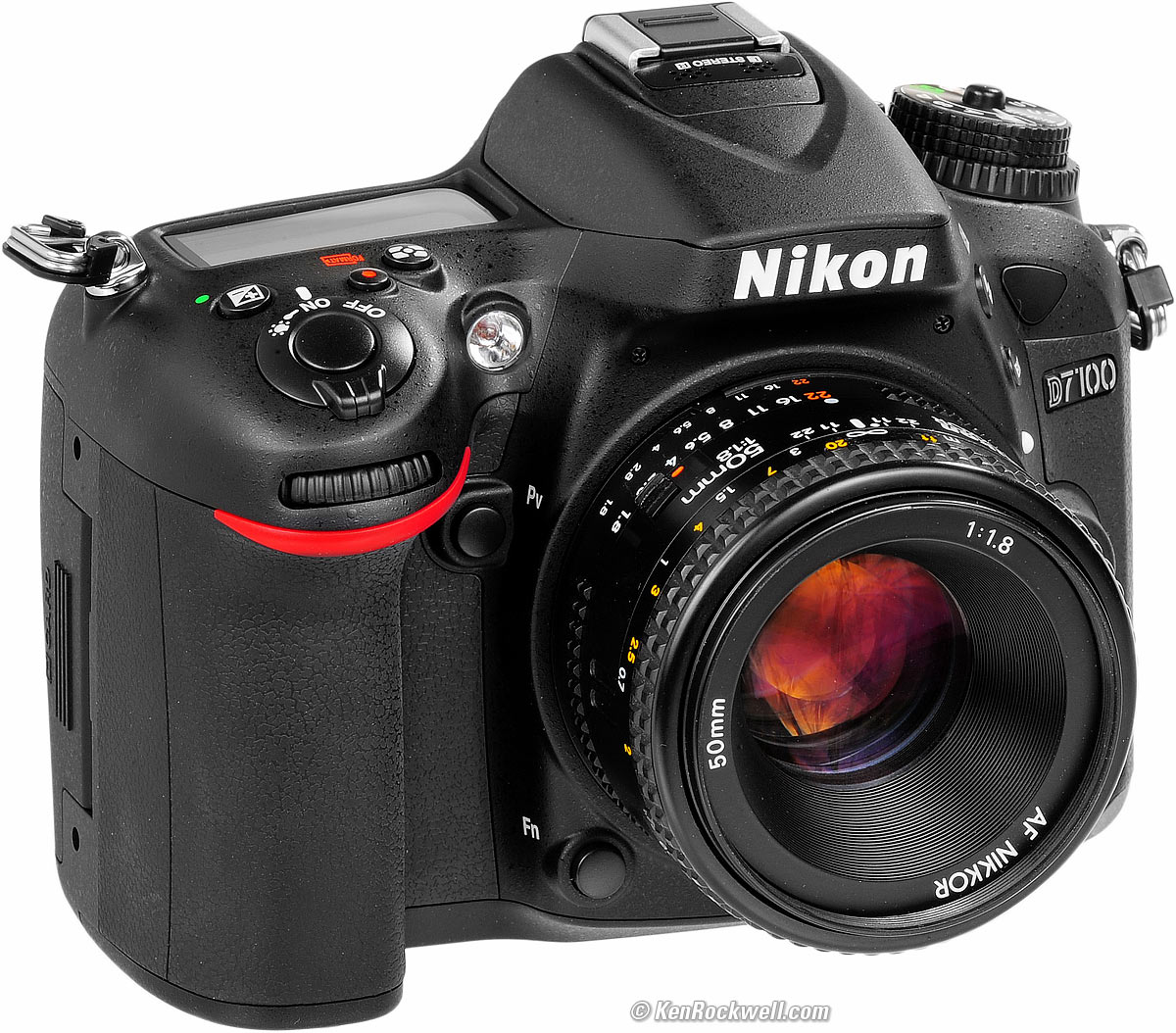
Nikon D7100 and 50mm f/1.8 AF.
21 February 2013: 24 MP DX, 6 FPS, 3.2" LCD, 1080p video, stereo mic, 26.8 oz. (759g) with battery, strap rings and card.
New in the D7100 were OLEDs for finder data display, a weird 1.3x crop mode inside the 1.5x DX frame, the first "i" button for controlling recent settings.
2012
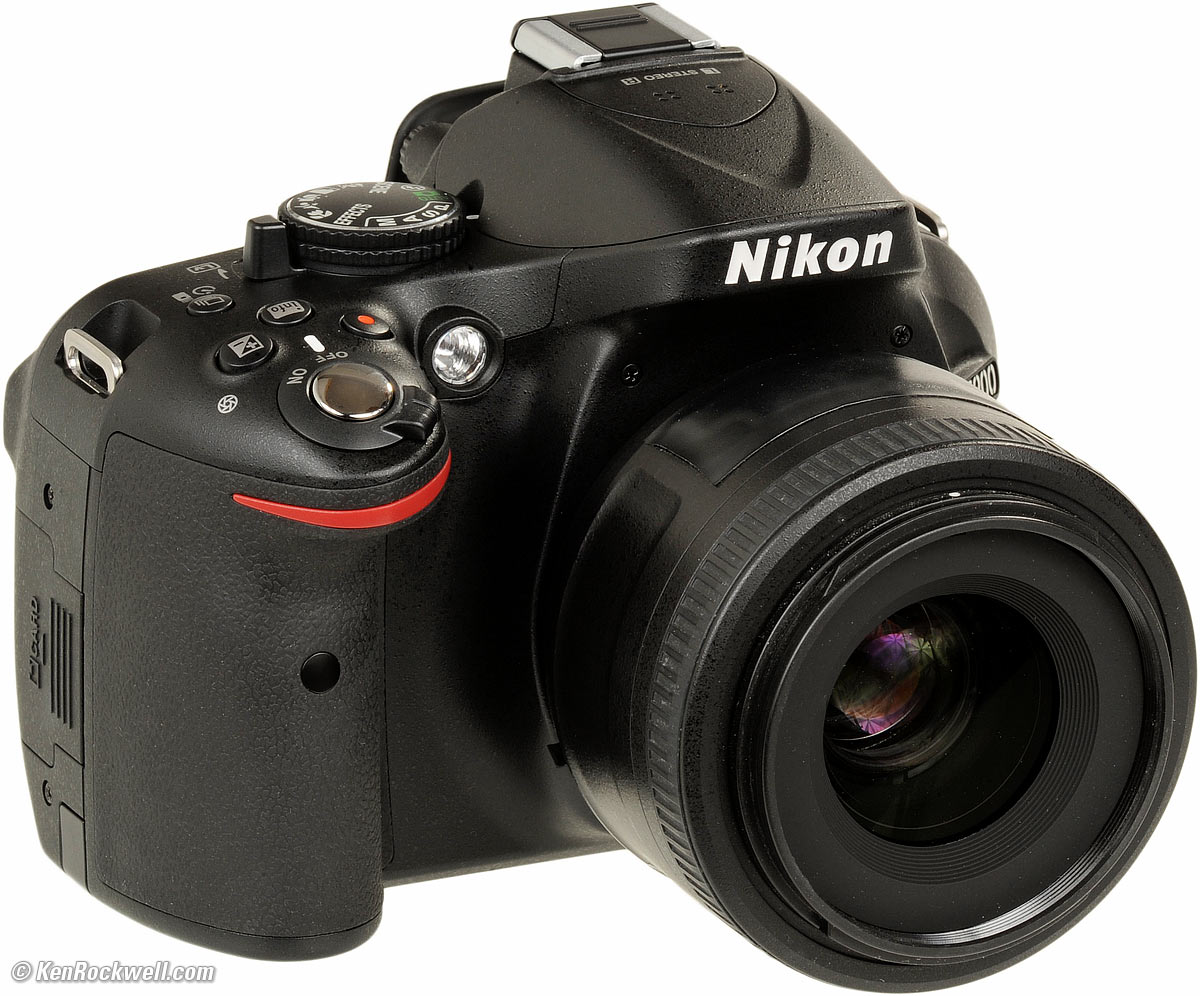
Nikon D5200 and 35mm f/1.8 DX.
06 November 2012: 24 MP DX, 5 FPS, 3" flippy LCD, 1080p video, 19.6 oz. (555 g) with battery and SD card. (USA release was delayed until 08 January 2013.)
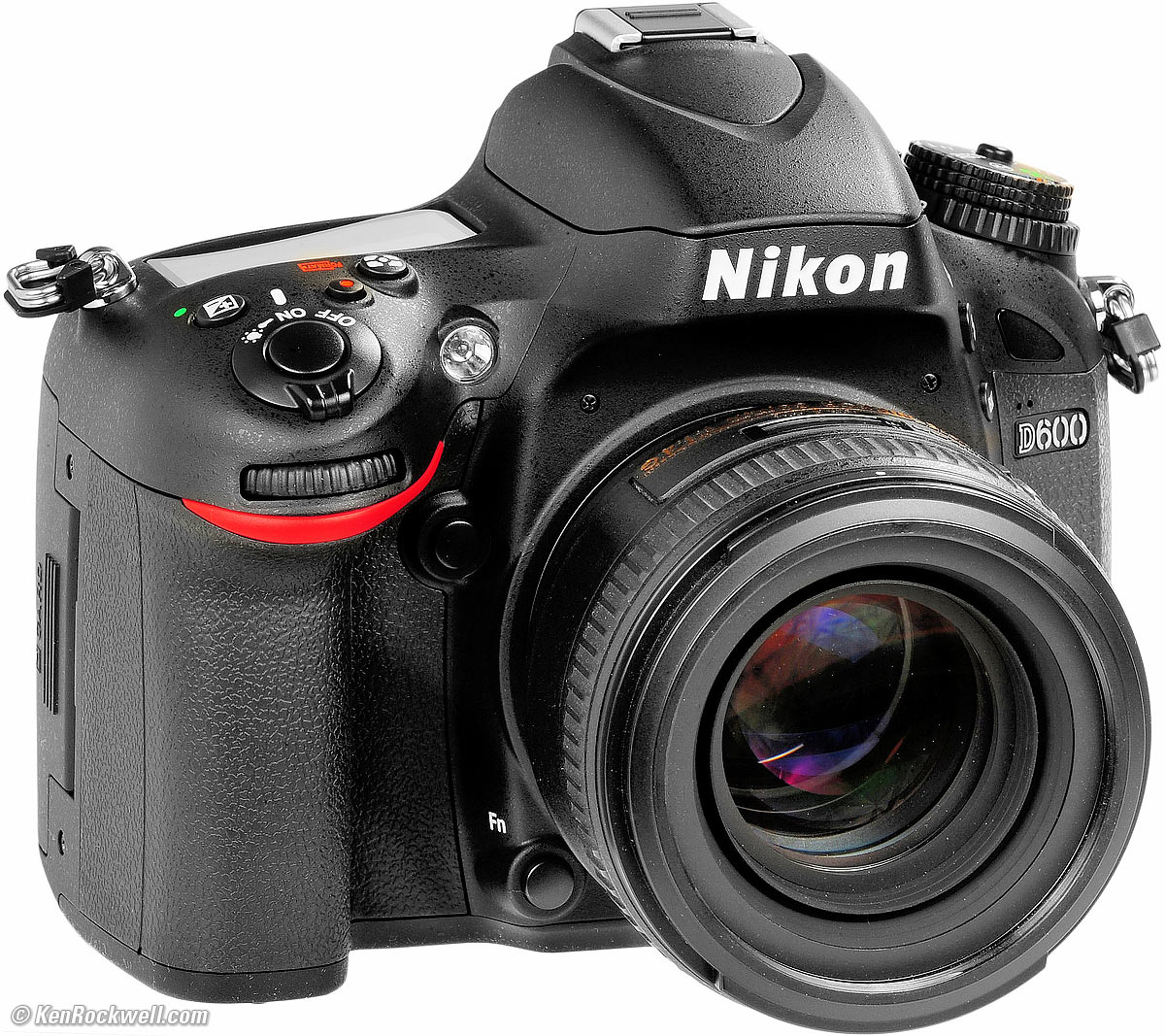
Nikon D600 and 50mm f/1.4 G.
13 September 2012: 24 MP FX, $2,099, 5.5 FPS, 3.2" LCD, 1080p video, 30.0 oz. (850g) with battery and SD card.
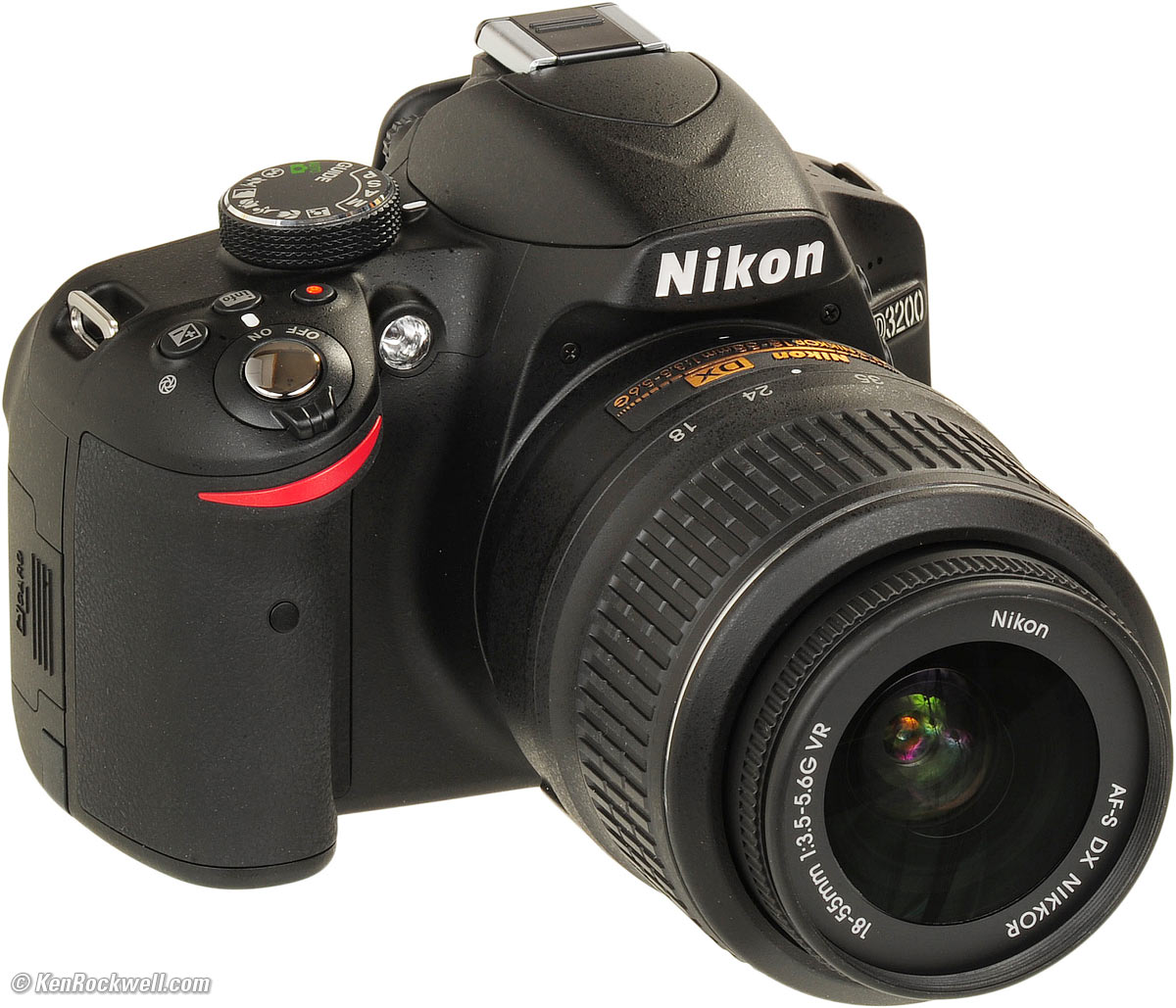
Nikon D3200 and 18-55mm DX VR.
19 April 2012: 24 MP DX, $700 with 18-55mm VR, 4 FPS, 3" LCD, 1080p video, 26.9 oz. (498g) with battery and SD card.
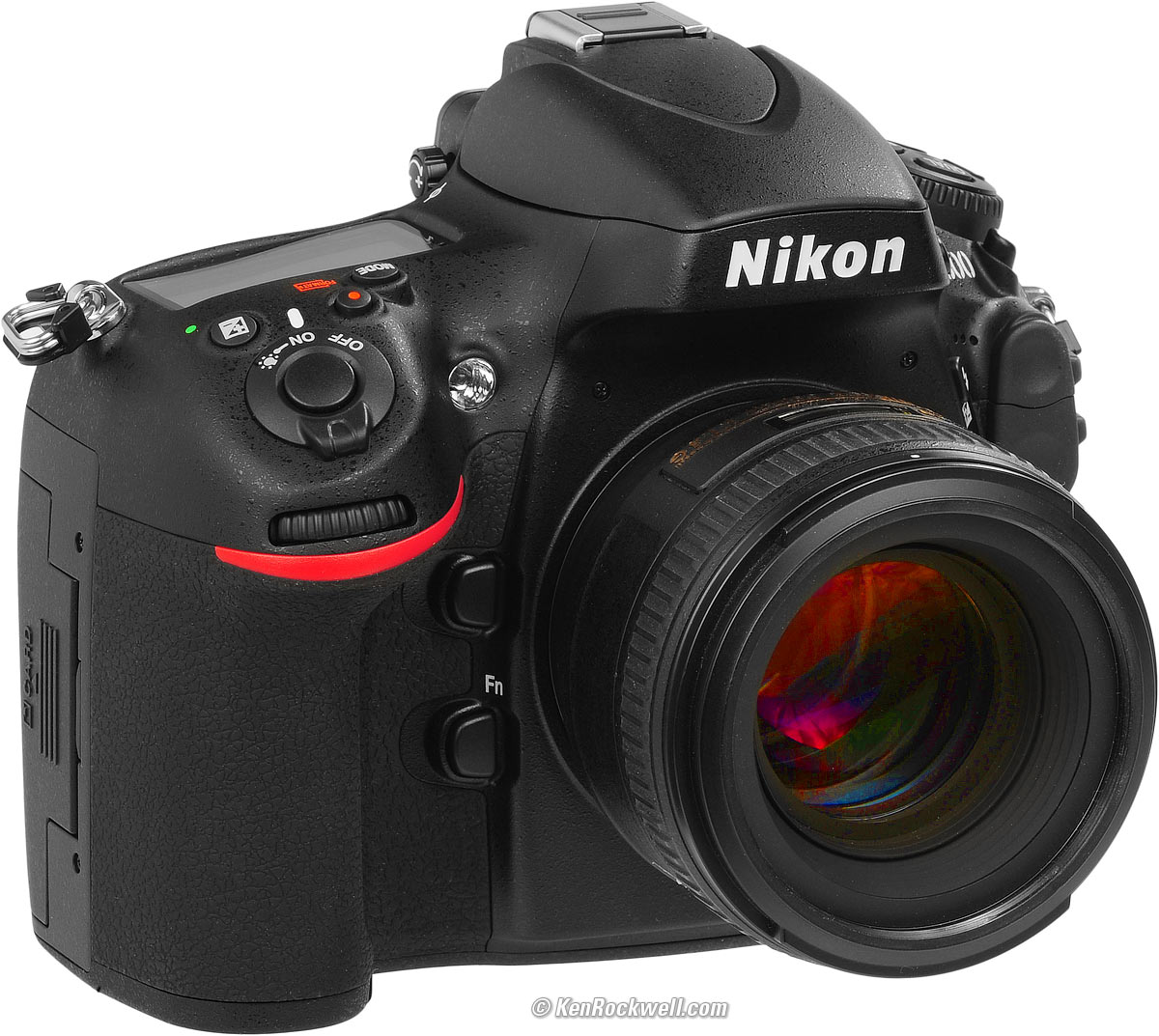
Nikon D800 and D800E and 50mm f/1.4 G.
07 February 2012: 36MP FX, $3,000 and $3,300, 4 FPS, 3.2" LCD, 1080p video, 35.1 oz. (994g) with battery and SD card.
The D800 completely rewrites the book, and obsoletes most of Nikon's DSLR line. Yipee!
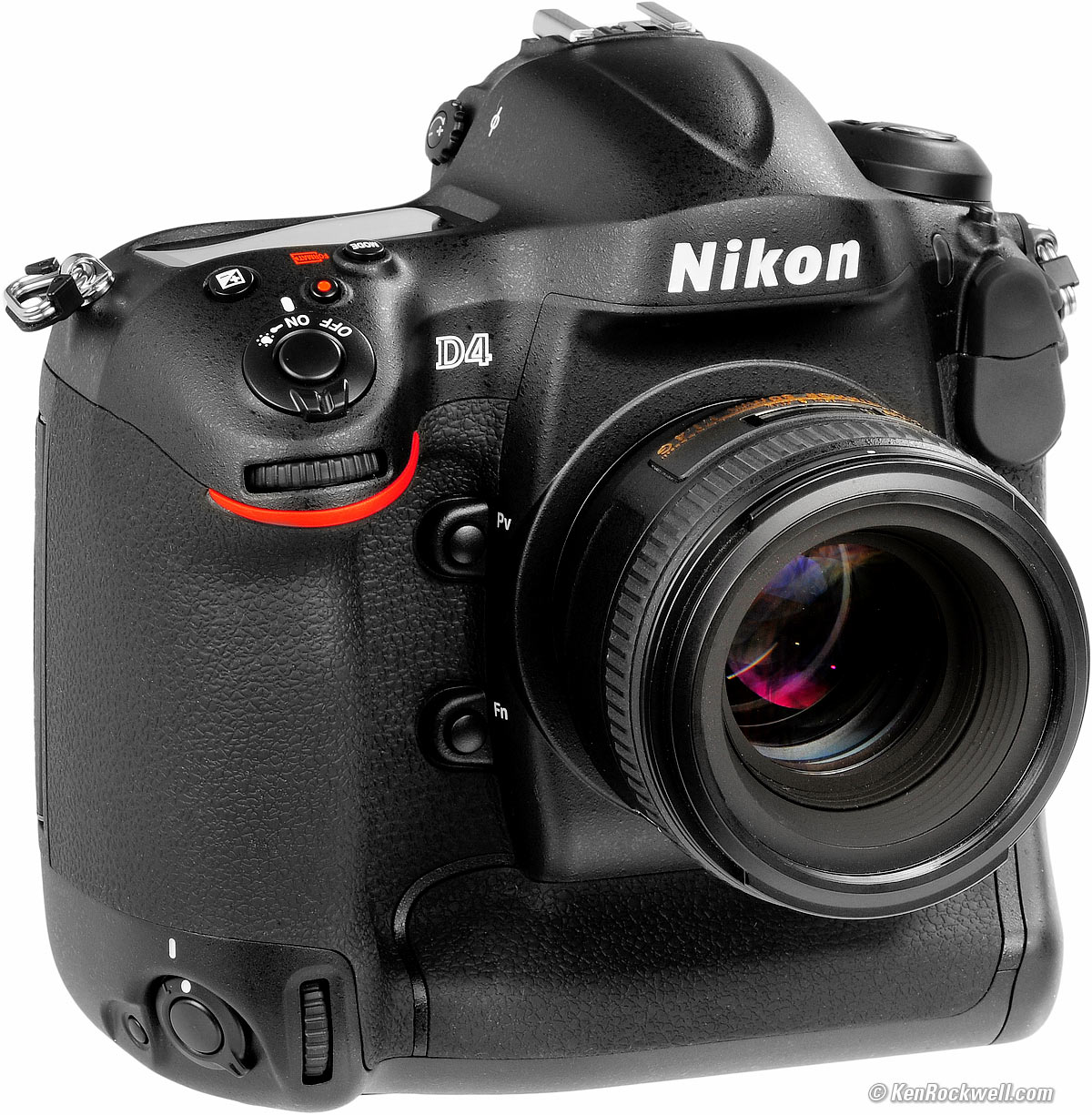
Nikon D4 and 50mm f/1.4 G.
06 January 2012: 16MP FX, 10 FPS, 47.3 oz./1,337g, $6,000. Pretty much only a D3¼ with less weight, more FPS, no big deal. What can be a big deal is the removal of the rear AF-area mode switch, replacing it with a button and dials instead.
2011
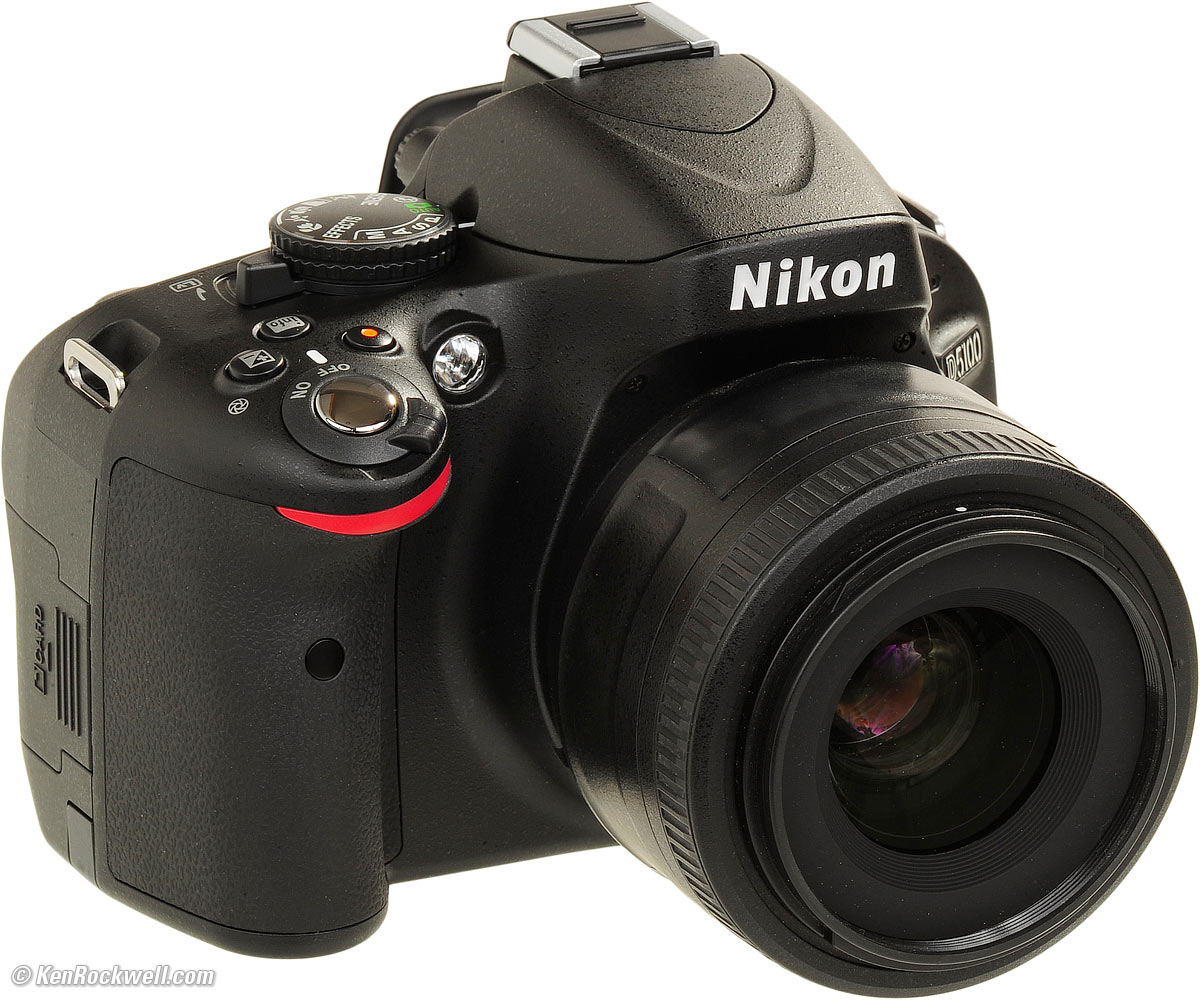
Nikon D5100 and Nikon 35mm f/1.8 DX.
05 April 2011: Nikon D5100. 16MP DX, 4 FPS, 3" flippy LCD, 1080p movies. $799.95, available May 2011.
An updated D5000.
2010
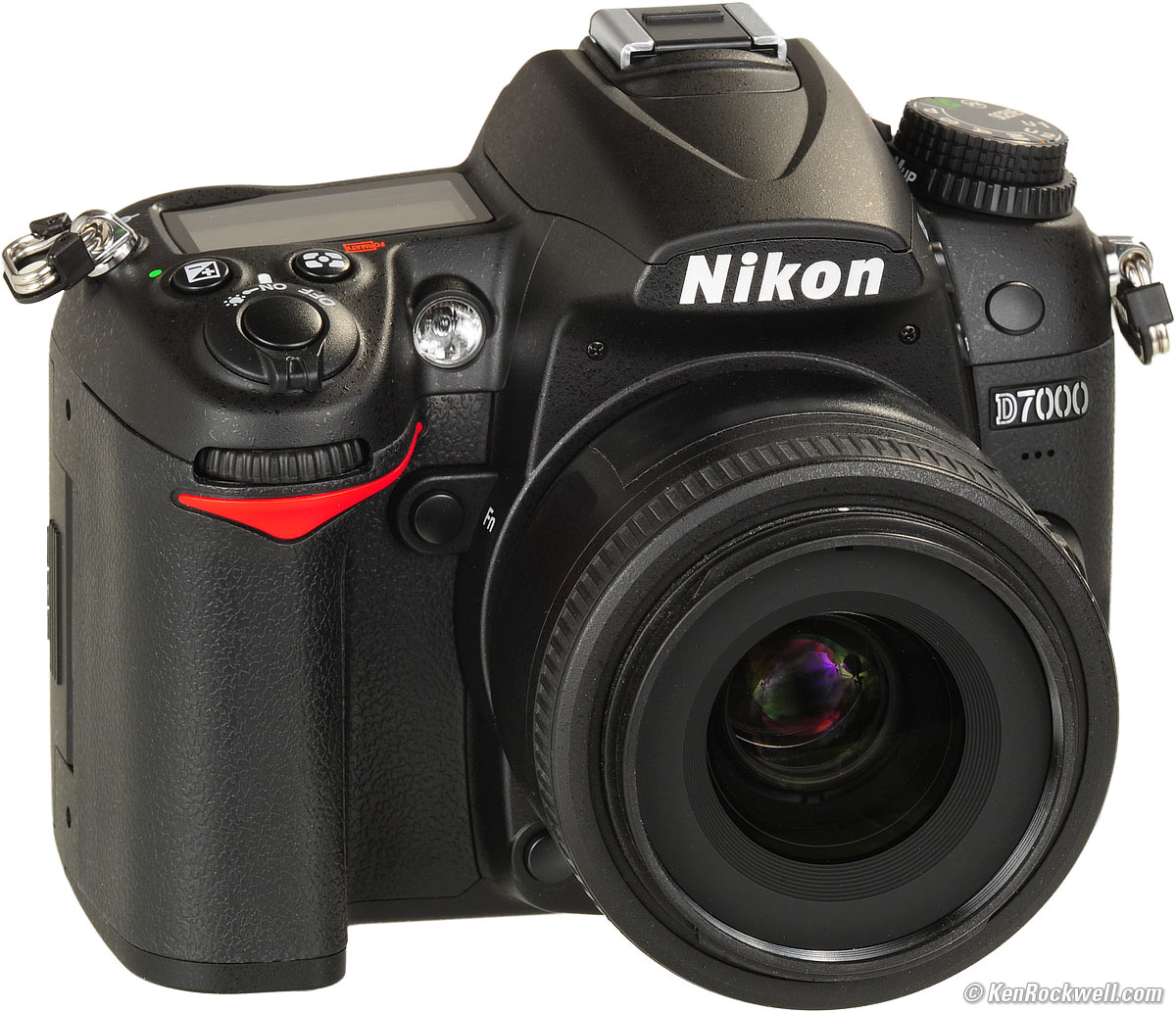
Nikon D7000 and Nikon 35mm f/1.8 DX.
15 September 2010: Nikon D7000. 16MP DX, 6 FPS, 3" LCD, movies. $1,199.95, available mid-October 2010.
New in the D7000 is two SD card slots, Nikon's first 2,016-segment RGB meter, two new programmable mode-dial positions, U1 and U2 (as copied from Canon's C1 and C2 instant-recall settings), a 39-point AF system, and two types of Auto White Balance.
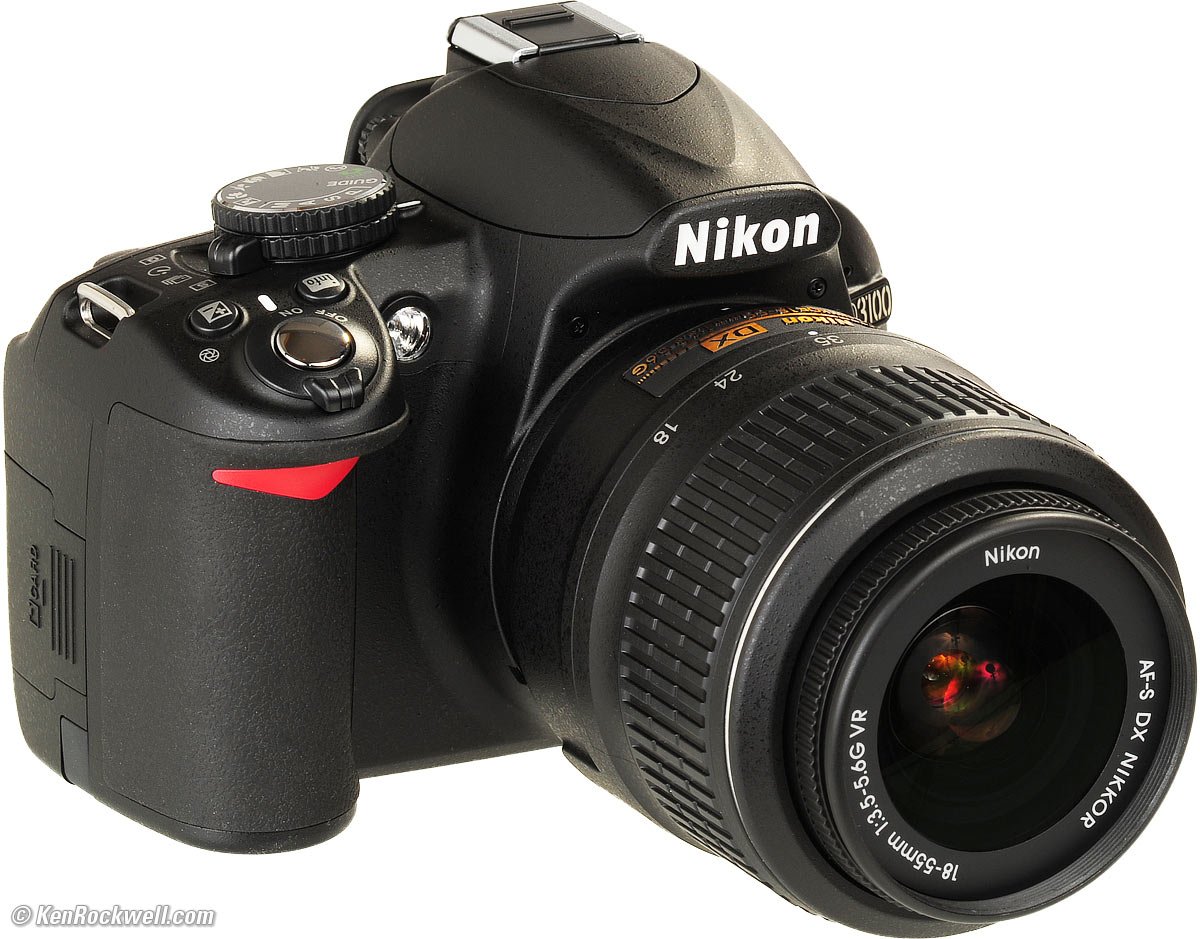
Nikon D3100 and 18-55mm DX VR.
19 August 2010: Nikon D3100. 14MP DX, 3 FPS, 3" LCD, movies. $699.95 with 18-55mm VR, available mid-September 2010.
2009
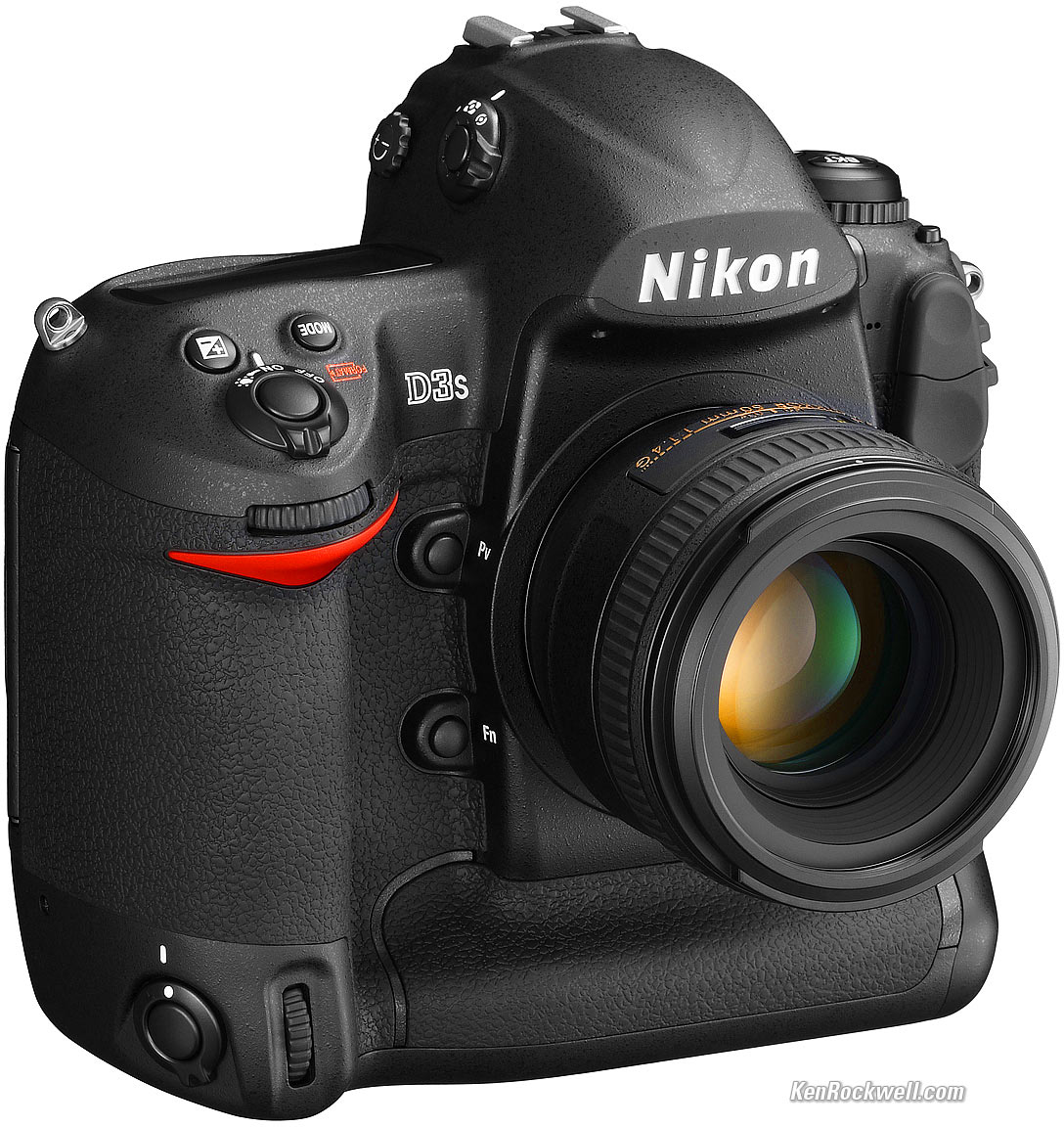
Nikon D3s and 50mm f/1.4 G.
14 October 2009: The Nikon D3s is just a mid-product-cycle freshening of the D3. Both are 12MP FX 9FPS cameras. Price is $5,200.
The D3s adds video, a sensor cleaner, an additional 1.2x 8MP crop mode, dedicated INFO and Live View buttons, Quiet Mode, stupid-high ISOs to ISO 102,000, and $300 to the price of the D3.
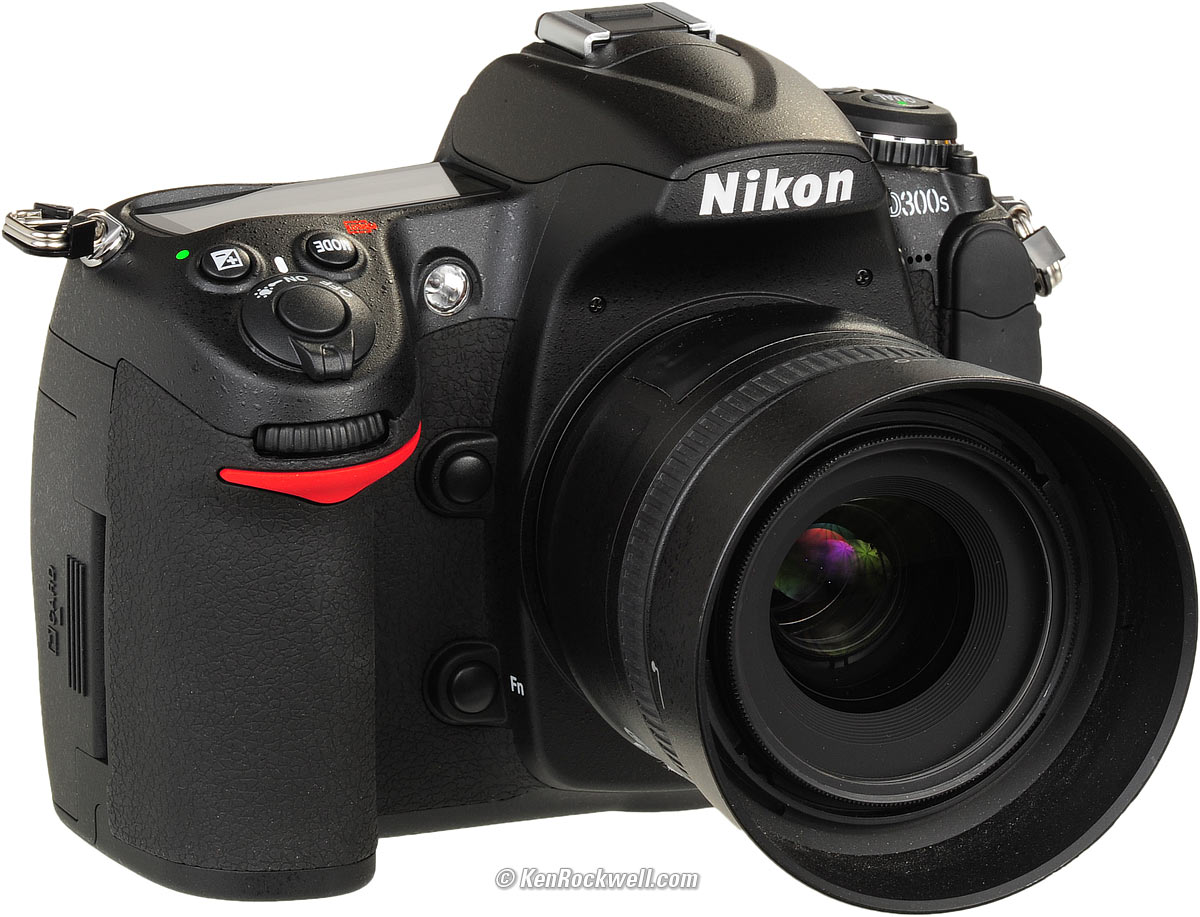
Nikon D300s and Nikon 35mm f/1.8 DX.
30 July 2009: The Nikon D300s adds movies, a dedicated INFO button and the QUIET mode to the D300.
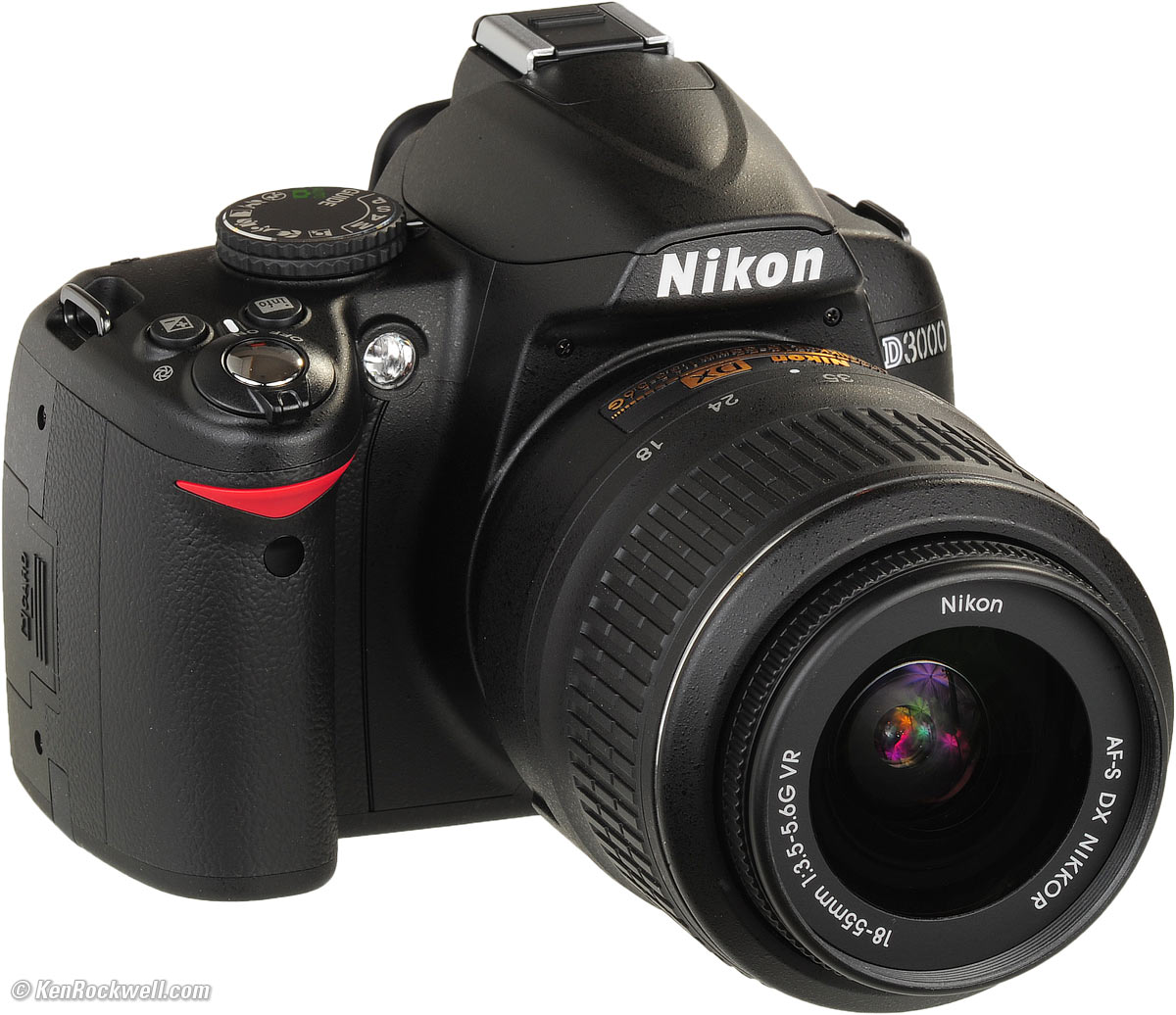
Nikon D3000 and 18-55mm DX VR.
30 July 2009: The Nikon D3000 has a low-resolution 3" LCD and 10MP DX for $599, including an excellent 18-55mm VR lens. It's the worst Nikon DSLR ever made because it has very slow operation in most use, and has poor performance at high ISOs. The D40 of 2006 is superior and costs less.
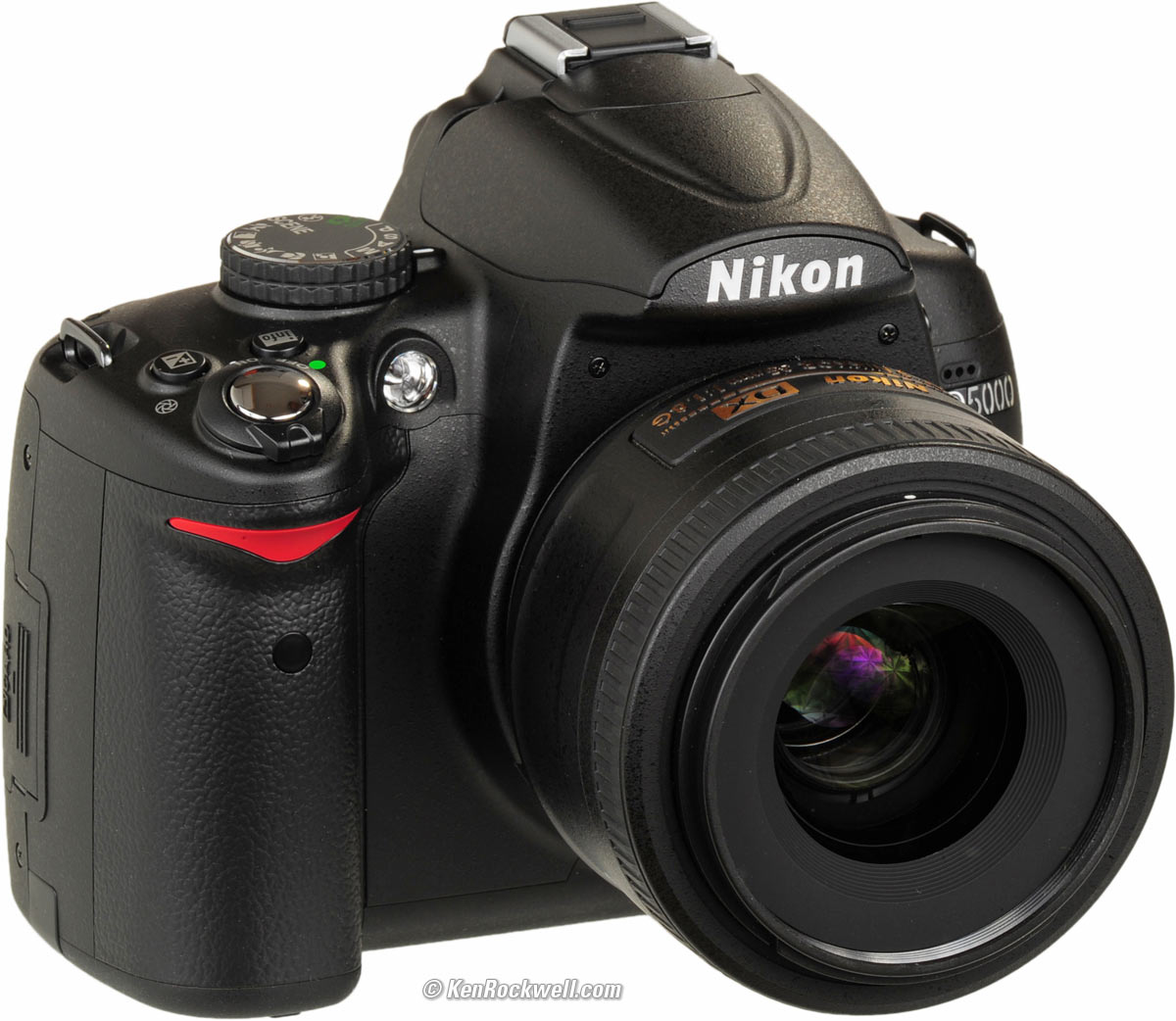
Nikon D5000 and Nikon 35mm f/1.8 DX.
14 April 2009: The Nikon D5000 adds a flippy LCD screen, movies and 12MP DX for $730. It's slotted below the D90 but above the D40 from 2006.
2008
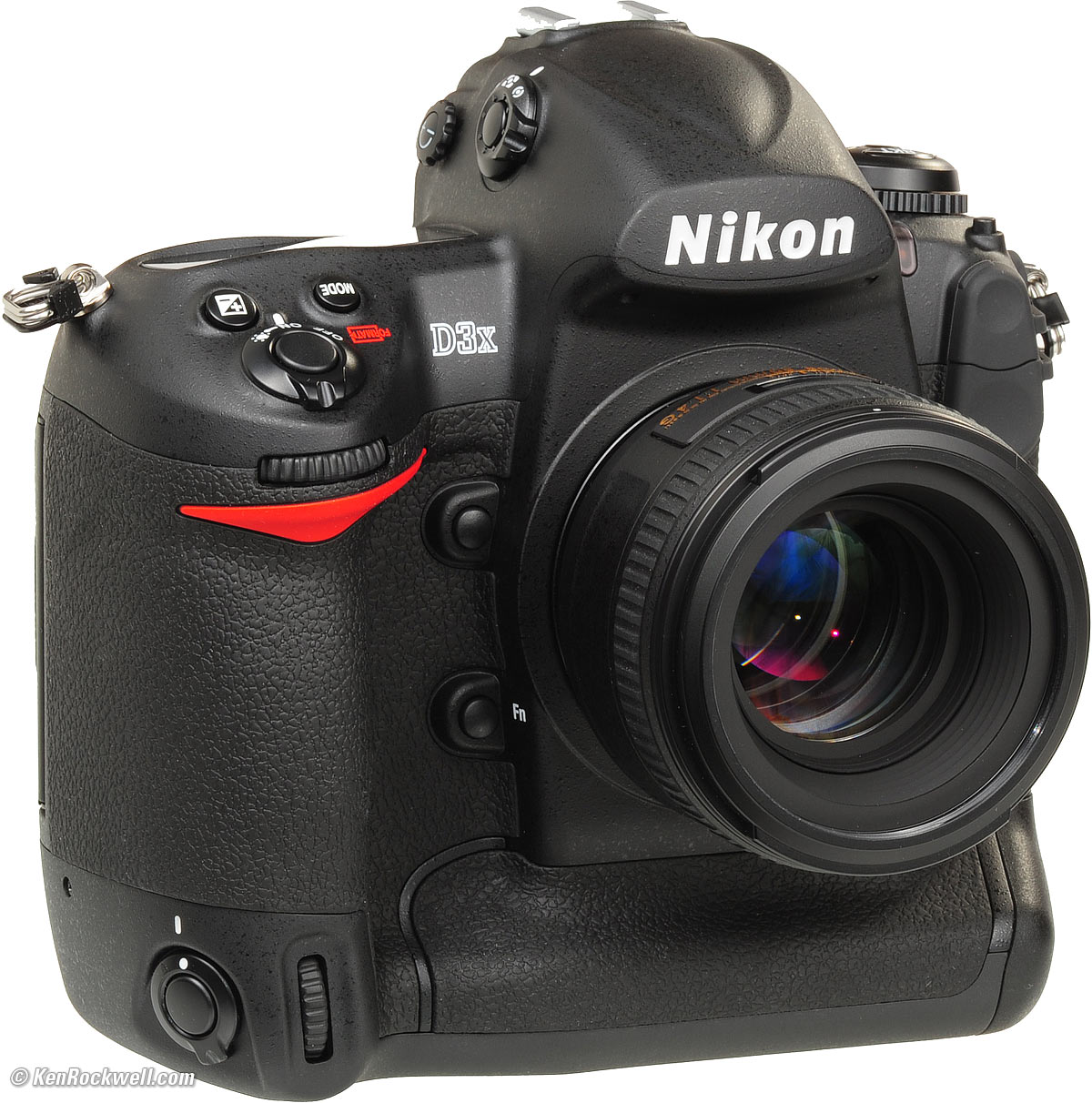
Nikon D3X and 50mm f/1.4 G.
01 December 2008: The D3X is announced. It's identical to the original D3, except with 24.4MP and only 5FPS and lower ISOs.
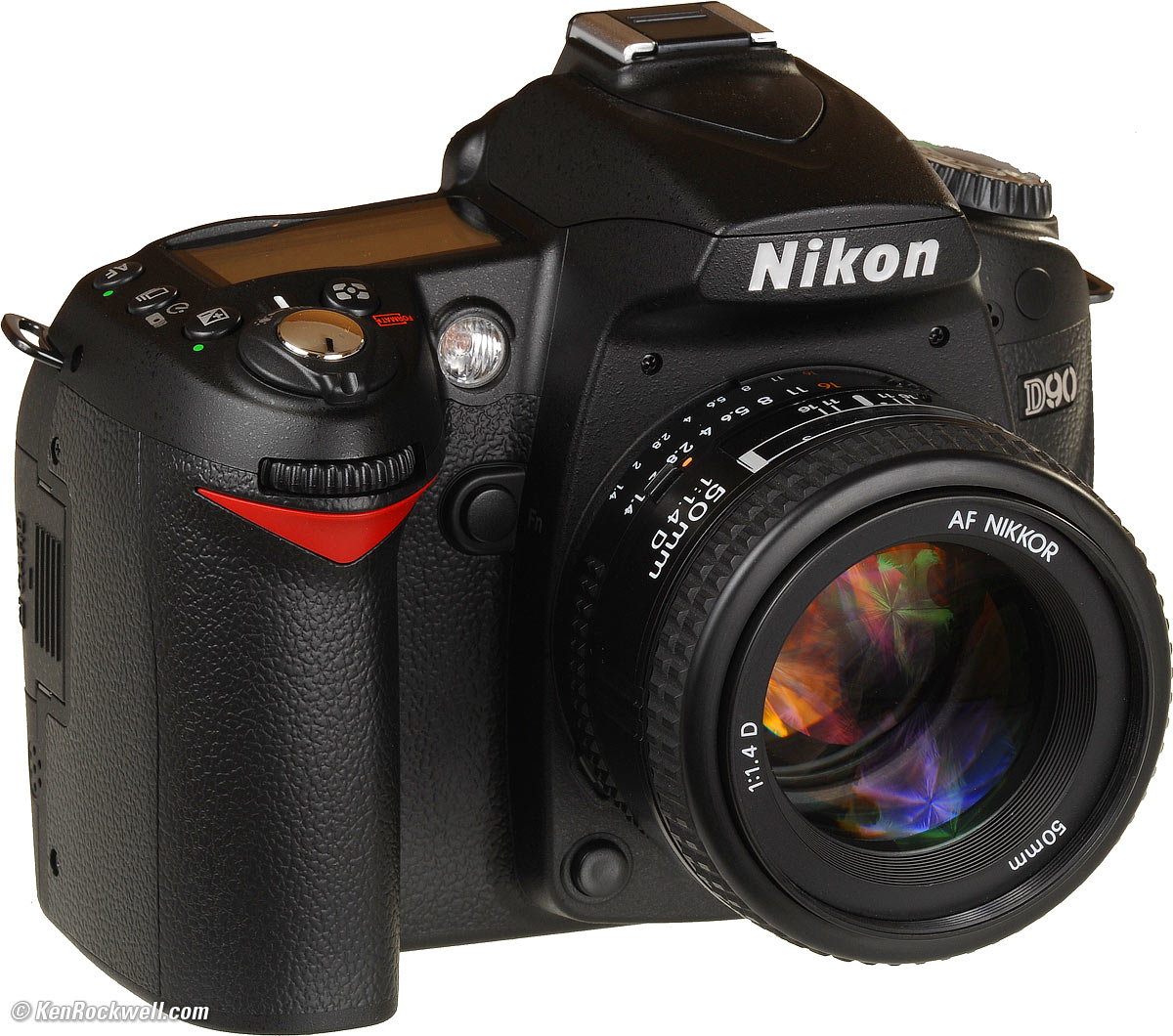
Nikon D90 and 50mm f/1.4 AF-D.
27 August 2008: The D90, a 12MP DX mid-line DSLR for $999. Replaces D80, and is a huge improvement over the D80 because it jumps to Gen 2.
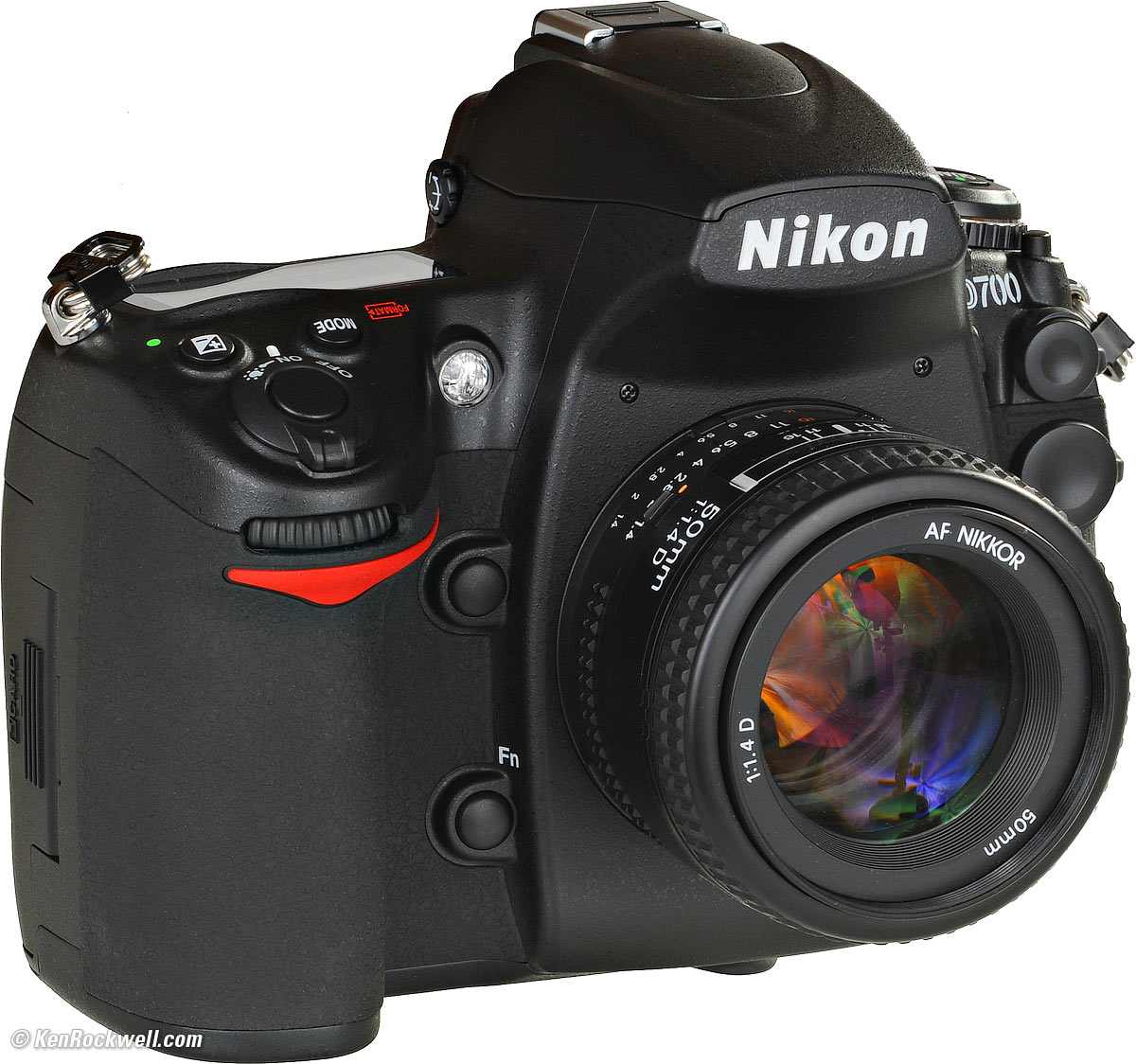
Nikon D700 and 50mm f/1.4 AF-D.
01 July 2008: The D700, a 12MP FX DSLR for $2,999.95. It's Nikon's top amateur camera.
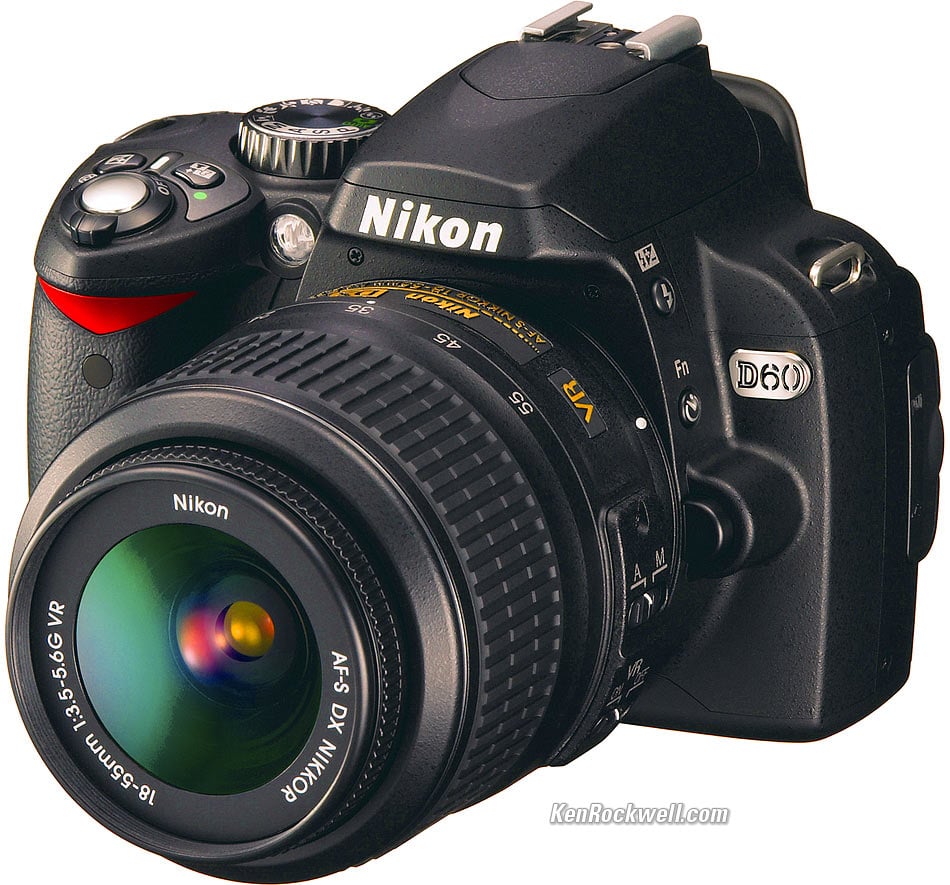
Nikon D60 and 18-55mm DX VR.
January 28, 2008: Nikon D60 announced. Replaces D40x. DX
2007
There are vast differences in real image quality between Nikon's two generations of digital cameras.
Like most marketing organizations and repressive governments, camera makers keep most people in the dark by keeping them worrying about easy-to-understand things which make no difference, like pixels and ISOs which are easy to describe with just one number, instead of trying to teach people what really matters, which are the subtleties of how a picture actually looks.
Because camera makers have the masses worrying about pixels and bit depths, when Nikon makes significant advances, they're usually not obvious behind all the fluff.
The difference between generations is so significant that the best Gen 1 camera, the D2Xs, can't make pictures as good as the cheapest Gen 2 camera, the D90, in most real picture-taking situations.
First Generation
Nikon's first generation of digital SLRs started with the D1 of 1999 and continues in 2008 with the D40.
The first generation has only primitive picture and white balance adjustments.
Gen 1 cameras have an Optimize Image menu with crude controls allowing only two rudimentary options of "Enhance (+)" or "Moderate (-)" for saturation, and WB trims that extend only to ±3. There is no green/magenta adjustment for WB.
There were meaningless mentions of undefined modes I, II and III in the Optimize Image menu, but no clever dynamic range management as Gen 2 adds.
Gen 1 cameras are the D1 and D2 series, D40, D40x, D50, D70, D70s, D80, D100 and D200.
Second Generation
Nikon's second generation DSLRs started coming out in 2007 with the D3 and D300.
Second generation cameras offer the potential of significantly better real image quality because Gen 2 cameras add Nikon's Adaptive Dynamic Range (ADR).
Presuming its turned on, ADR allows Gen 2 cameras to render most real scenes much closer to the way our eyes see them, without all added contrast, blown highlights and blocked shadows common on film and Gen 1 cameras for most people.
If you're a pro who knows how, and actually controls his lighting perfectly, then you can get great results on Gen 1 cameras, but for most people who don't, Gen 2 cameras will give significantly better pictures.
The D90 has ADR on by default, and the D3, D700 and D300 need it turned on in the menus. I always shoot my cameras with ADR in NORMAL (or AUTO if available) for every shot.
Gen 2 cameras also are Nikon's first cameras to allow a full range of saturation and other image adjustments. Saturation and other values are set in direct units of up to ±3. These are set in the Picture Controls menus.
Gen 2 cameras have WB trims which extend 6 units in each direction, marked in blue and amber (not + and -) and allow green/magenta adjustment.
Gen 2 cameras offer five manual preset (gray card) WB storage settings, complete with icons and notes.
Gen 2 cameras magically and automatically correct color fringes caused by most lenses. If you're a tweaker, this alone significantly improves corner sharpness.
 |
 |
 |
The Gen 2 D90 is far, far better than the Gen 1 D200. I didn't have a D2Xs for comparison, but it would be the same as the D200. These shots are crops from the corner with the 18-200mm VR at 18mm. The D90 is as sharp as the D300. The D90 was focused elsewhere in this example. |
Gen 2 cameras are using the increased in-camera processing horsepower to do all these tricks. If you're wasting your time shooting raw, you will have to hope that whatever software you're using to open raw files is as smart as what Nikon is building into these cameras for free. Many off-brands of software can't do any of this.
There was never much reason for raw, and in Gen 2, even less. It's quite likely that using raw with a Gen 2 camera and most, if not all, software, will throw you back into Gen 1 quality. It's not 2006 anymore. Most raw software does not do any of the clever things, like ADR, expanded color controls or totally automatic lens corrections, that are done in-camera.
Gen 2 cameras also have a super-sharp new 3" LCD screen.
Gen 2 cameras are the D3, D700, D300 and D90.
The D60 has ADR, but its stuck with the old Optimize Image menu and none of the other Gen 2 additions, so call it Gen 1.1 if you insist. I'm calling it Gen 1.
The D3000 has ADR and Gen II Picture Controls, but it has a crummier 3" LCD screen and does not correct lateral color fringes, so I'll call it Gen 1.5.
2007
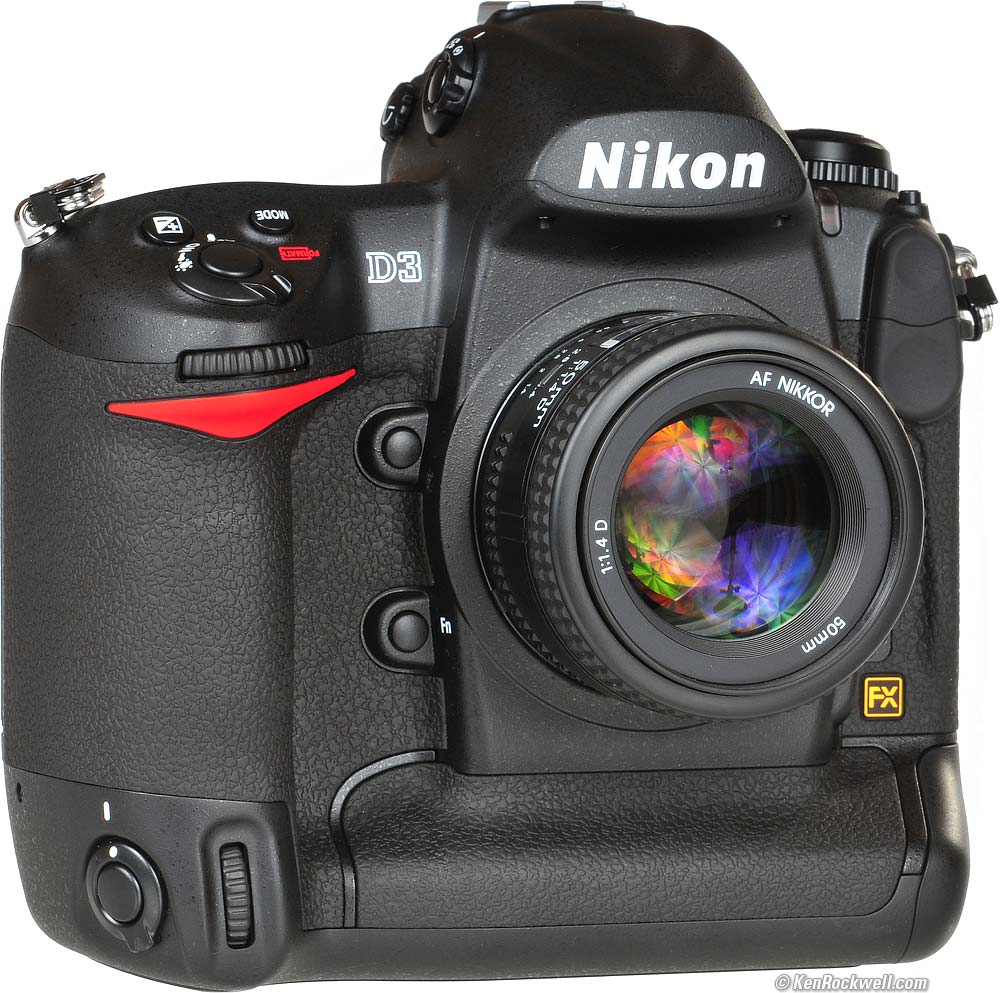
Nikon D3 and 50mm f/1.4 AF-D.
23 August 2007: The D300 and D3 are announced for November sale. Both have new 3" LCDs with live viewing.
The D3 is another milestone with Nikon's first 24x36mm sensor, dubbed FX. It runs 9FPS for $5,000. The D3 replaces the D2Xs. Nikon's press release on the D3.
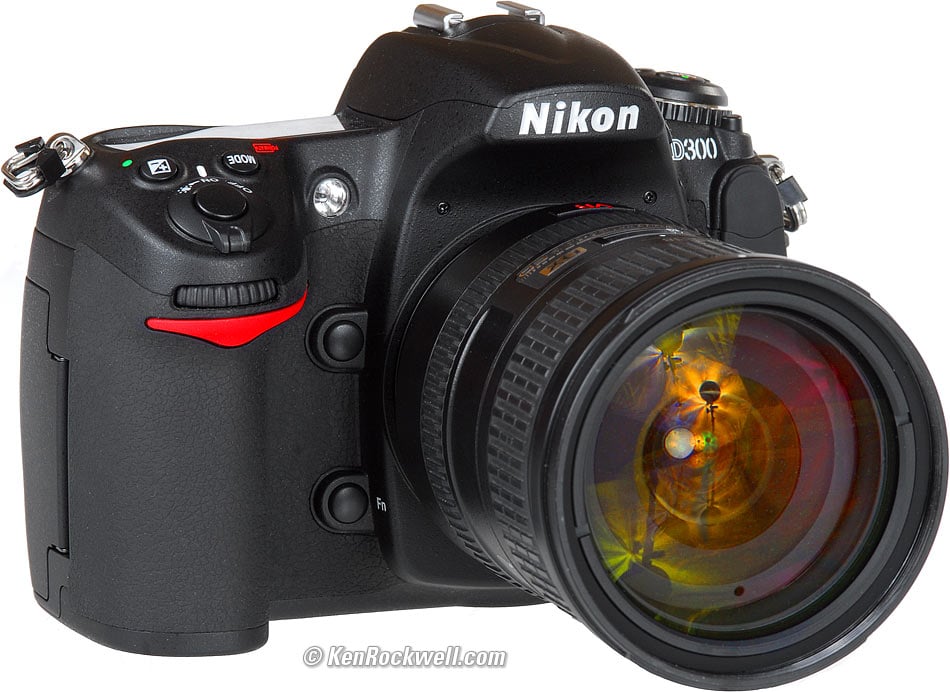
Nikon D300 and 18-200mm VR DX.
The D300 is an evolution of the D200, now with a 12MP DX sensor and 6-8 FPS for $1,800. $1,800 oddly is a price increase $300 over the D200. The D300 replaces the D200. Nikon's press release on the D300.
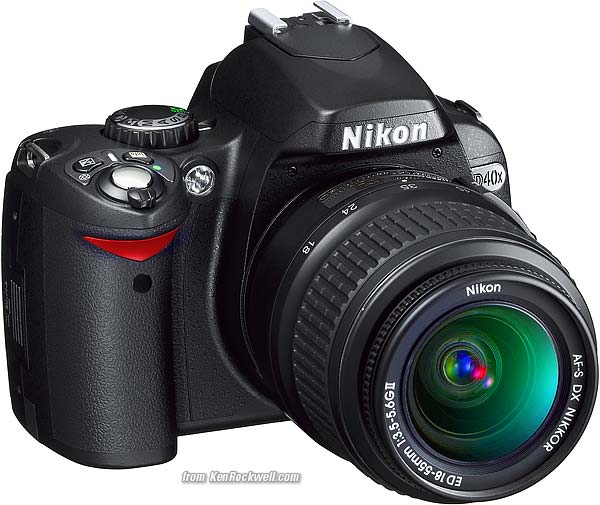
Nikon D40x and 18-55mm DX II.
05 March 2007: The D40x is announced to fill a vacant price point in Nikon's line. It is the same as the excellent D40, but with 10MP DX instead of 6MP, but a slower sync speed of 1/200 vs. 1/500, a slower default ISO of 100 vs. 200, and a $200 higher price than the D40. The D40x was introduced to let Nikon fill in a price point in its camera line for competitive purposes. Personally I prefer the less expensive D40. See also the Megapixel Myth.
2006
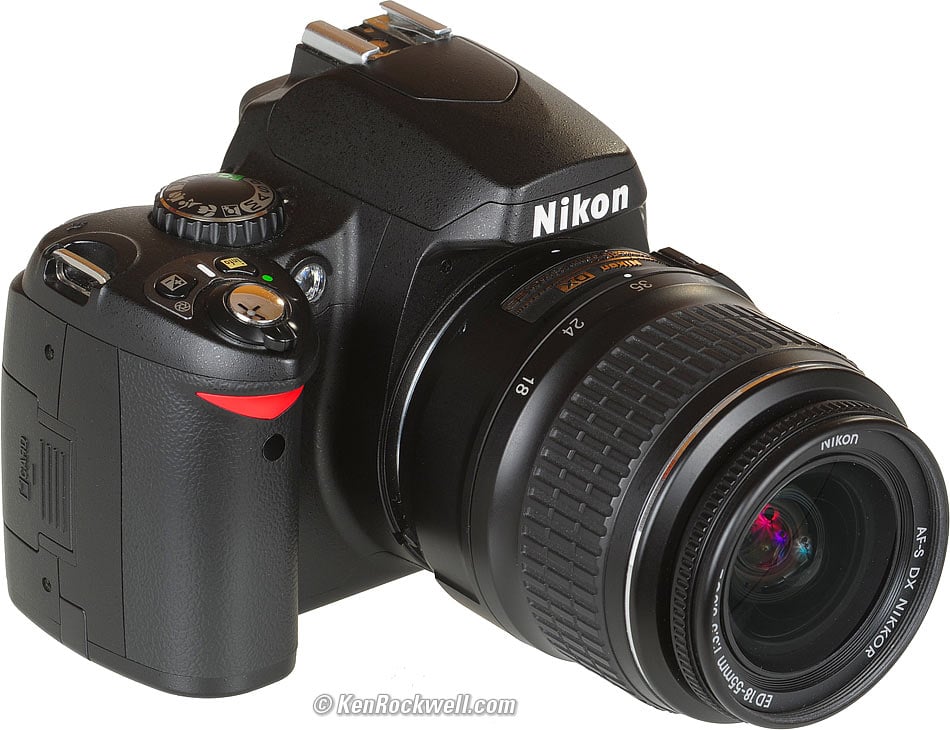
Nikon D40 and 18-55mm DX II.
16 November 2006: The D40 is announced for Christmas at $599 with included excellent 18-55mm II lens. It is the smallest, lightest and least expensive Nikon DSLR ever. It started shipping on November 30th, 2006. 6MP DX.
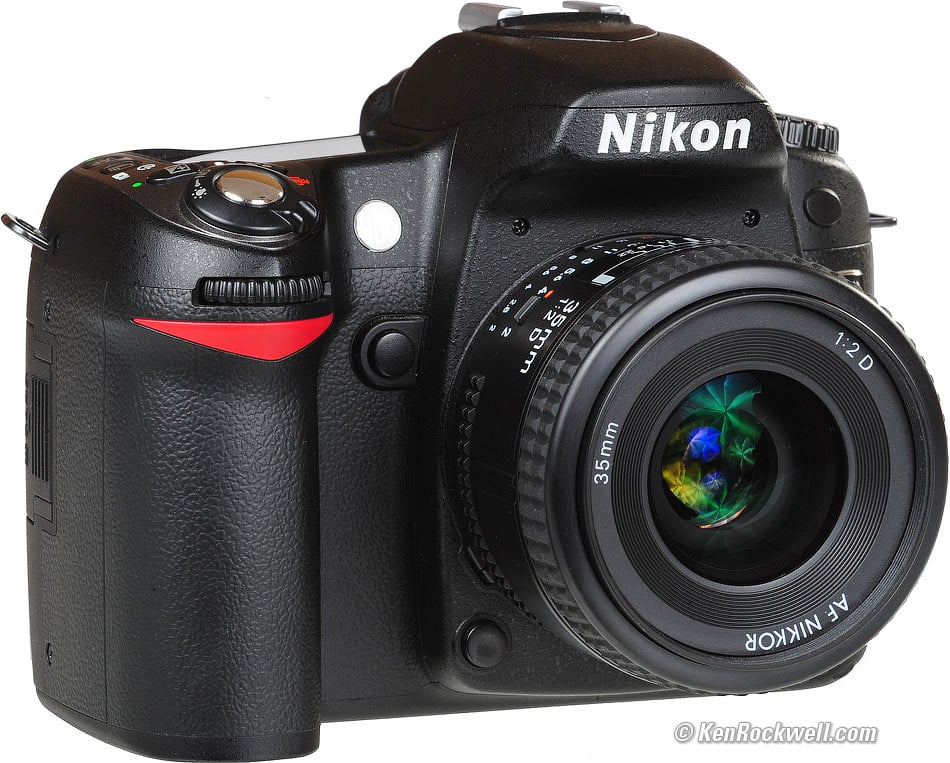
Nikon D80 and 35mm f/2 AF-D.
09 August, 2006: The D80 is announced. 10 MP DX, 3 FPS for $999. The D80 is a D70 body and mechanics with the sensor and LCD of the D200.
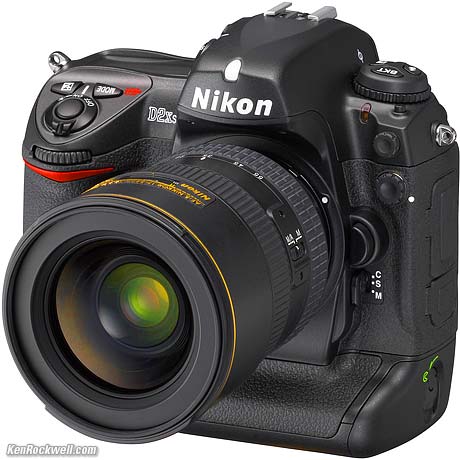
Nikon D2Xs and 17-55mm f/2.8 DX.
June 2006: The D2Xs is announced, a slight improvement to the D2X. Same 12 MP DX and 5FPS and weird crop mode. $4,700.
2005
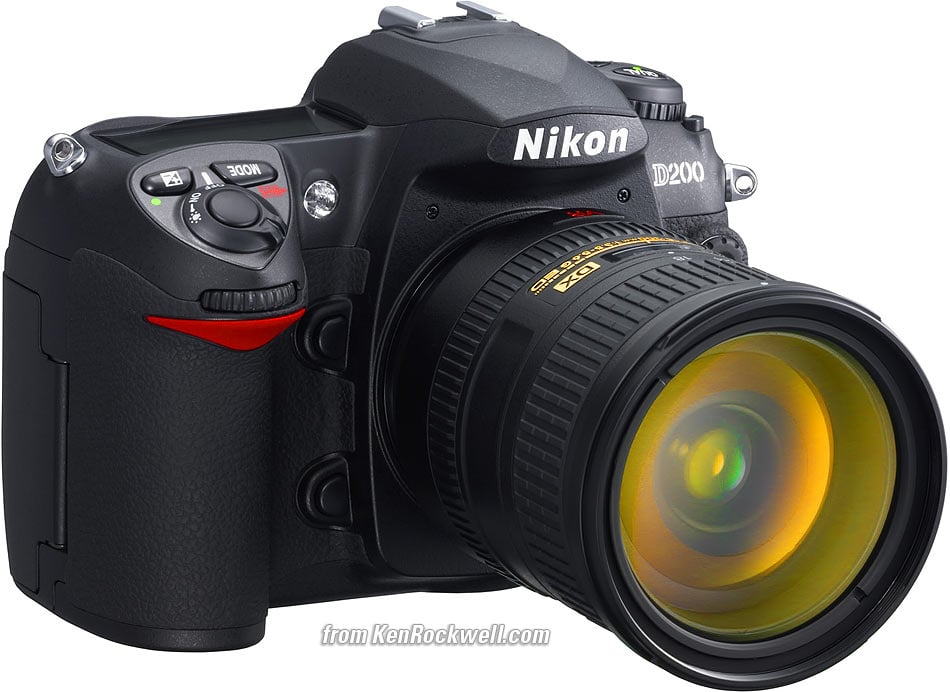
Nikon D200 and 18-200mm VR DX.
01 November 2005: the D200 is announced. It's a groundbreaker at 10MP DX and 5 FPS at $1,699. It shipped in December 2005 as promised. It was on backorder until about October 2006. The D200 starts a new level in the Nikon line between the plastic D70 and the pro D2X.

Nikon D70s and 18-70mm DX.
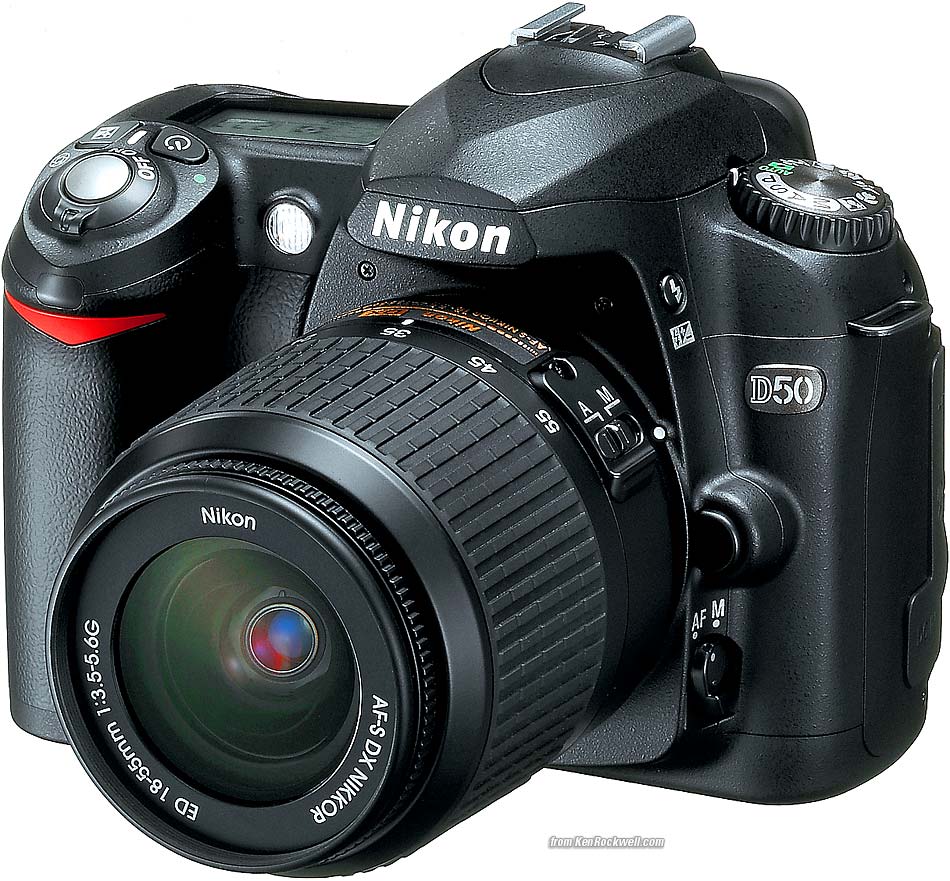
Nikon D50 and 18-55mm DX.
22 April 2005: The D70s and D50 are introduced. The D70s is a D70 with slightly larger screen. The D50 is a D70 with a couple of features removed. The D50 is still 6MP DX but only 2.5 FPS.
The D70, D70s and D50 are great cameras new or used, but replaced by the two-year-newer D80 of late 2006.
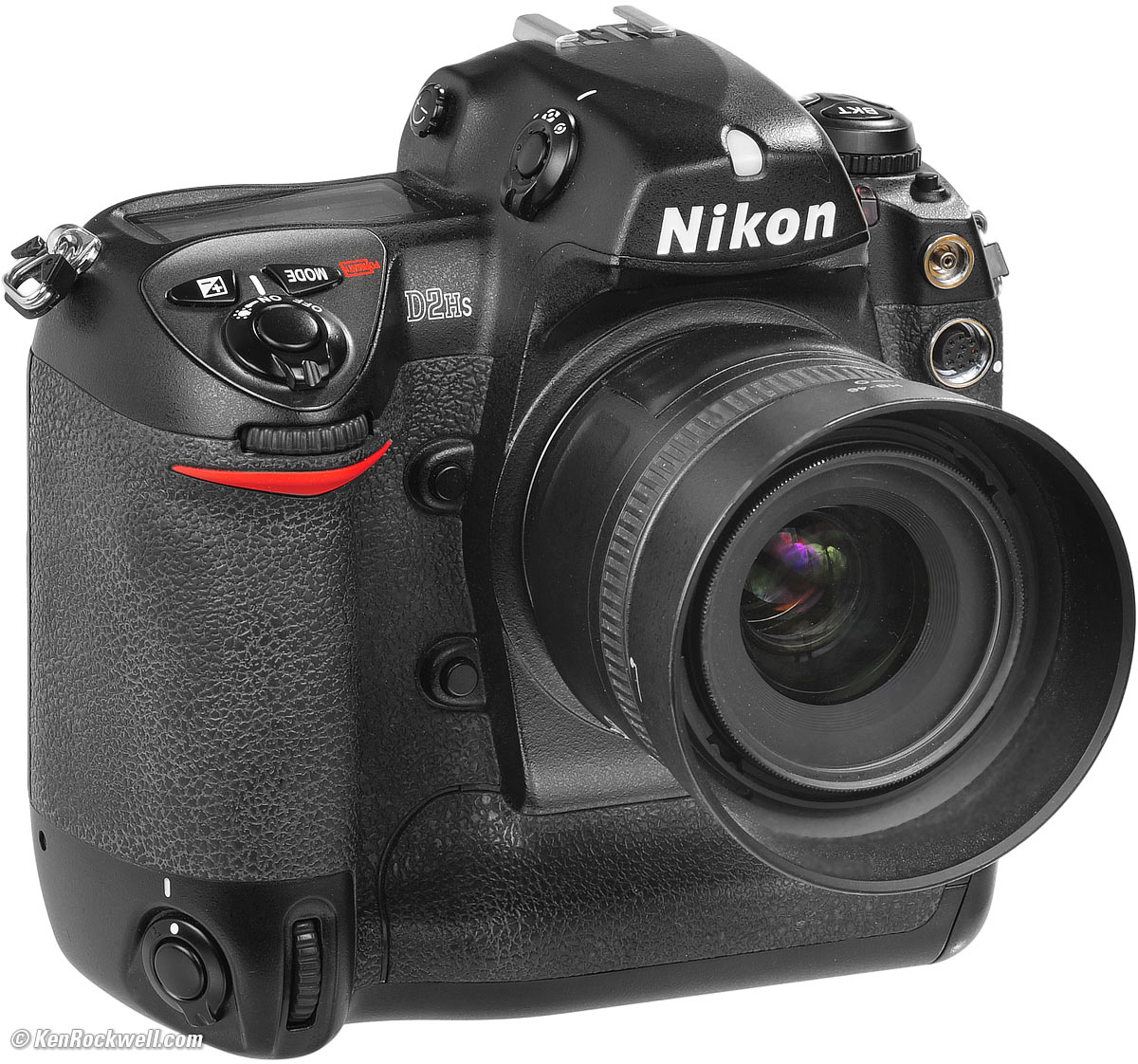
Nikon D2Hs and Nikon 35mm f/1.8 DX.
16 February, 2005: The D2Hs is announced: 8 FPS DX, 4 MP, 2.5" LCD.
It's a minor revision of the D2H at a bargain price of $3,500. This makes a used D2H or new D2HS a great buy for sports. They are the same as the more expensive D2Xs, just faster with a few less pixels.
2004

Nikon D2X and 17-55mm f/2.8 DX.
16 September, 2004: the D2X is announced. 12MP DX, 5 FPS, $5,000. The D2X also has a bizarre cropped 7 MP, 8 FPS mode. Most of what the D2X does is replaced by the D200 in 2005. I'd get a used D2X if the price was right. It's Nikon's top of the line. I prefer the D200 for smaller size and a couple of more features.

Nikon D70 and 18-70mm DX.
February 2004: Nikon shows the D70 at PMA. It's lightweight, 6MP DX, 3 FPS and a groundbreaker at $999. The D70 is a huge improvement over the D100 in almost every way except having no accessory vertical grip. All this, and it's priced less, too! The D70 fixes the dust problem by moving the CCD filter further away from the CCD. This throws dust out of focus and makes it much less of an annoyance than on the D1 series cameras.
The D70 replaced the D100.
Nikon was going to discontinue the D100, but instead decided to keep making the D100 because they discovered they could get a higher price than the D70 just because of the model number. People who equated price with quality kept buying D100s because they cost more.
2003
December, 2003: Nikon announced the development of the D70. Nikon had little to say other than the D70 would be cheap. Nikon was still inventing the D70 and had none to sell. Nikon made the announcement to get people to wait instead of fleeing from Nikon to Canon's inexpensive Digital Rebel.
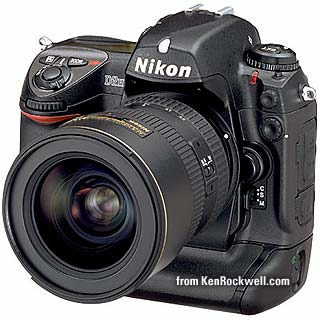
Nikon D2H and 17-55mm f/2.8 DX.
22 July, 2003: The D2H is announced. 4.1 MP DX, 8 FPS, $5,000. The D2H was a new design with a much improved Li-Ion battery and a new flash exposure system. The D2H is a bargain used and a fantastic camera for sports.
2002

Nikon D100 and 18-70mm DX.
21 February, 2002: The D100 is announced. It's 6 MP DX and 3 FPS for $1,999. This is Nikon's first lightweight amateur DSLR camera. It was an N80 with digital guts. It wasn't available for sale until June, 2002. It was a sellout with long waiting lists for a year after its introduction.
In May 2003 the D100 dropped to $1,699. In December 2003 it dropped to $1,499 where it stayed for a year or two. In May 2005 it dropped to $999.
Forget the D100, but snap one up if you can get a screaming deal.. The newer D70 and D50 work better. The D100 required messing with a wheel and knob to make critical adjustments. The newer cameras have direct entry buttons. The newer cameras have two years of extra wisdom in their firmware and just do everything better. Flash exposure isn't very good on the D100. See a comparison here. The D100 used the same EN-EL3 Li-Ion battery of the D50 and D70.
2001

Nikon D1H and 17-35mm f/2.8. Nikon D1X looks the same except for model number.
05 February 2001: Nikon announces the D1X and D1H, improvements to the D1. Performance was honed, a few features were added and price remained at $5,000.
They both replaced the numerical menu system with easy to understand menus in English.
The D1H kept the 2.7 MPDX sensor and increased speed to 5 FPS.
The D1X slowed to 3 FPS, but increased resolution to 5.3 MP. The resolution of the D1X is still decent in 2006. It used a bizarre CCD with twice the horizontal pixel density of the D1. Image quality was, and still is, extremely good because it had 4,024 horizontal pixels on the CCD. It had to do less Bayer interpolation and thus has much better image quality than one would expect in its 3,008 x 2,000 pixel images.
Don't buy either of these today regardless of price. They had awful battery systems. I had a D1H. They only run for about 250 shots on a charge. The batteries are huge, heavy Ni-MH packs which require constant babying in charging. The packs have protuberances which make them painful to carry in a pocket. They lose charge if left unused. Even a freshly charged battery would indicate almost dead after a few shots. Most D1, D1H and D1X users including myself lived with the viewfinder indications turning off, indicating almost dead battery, after just a few shots. They also had awful flash exposure. Many photographers had to revert to non-TTL exposure modes because the TTL mode was so flaky. Dust was a horrible problem because the CCD cover filter was too close to the CCD. At almost any aperture you'd see dust clearly on the image. They were state of the art in their era (2001 - 2003), but that era is long gone.
1999: The World's First Practical DSLR
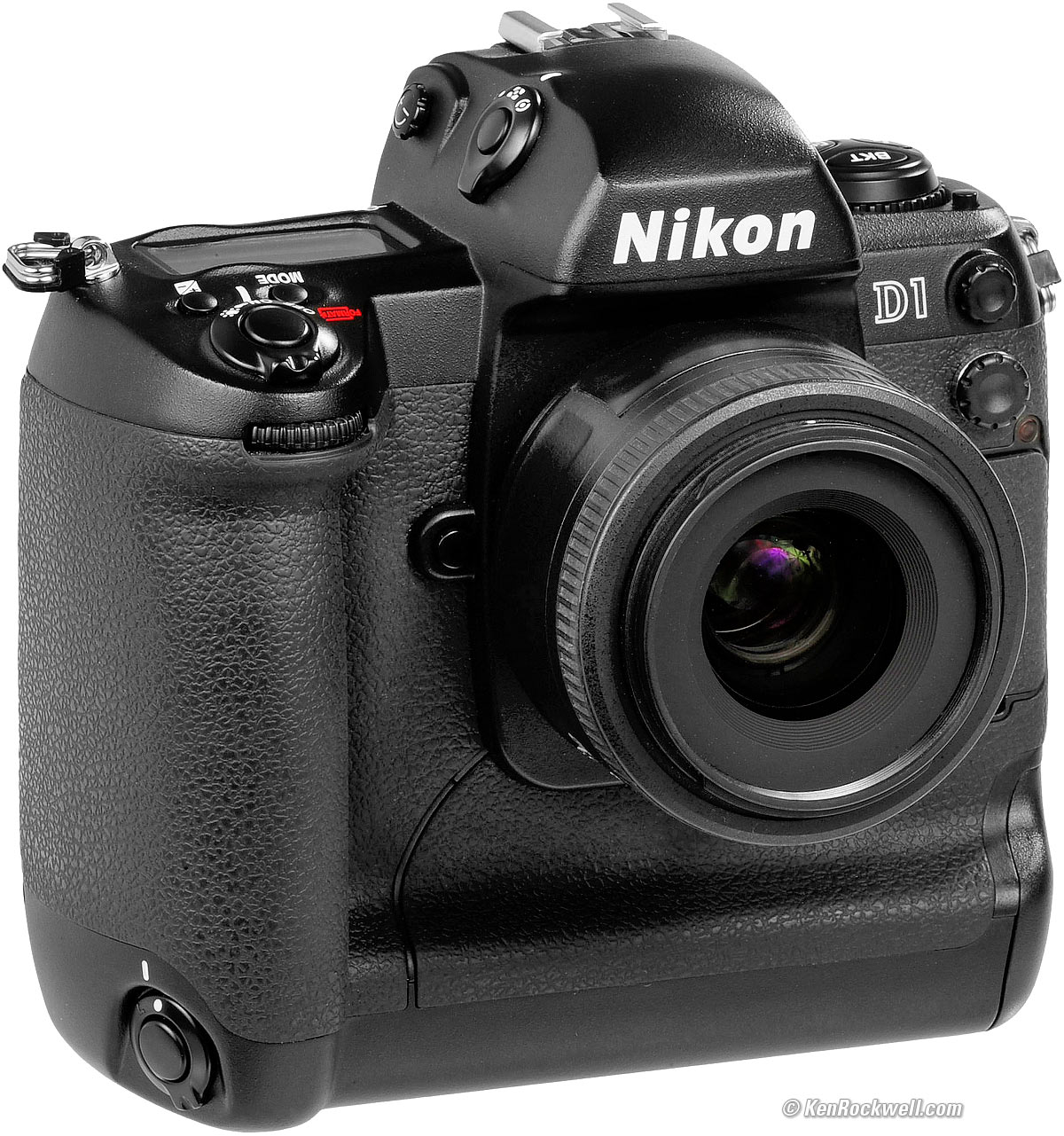
Nikon D1 and Nikon 35mm f/1.8 DX.
15 February 1999: Nikon announced it was working on "a new professional class, high-quality digital Single Lens Reflex Camera."
15 June, 1999: Nikon announces the D1, the world's first practical DSLR. It is the first practical DSLR because it's the first DSLR with good enough image quality for print (2.7 MP DX), fast enough (4.5 FPS) and priced low enough ($5,000) and functional enough to be sensible to use daily as a primary camera. It's also the first DSLR made with Nikon electronics in a Nikon body, by Nikon.
It replaced film at forward-looking newspapers.
Forget about it today, regardless of price. For the same price you can get the greatly improved D1H or D1X, neither of which are worthwhile today either. The D1 is confined to the dumpster of history (and collectors) because its battery system is a pain, and its menu structure requires interpreting numerical custom functions. It requires a cheat sheet to decipher. Flash exposure performance is awful. Get one only as a landmark camera to collect. The D1 is the landmark. The D1 is the camera that replaced film at newspapers.
The D1 is unique in having a 1/16,000 top shutter speed, since its shutter is also electronic. That's how it gets a 1/500 sync speed. If you use the PC sync terminal or a non-dedicated flash so the D1 doesn't know you've got a flash attached; sync goes all the way to 1/16,000!
Nikon announced no new DSLRs for a couple of years.
1998
The similar E3 and E3S came out, still based on a big klunky Fuji body. They were still only 1.3 MP (1,280 x 1,000 pixels). SCSI interface. Still about $20,000.
These relics are worth about $300 in 2006. Don't bother using them for serious photography.
1996
A minor upgrade, the E2N and E2NS came out and was still about $20,000.
These relics are worth about $300 in 2006. Don't bother using them for serious photography.
1995
Digital SLRs are still science experiments, but in series production for special events. Nikon finally makes its first commercialized DSLR, over twenty years after America invented digital cameras.
It was called the Nikon E2 and E2S. They weren't Nikon bodies at all. They were hacked out of Fuji bodies with Nikon electronics! Bizarre internal reduction optics helped restore the field of view, with weird effective apertures. PCMCIA card memory. About $20,000 and only 1.3 megapixels, which is why they don't count as practical cameras.
These relics are worth about $300 in 2006. Don't bother using them for serious photography.
1991
Digital SLRs are still custom built laboratory experiments. NASA had some Texans hack an F4 to fly on the STS-48 shuttle mission. It had a 1MP black-and-white sensor and recorded to a Texas-sized hard drive hacked to the bottom of the F4. See it here. Nikon had nothing to do with this as far as I know. It was the Texans who played Frankenstein with a stock F4 body.
Kodak sold the $13,000 1.3 MP DCS-100, hacked into an F3HP body.
1990
Kodak shows a hacked Nikon body with a Kodak sensor at Photokina called the DCS. It was 1 MP and cost $25,000. It shipped in 1991.
Kodak kept trying through about 2003, and gave up after the 14n.
These and later model Kodaks were popular for some news events, but most newspapers that had them threw them away when the D1 came out in 1999.
1973
Kodak created the first digital camera in Rochester, New York, USA. It was big and scary and certainly didn't run on batteries. Nikon had nothing to do with this, although Kodak probably used a Nikkor lens.
More Information: This site also has an excellent history of digital Nikons.
© Ken Rockwell. All rights reserved. Tous droits réservés. Alle Rechte vorbehalten.
Help Me Help You
I support my growing family through this website, as crazy as it might seem.
The biggest help is when you use any of these links when you get anything. It costs you nothing, and is this site's, and thus my family's, biggest source of support. These places always have the best prices and service, which is why I've used them since before this website existed. I recommend them all personally.
If you find this page as helpful as a book you might have had to buy or a workshop you may have had to take, feel free to help me continue helping everyone.
If you've gotten your gear through one of my links or helped otherwise, you're family. It's great people like you who allow me to keep adding to this site full-time. Thanks!
If you haven't helped yet, please do, and consider helping me with a gift of $5.00.
As this page is copyrighted and formally registered, it is unlawful to make copies, especially in the form of printouts for personal use. If you wish to make a printout for personal use, you are granted one-time permission only if you PayPal me $5.00 per printout or part thereof. Thank you!
Thanks for reading!
Ken Rockwell.